
A 50M-parameter GLM-5.2 architecture study with MLA, DSA, IndexShare, sparse MoE, shared MTP, and Muon Split.
Python
5
2 commits
updated Jul 29, 2026
README
smol-glm-5.2
A 50.15M-parameter, GLM-5.2-inspired language model for one consumer GPU





MLA · DSA · Lightning Indexer · IndexShare · Sparse MoE · Shared MTP · Muon Split
Quick start · Architecture · Download · Dashboard · Verification
smol-glm-5.2 is a readable, training-oriented miniature of the public
GLM-5/GLM-5.2 language-model architecture. It compresses the defining ideas
of a 753B-parameter sparse frontier model into 50,153,344 trainable
parameters, with approximately 21,768,064 parameters active for each
token, and trains from scratch on TinyStories.
This repository keeps the interesting machinery instead of quietly replacing it with a standard dense Transformer:
- low-rank Multi-head Latent Attention with separate RoPE and NoPE channels;
- DeepSeek Sparse Attention driven by a trainable multi-head lightning indexer;
- the public GLM-5.2
FFFSSSFSSSFSSIndexShare schedule; - detached full-attention teachers and multi-layer indexer distillation;
- three dense feed-forward layers followed by ten sparse MoE layers;
- sigmoid top-k routing with a correction bias and no auxiliary balancing loss;
- one parameter-shared multi-token predictor unrolled across three depths;
- Muon Split for matrices and AdamW for embeddings, norms, and scalars;
- compressed-KV cached decoding, atomic checkpoints, and a live local dashboard.
This is an architecture study, not a claim that 50M parameters reproduce the reasoning, coding, agentic, multilingual, or long-context capabilities of the full GLM-5.2 release. The goal is to make the mechanisms small enough to read, run, instrument, and modify on one machine.
[!NOTE] CUDA training uses BF16 autocast. Mask values, sparse-MoE accumulation, and indexer distillation are explicitly BF16-safe and covered by a forward/ backward regression test.
Why this exists
Frontier MoE reports are fascinating but difficult to turn into a local experiment. A conventional tiny Transformer answers a different question: "can a small decoder learn TinyStories?" This project asks:
What does the GLM-5.2 data flow look like when its architectural choices are preserved but its widths, expert counts, layer count, vocabulary, and context are scaled down to local-training size?
The result is intentionally plain PyTorch. There are no custom CUDA kernels, distributed expert-parallel collectives, or opaque training frameworks between the reader and the model.
Architecture
1. Thirteen-layer backbone
The authoritative shape lives in
configs/glm52_50m.json. Every decoder layer uses
MLA; layers 1–3 use dense SwiGLU MLPs, while layers 4–13 use sparse
mixture-of-experts blocks.
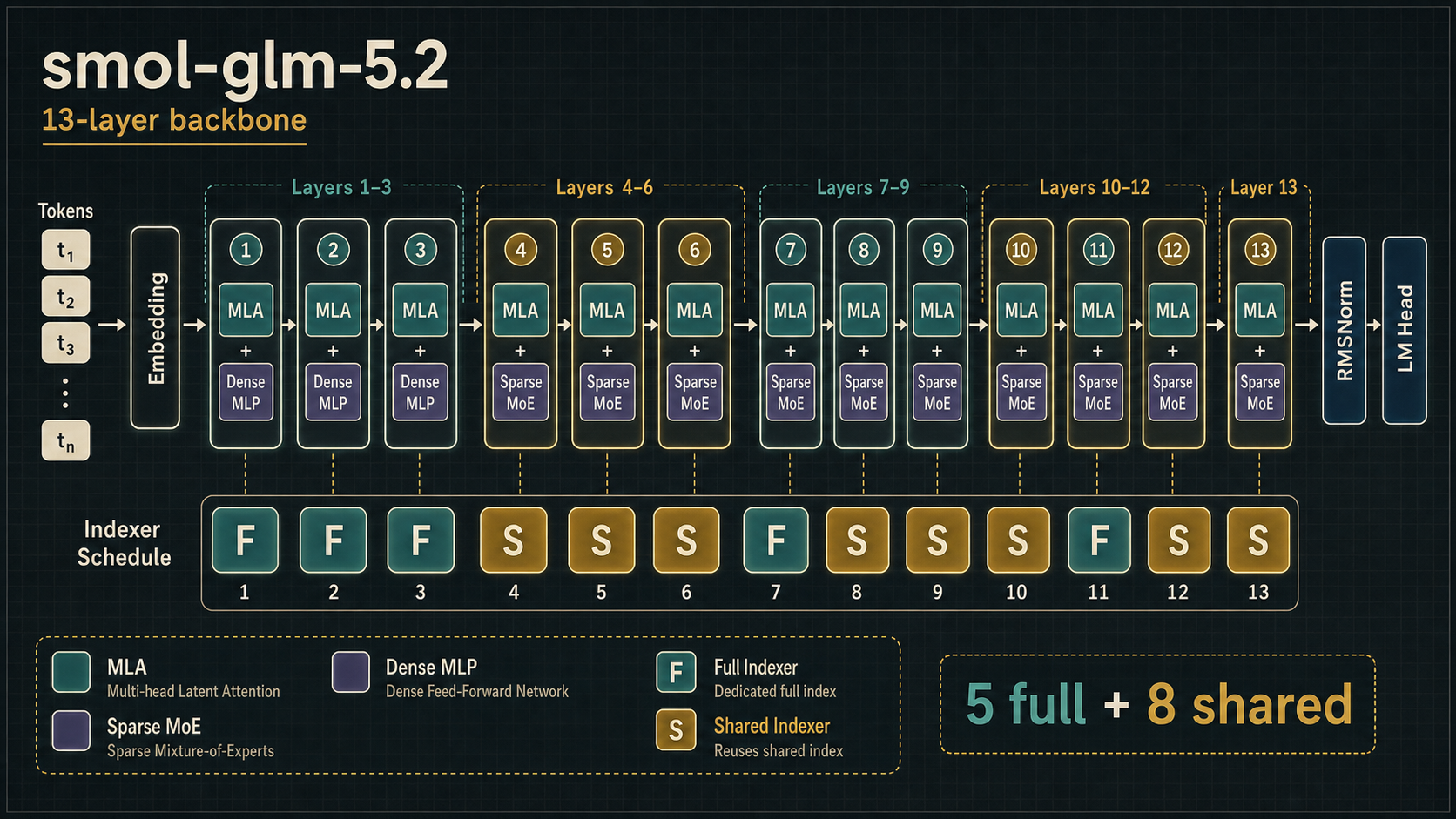
F means the layer owns a full lightning indexer. S means the layer reuses
the most recent full indexer's selected token positions:
layer          01 02 03 04 05 06 07 08 09 10 11 12 13
indexer        F  F  F  S  S  S  F  S  S  S  F  S  S
feed-forward   D  D  D  M  M  M  M  M  M  M  M  M  M
That is five retained indexers and eight shared-indexer layers. The first
three full indexers preserve the public schedule's offset before the repeating
FSSS rhythm.
2. Multi-head Latent Attention
The attention path follows the main ideas of DeepSeek-style MLA:
- The query is compressed to a rank-128 latent, normalized, and expanded into six heads.
- Keys and values share a rank-64 compressed latent.
- Query/key channels split into 48 NoPE dimensions and 16 RoPE dimensions.
- The rotary key is stored separately from the compressed KV latent.
- Only the indexer's selected causal positions participate in the final attention softmax.
For autoregressive decoding, each layer caches compressed latent KV and rotary keys. Full-indexer layers additionally cache their index keys. Shared-indexer layers reuse selection and do not allocate duplicate index-key caches.
3. Lightning indexer, DSA, and IndexShare
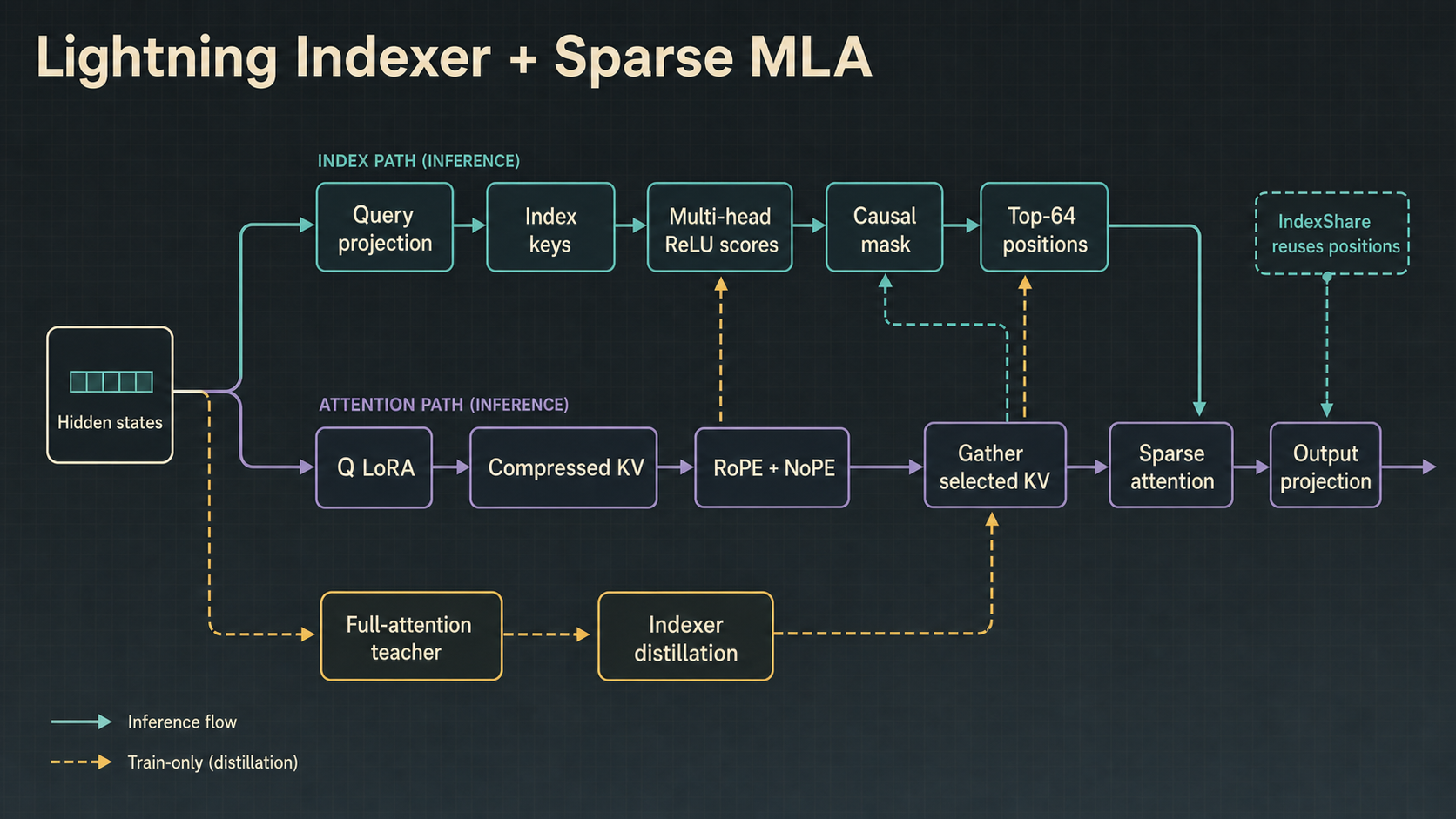
Each retained indexer projects a low-rank query into four 32-dimensional heads, scores normalized index keys with ReLU similarities, then learns a token-dependent head weighting. A hard causal mask is applied before selecting the top 64 positions.
During training, the regular MLA scores also produce a detached full-attention teacher distribution. One retained indexer is supervised by every attention layer that consumes its selection. The targets are averaged before cross-entropy:
retained indexer → its own teacher + teachers from following shared layers
                 → averaged target distribution
                 → indexer cross-entropy
At a sequence length of 256, the first 64 positions naturally attend to every available causal token; later positions use a true top-64 subset. The lightning indexer itself still computes dense scores, so this eager implementation demonstrates the architecture rather than claiming a production long-context speedup.
4. Sparse mixture of experts
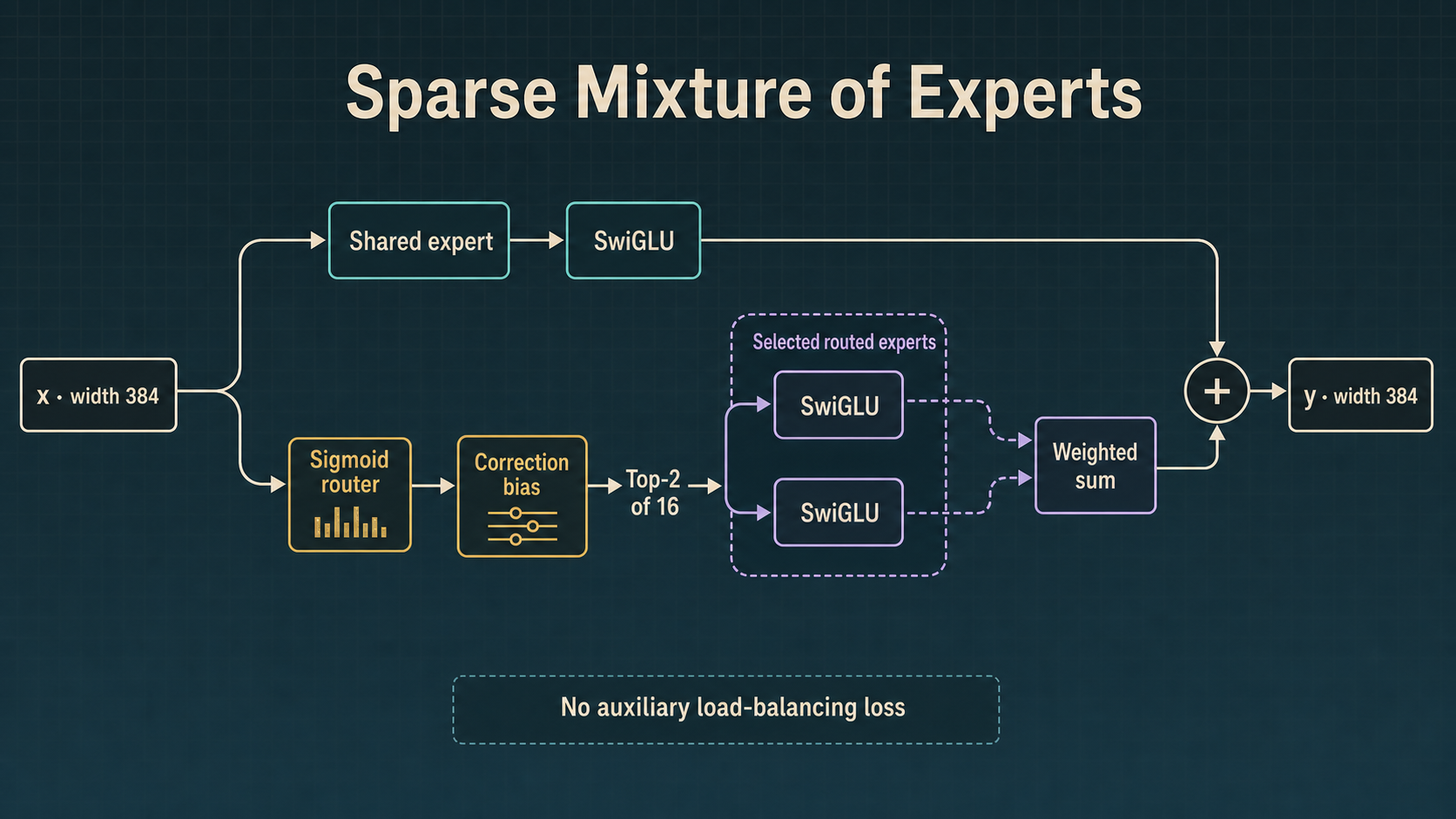
The final ten decoder layers contain:
- 16 routed experts, of which the top two run for each token;
- one always-on shared expert;
- 176 hidden units per expert;
- sigmoid router scores normalized only across the selected experts;
- a routing correction bias updated from exact local-batch quantiles.
The correction bias affects expert selection but not mixture weights. This keeps routing auxiliary-loss-free while nudging expert usage toward balance. At local batch sizes, exact quantiles are simpler and more readable than the distributed histogram approximation used by frontier-scale systems.
Expert contributions are accumulated in the residual stream's dtype. Under
BF16 autocast, expert outputs are promoted into the FP32 accumulator before
index_add_, avoiding mixed-dtype failures and preserving stable summation.
5. Shared multi-token prediction
One auxiliary predictor is reused at every future-token depth:
backbone state + known future-token embedding
             ↓ normalize, concatenate, fuse
       causal attention + SwiGLU
             ↓
      predict token at depth d
             ↓ reuse the same predictor
      predict depths 1, 2, and 3
The predictor parameters are shared across all three depths. This adds a training-only signal for future-token structure without tripling the auxiliary module size. Normal generation uses the backbone LM head and does not execute the MTP loss path.
6. Optimizer split
Two optimizers advance together:
| Parameter family | Optimizer | Default LR | Weight decay |
|---|---|---|---|
| Matrix parameters except embeddings/LM head | Muon | 1e-2 | 0.1 |
| Token embeddings and LM head | AdamW | 3e-4 | 0.1 |
| Norm weights, biases, and scalars | AdamW | 3e-4 | 0.0 |
Muon uses five Newton–Schulz steps to approximate the matrix polar factor. Query, KV, MTP-attention, and indexer projections carry per-head metadata so their updates are orthogonalized head by head instead of as one flattened matrix. Router correction biases are non-parameter state updated directly from the current batch's score quantiles.
What was scaled—and what was not
| Component | Public GLM-5.2 | smol-glm-5.2 |
|---|---|---|
| Total parameters | ~753B | 50,153,344 |
| Active parameters | ~40B | ~21,768,064 |
| Decoder layers | 78 | 13 |
| Hidden size | 6,144 | 384 |
| Attention heads | 64 | 6 |
| Q LoRA rank | 2,048 | 128 |
| KV LoRA rank | 512 | 64 |
| QK dimensions | 192 NoPE + 64 RoPE | 48 NoPE + 16 RoPE |
| Value head dimension | 256 | 64 |
| Indexer heads / head size | 32 / 128 | 4 / 32 |
| Sparse top-k | 2,048 | 64 |
| Indexer pattern | FFFSSS(FSSS)… | FFFSSSFSSSFSS |
| Dense MLP layers | first 3 | first 3 |
| Routed experts | 256, Top-8 | 16, Top-2 |
| Shared experts | 1 | 1 |
| MTP | shared auxiliary predictor | shared across 3 depths |
| Vocabulary | 154,880 | 8,192 BPE |
| Word embeddings | untied | untied |
| Release context | up to 1M | 256 training default |
| Training corpus | frontier mixture | TinyStories |
The scale changes are deliberate. The attention factorization, causal sparse selection, index-sharing rhythm, router semantics, MTP parameter sharing, and optimizer partition remain visible in code. Production FP8 indexer kernels, expert parallelism, distributed training, reinforcement learning, and agentic post-training are outside this repository's scope.
Model card
| Field | Value |
|---|---|
| Model name | smol-glm-5.2 |
| Task | decoder-only causal language modeling |
| Trainable parameters | 50,153,344 |
| Approx. active parameters/token | 21,768,064 |
| Layers | 13 |
| Hidden size | 384 |
| Attention heads | 6 |
| Q/K head size | 64 |
| Value head size | 64 |
| Dense / MoE layers | 3 / 10 |
| Routed experts | 16, Top-2 |
| Shared experts | 1 |
| Indexers | 5 full, 8 shared |
| Sparse attention | causal Top-64 |
| MTP depth | 3, parameter-shared |
| Vocabulary | 8,192 byte-level BPE |
| Embeddings | untied |
| RoPE theta | 8,000,000 |
| Default sequence length | 256 |
| Default effective token batch | 8,192 |
| Precision | CUDA BF16 autocast |
| Optimizer | Muon Split + AdamW |
| Initialization | normal, σ = 0.02 |
| Training dataset | TinyStories |
Training objective
The total objective is:
L = L(next-token)
  + 0.10 × mean[L(shared MTP depth 1..3)]
  + 0.02 × mean[L(indexer distillation groups)]
L(next-token) and MTP use cross-entropy with -100 ignored. Indexer targets
are detached full-attention distributions. Masked causal positions are removed
from the distillation product explicitly, keeping the hard -inf attention
mask without introducing 0 × -inf NaNs.
Quick start
Run all commands from the repository root.
1. Clone and install
git clone https://github.com/cneuralnetwork/smol-glm-5.2.git
cd smol-glm-5.2
python3 -m pip install -r requirements.txt
Python 3.10+ and PyTorch 2.5+ are recommended. Full training expects a CUDA-capable GPU; the smoke configuration also runs on CPU.
2. Prepare TinyStories
Create the full training split, 10,000-story validation split, and an 8,192-token byte-level BPE tokenizer:
python3 scripts/prepare_tinystories.py \
  --output-dir data/tinystories
The prepared representation is deliberately simple:
data/tinystories/
├── metadata.json
├── tokenizer.json
├── train.bin
└── validation.bin
Token IDs are stored consecutively as uint16; stories are separated by the
<eos> token. The trainer memory-maps both binary shards instead of loading
the corpus into RAM.
For a quick pipeline fixture:
python3 scripts/prepare_tinystories.py \
  --output-dir data/tinystories-smoke \
  --tokenizer-stories 10000 \
  --train-stories 10000 \
  --validation-stories 1000
3. Start the dashboard
In terminal A:
python3 dashboard.py \
  --run-dir checkpoints/glm52-50m \
  --port 8080
Open http://127.0.0.1:8080. The page displays a waiting state until the trainer creates its first run artifacts.
4. Train
In terminal B:
python3 train.py
The command expands to:
python3 train.py \
  --config configs/glm52_50m.json \
  --data-dir data/tinystories \
  --output-dir checkpoints/glm52-50m \
  --steps 10000 \
  --batch-size 16 \
  --gradient-accumulation 2 \
  --sequence-length 256
Default training behavior:
micro-batch             16 sequences
sequence length         256 tokens
gradient accumulation   2
effective token batch   8,192 tokens
warmup                  1%
schedule                cosine to 10% of base LR
gradient clipping       global norm 1.0
evaluation              every 250 steps
checkpointing           every 250 steps
sample generation       every 250 steps
At startup, the model reports:
parameters: 50,153,344 total / 21,768,064 active per token
architecture: 13 layers, 5 full indexers, 8 shared indexers
Memory use depends on GPU architecture, CUDA/PyTorch versions, allocator state, and other desktop processes. If the default micro-batch is too large, preserve the 8,192-token effective batch with:
python3 train.py \
  --batch-size 8 \
  --gradient-accumulation 4
For a lower-memory experiment, reduce both micro-batch and sequence length:
python3 train.py \
  --batch-size 4 \
  --gradient-accumulation 8 \
  --sequence-length 128
Resume training
latest.pt includes model weights, both optimizer states, best validation
loss, training arguments, and Python/NumPy/PyTorch/CUDA RNG state.
python3 train.py \
  --resume checkpoints/glm52-50m/latest.pt
--steps is the final target step count, not the number of additional steps.
For example, resuming a step-4,999 checkpoint with --steps 10000 continues
through step 9,999.
SIGTERM and Ctrl+C preserve latest.pt after the most recently completed
optimizer step. Checkpoints are written to a temporary path and atomically
renamed to avoid exposing half-written files.
Generate text
From a training checkpoint:
python3 generate.py checkpoints/glm52-50m/best.pt \
  --prompt "Once upon a time, a little fox" \
  --tokens 200 \
  --temperature 0.8 \
  --top-k 50
Generation automatically uses CUDA when available and falls back to CPU. Token-by-token decoding carries compressed MLA caches and current IndexShare selections across layers.
Export SafeTensors
python3 scripts/export_model.py checkpoints/glm52-50m/best.pt \
  --dashboard-state checkpoints/glm52-50m/dashboard_state.json
The default export directory is release/smol-glm-5.2-tinystories/:
| File | Purpose |
|---|---|
model.safetensors | BF16 inference weights |
config.json | exact architecture configuration |
tokenizer.json | 8,192-token TinyStories BPE |
training_metadata.json | step, validation loss, run settings, parameter counts |
sha256sums.txt | integrity checksum for every bundle artifact |
Load the exported bundle:
python3 generate.py release/smol-glm-5.2-tinystories/model.safetensors \
  --prompt "Once upon a time"
No pretrained weights are committed to this repository. The official bundle
is published separately in the GitHub Release below; checkpoints/,
release/, and prepared binary data remain ignored by Git.
Download the trained model
The best checkpoint from the completed 10,000-step TinyStories run is
published in the
v0.1.0-tinystories GitHub Release.
It contains BF16 SafeTensors inference weights without optimizer state.
mkdir -p pretrained/smol-glm-5.2

gh release download v0.1.0-tinystories \
  --repo cneuralnetwork/smol-glm-5.2 \
  --dir pretrained/smol-glm-5.2

python3 generate.py pretrained/smol-glm-5.2/model.safetensors \
  --prompt "Once upon a time, a little fox"
Published bundle:
| File | Purpose |
|---|---|
model.safetensors | 50.15M-parameter BF16 inference weights |
config.json | exact architecture configuration |
tokenizer.json | 8,192-token TinyStories BPE tokenizer |
training_metadata.json | selected checkpoint, run settings, and final dashboard state |
sha256sums.txt | integrity checksums for every bundle artifact |
Completed training result
| Metric | Result |
|---|---|
| Optimizer steps | 10,000 |
| Selected checkpoint | step 9,750 |
| Best validation loss | 1.6653 |
| Final validation loss | 1.6774 |
| Final next-token train loss | 1.5918 |
| Final measured throughput | 8,199 tokens/s |
| Peak allocated VRAM | 3.86 GiB |
| Training hardware | RTX 4060 Laptop GPU, 8 GB |
Example from the exported model:
Once upon a time, a little fox was walking in the woods when he stumbled on a piece of cardboard. He was very sad because he could not find any friends. He looked around, but the cardboard wasn't there.
Live training dashboard
The monitoring stack intentionally follows a durable, dependency-light model: the trainer owns the artifacts and the browser only polls them.
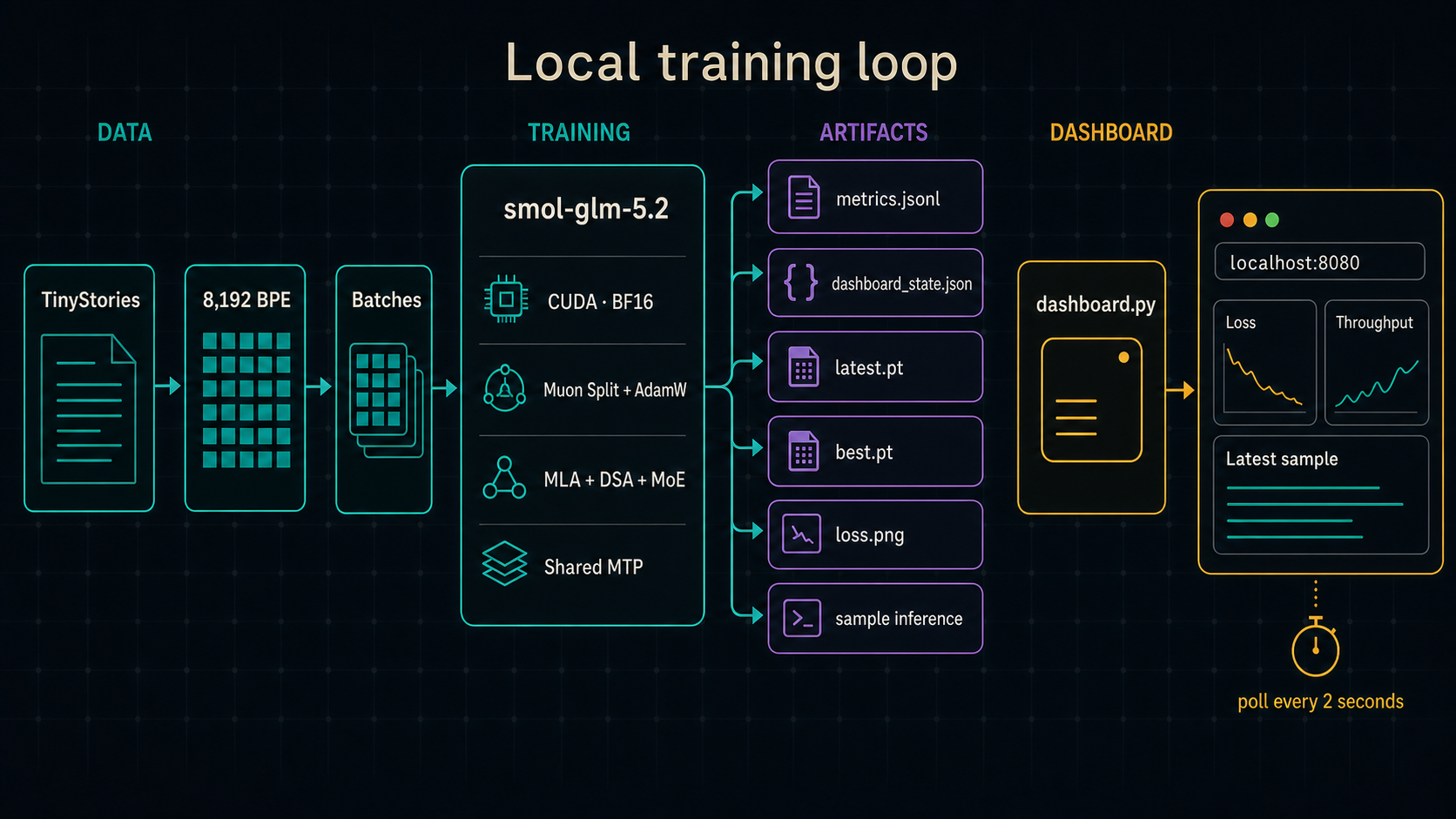
train.py
  ├── metrics.jsonl             append-only train/validation history
  ├── dashboard_state.json      latest atomic state snapshot
  ├── loss.png                  Matplotlib-rendered loss chart
  ├── latest.pt                 resumable checkpoint
  └── best.pt                   best validation checkpoint
             ↓
dashboard.py → /api/state + /artifacts/loss.png
             ↓
browser polls every two seconds
The dashboard shows:
- run status, current step, progress, elapsed time, and ETA;
- total objective, next-token loss, validation loss, MTP loss, and indexer loss;
- token throughput, tokens processed, peak allocated VRAM, gradient norm, and current learning-rate scale;
- total versus active parameters, layer counts, IndexShare structure, expert count, experts per token, and MTP depth;
- the current loss plot and most recent cached generation sample.
Use --sample-interval, --sample-tokens, and --sample-prompt to control
dashboard samples. Use --skip-samples when measuring pure training
throughput.
Verification
Run the full suite:
python3 -m pytest -q
Expected result:
8 passed
The tests cover:
- the exact
FFFSSSFSSSFSSIndexShare and dense/MoE schedules; - the exact 50,153,344 parameter budget and active-path estimate;
- forward, backward, next-token, MTP, and indexer-distillation losses;
- nonzero indexer gradients and router correction-bias behavior;
- BF16-autocast forward/backward with finite loss and gradients;
- causal invariance under sparse top-k selection;
- cached token-by-token decoding against full-sequence logits;
- dashboard JSONL/state/plot output and SafeTensors inference round-trip.
The exact 50M configuration has also completed a finite BF16-autocast forward/backward pass, and the combined Muon + AdamW optimizer path has completed a finite update.
Run lint:
python3 -m ruff check .
Run a one-step CPU pipeline smoke test:
python3 train.py \
  --config configs/glm52_smoke.json \
  --data-dir data/tinystories-smoke \
  --output-dir /tmp/smol-glm52-smoke \
  --steps 1 \
  --batch-size 1 \
  --gradient-accumulation 1 \
  --sequence-length 8 \
  --eval-batches 1 \
  --skip-samples \
  --device cpu
The smoke path produces best.pt, latest.pt, metrics.jsonl,
dashboard_state.json, and loss.png.
Troubleshooting
CUDA is not available
The default 50M run intentionally requires CUDA. Use --device cpu only with
the smoke configuration or another substantially reduced experiment:
python3 train.py \
  --config configs/glm52_smoke.json \
  --data-dir data/tinystories-smoke \
  --device cpu
CUDA out of memory
Reduce --batch-size, increase --gradient-accumulation, close other GPU
applications, or shorten --sequence-length. Gradient checkpointing and
production fused sparse-attention kernels are not implemented.
Dataset or tokenizer not found
Run the preparation command from the repository root. The model configuration and tokenizer must have matching vocabulary sizes:
python3 scripts/prepare_tinystories.py --output-dir data/tinystories
BF16 mask overflow or mixed-dtype accumulation
Current code uses -inf for the lightning indexer's hard causal mask, promotes
BF16 expert contributions into the residual accumulator, and excludes masked
positions from indexer distillation. If an older checkout reports
value cannot be converted to type c10::BFloat16 without overflow, update to
the latest commit.
Dashboard says waiting
The dashboard can start before training. It switches from waiting when
train.py writes dashboard_state.json into the same --run-dir.
Repository map
smol-glm-5.2/
├── assets/
│   └── diagrams/
│       ├── backbone.png
│       ├── lightning-indexer.png
│       ├── sparse-moe.png
│       └── training-dashboard.png
├── configs/
│   ├── glm52_50m.json          # authoritative 50.15M shape
│   └── glm52_smoke.json        # tiny CPU pipeline fixture
├── dashboard/
│   ├── app.js                  # two-second state polling
│   ├── index.html
│   └── styles.css
├── data/
│   └── README.md               # prepared-corpus format
├── glm52/
│   ├── __init__.py
│   ├── config.py               # shape + layer schedules
│   ├── model.py                # MLA, DSA, IndexShare, MoE, MTP, decoding
│   ├── monitoring.py           # JSONL/state/Matplotlib artifacts
│   └── optim.py                # Muon, per-head Muon, AdamW split
├── scripts/
│   ├── export_model.py         # BF16 SafeTensors release bundle
│   └── prepare_tinystories.py  # tokenizer + uint16 memmaps
├── tests/
│   └── test_model.py
├── dashboard.py                # local HTTP server
├── generate.py                 # checkpoint/SafeTensors inference
├── train.py                    # single-device training loop
├── pyproject.toml
└── requirements.txt
Design notes
- Readable first: attention, routing, distillation, caching, and optimizer logic are ordinary PyTorch operations.
- Pre-norm residual stream: RMSNorm precedes both attention and feed-forward sublayers.
- Sparse attention: the main attention softmax is restricted to selected positions; the indexer score computation remains dense.
- IndexShare: only
Flayers own indexer parameters and caches;Slayers consume the current selection. - Distillation: teacher probabilities are detached, averaged across a sharing group, and applied only to causally valid positions.
- Routing: correction biases influence selection but never routed mixture weights.
- Active parameters: the reported estimate counts shared parameters and only two routed experts per MoE layer.
- BF16 stability: sensitive scores, softmaxes, router math, RMS statistics, and Muon Newton–Schulz iterations use FP32 where appropriate.
- Checkpoint safety: writes are temporary-file-plus-rename; RNG state is included for reproducible continuation.
- Inference: decoding caches compressed KV state and index keys rather than recomputing the full prefix.
Scope and limitations
- TinyStories supports base language-model pretraining, not instruction following or tool use.
- The model has not inherited knowledge from upstream GLM weights; it starts from random initialization.
- Top-64 sparsity at context 256 is primarily an architectural demonstration.
- This repository does not implement FP8 indexer kernels, FlashMLA, expert-parallel dispatch, tensor/pipeline parallelism, distributed checkpointing, speculative decoding, RL, or agentic post-training.
- Generated diagrams explain this implementation and are not official Zhipu AI architecture figures.
References and acknowledgements
The implementation is derived from publicly documented ideas in:
- the GLM-5 technical report;
- the public GLM-5.2 configuration;
- the IndexCache/IndexShare paper;
- the DeepSeek-V3 technical report for MLA and auxiliary-loss-free sparse routing;
- the DeepSeek-V3.2 report for DeepSeek Sparse Attention;
- the Muon optimizer and its Newton–Schulz orthogonalization approach;
- the TinyStories dataset.
Please use the upstream reports, model cards, and repositories as the authoritative sources for their architectures, licenses, and claims.
Frontier architecture, local scale.
Contributors

2 commits
Similar repos





Languages
Python
83.2%
CSS
7.8%
HTML
4.8%
JavaScript
4.2%
A 50M-parameter GLM-5.2 architecture study with MLA, DSA, IndexShare, sparse MoE, shared MTP, and Muon Split.
Python
5
2 commits
updated Jul 29, 2026
README
smol-glm-5.2
A 50.15M-parameter, GLM-5.2-inspired language model for one consumer GPU
MLA · DSA · Lightning Indexer · IndexShare · Sparse MoE · Shared MTP · Muon Split
Quick start · Architecture · Download · Dashboard · Verification
smol-glm-5.2 is a readable, training-oriented miniature of the public
GLM-5/GLM-5.2 language-model architecture. It compresses the defining ideas
of a 753B-parameter sparse frontier model into 50,153,344 trainable
parameters, with approximately 21,768,064 parameters active for each
token, and trains from scratch on TinyStories.
This repository keeps the interesting machinery instead of quietly replacing it with a standard dense Transformer:
- low-rank Multi-head Latent Attention with separate RoPE and NoPE channels;
- DeepSeek Sparse Attention driven by a trainable multi-head lightning indexer;
- the public GLM-5.2
FFFSSSFSSSFSSIndexShare schedule; - detached full-attention teachers and multi-layer indexer distillation;
- three dense feed-forward layers followed by ten sparse MoE layers;
- sigmoid top-k routing with a correction bias and no auxiliary balancing loss;
- one parameter-shared multi-token predictor unrolled across three depths;
- Muon Split for matrices and AdamW for embeddings, norms, and scalars;
- compressed-KV cached decoding, atomic checkpoints, and a live local dashboard.
This is an architecture study, not a claim that 50M parameters reproduce the reasoning, coding, agentic, multilingual, or long-context capabilities of the full GLM-5.2 release. The goal is to make the mechanisms small enough to read, run, instrument, and modify on one machine.
[!NOTE] CUDA training uses BF16 autocast. Mask values, sparse-MoE accumulation, and indexer distillation are explicitly BF16-safe and covered by a forward/ backward regression test.
Why this exists
Frontier MoE reports are fascinating but difficult to turn into a local experiment. A conventional tiny Transformer answers a different question: "can a small decoder learn TinyStories?" This project asks:
What does the GLM-5.2 data flow look like when its architectural choices are preserved but its widths, expert counts, layer count, vocabulary, and context are scaled down to local-training size?
The result is intentionally plain PyTorch. There are no custom CUDA kernels, distributed expert-parallel collectives, or opaque training frameworks between the reader and the model.
Architecture
1. Thirteen-layer backbone
The authoritative shape lives in
configs/glm52_50m.json. Every decoder layer uses
MLA; layers 1–3 use dense SwiGLU MLPs, while layers 4–13 use sparse
mixture-of-experts blocks.
F means the layer owns a full lightning indexer. S means the layer reuses
the most recent full indexer's selected token positions:
layer          01 02 03 04 05 06 07 08 09 10 11 12 13
indexer        F  F  F  S  S  S  F  S  S  S  F  S  S
feed-forward   D  D  D  M  M  M  M  M  M  M  M  M  M
That is five retained indexers and eight shared-indexer layers. The first
three full indexers preserve the public schedule's offset before the repeating
FSSS rhythm.
2. Multi-head Latent Attention
The attention path follows the main ideas of DeepSeek-style MLA:
- The query is compressed to a rank-128 latent, normalized, and expanded into six heads.
- Keys and values share a rank-64 compressed latent.
- Query/key channels split into 48 NoPE dimensions and 16 RoPE dimensions.
- The rotary key is stored separately from the compressed KV latent.
- Only the indexer's selected causal positions participate in the final attention softmax.
For autoregressive decoding, each layer caches compressed latent KV and rotary keys. Full-indexer layers additionally cache their index keys. Shared-indexer layers reuse selection and do not allocate duplicate index-key caches.
3. Lightning indexer, DSA, and IndexShare
Each retained indexer projects a low-rank query into four 32-dimensional heads, scores normalized index keys with ReLU similarities, then learns a token-dependent head weighting. A hard causal mask is applied before selecting the top 64 positions.
During training, the regular MLA scores also produce a detached full-attention teacher distribution. One retained indexer is supervised by every attention layer that consumes its selection. The targets are averaged before cross-entropy:
retained indexer → its own teacher + teachers from following shared layers
                 → averaged target distribution
                 → indexer cross-entropy
At a sequence length of 256, the first 64 positions naturally attend to every available causal token; later positions use a true top-64 subset. The lightning indexer itself still computes dense scores, so this eager implementation demonstrates the architecture rather than claiming a production long-context speedup.
4. Sparse mixture of experts
The final ten decoder layers contain:
- 16 routed experts, of which the top two run for each token;
- one always-on shared expert;
- 176 hidden units per expert;
- sigmoid router scores normalized only across the selected experts;
- a routing correction bias updated from exact local-batch quantiles.
The correction bias affects expert selection but not mixture weights. This keeps routing auxiliary-loss-free while nudging expert usage toward balance. At local batch sizes, exact quantiles are simpler and more readable than the distributed histogram approximation used by frontier-scale systems.
Expert contributions are accumulated in the residual stream's dtype. Under
BF16 autocast, expert outputs are promoted into the FP32 accumulator before
index_add_, avoiding mixed-dtype failures and preserving stable summation.
5. Shared multi-token prediction
One auxiliary predictor is reused at every future-token depth:
backbone state + known future-token embedding
             ↓ normalize, concatenate, fuse
       causal attention + SwiGLU
             ↓
      predict token at depth d
             ↓ reuse the same predictor
      predict depths 1, 2, and 3
The predictor parameters are shared across all three depths. This adds a training-only signal for future-token structure without tripling the auxiliary module size. Normal generation uses the backbone LM head and does not execute the MTP loss path.
6. Optimizer split
Two optimizers advance together:
| Parameter family | Optimizer | Default LR | Weight decay |
|---|---|---|---|
| Matrix parameters except embeddings/LM head | Muon | 1e-2 | 0.1 |
| Token embeddings and LM head | AdamW | 3e-4 | 0.1 |
| Norm weights, biases, and scalars | AdamW | 3e-4 | 0.0 |
Muon uses five Newton–Schulz steps to approximate the matrix polar factor. Query, KV, MTP-attention, and indexer projections carry per-head metadata so their updates are orthogonalized head by head instead of as one flattened matrix. Router correction biases are non-parameter state updated directly from the current batch's score quantiles.
What was scaled—and what was not
| Component | Public GLM-5.2 | smol-glm-5.2 |
|---|---|---|
| Total parameters | ~753B | 50,153,344 |
| Active parameters | ~40B | ~21,768,064 |
| Decoder layers | 78 | 13 |
| Hidden size | 6,144 | 384 |
| Attention heads | 64 | 6 |
| Q LoRA rank | 2,048 | 128 |
| KV LoRA rank | 512 | 64 |
| QK dimensions | 192 NoPE + 64 RoPE | 48 NoPE + 16 RoPE |
| Value head dimension | 256 | 64 |
| Indexer heads / head size | 32 / 128 | 4 / 32 |
| Sparse top-k | 2,048 | 64 |
| Indexer pattern | FFFSSS(FSSS)… | FFFSSSFSSSFSS |
| Dense MLP layers | first 3 | first 3 |
| Routed experts | 256, Top-8 | 16, Top-2 |
| Shared experts | 1 | 1 |
| MTP | shared auxiliary predictor | shared across 3 depths |
| Vocabulary | 154,880 | 8,192 BPE |
| Word embeddings | untied | untied |
| Release context | up to 1M | 256 training default |
| Training corpus | frontier mixture | TinyStories |
The scale changes are deliberate. The attention factorization, causal sparse selection, index-sharing rhythm, router semantics, MTP parameter sharing, and optimizer partition remain visible in code. Production FP8 indexer kernels, expert parallelism, distributed training, reinforcement learning, and agentic post-training are outside this repository's scope.
Model card
| Field | Value |
|---|---|
| Model name | smol-glm-5.2 |
| Task | decoder-only causal language modeling |
| Trainable parameters | 50,153,344 |
| Approx. active parameters/token | 21,768,064 |
| Layers | 13 |
| Hidden size | 384 |
| Attention heads | 6 |
| Q/K head size | 64 |
| Value head size | 64 |
| Dense / MoE layers | 3 / 10 |
| Routed experts | 16, Top-2 |
| Shared experts | 1 |
| Indexers | 5 full, 8 shared |
| Sparse attention | causal Top-64 |
| MTP depth | 3, parameter-shared |
| Vocabulary | 8,192 byte-level BPE |
| Embeddings | untied |
| RoPE theta | 8,000,000 |
| Default sequence length | 256 |
| Default effective token batch | 8,192 |
| Precision | CUDA BF16 autocast |
| Optimizer | Muon Split + AdamW |
| Initialization | normal, σ = 0.02 |
| Training dataset | TinyStories |
Training objective
The total objective is:
L = L(next-token)
  + 0.10 × mean[L(shared MTP depth 1..3)]
  + 0.02 × mean[L(indexer distillation groups)]
L(next-token) and MTP use cross-entropy with -100 ignored. Indexer targets
are detached full-attention distributions. Masked causal positions are removed
from the distillation product explicitly, keeping the hard -inf attention
mask without introducing 0 × -inf NaNs.
Quick start
Run all commands from the repository root.
1. Clone and install
git clone https://github.com/cneuralnetwork/smol-glm-5.2.git
cd smol-glm-5.2
python3 -m pip install -r requirements.txt
Python 3.10+ and PyTorch 2.5+ are recommended. Full training expects a CUDA-capable GPU; the smoke configuration also runs on CPU.
2. Prepare TinyStories
Create the full training split, 10,000-story validation split, and an 8,192-token byte-level BPE tokenizer:
python3 scripts/prepare_tinystories.py \
  --output-dir data/tinystories
The prepared representation is deliberately simple:
data/tinystories/
├── metadata.json
├── tokenizer.json
├── train.bin
└── validation.bin
Token IDs are stored consecutively as uint16; stories are separated by the
<eos> token. The trainer memory-maps both binary shards instead of loading
the corpus into RAM.
For a quick pipeline fixture:
python3 scripts/prepare_tinystories.py \
  --output-dir data/tinystories-smoke \
  --tokenizer-stories 10000 \
  --train-stories 10000 \
  --validation-stories 1000
3. Start the dashboard
In terminal A:
python3 dashboard.py \
  --run-dir checkpoints/glm52-50m \
  --port 8080
Open http://127.0.0.1:8080. The page displays a waiting state until the trainer creates its first run artifacts.
4. Train
In terminal B:
python3 train.py
The command expands to:
python3 train.py \
  --config configs/glm52_50m.json \
  --data-dir data/tinystories \
  --output-dir checkpoints/glm52-50m \
  --steps 10000 \
  --batch-size 16 \
  --gradient-accumulation 2 \
  --sequence-length 256
Default training behavior:
micro-batch             16 sequences
sequence length         256 tokens
gradient accumulation   2
effective token batch   8,192 tokens
warmup                  1%
schedule                cosine to 10% of base LR
gradient clipping       global norm 1.0
evaluation              every 250 steps
checkpointing           every 250 steps
sample generation       every 250 steps
At startup, the model reports:
parameters: 50,153,344 total / 21,768,064 active per token
architecture: 13 layers, 5 full indexers, 8 shared indexers
Memory use depends on GPU architecture, CUDA/PyTorch versions, allocator state, and other desktop processes. If the default micro-batch is too large, preserve the 8,192-token effective batch with:
python3 train.py \
  --batch-size 8 \
  --gradient-accumulation 4
For a lower-memory experiment, reduce both micro-batch and sequence length:
python3 train.py \
  --batch-size 4 \
  --gradient-accumulation 8 \
  --sequence-length 128
Resume training
latest.pt includes model weights, both optimizer states, best validation
loss, training arguments, and Python/NumPy/PyTorch/CUDA RNG state.
python3 train.py \
  --resume checkpoints/glm52-50m/latest.pt
--steps is the final target step count, not the number of additional steps.
For example, resuming a step-4,999 checkpoint with --steps 10000 continues
through step 9,999.
SIGTERM and Ctrl+C preserve latest.pt after the most recently completed
optimizer step. Checkpoints are written to a temporary path and atomically
renamed to avoid exposing half-written files.
Generate text
From a training checkpoint:
python3 generate.py checkpoints/glm52-50m/best.pt \
  --prompt "Once upon a time, a little fox" \
  --tokens 200 \
  --temperature 0.8 \
  --top-k 50
Generation automatically uses CUDA when available and falls back to CPU. Token-by-token decoding carries compressed MLA caches and current IndexShare selections across layers.
Export SafeTensors
python3 scripts/export_model.py checkpoints/glm52-50m/best.pt \
  --dashboard-state checkpoints/glm52-50m/dashboard_state.json
The default export directory is release/smol-glm-5.2-tinystories/:
| File | Purpose |
|---|---|
model.safetensors | BF16 inference weights |
config.json | exact architecture configuration |
tokenizer.json | 8,192-token TinyStories BPE |
training_metadata.json | step, validation loss, run settings, parameter counts |
sha256sums.txt | integrity checksum for every bundle artifact |
Load the exported bundle:
python3 generate.py release/smol-glm-5.2-tinystories/model.safetensors \
  --prompt "Once upon a time"
No pretrained weights are committed to this repository. The official bundle
is published separately in the GitHub Release below; checkpoints/,
release/, and prepared binary data remain ignored by Git.
Download the trained model
The best checkpoint from the completed 10,000-step TinyStories run is
published in the
v0.1.0-tinystories GitHub Release.
It contains BF16 SafeTensors inference weights without optimizer state.
mkdir -p pretrained/smol-glm-5.2

gh release download v0.1.0-tinystories \
  --repo cneuralnetwork/smol-glm-5.2 \
  --dir pretrained/smol-glm-5.2

python3 generate.py pretrained/smol-glm-5.2/model.safetensors \
  --prompt "Once upon a time, a little fox"
Published bundle:
| File | Purpose |
|---|---|
model.safetensors | 50.15M-parameter BF16 inference weights |
config.json | exact architecture configuration |
tokenizer.json | 8,192-token TinyStories BPE tokenizer |
training_metadata.json | selected checkpoint, run settings, and final dashboard state |
sha256sums.txt | integrity checksums for every bundle artifact |
Completed training result
| Metric | Result |
|---|---|
| Optimizer steps | 10,000 |
| Selected checkpoint | step 9,750 |
| Best validation loss | 1.6653 |
| Final validation loss | 1.6774 |
| Final next-token train loss | 1.5918 |
| Final measured throughput | 8,199 tokens/s |
| Peak allocated VRAM | 3.86 GiB |
| Training hardware | RTX 4060 Laptop GPU, 8 GB |
Example from the exported model:
Once upon a time, a little fox was walking in the woods when he stumbled on a piece of cardboard. He was very sad because he could not find any friends. He looked around, but the cardboard wasn't there.
Live training dashboard
The monitoring stack intentionally follows a durable, dependency-light model: the trainer owns the artifacts and the browser only polls them.
train.py
  ├── metrics.jsonl             append-only train/validation history
  ├── dashboard_state.json      latest atomic state snapshot
  ├── loss.png                  Matplotlib-rendered loss chart
  ├── latest.pt                 resumable checkpoint
  └── best.pt                   best validation checkpoint
             ↓
dashboard.py → /api/state + /artifacts/loss.png
             ↓
browser polls every two seconds
The dashboard shows:
- run status, current step, progress, elapsed time, and ETA;
- total objective, next-token loss, validation loss, MTP loss, and indexer loss;
- token throughput, tokens processed, peak allocated VRAM, gradient norm, and current learning-rate scale;
- total versus active parameters, layer counts, IndexShare structure, expert count, experts per token, and MTP depth;
- the current loss plot and most recent cached generation sample.
Use --sample-interval, --sample-tokens, and --sample-prompt to control
dashboard samples. Use --skip-samples when measuring pure training
throughput.
Verification
Run the full suite:
python3 -m pytest -q
Expected result:
8 passed
The tests cover:
- the exact
FFFSSSFSSSFSSIndexShare and dense/MoE schedules; - the exact 50,153,344 parameter budget and active-path estimate;
- forward, backward, next-token, MTP, and indexer-distillation losses;
- nonzero indexer gradients and router correction-bias behavior;
- BF16-autocast forward/backward with finite loss and gradients;
- causal invariance under sparse top-k selection;
- cached token-by-token decoding against full-sequence logits;
- dashboard JSONL/state/plot output and SafeTensors inference round-trip.
The exact 50M configuration has also completed a finite BF16-autocast forward/backward pass, and the combined Muon + AdamW optimizer path has completed a finite update.
Run lint:
python3 -m ruff check .
Run a one-step CPU pipeline smoke test:
python3 train.py \
  --config configs/glm52_smoke.json \
  --data-dir data/tinystories-smoke \
  --output-dir /tmp/smol-glm52-smoke \
  --steps 1 \
  --batch-size 1 \
  --gradient-accumulation 1 \
  --sequence-length 8 \
  --eval-batches 1 \
  --skip-samples \
  --device cpu
The smoke path produces best.pt, latest.pt, metrics.jsonl,
dashboard_state.json, and loss.png.
Troubleshooting
CUDA is not available
The default 50M run intentionally requires CUDA. Use --device cpu only with
the smoke configuration or another substantially reduced experiment:
python3 train.py \
  --config configs/glm52_smoke.json \
  --data-dir data/tinystories-smoke \
  --device cpu
CUDA out of memory
Reduce --batch-size, increase --gradient-accumulation, close other GPU
applications, or shorten --sequence-length. Gradient checkpointing and
production fused sparse-attention kernels are not implemented.
Dataset or tokenizer not found
Run the preparation command from the repository root. The model configuration and tokenizer must have matching vocabulary sizes:
python3 scripts/prepare_tinystories.py --output-dir data/tinystories
BF16 mask overflow or mixed-dtype accumulation
Current code uses -inf for the lightning indexer's hard causal mask, promotes
BF16 expert contributions into the residual accumulator, and excludes masked
positions from indexer distillation. If an older checkout reports
value cannot be converted to type c10::BFloat16 without overflow, update to
the latest commit.
Dashboard says waiting
The dashboard can start before training. It switches from waiting when
train.py writes dashboard_state.json into the same --run-dir.
Repository map
smol-glm-5.2/
├── assets/
│   └── diagrams/
│       ├── backbone.png
│       ├── lightning-indexer.png
│       ├── sparse-moe.png
│       └── training-dashboard.png
├── configs/
│   ├── glm52_50m.json          # authoritative 50.15M shape
│   └── glm52_smoke.json        # tiny CPU pipeline fixture
├── dashboard/
│   ├── app.js                  # two-second state polling
│   ├── index.html
│   └── styles.css
├── data/
│   └── README.md               # prepared-corpus format
├── glm52/
│   ├── __init__.py
│   ├── config.py               # shape + layer schedules
│   ├── model.py                # MLA, DSA, IndexShare, MoE, MTP, decoding
│   ├── monitoring.py           # JSONL/state/Matplotlib artifacts
│   └── optim.py                # Muon, per-head Muon, AdamW split
├── scripts/
│   ├── export_model.py         # BF16 SafeTensors release bundle
│   └── prepare_tinystories.py  # tokenizer + uint16 memmaps
├── tests/
│   └── test_model.py
├── dashboard.py                # local HTTP server
├── generate.py                 # checkpoint/SafeTensors inference
├── train.py                    # single-device training loop
├── pyproject.toml
└── requirements.txt
Design notes
- Readable first: attention, routing, distillation, caching, and optimizer logic are ordinary PyTorch operations.
- Pre-norm residual stream: RMSNorm precedes both attention and feed-forward sublayers.
- Sparse attention: the main attention softmax is restricted to selected positions; the indexer score computation remains dense.
- IndexShare: only
Flayers own indexer parameters and caches;Slayers consume the current selection. - Distillation: teacher probabilities are detached, averaged across a sharing group, and applied only to causally valid positions.
- Routing: correction biases influence selection but never routed mixture weights.
- Active parameters: the reported estimate counts shared parameters and only two routed experts per MoE layer.
- BF16 stability: sensitive scores, softmaxes, router math, RMS statistics, and Muon Newton–Schulz iterations use FP32 where appropriate.
- Checkpoint safety: writes are temporary-file-plus-rename; RNG state is included for reproducible continuation.
- Inference: decoding caches compressed KV state and index keys rather than recomputing the full prefix.
Scope and limitations
- TinyStories supports base language-model pretraining, not instruction following or tool use.
- The model has not inherited knowledge from upstream GLM weights; it starts from random initialization.
- Top-64 sparsity at context 256 is primarily an architectural demonstration.
- This repository does not implement FP8 indexer kernels, FlashMLA, expert-parallel dispatch, tensor/pipeline parallelism, distributed checkpointing, speculative decoding, RL, or agentic post-training.
- Generated diagrams explain this implementation and are not official Zhipu AI architecture figures.
References and acknowledgements
The implementation is derived from publicly documented ideas in:
- the GLM-5 technical report;
- the public GLM-5.2 configuration;
- the IndexCache/IndexShare paper;
- the DeepSeek-V3 technical report for MLA and auxiliary-loss-free sparse routing;
- the DeepSeek-V3.2 report for DeepSeek Sparse Attention;
- the Muon optimizer and its Newton–Schulz orthogonalization approach;
- the TinyStories dataset.
Please use the upstream reports, model cards, and repositories as the authoritative sources for their architectures, licenses, and claims.
Frontier architecture, local scale.
Similar repos
Contributors
2 commits
Languages
Python
83.2%
CSS
7.8%
HTML
4.8%
JavaScript
4.2%