
Discover great opportunities to become a Cloud Native contributor
See the codeREADME
CLOTributor
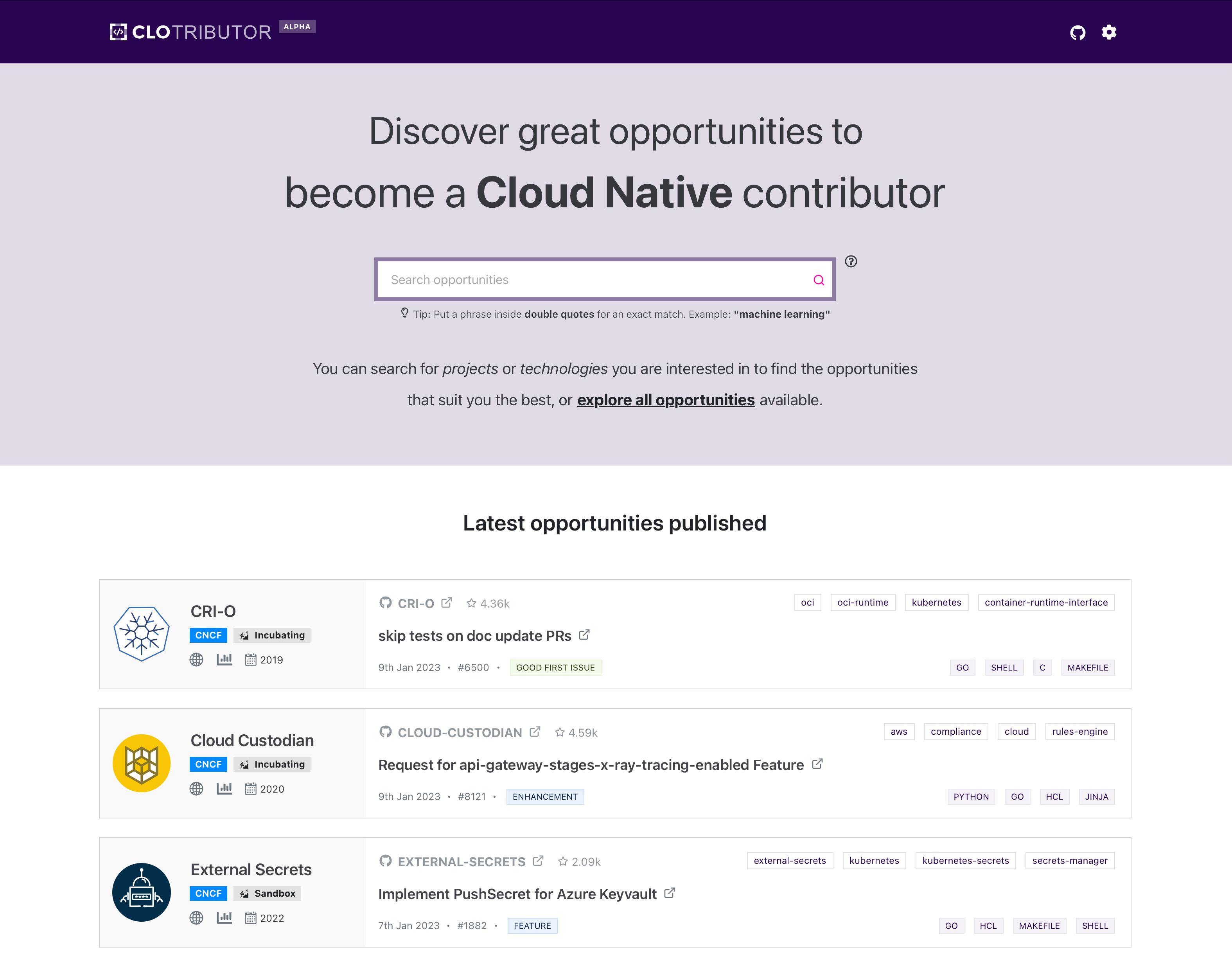
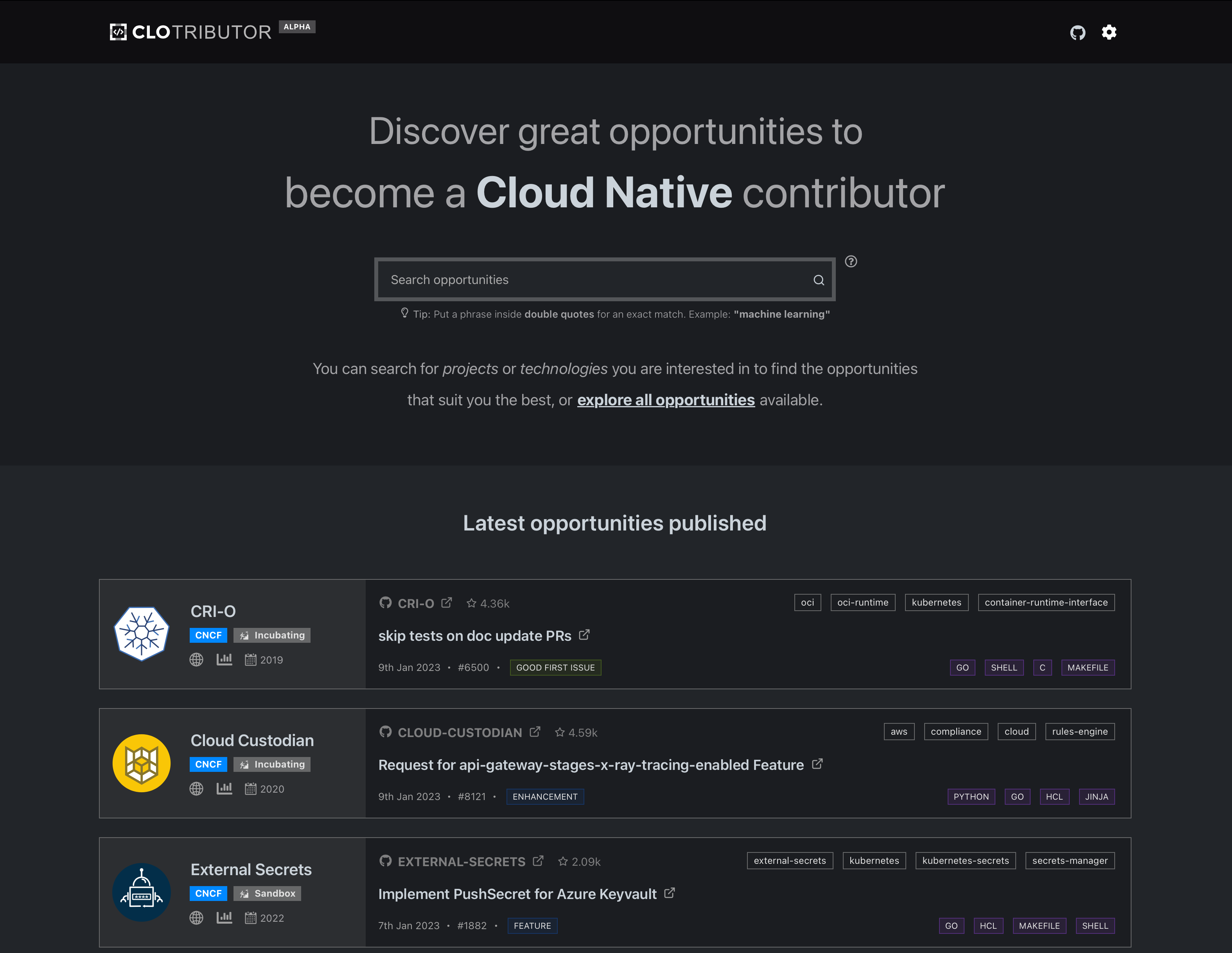
CLOTributor makes it easier to discover great opportunities to become a Cloud Native contributor.
 |  |
How it works
One of the CLOTributor's goals is to surface interesting opportunities for potential contributors to Cloud Native projects, allowing them to find those that suit their skills and interests best.
To achieve this, CLOTributor scans periodically hundreds of repositories, indexing issues that match certain criteria:
- Contain the
help wantedlabel - Their state is
OPEN - They are
unassigned - Updated within the last year
Issues that no longer match the required criteria are removed automatically from CLOTributor. This way, if an issue is assigned to someone or it is closed, it won't be displayed anymore.
In addition to some issue's details, like the title or labels, we also collect and index some metadata from the corresponding repository, like its topics or the programming languages used. In general, the more context projects can provide in their issues via labels, the better. There is a set of labels that have a special meaning for CLOTributor. Other labels like frontend, or even mentioning specific frameworks like react or vue, may also help users finding issues that suit them best.
The generated index can be searched from https://clotributor.dev. The following syntax can be used to narrow down the results:
- Use multiple words to refine the search. Example: gitops go
- Use
-to exclude words from the search. Example: rust -webassembly - Put a phrase inside
double quotesfor an exact match. Example: "machine learning" - Use
orcombine multiple searches. Example: networking or security
It's possible to search by project name, repository name, description, topics, or programming languages, as well as issue title and labels. Prefix matching for all of them is also supported (e.g. searching for backst should return issues from the Backstage project).
Labels with special meaning
Some of the features of CLOTributor are controlled by some special labels (or labels that contain some strings) that can be set on issues. One of the most important labels for CLOTributor is help wanted, as it only processes issues where help is wanted. Issues are categorized in some different ways based on these labels:
Area
- docs: the issue has a label that contains the string
docsordocumentation.
Kind
- bug: the issue has a label that contains the string
bug. - feature: the issue has a label that contains the string
feature. - enhancement: the issue has a label that contains the string
enhancementorimprovement.
Difficulty
- easy: the issue has the label
difficulty/easyorlevel/easy. - medium: the issue has the label
difficulty/mediumorlevel/medium. - hard: the issue has the label
difficulty/hardorlevel/hard.
Other filters
good first issue: use this label to highlight issues that may be a good fit for new contributors to the project.mentor availableormentorship: to indicate that someone may be available to guide contributors with this issue.
Maintainers wanted
If your project is looking for maintainers, CLOTributor can highlight this in a special way to let potential candidates know. This feature can be enabled by submitting a PR to add the block below to the corresponding project in the data files. You can add as many links or contacts as you need, or omit any of them if you prefer.
maintainers_wanted:
  enabled: true
  links:
    - title: How to contribute to the project
      url: https://github.com/org/repo/CONTRIBUTING.md
    - title: Development environment setup
      url: https://github.com/org/repo/docs/dev_env_setup.md
  contacts:
    - github_handle: user1
    - github_handle: user2
NOTE: the user submitting the pull request must already be a project's maintainer.
Contributing
Please see CONTRIBUTING.md for more details.
Code of Conduct
This project follows the CNCF Code of Conduct.
License
CLOTributor is an Open Source project licensed under the Apache License 2.0.
Contributors


Similar repos


Languages
TypeScript
46.3%
Rust
32.4%
HTML
6.4%
PLpgSQL
6.4%
CSS
5.1%
Mustache
1.4%
Dockerfile
1.0%
Discover great opportunities to become a Cloud Native contributor
See the codeREADME
CLOTributor
CLOTributor makes it easier to discover great opportunities to become a Cloud Native contributor.
| |
How it works
One of the CLOTributor's goals is to surface interesting opportunities for potential contributors to Cloud Native projects, allowing them to find those that suit their skills and interests best.
To achieve this, CLOTributor scans periodically hundreds of repositories, indexing issues that match certain criteria:
- Contain the
help wantedlabel - Their state is
OPEN - They are
unassigned - Updated within the last year
Issues that no longer match the required criteria are removed automatically from CLOTributor. This way, if an issue is assigned to someone or it is closed, it won't be displayed anymore.
In addition to some issue's details, like the title or labels, we also collect and index some metadata from the corresponding repository, like its topics or the programming languages used. In general, the more context projects can provide in their issues via labels, the better. There is a set of labels that have a special meaning for CLOTributor. Other labels like frontend, or even mentioning specific frameworks like react or vue, may also help users finding issues that suit them best.
The generated index can be searched from https://clotributor.dev. The following syntax can be used to narrow down the results:
- Use multiple words to refine the search. Example: gitops go
- Use
-to exclude words from the search. Example: rust -webassembly - Put a phrase inside
double quotesfor an exact match. Example: "machine learning" - Use
orcombine multiple searches. Example: networking or security
It's possible to search by project name, repository name, description, topics, or programming languages, as well as issue title and labels. Prefix matching for all of them is also supported (e.g. searching for backst should return issues from the Backstage project).
Labels with special meaning
Some of the features of CLOTributor are controlled by some special labels (or labels that contain some strings) that can be set on issues. One of the most important labels for CLOTributor is help wanted, as it only processes issues where help is wanted. Issues are categorized in some different ways based on these labels:
Area
- docs: the issue has a label that contains the string
docsordocumentation.
Kind
- bug: the issue has a label that contains the string
bug. - feature: the issue has a label that contains the string
feature. - enhancement: the issue has a label that contains the string
enhancementorimprovement.
Difficulty
- easy: the issue has the label
difficulty/easyorlevel/easy. - medium: the issue has the label
difficulty/mediumorlevel/medium. - hard: the issue has the label
difficulty/hardorlevel/hard.
Other filters
good first issue: use this label to highlight issues that may be a good fit for new contributors to the project.mentor availableormentorship: to indicate that someone may be available to guide contributors with this issue.
Maintainers wanted
If your project is looking for maintainers, CLOTributor can highlight this in a special way to let potential candidates know. This feature can be enabled by submitting a PR to add the block below to the corresponding project in the data files. You can add as many links or contacts as you need, or omit any of them if you prefer.
maintainers_wanted:
  enabled: true
  links:
    - title: How to contribute to the project
      url: https://github.com/org/repo/CONTRIBUTING.md
    - title: Development environment setup
      url: https://github.com/org/repo/docs/dev_env_setup.md
  contacts:
    - github_handle: user1
    - github_handle: user2
NOTE: the user submitting the pull request must already be a project's maintainer.
Contributing
Please see CONTRIBUTING.md for more details.
Code of Conduct
This project follows the CNCF Code of Conduct.
License
CLOTributor is an Open Source project licensed under the Apache License 2.0.
Similar repos
Contributors
Languages
TypeScript
46.3%
Rust
32.4%
HTML
6.4%
PLpgSQL
6.4%
CSS
5.1%
Mustache
1.4%
Dockerfile
1.0%