Impact-driven test runner for CI: runs only the tests affected by your git diff. Go, JS/TS (Vitest/Jest), Python, Rust, Java and C#. No Bazel, drop-in for GitHub Actions.
Go
0
73 commits
updated Oct 19, 2026
fastci is a lightweight CI accelerator. Its first feature is the Impact-Driven Test Runner: it looks at your git diff, builds a dependency graph for your project, and runs your tests only against the packages/files that actually changed or transitively depend on something that changed — instead of your whole test suite.
No Bazel, no build-system migration. Drop it in front of your test runner in your existing GitHub Actions workflow (or run it locally) and it gets out of the way otherwise. See Benchmarks for real, reproducible measurements — including where it helps, where it doesn't, and the scripts to check both on your own hardware — and fastci vs. Nx/Turborepo for how it differs from monorepo build orchestrators, and when each fits. JS/TS monorepo users specifically: see fastci and your JS/TS monorepo for what workspace cross-package resolution does and a reproducible demo.
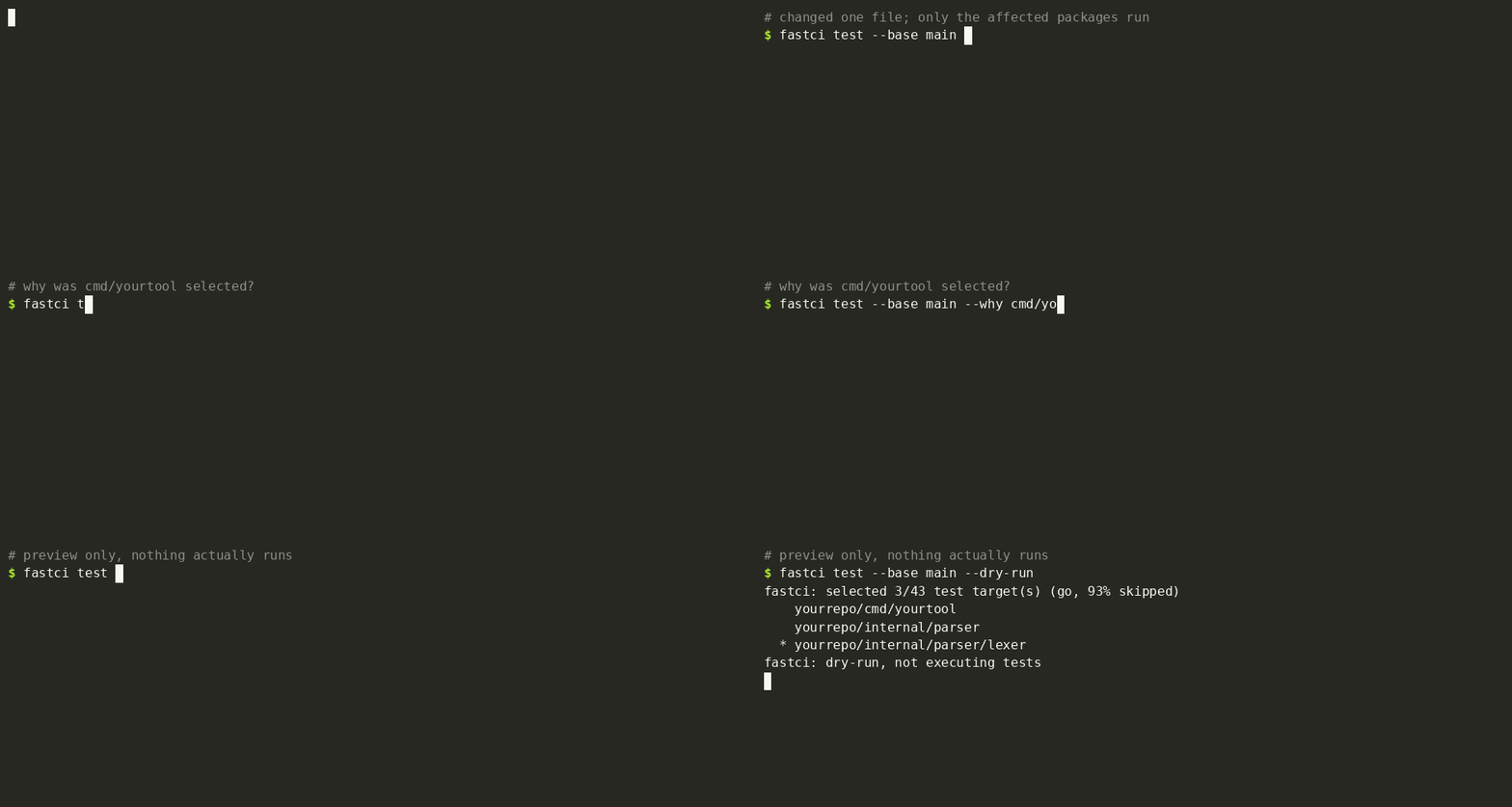
This is an early, incrementally-developed project. Today it covers:
go test) — package-level, module or workspaceSee Roadmap for what's next.
A one-package change in a synthetic monorepo, cold caches, median of 3 runs on a shared 2-vCPU sandbox VM:
| Repo | Full suite | fastci test | Speedup | Tests run |
|---|---|---|---|---|
| Go, 1000 packages | 119.07s | 5.57s | 21.3x | 1 / 1001 packages |
| Go, 200 packages | 11.91s | 2.29s | 5.2x | 1 / 201 packages |
| Java (Maven), 200 modules | 33.01s | 4.59s | 7.1x | 1 / 201 modules |
| Go, 200 packages, shared dependency changed (worst case) | 33.45s | 36.67s | 1.0x | 201 / 201 packages |
Small repos (roughly under 10-20 packages) can be slightly slower, since fastci's fixed analysis overhead isn't yet covered by the time it saves. Full methodology, raw repeats, and scripts to reproduce on your own hardware: Benchmarks.
In your existing .github/workflows/ci.yml (on pull_request), swap your
test command for two lines:
       - uses: actions/checkout@v4
-      - run: go test ./...
+      - run: go install github.com/cmc-labo/fastci/cmd/fastci@latest
+      - run: fastci test --base origin/${{ github.base_ref }}
The project type (Go, Vitest, Jest, pytest, Cargo, Maven/Gradle, .NET) is
auto-detected, so the same two lines work in place of npm test,
pytest, cargo test, and so on. See GitHub Actions
for a complete workflow with per-language setup steps.
fastci itself is a single Go binary, installed with go install — this is
required even if the project you'll run it against is JavaScript, Python,
or Rust; only building fastci needs a Go toolchain, not your project:
go install github.com/cmc-labo/fastci/cmd/fastci@latest
This needs Go on your machine (install Go if
you don't have it) — Go 1.21 or later is enough, since GOTOOLCHAIN=auto
(the default since Go 1.21) transparently downloads whatever newer toolchain
fastci's own go.mod requires.
Verify it installed and is on your PATH:
fastci --help
If that prints command not found: fastci, go install put the binary in
$(go env GOPATH)/bin, which isn't on PATH by default on many systems:
export PATH="$PATH:$(go env GOPATH)/bin"
Add that line to your shell profile (~/.bashrc, ~/.zshrc, etc.) to make
it permanent.
cd into your project's root — wherever its go.mod/go.work,
vitest.config.*, Jest-configured package.json, pytest config, or
Cargo.toml lives (see How it works for exactly what's
auto-detected) — and first preview what fastci would do, without running
anything:
fastci test --dry-run -v
On a clean working tree this reports fastci: no changed files detected, nothing to test — that's expected, since fastci narrows based on your git
diff, not on the whole project. Make a small, real edit to one file (or
check out a branch that already has one), then try again. You should see
the file(s) you changed and the test targets fastci selected because of
them. Once you're satisfied it picked the right thing, drop --dry-run to
actually run them:
fastci test
The commands above compare your working tree against HEAD — uncommitted
changes. To preview what a pull request would trigger instead (committed
changes against a target branch, the way CI sees it):
fastci test --base origin/main
See GitHub Actions below for a drop-in workflow step that runs this automatically on every pull request.
That's the core loop. Everything else in this README is reference
material: the full flag list and output format per language, the
test-result cache, fastci analyze (AI-assisted failure triage), fastci guard (vulnerability scanning), fastci local (reproduce CI locally), and
per-language limitations. If something doesn't
behave as expected, check Troubleshooting first.
fastci test auto-detects the project type in the working directory
(Go module/workspace, a Vitest-configured project, a Jest-configured
package.json, a pytest-configured Python project, a Rust
crate/Cargo workspace, a Maven/Gradle Java project, or a .NET solution
or standalone project) and resolves the files changed in your working
tree (or, with --base, the files changed between a base ref and
HEAD).go/packages
(backed by go list), which resolves module paths, internal/
visibility, replace directives, and go.work workspaces exactly the
way the Go toolchain itself would.esbuild's resolver,
which understands relative imports, tsconfig.json paths/baseUrl
aliases, extension/index resolution, and import() calls with a
static string argument — the same way your bundler would resolve
them. A Jest moduleNameMapper config (from jest.config.json or
package.json's "jest" field) is additionally applied through a
custom esbuild resolver plugin, so aliases defined only there (not in
tsconfig.json) are tracked too. Vitest's own resolve.alias
(vite.config.*/vitest.config.*) is resolved the same way Vite
itself resolves it — by actually bundling and executing the config
file under Node — since, unlike moduleNameMapper, it's arbitrary
JS/TS code rather than a JSON-shaped value; see
Current limitations for what that needs. A
cross-package import within an npm/pnpm/yarn workspace monorepo
(e.g. import {x} from '@myorg/utils' from a sibling package) is
resolved for both Vitest and Jest the same way — see
Current limitations below..py file is parsed with Python's own ast module, and
import targets (including relative imports like from ..pkg import x)
are normalized with the stdlib's importlib.util.resolve_name, then
matched against a registry of every file's dotted module name built by
walking the project tree. This never imports/executes the project's
own code — see Current limitations for what
that trades off.cargo metadata,
which resolves the real crate dependency graph (path dependencies,
normal/dev/build dependencies) the same way cargo build/cargo test
would.com.sun.source.*, the same
Compiler Tree API javac itself parses with), run via a small shim
embedded in fastci, in parse-only mode - never .analyze(), so
unlike jdeps (which can only inspect already-compiled .class/JAR
files) this needs nothing beyond the source tree itself: no
classpath, no dependency resolution, no successful compile, the same
guarantee every analyzer above keeps. It does need a java binary on
PATH, which in practice is never a new requirement - anything that
can run mvn test/gradle test at all already has a JDK installed.
See Current limitations for exactly what a
parse-only pass still can't resolve, and why.Microsoft.CodeAnalysis.CSharp) - the same compiler
frontend csc itself uses - run via a small shim embedded in fastci,
in parse-only mode (CSharpSyntaxTree.ParseText, never a
Compilation/SemanticModel), the same "needs nothing beyond the
source tree itself" guarantee as Java above. Unlike the JDK, which
exposes its Compiler Tree API as a public, single-file-launchable API
any JDK install already has on hand, the .NET SDK doesn't package
Roslyn as a NuGet-free API - Microsoft.CodeAnalysis.CSharp is
normally a separate NuGet package. But Roslyn is already present on
disk inside every .NET SDK install regardless, at
<sdk>/Roslyn/bincore (it's how csc.dll itself is implemented) -
fastci compiles its own shim directly against those bundled
assemblies (dotnet exec <sdk>/Roslyn/bincore/csc.dll ..., the SDK's
own compiler, invoked directly), the one time it's needed per project
(cached under .fastci-cache/ after that), with no NuGet restore
and no network access at any point - verified directly, with
network access blocked outright. It does need a dotnet binary on
PATH, which in practice is never a new requirement - anything that
can run dotnet test at all already has one. See
Current limitations for exactly what this
does and doesn't resolve, and why C#'s own using directives (which
name a namespace, almost never one specific type, unlike Java's
import) make the identifier-token check a bigger part of the
design than it is for Java.--full-run-threshold (see Usage)
adds an optional, separate safety net for the opposite situation - a
diff broad enough that per-file narrowing itself carries more risk than
it saves.Run from the project root — a Go module (go.mod), a Go workspace
(go.work), a Vitest project (vitest.config.* or a vitest dependency),
a Jest project (package.json with Jest configured), a pytest project
(pytest.ini, conftest.py, or a
[tool.pytest.ini_options]/[tool:pytest] section), a Rust crate or
Cargo workspace (Cargo.toml), a Maven (pom.xml) or Gradle
(build.gradle/build.gradle.kts) Java project (single- or
multi-module), or a .NET solution (*.sln) or standalone project
(*.csproj):
# Test whatever's affected by your uncommitted changes
fastci test

# Test what's affected between the target branch and HEAD (PR-style diff)
fastci test --base origin/main

# See what would run without running it
fastci test --dry-run -v

# Bypass impact analysis and run everything
fastci test --all

# Safety net: run everything anyway if a diff this broad touched >=30% of
# tracked source files, rather than trusting per-file narrowing on it
fastci test --full-run-threshold 30

# Explain why a file/package/crate was (or wasn't) selected - diagnostic
# only, doesn't run any tests
fastci test --why src/consumer.test.ts
fastci test --why internal/impact          # a Go import path works too

# Force a real run of everything selected, bypassing the local
# test-result cache (see below)
fastci test --no-cache

# Forward flags to the underlying test runner
fastci test -- -race -v        # go test
fastci test -- --coverage      # vitest run / jest
fastci test -- -x -k foo       # pytest
fastci test -- --no-fail-fast  # cargo test
Example output (Go):
$ fastci test --base origin/main
fastci: selected 3/42 test target(s) (go, 93% skipped)
  * internal/parser
    internal/parser/lexer
    cmd/yourtool
ok  	github.com/you/yourrepo/internal/parser	0.004s
ok  	github.com/you/yourrepo/internal/parser/lexer	0.002s
ok  	github.com/you/yourrepo/cmd/yourtool	0.011s
Example output (Vitest, with a tsconfig.json path alias in the mix):
$ fastci test --dry-run -v
fastci: 1 changed file(s):
  src/leaf.ts
fastci: selected 3/5 test target(s) (vitest, 40% skipped)
    src/consumer.test.ts
    src/leaf.test.ts
    src/mid.test.ts
fastci: dry-run, not executing tests
Example output (Jest, with a tsconfig.json path alias in the mix):
$ fastci test --dry-run -v
fastci: 1 changed file(s):
  src/leaf.ts
fastci: selected 3/4 test target(s) (jest, 25% skipped)
    src/consumer.test.ts
    src/leaf.test.ts
    src/mid.test.ts
fastci: dry-run, not executing tests
Example output (pytest, with a relative import crossing a package boundary):
$ fastci test --dry-run -v
fastci: 1 changed file(s):
  src/mypkg/leaf.py
fastci: selected 3/4 test target(s) (pytest, 25% skipped)
    tests/test_consumer.py
    tests/test_leaf.py
    tests/test_mid.py
fastci: dry-run, not executing tests
Example output (Cargo, a path-dependency chain across a workspace):
$ fastci test --dry-run -v
fastci: 1 changed file(s):
  crates/leaf/src/lib.rs
fastci: selected 3/4 test target(s) (cargo, 25% skipped)
    consumer
  * leaf
    mid
fastci: dry-run, not executing tests
Example output (Maven/JUnit, a same-package reference that needs no
import at all - see Current limitations for
how Java resolution works):
$ fastci test --dry-run -v
fastci: 1 changed file(s):
  src/main/java/com/example/Calc.java
fastci: selected 2/3 test target(s) (java, 33% skipped)
    src/test/java/com/example/CalcTest.java
    src/test/java/com/example/FormatterTest.java
fastci: dry-run, not executing tests
Example output (.NET/xUnit, a cross-project reference - via a nested type
$ fastci test --dry-run -v
fastci: 1 changed file(s):
  LibA/Class1.cs
fastci: selected 1/2 test target(s) (csharp, 50% skipped)
    LibA.Tests/UnitTest1.cs
fastci: dry-run, not executing tests
Lines marked * are packages/files that changed directly; lines marked ~
contain an import fastci can't statically resolve (see the Vitest/Jest/pytest
dynamic-import notes under Current limitations) and
are always included as a safety net; unmarked lines are pulled in
transitively because they depend on something that changed (directly, or
via a ~ line).
An unmarked line's exact dependency chain, or why some file isn't in the
list at all, can be checked directly with --why:
$ fastci test --why src/consumer.test.ts
fastci: why is "src/consumer.test.ts" selected?
  Selected because of this dependency chain:
    src/leaf.ts (changed)
    -> src/mid.ts
    -> src/consumer.ts
    -> src/consumer.test.ts

$ fastci test --why src/isolated.test.ts
fastci: why is "src/isolated.test.ts" selected?
  NOT selected: no changed file's effect reaches this target through the dependency graph.
Every selected target is checked against a content-hash-keyed cache
(.fastci-cache/test-results.json, git-ignored automatically) before it's
actually run: if the target's own files and everything it transitively
depends on are byte-for-byte identical to a previous run that passed (under
the same test-runner invocation), it's skipped entirely rather than
re-executed. This is a different, more precise mechanism than the
dependency-graph narrowing fastci test already does above — that
narrowing decides which targets a diff could possibly affect; this cache
asks have we already seen this exact content pass at all, so it keeps
finding things to skip even during a full run (a lockfile change, say,
forces every target to be considered, but most of them likely didn't
actually change content):
$ fastci test -v
fastci: could not safely narrow the test set, running the full suite (go). Reason(s):
  - go.mod
fastci: 3/3 target(s) skipped (cache hit - unchanged content already passed): pkga, pkgb, pkgc
fastci: nothing to run - every selected target was a cache hit
Only a passing result is ever trusted — a cached failure never skips a
run, since that would hide a real problem instead of saving time. A target
whose dependency graph includes an unresolvable dynamic import (marked ~
in the output legend above) is never cached either, for the same
reason it's always treated as possibly affected there: the graph can't
prove it has captured that target's full dependency set. --no-cache
bypasses this entirely and always actually runs every selected target.
By default this is a local-machine cache only. Setting
FASTCI_REMOTE_CACHE_URL additionally shares it across machines and CI
runners — the "distributed" half of the Roadmap's Phase 1
cache:
export FASTCI_REMOTE_CACHE_URL=https://cache.example.com/fastci
export FASTCI_REMOTE_CACHE_TOKEN=...   # optional, sent as a bearer token
fastci test
The protocol is a minimal HTTP GET/PUT key-value store — the same shape
Bazel's remote cache or sccache use: GET <url>/<key> returning 200 means
a hit, 404 (or anything else) means a miss; PUT <url>/<key> records a
pass. fastci has no opinion on what's actually behind the URL: a small
self-hosted server, a static-file host that accepts PUT, an S3-compatible
bucket via presigned URLs a CI job generates ahead of time, etc. Every
request has a 5-second timeout and is best-effort — a network error, a
timeout, or the remote being entirely unreachable degrades to "just don't
use the remote cache" (one warning printed to stderr per run, not a failed
build), never blocking or failing the actual test run. A circuit breaker
additionally stops attempting the remote at all for the rest of the run
after a few consecutive failed round trips, so a remote that's merely slow
to fail (rather than refusing the connection outright) can't turn into a
real multi-minute stall across a large target set, one 5-second timeout at
a time - see
docs/remote-cache-circuit-breaker.md
for exactly how that's decided and what it changes for you. A remote hit
is folded into the local cache file too, so a later run on the same
machine doesn't pay for another round trip to see it
again.
fastci analyzeWhen fastci test fails, it saves the failing run's combined output to
.fastci-cache/last-failure.json (git-ignored automatically, same as the
pytest AST cache). fastci analyze reads that and
asks Claude to diagnose it:
export ANTHROPIC_API_KEY=sk-ant-...
fastci test        # fails
fastci analyze      # asks Claude why, using the failure fastci test just captured
$ fastci analyze
fastci: asking claude-sonnet-5 about the go failure from 2026-09-08 08:24:44...

Root cause: pkga.A() returns 1 but the test expects 2. Fix: either update
A() to return 2, or fix the test's expected value if 1 is actually correct.
If the last fastci test run passed (or none has run yet), analyze just
says so — there's nothing to diagnose. Options:
fastci analyze --model claude-opus-5   # a different model
fastci analyze --max-tokens 2048       # allow a longer response
This makes a real, billed network request to api.anthropic.com. It
requires ANTHROPIC_API_KEY in the environment, and only ever runs when you
explicitly invoke fastci analyze — never automatically as part of
fastci test. The captured output sent to Anthropic can include file paths,
source snippets, or other project-specific content from your test run;
don't run it on output you wouldn't want leaving your machine.
(ANTHROPIC_BASE_URL is also honored, for a proxy or an API-compatible
alternative endpoint.)
fastci guardPhase 3's fastci guard (see Roadmap): supply-chain security
scanning. Most of its checks run each ecosystem's own official, trusted
scanner and report what it finds, rather than implementing vulnerability
detection itself. This is the full reference; for a hands-on, worked
walkthrough of every feature (install steps, a vulnerable-dependency
fix-it example, CI setup), see
docs/guard-guide.md.
| Ecosystem | Scanner | Install |
|---|---|---|
| Go | govulncheck | go install golang.org/x/vuln/cmd/govulncheck@latest |
| JS/TS | npm audit / pnpm audit / yarn audit (picked by lockfile) | comes with Node.js |
| Python | pip-audit | pip install pip-audit |
| Rust | cargo-audit | cargo install cargo-audit |
The problem — every scanner above can fail to even complete its scan, most commonly from having no network access to fetch its own vulnerability/advisory database (a flaky connection, a firewalled CI runner, a dead proxy). Several of them - npm/pnpm/yarn audit, pip-audit, and cargo-audit - reuse the exact same exit code for that as they do for "the scan completed and found a real vulnerability." Treating any non-zero exit as a finding, the naive generic-Unix-tool assumption, would misreport an ordinary network hiccup as a real vulnerability - this was a genuine bug found in this project (by deliberately forcing every scanner to fail this way against the real tool, not just by reading their docs) and fixed per-tool, as described below.
How each tool is told apart:
3, exclusively for "your code is affected by a
vulnerability it can actually reach." Exit 0 is clean; any other exit
code (most commonly 1, from a database-fetch failure) is treated as
the tool failing to complete, never as a finding.audit endpoint returned an error; pnpm's
ERR_PNPM_AUDIT_BAD_RESPONSE; or, as a broader net covering all three
(yarn in particular has no distinct string of its own - its real failure
text is a generic connection-error dump) - a Node.js network error code
(ECONNREFUSED, ENOTFOUND, ETIMEDOUT, ECONNRESET) or the
plain-English OS errno text pnpm's own Rust-based HTTP client prints
instead (Connection refused, Connection reset, Connection timed out).Traceback (most recent call last):) or one
of pip-audit's own logged ERROR:pip_audit.* messages, neither of which
its real vulnerability-report format (a formatted table) could ever
produce.couldn't fetch advisory database.Every one of these markers was verified directly against the real tool,
not inferred from documentation: by pointing HTTP_PROXY/HTTPS_PROXY at
a port nothing listens on and running the real scanner against it, then
capturing its actual failure text - the same empirical approach used
throughout this project.
How it's reported — each checker's Run has exactly three possible
outcomes:
| Outcome | What's printed | Counts as a "finding"? |
|---|---|---|
| Real vulnerability found | the tool's own output, then fastci: <name> reported issues (see above) | yes - guard exits non-zero |
| Clean scan, nothing found | fastci: <name>: no issues found | no |
| Infrastructure failure | fastci: <name>: could not complete - <reason> | no - treated exactly like the tool not being installed at all ("couldn't check", not "checked and found a problem") |
Two real, captured examples - the same project, with and without a live network connection:
$ HTTP_PROXY=http://127.0.0.1:1 HTTPS_PROXY=http://127.0.0.1:1 fastci guard
fastci: running govulncheck...
fastci: govulncheck: could not complete - govulncheck: exited 1 without completing the scan (a usage error, or most commonly a failure to fetch its vulnerability database - not a vulnerability finding, which uses exit code 3 specifically):
govulncheck: fetching vulnerabilities: Get "https://vuln.go.dev/index/modules.json.gz": proxyconnect tcp: dial tcp 127.0.0.1:1: connect: connection refused

fastci: no vulnerabilities found by the scanners that ran, but at least one applicable scanner was skipped - see above
$ fastci guard
fastci: running govulncheck...
=== Symbol Results ===

Vulnerability #1: GO-2021-0113
    Out-of-bounds read in golang.org/x/text/language
  More info: https://pkg.go.dev/vuln/GO-2021-0113
  Module: golang.org/x/text
    Found in: golang.org/x/[email protected]
    Fixed in: golang.org/x/[email protected]
    Example traces found:
      #1: main.go:6:23: m.main calls language.Parse

Your code is affected by 1 vulnerability from 1 module.

fastci: govulncheck reported issues (see above)

fastci: one or more scanners reported vulnerabilities
A checker that "could not complete" never stops any other applicable
checker in the same run from still executing - a monorepo with both a
go.mod and a package.json still gets its npm audit run even if
govulncheck's own database fetch failed. Each check also runs in its own
process group with a bounded timeout, so a single scanner that hangs
outright can't block the rest of guard either - see below.
Across the whole guard run: any real finding makes it exit non-zero
regardless of anything else; with no finding but at least one checker that
couldn't complete or was skipped, it exits 0 but says so explicitly
rather than silently reporting a clean bill of health; only when every
applicable checker both ran and found nothing does it report a plain "no
vulnerabilities found".
Detection — this check becomes applicable whenever the working
directory contains a requirements.txt, pyproject.toml, Pipfile,
setup.py, or setup.cfg; otherwise it's skipped entirely, the same as
any inapplicable checker (not reported as a failure).
What it audits:
requirements.txt is present, it's audited directly
(pip-audit -r requirements.txt) — the project's own dependencies don't
need to be installed first, the same no-install-required approach
fastci's own pytest analyzer already uses to build its import graph.pyproject.toml-only project, or one with no
requirements.txt committed), it falls back to pip-audit's own default
behavior: auditing every package already installed in the active Python
environment.Configuration — there's no fastci-specific config file or flag for
this; the one thing worth understanding is how the active-environment
fallback targets the right interpreter. By default, pip-audit resolves
installed packages against whatever Python interpreter it itself happens
to be installed under (sys.executable), not necessarily the project's
active virtualenv — a pip-audit installed globally or via pipx would
otherwise silently audit a completely unrelated environment (pip-audit
even warns about this itself: "This may result in unintuitive audits").
To avoid that, this checker points pip-audit at whatever python3 resolves
to on PATH, via pip-audit's own PIPAPI_PYTHON_LOCATION environment
variable. Practically, that means: activate the project's virtualenv (or
otherwise make sure its python3 is first on PATH) before running
fastci guard when relying on this fallback — a requirements.txt
doesn't need this, since it's audited directly without touching any
environment.
Vulnerabilities detected — pip-audit queries PyPI's own vulnerability
data by default (its pypi vulnerability service, no API key or extra
setup needed), backed by the
PyPA Advisory Database/OSV.dev's
Python advisories. Each finding reports the affected package and installed
version, the advisory ID (PYSEC-..., often with a cross-referenced
CVE-.../GHSA-... alias), and the fixed version(s) to upgrade to — the
same information running pip-audit directly would print. This covers
both direct and transitive dependencies actually resolved from the
requirements file or environment; unlike govulncheck for Go, it does not
do reachability analysis — a vulnerable package merely being installed is
reported regardless of whether your code actually calls the vulnerable
code path.
Real finding vs. an infrastructure failure — like the other scanners
fastci guard wraps, pip-audit reuses the same exit code both for "found
vulnerabilities" and for failing to even complete the audit (most commonly
no network access to fetch vulnerability data). This checker tells the two
apart from pip-audit's own output: an unhandled Python traceback, or one of
its own logged ERROR:pip_audit.* messages, is treated as "could not
complete" rather than a finding — see the exit-code note below for why
this distinction matters in general.
Two checks are fastci's own, since no equivalent official tool exists for either:
node_modules present, it scans every
installed dependency's package.json for a preinstall/install/
postinstall script - the mechanism behind real supply-chain attacks
like event-stream (2018) and ua-parser-js (2021), where malicious code
ran automatically the moment a dependency was installed. A lifecycle
script isn't inherently malicious (esbuild, puppeteer, and husky all
legitimately use one), so this doesn't judge intent - it just surfaces
which dependencies can run code at install time, so a human can look.cargo metadata and flags every dependency
(direct or transitive) that defines a custom build script - the same
class of risk as a JS lifecycle script, but at build time instead of
install time: a build.rs (or whatever Cargo.toml's own build field
names it - detected via cargo metadata's own structured output, not a
filename guess) runs arbitrary Rust code before the crate's own code is
even compiled. Same non-judgmental framing as the lifecycle-script scan:
linking a C library or emitting cfg flags are common, legitimate uses.Detection — this check becomes applicable whenever the working
directory contains a package.json. It additionally requires a
node_modules directory to actually scan; if one doesn't exist yet (no
npm install/pnpm install/yarn install has been run), it's skipped
with that install hint printed, the same as a missing scanner binary for
any of the other checks — not reported as a failure.
What it scans — it walks every package.json under node_modules
(including scoped packages like @org/name, and every level of nested,
transitive node_modules) and reads each one's own scripts field
looking for a preinstall, install, or postinstall entry. This is a
pure, read-only filesystem scan: it never runs npm install (or any
install command) itself and never executes any script it finds — fastci
shouldn't trigger arbitrary code execution as a side effect of running a
security scan. It only reports on dependencies already installed on
disk at scan time, so results reflect whatever node_modules currently
contains; reinstalling or updating dependencies and re-running fastci guard picks up any change.
Configuration — there's nothing to configure: no flags, no ignore list, no config file. It isn't meant to replace judgment, so it doesn't try to decide which scripts are suspicious — see "risk" below.
Risk this surfaces — an install-time lifecycle script is real, long-standing attack surface in the npm ecosystem: it's the exact mechanism behind supply-chain attacks like event-stream (2018) and ua-parser-js (2021), where malicious code ran automatically the moment a compromised package was installed, before any application code ever executed and often before a human ever looked at what was pulled in. A lifecycle script is not inherently malicious — plenty of legitimate, widely-used packages (esbuild, puppeteer, husky, core-js, and others) use one to fetch a prebuilt binary, compile a native addon, or set up git hooks — so this check deliberately doesn't try to judge intent or flag specific packages as bad. It only surfaces which installed dependencies can run arbitrary code automatically at install time, so a human can decide whether each one is expected.
Example output:
$ fastci guard
fastci: running npm/pnpm/yarn lifecycle scripts...
2 installed dependencies define an install-time lifecycle script - not necessarily malicious, but each one runs code automatically during install, so review any you don't recognize:
  @org/[email protected]: preinstall
  [email protected]: postinstall
fastci: npm/pnpm/yarn lifecycle scripts reported issues (see above)
A clean result (no installed dependency defines any of the three scripts)
reports no installed dependency defines a preinstall/install/postinstall script and doesn't count as an issue.
Detection — this check becomes applicable whenever the working
directory contains a Cargo.toml. It requires cargo on PATH to run
(not cargo-audit — plain cargo, already required to build the project
at all); if cargo isn't found, it's skipped with that install hint
printed, the same as a missing scanner binary for any other check — not
reported as a failure.
What it scans — it runs cargo metadata --format-version=1 and reads
its structured JSON output for every package's own build targets, flagging
any dependency (direct or transitive) whose target list includes one
of kind "custom-build" — Cargo's own resolution of whatever Cargo.toml's
build field actually names (conventionally build.rs, but not
necessarily), not a filename guess. Only dependencies are in scope, the
same way LifecycleScripts only scans
node_modules: a project's own build script is something its own
developers already wrote and can already see, not a third-party
supply-chain risk, so the project's own root crate (and every other member
of its own [workspace], if any) is never flagged, no matter what its own
build field says. Because cargo metadata resolves the real dependency
graph the same way cargo build/cargo test would, this needs network
access the first time it resolves a new dependency, same as an ordinary
build.
Configuration — there's nothing to configure: no flags, no ignore list, no config file, matching LifecycleScripts' same deliberately judgment-free design.
Risk this surfaces — a build script (build.rs) runs arbitrary Rust
code automatically at build time, before the crate's own code is even
compiled or used — the same class of supply-chain risk as a JS/TS
install-time lifecycle script (see
LifecycleScripts), just triggered by cargo build/cargo test instead of a package-manager install step, and real
malicious-crate incidents have used exactly this mechanism. A build script
is not inherently malicious — linking a system C library, generating
code from a schema, or emitting cfg flags for conditional compilation
are all common, legitimate uses — so, like LifecycleScripts, this
deliberately doesn't try to judge intent. It only surfaces which
dependency crates can run code at build time, so a human can decide
whether each one is expected.
Example output:
$ fastci guard
fastci: running cargo build scripts...
1 dependency defines a custom build script - not necessarily malicious, but each one runs arbitrary code automatically at build time, so review any you don't recognize:
  [email protected]: /path/to/dep/build.rs
fastci: cargo build scripts reported issues (see above)
A clean result (no dependency defines a custom build script) reports no dependency defines a custom build script and doesn't count as an issue.
fastci guard
Unlike fastci test, which picks a single project type, guard detects
and runs every applicable check independently - a monorepo with both a
go.mod and a package.json gets govulncheck, js audit, and the lifecycle
script scan. A check whose underlying tool isn't installed (or, for the
lifecycle scan, whose node_modules doesn't exist yet) is skipped with an
install hint printed, rather than failing the whole command; guard exits
non-zero only when a check that did run reports something.
Each scanner's own exit code is interpreted according to that tool's
actual convention, not a generic "any non-zero exit means a finding"
assumption - a check that fails to even complete its scan (most commonly a
network problem fetching its vulnerability/advisory database) is reported
as "could not complete", the same as a missing binary, rather than as a
finding, and - like a missing binary - never stops guard from still
running every other applicable check. See
Distinguishing a real finding from an infrastructure failure
above for exactly how each tool is told apart, and for real, captured
examples of both outcomes.
Each check also runs in its own process group with a bounded timeout (a
few minutes - generous for an ordinary scan, including a fresh advisory-
database fetch), so a single scanner that hangs outright can't block the
rest of guard, or the CI job running it, forever - found to matter in
practice, not just in theory, since some of these tools do spawn their
own child processes that don't always exit cleanly on a failure.
guard's other, runtime piece is a --network-report flag on fastci test (and fastci local, below) rather than its own subcommand, since
it has to wrap the actual test/build process running - something only
those two already do.
--network-report)Activation — unlike the Checkers above, this isn't auto-detected; it's an opt-in flag you pass explicitly, since it changes how the test/build run itself executes rather than running an independent scan alongside it:
fastci test --network-report
fastci local --network-report   # same flag, same behavior
What it does — it starts a small local forward proxy on an ephemeral
port and points the test/build run at it by setting HTTP_PROXY,
HTTPS_PROXY, and their lowercase variants (http_proxy/https_proxy -
different tools disagree on which casing they honor, so both are set) for
the duration of that one run only; whatever those variables held before
(a real corporate proxy, say, or nothing at all) is restored exactly once
the run finishes, even if the run itself fails. Every distinct host the
run contacted through the proxy is then reported:
$ fastci test --network-report
ok  	example.com/netcheck	0.191s
fastci: network report: 1 host(s) contacted:
  example.com:80
$ fastci test --network-report
ok  	example.com/netcheck	0.191s
fastci: network report: no outbound connections observed
This is useful for noticing a dependency phoning home somewhere unexpected during a build or test run - a postinstall/build script (see LifecycleScripts/CargoBuildScripts above) reaching out to a host that has nothing to do with the package registry, for instance.
What it can see — HTTPS traffic (the overwhelming majority of real
traffic: virtually every package registry and API fastci-driven tooling
talks to is HTTPS) is tunneled through the proxy unmodified: it only ever
reads the plaintext CONNECT host:port line itself to learn the
destination, then splices the raw TCP connection through byte-for-byte -
it never holds a TLS certificate/key that would let it decrypt or inspect
anything past that line. Plain HTTP requests are forwarded the same way an
ordinary HTTP forward proxy does, which does mean their request line and
headers pass through in the clear (rare in practice, for the reason
above).
Configuration and limitations — there's no port, host, or allowlist to
configure; it's purely informational and never blocks or fails the run
based on what it sees, unlike the allowlist-enforcement approach some
tools take, which this deliberately doesn't do. The one real limitation
worth knowing: it can only see traffic from a tool that actually honors
HTTP_PROXY/HTTPS_PROXY (or the lowercase variants) in the first
place - nearly all HTTP(S) clients in every ecosystem fastci targets do,
but a tool making a raw TCP/UDP connection, resolving DNS itself and
dialing an IP directly, or otherwise ignoring the proxy environment
variables entirely, would make a real outbound connection that never
passes through the proxy and so never appears in the report.
fastci localPhase 3's other piece (see Roadmap): reproducing what CI would
run, locally, without having to remember or hand-pick --base. local
figures out the base branch a pull/merge request would be diffed against,
then runs fastci test with that as --base:
fastci local
It tries each of the following in order, using the first that gives an answer:
FASTCI_BASE_BRANCH environment variable, if set - a universal,
explicit override that works identically no matter which CI platform
(or none) is in play, including ones nothing below reads at all
(Jenkins, Bitbucket Pipelines, Azure DevOps, Travis, Buildkite, ...).on.pull_request.branches in a GitHub Actions
workflow file (.github/workflows/*.yml).on.push.branches - a bare
pull_request: trigger with no branches filter is common (GitHub
already scopes it to the PR's own base branch, so there's often nothing
to read there), and a repo's main integration branch is almost always
both what pushes deploy from and what pull requests target.rules/only
trigger in a GitLab CI/CD .gitlab-ci.yml (e.g. rules: - if: '$CI_COMMIT_BRANCH == "main"', or the legacy only: [main]). GitLab's
own config format has no equivalent of a merge request's target branch
at all - that's only available at pipeline runtime, which doesn't help
a local run - so this reads the same kind of signal as step 3 above: a
push/deploy trigger's branch, not a merge-request-specific one. A rule
gated on $CI_DEFAULT_BRANCH (a variable, not a literal) is skipped,
since it carries no information step 6 below doesn't already have.filters.branches.only in a CircleCI .circleci/config.yml - same
reasoning as step 4 (CircleCI's config format has no pull-request
concept either), and a regex-style filter (/release-.*/) is skipped
the same way a GitLab variable reference is, since it names a pattern,
not one concrete branch.refs/remotes/origin/HEAD) - this step alone is genuinely
platform-agnostic, unlike 2-5 above.main.$ fastci local
fastci: reproducing CI locally against origin/main (no pull_request.branches filter found, inferred from on.push.branches in .github/workflows/ci.yml)
fastci: 2 changed file(s):
...
Steps 2-5 only read the single top-level config file each platform
conventionally uses - job templates split across other files (GitHub
Actions reusable workflows, GitLab's include:) aren't followed. If your
CI setup doesn't fit any of them (or you'd simply rather not rely on
guesswork), FASTCI_BASE_BRANCH is the direct, zero-guesswork answer:
export FASTCI_BASE_BRANCH=main
fastci local
It accepts the same --dry-run, --no-cache, and -- <flags> passthrough
as fastci test (see above); --base isn't accepted, since detecting it
is the entire point.
Everything above narrows which packages to test. For Go, fastci test
additionally tries to narrow which tests within a selected package —
down from every test in it to just the ones that actually, transitively
call whatever function changed:
$ fastci test -- -v
fastci: selected 1/1 test target(s) (go, 0% skipped)
  * example.com/calc
=== RUN   TestComputeViaAdd
--- PASS: TestComputeViaAdd (0.00s)
PASS
ok  	example.com/calc	0.002s
(TestMultiply, also in that package, was correctly left out — nothing it
exercises calls the function that actually changed.)
This builds a real call graph for the whole module using
RTA (Rapid Type
Analysis, from every test function in the module as roots — the same
golang.org/x/tools family go/packages is already part of), then walks
it backward from the changed function to find every transitive caller
among those roots, and passes the result to go test as a -run pattern.
RTA, not the simpler CHA algorithm, is essential here: CHA resolves any
non-static call by signature alone against every function in the whole
program (stdlib included), which for a plain function with a common
signature like func(int, int) int reaches close to essentially
everything and makes narrowing useless.
That backward walk only ever follows a static call edge — an ordinary
call to a named function or a method on a concrete (non-interface) type.
It deliberately never crosses an interface method call or a plain
function/closure value call, even though RTA resolves those too: RTA
resolves a dynamic call site's possible callees per call site, not per
calling instance, so if two unrelated callers each pass their own closure
(or their own concrete type, for an interface call) through the very same
higher-order function or interface method — an everyday pattern,
testing.T.Run itself being the most common example, since every subtest
passes its own closure through it — RTA can't tell the two apart. In a
codebase using t.Run at all (nearly all real Go test suites do), that
turns into "every test is reachable from every other test" within a
handful of hops, discovered the hard way by running this against fastci's
own test suite during development. Restricting to static edges gives up on
narrowing through an interface or closure boundary (that part of the diff
falls back to running everything, the same as any other case this can't
safely narrow) in exchange for the results that do come back being
genuinely trustworthy rather than an unbounded, often near-total
over-approximation.
One direct consequence: if a diff's selected packages include one whose only real path to the changed function crosses such a boundary, this doesn't narrow that package down to an empty, wrong test set — it recognizes the gap and falls back to running every test in every selected package instead, exactly as if narrowing weren't attempted at all. So a codebase whose packages mostly talk to each other through interfaces (a perfectly normal, often desirable design — fastci's own analyzer abstraction is one) will see this narrow less often across package boundaries, but never incorrectly.
This is deliberately conservative and always all-or-nothing for the whole
diff: it only ever narrows when every changed file is a non-test .go
file whose diff hunks each fall entirely inside one existing function's
body — no added/removed functions, no signature changes, no package-level
declaration changes, no test file changes, nothing unparseable — and
every one of the diff's already-selected target packages has at least one
test reachable through a static-only call chain. Failing either makes it
fall straight back to running every test in the normally-selected
packages, same as if this didn't exist; it never narrows a package down to
zero tests. An explicit --run/-run you pass yourself (e.g. fastci test -- -run TestFoo) is never overridden.
Like RTA itself, this can't see calls made via reflection, cgo, assembly,
or //go:linkname — a real, if narrow, gap in soundness for code relying
on those, accepted here for a real reduction in what has to run for the
overwhelmingly common case of an ordinary function-body edit reached by an
ordinary, direct call chain.
name: CI
on:
  pull_request:

jobs:
  test:
    runs-on: ubuntu-latest
    steps:
      - uses: actions/checkout@v4
        with:
          fetch-depth: 0   # simplest: full history, no recovery fetch needed at all

      # Go projects
      - uses: actions/setup-go@v5
        with:
          go-version-file: go.mod

      # Vitest/Jest projects
      # - uses: actions/setup-node@v4
      #   with:
      #     node-version: 22
      # - run: npm ci

      # pytest projects
      # - uses: actions/setup-python@v5
      #   with:
      #     python-version: "3.12"
      # - run: pip install -r requirements.txt

      # Cargo projects: actions-rs or dtolnay/rust-toolchain, or nothing
      # if the runner image already ships a toolchain.

      # Java (Maven/Gradle) projects
      # - uses: actions/setup-java@v4
      #   with:
      #     distribution: temurin
      #     java-version: "21"

      # C# (.NET) projects
      # - uses: actions/setup-dotnet@v4
      #   with:
      #     dotnet-version: "8.0.x"

      - run: go install github.com/cmc-labo/fastci/cmd/fastci@latest
      - run: fastci test --base origin/${{ github.base_ref }}
fetch-depth: 0 above is a recommendation, not a hard requirement: if you leave the
default fetch-depth: 1 (or any other shallow/partial checkout) in place,
fastci test --base <ref> detects that it can't resolve a merge base and
automatically runs the equivalent of git fetch --unshallow and/or fetches
<ref> itself before diffing — the same recovery you'd otherwise have to
script by hand. This only kicks in when needed, so it costs nothing on a
full checkout; it does mean the first fastci test invocation on a shallow
checkout does extra network I/O. If that fetch itself fails (no network, a
<ref> that doesn't exist at all, permissions), fastci reports a clear
error rather than a bare git failure.
Jenkins users: fastci needs no plugin - it runs from a plain shell
step in any job type. See docs/jenkins.md for a full
setup guide: Declarative Pipeline and Freestyle examples, getting
--base right for both regular and pull-request builds, shallow clones,
and fastci analyze/fastci guard as their own stages.
Go
fastci from either a Go module root (go.mod present) or a Go
workspace root (go.work present, listing member modules as
subdirectories). Cross-module import edges within a workspace are
resolved correctly, including test-only edges. go.work/go.work.sum
changes trigger a full run, same as go.mod/go.sum.//go:embed) aren't tracked yet.Vitest
import()/require() handling with Jest (see below) — everything in
the Jest section below other than the moduleNameMapper/jest.config.*
points applies to Vitest too, including npm/pnpm/yarn workspace
cross-package resolution.resolve.alias config (in vite.config.*/vitest.config.*,
vitest.config.* taking priority when both exist, matching Vitest's own
precedence) is resolved — unlike Jest's moduleNameMapper, which is
a JSON-shaped value that can be read as data, a Vite alias list lives
inside arbitrary JS/TS config code, so fastci bundles the config file
with esbuild and actually executes it under Node, the same way
Vite/Vitest themselves load it, then feeds the resulting alias map into
esbuild's resolver. This needs node on PATH and the config's own
imports (typically just vite, for defineConfig) already installed in
node_modules; without either, or if the config fails to execute for any
other reason, this degrades silently back to the old behavior — an
alias-only-reachable import is invisible to the graph — rather than
failing the whole analysis. resolve.alias entries keyed by a RegExp
(Vite allows this; esbuild's own alias resolver only supports
string/prefix matching) are skipped the same way. tsconfig.json
paths/baseUrl aliases (which esbuild resolves directly, with no
execution needed) are unaffected by any of this and always work.include pattern
(**/*.{test,spec}.?(c|m)[jt]sx?). A custom test.include/test.exclude
in vitest.config.* isn't honored yet — such a project still works, but
test-file classification falls back to the default.vitest.config.* or vite.config.* change forces a full run (same
treatment as jest.config.* for Jest), since either can change aliases,
plugins, or test settings the import graph can't see.Jest
node_modules are treated as external
and are not walked further, except a cross-package import within an
npm/pnpm/yarn workspace monorepo — e.g. import {x} from '@myorg/utils' from a sibling package — which is resolved to that
package's real files (both its bare main entry and any subpath, e.g.
@myorg/utils/helpers). This is fully static: the workspace root's
package.json "workspaces" field (npm/yarn - either the array or
{"packages": [...]} form) or pnpm-workspace.yaml's packages: list
(pnpm) is read to map each member package's name to its directory, then
esbuild's own resolver is pointed at that directory - npm install/pnpm install/yarn install having been run is not required.
fastci must be run from the workspace root for this (the same place that
manifest lives) — running it from within a single member package treats
that package in isolation, with cross-package imports staying external
as before. An exclusion glob (a pattern starting with ! in
pnpm-workspace.yaml) is not honored; a member matched by a broader
inclusion pattern despite an unread exclusion is only ever a false
inclusion, never a missed one.*.test.{js,jsx,ts,tsx,mjs,cjs}, *.spec.{...}, or anything under
__tests__/). Custom testMatch/testRegex overrides in a
jest.config.*/package.json "jest" field aren't honored yet — such
a project still works, but test-file classification falls back to the
defaults.jest.config.js/.ts/.mjs/.cjs (JS-computed config) isn't parsed for any
purpose beyond "this file changing forces a full run"; only
jest.config.json and the package.json "jest" field are read. This
also means a moduleNameMapper defined only in a JS-computed config
(rather than jest.config.json) isn't picked up..d.ts files are ignored (no runtime effect on tests).import()/require() with a runtime-computed argument (a
variable, a function call, string concatenation, etc.) can't be resolved
by esbuild or any other static tool — there's no way to know which file
it'll load without actually running the code. fastci detects these call
sites with a lightweight source scan and marks the containing file ~
(see the output legend above): it's always included in the selected test
set whenever anything in the project changes, rather than only when
something it statically depends on changed, trading away some of the "%
skipped" narrowing for soundness. A template-literal argument with a
static directory prefix (import(`./plugins/${name}`)) is a special
case: if that directory exists, fastci resolves it to real edges against
every file under it (a safe superset, since the exact match can't be
known without running the code) instead of marking the file ~; if the
directory doesn't exist, the file is marked ~ and the build no longer
fails outright (an earlier limitation). Dynamic imports with a static
string literal argument (import("./foo"), including ones resolved
through tsconfig.json paths or moduleNameMapper) are fully tracked,
same as a regular import statement, and never marked ~.pytest
importlib.util.find_spec approach — this avoids
executing arbitrary __init__.py side effects or requiring dependencies
to be installed just to build the graph. Dynamic imports
(importlib.import_module(...), bare __import__(...)) are detected —
the argument isn't inspected, even a literal is treated the same as a
computed one — and the containing file is marked ~ (see the output
legend above): it's always included in the selected test set whenever
anything in the project changes, same safety-net semantics as Jest's
dynamic import() handling, rather than trying to resolve the call's
actual target. Plugin/entry-point style loading through some other
indirection, and symbols re-exported through a package's __init__.py
from somewhere non-obvious, aren't detected at all.src/ directory (covering both flat and src layouts). Other custom
layouts (e.g. a package_dir remapping in setup.cfg) aren't read.conftest.py changing anywhere forces a full run, since fixture scope
and autouse effects aren't something the import graph captures safely.test_*.py /
*_test.py). Custom python_files/python_classes/python_functions
overrides in pytest.ini/pyproject.toml/setup.cfg aren't honored
yet — such a project still works, but test-file classification falls
back to the defaults.<project>/.fastci-cache/pytest-imports.json,
keyed by each file's mtime and size — a file whose (mtime, size) hasn't
changed since the cache was written reuses its previous result instead of
being re-parsed. Adding, removing, or renaming any .py file anywhere in
the project invalidates the whole cache for that run (a full reparse,
same as no cache at all) rather than risk reusing a resolution a changed
registry could have made stale. This is a fast check, not a content
hash: a file edited twice within the same mtime tick that also happens to
land on the exact same byte size (rare) could be missed — delete
.fastci-cache/ to force a full reparse if that's ever a concern. The
cache directory is git-ignored automatically (it writes its own
.gitignore), so nothing needs to be done to keep it out of version
control.python3 (or python) interpreter on
PATH; running tests additionally looks for .venv/bin/pytest,
venv/bin/pytest, or env/bin/pytest before falling back to pytest/
python3 -m pytest on PATH.Cargo
cargo test -p <crate> for every crate
reachable through it in the reverse dependency graph. Unit tests
(#[cfg(test)] modules embedded in src/) and integration tests
(tests/*.rs) are both covered, since they belong to the same crate.tests/ directory or any #[test]
attribute found via a lightweight source scan — not a full parse, so an
unusually-formatted attribute (e.g. built by a macro) could be missed;
worst case that crate is silently skipped from --all/full-run target
counts only; cargo test -p is still always safe to run against it
either way.Cargo.toml changing — the workspace root's or any single crate's —
forces a full run, since dependency/feature changes can ripple in ways
the resolved graph snapshot alone doesn't capture as a diff. Cargo.lock,
build.rs, rust-toolchain(.toml), and .cargo/config.toml do too.cargo on PATH; it shells out to
cargo metadata, which (like go list) may need network access the
first time it resolves a new dependency.Java (Maven/Gradle)
This is the newest analyzer. Import resolution uses the JDK's own
Compiler Tree API in parse-only mode (see How it works) -
real tooling, same as every other language above - but it's still the
least mature of the bunch, and the one that needs a java binary on
PATH to build the graph at all (every other analyzer only needs that
language's own toolchain at test-run time, not graph-build time).
pom.xml with <modules>) and
multi-project Gradle builds (settings.gradle's include(...)) are
supported - run fastci test from the aggregator/parent root, same as
any other analyzer's project-root convention. A cross-module import
(one module's class imported by another via its Maven/Gradle
coordinates) is tracked exactly like any other import - see
How it works. Two real build-tool behaviors needed a
specific workaround to make a partial module selection actually run,
rather than just the trivial "every module has at least one selected
test" case:
-DfailIfNoTests=false, and injects a
Gradle --init-script disabling failOnNoMatchingTests for every
Test task, so a module with nothing selected is cleanly skipped
instead of failing everything after it.mvn test -Dtest=com.example.a.Foo,com.example.b.Bar / gradle test --tests com.example.a.Foo --tests com.example.b.Bar), not simple
name - two different modules can easily share a simple class name,
and Gradle's own --tests matching isn't reliably simple-name-aware
without a wildcard.-pl <module> -am, say) -
every module in the reactor/build still gets processed (compiled),
even ones with nothing selected to actually test. Selection is still
fully correct either way; this is a performance opportunity, not a
correctness gap. See the Java benchmark
for exactly how much that opportunity is worth, measured directly.import at all in real Java - a
test class is routinely written in the very same package as the class
it tests, specifically to reach package-private members) and a
plain, non-static wildcard import (import a.b.*;) are both resolved
by checking whether the referenced class's simple name appears
anywhere among the real identifier tokens the parser found in the
file's actual code - not its comments or string literals, unlike a
text-based scan, but still a token check rather than true symbol
resolution. Real Java has no import-renaming syntax, so a genuine
reference always includes that literal name somewhere in the file -
an occasional false positive (a coincidentally-named local variable
or field) only ever costs an unnecessary extra test run, never a
missed one.node_modules import for
Jest/Vitest.Test*.java,
*Test.java, *Tests.java, *TestCase.java. A custom test-file naming
convention isn't honored yet - such a project still works, but
test-file classification falls back to these defaults.pom.xml, build.gradle(.kts), settings.gradle(.kts), and
gradle.properties changing all force a full run, since dependency and
plugin changes can ripple in ways the import graph alone doesn't
capture.mvnw/gradlew) over
a global mvn/gradle install, the same reproducible-build convention
real Maven/Gradle projects already widely use.C# (.NET)
Microsoft.CodeAnalysis.CSharp), run
via a shim fastci compiles against the copy already bundled inside the
installed .NET SDK (<sdk>/Roslyn/bincore), with no NuGet restore and
no network access — see How it works for exactly how.
Every type a file declares is registered with its own correct
fully-qualified name, including a nested type (Outer+Inner, reflection's
own notation) at any depth, and a file declaring more than one
namespace block has each of its types correctly attributed to its own
enclosing one — both genuine gaps an earlier, regexp-based version of
this analyzer had.using Some.Namespace; names a namespace, not one specific
type (unlike Java's import a.b.C;), so resolving it is a
namespace-plus-identifier-token check, not a pinpoint type lookup —
this is a blunter signal than Java's import resolution and can both
miss an edge (identifier collision across namespaces isn't
disambiguated) and keep one (any token match is treated as a
reference). using static X.Y; and using Alias = X.Y; are resolved
precisely, by exact fully-qualified-name match, since both name one
type (or namespace) directly. global using (C# 10+, any of the three
forms) is collected project-wide and applied to every file, not just
the one declaring it.[Fact], [Theory], [Test], [TestCase], [TestMethod],
[DataTestMethod] (with or without the attribute class's own
Attribute suffix) — found directly in the parsed syntax tree, since no
.NET test framework (xUnit/NUnit/MSTest) depends on filename at all;
dotnet new xunit's own default-generated UnitTest1.cs is a real
example of a test file no naming convention would catch. A
*Test.cs/*Tests.cs filename convention is still honored as a
fallback for files the attribute scan misses, and as the way a specific
type is chosen for test execution out of several declared in one file
(picking which type to run can't use the attribute signal the same
way isolating a test file can).bin/ and obj/ directories are excluded, including the real .cs
files the .NET SDK unconditionally generates under obj/ on every
build (AssemblyInfo.cs, GlobalUsings.g.cs, and similar) — a project
without a .gitignore excluding these can otherwise surface them as
unresolved changed files and force a full run..fastci-cache/ directory (gitignored automatically), recompiled only
when fastci's own embedded shim source or the installed SDK's Roslyn
path changes — the first fastci test in a given project pays a
roughly one-second one-time compile cost; every run after that reuses
it.Detect() looks for a *.sln or *.csproj at the project root; a
directory with multiple .csproj files and no .sln tying them
together is detected, but cross-project references between them rely
on the same namespace/using resolution as everything else, not any
.sln/.csproj project-reference parsing.*.csproj, *.sln, Directory.Build.props/.targets,
Directory.Packages.props, and nuget.config changing all force a
full run, the same rationale as pom.xml/build.gradle above.command not found: fastci after go install
go install places the binary in $(go env GOPATH)/bin, which isn't on
PATH by default on many systems. Add it:
export PATH="$PATH:$(go env GOPATH)/bin" — see
Quickstart.
Something's slow, hangs, or fails in a way the error message doesn't
explain
Set FASTCI_DEBUG=1 before trying again. This is a separate, lower-level
mechanism from -v/--verbose: -v explains impact analysis's own
reasoning (which files changed, why a target was or wasn't selected);
FASTCI_DEBUG instead traces every subprocess fastci runs along the way -
git, go list (via go/packages' own internal tracing), cargo metadata, the actual test runner, every fastci guard scanner, and so
on - printing each one's exact command line, working directory, and how
long it took:
$ FASTCI_DEBUG=1 fastci test --dry-run
fastci: [debug] gitdiff: running [git rev-parse --show-toplevel] in "/path/to/repo"
fastci: [debug] gitdiff: finished in 15.9ms
fastci: [debug] gitdiff: running [git diff --name-only HEAD] in "/path/to/repo"
fastci: [debug] gitdiff: finished in 12.5ms
fastci: [debug] starting GOROOT= GOPATH= ... go list -e -json=... -- ./...
fastci: [debug] 166.6ms for GOROOT= GOPATH= ... go list -e -json=... -- ./...
fastci: selected 1/1 test target(s) (go, 0% skipped)
This is the first thing worth checking for any "why is this doing that" question this page doesn't already answer directly - seeing the exact command fastci ran (and against which directory) is usually the fastest way to tell a real fastci bug apart from the underlying tool just behaving the way it actually behaves in your project.
fastci: no supported project detected in <dir>
fastci auto-detects the project type by looking for one of: a Go
go.mod/go.work, a Vitest config or vitest dependency, a
Jest-configured package.json, a pytest config (pytest.ini,
conftest.py, or a [tool.pytest.ini_options]/[tool:pytest] section), or
a Cargo.toml. Run fastci from that project's own root directory, not a
subdirectory of it or a parent directory containing several unrelated
projects. Note that fastci test picks a single project type per run (the
first match, in a monorepo with more than one at the same root) — fastci guard, by contrast, detects and runs every applicable check in a
monorepo; see fastci guard.
fastci: no changed files detected, nothing to test
Expected on a clean working tree: fastci narrows based on your git diff
(uncommitted changes by default, or --base <ref> for a diff against a
specific ref). Make an actual edit, pass --base against the right ref, or
use --all to run everything regardless of any diff.
A shallow CI checkout and --base
See the note under GitHub Actions — a fetch-depth: 1
checkout (or any other shallow/partial one) is detected automatically and
recovered from (an on-demand git fetch --unshallow or equivalent), at the
cost of one extra network fetch on the first invocation. A total failure to
fetch (no network, a --base ref that doesn't exist at all, permissions)
is reported as a clear error rather than a bare git failure.
fastci analyze says there's nothing to analyze, or errors about a
missing API key
It needs ANTHROPIC_API_KEY in the environment, and only has something to
diagnose after a fastci test run that actually failed — if the last run
passed, or none has run yet, it says so rather than erroring; see fastci analyze.
fastci guard reports "could not complete", or skips a check with an
install hint
That's "couldn't check", not "checked and found a problem" — either the
underlying scanner isn't installed yet (the printed hint is the exact
install command) or it failed to complete for an infrastructure reason
(most commonly, no network access to fetch its vulnerability/advisory
database), not because it actually found and is reporting a vulnerability.
See fastci guard for the full table of scanners and
their install commands.
Nothing seems to get narrowed — every test still runs
First check --why <file-or-package> (see Usage) for fastci's
actual reasoning about that specific target. Running everything can also
be the deliberately correct outcome: a changed manifest/lockfile, an
unresolvable dynamic import, or a diff wide enough to cross
--full-run-threshold are all designed to fall back to a full run rather
than risk silently skipping something that matters — see Current
limitations for what else triggers this per
language.
This tracks the phased plan in the project design doc:
FASTCI_REMOTE_CACHE_URL-backed sharing across machines/CI runners —
see Test-result cache (local and distributed)
above.fastci analyze: AI-assisted failure log analysis
and fix suggestions. Implemented — see Usage and
fastci analyze below.fastci local (fast local CI reproduction) and
fastci guard (supply-chain / runtime security guardrails). Implemented:
fastci guard's supply-chain vulnerability scanning (govulncheck,
npm/pnpm/yarn audit, pip-audit, cargo-audit), a JS/TS install-time
lifecycle-script scan, a Rust build-script scan, and a
--network-report runtime guardrail on
fastci test/fastci local that reports which hosts a run contacted —
see fastci guard above. fastci local is implemented
for its core scope — auto-detecting CI's diff base branch (from a
GitHub Actions/GitLab CI/CircleCI config, a universal
FASTCI_BASE_BRANCH override, or the repository's own default branch —
see fastci local) and running fastci test against
it locally; faithfully replaying a workflow's other steps (e.g. its
uses: actions) is out of scope for this. This closes out every item
originally planned for Phase 3.Language coverage grows incrementally alongside this. Vite resolve.alias
resolution, Vitest/Jest monorepo/workspace cross-package resolution,
function-level impact analysis (Go only for now — see
Function-level impact analysis (Go)),
an initial Java (Maven/Gradle) analyzer, and an initial C# (.NET) analyzer
are all implemented — see
Current limitations above for exactly how mature
each is. Extending function-level analysis to Jest/Vitest/pytest is not
planned in the near term: unlike Go, a sound static call graph for
dynamically-typed JS/TS or Python would have a real, material false-
negative risk (missing a test that should run) from ordinary, common
patterns — callbacks, monkey-patching, dynamic dispatch — that Go's static
typing makes tractable to rule out.
MIT — see LICENSE.
Impact-driven test runner for CI: runs only the tests affected by your git diff. Go, JS/TS (Vitest/Jest), Python, Rust, Java and C#. No Bazel, drop-in for GitHub Actions.
Go
0
73 commits
updated Oct 19, 2026
fastci is a lightweight CI accelerator. Its first feature is the Impact-Driven Test Runner: it looks at your git diff, builds a dependency graph for your project, and runs your tests only against the packages/files that actually changed or transitively depend on something that changed — instead of your whole test suite.
No Bazel, no build-system migration. Drop it in front of your test runner in your existing GitHub Actions workflow (or run it locally) and it gets out of the way otherwise. See Benchmarks for real, reproducible measurements — including where it helps, where it doesn't, and the scripts to check both on your own hardware — and fastci vs. Nx/Turborepo for how it differs from monorepo build orchestrators, and when each fits. JS/TS monorepo users specifically: see fastci and your JS/TS monorepo for what workspace cross-package resolution does and a reproducible demo.
This is an early, incrementally-developed project. Today it covers:
go test) — package-level, module or workspaceSee Roadmap for what's next.
A one-package change in a synthetic monorepo, cold caches, median of 3 runs on a shared 2-vCPU sandbox VM:
| Repo | Full suite | fastci test | Speedup | Tests run |
|---|---|---|---|---|
| Go, 1000 packages | 119.07s | 5.57s | 21.3x | 1 / 1001 packages |
| Go, 200 packages | 11.91s | 2.29s | 5.2x | 1 / 201 packages |
| Java (Maven), 200 modules | 33.01s | 4.59s | 7.1x | 1 / 201 modules |
| Go, 200 packages, shared dependency changed (worst case) | 33.45s | 36.67s | 1.0x | 201 / 201 packages |
Small repos (roughly under 10-20 packages) can be slightly slower, since fastci's fixed analysis overhead isn't yet covered by the time it saves. Full methodology, raw repeats, and scripts to reproduce on your own hardware: Benchmarks.
In your existing .github/workflows/ci.yml (on pull_request), swap your
test command for two lines:
       - uses: actions/checkout@v4
-      - run: go test ./...
+      - run: go install github.com/cmc-labo/fastci/cmd/fastci@latest
+      - run: fastci test --base origin/${{ github.base_ref }}
The project type (Go, Vitest, Jest, pytest, Cargo, Maven/Gradle, .NET) is
auto-detected, so the same two lines work in place of npm test,
pytest, cargo test, and so on. See GitHub Actions
for a complete workflow with per-language setup steps.
fastci itself is a single Go binary, installed with go install — this is
required even if the project you'll run it against is JavaScript, Python,
or Rust; only building fastci needs a Go toolchain, not your project:
go install github.com/cmc-labo/fastci/cmd/fastci@latest
This needs Go on your machine (install Go if
you don't have it) — Go 1.21 or later is enough, since GOTOOLCHAIN=auto
(the default since Go 1.21) transparently downloads whatever newer toolchain
fastci's own go.mod requires.
Verify it installed and is on your PATH:
fastci --help
If that prints command not found: fastci, go install put the binary in
$(go env GOPATH)/bin, which isn't on PATH by default on many systems:
export PATH="$PATH:$(go env GOPATH)/bin"
Add that line to your shell profile (~/.bashrc, ~/.zshrc, etc.) to make
it permanent.
cd into your project's root — wherever its go.mod/go.work,
vitest.config.*, Jest-configured package.json, pytest config, or
Cargo.toml lives (see How it works for exactly what's
auto-detected) — and first preview what fastci would do, without running
anything:
fastci test --dry-run -v
On a clean working tree this reports fastci: no changed files detected, nothing to test — that's expected, since fastci narrows based on your git
diff, not on the whole project. Make a small, real edit to one file (or
check out a branch that already has one), then try again. You should see
the file(s) you changed and the test targets fastci selected because of
them. Once you're satisfied it picked the right thing, drop --dry-run to
actually run them:
fastci test
The commands above compare your working tree against HEAD — uncommitted
changes. To preview what a pull request would trigger instead (committed
changes against a target branch, the way CI sees it):
fastci test --base origin/main
See GitHub Actions below for a drop-in workflow step that runs this automatically on every pull request.
That's the core loop. Everything else in this README is reference
material: the full flag list and output format per language, the
test-result cache, fastci analyze (AI-assisted failure triage), fastci guard (vulnerability scanning), fastci local (reproduce CI locally), and
per-language limitations. If something doesn't
behave as expected, check Troubleshooting first.
fastci test auto-detects the project type in the working directory
(Go module/workspace, a Vitest-configured project, a Jest-configured
package.json, a pytest-configured Python project, a Rust
crate/Cargo workspace, a Maven/Gradle Java project, or a .NET solution
or standalone project) and resolves the files changed in your working
tree (or, with --base, the files changed between a base ref and
HEAD).go/packages
(backed by go list), which resolves module paths, internal/
visibility, replace directives, and go.work workspaces exactly the
way the Go toolchain itself would.esbuild's resolver,
which understands relative imports, tsconfig.json paths/baseUrl
aliases, extension/index resolution, and import() calls with a
static string argument — the same way your bundler would resolve
them. A Jest moduleNameMapper config (from jest.config.json or
package.json's "jest" field) is additionally applied through a
custom esbuild resolver plugin, so aliases defined only there (not in
tsconfig.json) are tracked too. Vitest's own resolve.alias
(vite.config.*/vitest.config.*) is resolved the same way Vite
itself resolves it — by actually bundling and executing the config
file under Node — since, unlike moduleNameMapper, it's arbitrary
JS/TS code rather than a JSON-shaped value; see
Current limitations for what that needs. A
cross-package import within an npm/pnpm/yarn workspace monorepo
(e.g. import {x} from '@myorg/utils' from a sibling package) is
resolved for both Vitest and Jest the same way — see
Current limitations below..py file is parsed with Python's own ast module, and
import targets (including relative imports like from ..pkg import x)
are normalized with the stdlib's importlib.util.resolve_name, then
matched against a registry of every file's dotted module name built by
walking the project tree. This never imports/executes the project's
own code — see Current limitations for what
that trades off.cargo metadata,
which resolves the real crate dependency graph (path dependencies,
normal/dev/build dependencies) the same way cargo build/cargo test
would.com.sun.source.*, the same
Compiler Tree API javac itself parses with), run via a small shim
embedded in fastci, in parse-only mode - never .analyze(), so
unlike jdeps (which can only inspect already-compiled .class/JAR
files) this needs nothing beyond the source tree itself: no
classpath, no dependency resolution, no successful compile, the same
guarantee every analyzer above keeps. It does need a java binary on
PATH, which in practice is never a new requirement - anything that
can run mvn test/gradle test at all already has a JDK installed.
See Current limitations for exactly what a
parse-only pass still can't resolve, and why.Microsoft.CodeAnalysis.CSharp) - the same compiler
frontend csc itself uses - run via a small shim embedded in fastci,
in parse-only mode (CSharpSyntaxTree.ParseText, never a
Compilation/SemanticModel), the same "needs nothing beyond the
source tree itself" guarantee as Java above. Unlike the JDK, which
exposes its Compiler Tree API as a public, single-file-launchable API
any JDK install already has on hand, the .NET SDK doesn't package
Roslyn as a NuGet-free API - Microsoft.CodeAnalysis.CSharp is
normally a separate NuGet package. But Roslyn is already present on
disk inside every .NET SDK install regardless, at
<sdk>/Roslyn/bincore (it's how csc.dll itself is implemented) -
fastci compiles its own shim directly against those bundled
assemblies (dotnet exec <sdk>/Roslyn/bincore/csc.dll ..., the SDK's
own compiler, invoked directly), the one time it's needed per project
(cached under .fastci-cache/ after that), with no NuGet restore
and no network access at any point - verified directly, with
network access blocked outright. It does need a dotnet binary on
PATH, which in practice is never a new requirement - anything that
can run dotnet test at all already has one. See
Current limitations for exactly what this
does and doesn't resolve, and why C#'s own using directives (which
name a namespace, almost never one specific type, unlike Java's
import) make the identifier-token check a bigger part of the
design than it is for Java.--full-run-threshold (see Usage)
adds an optional, separate safety net for the opposite situation - a
diff broad enough that per-file narrowing itself carries more risk than
it saves.Run from the project root — a Go module (go.mod), a Go workspace
(go.work), a Vitest project (vitest.config.* or a vitest dependency),
a Jest project (package.json with Jest configured), a pytest project
(pytest.ini, conftest.py, or a
[tool.pytest.ini_options]/[tool:pytest] section), a Rust crate or
Cargo workspace (Cargo.toml), a Maven (pom.xml) or Gradle
(build.gradle/build.gradle.kts) Java project (single- or
multi-module), or a .NET solution (*.sln) or standalone project
(*.csproj):
# Test whatever's affected by your uncommitted changes
fastci test

# Test what's affected between the target branch and HEAD (PR-style diff)
fastci test --base origin/main

# See what would run without running it
fastci test --dry-run -v

# Bypass impact analysis and run everything
fastci test --all

# Safety net: run everything anyway if a diff this broad touched >=30% of
# tracked source files, rather than trusting per-file narrowing on it
fastci test --full-run-threshold 30

# Explain why a file/package/crate was (or wasn't) selected - diagnostic
# only, doesn't run any tests
fastci test --why src/consumer.test.ts
fastci test --why internal/impact          # a Go import path works too

# Force a real run of everything selected, bypassing the local
# test-result cache (see below)
fastci test --no-cache

# Forward flags to the underlying test runner
fastci test -- -race -v        # go test
fastci test -- --coverage      # vitest run / jest
fastci test -- -x -k foo       # pytest
fastci test -- --no-fail-fast  # cargo test
Example output (Go):
$ fastci test --base origin/main
fastci: selected 3/42 test target(s) (go, 93% skipped)
  * internal/parser
    internal/parser/lexer
    cmd/yourtool
ok  	github.com/you/yourrepo/internal/parser	0.004s
ok  	github.com/you/yourrepo/internal/parser/lexer	0.002s
ok  	github.com/you/yourrepo/cmd/yourtool	0.011s
Example output (Vitest, with a tsconfig.json path alias in the mix):
$ fastci test --dry-run -v
fastci: 1 changed file(s):
  src/leaf.ts
fastci: selected 3/5 test target(s) (vitest, 40% skipped)
    src/consumer.test.ts
    src/leaf.test.ts
    src/mid.test.ts
fastci: dry-run, not executing tests
Example output (Jest, with a tsconfig.json path alias in the mix):
$ fastci test --dry-run -v
fastci: 1 changed file(s):
  src/leaf.ts
fastci: selected 3/4 test target(s) (jest, 25% skipped)
    src/consumer.test.ts
    src/leaf.test.ts
    src/mid.test.ts
fastci: dry-run, not executing tests
Example output (pytest, with a relative import crossing a package boundary):
$ fastci test --dry-run -v
fastci: 1 changed file(s):
  src/mypkg/leaf.py
fastci: selected 3/4 test target(s) (pytest, 25% skipped)
    tests/test_consumer.py
    tests/test_leaf.py
    tests/test_mid.py
fastci: dry-run, not executing tests
Example output (Cargo, a path-dependency chain across a workspace):
$ fastci test --dry-run -v
fastci: 1 changed file(s):
  crates/leaf/src/lib.rs
fastci: selected 3/4 test target(s) (cargo, 25% skipped)
    consumer
  * leaf
    mid
fastci: dry-run, not executing tests
Example output (Maven/JUnit, a same-package reference that needs no
import at all - see Current limitations for
how Java resolution works):
$ fastci test --dry-run -v
fastci: 1 changed file(s):
  src/main/java/com/example/Calc.java
fastci: selected 2/3 test target(s) (java, 33% skipped)
    src/test/java/com/example/CalcTest.java
    src/test/java/com/example/FormatterTest.java
fastci: dry-run, not executing tests
Example output (.NET/xUnit, a cross-project reference - via a nested type
$ fastci test --dry-run -v
fastci: 1 changed file(s):
  LibA/Class1.cs
fastci: selected 1/2 test target(s) (csharp, 50% skipped)
    LibA.Tests/UnitTest1.cs
fastci: dry-run, not executing tests
Lines marked * are packages/files that changed directly; lines marked ~
contain an import fastci can't statically resolve (see the Vitest/Jest/pytest
dynamic-import notes under Current limitations) and
are always included as a safety net; unmarked lines are pulled in
transitively because they depend on something that changed (directly, or
via a ~ line).
An unmarked line's exact dependency chain, or why some file isn't in the
list at all, can be checked directly with --why:
$ fastci test --why src/consumer.test.ts
fastci: why is "src/consumer.test.ts" selected?
  Selected because of this dependency chain:
    src/leaf.ts (changed)
    -> src/mid.ts
    -> src/consumer.ts
    -> src/consumer.test.ts

$ fastci test --why src/isolated.test.ts
fastci: why is "src/isolated.test.ts" selected?
  NOT selected: no changed file's effect reaches this target through the dependency graph.
Every selected target is checked against a content-hash-keyed cache
(.fastci-cache/test-results.json, git-ignored automatically) before it's
actually run: if the target's own files and everything it transitively
depends on are byte-for-byte identical to a previous run that passed (under
the same test-runner invocation), it's skipped entirely rather than
re-executed. This is a different, more precise mechanism than the
dependency-graph narrowing fastci test already does above — that
narrowing decides which targets a diff could possibly affect; this cache
asks have we already seen this exact content pass at all, so it keeps
finding things to skip even during a full run (a lockfile change, say,
forces every target to be considered, but most of them likely didn't
actually change content):
$ fastci test -v
fastci: could not safely narrow the test set, running the full suite (go). Reason(s):
  - go.mod
fastci: 3/3 target(s) skipped (cache hit - unchanged content already passed): pkga, pkgb, pkgc
fastci: nothing to run - every selected target was a cache hit
Only a passing result is ever trusted — a cached failure never skips a
run, since that would hide a real problem instead of saving time. A target
whose dependency graph includes an unresolvable dynamic import (marked ~
in the output legend above) is never cached either, for the same
reason it's always treated as possibly affected there: the graph can't
prove it has captured that target's full dependency set. --no-cache
bypasses this entirely and always actually runs every selected target.
By default this is a local-machine cache only. Setting
FASTCI_REMOTE_CACHE_URL additionally shares it across machines and CI
runners — the "distributed" half of the Roadmap's Phase 1
cache:
export FASTCI_REMOTE_CACHE_URL=https://cache.example.com/fastci
export FASTCI_REMOTE_CACHE_TOKEN=...   # optional, sent as a bearer token
fastci test
The protocol is a minimal HTTP GET/PUT key-value store — the same shape
Bazel's remote cache or sccache use: GET <url>/<key> returning 200 means
a hit, 404 (or anything else) means a miss; PUT <url>/<key> records a
pass. fastci has no opinion on what's actually behind the URL: a small
self-hosted server, a static-file host that accepts PUT, an S3-compatible
bucket via presigned URLs a CI job generates ahead of time, etc. Every
request has a 5-second timeout and is best-effort — a network error, a
timeout, or the remote being entirely unreachable degrades to "just don't
use the remote cache" (one warning printed to stderr per run, not a failed
build), never blocking or failing the actual test run. A circuit breaker
additionally stops attempting the remote at all for the rest of the run
after a few consecutive failed round trips, so a remote that's merely slow
to fail (rather than refusing the connection outright) can't turn into a
real multi-minute stall across a large target set, one 5-second timeout at
a time - see
docs/remote-cache-circuit-breaker.md
for exactly how that's decided and what it changes for you. A remote hit
is folded into the local cache file too, so a later run on the same
machine doesn't pay for another round trip to see it
again.
fastci analyzeWhen fastci test fails, it saves the failing run's combined output to
.fastci-cache/last-failure.json (git-ignored automatically, same as the
pytest AST cache). fastci analyze reads that and
asks Claude to diagnose it:
export ANTHROPIC_API_KEY=sk-ant-...
fastci test        # fails
fastci analyze      # asks Claude why, using the failure fastci test just captured
$ fastci analyze
fastci: asking claude-sonnet-5 about the go failure from 2026-09-08 08:24:44...

Root cause: pkga.A() returns 1 but the test expects 2. Fix: either update
A() to return 2, or fix the test's expected value if 1 is actually correct.
If the last fastci test run passed (or none has run yet), analyze just
says so — there's nothing to diagnose. Options:
fastci analyze --model claude-opus-5   # a different model
fastci analyze --max-tokens 2048       # allow a longer response
This makes a real, billed network request to api.anthropic.com. It
requires ANTHROPIC_API_KEY in the environment, and only ever runs when you
explicitly invoke fastci analyze — never automatically as part of
fastci test. The captured output sent to Anthropic can include file paths,
source snippets, or other project-specific content from your test run;
don't run it on output you wouldn't want leaving your machine.
(ANTHROPIC_BASE_URL is also honored, for a proxy or an API-compatible
alternative endpoint.)
fastci guardPhase 3's fastci guard (see Roadmap): supply-chain security
scanning. Most of its checks run each ecosystem's own official, trusted
scanner and report what it finds, rather than implementing vulnerability
detection itself. This is the full reference; for a hands-on, worked
walkthrough of every feature (install steps, a vulnerable-dependency
fix-it example, CI setup), see
docs/guard-guide.md.
| Ecosystem | Scanner | Install |
|---|---|---|
| Go | govulncheck | go install golang.org/x/vuln/cmd/govulncheck@latest |
| JS/TS | npm audit / pnpm audit / yarn audit (picked by lockfile) | comes with Node.js |
| Python | pip-audit | pip install pip-audit |
| Rust | cargo-audit | cargo install cargo-audit |
The problem — every scanner above can fail to even complete its scan, most commonly from having no network access to fetch its own vulnerability/advisory database (a flaky connection, a firewalled CI runner, a dead proxy). Several of them - npm/pnpm/yarn audit, pip-audit, and cargo-audit - reuse the exact same exit code for that as they do for "the scan completed and found a real vulnerability." Treating any non-zero exit as a finding, the naive generic-Unix-tool assumption, would misreport an ordinary network hiccup as a real vulnerability - this was a genuine bug found in this project (by deliberately forcing every scanner to fail this way against the real tool, not just by reading their docs) and fixed per-tool, as described below.
How each tool is told apart:
3, exclusively for "your code is affected by a
vulnerability it can actually reach." Exit 0 is clean; any other exit
code (most commonly 1, from a database-fetch failure) is treated as
the tool failing to complete, never as a finding.audit endpoint returned an error; pnpm's
ERR_PNPM_AUDIT_BAD_RESPONSE; or, as a broader net covering all three
(yarn in particular has no distinct string of its own - its real failure
text is a generic connection-error dump) - a Node.js network error code
(ECONNREFUSED, ENOTFOUND, ETIMEDOUT, ECONNRESET) or the
plain-English OS errno text pnpm's own Rust-based HTTP client prints
instead (Connection refused, Connection reset, Connection timed out).Traceback (most recent call last):) or one
of pip-audit's own logged ERROR:pip_audit.* messages, neither of which
its real vulnerability-report format (a formatted table) could ever
produce.couldn't fetch advisory database.Every one of these markers was verified directly against the real tool,
not inferred from documentation: by pointing HTTP_PROXY/HTTPS_PROXY at
a port nothing listens on and running the real scanner against it, then
capturing its actual failure text - the same empirical approach used
throughout this project.
How it's reported — each checker's Run has exactly three possible
outcomes:
| Outcome | What's printed | Counts as a "finding"? |
|---|---|---|
| Real vulnerability found | the tool's own output, then fastci: <name> reported issues (see above) | yes - guard exits non-zero |
| Clean scan, nothing found | fastci: <name>: no issues found | no |
| Infrastructure failure | fastci: <name>: could not complete - <reason> | no - treated exactly like the tool not being installed at all ("couldn't check", not "checked and found a problem") |
Two real, captured examples - the same project, with and without a live network connection:
$ HTTP_PROXY=http://127.0.0.1:1 HTTPS_PROXY=http://127.0.0.1:1 fastci guard
fastci: running govulncheck...
fastci: govulncheck: could not complete - govulncheck: exited 1 without completing the scan (a usage error, or most commonly a failure to fetch its vulnerability database - not a vulnerability finding, which uses exit code 3 specifically):
govulncheck: fetching vulnerabilities: Get "https://vuln.go.dev/index/modules.json.gz": proxyconnect tcp: dial tcp 127.0.0.1:1: connect: connection refused

fastci: no vulnerabilities found by the scanners that ran, but at least one applicable scanner was skipped - see above
$ fastci guard
fastci: running govulncheck...
=== Symbol Results ===

Vulnerability #1: GO-2021-0113
    Out-of-bounds read in golang.org/x/text/language
  More info: https://pkg.go.dev/vuln/GO-2021-0113
  Module: golang.org/x/text
    Found in: golang.org/x/[email protected]
    Fixed in: golang.org/x/[email protected]
    Example traces found:
      #1: main.go:6:23: m.main calls language.Parse

Your code is affected by 1 vulnerability from 1 module.

fastci: govulncheck reported issues (see above)

fastci: one or more scanners reported vulnerabilities
A checker that "could not complete" never stops any other applicable
checker in the same run from still executing - a monorepo with both a
go.mod and a package.json still gets its npm audit run even if
govulncheck's own database fetch failed. Each check also runs in its own
process group with a bounded timeout, so a single scanner that hangs
outright can't block the rest of guard either - see below.
Across the whole guard run: any real finding makes it exit non-zero
regardless of anything else; with no finding but at least one checker that
couldn't complete or was skipped, it exits 0 but says so explicitly
rather than silently reporting a clean bill of health; only when every
applicable checker both ran and found nothing does it report a plain "no
vulnerabilities found".
Detection — this check becomes applicable whenever the working
directory contains a requirements.txt, pyproject.toml, Pipfile,
setup.py, or setup.cfg; otherwise it's skipped entirely, the same as
any inapplicable checker (not reported as a failure).
What it audits:
requirements.txt is present, it's audited directly
(pip-audit -r requirements.txt) — the project's own dependencies don't
need to be installed first, the same no-install-required approach
fastci's own pytest analyzer already uses to build its import graph.pyproject.toml-only project, or one with no
requirements.txt committed), it falls back to pip-audit's own default
behavior: auditing every package already installed in the active Python
environment.Configuration — there's no fastci-specific config file or flag for
this; the one thing worth understanding is how the active-environment
fallback targets the right interpreter. By default, pip-audit resolves
installed packages against whatever Python interpreter it itself happens
to be installed under (sys.executable), not necessarily the project's
active virtualenv — a pip-audit installed globally or via pipx would
otherwise silently audit a completely unrelated environment (pip-audit
even warns about this itself: "This may result in unintuitive audits").
To avoid that, this checker points pip-audit at whatever python3 resolves
to on PATH, via pip-audit's own PIPAPI_PYTHON_LOCATION environment
variable. Practically, that means: activate the project's virtualenv (or
otherwise make sure its python3 is first on PATH) before running
fastci guard when relying on this fallback — a requirements.txt
doesn't need this, since it's audited directly without touching any
environment.
Vulnerabilities detected — pip-audit queries PyPI's own vulnerability
data by default (its pypi vulnerability service, no API key or extra
setup needed), backed by the
PyPA Advisory Database/OSV.dev's
Python advisories. Each finding reports the affected package and installed
version, the advisory ID (PYSEC-..., often with a cross-referenced
CVE-.../GHSA-... alias), and the fixed version(s) to upgrade to — the
same information running pip-audit directly would print. This covers
both direct and transitive dependencies actually resolved from the
requirements file or environment; unlike govulncheck for Go, it does not
do reachability analysis — a vulnerable package merely being installed is
reported regardless of whether your code actually calls the vulnerable
code path.
Real finding vs. an infrastructure failure — like the other scanners
fastci guard wraps, pip-audit reuses the same exit code both for "found
vulnerabilities" and for failing to even complete the audit (most commonly
no network access to fetch vulnerability data). This checker tells the two
apart from pip-audit's own output: an unhandled Python traceback, or one of
its own logged ERROR:pip_audit.* messages, is treated as "could not
complete" rather than a finding — see the exit-code note below for why
this distinction matters in general.
Two checks are fastci's own, since no equivalent official tool exists for either:
node_modules present, it scans every
installed dependency's package.json for a preinstall/install/
postinstall script - the mechanism behind real supply-chain attacks
like event-stream (2018) and ua-parser-js (2021), where malicious code
ran automatically the moment a dependency was installed. A lifecycle
script isn't inherently malicious (esbuild, puppeteer, and husky all
legitimately use one), so this doesn't judge intent - it just surfaces
which dependencies can run code at install time, so a human can look.cargo metadata and flags every dependency
(direct or transitive) that defines a custom build script - the same
class of risk as a JS lifecycle script, but at build time instead of
install time: a build.rs (or whatever Cargo.toml's own build field
names it - detected via cargo metadata's own structured output, not a
filename guess) runs arbitrary Rust code before the crate's own code is
even compiled. Same non-judgmental framing as the lifecycle-script scan:
linking a C library or emitting cfg flags are common, legitimate uses.Detection — this check becomes applicable whenever the working
directory contains a package.json. It additionally requires a
node_modules directory to actually scan; if one doesn't exist yet (no
npm install/pnpm install/yarn install has been run), it's skipped
with that install hint printed, the same as a missing scanner binary for
any of the other checks — not reported as a failure.
What it scans — it walks every package.json under node_modules
(including scoped packages like @org/name, and every level of nested,
transitive node_modules) and reads each one's own scripts field
looking for a preinstall, install, or postinstall entry. This is a
pure, read-only filesystem scan: it never runs npm install (or any
install command) itself and never executes any script it finds — fastci
shouldn't trigger arbitrary code execution as a side effect of running a
security scan. It only reports on dependencies already installed on
disk at scan time, so results reflect whatever node_modules currently
contains; reinstalling or updating dependencies and re-running fastci guard picks up any change.
Configuration — there's nothing to configure: no flags, no ignore list, no config file. It isn't meant to replace judgment, so it doesn't try to decide which scripts are suspicious — see "risk" below.
Risk this surfaces — an install-time lifecycle script is real, long-standing attack surface in the npm ecosystem: it's the exact mechanism behind supply-chain attacks like event-stream (2018) and ua-parser-js (2021), where malicious code ran automatically the moment a compromised package was installed, before any application code ever executed and often before a human ever looked at what was pulled in. A lifecycle script is not inherently malicious — plenty of legitimate, widely-used packages (esbuild, puppeteer, husky, core-js, and others) use one to fetch a prebuilt binary, compile a native addon, or set up git hooks — so this check deliberately doesn't try to judge intent or flag specific packages as bad. It only surfaces which installed dependencies can run arbitrary code automatically at install time, so a human can decide whether each one is expected.
Example output:
$ fastci guard
fastci: running npm/pnpm/yarn lifecycle scripts...
2 installed dependencies define an install-time lifecycle script - not necessarily malicious, but each one runs code automatically during install, so review any you don't recognize:
  @org/[email protected]: preinstall
  [email protected]: postinstall
fastci: npm/pnpm/yarn lifecycle scripts reported issues (see above)
A clean result (no installed dependency defines any of the three scripts)
reports no installed dependency defines a preinstall/install/postinstall script and doesn't count as an issue.
Detection — this check becomes applicable whenever the working
directory contains a Cargo.toml. It requires cargo on PATH to run
(not cargo-audit — plain cargo, already required to build the project
at all); if cargo isn't found, it's skipped with that install hint
printed, the same as a missing scanner binary for any other check — not
reported as a failure.
What it scans — it runs cargo metadata --format-version=1 and reads
its structured JSON output for every package's own build targets, flagging
any dependency (direct or transitive) whose target list includes one
of kind "custom-build" — Cargo's own resolution of whatever Cargo.toml's
build field actually names (conventionally build.rs, but not
necessarily), not a filename guess. Only dependencies are in scope, the
same way LifecycleScripts only scans
node_modules: a project's own build script is something its own
developers already wrote and can already see, not a third-party
supply-chain risk, so the project's own root crate (and every other member
of its own [workspace], if any) is never flagged, no matter what its own
build field says. Because cargo metadata resolves the real dependency
graph the same way cargo build/cargo test would, this needs network
access the first time it resolves a new dependency, same as an ordinary
build.
Configuration — there's nothing to configure: no flags, no ignore list, no config file, matching LifecycleScripts' same deliberately judgment-free design.
Risk this surfaces — a build script (build.rs) runs arbitrary Rust
code automatically at build time, before the crate's own code is even
compiled or used — the same class of supply-chain risk as a JS/TS
install-time lifecycle script (see
LifecycleScripts), just triggered by cargo build/cargo test instead of a package-manager install step, and real
malicious-crate incidents have used exactly this mechanism. A build script
is not inherently malicious — linking a system C library, generating
code from a schema, or emitting cfg flags for conditional compilation
are all common, legitimate uses — so, like LifecycleScripts, this
deliberately doesn't try to judge intent. It only surfaces which
dependency crates can run code at build time, so a human can decide
whether each one is expected.
Example output:
$ fastci guard
fastci: running cargo build scripts...
1 dependency defines a custom build script - not necessarily malicious, but each one runs arbitrary code automatically at build time, so review any you don't recognize:
  [email protected]: /path/to/dep/build.rs
fastci: cargo build scripts reported issues (see above)
A clean result (no dependency defines a custom build script) reports no dependency defines a custom build script and doesn't count as an issue.
fastci guard
Unlike fastci test, which picks a single project type, guard detects
and runs every applicable check independently - a monorepo with both a
go.mod and a package.json gets govulncheck, js audit, and the lifecycle
script scan. A check whose underlying tool isn't installed (or, for the
lifecycle scan, whose node_modules doesn't exist yet) is skipped with an
install hint printed, rather than failing the whole command; guard exits
non-zero only when a check that did run reports something.
Each scanner's own exit code is interpreted according to that tool's
actual convention, not a generic "any non-zero exit means a finding"
assumption - a check that fails to even complete its scan (most commonly a
network problem fetching its vulnerability/advisory database) is reported
as "could not complete", the same as a missing binary, rather than as a
finding, and - like a missing binary - never stops guard from still
running every other applicable check. See
Distinguishing a real finding from an infrastructure failure
above for exactly how each tool is told apart, and for real, captured
examples of both outcomes.
Each check also runs in its own process group with a bounded timeout (a
few minutes - generous for an ordinary scan, including a fresh advisory-
database fetch), so a single scanner that hangs outright can't block the
rest of guard, or the CI job running it, forever - found to matter in
practice, not just in theory, since some of these tools do spawn their
own child processes that don't always exit cleanly on a failure.
guard's other, runtime piece is a --network-report flag on fastci test (and fastci local, below) rather than its own subcommand, since
it has to wrap the actual test/build process running - something only
those two already do.
--network-report)Activation — unlike the Checkers above, this isn't auto-detected; it's an opt-in flag you pass explicitly, since it changes how the test/build run itself executes rather than running an independent scan alongside it:
fastci test --network-report
fastci local --network-report   # same flag, same behavior
What it does — it starts a small local forward proxy on an ephemeral
port and points the test/build run at it by setting HTTP_PROXY,
HTTPS_PROXY, and their lowercase variants (http_proxy/https_proxy -
different tools disagree on which casing they honor, so both are set) for
the duration of that one run only; whatever those variables held before
(a real corporate proxy, say, or nothing at all) is restored exactly once
the run finishes, even if the run itself fails. Every distinct host the
run contacted through the proxy is then reported:
$ fastci test --network-report
ok  	example.com/netcheck	0.191s
fastci: network report: 1 host(s) contacted:
  example.com:80
$ fastci test --network-report
ok  	example.com/netcheck	0.191s
fastci: network report: no outbound connections observed
This is useful for noticing a dependency phoning home somewhere unexpected during a build or test run - a postinstall/build script (see LifecycleScripts/CargoBuildScripts above) reaching out to a host that has nothing to do with the package registry, for instance.
What it can see — HTTPS traffic (the overwhelming majority of real
traffic: virtually every package registry and API fastci-driven tooling
talks to is HTTPS) is tunneled through the proxy unmodified: it only ever
reads the plaintext CONNECT host:port line itself to learn the
destination, then splices the raw TCP connection through byte-for-byte -
it never holds a TLS certificate/key that would let it decrypt or inspect
anything past that line. Plain HTTP requests are forwarded the same way an
ordinary HTTP forward proxy does, which does mean their request line and
headers pass through in the clear (rare in practice, for the reason
above).
Configuration and limitations — there's no port, host, or allowlist to
configure; it's purely informational and never blocks or fails the run
based on what it sees, unlike the allowlist-enforcement approach some
tools take, which this deliberately doesn't do. The one real limitation
worth knowing: it can only see traffic from a tool that actually honors
HTTP_PROXY/HTTPS_PROXY (or the lowercase variants) in the first
place - nearly all HTTP(S) clients in every ecosystem fastci targets do,
but a tool making a raw TCP/UDP connection, resolving DNS itself and
dialing an IP directly, or otherwise ignoring the proxy environment
variables entirely, would make a real outbound connection that never
passes through the proxy and so never appears in the report.
fastci localPhase 3's other piece (see Roadmap): reproducing what CI would
run, locally, without having to remember or hand-pick --base. local
figures out the base branch a pull/merge request would be diffed against,
then runs fastci test with that as --base:
fastci local
It tries each of the following in order, using the first that gives an answer:
FASTCI_BASE_BRANCH environment variable, if set - a universal,
explicit override that works identically no matter which CI platform
(or none) is in play, including ones nothing below reads at all
(Jenkins, Bitbucket Pipelines, Azure DevOps, Travis, Buildkite, ...).on.pull_request.branches in a GitHub Actions
workflow file (.github/workflows/*.yml).on.push.branches - a bare
pull_request: trigger with no branches filter is common (GitHub
already scopes it to the PR's own base branch, so there's often nothing
to read there), and a repo's main integration branch is almost always
both what pushes deploy from and what pull requests target.rules/only
trigger in a GitLab CI/CD .gitlab-ci.yml (e.g. rules: - if: '$CI_COMMIT_BRANCH == "main"', or the legacy only: [main]). GitLab's
own config format has no equivalent of a merge request's target branch
at all - that's only available at pipeline runtime, which doesn't help
a local run - so this reads the same kind of signal as step 3 above: a
push/deploy trigger's branch, not a merge-request-specific one. A rule
gated on $CI_DEFAULT_BRANCH (a variable, not a literal) is skipped,
since it carries no information step 6 below doesn't already have.filters.branches.only in a CircleCI .circleci/config.yml - same
reasoning as step 4 (CircleCI's config format has no pull-request
concept either), and a regex-style filter (/release-.*/) is skipped
the same way a GitLab variable reference is, since it names a pattern,
not one concrete branch.refs/remotes/origin/HEAD) - this step alone is genuinely
platform-agnostic, unlike 2-5 above.main.$ fastci local
fastci: reproducing CI locally against origin/main (no pull_request.branches filter found, inferred from on.push.branches in .github/workflows/ci.yml)
fastci: 2 changed file(s):
...
Steps 2-5 only read the single top-level config file each platform
conventionally uses - job templates split across other files (GitHub
Actions reusable workflows, GitLab's include:) aren't followed. If your
CI setup doesn't fit any of them (or you'd simply rather not rely on
guesswork), FASTCI_BASE_BRANCH is the direct, zero-guesswork answer:
export FASTCI_BASE_BRANCH=main
fastci local
It accepts the same --dry-run, --no-cache, and -- <flags> passthrough
as fastci test (see above); --base isn't accepted, since detecting it
is the entire point.
Everything above narrows which packages to test. For Go, fastci test
additionally tries to narrow which tests within a selected package —
down from every test in it to just the ones that actually, transitively
call whatever function changed:
$ fastci test -- -v
fastci: selected 1/1 test target(s) (go, 0% skipped)
  * example.com/calc
=== RUN   TestComputeViaAdd
--- PASS: TestComputeViaAdd (0.00s)
PASS
ok  	example.com/calc	0.002s
(TestMultiply, also in that package, was correctly left out — nothing it
exercises calls the function that actually changed.)
This builds a real call graph for the whole module using
RTA (Rapid Type
Analysis, from every test function in the module as roots — the same
golang.org/x/tools family go/packages is already part of), then walks
it backward from the changed function to find every transitive caller
among those roots, and passes the result to go test as a -run pattern.
RTA, not the simpler CHA algorithm, is essential here: CHA resolves any
non-static call by signature alone against every function in the whole
program (stdlib included), which for a plain function with a common
signature like func(int, int) int reaches close to essentially
everything and makes narrowing useless.
That backward walk only ever follows a static call edge — an ordinary
call to a named function or a method on a concrete (non-interface) type.
It deliberately never crosses an interface method call or a plain
function/closure value call, even though RTA resolves those too: RTA
resolves a dynamic call site's possible callees per call site, not per
calling instance, so if two unrelated callers each pass their own closure
(or their own concrete type, for an interface call) through the very same
higher-order function or interface method — an everyday pattern,
testing.T.Run itself being the most common example, since every subtest
passes its own closure through it — RTA can't tell the two apart. In a
codebase using t.Run at all (nearly all real Go test suites do), that
turns into "every test is reachable from every other test" within a
handful of hops, discovered the hard way by running this against fastci's
own test suite during development. Restricting to static edges gives up on
narrowing through an interface or closure boundary (that part of the diff
falls back to running everything, the same as any other case this can't
safely narrow) in exchange for the results that do come back being
genuinely trustworthy rather than an unbounded, often near-total
over-approximation.
One direct consequence: if a diff's selected packages include one whose only real path to the changed function crosses such a boundary, this doesn't narrow that package down to an empty, wrong test set — it recognizes the gap and falls back to running every test in every selected package instead, exactly as if narrowing weren't attempted at all. So a codebase whose packages mostly talk to each other through interfaces (a perfectly normal, often desirable design — fastci's own analyzer abstraction is one) will see this narrow less often across package boundaries, but never incorrectly.
This is deliberately conservative and always all-or-nothing for the whole
diff: it only ever narrows when every changed file is a non-test .go
file whose diff hunks each fall entirely inside one existing function's
body — no added/removed functions, no signature changes, no package-level
declaration changes, no test file changes, nothing unparseable — and
every one of the diff's already-selected target packages has at least one
test reachable through a static-only call chain. Failing either makes it
fall straight back to running every test in the normally-selected
packages, same as if this didn't exist; it never narrows a package down to
zero tests. An explicit --run/-run you pass yourself (e.g. fastci test -- -run TestFoo) is never overridden.
Like RTA itself, this can't see calls made via reflection, cgo, assembly,
or //go:linkname — a real, if narrow, gap in soundness for code relying
on those, accepted here for a real reduction in what has to run for the
overwhelmingly common case of an ordinary function-body edit reached by an
ordinary, direct call chain.
name: CI
on:
  pull_request:

jobs:
  test:
    runs-on: ubuntu-latest
    steps:
      - uses: actions/checkout@v4
        with:
          fetch-depth: 0   # simplest: full history, no recovery fetch needed at all

      # Go projects
      - uses: actions/setup-go@v5
        with:
          go-version-file: go.mod

      # Vitest/Jest projects
      # - uses: actions/setup-node@v4
      #   with:
      #     node-version: 22
      # - run: npm ci

      # pytest projects
      # - uses: actions/setup-python@v5
      #   with:
      #     python-version: "3.12"
      # - run: pip install -r requirements.txt

      # Cargo projects: actions-rs or dtolnay/rust-toolchain, or nothing
      # if the runner image already ships a toolchain.

      # Java (Maven/Gradle) projects
      # - uses: actions/setup-java@v4
      #   with:
      #     distribution: temurin
      #     java-version: "21"

      # C# (.NET) projects
      # - uses: actions/setup-dotnet@v4
      #   with:
      #     dotnet-version: "8.0.x"

      - run: go install github.com/cmc-labo/fastci/cmd/fastci@latest
      - run: fastci test --base origin/${{ github.base_ref }}
fetch-depth: 0 above is a recommendation, not a hard requirement: if you leave the
default fetch-depth: 1 (or any other shallow/partial checkout) in place,
fastci test --base <ref> detects that it can't resolve a merge base and
automatically runs the equivalent of git fetch --unshallow and/or fetches
<ref> itself before diffing — the same recovery you'd otherwise have to
script by hand. This only kicks in when needed, so it costs nothing on a
full checkout; it does mean the first fastci test invocation on a shallow
checkout does extra network I/O. If that fetch itself fails (no network, a
<ref> that doesn't exist at all, permissions), fastci reports a clear
error rather than a bare git failure.
Jenkins users: fastci needs no plugin - it runs from a plain shell
step in any job type. See docs/jenkins.md for a full
setup guide: Declarative Pipeline and Freestyle examples, getting
--base right for both regular and pull-request builds, shallow clones,
and fastci analyze/fastci guard as their own stages.
Go
fastci from either a Go module root (go.mod present) or a Go
workspace root (go.work present, listing member modules as
subdirectories). Cross-module import edges within a workspace are
resolved correctly, including test-only edges. go.work/go.work.sum
changes trigger a full run, same as go.mod/go.sum.//go:embed) aren't tracked yet.Vitest
import()/require() handling with Jest (see below) — everything in
the Jest section below other than the moduleNameMapper/jest.config.*
points applies to Vitest too, including npm/pnpm/yarn workspace
cross-package resolution.resolve.alias config (in vite.config.*/vitest.config.*,
vitest.config.* taking priority when both exist, matching Vitest's own
precedence) is resolved — unlike Jest's moduleNameMapper, which is
a JSON-shaped value that can be read as data, a Vite alias list lives
inside arbitrary JS/TS config code, so fastci bundles the config file
with esbuild and actually executes it under Node, the same way
Vite/Vitest themselves load it, then feeds the resulting alias map into
esbuild's resolver. This needs node on PATH and the config's own
imports (typically just vite, for defineConfig) already installed in
node_modules; without either, or if the config fails to execute for any
other reason, this degrades silently back to the old behavior — an
alias-only-reachable import is invisible to the graph — rather than
failing the whole analysis. resolve.alias entries keyed by a RegExp
(Vite allows this; esbuild's own alias resolver only supports
string/prefix matching) are skipped the same way. tsconfig.json
paths/baseUrl aliases (which esbuild resolves directly, with no
execution needed) are unaffected by any of this and always work.include pattern
(**/*.{test,spec}.?(c|m)[jt]sx?). A custom test.include/test.exclude
in vitest.config.* isn't honored yet — such a project still works, but
test-file classification falls back to the default.vitest.config.* or vite.config.* change forces a full run (same
treatment as jest.config.* for Jest), since either can change aliases,
plugins, or test settings the import graph can't see.Jest
node_modules are treated as external
and are not walked further, except a cross-package import within an
npm/pnpm/yarn workspace monorepo — e.g. import {x} from '@myorg/utils' from a sibling package — which is resolved to that
package's real files (both its bare main entry and any subpath, e.g.
@myorg/utils/helpers). This is fully static: the workspace root's
package.json "workspaces" field (npm/yarn - either the array or
{"packages": [...]} form) or pnpm-workspace.yaml's packages: list
(pnpm) is read to map each member package's name to its directory, then
esbuild's own resolver is pointed at that directory - npm install/pnpm install/yarn install having been run is not required.
fastci must be run from the workspace root for this (the same place that
manifest lives) — running it from within a single member package treats
that package in isolation, with cross-package imports staying external
as before. An exclusion glob (a pattern starting with ! in
pnpm-workspace.yaml) is not honored; a member matched by a broader
inclusion pattern despite an unread exclusion is only ever a false
inclusion, never a missed one.*.test.{js,jsx,ts,tsx,mjs,cjs}, *.spec.{...}, or anything under
__tests__/). Custom testMatch/testRegex overrides in a
jest.config.*/package.json "jest" field aren't honored yet — such
a project still works, but test-file classification falls back to the
defaults.jest.config.js/.ts/.mjs/.cjs (JS-computed config) isn't parsed for any
purpose beyond "this file changing forces a full run"; only
jest.config.json and the package.json "jest" field are read. This
also means a moduleNameMapper defined only in a JS-computed config
(rather than jest.config.json) isn't picked up..d.ts files are ignored (no runtime effect on tests).import()/require() with a runtime-computed argument (a
variable, a function call, string concatenation, etc.) can't be resolved
by esbuild or any other static tool — there's no way to know which file
it'll load without actually running the code. fastci detects these call
sites with a lightweight source scan and marks the containing file ~
(see the output legend above): it's always included in the selected test
set whenever anything in the project changes, rather than only when
something it statically depends on changed, trading away some of the "%
skipped" narrowing for soundness. A template-literal argument with a
static directory prefix (import(`./plugins/${name}`)) is a special
case: if that directory exists, fastci resolves it to real edges against
every file under it (a safe superset, since the exact match can't be
known without running the code) instead of marking the file ~; if the
directory doesn't exist, the file is marked ~ and the build no longer
fails outright (an earlier limitation). Dynamic imports with a static
string literal argument (import("./foo"), including ones resolved
through tsconfig.json paths or moduleNameMapper) are fully tracked,
same as a regular import statement, and never marked ~.pytest
importlib.util.find_spec approach — this avoids
executing arbitrary __init__.py side effects or requiring dependencies
to be installed just to build the graph. Dynamic imports
(importlib.import_module(...), bare __import__(...)) are detected —
the argument isn't inspected, even a literal is treated the same as a
computed one — and the containing file is marked ~ (see the output
legend above): it's always included in the selected test set whenever
anything in the project changes, same safety-net semantics as Jest's
dynamic import() handling, rather than trying to resolve the call's
actual target. Plugin/entry-point style loading through some other
indirection, and symbols re-exported through a package's __init__.py
from somewhere non-obvious, aren't detected at all.src/ directory (covering both flat and src layouts). Other custom
layouts (e.g. a package_dir remapping in setup.cfg) aren't read.conftest.py changing anywhere forces a full run, since fixture scope
and autouse effects aren't something the import graph captures safely.test_*.py /
*_test.py). Custom python_files/python_classes/python_functions
overrides in pytest.ini/pyproject.toml/setup.cfg aren't honored
yet — such a project still works, but test-file classification falls
back to the defaults.<project>/.fastci-cache/pytest-imports.json,
keyed by each file's mtime and size — a file whose (mtime, size) hasn't
changed since the cache was written reuses its previous result instead of
being re-parsed. Adding, removing, or renaming any .py file anywhere in
the project invalidates the whole cache for that run (a full reparse,
same as no cache at all) rather than risk reusing a resolution a changed
registry could have made stale. This is a fast check, not a content
hash: a file edited twice within the same mtime tick that also happens to
land on the exact same byte size (rare) could be missed — delete
.fastci-cache/ to force a full reparse if that's ever a concern. The
cache directory is git-ignored automatically (it writes its own
.gitignore), so nothing needs to be done to keep it out of version
control.python3 (or python) interpreter on
PATH; running tests additionally looks for .venv/bin/pytest,
venv/bin/pytest, or env/bin/pytest before falling back to pytest/
python3 -m pytest on PATH.Cargo
cargo test -p <crate> for every crate
reachable through it in the reverse dependency graph. Unit tests
(#[cfg(test)] modules embedded in src/) and integration tests
(tests/*.rs) are both covered, since they belong to the same crate.tests/ directory or any #[test]
attribute found via a lightweight source scan — not a full parse, so an
unusually-formatted attribute (e.g. built by a macro) could be missed;
worst case that crate is silently skipped from --all/full-run target
counts only; cargo test -p is still always safe to run against it
either way.Cargo.toml changing — the workspace root's or any single crate's —
forces a full run, since dependency/feature changes can ripple in ways
the resolved graph snapshot alone doesn't capture as a diff. Cargo.lock,
build.rs, rust-toolchain(.toml), and .cargo/config.toml do too.cargo on PATH; it shells out to
cargo metadata, which (like go list) may need network access the
first time it resolves a new dependency.Java (Maven/Gradle)
This is the newest analyzer. Import resolution uses the JDK's own
Compiler Tree API in parse-only mode (see How it works) -
real tooling, same as every other language above - but it's still the
least mature of the bunch, and the one that needs a java binary on
PATH to build the graph at all (every other analyzer only needs that
language's own toolchain at test-run time, not graph-build time).
pom.xml with <modules>) and
multi-project Gradle builds (settings.gradle's include(...)) are
supported - run fastci test from the aggregator/parent root, same as
any other analyzer's project-root convention. A cross-module import
(one module's class imported by another via its Maven/Gradle
coordinates) is tracked exactly like any other import - see
How it works. Two real build-tool behaviors needed a
specific workaround to make a partial module selection actually run,
rather than just the trivial "every module has at least one selected
test" case:
-DfailIfNoTests=false, and injects a
Gradle --init-script disabling failOnNoMatchingTests for every
Test task, so a module with nothing selected is cleanly skipped
instead of failing everything after it.mvn test -Dtest=com.example.a.Foo,com.example.b.Bar / gradle test --tests com.example.a.Foo --tests com.example.b.Bar), not simple
name - two different modules can easily share a simple class name,
and Gradle's own --tests matching isn't reliably simple-name-aware
without a wildcard.-pl <module> -am, say) -
every module in the reactor/build still gets processed (compiled),
even ones with nothing selected to actually test. Selection is still
fully correct either way; this is a performance opportunity, not a
correctness gap. See the Java benchmark
for exactly how much that opportunity is worth, measured directly.import at all in real Java - a
test class is routinely written in the very same package as the class
it tests, specifically to reach package-private members) and a
plain, non-static wildcard import (import a.b.*;) are both resolved
by checking whether the referenced class's simple name appears
anywhere among the real identifier tokens the parser found in the
file's actual code - not its comments or string literals, unlike a
text-based scan, but still a token check rather than true symbol
resolution. Real Java has no import-renaming syntax, so a genuine
reference always includes that literal name somewhere in the file -
an occasional false positive (a coincidentally-named local variable
or field) only ever costs an unnecessary extra test run, never a
missed one.node_modules import for
Jest/Vitest.Test*.java,
*Test.java, *Tests.java, *TestCase.java. A custom test-file naming
convention isn't honored yet - such a project still works, but
test-file classification falls back to these defaults.pom.xml, build.gradle(.kts), settings.gradle(.kts), and
gradle.properties changing all force a full run, since dependency and
plugin changes can ripple in ways the import graph alone doesn't
capture.mvnw/gradlew) over
a global mvn/gradle install, the same reproducible-build convention
real Maven/Gradle projects already widely use.C# (.NET)
Microsoft.CodeAnalysis.CSharp), run
via a shim fastci compiles against the copy already bundled inside the
installed .NET SDK (<sdk>/Roslyn/bincore), with no NuGet restore and
no network access — see How it works for exactly how.
Every type a file declares is registered with its own correct
fully-qualified name, including a nested type (Outer+Inner, reflection's
own notation) at any depth, and a file declaring more than one
namespace block has each of its types correctly attributed to its own
enclosing one — both genuine gaps an earlier, regexp-based version of
this analyzer had.using Some.Namespace; names a namespace, not one specific
type (unlike Java's import a.b.C;), so resolving it is a
namespace-plus-identifier-token check, not a pinpoint type lookup —
this is a blunter signal than Java's import resolution and can both
miss an edge (identifier collision across namespaces isn't
disambiguated) and keep one (any token match is treated as a
reference). using static X.Y; and using Alias = X.Y; are resolved
precisely, by exact fully-qualified-name match, since both name one
type (or namespace) directly. global using (C# 10+, any of the three
forms) is collected project-wide and applied to every file, not just
the one declaring it.[Fact], [Theory], [Test], [TestCase], [TestMethod],
[DataTestMethod] (with or without the attribute class's own
Attribute suffix) — found directly in the parsed syntax tree, since no
.NET test framework (xUnit/NUnit/MSTest) depends on filename at all;
dotnet new xunit's own default-generated UnitTest1.cs is a real
example of a test file no naming convention would catch. A
*Test.cs/*Tests.cs filename convention is still honored as a
fallback for files the attribute scan misses, and as the way a specific
type is chosen for test execution out of several declared in one file
(picking which type to run can't use the attribute signal the same
way isolating a test file can).bin/ and obj/ directories are excluded, including the real .cs
files the .NET SDK unconditionally generates under obj/ on every
build (AssemblyInfo.cs, GlobalUsings.g.cs, and similar) — a project
without a .gitignore excluding these can otherwise surface them as
unresolved changed files and force a full run..fastci-cache/ directory (gitignored automatically), recompiled only
when fastci's own embedded shim source or the installed SDK's Roslyn
path changes — the first fastci test in a given project pays a
roughly one-second one-time compile cost; every run after that reuses
it.Detect() looks for a *.sln or *.csproj at the project root; a
directory with multiple .csproj files and no .sln tying them
together is detected, but cross-project references between them rely
on the same namespace/using resolution as everything else, not any
.sln/.csproj project-reference parsing.*.csproj, *.sln, Directory.Build.props/.targets,
Directory.Packages.props, and nuget.config changing all force a
full run, the same rationale as pom.xml/build.gradle above.command not found: fastci after go install
go install places the binary in $(go env GOPATH)/bin, which isn't on
PATH by default on many systems. Add it:
export PATH="$PATH:$(go env GOPATH)/bin" — see
Quickstart.
Something's slow, hangs, or fails in a way the error message doesn't
explain
Set FASTCI_DEBUG=1 before trying again. This is a separate, lower-level
mechanism from -v/--verbose: -v explains impact analysis's own
reasoning (which files changed, why a target was or wasn't selected);
FASTCI_DEBUG instead traces every subprocess fastci runs along the way -
git, go list (via go/packages' own internal tracing), cargo metadata, the actual test runner, every fastci guard scanner, and so
on - printing each one's exact command line, working directory, and how
long it took:
$ FASTCI_DEBUG=1 fastci test --dry-run
fastci: [debug] gitdiff: running [git rev-parse --show-toplevel] in "/path/to/repo"
fastci: [debug] gitdiff: finished in 15.9ms
fastci: [debug] gitdiff: running [git diff --name-only HEAD] in "/path/to/repo"
fastci: [debug] gitdiff: finished in 12.5ms
fastci: [debug] starting GOROOT= GOPATH= ... go list -e -json=... -- ./...
fastci: [debug] 166.6ms for GOROOT= GOPATH= ... go list -e -json=... -- ./...
fastci: selected 1/1 test target(s) (go, 0% skipped)
This is the first thing worth checking for any "why is this doing that" question this page doesn't already answer directly - seeing the exact command fastci ran (and against which directory) is usually the fastest way to tell a real fastci bug apart from the underlying tool just behaving the way it actually behaves in your project.
fastci: no supported project detected in <dir>
fastci auto-detects the project type by looking for one of: a Go
go.mod/go.work, a Vitest config or vitest dependency, a
Jest-configured package.json, a pytest config (pytest.ini,
conftest.py, or a [tool.pytest.ini_options]/[tool:pytest] section), or
a Cargo.toml. Run fastci from that project's own root directory, not a
subdirectory of it or a parent directory containing several unrelated
projects. Note that fastci test picks a single project type per run (the
first match, in a monorepo with more than one at the same root) — fastci guard, by contrast, detects and runs every applicable check in a
monorepo; see fastci guard.
fastci: no changed files detected, nothing to test
Expected on a clean working tree: fastci narrows based on your git diff
(uncommitted changes by default, or --base <ref> for a diff against a
specific ref). Make an actual edit, pass --base against the right ref, or
use --all to run everything regardless of any diff.
A shallow CI checkout and --base
See the note under GitHub Actions — a fetch-depth: 1
checkout (or any other shallow/partial one) is detected automatically and
recovered from (an on-demand git fetch --unshallow or equivalent), at the
cost of one extra network fetch on the first invocation. A total failure to
fetch (no network, a --base ref that doesn't exist at all, permissions)
is reported as a clear error rather than a bare git failure.
fastci analyze says there's nothing to analyze, or errors about a
missing API key
It needs ANTHROPIC_API_KEY in the environment, and only has something to
diagnose after a fastci test run that actually failed — if the last run
passed, or none has run yet, it says so rather than erroring; see fastci analyze.
fastci guard reports "could not complete", or skips a check with an
install hint
That's "couldn't check", not "checked and found a problem" — either the
underlying scanner isn't installed yet (the printed hint is the exact
install command) or it failed to complete for an infrastructure reason
(most commonly, no network access to fetch its vulnerability/advisory
database), not because it actually found and is reporting a vulnerability.
See fastci guard for the full table of scanners and
their install commands.
Nothing seems to get narrowed — every test still runs
First check --why <file-or-package> (see Usage) for fastci's
actual reasoning about that specific target. Running everything can also
be the deliberately correct outcome: a changed manifest/lockfile, an
unresolvable dynamic import, or a diff wide enough to cross
--full-run-threshold are all designed to fall back to a full run rather
than risk silently skipping something that matters — see Current
limitations for what else triggers this per
language.
This tracks the phased plan in the project design doc:
FASTCI_REMOTE_CACHE_URL-backed sharing across machines/CI runners —
see Test-result cache (local and distributed)
above.fastci analyze: AI-assisted failure log analysis
and fix suggestions. Implemented — see Usage and
fastci analyze below.fastci local (fast local CI reproduction) and
fastci guard (supply-chain / runtime security guardrails). Implemented:
fastci guard's supply-chain vulnerability scanning (govulncheck,
npm/pnpm/yarn audit, pip-audit, cargo-audit), a JS/TS install-time
lifecycle-script scan, a Rust build-script scan, and a
--network-report runtime guardrail on
fastci test/fastci local that reports which hosts a run contacted —
see fastci guard above. fastci local is implemented
for its core scope — auto-detecting CI's diff base branch (from a
GitHub Actions/GitLab CI/CircleCI config, a universal
FASTCI_BASE_BRANCH override, or the repository's own default branch —
see fastci local) and running fastci test against
it locally; faithfully replaying a workflow's other steps (e.g. its
uses: actions) is out of scope for this. This closes out every item
originally planned for Phase 3.Language coverage grows incrementally alongside this. Vite resolve.alias
resolution, Vitest/Jest monorepo/workspace cross-package resolution,
function-level impact analysis (Go only for now — see
Function-level impact analysis (Go)),
an initial Java (Maven/Gradle) analyzer, and an initial C# (.NET) analyzer
are all implemented — see
Current limitations above for exactly how mature
each is. Extending function-level analysis to Jest/Vitest/pytest is not
planned in the near term: unlike Go, a sound static call graph for
dynamically-typed JS/TS or Python would have a real, material false-
negative risk (missing a test that should run) from ordinary, common
patterns — callbacks, monkey-patching, dynamic dispatch — that Go's static
typing makes tractable to rule out.
MIT — see LICENSE.



