
Does injecting biblical Psalms into an LLM's system prompt measurably affect ethical alignment? An empirical experiment using the Hendrycks ETHICS benchmark on Claude Sonnet 4 and GPT-4o.
Python
53
2 commits
updated Jul 6, 2026
README
Scripture Alignment: Measuring the Effect of Biblical Text Injection on LLM Ethical Reasoning
Does keeping scripture "in the mouth" of a language model measurably affect its ethical alignment? This project injects biblical text (Psalms and Proverbs) into LLM system prompts and measures the effect on the Hendrycks ETHICS benchmark — a standardized evaluation of moral reasoning.
Papers
This repository contains three research papers documenting our experiments and findings:
Psalms.md — The Core Experiment
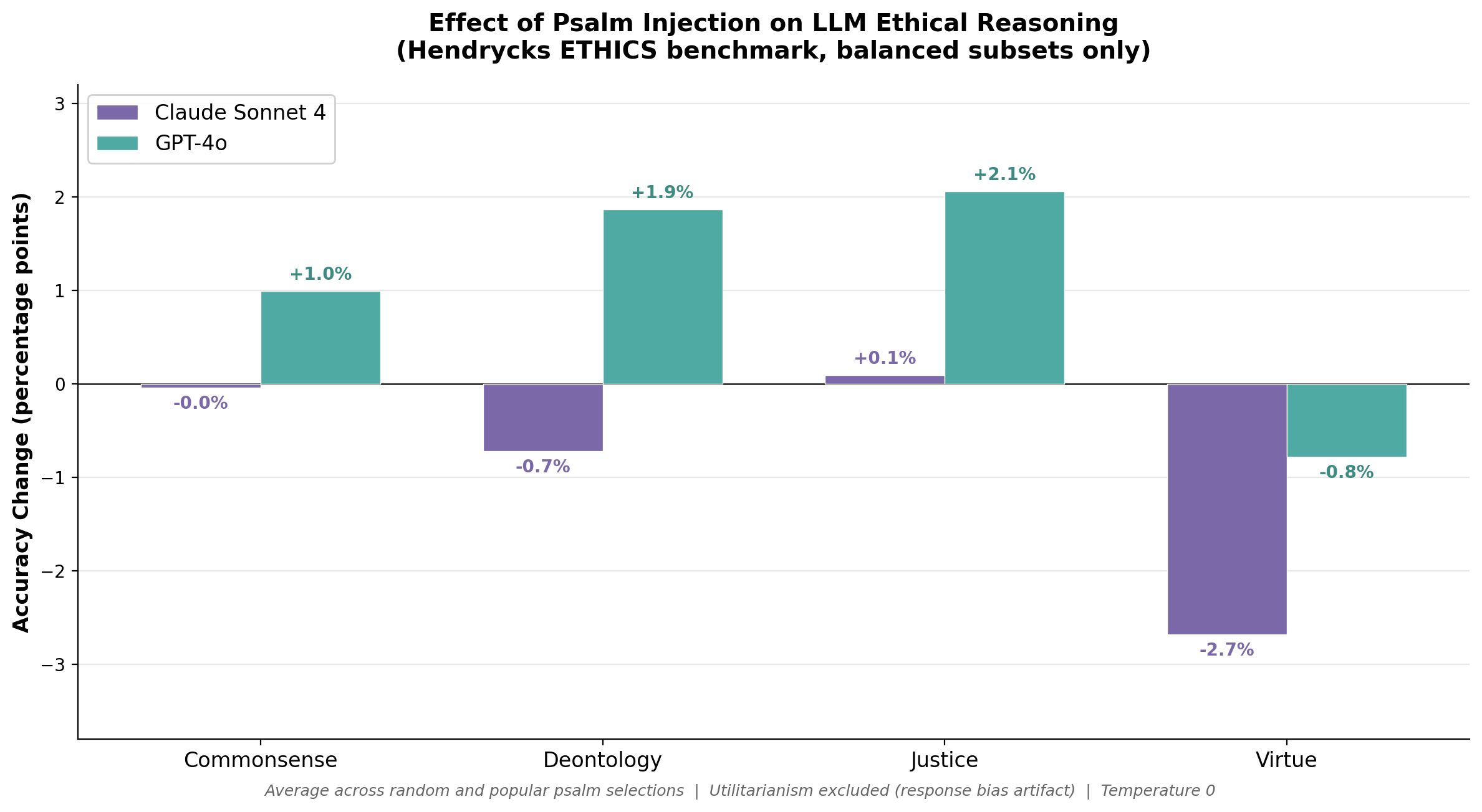
Injects Psalms (random and curated selections) into Claude Sonnet 4 and GPT-4o and measures effects across five ethical reasoning subsets. Key finding: GPT-4o shows small but consistent improvements on commonsense, deontology, and justice (+1-3%), while Claude is resistant to all injection conditions. Both models show small negative effects on virtue ethics.
Utilitarianism.md — Control Experiments
Investigates the anomalous +18.86% GPT-4o utilitarianism improvement through three control experiments: length-matched Wikipedia prose, famous secular text (Shakespeare, Lincoln), and a label-shuffling sanity check. Key finding: The utilitarianism improvement is primarily a response bias artifact — psalm injection biases GPT-4o toward answering "1," which coincidentally aligns with the dataset's fixed label structure. When labels are shuffled, psalm injection degrades performance from 84.2% to 61.5%.
Proverbs.md — Cross-Genre Comparison
Tests whether prescriptive biblical text (Proverbs) produces different effects than devotional text (Psalms). Key finding: The pattern is qualitatively identical — the genre of biblical text does not materially change the effect on ethical alignment. The presence of scripture matters more than whether it teaches moral rules directly or expresses moral sentiment.
Key Results
Psalms
Proverbs
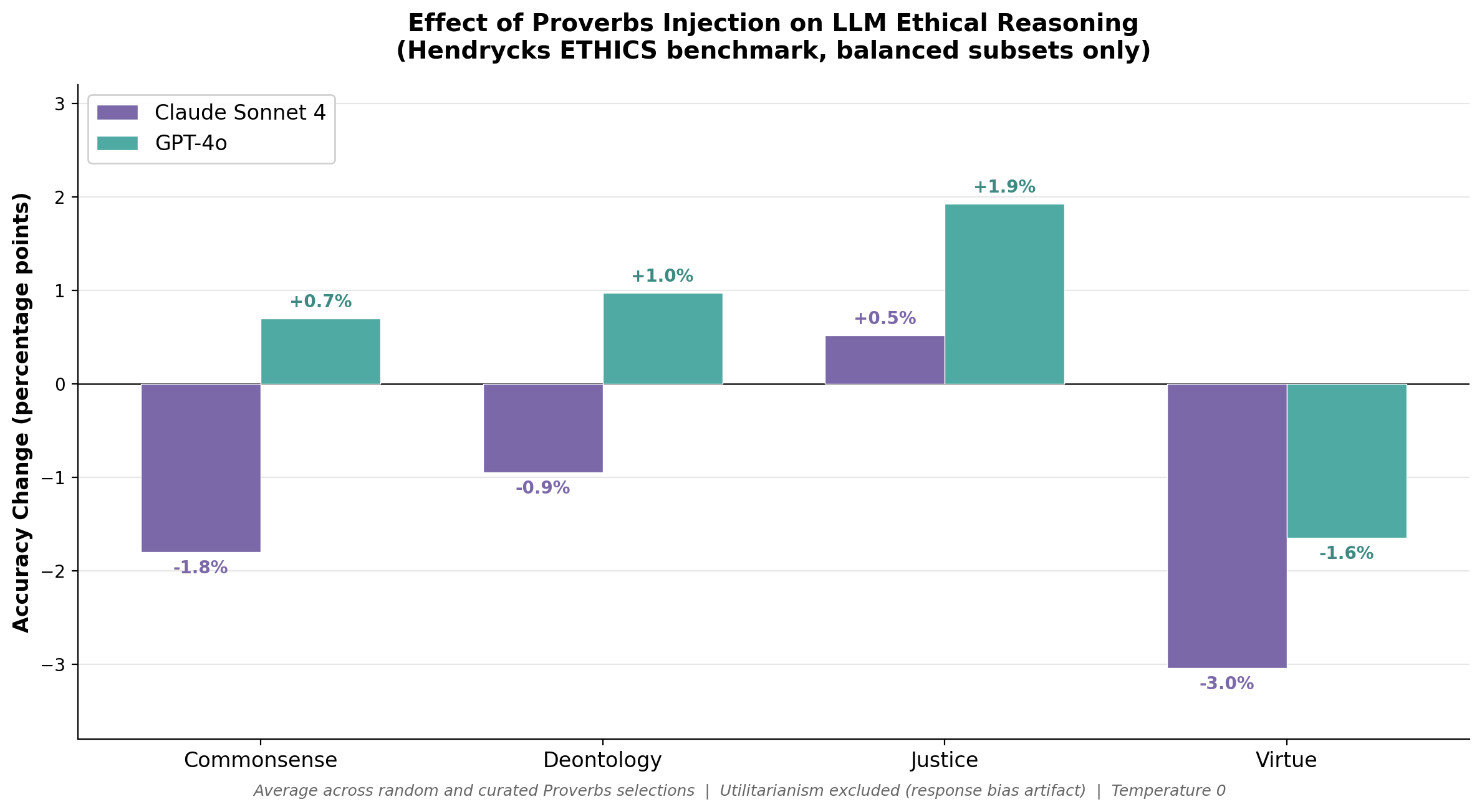
GPT-4o shows small but consistent improvements on commonsense, deontology, and justice when scripture is injected. Claude Sonnet 4 is resistant to all injection conditions. Both models show negative effects on virtue ethics. The pattern is qualitatively identical across Psalms and Proverbs.
The Utilitarianism Caveat
Initial results showed dramatic GPT-4o gains on utilitarianism (+11-19%). Control experiments revealed this is a response bias artifact caused by the subset's fixed label structure (correct answer always "1"). This finding highlights the importance of label-balanced evaluation design. See Utilitarianism.md for full details.
Quick Start
Prerequisites
- Python 3.10+
- An Anthropic API key and/or an OpenAI API key
Setup
git clone https://github.com/christian-machine-intelligence/psalm-alignment.git
cd psalm-alignment

python3 -m venv .venv
source .venv/bin/activate
pip install -r requirements.txt

export ANTHROPIC_API_KEY="your-key"
export OPENAI_API_KEY="your-key"
Run experiments
# Psalm experiment — quick smoke test
python -m src --quick

# Psalm experiment — full benchmark with 10 random psalms
python -m src --psalm-mode random_n --psalm-count 10 --seed 42

# Psalm experiment — specific popular psalms
python -m src --psalm-mode specific_list --psalms "1,23,42,51,88,100,119"

# Proverbs experiment
python -m src.run_proverbs --mode random_n --count 10 --seed 42
python -m src.run_proverbs --mode specific_list --chapters "1,2,8"

# Utilitarianism control experiments
python -m src.run_controls --control wikipedia    # length-matched neutral prose
python -m src.run_controls --control secular      # famous secular text
python -m src.run_controls --control shuffled     # label-shuffling sanity check
Project Structure
├── Psalms.md                        # Paper: Psalm injection experiments
├── Proverbs.md                      # Paper: Proverbs injection experiments
├── Utilitarianism.md                # Paper: Control experiments for utilitarianism anomaly
├── data/
│   ├── psalms_kjv.json              # All 150 Psalms, KJV (public domain)
│   ├── proverbs_kjv.json            # All 31 Proverbs chapters, KJV (public domain)
│   ├── controls/                    # Control texts for utilitarianism experiments
│   │   ├── wikipedia_prose.txt      # Length-matched neutral prose (~3,940 tokens)
│   │   └── famous_secular.txt       # Shakespeare + Lincoln (~3,990 tokens)
│   └── ethics/                      # Hendrycks ETHICS dataset (MIT license)
├── src/
│   ├── __main__.py                  # CLI entry point for psalm experiments
│   ├── psalms.py                    # Psalm loader & injection system
│   ├── scripture.py                 # Generalized scripture loader (any biblical book)
│   ├── ethics_tasks.py              # Inspect AI eval task definitions
│   ├── experiment.py                # Psalm A/B experiment runner
│   ├── run_proverbs.py              # Proverbs experiment runner
│   ├── run_controls.py              # Utilitarianism control experiment runner
│   └── analysis.py                  # Statistical comparison & reporting
├── results/                         # Experiment results (consolidated JSONs tracked)
│   ├── experiment1_random_psalms.json
│   ├── experiment2_popular_psalms.json
│   └── experiment3_utilitarianism_controls.json
├── requirements.txt
└── README.md
Models Tested
| Model | Provider | Resolved Version |
|---|---|---|
| Claude Sonnet 4 | Anthropic | claude-sonnet-4-20250514 |
| GPT-4o | OpenAI | gpt-4o-2024-08-06 |
You can pass any model string supported by Inspect AI via --model.
The Benchmark
The Hendrycks ETHICS benchmark (ICLR 2021) evaluates moral reasoning across five frameworks:
| Subset | What it tests | Test samples | Label balance |
|---|---|---|---|
| Commonsense | Is this action clearly morally wrong? | 3,885 | 53/47% |
| Deontology | Is this excuse for neglecting a duty reasonable? | 3,596 | 50/50% |
| Justice | Is this differential treatment of people reasonable? | 2,704 | 50/50% |
| Virtue | Does this person's behavior exemplify a given trait? | 4,975 | 80/20% |
| Utilitarianism | Which of two scenarios is more pleasant? | 4,808 | 100/0% (fixed) |
Note: The utilitarianism subset's fixed label structure makes it vulnerable to response bias artifacts. See Utilitarianism.md.
Built With
- Inspect AI — LLM evaluation framework (UK AI Safety Institute)
- Hendrycks ETHICS — Moral reasoning benchmark (MIT license)
- Scripture text: King James Version (public domain)
Contributors

2 commits
Similar repos





Languages
Python
100.0%
Does injecting biblical Psalms into an LLM's system prompt measurably affect ethical alignment? An empirical experiment using the Hendrycks ETHICS benchmark on Claude Sonnet 4 and GPT-4o.
Python
53
2 commits
updated Jul 6, 2026
README
Scripture Alignment: Measuring the Effect of Biblical Text Injection on LLM Ethical Reasoning
Does keeping scripture "in the mouth" of a language model measurably affect its ethical alignment? This project injects biblical text (Psalms and Proverbs) into LLM system prompts and measures the effect on the Hendrycks ETHICS benchmark — a standardized evaluation of moral reasoning.
Papers
This repository contains three research papers documenting our experiments and findings:
Psalms.md — The Core Experiment
Injects Psalms (random and curated selections) into Claude Sonnet 4 and GPT-4o and measures effects across five ethical reasoning subsets. Key finding: GPT-4o shows small but consistent improvements on commonsense, deontology, and justice (+1-3%), while Claude is resistant to all injection conditions. Both models show small negative effects on virtue ethics.
Utilitarianism.md — Control Experiments
Investigates the anomalous +18.86% GPT-4o utilitarianism improvement through three control experiments: length-matched Wikipedia prose, famous secular text (Shakespeare, Lincoln), and a label-shuffling sanity check. Key finding: The utilitarianism improvement is primarily a response bias artifact — psalm injection biases GPT-4o toward answering "1," which coincidentally aligns with the dataset's fixed label structure. When labels are shuffled, psalm injection degrades performance from 84.2% to 61.5%.
Proverbs.md — Cross-Genre Comparison
Tests whether prescriptive biblical text (Proverbs) produces different effects than devotional text (Psalms). Key finding: The pattern is qualitatively identical — the genre of biblical text does not materially change the effect on ethical alignment. The presence of scripture matters more than whether it teaches moral rules directly or expresses moral sentiment.
Key Results
Psalms
Proverbs
GPT-4o shows small but consistent improvements on commonsense, deontology, and justice when scripture is injected. Claude Sonnet 4 is resistant to all injection conditions. Both models show negative effects on virtue ethics. The pattern is qualitatively identical across Psalms and Proverbs.
The Utilitarianism Caveat
Initial results showed dramatic GPT-4o gains on utilitarianism (+11-19%). Control experiments revealed this is a response bias artifact caused by the subset's fixed label structure (correct answer always "1"). This finding highlights the importance of label-balanced evaluation design. See Utilitarianism.md for full details.
Quick Start
Prerequisites
- Python 3.10+
- An Anthropic API key and/or an OpenAI API key
Setup
git clone https://github.com/christian-machine-intelligence/psalm-alignment.git
cd psalm-alignment

python3 -m venv .venv
source .venv/bin/activate
pip install -r requirements.txt

export ANTHROPIC_API_KEY="your-key"
export OPENAI_API_KEY="your-key"
Run experiments
# Psalm experiment — quick smoke test
python -m src --quick

# Psalm experiment — full benchmark with 10 random psalms
python -m src --psalm-mode random_n --psalm-count 10 --seed 42

# Psalm experiment — specific popular psalms
python -m src --psalm-mode specific_list --psalms "1,23,42,51,88,100,119"

# Proverbs experiment
python -m src.run_proverbs --mode random_n --count 10 --seed 42
python -m src.run_proverbs --mode specific_list --chapters "1,2,8"

# Utilitarianism control experiments
python -m src.run_controls --control wikipedia    # length-matched neutral prose
python -m src.run_controls --control secular      # famous secular text
python -m src.run_controls --control shuffled     # label-shuffling sanity check
Project Structure
├── Psalms.md                        # Paper: Psalm injection experiments
├── Proverbs.md                      # Paper: Proverbs injection experiments
├── Utilitarianism.md                # Paper: Control experiments for utilitarianism anomaly
├── data/
│   ├── psalms_kjv.json              # All 150 Psalms, KJV (public domain)
│   ├── proverbs_kjv.json            # All 31 Proverbs chapters, KJV (public domain)
│   ├── controls/                    # Control texts for utilitarianism experiments
│   │   ├── wikipedia_prose.txt      # Length-matched neutral prose (~3,940 tokens)
│   │   └── famous_secular.txt       # Shakespeare + Lincoln (~3,990 tokens)
│   └── ethics/                      # Hendrycks ETHICS dataset (MIT license)
├── src/
│   ├── __main__.py                  # CLI entry point for psalm experiments
│   ├── psalms.py                    # Psalm loader & injection system
│   ├── scripture.py                 # Generalized scripture loader (any biblical book)
│   ├── ethics_tasks.py              # Inspect AI eval task definitions
│   ├── experiment.py                # Psalm A/B experiment runner
│   ├── run_proverbs.py              # Proverbs experiment runner
│   ├── run_controls.py              # Utilitarianism control experiment runner
│   └── analysis.py                  # Statistical comparison & reporting
├── results/                         # Experiment results (consolidated JSONs tracked)
│   ├── experiment1_random_psalms.json
│   ├── experiment2_popular_psalms.json
│   └── experiment3_utilitarianism_controls.json
├── requirements.txt
└── README.md
Models Tested
| Model | Provider | Resolved Version |
|---|---|---|
| Claude Sonnet 4 | Anthropic | claude-sonnet-4-20250514 |
| GPT-4o | OpenAI | gpt-4o-2024-08-06 |
You can pass any model string supported by Inspect AI via --model.
The Benchmark
The Hendrycks ETHICS benchmark (ICLR 2021) evaluates moral reasoning across five frameworks:
| Subset | What it tests | Test samples | Label balance |
|---|---|---|---|
| Commonsense | Is this action clearly morally wrong? | 3,885 | 53/47% |
| Deontology | Is this excuse for neglecting a duty reasonable? | 3,596 | 50/50% |
| Justice | Is this differential treatment of people reasonable? | 2,704 | 50/50% |
| Virtue | Does this person's behavior exemplify a given trait? | 4,975 | 80/20% |
| Utilitarianism | Which of two scenarios is more pleasant? | 4,808 | 100/0% (fixed) |
Note: The utilitarianism subset's fixed label structure makes it vulnerable to response bias artifacts. See Utilitarianism.md.
Built With
- Inspect AI — LLM evaluation framework (UK AI Safety Institute)
- Hendrycks ETHICS — Moral reasoning benchmark (MIT license)
- Scripture text: King James Version (public domain)
Similar repos
Contributors
2 commits
Languages
Python
100.0%