
README
EthosLM
One sentence in, a finished place out. Type "Build a walled town with a market and a keep," or "Build a fishing village," and a complete settlement gets planned, placed, built and checked inside a Minecraft world, with no person involved at any step. You give no coordinates, no size and no style, and you answer no follow-up questions. Nothing is left for you to fix afterwards. The system picks where to build, how big to make it, what palette of blocks to use, and lays every block itself.
What this project delivers is the architecture behind that. It is general. The towns it builds are tests of the architecture, not the product.
Why Minecraft
Minecraft is predictable and built from whole units: a fixed set of blocks, a grid of round numbers, known physics, and lighting you can work out in advance. Everything that normally makes 3D modelling hard, like curved surfaces, texture mapping, materials and shading, does not exist here. What is left is deciding which block goes where, and that is the real problem.
How it works
The model writes the plan, the library does the building. A model reads your sentence and the shape of the ground, then writes short programs that call a building library. The library turns those programs into blocks. The model decides what: the location, the layout, the kinds of buildings, the palette. The library decides how: every physical rule, and the buildings themselves.
A bug stays fixed once the library owns it. If the library builds something correctly every time, that kind of bug can never come back. If you only check for it afterwards, it keeps returning. Stair direction, doors, entrances, indoor staircases, building on uneven ground, water, outer walls, the monument, and the route up to an upper floor were all repeat offenders until the library took charge of them, and none has come back since. The library grows by admitting what it cannot do yet, and that becomes the next thing to add.
A place is a tree of parts, and a type is a shape. A plan is a hierarchy: a city holds rings, rings hold districts, districts hold plots. Walls are the edges, gates are the openings, and squares and fields are the open areas. Every leaf of that tree is an instance of a type, which is a generator for one kind of part. You write a type once, test it across different random seeds, sizes, ground and palettes, and after that you can place it anywhere for free. A type states what ground it needs and what it is for, but never names a material. It takes its palette from the settlement's voice. A monument is not simply a large type. It is a place in its own right, planned recursively into halls, courtyards, an inner wall and gates, which is also how a castle works.
The builder can check its own work, and the library is verified offline. Every call the model makes carries the real checker with it: the linter and the walking model, running on the actual cached ground. The model can run that checker as often as it likes before it finishes. The library itself is verified with no model involved: a hand-written reference type is built across a bank of saved ground, producing hundreds of buildings in a few minutes and making zero model calls. Model calls are for questions about the model, never for finding a bug in the library.
Two ways of reviewing, and neither gives a score. Automatic checks catch what is broken, never what is ugly, and they are a fixed minimum standard. Separately, a judge compares two builds side by side, without being told which is which or which came first, and says which one is better made. Only a person decides whether something is good, and that is a diagnosis of what the checks cannot see. It is never a stage in the automated loop.
The harness is predictable, and only the content varies. A run is one config file and
one command. Every stage, camera angle, decision and record is code. A --dry-run builds
the whole place in memory with no server, so "prove it before you write it" is a rule a run
can actually follow.
Where it stands
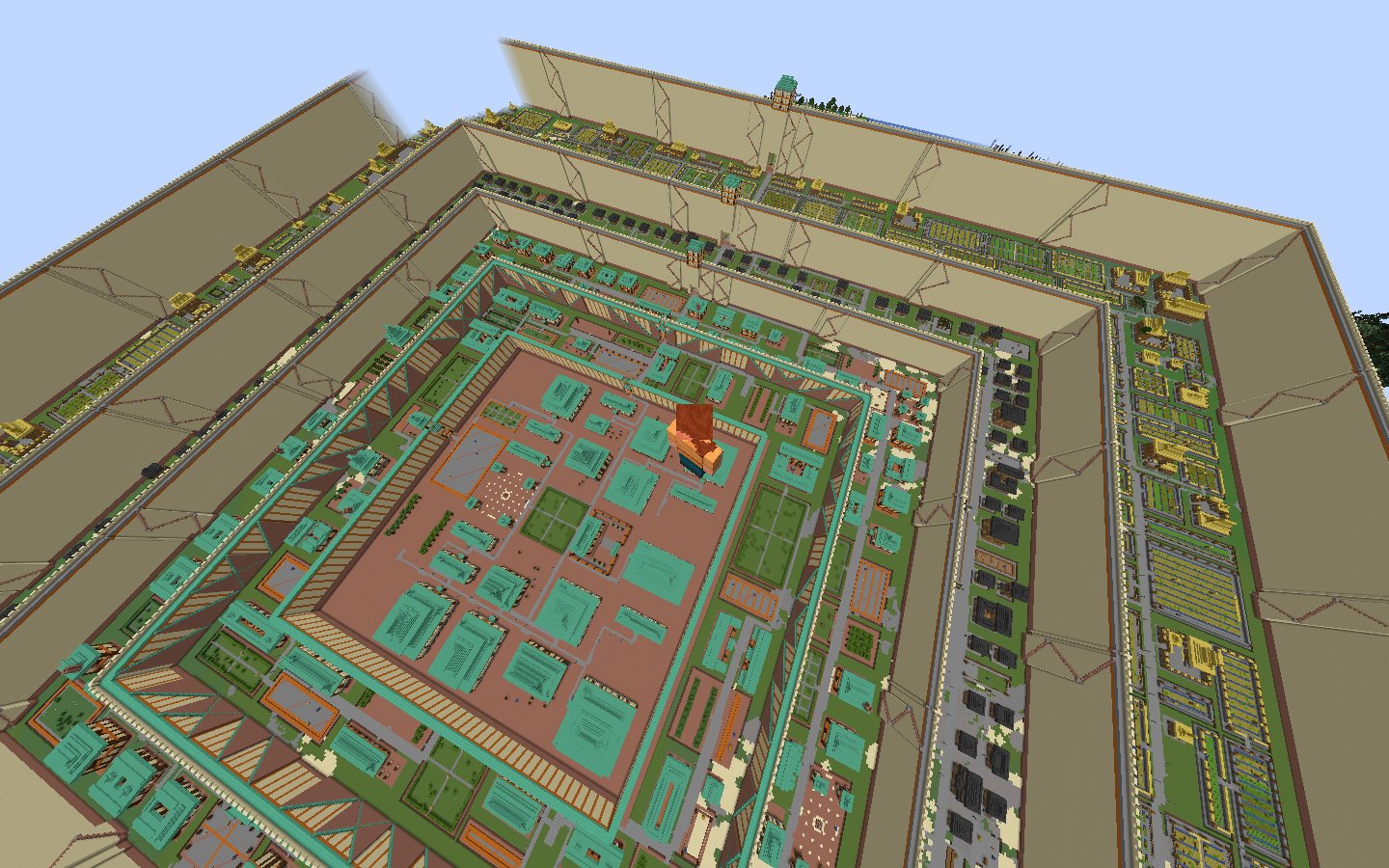
A city now stands, built from a single sentence: concentric ring walls, gates, buildings that get denser as you move from the farmland to the wealthy centre, a grand palace district, all on green ground the system chose, in a palette it wrote itself. It is built, checked, walkable and rendered. What is left is polish.
Layout
src/ethoslm/  the library, linter, walk model, judge, deterministic preview and the
                  model adapter; pipeline/ holds the staged driver (plan, build,
                  measure, media, and the seam where authoring is blinded)
types/            one file per kind of part: FORM, ROLE, KIND, PARAMS, NEEDS and
                  build(b, part, seed, **params). A part arrives already placed,
                  carrying the settlement's palette; a type names neither ground
                  nor material
voices/           one JSON per style: material roles, roof shape, prose for the
                  brief. Checked on load; the model can write one from a sentence
rounds/           one JSON per run: the input, the flags, and the thresholds that were
                  registered before it ran
scripts/          round.py (run a config), check_types.py, type_needs.py,
                  terrain_bank.py, test_*.py (the offline suites), server scripts
fixtures/         cached worlds and saved plans that the offline tools rely on
out/, run/        renders, caches, worlds, server. Never committed
Running it
Linux or macOS, Python 3.12 or newer. On Windows, use WSL. On NixOS only, see Native libraries at the end.
python3 -m venv .venv
.venv/bin/python -m pip install -r requirements.txt
.venv/bin/python -m pip install --no-deps gdpc==8.1.0   # see requirements.txt
source scripts/env.sh
The offline suites. No server, no model, no key. Every suite that writes blocks says so and skips.
for t in scripts/test_*.py; do "$PY" "$t" || echo "FAILED $t"; done
A place, built offline from a world we ship. A saved plan on a cached world that comes with the repository: placed, built out of the committed types, linted, with no server and no model call anywhere in it. About three minutes.
"$PY" scripts/round.py rounds/example.json --dry-run --stage parts,finish,lint
A place from a sentence. rounds/town.json is one sentence and nothing else, with no
coordinate, no size and no palette. This one calls a model, so read Models first.
"$PY" scripts/round.py rounds/town.json --dry-run                  # no server
bash scripts/mcrun.sh scripts/round.py rounds/town.json --live --wait
Models. By default, every call to the model is handed to a supervising agent, which is
how all of the development work was done: the run stops, writes the request to disk, and
carries on once an answer is there. To run it without supervision, models.json maps each
role to a model. The roles are the place spec, the planner, type authoring, revision and the
vision judge. model.py speaks both the Anthropic and the OpenAI-compatible wire formats,
so any hosted provider or local server works. Set ETHOSLM_MODEL_API and a key, or override
a single role with ETHOSLM_MODEL_<ROLE>.
The pipeline runs Python that a model wrote. That is the design, since the model writes programs against the library, but it does mean a run executes model-written code in your process and on your file system. Run it somewhere that is acceptable: a container, a throwaway user account, or a virtual machine.
A server. The live path needs Minecraft with the GDMC-HTTP mod on localhost:9000
(Fabric or NeoForge, GDMC-HTTP 1.8.4, WorldEdit 7.4.2, Minecraft 1.21.11). scripts/mcrun.sh
runs one session: server up, build, flush to disk, server down. Nothing offline needs it.
Native libraries (NixOS only). Put the store paths in an untracked .env (NIX_GLIBC,
NIX_GCCLIB, NIX_ZLIB) so the wheels can find them. Everywhere else the system supplies
them. ETHOSLM_LIBRARY_PATH, ETHOSLM_PYTHON and ETHOSLM_JAVA override the rest.
Licence
MIT. See LICENSE.
Contributors

2 commits
See what people are saying
Similar repos


Languages
Python
99.7%
README
EthosLM
One sentence in, a finished place out. Type "Build a walled town with a market and a keep," or "Build a fishing village," and a complete settlement gets planned, placed, built and checked inside a Minecraft world, with no person involved at any step. You give no coordinates, no size and no style, and you answer no follow-up questions. Nothing is left for you to fix afterwards. The system picks where to build, how big to make it, what palette of blocks to use, and lays every block itself.
What this project delivers is the architecture behind that. It is general. The towns it builds are tests of the architecture, not the product.
Why Minecraft
Minecraft is predictable and built from whole units: a fixed set of blocks, a grid of round numbers, known physics, and lighting you can work out in advance. Everything that normally makes 3D modelling hard, like curved surfaces, texture mapping, materials and shading, does not exist here. What is left is deciding which block goes where, and that is the real problem.
How it works
The model writes the plan, the library does the building. A model reads your sentence and the shape of the ground, then writes short programs that call a building library. The library turns those programs into blocks. The model decides what: the location, the layout, the kinds of buildings, the palette. The library decides how: every physical rule, and the buildings themselves.
A bug stays fixed once the library owns it. If the library builds something correctly every time, that kind of bug can never come back. If you only check for it afterwards, it keeps returning. Stair direction, doors, entrances, indoor staircases, building on uneven ground, water, outer walls, the monument, and the route up to an upper floor were all repeat offenders until the library took charge of them, and none has come back since. The library grows by admitting what it cannot do yet, and that becomes the next thing to add.
A place is a tree of parts, and a type is a shape. A plan is a hierarchy: a city holds rings, rings hold districts, districts hold plots. Walls are the edges, gates are the openings, and squares and fields are the open areas. Every leaf of that tree is an instance of a type, which is a generator for one kind of part. You write a type once, test it across different random seeds, sizes, ground and palettes, and after that you can place it anywhere for free. A type states what ground it needs and what it is for, but never names a material. It takes its palette from the settlement's voice. A monument is not simply a large type. It is a place in its own right, planned recursively into halls, courtyards, an inner wall and gates, which is also how a castle works.
The builder can check its own work, and the library is verified offline. Every call the model makes carries the real checker with it: the linter and the walking model, running on the actual cached ground. The model can run that checker as often as it likes before it finishes. The library itself is verified with no model involved: a hand-written reference type is built across a bank of saved ground, producing hundreds of buildings in a few minutes and making zero model calls. Model calls are for questions about the model, never for finding a bug in the library.
Two ways of reviewing, and neither gives a score. Automatic checks catch what is broken, never what is ugly, and they are a fixed minimum standard. Separately, a judge compares two builds side by side, without being told which is which or which came first, and says which one is better made. Only a person decides whether something is good, and that is a diagnosis of what the checks cannot see. It is never a stage in the automated loop.
The harness is predictable, and only the content varies. A run is one config file and
one command. Every stage, camera angle, decision and record is code. A --dry-run builds
the whole place in memory with no server, so "prove it before you write it" is a rule a run
can actually follow.
Where it stands
A city now stands, built from a single sentence: concentric ring walls, gates, buildings that get denser as you move from the farmland to the wealthy centre, a grand palace district, all on green ground the system chose, in a palette it wrote itself. It is built, checked, walkable and rendered. What is left is polish.
Layout
src/ethoslm/  the library, linter, walk model, judge, deterministic preview and the
                  model adapter; pipeline/ holds the staged driver (plan, build,
                  measure, media, and the seam where authoring is blinded)
types/            one file per kind of part: FORM, ROLE, KIND, PARAMS, NEEDS and
                  build(b, part, seed, **params). A part arrives already placed,
                  carrying the settlement's palette; a type names neither ground
                  nor material
voices/           one JSON per style: material roles, roof shape, prose for the
                  brief. Checked on load; the model can write one from a sentence
rounds/           one JSON per run: the input, the flags, and the thresholds that were
                  registered before it ran
scripts/          round.py (run a config), check_types.py, type_needs.py,
                  terrain_bank.py, test_*.py (the offline suites), server scripts
fixtures/         cached worlds and saved plans that the offline tools rely on
out/, run/        renders, caches, worlds, server. Never committed
Running it
Linux or macOS, Python 3.12 or newer. On Windows, use WSL. On NixOS only, see Native libraries at the end.
python3 -m venv .venv
.venv/bin/python -m pip install -r requirements.txt
.venv/bin/python -m pip install --no-deps gdpc==8.1.0   # see requirements.txt
source scripts/env.sh
The offline suites. No server, no model, no key. Every suite that writes blocks says so and skips.
for t in scripts/test_*.py; do "$PY" "$t" || echo "FAILED $t"; done
A place, built offline from a world we ship. A saved plan on a cached world that comes with the repository: placed, built out of the committed types, linted, with no server and no model call anywhere in it. About three minutes.
"$PY" scripts/round.py rounds/example.json --dry-run --stage parts,finish,lint
A place from a sentence. rounds/town.json is one sentence and nothing else, with no
coordinate, no size and no palette. This one calls a model, so read Models first.
"$PY" scripts/round.py rounds/town.json --dry-run                  # no server
bash scripts/mcrun.sh scripts/round.py rounds/town.json --live --wait
Models. By default, every call to the model is handed to a supervising agent, which is
how all of the development work was done: the run stops, writes the request to disk, and
carries on once an answer is there. To run it without supervision, models.json maps each
role to a model. The roles are the place spec, the planner, type authoring, revision and the
vision judge. model.py speaks both the Anthropic and the OpenAI-compatible wire formats,
so any hosted provider or local server works. Set ETHOSLM_MODEL_API and a key, or override
a single role with ETHOSLM_MODEL_<ROLE>.
The pipeline runs Python that a model wrote. That is the design, since the model writes programs against the library, but it does mean a run executes model-written code in your process and on your file system. Run it somewhere that is acceptable: a container, a throwaway user account, or a virtual machine.
A server. The live path needs Minecraft with the GDMC-HTTP mod on localhost:9000
(Fabric or NeoForge, GDMC-HTTP 1.8.4, WorldEdit 7.4.2, Minecraft 1.21.11). scripts/mcrun.sh
runs one session: server up, build, flush to disk, server down. Nothing offline needs it.
Native libraries (NixOS only). Put the store paths in an untracked .env (NIX_GLIBC,
NIX_GCCLIB, NIX_ZLIB) so the wheels can find them. Everywhere else the system supplies
them. ETHOSLM_LIBRARY_PATH, ETHOSLM_PYTHON and ETHOSLM_JAVA override the rest.
Licence
MIT. See LICENSE.
See what people are saying
Similar repos
Contributors
2 commits
Languages
Python
99.7%