A single Bash script to create blogs. Download, run, write, done!
Shell
1,931
215 commits
updated Jul 9, 2026
A single Bash script to create blogs.
I created it because I wanted a very, very simple way to post entries to a blog by using a public folder on my server, without any special requirements and dependencies. Works on GNU/Linux, OSX and BSD.
How simple? Just type ./bb.sh post and start writing your blogpost.

You can see a sample here: read the initial blog post. That page was 100% generated using bashblog, no additional tweaking.
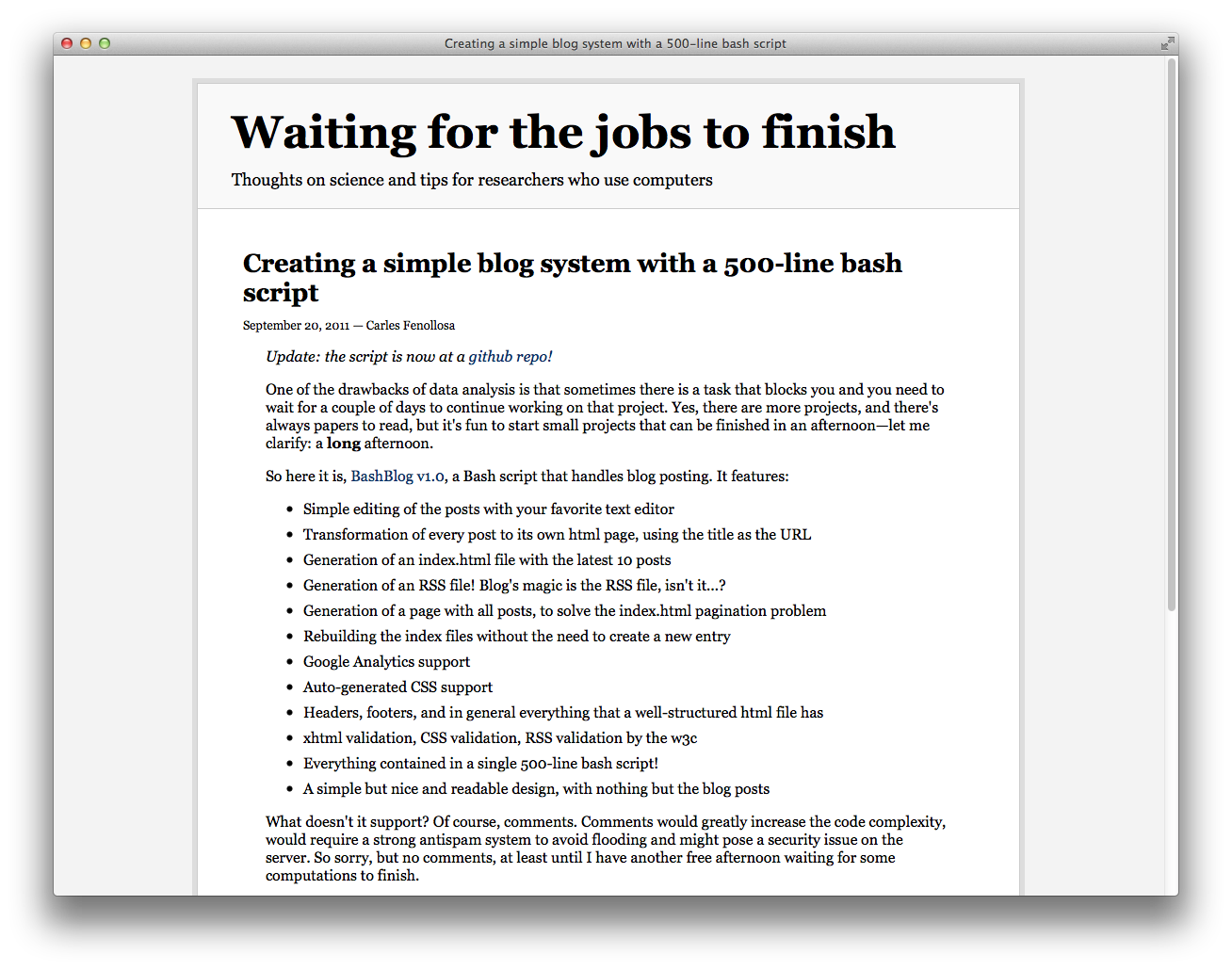
Check out other bashblog users
Download the code and copy bb.sh into a public folder (for example, $HOME/public_html/blog) and run
./bb.sh
This will show the available commands. If the file is not executable, type chmod +x bb.sh and retry.
Before creating your first post, you may want to configure the blog settings (title, author, etc). Read the Configuration section below for more information
To create your first post, just run:
./bb.sh post
It will try to use Markdown, if installed. To force HTML:
./bb.sh post -html
The script will handle the rest.
When you're done, access the public URL for that folder (e.g. http://server.com/~username/blog)
and you should see the index file and a new page for that post!
Please read the wiki to learn how to use the advanced features of Bashblog, such as headers and footers, static pages, and more.
bb.sh and start blogging.date, basename, grep, sed, head, etc)coreutils on a Mac.
It does some magic to autodetect which command switches it needs to run depending on your system.ftpfs and run this script locallyConfiguration is not required for a test drive, but if you plan on running your blog with bashblog, you will want to change the default titles, author names, etc, to match your own.
There are two ways to configure the blog strings:
bb.sh and modify the variables in the global_variables() function.config file with your configuration values -- useful if you don't want to touch the script and be able to update it regularly with gitThe software will load the values in the script first, then overwrite them with the values in the .config file.
This means that you don't need to define all variables in the config file, only those which you need to override
from the defaults.
The format of the .config file is just one variablename="value" per line, just like in the global_variables()
function. Please remember: quote the values, do not declare a variable with the dollar sign, do not use
spaces around the equal sign.
bashblog uses the $EDITOR environment value to open the text editor.
.backup.tar.gz)Read the Changelog section for more updates or check out the news on my blog
Important: I am not actively maintaining bashblog as of 2026-07-09. It still works (that was the point all along!) I will fix bugs I find myself, but there are no features on the roadmap. Feel free to fork the project and adapt it to your needs.
Bashblog started at 500 SLOC and it now has hit the 1000 SLOC barrier. If we want to keep the code minimal and understandable, we need to make the difficult effort to restrain ourselves from adding too many features.
All bugfixes are welcome, but brand new features need to be strongly justified to get into the main tree. Every new request will be honestly and civilly discussed on the comments. As a guideline, pull requests should:
create_html_file() or write_entry(), etc)date or grep)global_twitter_card_imagebody_begin_file_index.config for each onetemplate_tags_posts_singularThis program is free software: you can redistribute it and/or modify it under the terms of the GNU General Public License as published by the Free Software Foundation, either version 3 of the License, or (at your option) any later version.
This program is distributed in the hope that it will be useful, but WITHOUT ANY WARRANTY; without even the implied warranty of MERCHANTABILITY or FITNESS FOR A PARTICULAR PURPOSE. See the GNU General Public License for more details.
You should have received a copy of the GNU General Public License along with this program. If not, see http://www.gnu.org/licenses/.
3,475 followers · starred Apr 2026
318 followers · starred Oct 2020
101 followers · starred Apr 2022
174 followers · starred Jul 2026
A single Bash script to create blogs. Download, run, write, done!
Shell
1,931
215 commits
updated Jul 9, 2026
A single Bash script to create blogs.
I created it because I wanted a very, very simple way to post entries to a blog by using a public folder on my server, without any special requirements and dependencies. Works on GNU/Linux, OSX and BSD.
How simple? Just type ./bb.sh post and start writing your blogpost.
You can see a sample here: read the initial blog post. That page was 100% generated using bashblog, no additional tweaking.
Check out other bashblog users
Download the code and copy bb.sh into a public folder (for example, $HOME/public_html/blog) and run
./bb.sh
This will show the available commands. If the file is not executable, type chmod +x bb.sh and retry.
Before creating your first post, you may want to configure the blog settings (title, author, etc). Read the Configuration section below for more information
To create your first post, just run:
./bb.sh post
It will try to use Markdown, if installed. To force HTML:
./bb.sh post -html
The script will handle the rest.
When you're done, access the public URL for that folder (e.g. http://server.com/~username/blog)
and you should see the index file and a new page for that post!
Please read the wiki to learn how to use the advanced features of Bashblog, such as headers and footers, static pages, and more.
bb.sh and start blogging.date, basename, grep, sed, head, etc)coreutils on a Mac.
It does some magic to autodetect which command switches it needs to run depending on your system.ftpfs and run this script locallyConfiguration is not required for a test drive, but if you plan on running your blog with bashblog, you will want to change the default titles, author names, etc, to match your own.
There are two ways to configure the blog strings:
bb.sh and modify the variables in the global_variables() function.config file with your configuration values -- useful if you don't want to touch the script and be able to update it regularly with gitThe software will load the values in the script first, then overwrite them with the values in the .config file.
This means that you don't need to define all variables in the config file, only those which you need to override
from the defaults.
The format of the .config file is just one variablename="value" per line, just like in the global_variables()
function. Please remember: quote the values, do not declare a variable with the dollar sign, do not use
spaces around the equal sign.
bashblog uses the $EDITOR environment value to open the text editor.
.backup.tar.gz)Read the Changelog section for more updates or check out the news on my blog
Important: I am not actively maintaining bashblog as of 2026-07-09. It still works (that was the point all along!) I will fix bugs I find myself, but there are no features on the roadmap. Feel free to fork the project and adapt it to your needs.
Bashblog started at 500 SLOC and it now has hit the 1000 SLOC barrier. If we want to keep the code minimal and understandable, we need to make the difficult effort to restrain ourselves from adding too many features.
All bugfixes are welcome, but brand new features need to be strongly justified to get into the main tree. Every new request will be honestly and civilly discussed on the comments. As a guideline, pull requests should:
create_html_file() or write_entry(), etc)date or grep)global_twitter_card_imagebody_begin_file_index.config for each onetemplate_tags_posts_singularThis program is free software: you can redistribute it and/or modify it under the terms of the GNU General Public License as published by the Free Software Foundation, either version 3 of the License, or (at your option) any later version.
This program is distributed in the hope that it will be useful, but WITHOUT ANY WARRANTY; without even the implied warranty of MERCHANTABILITY or FITNESS FOR A PARTICULAR PURPOSE. See the GNU General Public License for more details.
You should have received a copy of the GNU General Public License along with this program. If not, see http://www.gnu.org/licenses/.
3,475 followers · starred Apr 2026
318 followers · starred Oct 2020
101 followers · starred Apr 2022
174 followers · starred Jul 2026