This is the repository for benchmarking genomic language model on Nullsettes.
See the codeThis repository contains the processed Nullsettes benchmark and reference inference scripts used to evaluate whether genomic language models can distinguish functional synthetic expression cassettes from matched virtual loss-of-function mutants. The benchmark focuses on zero-shot mutation effect prediction in sequences that are functional but evolutionarily implausible.
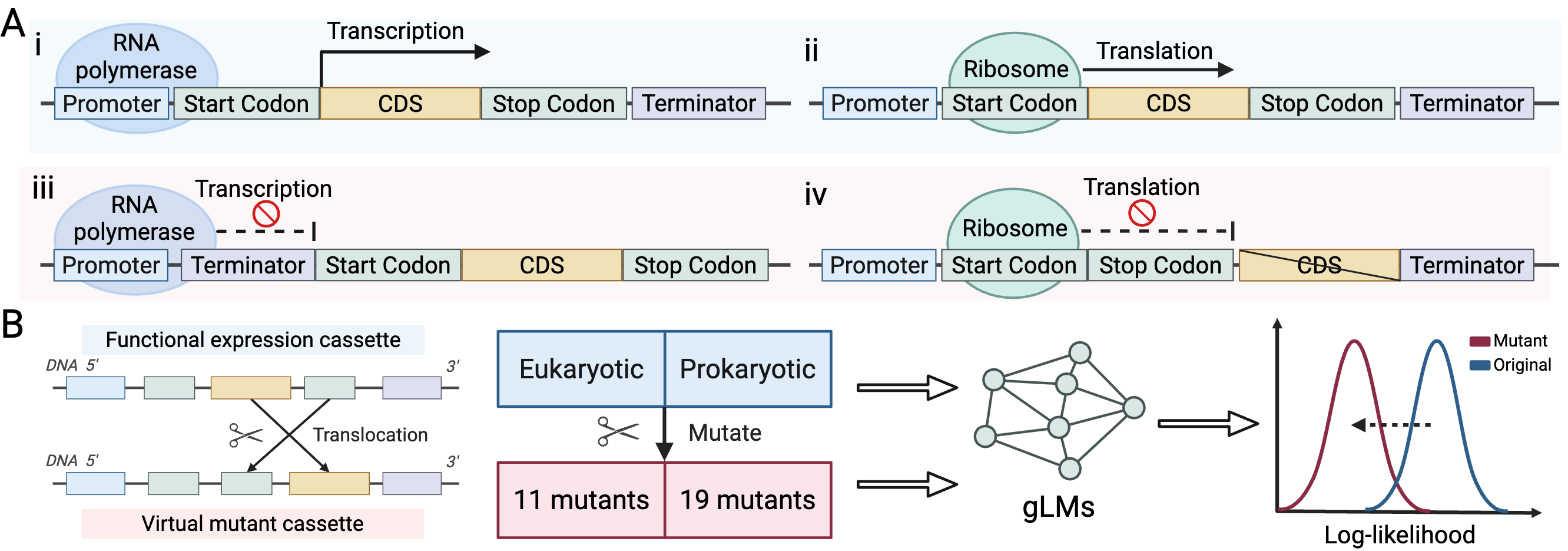
Each benchmark file contains 1,500 sequences. For every dataset, nonmutant.txt stores the original active expression cassettes and each mutant_translocation*.txt file stores the matched Nullsette mutants generated by translocating one key control element. Within a dataset, the FASTA headers and sequence order are preserved across files, so row i in a mutant file is paired with row i in nonmutant.txt for statistical testing.
The current release contains five processed datasets:
| Dataset folder | System | Upstream source | Nonmutant cassettes | Nullsette mutant types | Notes |
|---|---|---|---|---|---|
deboer/Abf1TATA | Yeast | deBoer MPRA library | 1500 | 11 | Abf1TATA is designed by embedding conserved transcription factor binding sites such as Abf1 and a canonical TATA box |
deboer/pTpA | Yeast | deBoer MPRA library | 1500 | 11 | pTpA consists of synthetic promoters constructed with a poly-T–poly-A architecture |
kosuri | E. coli | Kosuri promoter-RBS library | 1500 | 19 | Rationally designed promoter-RBS pairs upstream of sfGFP |
lagator | E. coli | Lagator promoter library | 1500 | 19 | Random promoter sequences upstream of sfGFP |
zahm | Mammalian | Zahm TRE/minimal-promoter library | 1500 | 11 | Human/mouse TREs combined with minimal promoters |
For the benchmark logic itself:
GLM-Nullsette-Benchmark/
|-- README.md
|-- environment.yml
|-- data/
|   |-- processed_data.zip
|   `-- example.txt
|-- database/
|   |-- README.md
|   |-- __init__.py
|   |-- ecoli_kosuri.py
|   |-- ecoli_lagator.py
|   |-- yeast_deboer.py
|   |-- mammlian_zahm.py
|   `-- pkls/
|-- model/
|   |-- alphagenome_infer.py
|   |-- evo1.py
|   |-- genslm.py
|   |-- hyenadna.py
|   |-- metagene1.py
|   |-- NT.py
|   |-- dnabert2.py
|   |-- generator.py
|   `-- utils/
|       |-- ll_calculation.py
|       `-- paired_mutation_test.py
`-- resource/
    `-- schematic.png
Useful starting points:
database/ stores the curated cassette architectures and promoter dictionaries used to build the benchmark.model/hyenadna.py, model/genslm.py, and model/alphagenome_infer.py are the most configurable scoring scripts in the current repository.model/NT.py, model/dnabert2.py, and model/generator.py are lightweight legacy examples that currently use hard-coded paths for a single dataset slice.The shortest end-to-end reproduction path is:
processed_data/ directory.nonmutant and mutant score files with the paired permutation test described below.Example:
conda env create -f environment.yml
conda activate glm_eval
unzip data/processed_data.zip -d .
python model/hyenadna.py \
  --input-root "$PWD/processed_data" \
  --output-root "$PWD/inference_out_csv/HyenaDNA" \
  --model-name LongSafari/hyenadna-large-1m-seqlen-hf \
  --batch-size 1 \
  --device cuda
git clone https://github.com/cellethology/GLM-Nullsette-Benchmark.git
cd GLM-Nullsette-Benchmark
conda env create -f environment.yml
conda activate glm_eval
The processed benchmark sequences used for scoring are distributed as a zip archive to keep the repository lightweight.
unzip data/processed_data.zip -d .
After extraction, the expected input layout is:
processed_data/
|-- deboer/
|   |-- Abf1TATA/
|   |   |-- nonmutant.txt
|   |   |-- mutant_translocation1.txt
|   |   |-- ...
|   |   `-- mutant_translocation11.txt
|   `-- pTpA/
|       |-- nonmutant.txt
|       |-- mutant_translocation1.txt
|       |-- ...
|       `-- mutant_translocation11.txt
|-- kosuri/
|   |-- nonmutant.txt
|   |-- mutant_translocation1.txt
|   |-- ...
|   `-- mutant_translocation19.txt
|-- lagator/
|   |-- nonmutant.txt
|   |-- mutant_translocation1.txt
|   |-- ...
|   `-- mutant_translocation19.txt
`-- zahm/
    |-- nonmutant.txt
    |-- mutant_translocation1.txt
    |-- ...
    `-- mutant_translocation11.txt
Important format details:
.txt, they are standard FASTA files.processed_data/ directory via --input-root.nonmutant and mutant files is preserved by FASTA header and file order.The curated cassette definitions can be imported directly from the database package:
from database import deboer_database, zahm_database, kosuri_database, lagator_database

print(deboer_database["deBoer_cassette"].keys())
print(kosuri_database["kosuri_cassette"].keys())
print(zahm_database["zahm_cassette"].keys())
print(lagator_database["lagator_cassette"].keys())
These dictionaries expose the fixed cassette components such as promoter, RBS, start codon, CDS, stop codon, terminator, and etc.
General notes for all scoring scripts:
seqs and scores.alphagenome_infer.py additionally writes score_region_start and score_region_end when --score-subsequence is used.model/hyenadna.py is a fully parameterized script for zero-shot scoring with Hugging Face HyenaDNA checkpoints.
python model/hyenadna.py \
  --input-root "$PWD/processed_data" \
  --output-root "$PWD/inference_out_csv/HyenaDNA" \
  --model-name LongSafari/hyenadna-large-1m-seqlen-hf \
  --batch-size 1 \
  --device cuda
model/genslm.py expects a local GenSLM source tree and a downloaded checkpoint.
Requirements specific to this script:
./genslm/genslm.--weights-path or via --model-cache-dir.Example:
python model/genslm.py \
  --input-root "$PWD/processed_data" \
  --output-root "$PWD/inference_out_csv/GenSLM" \
  --model-id genslm_2.5B_patric \
  --weights-path /absolute/path/to/patric_2.5b_epoch00_val_los_0.29_bias_removed.pt \
  --batch-size 1 \
  --device cuda
model/alphagenome_infer.py scores sequences with AlphaGenome by averaging predicted RNA-seq activity over a selected region of the input sequence.
Requirements specific to this script:
./alphagenome_research.--checkpoint-path is not supplied, the script downloads the requested checkpoint from Hugging Face.HF_TOKEN in the environment before running the script.--score-subsequence is used to locate the CDS region for scoring.Basic example:
python model/alphagenome_infer.py \
  --input-root "$PWD/processed_data" \
  --output-root "$PWD/inference_out_csv/AlphaGenome" \
  --organism homo_sapiens \
  --use-all-rna-tracks \
  --device gpu
  --score-subsequence ATCG...
Paper-aligned note:
--score-subsequence.database/. If --score-subsequence is omitted, the script averages over the full inserted sequence instead.model/evo1.py scores each FASTA file in an input directory and writes one tab-separated output file per input file.
python model/evo1.py \
  --input_dir "$PWD/processed_data/kosuri" \
  --output_dir "$PWD/inference_out_csv/Evo1/kosuri" \
  --model_name evo-1-131k-base \
  --batch_size 1 \
  --device cuda
This script assumes the upstream Evo package is already installed and importable.
model/metagene1.py runs causal language model scoring on every FASTA file in a dataset directory.
python model/metagene1.py \
  --input_dir "$PWD/processed_data/deboer/Abf1TATA" \
  --output_dir "$PWD/inference_out_csv/METAGENE-1"
The following scripts were kept as minimal single-dataset examples:
They require manual editing of dir_paths and out_root_path if you want to sweep additional datasets.
The repository uses different scoring rules for different model classes:
model/utils/ll_calculation.py as compute_ll_clm.compute_llr_mlm.Because these scores come from different objectives and inference procedures, their absolute values should not be interpreted on a common numerical scale across model families. The benchmark should therefore be evaluated within each model family by comparing mutant scores against their matched nonmutant scores.
The one-sided paired permutation test used in the manuscript is implemented in model/utils/paired_mutation_test.py. For a given model and dataset:
nonmutant.csv.mutant_translocation*.csv.alternative="less" because mutants are expected to receive lower scores than nonmutants.p < 0.05.Minimal example:
from pathlib import Path
import pandas as pd
from model.utils.paired_mutation_test import paired_permutation_test

root = Path("inference_out_csv/HyenaDNA/hyenadna-large-1m-seqlen-hf/kosuri")
wt = pd.read_csv(root / "nonmutant.csv", sep="\t")["scores"].to_numpy()

for mutant_file in sorted(root.glob("mutant_translocation*.csv")):
    mut = pd.read_csv(mutant_file, sep="\t")["scores"].to_numpy()
    p_value = paired_permutation_test(
        wt,
        mut,
        num_permutations=10000,
        alternative="less",
        seed=0,
    )
    print(mutant_file.name, p_value)
This repository distributes processed benchmark-ready inputs. The original upstream resources used to curate the benchmark are:
The manuscript describes the dataset-specific filtering used to select the 1,500 nonmutant cassettes included in this release.
[1] Kosuri, Sriram, et al. "Composability of regulatory sequences controlling transcription and translation in Escherichia coli." Proceedings of the National Academy of Sciences 110.34 (2013): 14024-14029.
[2] Vaishnav, Eeshit Dhaval, et al. "The evolution, evolvability and engineering of gene regulatory DNA." Nature 603.7901 (2022): 455-463.
[3] Zahm, Adam M., et al. "A massively parallel reporter assay library to screen short synthetic promoters in mammalian cells." Nature Communications 15.1 (2024): 10353.
[4] de Boer, Carl G., et al. "Deciphering eukaryotic gene-regulatory logic with 100 million random promoters." Nature Biotechnology 38.1 (2020): 56-65.
We acknowledge the valuable contributions to genomic language modeling made by the authors of the following repositories: Evo1, Evo2, Nucleotide Transformer, DNABERT-2, GENERator, METAGENE-1, Caduceus, GPN, GENA-LM, gLM2, PDLLM, GENERanno, GPN-Promoter, GenSLM, HyenaDNA, AlphaGenome.
This project is released under the MIT License.
@article{jiang2026evaluating,
  title={Evaluating DNA function understanding in genomic language models using evolutionarily implausible sequences},
  author={Jiang, Shiyu and Liu, Xuyin and Wang, Zitong Jerry},
  journal={ACS Synthetic Biology},
  year={2026},
  publisher={ACS Publications}
}
This is the repository for benchmarking genomic language model on Nullsettes.
See the codeThis repository contains the processed Nullsettes benchmark and reference inference scripts used to evaluate whether genomic language models can distinguish functional synthetic expression cassettes from matched virtual loss-of-function mutants. The benchmark focuses on zero-shot mutation effect prediction in sequences that are functional but evolutionarily implausible.
Each benchmark file contains 1,500 sequences. For every dataset, nonmutant.txt stores the original active expression cassettes and each mutant_translocation*.txt file stores the matched Nullsette mutants generated by translocating one key control element. Within a dataset, the FASTA headers and sequence order are preserved across files, so row i in a mutant file is paired with row i in nonmutant.txt for statistical testing.
The current release contains five processed datasets:
| Dataset folder | System | Upstream source | Nonmutant cassettes | Nullsette mutant types | Notes |
|---|---|---|---|---|---|
deboer/Abf1TATA | Yeast | deBoer MPRA library | 1500 | 11 | Abf1TATA is designed by embedding conserved transcription factor binding sites such as Abf1 and a canonical TATA box |
deboer/pTpA | Yeast | deBoer MPRA library | 1500 | 11 | pTpA consists of synthetic promoters constructed with a poly-T–poly-A architecture |
kosuri | E. coli | Kosuri promoter-RBS library | 1500 | 19 | Rationally designed promoter-RBS pairs upstream of sfGFP |
lagator | E. coli | Lagator promoter library | 1500 | 19 | Random promoter sequences upstream of sfGFP |
zahm | Mammalian | Zahm TRE/minimal-promoter library | 1500 | 11 | Human/mouse TREs combined with minimal promoters |
For the benchmark logic itself:
GLM-Nullsette-Benchmark/
|-- README.md
|-- environment.yml
|-- data/
|   |-- processed_data.zip
|   `-- example.txt
|-- database/
|   |-- README.md
|   |-- __init__.py
|   |-- ecoli_kosuri.py
|   |-- ecoli_lagator.py
|   |-- yeast_deboer.py
|   |-- mammlian_zahm.py
|   `-- pkls/
|-- model/
|   |-- alphagenome_infer.py
|   |-- evo1.py
|   |-- genslm.py
|   |-- hyenadna.py
|   |-- metagene1.py
|   |-- NT.py
|   |-- dnabert2.py
|   |-- generator.py
|   `-- utils/
|       |-- ll_calculation.py
|       `-- paired_mutation_test.py
`-- resource/
    `-- schematic.png
Useful starting points:
database/ stores the curated cassette architectures and promoter dictionaries used to build the benchmark.model/hyenadna.py, model/genslm.py, and model/alphagenome_infer.py are the most configurable scoring scripts in the current repository.model/NT.py, model/dnabert2.py, and model/generator.py are lightweight legacy examples that currently use hard-coded paths for a single dataset slice.The shortest end-to-end reproduction path is:
processed_data/ directory.nonmutant and mutant score files with the paired permutation test described below.Example:
conda env create -f environment.yml
conda activate glm_eval
unzip data/processed_data.zip -d .
python model/hyenadna.py \
  --input-root "$PWD/processed_data" \
  --output-root "$PWD/inference_out_csv/HyenaDNA" \
  --model-name LongSafari/hyenadna-large-1m-seqlen-hf \
  --batch-size 1 \
  --device cuda
git clone https://github.com/cellethology/GLM-Nullsette-Benchmark.git
cd GLM-Nullsette-Benchmark
conda env create -f environment.yml
conda activate glm_eval
The processed benchmark sequences used for scoring are distributed as a zip archive to keep the repository lightweight.
unzip data/processed_data.zip -d .
After extraction, the expected input layout is:
processed_data/
|-- deboer/
|   |-- Abf1TATA/
|   |   |-- nonmutant.txt
|   |   |-- mutant_translocation1.txt
|   |   |-- ...
|   |   `-- mutant_translocation11.txt
|   `-- pTpA/
|       |-- nonmutant.txt
|       |-- mutant_translocation1.txt
|       |-- ...
|       `-- mutant_translocation11.txt
|-- kosuri/
|   |-- nonmutant.txt
|   |-- mutant_translocation1.txt
|   |-- ...
|   `-- mutant_translocation19.txt
|-- lagator/
|   |-- nonmutant.txt
|   |-- mutant_translocation1.txt
|   |-- ...
|   `-- mutant_translocation19.txt
`-- zahm/
    |-- nonmutant.txt
    |-- mutant_translocation1.txt
    |-- ...
    `-- mutant_translocation11.txt
Important format details:
.txt, they are standard FASTA files.processed_data/ directory via --input-root.nonmutant and mutant files is preserved by FASTA header and file order.The curated cassette definitions can be imported directly from the database package:
from database import deboer_database, zahm_database, kosuri_database, lagator_database

print(deboer_database["deBoer_cassette"].keys())
print(kosuri_database["kosuri_cassette"].keys())
print(zahm_database["zahm_cassette"].keys())
print(lagator_database["lagator_cassette"].keys())
These dictionaries expose the fixed cassette components such as promoter, RBS, start codon, CDS, stop codon, terminator, and etc.
General notes for all scoring scripts:
seqs and scores.alphagenome_infer.py additionally writes score_region_start and score_region_end when --score-subsequence is used.model/hyenadna.py is a fully parameterized script for zero-shot scoring with Hugging Face HyenaDNA checkpoints.
python model/hyenadna.py \
  --input-root "$PWD/processed_data" \
  --output-root "$PWD/inference_out_csv/HyenaDNA" \
  --model-name LongSafari/hyenadna-large-1m-seqlen-hf \
  --batch-size 1 \
  --device cuda
model/genslm.py expects a local GenSLM source tree and a downloaded checkpoint.
Requirements specific to this script:
./genslm/genslm.--weights-path or via --model-cache-dir.Example:
python model/genslm.py \
  --input-root "$PWD/processed_data" \
  --output-root "$PWD/inference_out_csv/GenSLM" \
  --model-id genslm_2.5B_patric \
  --weights-path /absolute/path/to/patric_2.5b_epoch00_val_los_0.29_bias_removed.pt \
  --batch-size 1 \
  --device cuda
model/alphagenome_infer.py scores sequences with AlphaGenome by averaging predicted RNA-seq activity over a selected region of the input sequence.
Requirements specific to this script:
./alphagenome_research.--checkpoint-path is not supplied, the script downloads the requested checkpoint from Hugging Face.HF_TOKEN in the environment before running the script.--score-subsequence is used to locate the CDS region for scoring.Basic example:
python model/alphagenome_infer.py \
  --input-root "$PWD/processed_data" \
  --output-root "$PWD/inference_out_csv/AlphaGenome" \
  --organism homo_sapiens \
  --use-all-rna-tracks \
  --device gpu
  --score-subsequence ATCG...
Paper-aligned note:
--score-subsequence.database/. If --score-subsequence is omitted, the script averages over the full inserted sequence instead.model/evo1.py scores each FASTA file in an input directory and writes one tab-separated output file per input file.
python model/evo1.py \
  --input_dir "$PWD/processed_data/kosuri" \
  --output_dir "$PWD/inference_out_csv/Evo1/kosuri" \
  --model_name evo-1-131k-base \
  --batch_size 1 \
  --device cuda
This script assumes the upstream Evo package is already installed and importable.
model/metagene1.py runs causal language model scoring on every FASTA file in a dataset directory.
python model/metagene1.py \
  --input_dir "$PWD/processed_data/deboer/Abf1TATA" \
  --output_dir "$PWD/inference_out_csv/METAGENE-1"
The following scripts were kept as minimal single-dataset examples:
They require manual editing of dir_paths and out_root_path if you want to sweep additional datasets.
The repository uses different scoring rules for different model classes:
model/utils/ll_calculation.py as compute_ll_clm.compute_llr_mlm.Because these scores come from different objectives and inference procedures, their absolute values should not be interpreted on a common numerical scale across model families. The benchmark should therefore be evaluated within each model family by comparing mutant scores against their matched nonmutant scores.
The one-sided paired permutation test used in the manuscript is implemented in model/utils/paired_mutation_test.py. For a given model and dataset:
nonmutant.csv.mutant_translocation*.csv.alternative="less" because mutants are expected to receive lower scores than nonmutants.p < 0.05.Minimal example:
from pathlib import Path
import pandas as pd
from model.utils.paired_mutation_test import paired_permutation_test

root = Path("inference_out_csv/HyenaDNA/hyenadna-large-1m-seqlen-hf/kosuri")
wt = pd.read_csv(root / "nonmutant.csv", sep="\t")["scores"].to_numpy()

for mutant_file in sorted(root.glob("mutant_translocation*.csv")):
    mut = pd.read_csv(mutant_file, sep="\t")["scores"].to_numpy()
    p_value = paired_permutation_test(
        wt,
        mut,
        num_permutations=10000,
        alternative="less",
        seed=0,
    )
    print(mutant_file.name, p_value)
This repository distributes processed benchmark-ready inputs. The original upstream resources used to curate the benchmark are:
The manuscript describes the dataset-specific filtering used to select the 1,500 nonmutant cassettes included in this release.
[1] Kosuri, Sriram, et al. "Composability of regulatory sequences controlling transcription and translation in Escherichia coli." Proceedings of the National Academy of Sciences 110.34 (2013): 14024-14029.
[2] Vaishnav, Eeshit Dhaval, et al. "The evolution, evolvability and engineering of gene regulatory DNA." Nature 603.7901 (2022): 455-463.
[3] Zahm, Adam M., et al. "A massively parallel reporter assay library to screen short synthetic promoters in mammalian cells." Nature Communications 15.1 (2024): 10353.
[4] de Boer, Carl G., et al. "Deciphering eukaryotic gene-regulatory logic with 100 million random promoters." Nature Biotechnology 38.1 (2020): 56-65.
We acknowledge the valuable contributions to genomic language modeling made by the authors of the following repositories: Evo1, Evo2, Nucleotide Transformer, DNABERT-2, GENERator, METAGENE-1, Caduceus, GPN, GENA-LM, gLM2, PDLLM, GENERanno, GPN-Promoter, GenSLM, HyenaDNA, AlphaGenome.
This project is released under the MIT License.
@article{jiang2026evaluating,
  title={Evaluating DNA function understanding in genomic language models using evolutionarily implausible sequences},
  author={Jiang, Shiyu and Liu, Xuyin and Wang, Zitong Jerry},
  journal={ACS Synthetic Biology},
  year={2026},
  publisher={ACS Publications}
}