Put an RDF graph in one file. Drop it on a URL. Query it with SPARQL, no database server.
See the code
Put an RDF graph in one file. Drop it on a URL. Query it with SPARQL — no database server.
▶ Try it in your browser · JS lab (D3) · Historical atlas · Docs











[!IMPORTANT] Pre-1.0 — expect breaking changes. rete is 0.3.5, and until 1.0.0 both the public API and the
.retefile format may change in ways that break what you built on them — including changes that require rebuilding a file you already published. See compatibility for details.
The name comes from Latin rēte, meaning "net". Pronounce it RAY-teh
(Classical Latin: roughly /ˈreː.te/).
rete packs a whole RDF graph — its dictionary, permutation indexes, a community
summary, and a self-describing schema pyramid — into one immutable .rete
file. Put that file on S3, GitHub Pages, or any HTTP host that supports range
requests, hand a client the URL, and it runs real SPARQL against the file in
place, fetching only the bytes a query needs. The same engine compiles to
WebAssembly, so a browser can query the file directly with no backend.
Think Parquet (for tables) or PMTiles (for maps) — but for RDF graphs + SPARQL.

SERVICE
federation itself is supported).COUNT over the 9.83-billion-triple DataCite file
returns 779,399 in 4 s inside a 2 GiB container, and a GROUP BY over
its 1.38 B-row type slice fits in 4 GiB
(benchmark).rdf:type legend you read index-free in a couple of range
requests. See below.One engine, every runtime — every client opens local files and remote URLs through the same lazy range reader and returns parsed SPARQL results (all client versions track the engine's 0.3.x line):
| Client | Get it | Notes |
|---|---|---|
Python  | pip install rete-graph | CPython ≥ 3.9 wheels for Linux/macOS/Windows plus Pyodide (JupyterLite, marimo WASM) · docs · tutorial |
JavaScript  | npm install rete-graph — or one <script> tag: cdn.jsdelivr.net/npm/[email protected]/dist/rete-graph.min.js | Node ≥ 18 + browsers; TypeScript types included · docs |
Rust  | cargo install rete-cli --locked, or rete-core as a library | native + wasm · Rust API · CLI reference · docs.rs |
| Java | mvn -f clients/java install — not published to Maven Central yet, so there is no coordinate to depend on | pure JVM — the engine as wasm on Chicory, plus an RDF4J Sail binding · readme |
| R | remotes::install_github("caviri/rete", subdir = "clients/r", build = FALSE) (needs Rust) — not on CRAN or R-universe | R ≥ 4.2; SPARQL results as data frames · docs |
| Browser, zero install | playground · SPARQL IDE | query any .rete URL with no install at all |
| Claude Desktop | ⬇ rete.mcpb — double-click it (or take the checksummed copy from Releases) | one-click MCP Bundle: the engine runs locally, so your own graphs stay on your machine and work offline · docs |
| Blender | add-on zip from Releases | SPARQL results as 3D scenes; bundles the Python wheels · docs |
| Hosted gateway | katospiegel-rete.hf.space | no install: /mcp (agent tools), REST /api, and a W3C SPARQL 1.1 endpoint per dataset at /sparql/{dataset} |
This repo doubles as a Claude Code plugin marketplace. Two commands wire everything into Claude — the build/publish skills and the rete MCP server (SPARQL + SHACL over 65 public knowledge graphs, entity search, dataset cards, media previews):
/plugin marketplace add caviri/rete
/plugin install rete-graph@rete
After install: ask Claude to query any dataset ("how many Spanish laws cite
the Constitution?"), validate shapes, preview IIIF/PDF media, or build a
.rete from your own data with /rete-graph:rete-from-graph. The same MCP
server also plugs into ChatGPT (developer mode or as a connector) and any
other MCP client — see the
agentic interfaces guide.
Open a .rete you've never seen and the cold-start problem bites: which
classes exist, how do they connect, where do you even start? rete fixes this by
shipping the answer inside the file, read over a couple of HTTP range requests
without ever touching the triple index:
rete card-url <url>) — title/license, term and class
counts, the vocabulary, detected affordances (label / time / geo predicates,
spatial bbox, …), and an auto-generated, runnable starter-query library.rete summary --level k) — a leveled rdf:type
histogram where abstract classes describe the coarse view and leaf classes
resolve as you zoom in. It also keeps the lateral relations between classes
(not just the is-a tree), as a non-exclusive graph.

$ rete summary big.rete --level 0     # the big picture, index-free
   12048  <http://schema.org/Person>
    3017  <http://schema.org/Organization>
$ rete summary big.rete --level 2     # zoom in — leaves resolve
    4102  <http://schema.org/Scientist>  …
Full guide: Semantic zoom (schema pyramid).
✅ A good fit when…
🚫 Reach for a real triplestore instead when…
rete build --materialize) rather than
entailing during evaluation.You do not need Rust, a clone of this repo, or its dev container to use rete.
A prebuilt CLI image is published — ghcr.io/caviri/rete-cli, ~30 MB on
distroless, multi-arch (amd64 + arm64) — so RDF dump → .rete is one
command:
# run this in the directory that holds your dump
docker run --rm -v "$PWD:/data" ghcr.io/caviri/rete-cli:latest \
  build /data/dump.nt -o /data/out.rete --card --title "My graph"
embedded dataset card (16240 bytes of metadata)
wrote /data/out.rete: 5 triples, 8 terms, 1 pyramid level(s), 18061 bytes
-v "$PWD:/data" maps the current directory onto /data inside the container,
so /data/out.rete is ./out.rete on your machine: the file is sitting
next to your dump when the command exits, with nothing to copy out of a
container. --card embeds the
Dataset Card — counts,
vocabulary, and runnable starter queries — and is optional.
Inspect and query it with the same image. One alias keeps the rest readable
(-w /data makes the container's working directory your directory, so plain
filenames work):
alias rete='docker run --rm -i -v "$PWD:/data" -w /data ghcr.io/caviri/rete-cli:latest'

rete stats   out.rete    # size, counts, top predicates, planner stats, entity shapes
rete card    out.rete    # the self-description: vocabulary, signals, starter queries
rete summary out.rete --level 0   # the schema pyramid, most abstract level
rete sparql  out.rete 'SELECT ?s ?name WHERE { ?s <http://xmlns.com/foaf/0.1/name> ?name }'
rete why     out.rete --predicate '<http://ex/knows>'   # explain result provenance
Variants worth knowing:
# Turtle, N-Quads and RDF/XML (.rdf / .owl — how most OWL ontologies ship) are
# detected by extension; --format nt|nq|ttl|rdfxml overrides detection.
rete build ontology.owl -o ontology.rete

# Several inputs merge into one file under a shared dictionary.
rete build part1.nt part2.nt -o merged.rete

# `-` reads stdin, so a dump never has to touch your disk (defaults to N-Triples).
curl -sL https://host/dump.nt | rete build - -o out.rete
Three container gotchas, all of them silent. Piping needs
docker run -i— the alias above sets it, but without-istdin is empty andbuild -writes a valid, 0-triple file and exits 0. On Linux the image runs as root, so add--user "$(id -u):$(id -g)"unless you want output owned by root. On Windows Git Bash, MSYS rewrites both the mount and/data/…arguments (/data/dump.ntbecomesC:/Program Files/Git/data/dump.nt, and a$PWDmount resolves to a directory that is not yours — the build reports success and no file appears); useMSYS_NO_PATHCONV=1 docker run --rm -v "$(pwd -W):/data" ….
A graph that already lives on a URL needs no download, and no mount either if you point the bare image at it — these are the range-read commands, fetching only the bytes an answer needs:
docker run --rm ghcr.io/caviri/rete-cli:latest \
  card-url https://data.graphplaza.com/opencitations/opencitations.rete
# fetched 2764 of 35852509508 bytes in 3 range request(s) — index NOT fetched
#   title   : OpenCitations Meta
#   triples : 5178674356

rete query-url  https://my-bucket.s3.amazonaws.com/social.rete --object '<http://ex/Alice>'
rete sparql-url https://my-bucket.s3.amazonaws.com/social.rete 'SELECT * WHERE { ?s ?p ?o } LIMIT 5'
query-url resolves bound terms from the dictionary, then range-fetches only the
best-matching permutation payload for that triple pattern; sparql-url
faults in index tiles as a query touches them. rete cost --explain shows when a
query can use the summary-only or routed-pattern budgets.
Prefer not to go through Docker at all? The same engine ships as
pip install rete-graph and npm install rete-graph (see
Clients), which build and query files from Python and JavaScript
directly. The other two published images — the full toolchain and the
HTTP/MCP relay — are documented in docker/README.md.
The playground is a self-contained offline page bundling the WASM engine and 65 example datasets — from tiny embedded graphs to remote, lazily-queried ones served over HTTP range requests:
Pick a dataset, run filterable SPARQL examples, inspect progressive exactness metadata, validate SHACL, explore reachability, render schema summaries, and explain triple-pattern provenance — all offline. Two focused demos:
.rete from
JavaScript and wire the results straight into a D3 force graph, in one page..rete, with 80+ map overlays (battles, castles, treaties, …).Every shot below is the same single HTML page, querying a file that stays on its URL. Each links to the deep link that reproduces it.
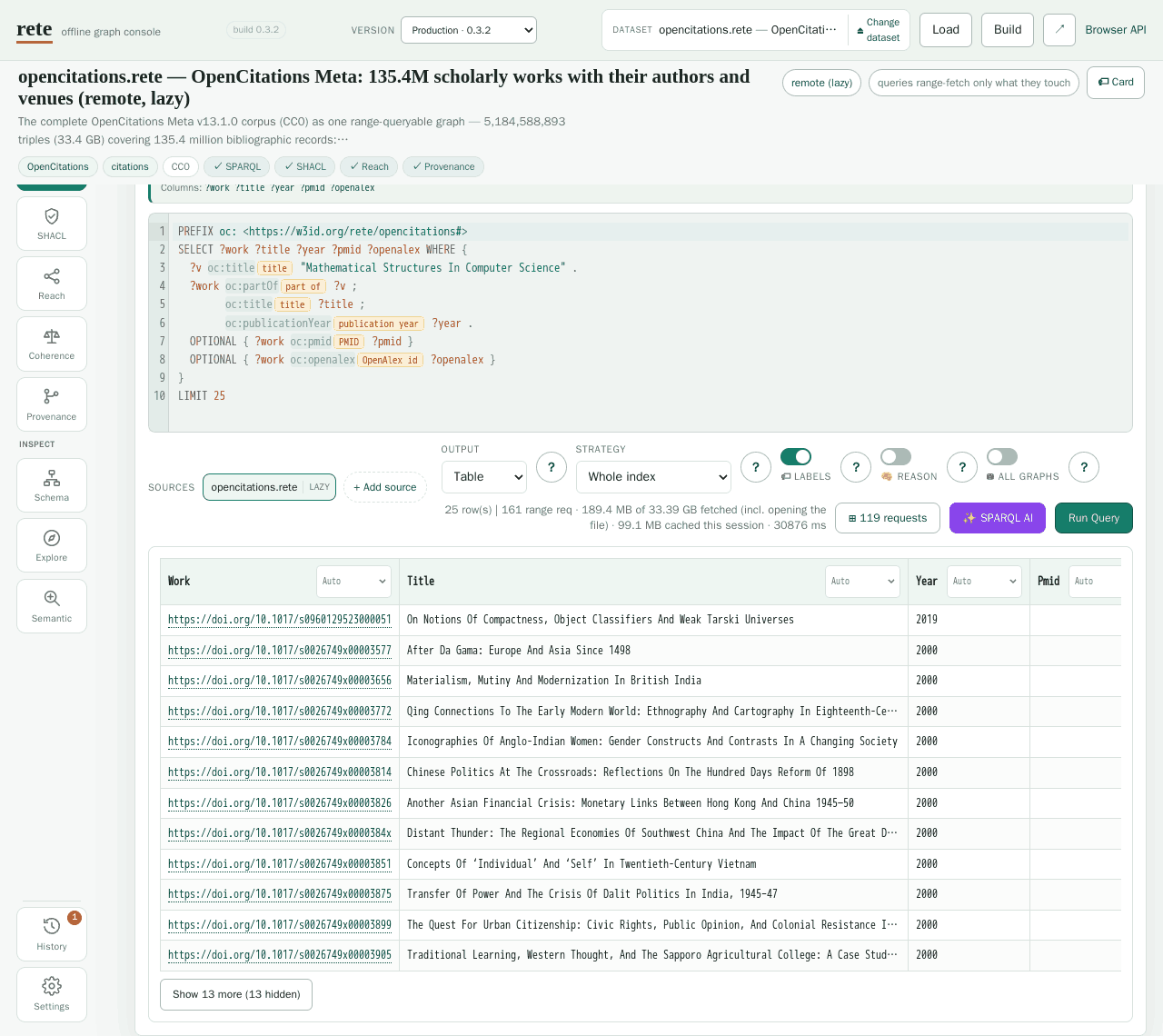
SPARQL against 5.18 billion triples, from a browser tab. opencitations.rete
is one 33.4 GB file on object storage. The line under the toolbar is the whole
point: 25 rows came back after 161 range requests and 189 MB — including
opening the file. The other 33 GB were never transferred, and there is no server
on the other end.
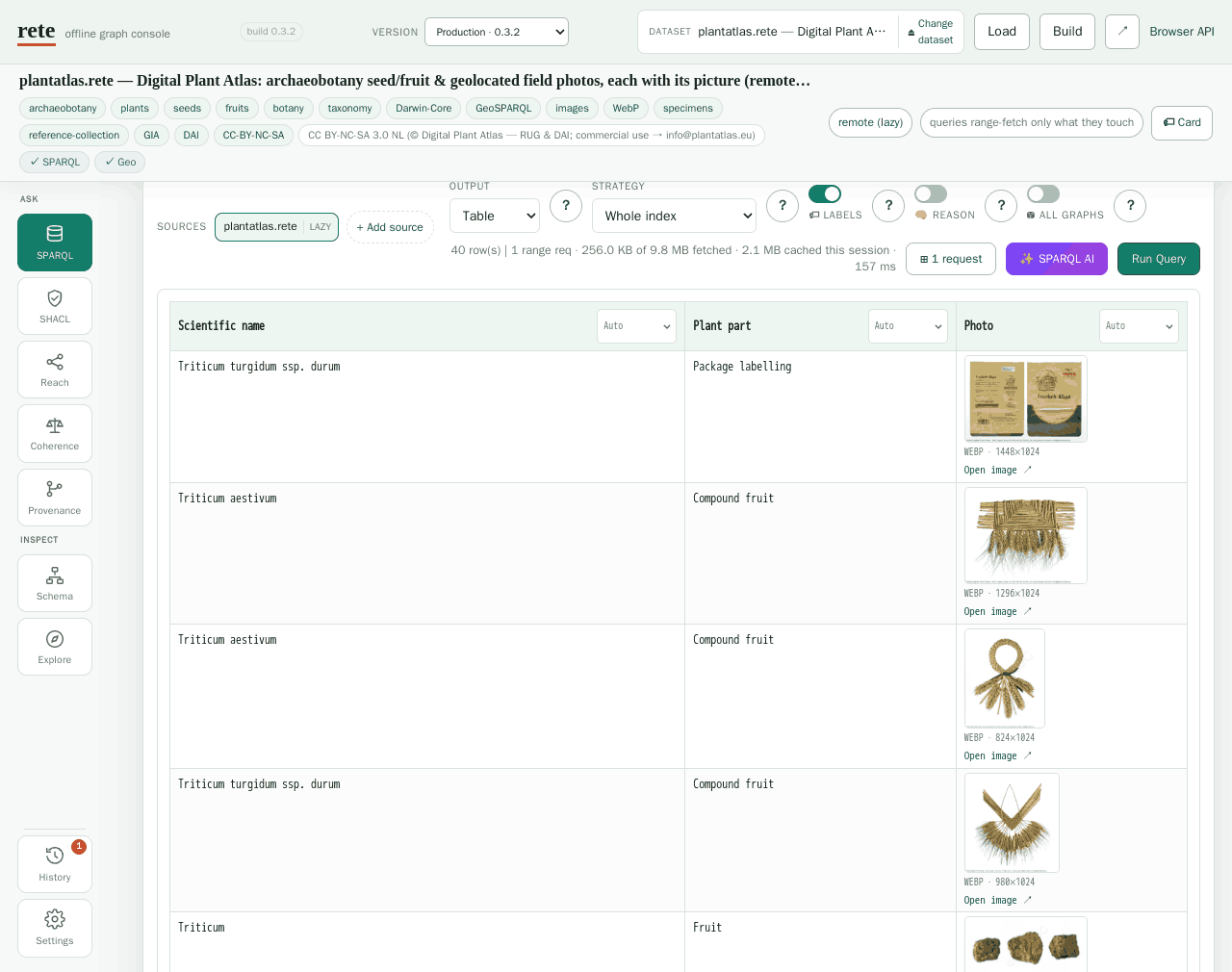
The pictures are in the graph. Those photographs are xsd:base64Binary
WebP literals stored inside the .rete, rendered straight into the result
cell — no image host, no second request, nothing to rot. Forty rows and their
pictures cost one range request and 256 KB of a 9.8 MB file. The same
renderers handle IIIF manifests, PDFs, audio, video and .glb 3D models.
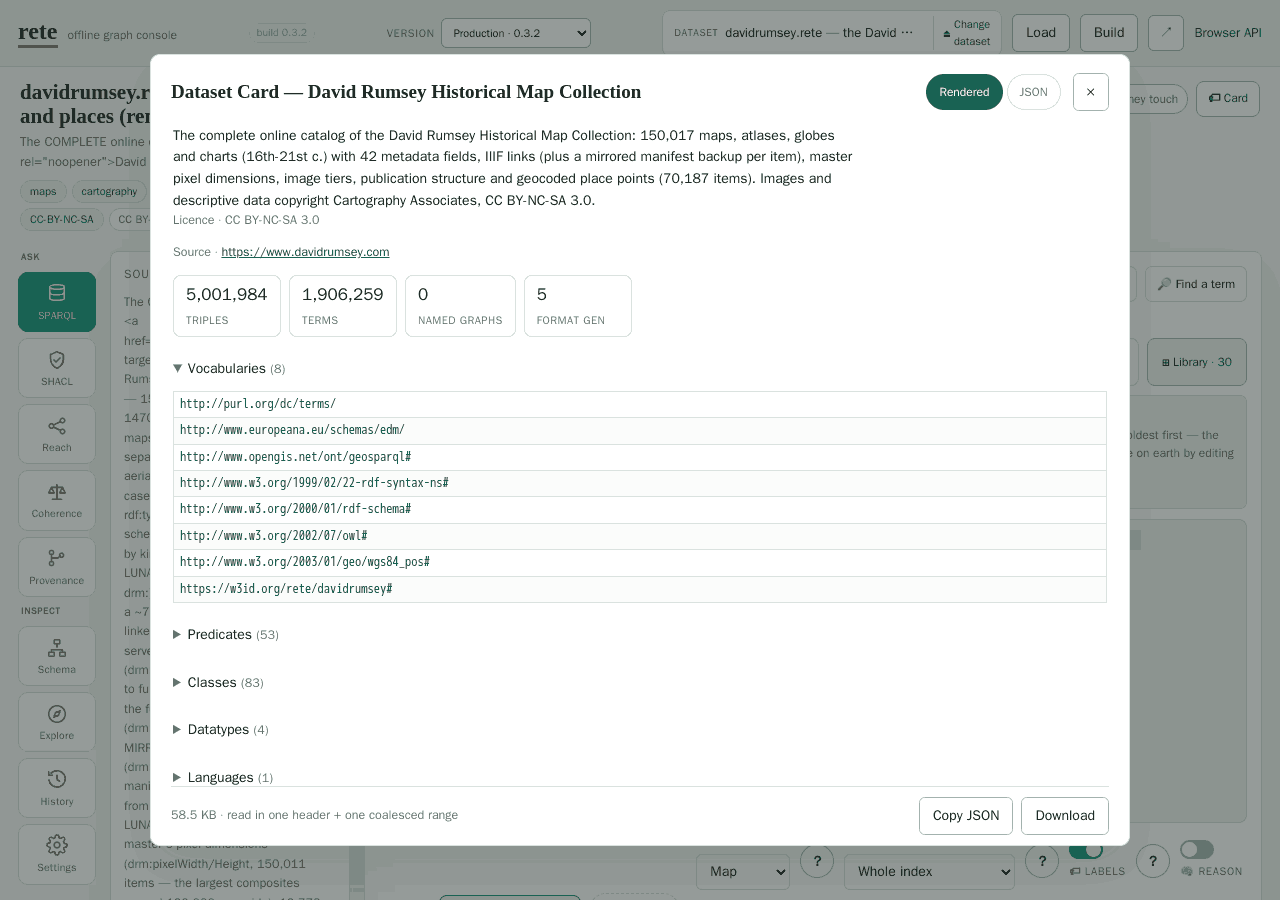
The file describes itself. Every .rete can carry a
Dataset Card — licence,
counts, vocabularies, classes, and runnable starter queries. Read straight off
the header: 58.5 KB in one coalesced range request, without touching the
triple index, on a 5 M-triple file or a 5 B-triple one alike.
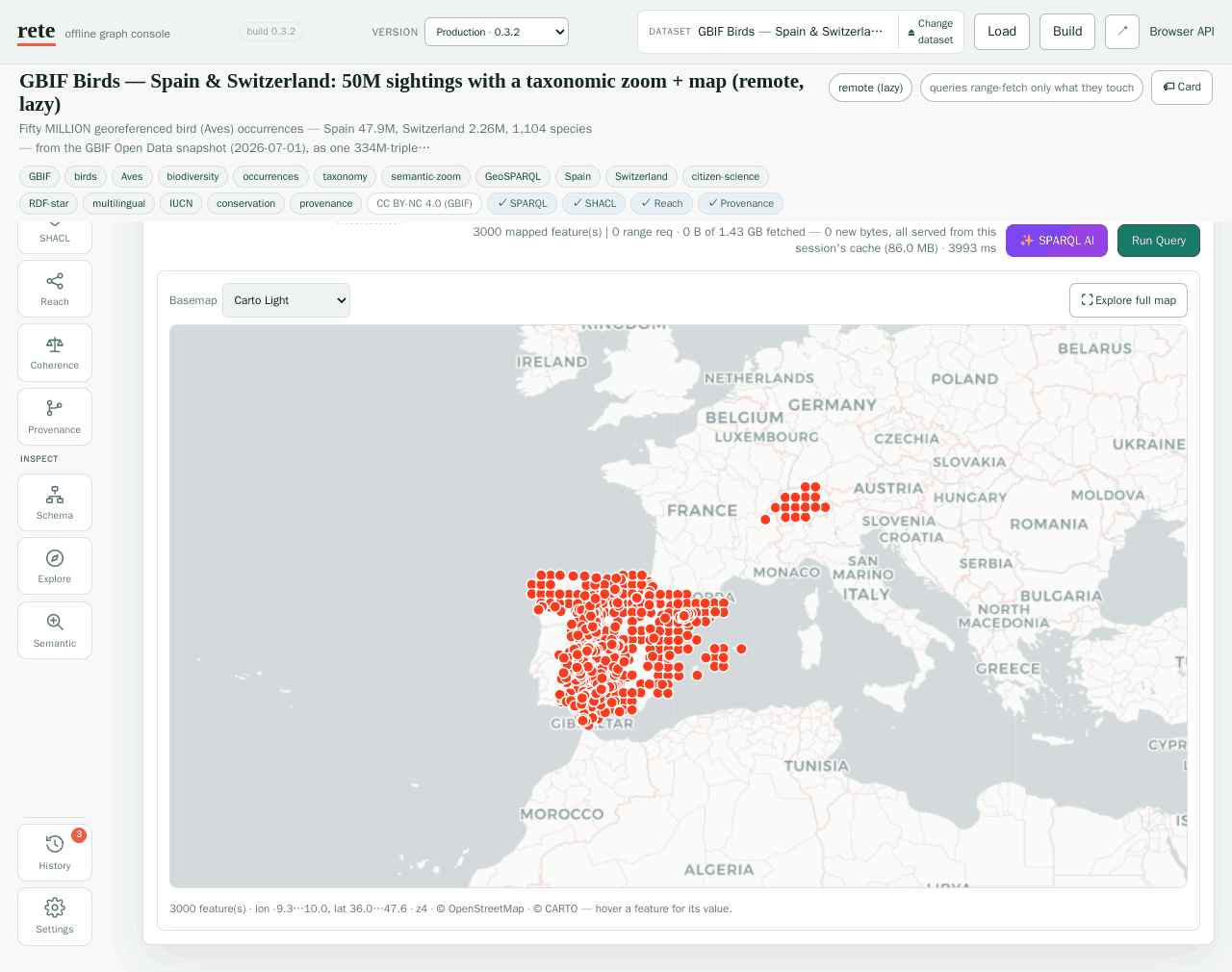
GeoSPARQL, drawn. 3,000 raptor sightings selected out of a 334 M-triple,
1.43 GB GBIF graph and put on a basemap — geo:asWKT literals detected in the
result and rendered as a map view. This run answers entirely from the session's
86 MB block cache, which is what makes panning around a remote graph feel local.
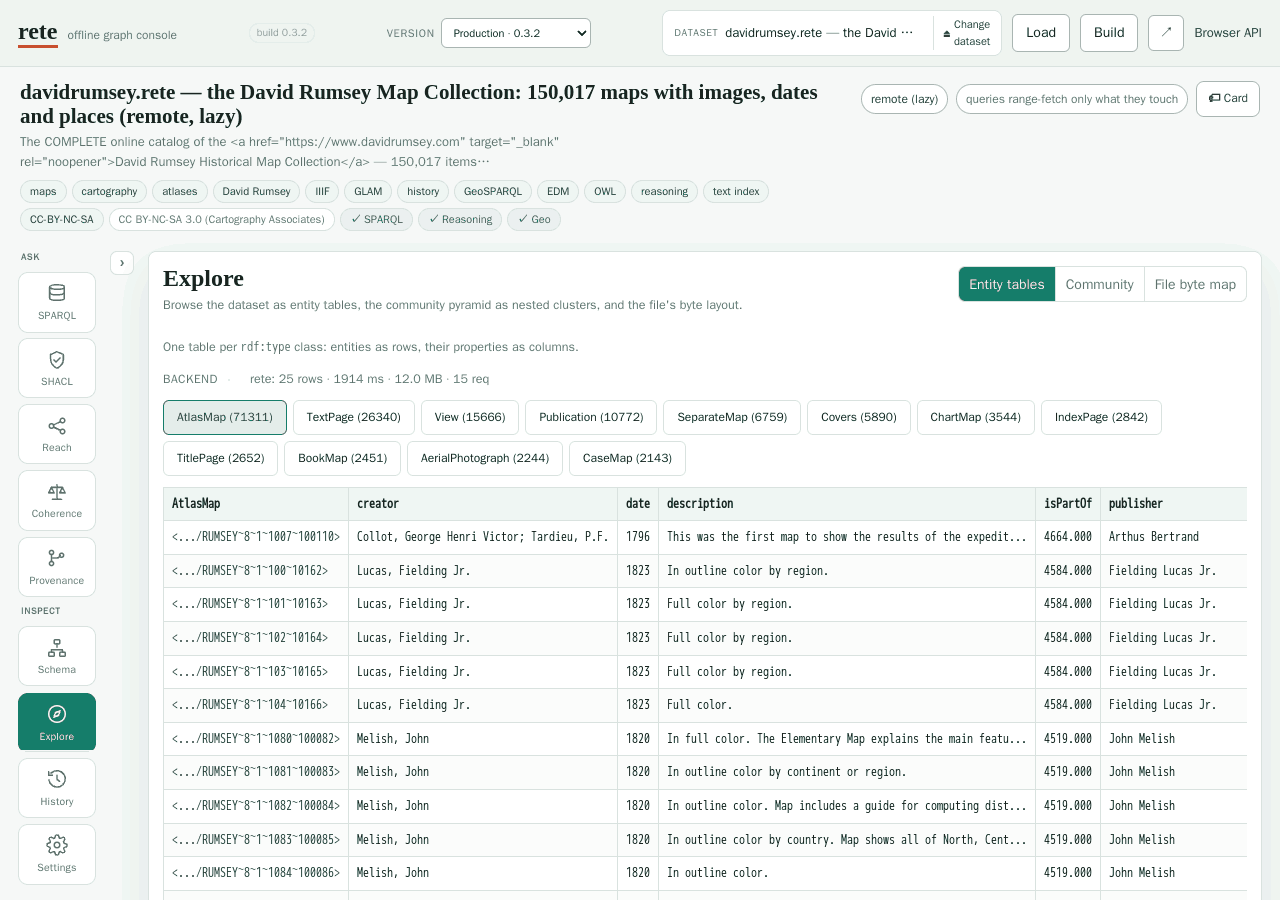
Browse it like an archive, without writing SPARQL. Explore turns each
rdf:type class into a table — entities as rows, their properties as columns —
so an unfamiliar graph is navigable before you know a single predicate in it.
Real OpenCitations citation network (539,246 sanitized triples from the ~588k-triple playground dataset), vs Oxigraph (in-memory), in the dev container — full writeup in Benchmarks:
| rete | Oxigraph | |
|---|---|---|
| Open / load the graph | ~20 ms (indexes prebuilt in the file) | ~2,440 ms (parse + index) |
| SPARQL queries (24 operators) | wins or ties 21/24 · 24/24 results identical | sub-ms to tens of ms |
| Batch reachability, 300 seeds | 641 ms → 39 ms with --parallel | 3,026 ms |
rete opens ~120× faster, and after the 2026 engine rework (lazy slot-row
pipeline, adaptive index-nested-loop joins, top-k ORDER BY) it wins or ties most
SPARQL shapes — aggregates, GROUP BY, DISTINCT, OPTIONAL, UNION/VALUES, paths,
sorted pagination. Oxigraph keeps a fractional edge on ASK, the tightest LIMIT
joins, and non-literal REGEX scans. File size: ~6.4× smaller than raw
N-Triples, ~2.3× of gzip — but queryable.
And it holds at scale: the 52 GB, 9.83-billion-triple DataCite file answers
a COUNT in 4 s inside a 2 GiB container and a GROUP BY over 1.38 B rows
in 131 s inside 4 GiB — aggregation streams, memory is O(groups)
(full numbers).
Honest note on the pyramid. Two structures ship in the file: the community summary scales with the graph and helps overview/aggregate queries but adds build time and gives node-selective queries no benefit (use
--no-pyramidto drop it); the schema pyramid is bounded by the ontology and stays cheap at any scale. See the cost-vs-benefit benchmark.
A 1 KB header — a small fixed core plus a typed section directory — points at every section, so a client reads only what it needs (and new sections are just new directory entries).

The anatomy on a real specimen (dblp.rete, 179 M triples) — in the spirit of the classic Parquet file-layout figure.
See the format spec and architecture for the details.
The docs render as Markdown on GitHub, or as an HTML site (docs/*.html,
regenerated with cargo run -p docgen).
v0.3.5 — the 0.3.x engine line, shipped to crates.io (rete-core,
rete-cli, rete-wasm, rete-graph), PyPI and npm (rete-graph), the
container images, the Claude Desktop extension and the desktop File Explorer,
with every client in lockstep (see CHANGELOG). The Java client and the R package are
built from this repo and are not on Maven Central or CRAN.
Working end-to-end — the single-file format, dictionary + permutation indexes, the
community summary and a self-describing schema pyramid, SPARQL + GeoSPARQL,
lazy HTTP-range queries (with per-tile synopses that prune a routed tile before
fetching it), and the browser/WASM engine. Stable file-format generation 1
(header byte 0x05, frozen 2026-07-14 and first released in 0.3.0) has not moved
since that freeze — but "stable" names the generation and is not a compatibility
promise: no backwards-compatibility guarantee is made before 1.0.0, and the
format may still change in ways that require rebuilding a file you already
published. The experimental generations 0x01–0x04 predate that freeze and
must be rebuilt from RDF source. The generation number is not the release version
— there is no Rete 1.0.0, and the Rust, CLI, and WASM APIs carry no semver
promise until there is. SPARQL evaluation is exact for supported shapes
(no implicit OWL/RDFS query-time entailment); cross-file federation is
UNION-fan-out, while SPARQL 1.1 SERVICE calls external endpoints from inside a
query.
This section is about building the project, not using it — if you only want
to turn a dump into a .rete, the quick start above needs none
of it. Everything here runs through the checked-in Docker Compose/devcontainer
toolchain, so nothing builds on your host:
# The canonical image, then the CLI in the shared target volume (target/release/rete):
docker compose build dev
docker compose run --rm dev cargo build --release -p rete-cli
docker compose run --rm dev cargo test --workspace --exclude rete-bench
docker compose run --rm dev cargo run -p rete-cli -- info some.rete
docker compose run --rm dev bash scripts/smoke.sh
docker compose run --rm dev uv run python scripts/build_playground.py
docker compose run --rm gate                   # full Playwright regression gate
docker compose run --rm gate-catalog           # every embedded catalog query
docker compose run --rm gate-catalog-live      # every catalog query (slow, live R2)
docker compose run --rm gate-firefox           # regular gate in Firefox
Open the repository in its devcontainer for an interactive shell backed by the
same dev service. check, wasm, wasm-async, docs, and the gate* services
are named Compose services used by local development and release verification.
CI runs fmt, clippy, the test matrix, the CLI smoke test, a query-engine
regression check (qbench --check: per-query row counts + time ceilings), and
the WASM build in containers, so nothing builds on the host. See
Getting started for the dev-container setup.
rete is free and open source. If it's useful to you, you can support its development on Ko-fi:

Put an RDF graph in one file. Drop it on a URL. Query it with SPARQL, no database server.
See the code
Put an RDF graph in one file. Drop it on a URL. Query it with SPARQL — no database server.
▶ Try it in your browser · JS lab (D3) · Historical atlas · Docs
[!IMPORTANT] Pre-1.0 — expect breaking changes. rete is 0.3.5, and until 1.0.0 both the public API and the
.retefile format may change in ways that break what you built on them — including changes that require rebuilding a file you already published. See compatibility for details.
The name comes from Latin rēte, meaning "net". Pronounce it RAY-teh
(Classical Latin: roughly /ˈreː.te/).
rete packs a whole RDF graph — its dictionary, permutation indexes, a community
summary, and a self-describing schema pyramid — into one immutable .rete
file. Put that file on S3, GitHub Pages, or any HTTP host that supports range
requests, hand a client the URL, and it runs real SPARQL against the file in
place, fetching only the bytes a query needs. The same engine compiles to
WebAssembly, so a browser can query the file directly with no backend.
Think Parquet (for tables) or PMTiles (for maps) — but for RDF graphs + SPARQL.
SERVICE
federation itself is supported).COUNT over the 9.83-billion-triple DataCite file
returns 779,399 in 4 s inside a 2 GiB container, and a GROUP BY over
its 1.38 B-row type slice fits in 4 GiB
(benchmark).rdf:type legend you read index-free in a couple of range
requests. See below.One engine, every runtime — every client opens local files and remote URLs through the same lazy range reader and returns parsed SPARQL results (all client versions track the engine's 0.3.x line):
| Client | Get it | Notes |
|---|---|---|
| Python | pip install rete-graph | CPython ≥ 3.9 wheels for Linux/macOS/Windows plus Pyodide (JupyterLite, marimo WASM) · docs · tutorial |
| JavaScript | npm install rete-graph — or one <script> tag: cdn.jsdelivr.net/npm/[email protected]/dist/rete-graph.min.js | Node ≥ 18 + browsers; TypeScript types included · docs |
| Rust | cargo install rete-cli --locked, or rete-core as a library | native + wasm · Rust API · CLI reference · docs.rs |
| Java | mvn -f clients/java install — not published to Maven Central yet, so there is no coordinate to depend on | pure JVM — the engine as wasm on Chicory, plus an RDF4J Sail binding · readme |
| R | remotes::install_github("caviri/rete", subdir = "clients/r", build = FALSE) (needs Rust) — not on CRAN or R-universe | R ≥ 4.2; SPARQL results as data frames · docs |
| Browser, zero install | playground · SPARQL IDE | query any .rete URL with no install at all |
| Claude Desktop | ⬇ rete.mcpb — double-click it (or take the checksummed copy from Releases) | one-click MCP Bundle: the engine runs locally, so your own graphs stay on your machine and work offline · docs |
| Blender | add-on zip from Releases | SPARQL results as 3D scenes; bundles the Python wheels · docs |
| Hosted gateway | katospiegel-rete.hf.space | no install: /mcp (agent tools), REST /api, and a W3C SPARQL 1.1 endpoint per dataset at /sparql/{dataset} |
This repo doubles as a Claude Code plugin marketplace. Two commands wire everything into Claude — the build/publish skills and the rete MCP server (SPARQL + SHACL over 65 public knowledge graphs, entity search, dataset cards, media previews):
/plugin marketplace add caviri/rete
/plugin install rete-graph@rete
After install: ask Claude to query any dataset ("how many Spanish laws cite
the Constitution?"), validate shapes, preview IIIF/PDF media, or build a
.rete from your own data with /rete-graph:rete-from-graph. The same MCP
server also plugs into ChatGPT (developer mode or as a connector) and any
other MCP client — see the
agentic interfaces guide.
Open a .rete you've never seen and the cold-start problem bites: which
classes exist, how do they connect, where do you even start? rete fixes this by
shipping the answer inside the file, read over a couple of HTTP range requests
without ever touching the triple index:
rete card-url <url>) — title/license, term and class
counts, the vocabulary, detected affordances (label / time / geo predicates,
spatial bbox, …), and an auto-generated, runnable starter-query library.rete summary --level k) — a leveled rdf:type
histogram where abstract classes describe the coarse view and leaf classes
resolve as you zoom in. It also keeps the lateral relations between classes
(not just the is-a tree), as a non-exclusive graph.
$ rete summary big.rete --level 0     # the big picture, index-free
   12048  <http://schema.org/Person>
    3017  <http://schema.org/Organization>
$ rete summary big.rete --level 2     # zoom in — leaves resolve
    4102  <http://schema.org/Scientist>  …
Full guide: Semantic zoom (schema pyramid).
✅ A good fit when…
🚫 Reach for a real triplestore instead when…
rete build --materialize) rather than
entailing during evaluation.You do not need Rust, a clone of this repo, or its dev container to use rete.
A prebuilt CLI image is published — ghcr.io/caviri/rete-cli, ~30 MB on
distroless, multi-arch (amd64 + arm64) — so RDF dump → .rete is one
command:
# run this in the directory that holds your dump
docker run --rm -v "$PWD:/data" ghcr.io/caviri/rete-cli:latest \
  build /data/dump.nt -o /data/out.rete --card --title "My graph"
embedded dataset card (16240 bytes of metadata)
wrote /data/out.rete: 5 triples, 8 terms, 1 pyramid level(s), 18061 bytes
-v "$PWD:/data" maps the current directory onto /data inside the container,
so /data/out.rete is ./out.rete on your machine: the file is sitting
next to your dump when the command exits, with nothing to copy out of a
container. --card embeds the
Dataset Card — counts,
vocabulary, and runnable starter queries — and is optional.
Inspect and query it with the same image. One alias keeps the rest readable
(-w /data makes the container's working directory your directory, so plain
filenames work):
alias rete='docker run --rm -i -v "$PWD:/data" -w /data ghcr.io/caviri/rete-cli:latest'

rete stats   out.rete    # size, counts, top predicates, planner stats, entity shapes
rete card    out.rete    # the self-description: vocabulary, signals, starter queries
rete summary out.rete --level 0   # the schema pyramid, most abstract level
rete sparql  out.rete 'SELECT ?s ?name WHERE { ?s <http://xmlns.com/foaf/0.1/name> ?name }'
rete why     out.rete --predicate '<http://ex/knows>'   # explain result provenance
Variants worth knowing:
# Turtle, N-Quads and RDF/XML (.rdf / .owl — how most OWL ontologies ship) are
# detected by extension; --format nt|nq|ttl|rdfxml overrides detection.
rete build ontology.owl -o ontology.rete

# Several inputs merge into one file under a shared dictionary.
rete build part1.nt part2.nt -o merged.rete

# `-` reads stdin, so a dump never has to touch your disk (defaults to N-Triples).
curl -sL https://host/dump.nt | rete build - -o out.rete
Three container gotchas, all of them silent. Piping needs
docker run -i— the alias above sets it, but without-istdin is empty andbuild -writes a valid, 0-triple file and exits 0. On Linux the image runs as root, so add--user "$(id -u):$(id -g)"unless you want output owned by root. On Windows Git Bash, MSYS rewrites both the mount and/data/…arguments (/data/dump.ntbecomesC:/Program Files/Git/data/dump.nt, and a$PWDmount resolves to a directory that is not yours — the build reports success and no file appears); useMSYS_NO_PATHCONV=1 docker run --rm -v "$(pwd -W):/data" ….
A graph that already lives on a URL needs no download, and no mount either if you point the bare image at it — these are the range-read commands, fetching only the bytes an answer needs:
docker run --rm ghcr.io/caviri/rete-cli:latest \
  card-url https://data.graphplaza.com/opencitations/opencitations.rete
# fetched 2764 of 35852509508 bytes in 3 range request(s) — index NOT fetched
#   title   : OpenCitations Meta
#   triples : 5178674356

rete query-url  https://my-bucket.s3.amazonaws.com/social.rete --object '<http://ex/Alice>'
rete sparql-url https://my-bucket.s3.amazonaws.com/social.rete 'SELECT * WHERE { ?s ?p ?o } LIMIT 5'
query-url resolves bound terms from the dictionary, then range-fetches only the
best-matching permutation payload for that triple pattern; sparql-url
faults in index tiles as a query touches them. rete cost --explain shows when a
query can use the summary-only or routed-pattern budgets.
Prefer not to go through Docker at all? The same engine ships as
pip install rete-graph and npm install rete-graph (see
Clients), which build and query files from Python and JavaScript
directly. The other two published images — the full toolchain and the
HTTP/MCP relay — are documented in docker/README.md.
The playground is a self-contained offline page bundling the WASM engine and 65 example datasets — from tiny embedded graphs to remote, lazily-queried ones served over HTTP range requests:
Pick a dataset, run filterable SPARQL examples, inspect progressive exactness metadata, validate SHACL, explore reachability, render schema summaries, and explain triple-pattern provenance — all offline. Two focused demos:
.rete from
JavaScript and wire the results straight into a D3 force graph, in one page..rete, with 80+ map overlays (battles, castles, treaties, …).Every shot below is the same single HTML page, querying a file that stays on its URL. Each links to the deep link that reproduces it.
SPARQL against 5.18 billion triples, from a browser tab. opencitations.rete
is one 33.4 GB file on object storage. The line under the toolbar is the whole
point: 25 rows came back after 161 range requests and 189 MB — including
opening the file. The other 33 GB were never transferred, and there is no server
on the other end.
The pictures are in the graph. Those photographs are xsd:base64Binary
WebP literals stored inside the .rete, rendered straight into the result
cell — no image host, no second request, nothing to rot. Forty rows and their
pictures cost one range request and 256 KB of a 9.8 MB file. The same
renderers handle IIIF manifests, PDFs, audio, video and .glb 3D models.
The file describes itself. Every .rete can carry a
Dataset Card — licence,
counts, vocabularies, classes, and runnable starter queries. Read straight off
the header: 58.5 KB in one coalesced range request, without touching the
triple index, on a 5 M-triple file or a 5 B-triple one alike.
GeoSPARQL, drawn. 3,000 raptor sightings selected out of a 334 M-triple,
1.43 GB GBIF graph and put on a basemap — geo:asWKT literals detected in the
result and rendered as a map view. This run answers entirely from the session's
86 MB block cache, which is what makes panning around a remote graph feel local.
Browse it like an archive, without writing SPARQL. Explore turns each
rdf:type class into a table — entities as rows, their properties as columns —
so an unfamiliar graph is navigable before you know a single predicate in it.
Real OpenCitations citation network (539,246 sanitized triples from the ~588k-triple playground dataset), vs Oxigraph (in-memory), in the dev container — full writeup in Benchmarks:
| rete | Oxigraph | |
|---|---|---|
| Open / load the graph | ~20 ms (indexes prebuilt in the file) | ~2,440 ms (parse + index) |
| SPARQL queries (24 operators) | wins or ties 21/24 · 24/24 results identical | sub-ms to tens of ms |
| Batch reachability, 300 seeds | 641 ms → 39 ms with --parallel | 3,026 ms |
rete opens ~120× faster, and after the 2026 engine rework (lazy slot-row
pipeline, adaptive index-nested-loop joins, top-k ORDER BY) it wins or ties most
SPARQL shapes — aggregates, GROUP BY, DISTINCT, OPTIONAL, UNION/VALUES, paths,
sorted pagination. Oxigraph keeps a fractional edge on ASK, the tightest LIMIT
joins, and non-literal REGEX scans. File size: ~6.4× smaller than raw
N-Triples, ~2.3× of gzip — but queryable.
And it holds at scale: the 52 GB, 9.83-billion-triple DataCite file answers
a COUNT in 4 s inside a 2 GiB container and a GROUP BY over 1.38 B rows
in 131 s inside 4 GiB — aggregation streams, memory is O(groups)
(full numbers).
Honest note on the pyramid. Two structures ship in the file: the community summary scales with the graph and helps overview/aggregate queries but adds build time and gives node-selective queries no benefit (use
--no-pyramidto drop it); the schema pyramid is bounded by the ontology and stays cheap at any scale. See the cost-vs-benefit benchmark.
A 1 KB header — a small fixed core plus a typed section directory — points at every section, so a client reads only what it needs (and new sections are just new directory entries).
The anatomy on a real specimen (dblp.rete, 179 M triples) — in the spirit of the classic Parquet file-layout figure.
See the format spec and architecture for the details.
The docs render as Markdown on GitHub, or as an HTML site (docs/*.html,
regenerated with cargo run -p docgen).
v0.3.5 — the 0.3.x engine line, shipped to crates.io (rete-core,
rete-cli, rete-wasm, rete-graph), PyPI and npm (rete-graph), the
container images, the Claude Desktop extension and the desktop File Explorer,
with every client in lockstep (see CHANGELOG). The Java client and the R package are
built from this repo and are not on Maven Central or CRAN.
Working end-to-end — the single-file format, dictionary + permutation indexes, the
community summary and a self-describing schema pyramid, SPARQL + GeoSPARQL,
lazy HTTP-range queries (with per-tile synopses that prune a routed tile before
fetching it), and the browser/WASM engine. Stable file-format generation 1
(header byte 0x05, frozen 2026-07-14 and first released in 0.3.0) has not moved
since that freeze — but "stable" names the generation and is not a compatibility
promise: no backwards-compatibility guarantee is made before 1.0.0, and the
format may still change in ways that require rebuilding a file you already
published. The experimental generations 0x01–0x04 predate that freeze and
must be rebuilt from RDF source. The generation number is not the release version
— there is no Rete 1.0.0, and the Rust, CLI, and WASM APIs carry no semver
promise until there is. SPARQL evaluation is exact for supported shapes
(no implicit OWL/RDFS query-time entailment); cross-file federation is
UNION-fan-out, while SPARQL 1.1 SERVICE calls external endpoints from inside a
query.
This section is about building the project, not using it — if you only want
to turn a dump into a .rete, the quick start above needs none
of it. Everything here runs through the checked-in Docker Compose/devcontainer
toolchain, so nothing builds on your host:
# The canonical image, then the CLI in the shared target volume (target/release/rete):
docker compose build dev
docker compose run --rm dev cargo build --release -p rete-cli
docker compose run --rm dev cargo test --workspace --exclude rete-bench
docker compose run --rm dev cargo run -p rete-cli -- info some.rete
docker compose run --rm dev bash scripts/smoke.sh
docker compose run --rm dev uv run python scripts/build_playground.py
docker compose run --rm gate                   # full Playwright regression gate
docker compose run --rm gate-catalog           # every embedded catalog query
docker compose run --rm gate-catalog-live      # every catalog query (slow, live R2)
docker compose run --rm gate-firefox           # regular gate in Firefox
Open the repository in its devcontainer for an interactive shell backed by the
same dev service. check, wasm, wasm-async, docs, and the gate* services
are named Compose services used by local development and release verification.
CI runs fmt, clippy, the test matrix, the CLI smoke test, a query-engine
regression check (qbench --check: per-query row counts + time ceilings), and
the WASM build in containers, so nothing builds on the host. See
Getting started for the dev-container setup.
rete is free and open source. If it's useful to you, you can support its development on Ko-fi:



