
Local-first, on-device AI chat. Forever private and 100% free.
3
stars
364
commits
TypeScript
primary language
Sep 13, 2026
updated
README
Eco
Local-first AI chat that runs on your own device.


Eco is an AI chat app that keeps the conversation on your device. The model runs in your browser, so the words you type never have to leave the machine you typed them on. It's an alternative to ChatGPT, Claude, and Gemini for people who want a good product without trading away their privacy to get it.
Privacy here is a property of the architecture, not a policy. Inference happens on-device via WebGPU; there is no server in the loop for chat. An optional web search, off by default, sends a live question, as you typed it and nothing else, to a relay Eco runs; successful searches are not logged or linked to you. Conversations can persist locally in the browser (OPFS / IndexedDB) so you can pick up where you left off, and they stay there. The only parts that touch a server are the ones that need one — signing in.
Eco is free and open source under AGPL-3.0. There are no tiers, plans, or feature gates, and no payments are processed by Eco.
Live at econetwork.ai.
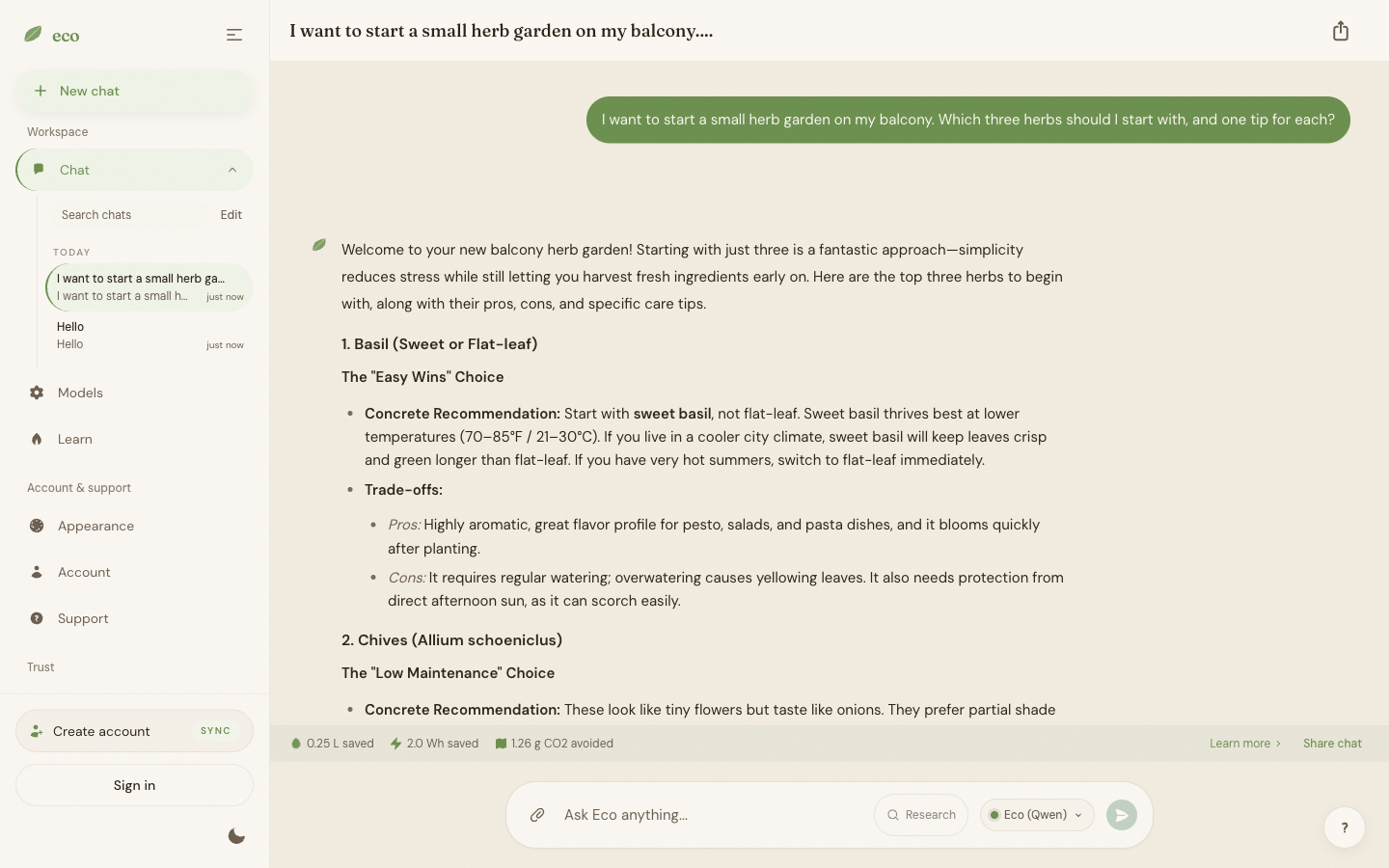
Quickstart — chat with zero services
The on-device chat runs entirely in your browser. To try it, you don't need a database, a Redis instance, or any secrets.
pnpm install
pnpm dev
Then open http://localhost:3000/chat.
(pnpm dev also starts the API gateway on :3001; without a database it runs in a
degraded no-op mode, which is fine — chat never touches it. To run only the web app,
build the shared UI package once with pnpm --filter @eco/ui build, then
pnpm --filter @eco/web dev.)
The chat surface is usable as a guest, so nothing gates your way in during local development, and the first model downloads and runs directly in the browser. Requirements: Node 22, pnpm 9, and a WebGPU-capable browser (recent Chrome or Edge is the smoothest path; the app falls back to a small CPU model where WebGPU isn't available).
Browser support
- Chrome and Edge (WebGPU with shader-f16): the full model ladder, including the larger Smart picks, and the fastest replies.
- Safari and Firefox: the smaller models only. Replies take tens of seconds.
- iOS Safari: one small model built for the phone.
The first model download can take a few minutes depending on the model and your connection — the setup flow starts you on a small "starter" model and offers an opt-in upgrade once you're chatting.
Full-stack development
You only need this if you're working on auth — the server-side surface. The API
gateway (apps/api) provides authentication and sessions; it needs PostgreSQL and
Redis.
-
Bring up Postgres (
127.0.0.1:5432) and Redis (127.0.0.1:6379) however you prefer (Docker, Homebrew, a managed instance — anything reachable at those addresses). -
Copy the example env files and fill in what you need:
cp apps/api/.env.example apps/api/.env
cp apps/web/.env.example apps/web/.env.local
Both example files document every variable inline. Sensible defaults point the web app at the API on
http://localhost:3001. Email verification and password reset stay off unlessRESEND_API_KEYis set. None of that is required to run auth locally. -
Run everything together:
pnpm dev # web on :3000, api on :3001
If you need to sign in to a member-only surface without standing up a real auth session,
there's a loopback-only POST /api/dev-login route that sets a throwaway session cookie
for local UI testing. It only works over localhost and never creates a real account.
Ports: web 3000, api 3001. Database: Postgres 127.0.0.1:5432, Redis
127.0.0.1:6379.
Architecture
Eco is a pnpm + Turborepo monorepo.
apps/
  web/        Next.js 16 (App Router) web app — landing, on-device chat,
              settings, auth, content pages. This is the product.
  api/        Hono API gateway — auth + sessions (Better Auth) only. No chat
              traffic passes through it.
packages/
  ui/         Shared component library used by the web app.
  config/     Shared TypeScript + ESLint configuration.
The on-device AI lives in apps/web/src/local-ai/. Inference runs through two
in-browser runtimes depending on the model and device:
- Transformers.js v4 + WebGPU — the primary runtime for most models.
- LiteRT-LM — runs Gemma 4 E2B.
The shipping model catalog is defined in
apps/web/src/local-ai/catalog/catalog-data.json. A diagnostics surface is available at
/diagnostics/local-ai?eco-diagnostics=1 for inspecting device capability, model
selection, and download behavior.
Stack: Next.js 16, React 19, Tailwind CSS 4, Zustand, Motion (web) · Hono, Better Auth, Drizzle ORM, PostgreSQL, Redis (api) · Node 22, pnpm 9, TypeScript 5 strict.
Testing & QA
pnpm type-check      # type-check the whole monorepo
pnpm lint            # lint
pnpm test            # all TypeScript unit tests (Vitest)
pnpm check:cycles    # guard against circular dependencies

pnpm --filter @eco/web exec playwright test   # end-to-end (Playwright)
Package-scoped test runs are faster when your change is contained:
pnpm --filter @eco/web test
pnpm --filter @eco/api test
pnpm --filter @eco/ui test
License
Eco is licensed under AGPL-3.0-or-later — see LICENSE. In plain terms:
you're free to use, study, modify, and share it, but if you run a modified version as a
network service, you must offer that service's users the corresponding source. Every
source file carries an SPDX header.
Contributing
Contributions are welcome — start with CONTRIBUTING.md for the dev
setup, the QA bar, UI guidelines, and how to sign your commits. AGENTS.md
is the codebase orientation for contributors and AI coding agents. Security reports go
through SECURITY.md.
Contributors

358 commits

6 commits
Similar repos


Languages
TypeScript
97.7%
JavaScript
1.3%
Local-first, on-device AI chat. Forever private and 100% free.
3
stars
364
commits
TypeScript
primary language
Sep 13, 2026
updated
README
Eco
Local-first AI chat that runs on your own device.
Eco is an AI chat app that keeps the conversation on your device. The model runs in your browser, so the words you type never have to leave the machine you typed them on. It's an alternative to ChatGPT, Claude, and Gemini for people who want a good product without trading away their privacy to get it.
Privacy here is a property of the architecture, not a policy. Inference happens on-device via WebGPU; there is no server in the loop for chat. An optional web search, off by default, sends a live question, as you typed it and nothing else, to a relay Eco runs; successful searches are not logged or linked to you. Conversations can persist locally in the browser (OPFS / IndexedDB) so you can pick up where you left off, and they stay there. The only parts that touch a server are the ones that need one — signing in.
Eco is free and open source under AGPL-3.0. There are no tiers, plans, or feature gates, and no payments are processed by Eco.
Live at econetwork.ai.
Quickstart — chat with zero services
The on-device chat runs entirely in your browser. To try it, you don't need a database, a Redis instance, or any secrets.
pnpm install
pnpm dev
Then open http://localhost:3000/chat.
(pnpm dev also starts the API gateway on :3001; without a database it runs in a
degraded no-op mode, which is fine — chat never touches it. To run only the web app,
build the shared UI package once with pnpm --filter @eco/ui build, then
pnpm --filter @eco/web dev.)
The chat surface is usable as a guest, so nothing gates your way in during local development, and the first model downloads and runs directly in the browser. Requirements: Node 22, pnpm 9, and a WebGPU-capable browser (recent Chrome or Edge is the smoothest path; the app falls back to a small CPU model where WebGPU isn't available).
Browser support
- Chrome and Edge (WebGPU with shader-f16): the full model ladder, including the larger Smart picks, and the fastest replies.
- Safari and Firefox: the smaller models only. Replies take tens of seconds.
- iOS Safari: one small model built for the phone.
The first model download can take a few minutes depending on the model and your connection — the setup flow starts you on a small "starter" model and offers an opt-in upgrade once you're chatting.
Full-stack development
You only need this if you're working on auth — the server-side surface. The API
gateway (apps/api) provides authentication and sessions; it needs PostgreSQL and
Redis.
-
Bring up Postgres (
127.0.0.1:5432) and Redis (127.0.0.1:6379) however you prefer (Docker, Homebrew, a managed instance — anything reachable at those addresses). -
Copy the example env files and fill in what you need:
cp apps/api/.env.example apps/api/.env
cp apps/web/.env.example apps/web/.env.local
Both example files document every variable inline. Sensible defaults point the web app at the API on
http://localhost:3001. Email verification and password reset stay off unlessRESEND_API_KEYis set. None of that is required to run auth locally. -
Run everything together:
pnpm dev # web on :3000, api on :3001
If you need to sign in to a member-only surface without standing up a real auth session,
there's a loopback-only POST /api/dev-login route that sets a throwaway session cookie
for local UI testing. It only works over localhost and never creates a real account.
Ports: web 3000, api 3001. Database: Postgres 127.0.0.1:5432, Redis
127.0.0.1:6379.
Architecture
Eco is a pnpm + Turborepo monorepo.
apps/
  web/        Next.js 16 (App Router) web app — landing, on-device chat,
              settings, auth, content pages. This is the product.
  api/        Hono API gateway — auth + sessions (Better Auth) only. No chat
              traffic passes through it.
packages/
  ui/         Shared component library used by the web app.
  config/     Shared TypeScript + ESLint configuration.
The on-device AI lives in apps/web/src/local-ai/. Inference runs through two
in-browser runtimes depending on the model and device:
- Transformers.js v4 + WebGPU — the primary runtime for most models.
- LiteRT-LM — runs Gemma 4 E2B.
The shipping model catalog is defined in
apps/web/src/local-ai/catalog/catalog-data.json. A diagnostics surface is available at
/diagnostics/local-ai?eco-diagnostics=1 for inspecting device capability, model
selection, and download behavior.
Stack: Next.js 16, React 19, Tailwind CSS 4, Zustand, Motion (web) · Hono, Better Auth, Drizzle ORM, PostgreSQL, Redis (api) · Node 22, pnpm 9, TypeScript 5 strict.
Testing & QA
pnpm type-check      # type-check the whole monorepo
pnpm lint            # lint
pnpm test            # all TypeScript unit tests (Vitest)
pnpm check:cycles    # guard against circular dependencies

pnpm --filter @eco/web exec playwright test   # end-to-end (Playwright)
Package-scoped test runs are faster when your change is contained:
pnpm --filter @eco/web test
pnpm --filter @eco/api test
pnpm --filter @eco/ui test
License
Eco is licensed under AGPL-3.0-or-later — see LICENSE. In plain terms:
you're free to use, study, modify, and share it, but if you run a modified version as a
network service, you must offer that service's users the corresponding source. Every
source file carries an SPDX header.
Contributing
Contributions are welcome — start with CONTRIBUTING.md for the dev
setup, the QA bar, UI guidelines, and how to sign your commits. AGENTS.md
is the codebase orientation for contributors and AI coding agents. Security reports go
through SECURITY.md.
Similar repos
Contributors
358 commits
6 commits
Languages
TypeScript
97.7%
JavaScript
1.3%