
A Python-native code knowledge graph that runs Personalized PageRank in both directions over a tree-sitter AST graph, giving AI agents exact structural context (callers + dependencies) via MCP - with up to ~90% token savings on structural queries (early benchmarks on small codebases).
Python
3
46 commits
updated Jul 25, 2026
README
GraphRAG-Code 🚀
Python-native Code Knowledge Graph using bidirectional Personalized PageRank
A directed-graph PPR engine that ranks structurally related code and extracts exact source blocks (not just metadata). A single tunable weight selects between two query modes: downstream dependency context and upstream blast-radius.
Author: Bydecom · graphrag-code
Why GraphRAG-Code? (The "Why")
In 2026, dumping entire raw files into LLM Agents is highly inefficient, leading to high token costs and increased hallucination rates.
GraphRAG-Code solves this by combining Abstract Syntax Tree (AST) parsing with Personalized PageRank run in both edge directions (forward on the graph, backward on a reversed graph) on an optimized, in-memory graph. The two passes are merged with a tunable backward_weight.
graph TD
    Source[Source Code] -->|"Tree-sitter AST"| Indexer[SQLite DB]
    Indexer -->|"In-Memory Load"| Engine[rustworkx Graph]
    Engine -->|"Bidirectional PPR"| MCP[FastMCP Server]
    MCP -->|"stdio Protocol"| Client[Cursor Agent]
📊 Benchmark Status (honest)
Older, small-codebase numbers are not used as headline evidence anymore. The current, reproducible benchmark story is RQ1 below (LLM-free structural retrieval), with full methodology + threats-to-validity in docs/RESEARCH.md.
🧪 RQ1 — Structural Retrieval (deterministic, no LLM)
A reproducible, LLM-free retrieval eval (eval_retrieval.py) compares three arms against a graph-derived ground truth (transitive closure). The durable, repo-independent finding is on precision for blast-radius queries: a forward-only PageRank spends most of its budget on irrelevant nodes, while Bidirectional PPR stays sharp — empirical evidence that the backward pass is a necessary component, not decoration.
blast_radius · Precision@10 | requests | click | httpx |
|---|---|---|---|
| Unidirectional PPR (ablation) | 0.27 | 0.64 | 0.65 |
| Bidirectional PPR (ours) | 0.98 | 0.99 | 0.98 |
| Brute-force (1-hop) | 0.97 | 0.98 | 0.99 |
Measured on the real
requests,click, andhttpxpackages (15 auto-seeds each, post symbol-dedup). Held-out case files (outside top-15 seeds):eval/cases/. Bidirectional matches a naive 1-hop baseline on precision and far exceeds the single-direction ablation. We deliberately do not headline Recall@k: against a full transitive-closure ground truth it is dominated by closure size on large graphs. Reproduce:python eval_retrieval.py --codebase-dir <pkg> --task blast_radius --k "3,5,10". Full methodology:docs/RESEARCH.md§4.
Install (from source)
git clone https://github.com/bydecom/graphrag-code
cd graphrag-code
pip install -e .

graphrag-code-index --db graphrag_code.sqlite src
graphrag-code-mcp   # MCP stdio server (configure in Cursor / Claude Desktop)
🔥 Core Differentiators:
- Bidirectional PPR Merge (two query modes): An engineering extension of the Repo Map concept. It runs Forward PPR (downstream dependencies) and Backward PPR (on the reversed graph) as two independent passes, then merges them with a tunable
backward_weight. The default0.2leans toward downstream implementation context, whileget_impactraises it to0.9to surface upstream callers (blast radius). It is therefore two weight-selected modes, not one symmetric "see everything" query. - Source Code Block Extraction: Injects exact code blocks (snippets) into the LLM context using AST coordinates rather than just spitting out symbol metadata.
- Interface Expansion (P0-2): Traversing interface boundaries automatically via inheritance/dependency mapping (e.g., tracking consumers of implemented classes).
- Orphan / Dead-Code Detection: Because edges are derived purely from real
import,call,contains, andhandles(route→handler) relationships, modules and classes that nothing references stay disconnected from the main graph. A class that floats alone is the graph honestly telling you it is never imported or instantiated anywhere — a free static smell-detector for dead or dynamically-invoked code. - Route Semantic Edges: Flask/FastAPI-style decorators (
@app.route,@app.get, …) become first-class route nodes linked to their handler viahandlesedges — visible in the graph export as purple diamonds (e.g.route:/users→get_users). - Python-Native: Highly optimized for the Python ecosystem (FastAPI, Django, Data Science).
- Zero-Ops MCP Server: Complies with the Model Context Protocol (MCP). Plugs directly into Cursor or Claude Desktop in seconds.
🛠 Quick Start
To run the pipeline natively using Python 3.10+:
# Install from source (pip install -e .)

# Parse the codebase and generate the Knowledge Graph
graphrag-code-index --db graphrag_code.sqlite src

# Set your LLM API Key (Gemini recommended)
export GEMINI_API_KEY="your-api-key"

# Launch the interactive Terminal Agent
graphrag-code-agent
📊 Native IDE Integration
If you use Cursor IDE or Claude Desktop, GraphRAG-Code exposes standard Model Context Protocol (MCP) tools out-of-the-box.
👉 See detailed instructions in docs/CURSOR_CLAUDE_INTEGRATION.md.
🧰 MCP Tools
| Tool | When to use |
|---|---|
plan_change (v0.1.x) | Call before editing a symbol. One-shot, token-light pre-edit briefing: overall risk + direct callers + ranked upstream blast radius + downstream deps. Metadata-only by default (include_snippets=False). |
get_impact | Full blast-radius table (Bidirectional PPR, backward_weight=0.9) with per-row HIGH/MEDIUM/LOW confidence tiers. |
get_context | 360° view of one symbol: direct callers + source code + downstream dependencies (with snippets). |
get_pruned_context | Broad downstream context across related symbols, with token budgeting. |
get_callers | Flat depth-1 list of upstream callers. |
list_symbols | Structural overview of the codebase (or a single file). |
Ambiguous names (e.g. a
validatedefined in two files) return a disambiguation prompt listing fully-qualified names instead of silently picking one — so blast-radius answers and benchmark seeds stay correct.
🏗 Architecture
The system utilizes tree-sitter to parse Python files into a graph of syntax nodes, stores it incrementally using SQLite, and loads it into a high-performance in-memory C-backed graph (rustworkx) to run PPR calculations in milliseconds.
🔍 Codebase Graph Visualization (Phase 2)
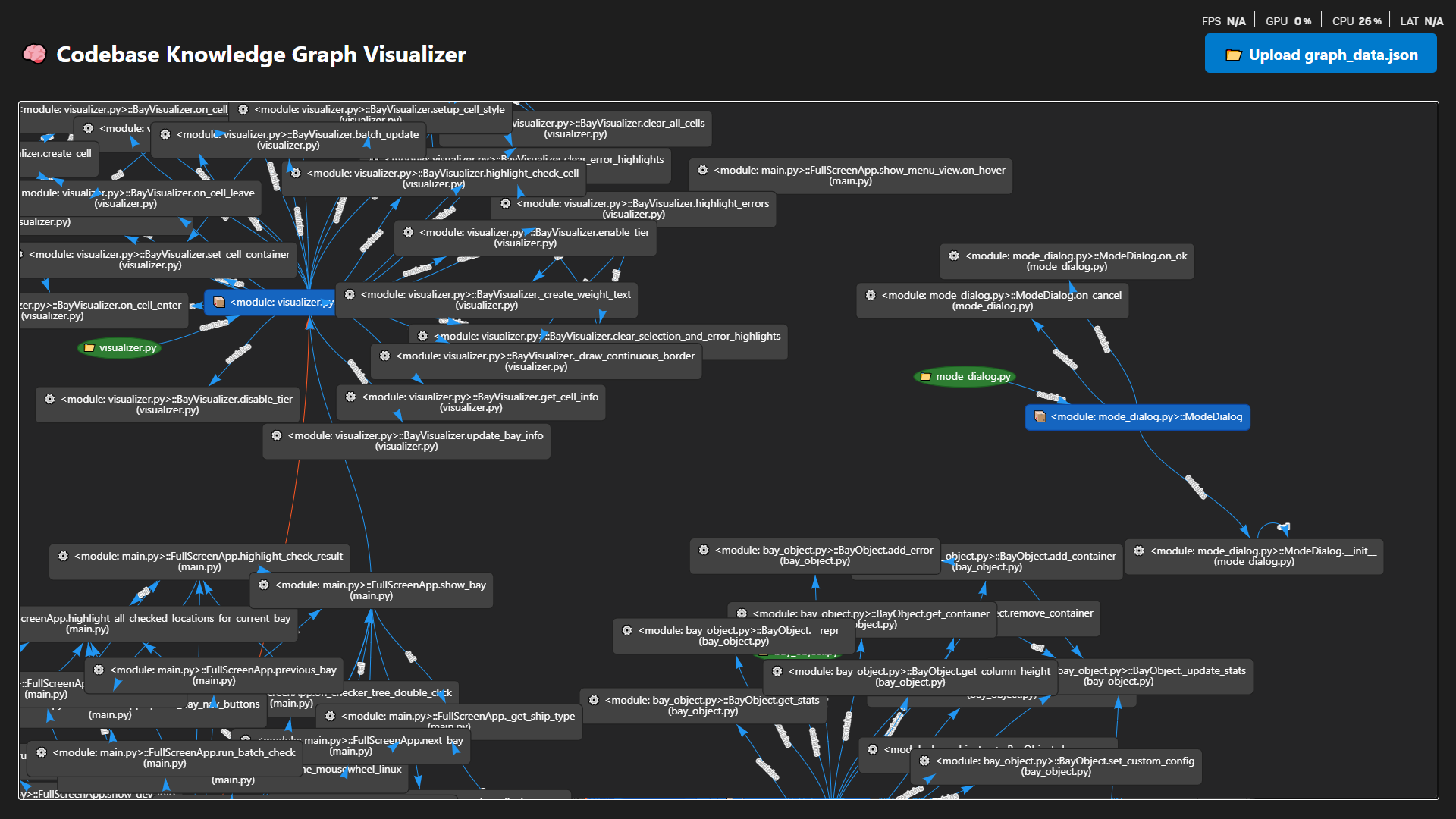
💡 Reading the graph: Every symbol is attached to its file via
containsedges, so each module forms a tight cluster of its classes and functions. If a whole cluster floats away from the rest (like an unused dialog), that is intended — it means nothing in the codebase statically imports or calls it. The graph surfaces orphan/dead code instead of hiding it behind fake links.
Color Legend (Node Types):
- 🟢 Green (Ellipse):
File / Module(e.g.,main.py) - 🔵 Blue (Box):
Class(e.g.,FullScreenApp,AppMenu) - 🟣 Purple (Diamond):
HTTP Route(e.g.,route:/users,GET /items) — Flask/FastAPI decorators - ⚫ Dark Grey (Box):
Function / Method(e.g.,__init__,create_widgets)
How to generate and view this interactive graph locally:
# Export the indexed SQLite graph to a JSON format
graphrag-code-export --db graphrag_code.sqlite --out graph_data.json

# Open the visualizer in your browser and upload the JSON file
open examples/graph_visualizer.html
Related Work
GraphRAG-Code targets structural context for coding agents (call/import graphs, blast radius, dependency snippets via MCP). It is not the Microsoft GraphRAG project, which indexes unstructured text with a different graph and query stack.
Work directly relevant to this problem:
| Reference | Relevance to GraphRAG-Code |
|---|---|
| LocAgent (Chen et al., ACL 2025) | Graph-guided code localization (where to edit) using directed heterogeneous graphs. Reports up to 92.7% file-level Acc@5 (Qwen2.5-32B-ft) with ~86% cost reduction. |
| CodexGraph (Liu et al., NAACL 2025) | Graph database (Neo4j) + Cypher queries as the interface between agents and repositories; evaluated on CrossCodeEval, SWE-bench, and EvoCodeBench. |
| RepoGraph (Ouyang et al., ICLR 2025) | Plug-in repository-level code graph module that boosts SWE-bench performance when integrated into existing frameworks (e.g., Agentless, SWE-agent). |
| Aider Repo Map (Gauthier, 2024) | Tree-sitter + PageRank for repo context; we use directed graphs, Personalized PageRank from a seed symbol, and MCP-delivered source blocks. |
| Codebase-Memory (Vogel et al., 2026) | Tree-sitter knowledge graph + MCP; closest parallel. Aggregate quality 0.83 vs explorer 0.92, but graph wins hub/caller tasks on 19/31 langs. We add Personalized PPR and snippet extraction; they add 6-strategy call resolution. |
| Reliable Graph-RAG for Codebases (Chinthareddy, 2026) | AST-derived DKB vs LLM-KB vs No-Graph on Java repos (Shopizer, ThingsBoard, OpenMRS). 95.6% aggregate (calculated: 43/45) for DKB, but ties No-Graph on ThingsBoard; validates bidirectional + interface expansion. |
| Practical Code RAG at Scale (Galimzyanov et al., NeurIPS 2025) | Retrieval quality depends on task type; motivates separate tools (get_impact vs get_context) and a future hybrid intent router (graph vs lexical). |
Deeper positioning, debates, and metrics: docs/RESEARCH.md · docs/LITERATURE_REVIEW.md.
Sibling project: Medical Citation Agent — same Deterministic-First + MCP pattern applied to FDA drug-label claim extraction with verifiable citations.
Acknowledgments
Developed primarily in Cursor. Architecture, evaluation design (eval_retrieval.py), and shipped code are the author's responsibility.
⚠️ Handled vs Open Limitations
GraphRAG-Code uses assignment-based heuristics, not a full type checker. That is intentional — full resolution is what LSP/LSIF is for (planned Phase 2). What we handle today vs what we honestly do not:
✅ Handled today (static AST heuristics)
| Capability | Example | How |
|---|---|---|
| Assignment-based call disambiguation | session = Session(); session.send() | Maps variable → constructor class per scope; edge targets Session.send instead of every send in the repo |
self / cls method calls | self.validate() inside class Session | Resolves to Session.validate via enclosing class context |
| Flask / FastAPI route decorators | @app.route("/users"), @app.get("/items") | Creates route nodes (route:/users, GET /items) with handles → handler function |
| Structural edges | import, call, extends, contains | Tree-sitter capture + cross-file import gate in resolved_edges |
| Ambiguous symbol safety | Two validate() in different files | MCP tools return a disambiguation list instead of silently guessing |
❌ Not handled (falls back to bare method name or no edge)
| Gap | Example | Why |
|---|---|---|
self.attr chains | self.adapter.send() after self.adapter = HTTPAdapter() in __init__ | No instance-attribute type map yet |
| Import aliases | from requests import Session as S; s = S(); s.send() | Constructor tracked as S, not resolved to Session |
| Chained call return types | client.get_session().send() | Needs return-type inference |
| Conditional / multi-path assignment | if x: s = A() else: s = B() | Needs flow analysis |
| Untyped parameters | def process(session): session.send() | Needs annotations or call-site analysis |
| Tuple/list unpacking | session, _ = Session(), Adapter() | Assignment LHS not a simple identifier |
| Dynamic dispatch | getattr(obj, "send")(), __getattr__, metaclasses | Runtime-only; out of scope for syntax-level indexing |
| Generic decorators | @login_required, @cache, custom wrappers | Only HTTP route patterns are recognized |
Other known limits
- Python-only for now (multi-language planned).
- ~20–25% latency overhead on tiny codebases (<20 files) from MCP init + in-memory graph load; pays off on larger repos.
- Private-method heuristics (
_prefix) are still being refined.
Contributors

46 commits
Similar repos


Languages
Python
99.4%
A Python-native code knowledge graph that runs Personalized PageRank in both directions over a tree-sitter AST graph, giving AI agents exact structural context (callers + dependencies) via MCP - with up to ~90% token savings on structural queries (early benchmarks on small codebases).
Python
3
46 commits
updated Jul 25, 2026
README
GraphRAG-Code 🚀
Python-native Code Knowledge Graph using bidirectional Personalized PageRank
A directed-graph PPR engine that ranks structurally related code and extracts exact source blocks (not just metadata). A single tunable weight selects between two query modes: downstream dependency context and upstream blast-radius.
Author: Bydecom · graphrag-code
Why GraphRAG-Code? (The "Why")
In 2026, dumping entire raw files into LLM Agents is highly inefficient, leading to high token costs and increased hallucination rates.
GraphRAG-Code solves this by combining Abstract Syntax Tree (AST) parsing with Personalized PageRank run in both edge directions (forward on the graph, backward on a reversed graph) on an optimized, in-memory graph. The two passes are merged with a tunable backward_weight.
graph TD
    Source[Source Code] -->|"Tree-sitter AST"| Indexer[SQLite DB]
    Indexer -->|"In-Memory Load"| Engine[rustworkx Graph]
    Engine -->|"Bidirectional PPR"| MCP[FastMCP Server]
    MCP -->|"stdio Protocol"| Client[Cursor Agent]
📊 Benchmark Status (honest)
Older, small-codebase numbers are not used as headline evidence anymore. The current, reproducible benchmark story is RQ1 below (LLM-free structural retrieval), with full methodology + threats-to-validity in docs/RESEARCH.md.
🧪 RQ1 — Structural Retrieval (deterministic, no LLM)
A reproducible, LLM-free retrieval eval (eval_retrieval.py) compares three arms against a graph-derived ground truth (transitive closure). The durable, repo-independent finding is on precision for blast-radius queries: a forward-only PageRank spends most of its budget on irrelevant nodes, while Bidirectional PPR stays sharp — empirical evidence that the backward pass is a necessary component, not decoration.
blast_radius · Precision@10 | requests | click | httpx |
|---|---|---|---|
| Unidirectional PPR (ablation) | 0.27 | 0.64 | 0.65 |
| Bidirectional PPR (ours) | 0.98 | 0.99 | 0.98 |
| Brute-force (1-hop) | 0.97 | 0.98 | 0.99 |
Measured on the real
requests,click, andhttpxpackages (15 auto-seeds each, post symbol-dedup). Held-out case files (outside top-15 seeds):eval/cases/. Bidirectional matches a naive 1-hop baseline on precision and far exceeds the single-direction ablation. We deliberately do not headline Recall@k: against a full transitive-closure ground truth it is dominated by closure size on large graphs. Reproduce:python eval_retrieval.py --codebase-dir <pkg> --task blast_radius --k "3,5,10". Full methodology:docs/RESEARCH.md§4.
Install (from source)
git clone https://github.com/bydecom/graphrag-code
cd graphrag-code
pip install -e .

graphrag-code-index --db graphrag_code.sqlite src
graphrag-code-mcp   # MCP stdio server (configure in Cursor / Claude Desktop)
🔥 Core Differentiators:
- Bidirectional PPR Merge (two query modes): An engineering extension of the Repo Map concept. It runs Forward PPR (downstream dependencies) and Backward PPR (on the reversed graph) as two independent passes, then merges them with a tunable
backward_weight. The default0.2leans toward downstream implementation context, whileget_impactraises it to0.9to surface upstream callers (blast radius). It is therefore two weight-selected modes, not one symmetric "see everything" query. - Source Code Block Extraction: Injects exact code blocks (snippets) into the LLM context using AST coordinates rather than just spitting out symbol metadata.
- Interface Expansion (P0-2): Traversing interface boundaries automatically via inheritance/dependency mapping (e.g., tracking consumers of implemented classes).
- Orphan / Dead-Code Detection: Because edges are derived purely from real
import,call,contains, andhandles(route→handler) relationships, modules and classes that nothing references stay disconnected from the main graph. A class that floats alone is the graph honestly telling you it is never imported or instantiated anywhere — a free static smell-detector for dead or dynamically-invoked code. - Route Semantic Edges: Flask/FastAPI-style decorators (
@app.route,@app.get, …) become first-class route nodes linked to their handler viahandlesedges — visible in the graph export as purple diamonds (e.g.route:/users→get_users). - Python-Native: Highly optimized for the Python ecosystem (FastAPI, Django, Data Science).
- Zero-Ops MCP Server: Complies with the Model Context Protocol (MCP). Plugs directly into Cursor or Claude Desktop in seconds.
🛠 Quick Start
To run the pipeline natively using Python 3.10+:
# Install from source (pip install -e .)

# Parse the codebase and generate the Knowledge Graph
graphrag-code-index --db graphrag_code.sqlite src

# Set your LLM API Key (Gemini recommended)
export GEMINI_API_KEY="your-api-key"

# Launch the interactive Terminal Agent
graphrag-code-agent
📊 Native IDE Integration
If you use Cursor IDE or Claude Desktop, GraphRAG-Code exposes standard Model Context Protocol (MCP) tools out-of-the-box.
👉 See detailed instructions in docs/CURSOR_CLAUDE_INTEGRATION.md.
🧰 MCP Tools
| Tool | When to use |
|---|---|
plan_change (v0.1.x) | Call before editing a symbol. One-shot, token-light pre-edit briefing: overall risk + direct callers + ranked upstream blast radius + downstream deps. Metadata-only by default (include_snippets=False). |
get_impact | Full blast-radius table (Bidirectional PPR, backward_weight=0.9) with per-row HIGH/MEDIUM/LOW confidence tiers. |
get_context | 360° view of one symbol: direct callers + source code + downstream dependencies (with snippets). |
get_pruned_context | Broad downstream context across related symbols, with token budgeting. |
get_callers | Flat depth-1 list of upstream callers. |
list_symbols | Structural overview of the codebase (or a single file). |
Ambiguous names (e.g. a
validatedefined in two files) return a disambiguation prompt listing fully-qualified names instead of silently picking one — so blast-radius answers and benchmark seeds stay correct.
🏗 Architecture
The system utilizes tree-sitter to parse Python files into a graph of syntax nodes, stores it incrementally using SQLite, and loads it into a high-performance in-memory C-backed graph (rustworkx) to run PPR calculations in milliseconds.
🔍 Codebase Graph Visualization (Phase 2)
💡 Reading the graph: Every symbol is attached to its file via
containsedges, so each module forms a tight cluster of its classes and functions. If a whole cluster floats away from the rest (like an unused dialog), that is intended — it means nothing in the codebase statically imports or calls it. The graph surfaces orphan/dead code instead of hiding it behind fake links.
Color Legend (Node Types):
- 🟢 Green (Ellipse):
File / Module(e.g.,main.py) - 🔵 Blue (Box):
Class(e.g.,FullScreenApp,AppMenu) - 🟣 Purple (Diamond):
HTTP Route(e.g.,route:/users,GET /items) — Flask/FastAPI decorators - ⚫ Dark Grey (Box):
Function / Method(e.g.,__init__,create_widgets)
How to generate and view this interactive graph locally:
# Export the indexed SQLite graph to a JSON format
graphrag-code-export --db graphrag_code.sqlite --out graph_data.json

# Open the visualizer in your browser and upload the JSON file
open examples/graph_visualizer.html
Related Work
GraphRAG-Code targets structural context for coding agents (call/import graphs, blast radius, dependency snippets via MCP). It is not the Microsoft GraphRAG project, which indexes unstructured text with a different graph and query stack.
Work directly relevant to this problem:
| Reference | Relevance to GraphRAG-Code |
|---|---|
| LocAgent (Chen et al., ACL 2025) | Graph-guided code localization (where to edit) using directed heterogeneous graphs. Reports up to 92.7% file-level Acc@5 (Qwen2.5-32B-ft) with ~86% cost reduction. |
| CodexGraph (Liu et al., NAACL 2025) | Graph database (Neo4j) + Cypher queries as the interface between agents and repositories; evaluated on CrossCodeEval, SWE-bench, and EvoCodeBench. |
| RepoGraph (Ouyang et al., ICLR 2025) | Plug-in repository-level code graph module that boosts SWE-bench performance when integrated into existing frameworks (e.g., Agentless, SWE-agent). |
| Aider Repo Map (Gauthier, 2024) | Tree-sitter + PageRank for repo context; we use directed graphs, Personalized PageRank from a seed symbol, and MCP-delivered source blocks. |
| Codebase-Memory (Vogel et al., 2026) | Tree-sitter knowledge graph + MCP; closest parallel. Aggregate quality 0.83 vs explorer 0.92, but graph wins hub/caller tasks on 19/31 langs. We add Personalized PPR and snippet extraction; they add 6-strategy call resolution. |
| Reliable Graph-RAG for Codebases (Chinthareddy, 2026) | AST-derived DKB vs LLM-KB vs No-Graph on Java repos (Shopizer, ThingsBoard, OpenMRS). 95.6% aggregate (calculated: 43/45) for DKB, but ties No-Graph on ThingsBoard; validates bidirectional + interface expansion. |
| Practical Code RAG at Scale (Galimzyanov et al., NeurIPS 2025) | Retrieval quality depends on task type; motivates separate tools (get_impact vs get_context) and a future hybrid intent router (graph vs lexical). |
Deeper positioning, debates, and metrics: docs/RESEARCH.md · docs/LITERATURE_REVIEW.md.
Sibling project: Medical Citation Agent — same Deterministic-First + MCP pattern applied to FDA drug-label claim extraction with verifiable citations.
Acknowledgments
Developed primarily in Cursor. Architecture, evaluation design (eval_retrieval.py), and shipped code are the author's responsibility.
⚠️ Handled vs Open Limitations
GraphRAG-Code uses assignment-based heuristics, not a full type checker. That is intentional — full resolution is what LSP/LSIF is for (planned Phase 2). What we handle today vs what we honestly do not:
✅ Handled today (static AST heuristics)
| Capability | Example | How |
|---|---|---|
| Assignment-based call disambiguation | session = Session(); session.send() | Maps variable → constructor class per scope; edge targets Session.send instead of every send in the repo |
self / cls method calls | self.validate() inside class Session | Resolves to Session.validate via enclosing class context |
| Flask / FastAPI route decorators | @app.route("/users"), @app.get("/items") | Creates route nodes (route:/users, GET /items) with handles → handler function |
| Structural edges | import, call, extends, contains | Tree-sitter capture + cross-file import gate in resolved_edges |
| Ambiguous symbol safety | Two validate() in different files | MCP tools return a disambiguation list instead of silently guessing |
❌ Not handled (falls back to bare method name or no edge)
| Gap | Example | Why |
|---|---|---|
self.attr chains | self.adapter.send() after self.adapter = HTTPAdapter() in __init__ | No instance-attribute type map yet |
| Import aliases | from requests import Session as S; s = S(); s.send() | Constructor tracked as S, not resolved to Session |
| Chained call return types | client.get_session().send() | Needs return-type inference |
| Conditional / multi-path assignment | if x: s = A() else: s = B() | Needs flow analysis |
| Untyped parameters | def process(session): session.send() | Needs annotations or call-site analysis |
| Tuple/list unpacking | session, _ = Session(), Adapter() | Assignment LHS not a simple identifier |
| Dynamic dispatch | getattr(obj, "send")(), __getattr__, metaclasses | Runtime-only; out of scope for syntax-level indexing |
| Generic decorators | @login_required, @cache, custom wrappers | Only HTTP route patterns are recognized |
Other known limits
- Python-only for now (multi-language planned).
- ~20–25% latency overhead on tiny codebases (<20 files) from MCP init + in-memory graph load; pays off on larger repos.
- Private-method heuristics (
_prefix) are still being refined.
Similar repos
Contributors
46 commits
Languages
Python
99.4%