
Fast logging module written in Rust
See the codeSee what people are saying (1)
README
fastlogging-rs
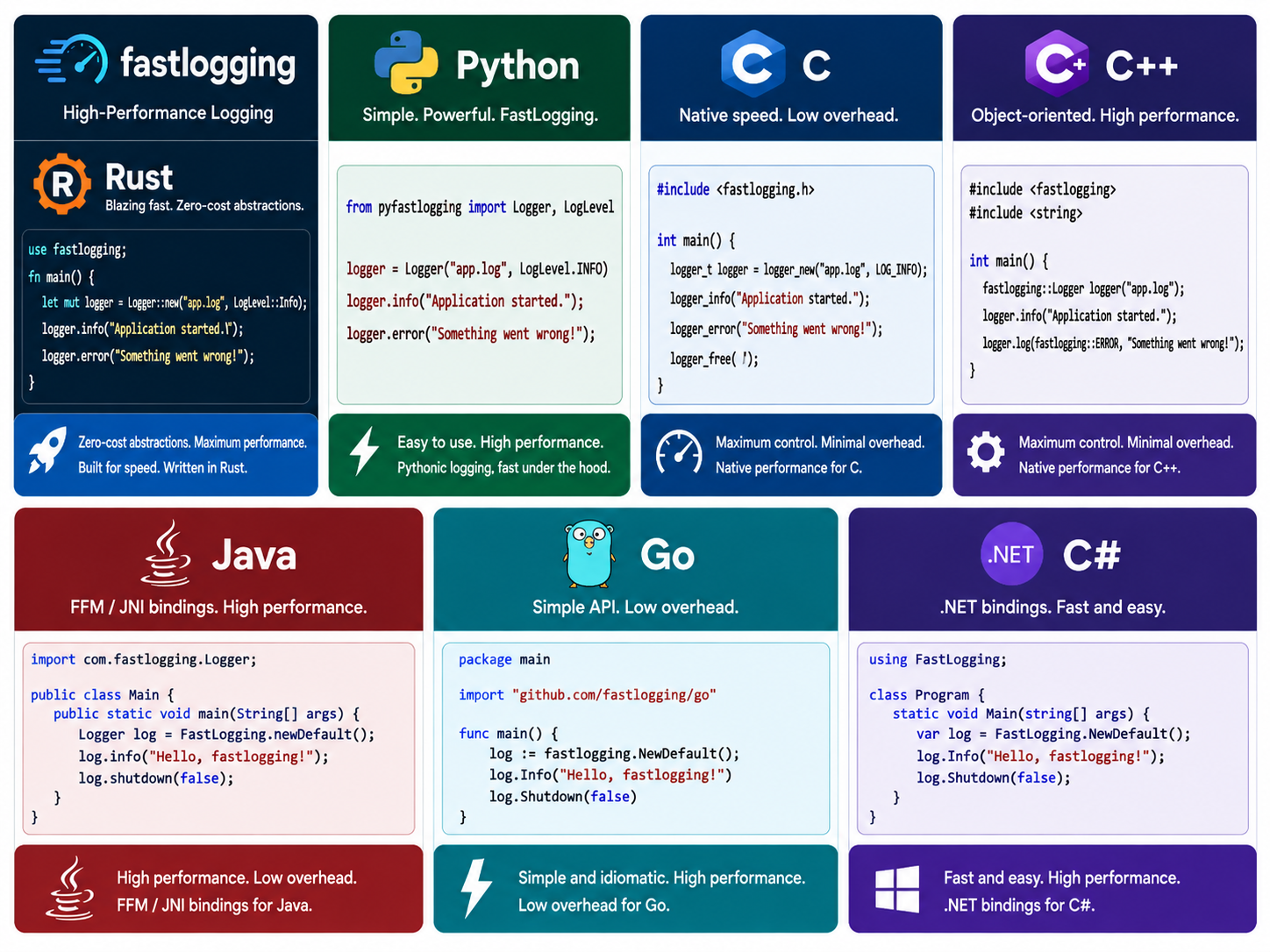
fastlogging-rs is a very fast and versatile logging framework. It supports the following programming languages with similar APIs:
- Rust (of course, as it is written in Rust ;-) )
- Python >=3.10 (using pyo3)
- C (FFI)
- C++ (FFI and CXX)
- Go
- Java FFM
- Java JNI
- C#
Features
- Extremely fast — logging calls are non-blocking and writers run in background threads
- Thread-safe logging calls
- Multiple writers (sinks) per logger: console, file, network, syslog, callback, …
- Optional file rotation and compression
- Optional AES encryption for network logging
- Configuration via API or configuration file (JSON, XML, YAML)
- Automatic forwarding of log messages from sub processes to the main process
Writers
Writers are sinks for the logging data. The following writers are available:
- Console (optional colored)
- File (optional rotation and compression)
- TCP client (optional authentication key and AES encryption)
- Syslog (Linux), EventLog (Windows)
- Callback function
All writers run in background threads. So the speed / slowness of the writers doesn't slow down the application as long as the queue is not running full.
Threads
Logging calls are thread safe.
Processes
fastlogging-rs supports logging from sub processes to the main process automatically.
So if a sub process logs messages, these messages are forwarded to the main process.
This also works with higher nesting levels. This feature is enabled by default and can be disabled.
Configuration
As an alternative to API calls, configuration can be done through a configuration file.
Supported formats are JSON, XML and YAML. The configuration file must have the filename fastlogging.<EXT>,
where EXT is one of json, xml or yaml.
Example configuration files (default and full) are available in docs/configs.
Benchmarks
To give you an idea how fast fastlogging-rs is, here are some benchmarks:
Writing to a file
| Framework | Time |
|---|---|
| Python logging | 29.37s |
| log4j | 1.48s |
| fastlogging-rs | 0.2s |
Rotating file logging
| Framework | Time |
|---|---|
| Python logging | 35.24s |
| log4j | 1.56s |
| fastlogging-rs | 0.17s |
More benchmarks can be found in doc/benchmarks in each sub package.
You can explore the full benchmark results with charts and tables: Benchmarks overview (generated from the raw JSON data).
Usage
Rust
use fastlogging::{logging_new_default, LoggingError};

fn main() -> Result<(), LoggingError> {
    let mut log = logging_new_default()?;
    log.info("Hello, fastlogging!")?;
    log.shutdown(false)?;
    Ok(())
}
Python
from fastlogging import Logging

log = Logging()
log.info("Hello, fastlogging!")
log.shutdown(False)
Documentation

Detailed documentation is available for each language binding:
- Rust: fastlogging/README.md
- Python: pyfastlogging/README.md
- C: cfastlogging/README.md
- C++: cppfastlogging/README.md
- Go: gofastlogging/README.md
- Java FFM: jfastlogging-ffm/README.md
- Java JNI: jfastlogging-jni/README.md
- C#: csharpfastlogging/README.md
Contributors

333 commits
Similar repos


Languages
Rust
39.0%
Java
18.5%
HTML
11.2%
C++
8.0%
Go
6.8%
C
6.5%
Python
5.6%
C#
2.7%
Makefile
1.2%
Fast logging module written in Rust
See the codeSee what people are saying (1)
README
fastlogging-rs
fastlogging-rs is a very fast and versatile logging framework. It supports the following programming languages with similar APIs:
- Rust (of course, as it is written in Rust ;-) )
- Python >=3.10 (using pyo3)
- C (FFI)
- C++ (FFI and CXX)
- Go
- Java FFM
- Java JNI
- C#
Features
- Extremely fast — logging calls are non-blocking and writers run in background threads
- Thread-safe logging calls
- Multiple writers (sinks) per logger: console, file, network, syslog, callback, …
- Optional file rotation and compression
- Optional AES encryption for network logging
- Configuration via API or configuration file (JSON, XML, YAML)
- Automatic forwarding of log messages from sub processes to the main process
Writers
Writers are sinks for the logging data. The following writers are available:
- Console (optional colored)
- File (optional rotation and compression)
- TCP client (optional authentication key and AES encryption)
- Syslog (Linux), EventLog (Windows)
- Callback function
All writers run in background threads. So the speed / slowness of the writers doesn't slow down the application as long as the queue is not running full.
Threads
Logging calls are thread safe.
Processes
fastlogging-rs supports logging from sub processes to the main process automatically.
So if a sub process logs messages, these messages are forwarded to the main process.
This also works with higher nesting levels. This feature is enabled by default and can be disabled.
Configuration
As an alternative to API calls, configuration can be done through a configuration file.
Supported formats are JSON, XML and YAML. The configuration file must have the filename fastlogging.<EXT>,
where EXT is one of json, xml or yaml.
Example configuration files (default and full) are available in docs/configs.
Benchmarks
To give you an idea how fast fastlogging-rs is, here are some benchmarks:
Writing to a file
| Framework | Time |
|---|---|
| Python logging | 29.37s |
| log4j | 1.48s |
| fastlogging-rs | 0.2s |
Rotating file logging
| Framework | Time |
|---|---|
| Python logging | 35.24s |
| log4j | 1.56s |
| fastlogging-rs | 0.17s |
More benchmarks can be found in doc/benchmarks in each sub package.
You can explore the full benchmark results with charts and tables: Benchmarks overview (generated from the raw JSON data).
Usage
Rust
use fastlogging::{logging_new_default, LoggingError};

fn main() -> Result<(), LoggingError> {
    let mut log = logging_new_default()?;
    log.info("Hello, fastlogging!")?;
    log.shutdown(false)?;
    Ok(())
}
Python
from fastlogging import Logging

log = Logging()
log.info("Hello, fastlogging!")
log.shutdown(False)
Documentation
Detailed documentation is available for each language binding:
- Rust: fastlogging/README.md
- Python: pyfastlogging/README.md
- C: cfastlogging/README.md
- C++: cppfastlogging/README.md
- Go: gofastlogging/README.md
- Java FFM: jfastlogging-ffm/README.md
- Java JNI: jfastlogging-jni/README.md
- C#: csharpfastlogging/README.md
Similar repos
Contributors
333 commits
Languages
Rust
39.0%
Java
18.5%
HTML
11.2%
C++
8.0%
Go
6.8%
C
6.5%
Python
5.6%
C#
2.7%
Makefile
1.2%