Toolkit to segment text into sentences or other semantic units in a robust, efficient and adaptable way.
Python
1,373
835 commits
updated Sep 25, 2026
This repository allows you to segment text into sentences or other semantic units. It implements the models from:
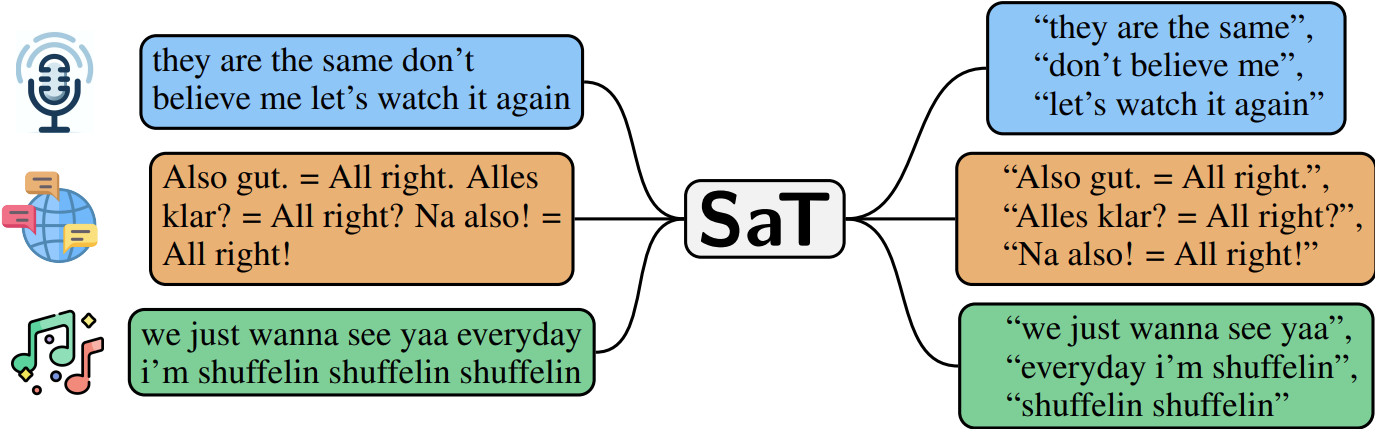
The namesake WtP is maintained for consistency. Our new followup SaT provides robust, efficient and adaptable sentence segmentation across 85 languages at higher performance and less compute cost. Check out the state-of-the-art results in 8 distinct corpora and 85 languages demonstrated in our Segment any Text paper.
pip install wtpsplit
Or one of the following for ONNX support:
pip install wtpsplit[onnx-gpu]
pip install wtpsplit[onnx-cpu]
from wtpsplit import SaT

sat = SaT("sat-3l")
# optionally run on GPU for better performance
# also supports TPUs via e.g. sat.to("xla:0"), in that case pass `pad_last_batch=True` to sat.split
sat.half().to("cuda")

sat.split("This is a test This is another test.")
# returns ["This is a test ", "This is another test."]

# do this instead of calling sat.split on every text individually for much better performance
sat.split(["This is a test This is another test.", "And some more texts..."])
# returns an iterator yielding lists of sentences for every text

# use our '-sm' models for general sentence segmentation tasks
sat_sm = SaT("sat-3l-sm")
sat_sm.half().to("cuda") # optional, see above
sat_sm.split("this is a test this is another test")
# returns ["this is a test ", "this is another test"]

# use trained lora modules for strong adaptation to language & domain/style
sat_adapted = SaT("sat-3l", style_or_domain="ud", language="en")
sat_adapted.half().to("cuda") # optional, see above
sat_adapted.split("This is a test This is another test.")
# returns ['This is a test ', 'This is another test']
torch.compile / TorchInductor)For repeated inference without exporting to ONNX, compile the PyTorch model with TorchInductor via optimize() (PyTorch 2.0+). This is optional - the first split after optimize() can be slow while graphs are built. Call optimize() after to() / half() so the compiled graph matches your device and dtype.
from wtpsplit import SaT

sat = SaT("sat-3l-sm")
sat.half().to("cuda")
sat.optimize()  # backend="inductor" (default); dynamic shapes on

sat.split("This is a test This is another test.")
ort_providers / ONNX.backend synonyms: "inductor", "torchinductor".dynamic=True is the default. mode="reduce-overhead" (CUDA graphs) is faster only when every forward uses the same shapes; otherwise use the default or mode="max-autotune-no-cudagraphs".torch.set_float32_matmul_precision("high") before inference (faster fp32 matmuls).NVIDIA AITune benchmarks backends (TensorRT, Torch-TensorRT, Torch Inductor, …) on your GPU and picks a fast path. Requires Linux, CUDA, and a separate install:
pip install wtpsplit[aitune] --extra-index-url https://pypi.nvidia.com
sat = SaT("sat-3l-sm")
sat.half().to("cuda")
# first_wins tries TensorRT → Torch-TensorRT → Inductor when available
sat.optimize(backend="aitune")
# or only Inductor via AITune (faster tuning, no TensorRT dependency):
# sat.optimize(backend="aitune", aitune_strategy="inductor_only", aitune_max_batches=4)

sat.split("This is a test This is another test.")
🚀 You can now enable even faster ONNX inference for sat and sat-sm models! 🚀
sat = SaT("sat-3l-sm", ort_providers=["CUDAExecutionProvider", "CPUExecutionProvider"])
>>> from wtpsplit import SaT
>>> texts = ["This is a sentence. This is another sentence."] * 1000

# PyTorch GPU
>>> model_pytorch = SaT("sat-3l-sm")
>>> model_pytorch.half().to("cuda");
>>> %timeit list(model_pytorch.split(texts))
# 144 ms ± 252 μs per loop (mean ± std. dev. of 7 runs, 10 loops each)
# quite fast already, but...

# onnxruntime GPU
>>> model_ort = SaT("sat-3l-sm", ort_providers=["CUDAExecutionProvider", "CPUExecutionProvider"])
>>> %timeit list(model_ort.split(texts))
# 94.9 ms ± 165 μs per loop (mean ± std. dev. of 7 runs, 10 loops each
# ...this should be ~50% faster! (tested on RTX 3090)
If you wish to use LoRA in combination with an ONNX model:
scripts/export_to_onnx_sat.py with use_lora: True and an appropriate output_dir: <OUTPUT_DIR>.
lora_path.style_or_domain and language.sat = SaT(<OUTPUT_DIR>, onnx_providers=["CUDAExecutionProvider", "CPUExecutionProvider"])If you need a general sentence segmentation model, use -sm models (e.g., sat-3l-sm)
For speed-sensitive applications, we recommend 3-layer models (sat-3l and sat-3l-sm). They provide a great tradeoff between speed and performance.
The best models are our 12-layer models: sat-12l and sat-12l-sm.
| Model | English Score | Multilingual Score |
|---|---|---|
| sat-1l | 88.5 | 84.3 |
| sat-1l-sm | 88.2 | 87.9 |
| sat-3l | 93.7 | 89.2 |
| sat-3l-lora | 96.7 | 94.8 |
| sat-3l-sm | 96.5 | 93.5 |
| sat-6l | 94.1 | 89.7 |
| sat-6l-sm | 96.9 | 95.1 |
| sat-9l | 94.3 | 90.3 |
| sat-12l | 94.0 | 90.4 |
| sat-12l-lora | 97.3 | 95.9 |
| sat-12l-sm | 97.4 | 96.0 |
The scores are macro-average F1 score across all available datasets for "English", and macro-average F1 score across all datasets and languages for "Multilingual". "adapted" means adapation via LoRA; check out the paper for details.
For comparison, here the English scores of some other tools:
| Model | English Score |
|---|---|
| PySBD | 69.6 |
| SpaCy (sentencizer; monolingual) | 92.9 |
| SpaCy (sentencizer; multilingual) | 91.5 |
| Ersatz | 91.4 |
Punkt (nltk.sent_tokenize) | 92.2 |
| WtP (3l) | 93.9 |
Note that this library also supports previous WtP models.
You can use them in essentially the same way as SaTmodels:
from wtpsplit import WtP

wtp = WtP("wtp-bert-mini")
# similar functionality as for SaT models
wtp.split("This is a test This is another test.")
For more details on WtP and reproduction details, see the WtP doc.
Since SaT are trained to predict newline probablity, they can segment text into paragraphs in addition to sentences.
# returns a list of paragraphs, each containing a list of sentences
# adjust the paragraph threshold via the `paragraph_threshold` argument.
sat.split(text, do_paragraph_segmentation=True)
Control segment lengths with min_length and max_length parameters. This is useful when you need segments within specific size limits (e.g., for embedding models, storage, or downstream processing).
from wtpsplit import SaT

sat = SaT("sat-3l-sm")

text = (
    "In the beginning God created the heaven and the earth. "
    "And the earth was without form, and void; and darkness was upon the face of the deep. "
    "And the Spirit of God moved upon the face of the waters. "
    "And God said, Let there be light: and there was light. "
    "And God saw the light, that it was good: and God divided the light from the darkness. "
    "And God called the light Day, and the darkness he called Night. "
    "And the evening and the morning were the first day."
)

# Split with a maximum segment length of 120 characters
segments = sat.split(text, max_length=120)
for i, s in enumerate(segments):
    print(f"[{len(s):3d} chars] {s}")
# [ 55 chars] In the beginning God created the heaven and the earth.
# [ 86 chars] And the earth was without form, and void; and darkness was upon the face of the deep.
# [112 chars] And the Spirit of God moved upon the face of the waters. And God said, Let there be light: and there was light.
# [ 86 chars] And God saw the light, that it was good: and God divided the light from the darkness.
# [115 chars] And God called the light Day, and the darkness he called Night. And the evening and the morning were the first day.

assert "".join(segments) == text  # text is perfectly preserved

# Enforce both min and max length
sat.split(text, min_length=80, max_length=200)

# Use the greedy algorithm for minimally faster (but less optimal) results
sat.split(text, max_length=120, algorithm="greedy")
Use priors to influence segment length distribution. Available priors:
| Prior | Best For |
|---|---|
"uniform" (default) | Just enforce max_length, let model decide |
"gaussian" | Prefer segments around a target length (intuitive) |
"lognormal" | Right-skewed preference (more tolerant of longer segments) |
"clipped_polynomial" | Must be very close to target length |
# Gaussian prior (recommended): prefer segments around target_length
sat.split(text, max_length=100, prior_type="gaussian",
          prior_kwargs={"target_length": 50, "spread": 10})

# Log-normal prior: right-skewed (more tolerant of longer segments)
sat.split(text, max_length=100, prior_type="lognormal",
          prior_kwargs={"target_length": 70, "spread": 25})

# Clipped polynomial: hard cutoff at ±spread from target
sat.split(text, max_length=100, prior_type="clipped_polynomial",
          prior_kwargs={"target_length": 60, "spread": 25})
Pass lang_code to use language-specific defaults for target_length and spread (based on language-specific corpus statistics):
# German has longer average sentences → auto-uses target_length=90, spread=35
sat.split(text, max_length=150, prior_type="gaussian",
          prior_kwargs={"lang_code": "de"})

# Chinese has shorter sentences → auto-uses target_length=45, spread=15
sat.split(text, max_length=100, prior_type="gaussian",
          prior_kwargs={"lang_code": "zh"})
When using LoRA with a language, this happens automatically:
sat = SaT("sat-3l", style_or_domain="ud", language="de")
sat.split(text, max_length=150, prior_type="gaussian")  # auto-uses German defaults
The Viterbi algorithm finds globally optimal segmentation points that balance:
Text Reconstruction:
# With constraints (max_length or min_length):
original_text = "".join(segments)  # segments may contain newlines

# Without constraints (SaT default with split_on_input_newlines=True):
original_text = "\n".join(segments)
Note: When using length constraints, segments may contain newlines. If you want to remove them, you can just post-process the output.
Note: When
max_lengthis set, thethresholdparameter is ignored. The Viterbi/greedy algorithms use raw model probabilities directly instead of threshold-based filtering.
For more details, see the Length Constraints Documentation.
SaT can be domain- and style-adapted via LoRA. We provide trained LoRA modules for Universal Dependencies, OPUS100, Ersatz, and TED (i.e., ASR-style transcribed speeches) sentence styles in 81 languages for sat-3land sat-12l. Additionally, we provide LoRA modules for legal documents (laws and judgements) in 6 languages, code-switching in 4 language pairs, and tweets in 3 languages. For details, we refer to our paper.
We also provided verse segmentation modules for 16 genres for sat-12-no-limited-lookahead.
Load LoRA modules like this:
# requires both lang_code and style_or_domain
# for available ones, check the <model_repository>/loras folder
sat_lora = SaT("sat-3l", style_or_domain="ud", language="en")
sat_lora.split("Hello this is a test But this is different now Now the next one starts looool")
# now for a highly distinct domain
sat_lora_distinct = SaT("sat-12l", style_or_domain="code-switching", language="es-en")
sat_lora_distinct.split("in the morning over there cada vez que yo decía algo él me decía algo")
You can also freely adapt the segmentation threshold, with a higher threshold leading to more conservative segmentation:
sat.split("This is a test This is another test.", threshold=0.4)
# works similarly for lora; but thresholds are higher
sat_lora.split("Hello this is a test But this is different now Now the next one starts looool", threshold=0.7)
# returns newline probabilities (supports batching!)
sat.predict_proba(text)
transformers:# import library to register the custom models
import wtpsplit.models
from transformers import AutoModelForTokenClassification
model = AutoModelForTokenClassification.from_pretrained("segment-any-text/sat-3l-sm") # or some other model name; see https://huggingface.co/segment-any-text
Our models can be efficiently adapted via LoRA in a powerful way. Only 10-100 training segmented training sentences should already improve performance considerably. To do so:
Clone the repository and install requirements:
git clone https://github.com/segment-any-text/wtpsplit
cd wtpsplit
pip install -r requirements.txt
pip install adapters==0.2.1 --no-dependencies
cd ..
import torch

torch.save(
    {
        "language_code": {
            "sentence": {
                "dummy-dataset": {
                    "meta": {
                        "train_data": ["train sentence 1", "train sentence 2"],
                    },
                    "data": [
                        "test sentence 1",
                        "test sentence 2",
                    ]
                }
            }
        }
    },
    "dummy-dataset.pth"
)
Note that there should not be any newlines within individual sentences! This now raises an error. Instead, each entry of a list should be a sentence, and there should be no "\n" characters. So your corpus should already be well-split.
model_name_or_path and training data .pth via text_path:configs/lora/lora_dummy_config.json
We recommend starting using this config, and adapting model_name_or_path, output_dir, and text_path if needed.
You may also wish to adapt other aspects such as adapter_config and batch sizes, but this is more experimental.
python3 wtpsplit/train/train_lora.py configs/lora/lora_dummy_config.json
sat_lora_adapted = SaT("model-used", lora_path="dummy_lora_path")
sat_lora_adapted.split("Some domains-specific or styled text")
Important: Use the same model variant for inference as for training (e.g. sat-12l-sm and sat-12l have different configs; an adapter trained on one cannot be loaded on the other).
Adjust the dataset name, language and model in the above to your needs.
configs/ contains the configs for the runs from the paper for base and sm models as well as LoRA modules. Launch training for each of them like this:
python3 wtpsplit/train/train.py configs/<config_name>.json
python3 wtpsplit/train/train_sm.py configs/<config_name>.json
python3 wtpsplit/train/train_lora.py configs/<config_name>.json
In addition:
wtpsplit/data_acquisition contains the code for obtaining evaluation data and raw text from the mC4 corpus.wtpsplit/evaluation contains the code for:
intrinsic.py.intrinsic_pairwise.py.llm_sentence.py), legal baseline evaluation (legal_baselines.py)intrinsic_baselines.py and intrinsic_baselines_multi.pyevaluation_results/stat_tests/punct_annotation.py and punct_annotation_wtp.py (WtP only)extrinsic.py (WtP only)Ensure to install packages from requirements.txt beforehand.
| iso | Name |
|---|---|
| af | Afrikaans |
| am | Amharic |
| ar | Arabic |
| az | Azerbaijani |
| be | Belarusian |
| bg | Bulgarian |
| bn | Bengali |
| ca | Catalan |
| ceb | Cebuano |
| cs | Czech |
| cy | Welsh |
| da | Danish |
| de | German |
| el | Greek |
| en | English |
| eo | Esperanto |
| es | Spanish |
| et | Estonian |
| eu | Basque |
| fa | Persian |
| fi | Finnish |
| fr | French |
| fy | Western Frisian |
| ga | Irish |
| gd | Scottish Gaelic |
| gl | Galician |
| gu | Gujarati |
| ha | Hausa |
| he | Hebrew |
| hi | Hindi |
| hu | Hungarian |
| hy | Armenian |
| id | Indonesian |
| ig | Igbo |
| is | Icelandic |
| it | Italian |
| ja | Japanese |
| jv | Javanese |
| ka | Georgian |
| kk | Kazakh |
| km | Central Khmer |
| kn | Kannada |
| ko | Korean |
| ku | Kurdish |
| ky | Kirghiz |
| la | Latin |
| lt | Lithuanian |
| lv | Latvian |
| mg | Malagasy |
| mk | Macedonian |
| ml | Malayalam |
| mn | Mongolian |
| mr | Marathi |
| ms | Malay |
| mt | Maltese |
| my | Burmese |
| ne | Nepali |
| nl | Dutch |
| no | Norwegian |
| pa | Panjabi |
| pl | Polish |
| ps | Pushto |
| pt | Portuguese |
| ro | Romanian |
| ru | Russian |
| si | Sinhala |
| sk | Slovak |
| sl | Slovenian |
| sq | Albanian |
| sr | Serbian |
| sv | Swedish |
| ta | Tamil |
| te | Telugu |
| tg | Tajik |
| th | Thai |
| tr | Turkish |
| uk | Ukrainian |
| ur | Urdu |
| uz | Uzbek |
| vi | Vietnamese |
| xh | Xhosa |
| yi | Yiddish |
| yo | Yoruba |
| zh | Chinese |
| zu | Zulu |
For details, please see our Segment any Text paper.
Note: Community ports are independently maintained and may have different feature sets or update schedules.
For the SaT models, please kindly cite our paper:
@inproceedings{frohmann-etal-2024-segment,
    title = "Segment Any Text: A Universal Approach for Robust, Efficient and Adaptable Sentence Segmentation",
    author = "Frohmann, Markus  and
      Sterner, Igor  and
      Vuli{\'c}, Ivan  and
      Minixhofer, Benjamin  and
      Schedl, Markus",
    editor = "Al-Onaizan, Yaser  and
      Bansal, Mohit  and
      Chen, Yun-Nung",
    booktitle = "Proceedings of the 2024 Conference on Empirical Methods in Natural Language Processing",
    month = nov,
    year = "2024",
    address = "Miami, Florida, USA",
    publisher = "Association for Computational Linguistics",
    url = "https://aclanthology.org/2024.emnlp-main.665",
    pages = "11908--11941"
}
For the library and the WtP models, please cite:
@inproceedings{minixhofer-etal-2023-wheres,
    title = "Where{'}s the Point? Self-Supervised Multilingual Punctuation-Agnostic Sentence Segmentation",
    author = "Minixhofer, Benjamin  and
      Pfeiffer, Jonas  and
      Vuli{\'c}, Ivan",
    booktitle = "Proceedings of the 61st Annual Meeting of the Association for Computational Linguistics (Volume 1: Long Papers)",
    month = jul,
    year = "2023",
    address = "Toronto, Canada",
    publisher = "Association for Computational Linguistics",
    url = "https://aclanthology.org/2023.acl-long.398",
    pages = "7215--7235"
}
This research was funded in whole or in part by the Austrian Science Fund (FWF): P36413, P33526, and DFH-23, and by the State of Upper Austria and the Federal Ministry of Education, Science, and Research, through grants LIT-2021-YOU-215. In addition, Ivan Vulic and Benjamin Minixhofer have been supported through the Royal Society University Research Fellowship ‘Inclusive and Sustainable Language Technology for a Truly Multilingual World’ (no 221137) awarded to Ivan Vulić. This research has also been supported with Cloud TPUs from Google’s TPU Research Cloud (TRC). This work was also supported by compute credits from a Cohere For AI Research Grant, these grants are designed to support academic partners conducting research with the goal of releasing scientific artifacts and data for good projects. We also thank Simone Teufel for fruitful discussions.
For any questions, please create an issue or send an email to [email protected], and I will get back to you as soon as possible.
Toolkit to segment text into sentences or other semantic units in a robust, efficient and adaptable way.
Python
1,373
835 commits
updated Sep 25, 2026
This repository allows you to segment text into sentences or other semantic units. It implements the models from:
The namesake WtP is maintained for consistency. Our new followup SaT provides robust, efficient and adaptable sentence segmentation across 85 languages at higher performance and less compute cost. Check out the state-of-the-art results in 8 distinct corpora and 85 languages demonstrated in our Segment any Text paper.
pip install wtpsplit
Or one of the following for ONNX support:
pip install wtpsplit[onnx-gpu]
pip install wtpsplit[onnx-cpu]
from wtpsplit import SaT

sat = SaT("sat-3l")
# optionally run on GPU for better performance
# also supports TPUs via e.g. sat.to("xla:0"), in that case pass `pad_last_batch=True` to sat.split
sat.half().to("cuda")

sat.split("This is a test This is another test.")
# returns ["This is a test ", "This is another test."]

# do this instead of calling sat.split on every text individually for much better performance
sat.split(["This is a test This is another test.", "And some more texts..."])
# returns an iterator yielding lists of sentences for every text

# use our '-sm' models for general sentence segmentation tasks
sat_sm = SaT("sat-3l-sm")
sat_sm.half().to("cuda") # optional, see above
sat_sm.split("this is a test this is another test")
# returns ["this is a test ", "this is another test"]

# use trained lora modules for strong adaptation to language & domain/style
sat_adapted = SaT("sat-3l", style_or_domain="ud", language="en")
sat_adapted.half().to("cuda") # optional, see above
sat_adapted.split("This is a test This is another test.")
# returns ['This is a test ', 'This is another test']
torch.compile / TorchInductor)For repeated inference without exporting to ONNX, compile the PyTorch model with TorchInductor via optimize() (PyTorch 2.0+). This is optional - the first split after optimize() can be slow while graphs are built. Call optimize() after to() / half() so the compiled graph matches your device and dtype.
from wtpsplit import SaT

sat = SaT("sat-3l-sm")
sat.half().to("cuda")
sat.optimize()  # backend="inductor" (default); dynamic shapes on

sat.split("This is a test This is another test.")
ort_providers / ONNX.backend synonyms: "inductor", "torchinductor".dynamic=True is the default. mode="reduce-overhead" (CUDA graphs) is faster only when every forward uses the same shapes; otherwise use the default or mode="max-autotune-no-cudagraphs".torch.set_float32_matmul_precision("high") before inference (faster fp32 matmuls).NVIDIA AITune benchmarks backends (TensorRT, Torch-TensorRT, Torch Inductor, …) on your GPU and picks a fast path. Requires Linux, CUDA, and a separate install:
pip install wtpsplit[aitune] --extra-index-url https://pypi.nvidia.com
sat = SaT("sat-3l-sm")
sat.half().to("cuda")
# first_wins tries TensorRT → Torch-TensorRT → Inductor when available
sat.optimize(backend="aitune")
# or only Inductor via AITune (faster tuning, no TensorRT dependency):
# sat.optimize(backend="aitune", aitune_strategy="inductor_only", aitune_max_batches=4)

sat.split("This is a test This is another test.")
🚀 You can now enable even faster ONNX inference for sat and sat-sm models! 🚀
sat = SaT("sat-3l-sm", ort_providers=["CUDAExecutionProvider", "CPUExecutionProvider"])
>>> from wtpsplit import SaT
>>> texts = ["This is a sentence. This is another sentence."] * 1000

# PyTorch GPU
>>> model_pytorch = SaT("sat-3l-sm")
>>> model_pytorch.half().to("cuda");
>>> %timeit list(model_pytorch.split(texts))
# 144 ms ± 252 μs per loop (mean ± std. dev. of 7 runs, 10 loops each)
# quite fast already, but...

# onnxruntime GPU
>>> model_ort = SaT("sat-3l-sm", ort_providers=["CUDAExecutionProvider", "CPUExecutionProvider"])
>>> %timeit list(model_ort.split(texts))
# 94.9 ms ± 165 μs per loop (mean ± std. dev. of 7 runs, 10 loops each
# ...this should be ~50% faster! (tested on RTX 3090)
If you wish to use LoRA in combination with an ONNX model:
scripts/export_to_onnx_sat.py with use_lora: True and an appropriate output_dir: <OUTPUT_DIR>.
lora_path.style_or_domain and language.sat = SaT(<OUTPUT_DIR>, onnx_providers=["CUDAExecutionProvider", "CPUExecutionProvider"])If you need a general sentence segmentation model, use -sm models (e.g., sat-3l-sm)
For speed-sensitive applications, we recommend 3-layer models (sat-3l and sat-3l-sm). They provide a great tradeoff between speed and performance.
The best models are our 12-layer models: sat-12l and sat-12l-sm.
| Model | English Score | Multilingual Score |
|---|---|---|
| sat-1l | 88.5 | 84.3 |
| sat-1l-sm | 88.2 | 87.9 |
| sat-3l | 93.7 | 89.2 |
| sat-3l-lora | 96.7 | 94.8 |
| sat-3l-sm | 96.5 | 93.5 |
| sat-6l | 94.1 | 89.7 |
| sat-6l-sm | 96.9 | 95.1 |
| sat-9l | 94.3 | 90.3 |
| sat-12l | 94.0 | 90.4 |
| sat-12l-lora | 97.3 | 95.9 |
| sat-12l-sm | 97.4 | 96.0 |
The scores are macro-average F1 score across all available datasets for "English", and macro-average F1 score across all datasets and languages for "Multilingual". "adapted" means adapation via LoRA; check out the paper for details.
For comparison, here the English scores of some other tools:
| Model | English Score |
|---|---|
| PySBD | 69.6 |
| SpaCy (sentencizer; monolingual) | 92.9 |
| SpaCy (sentencizer; multilingual) | 91.5 |
| Ersatz | 91.4 |
Punkt (nltk.sent_tokenize) | 92.2 |
| WtP (3l) | 93.9 |
Note that this library also supports previous WtP models.
You can use them in essentially the same way as SaTmodels:
from wtpsplit import WtP

wtp = WtP("wtp-bert-mini")
# similar functionality as for SaT models
wtp.split("This is a test This is another test.")
For more details on WtP and reproduction details, see the WtP doc.
Since SaT are trained to predict newline probablity, they can segment text into paragraphs in addition to sentences.
# returns a list of paragraphs, each containing a list of sentences
# adjust the paragraph threshold via the `paragraph_threshold` argument.
sat.split(text, do_paragraph_segmentation=True)
Control segment lengths with min_length and max_length parameters. This is useful when you need segments within specific size limits (e.g., for embedding models, storage, or downstream processing).
from wtpsplit import SaT

sat = SaT("sat-3l-sm")

text = (
    "In the beginning God created the heaven and the earth. "
    "And the earth was without form, and void; and darkness was upon the face of the deep. "
    "And the Spirit of God moved upon the face of the waters. "
    "And God said, Let there be light: and there was light. "
    "And God saw the light, that it was good: and God divided the light from the darkness. "
    "And God called the light Day, and the darkness he called Night. "
    "And the evening and the morning were the first day."
)

# Split with a maximum segment length of 120 characters
segments = sat.split(text, max_length=120)
for i, s in enumerate(segments):
    print(f"[{len(s):3d} chars] {s}")
# [ 55 chars] In the beginning God created the heaven and the earth.
# [ 86 chars] And the earth was without form, and void; and darkness was upon the face of the deep.
# [112 chars] And the Spirit of God moved upon the face of the waters. And God said, Let there be light: and there was light.
# [ 86 chars] And God saw the light, that it was good: and God divided the light from the darkness.
# [115 chars] And God called the light Day, and the darkness he called Night. And the evening and the morning were the first day.

assert "".join(segments) == text  # text is perfectly preserved

# Enforce both min and max length
sat.split(text, min_length=80, max_length=200)

# Use the greedy algorithm for minimally faster (but less optimal) results
sat.split(text, max_length=120, algorithm="greedy")
Use priors to influence segment length distribution. Available priors:
| Prior | Best For |
|---|---|
"uniform" (default) | Just enforce max_length, let model decide |
"gaussian" | Prefer segments around a target length (intuitive) |
"lognormal" | Right-skewed preference (more tolerant of longer segments) |
"clipped_polynomial" | Must be very close to target length |
# Gaussian prior (recommended): prefer segments around target_length
sat.split(text, max_length=100, prior_type="gaussian",
          prior_kwargs={"target_length": 50, "spread": 10})

# Log-normal prior: right-skewed (more tolerant of longer segments)
sat.split(text, max_length=100, prior_type="lognormal",
          prior_kwargs={"target_length": 70, "spread": 25})

# Clipped polynomial: hard cutoff at ±spread from target
sat.split(text, max_length=100, prior_type="clipped_polynomial",
          prior_kwargs={"target_length": 60, "spread": 25})
Pass lang_code to use language-specific defaults for target_length and spread (based on language-specific corpus statistics):
# German has longer average sentences → auto-uses target_length=90, spread=35
sat.split(text, max_length=150, prior_type="gaussian",
          prior_kwargs={"lang_code": "de"})

# Chinese has shorter sentences → auto-uses target_length=45, spread=15
sat.split(text, max_length=100, prior_type="gaussian",
          prior_kwargs={"lang_code": "zh"})
When using LoRA with a language, this happens automatically:
sat = SaT("sat-3l", style_or_domain="ud", language="de")
sat.split(text, max_length=150, prior_type="gaussian")  # auto-uses German defaults
The Viterbi algorithm finds globally optimal segmentation points that balance:
Text Reconstruction:
# With constraints (max_length or min_length):
original_text = "".join(segments)  # segments may contain newlines

# Without constraints (SaT default with split_on_input_newlines=True):
original_text = "\n".join(segments)
Note: When using length constraints, segments may contain newlines. If you want to remove them, you can just post-process the output.
Note: When
max_lengthis set, thethresholdparameter is ignored. The Viterbi/greedy algorithms use raw model probabilities directly instead of threshold-based filtering.
For more details, see the Length Constraints Documentation.
SaT can be domain- and style-adapted via LoRA. We provide trained LoRA modules for Universal Dependencies, OPUS100, Ersatz, and TED (i.e., ASR-style transcribed speeches) sentence styles in 81 languages for sat-3land sat-12l. Additionally, we provide LoRA modules for legal documents (laws and judgements) in 6 languages, code-switching in 4 language pairs, and tweets in 3 languages. For details, we refer to our paper.
We also provided verse segmentation modules for 16 genres for sat-12-no-limited-lookahead.
Load LoRA modules like this:
# requires both lang_code and style_or_domain
# for available ones, check the <model_repository>/loras folder
sat_lora = SaT("sat-3l", style_or_domain="ud", language="en")
sat_lora.split("Hello this is a test But this is different now Now the next one starts looool")
# now for a highly distinct domain
sat_lora_distinct = SaT("sat-12l", style_or_domain="code-switching", language="es-en")
sat_lora_distinct.split("in the morning over there cada vez que yo decía algo él me decía algo")
You can also freely adapt the segmentation threshold, with a higher threshold leading to more conservative segmentation:
sat.split("This is a test This is another test.", threshold=0.4)
# works similarly for lora; but thresholds are higher
sat_lora.split("Hello this is a test But this is different now Now the next one starts looool", threshold=0.7)
# returns newline probabilities (supports batching!)
sat.predict_proba(text)
transformers:# import library to register the custom models
import wtpsplit.models
from transformers import AutoModelForTokenClassification
model = AutoModelForTokenClassification.from_pretrained("segment-any-text/sat-3l-sm") # or some other model name; see https://huggingface.co/segment-any-text
Our models can be efficiently adapted via LoRA in a powerful way. Only 10-100 training segmented training sentences should already improve performance considerably. To do so:
Clone the repository and install requirements:
git clone https://github.com/segment-any-text/wtpsplit
cd wtpsplit
pip install -r requirements.txt
pip install adapters==0.2.1 --no-dependencies
cd ..
import torch

torch.save(
    {
        "language_code": {
            "sentence": {
                "dummy-dataset": {
                    "meta": {
                        "train_data": ["train sentence 1", "train sentence 2"],
                    },
                    "data": [
                        "test sentence 1",
                        "test sentence 2",
                    ]
                }
            }
        }
    },
    "dummy-dataset.pth"
)
Note that there should not be any newlines within individual sentences! This now raises an error. Instead, each entry of a list should be a sentence, and there should be no "\n" characters. So your corpus should already be well-split.
model_name_or_path and training data .pth via text_path:configs/lora/lora_dummy_config.json
We recommend starting using this config, and adapting model_name_or_path, output_dir, and text_path if needed.
You may also wish to adapt other aspects such as adapter_config and batch sizes, but this is more experimental.
python3 wtpsplit/train/train_lora.py configs/lora/lora_dummy_config.json
sat_lora_adapted = SaT("model-used", lora_path="dummy_lora_path")
sat_lora_adapted.split("Some domains-specific or styled text")
Important: Use the same model variant for inference as for training (e.g. sat-12l-sm and sat-12l have different configs; an adapter trained on one cannot be loaded on the other).
Adjust the dataset name, language and model in the above to your needs.
configs/ contains the configs for the runs from the paper for base and sm models as well as LoRA modules. Launch training for each of them like this:
python3 wtpsplit/train/train.py configs/<config_name>.json
python3 wtpsplit/train/train_sm.py configs/<config_name>.json
python3 wtpsplit/train/train_lora.py configs/<config_name>.json
In addition:
wtpsplit/data_acquisition contains the code for obtaining evaluation data and raw text from the mC4 corpus.wtpsplit/evaluation contains the code for:
intrinsic.py.intrinsic_pairwise.py.llm_sentence.py), legal baseline evaluation (legal_baselines.py)intrinsic_baselines.py and intrinsic_baselines_multi.pyevaluation_results/stat_tests/punct_annotation.py and punct_annotation_wtp.py (WtP only)extrinsic.py (WtP only)Ensure to install packages from requirements.txt beforehand.
| iso | Name |
|---|---|
| af | Afrikaans |
| am | Amharic |
| ar | Arabic |
| az | Azerbaijani |
| be | Belarusian |
| bg | Bulgarian |
| bn | Bengali |
| ca | Catalan |
| ceb | Cebuano |
| cs | Czech |
| cy | Welsh |
| da | Danish |
| de | German |
| el | Greek |
| en | English |
| eo | Esperanto |
| es | Spanish |
| et | Estonian |
| eu | Basque |
| fa | Persian |
| fi | Finnish |
| fr | French |
| fy | Western Frisian |
| ga | Irish |
| gd | Scottish Gaelic |
| gl | Galician |
| gu | Gujarati |
| ha | Hausa |
| he | Hebrew |
| hi | Hindi |
| hu | Hungarian |
| hy | Armenian |
| id | Indonesian |
| ig | Igbo |
| is | Icelandic |
| it | Italian |
| ja | Japanese |
| jv | Javanese |
| ka | Georgian |
| kk | Kazakh |
| km | Central Khmer |
| kn | Kannada |
| ko | Korean |
| ku | Kurdish |
| ky | Kirghiz |
| la | Latin |
| lt | Lithuanian |
| lv | Latvian |
| mg | Malagasy |
| mk | Macedonian |
| ml | Malayalam |
| mn | Mongolian |
| mr | Marathi |
| ms | Malay |
| mt | Maltese |
| my | Burmese |
| ne | Nepali |
| nl | Dutch |
| no | Norwegian |
| pa | Panjabi |
| pl | Polish |
| ps | Pushto |
| pt | Portuguese |
| ro | Romanian |
| ru | Russian |
| si | Sinhala |
| sk | Slovak |
| sl | Slovenian |
| sq | Albanian |
| sr | Serbian |
| sv | Swedish |
| ta | Tamil |
| te | Telugu |
| tg | Tajik |
| th | Thai |
| tr | Turkish |
| uk | Ukrainian |
| ur | Urdu |
| uz | Uzbek |
| vi | Vietnamese |
| xh | Xhosa |
| yi | Yiddish |
| yo | Yoruba |
| zh | Chinese |
| zu | Zulu |
For details, please see our Segment any Text paper.
Note: Community ports are independently maintained and may have different feature sets or update schedules.
For the SaT models, please kindly cite our paper:
@inproceedings{frohmann-etal-2024-segment,
    title = "Segment Any Text: A Universal Approach for Robust, Efficient and Adaptable Sentence Segmentation",
    author = "Frohmann, Markus  and
      Sterner, Igor  and
      Vuli{\'c}, Ivan  and
      Minixhofer, Benjamin  and
      Schedl, Markus",
    editor = "Al-Onaizan, Yaser  and
      Bansal, Mohit  and
      Chen, Yun-Nung",
    booktitle = "Proceedings of the 2024 Conference on Empirical Methods in Natural Language Processing",
    month = nov,
    year = "2024",
    address = "Miami, Florida, USA",
    publisher = "Association for Computational Linguistics",
    url = "https://aclanthology.org/2024.emnlp-main.665",
    pages = "11908--11941"
}
For the library and the WtP models, please cite:
@inproceedings{minixhofer-etal-2023-wheres,
    title = "Where{'}s the Point? Self-Supervised Multilingual Punctuation-Agnostic Sentence Segmentation",
    author = "Minixhofer, Benjamin  and
      Pfeiffer, Jonas  and
      Vuli{\'c}, Ivan",
    booktitle = "Proceedings of the 61st Annual Meeting of the Association for Computational Linguistics (Volume 1: Long Papers)",
    month = jul,
    year = "2023",
    address = "Toronto, Canada",
    publisher = "Association for Computational Linguistics",
    url = "https://aclanthology.org/2023.acl-long.398",
    pages = "7215--7235"
}
This research was funded in whole or in part by the Austrian Science Fund (FWF): P36413, P33526, and DFH-23, and by the State of Upper Austria and the Federal Ministry of Education, Science, and Research, through grants LIT-2021-YOU-215. In addition, Ivan Vulic and Benjamin Minixhofer have been supported through the Royal Society University Research Fellowship ‘Inclusive and Sustainable Language Technology for a Truly Multilingual World’ (no 221137) awarded to Ivan Vulić. This research has also been supported with Cloud TPUs from Google’s TPU Research Cloud (TRC). This work was also supported by compute credits from a Cohere For AI Research Grant, these grants are designed to support academic partners conducting research with the goal of releasing scientific artifacts and data for good projects. We also thank Simone Teufel for fruitful discussions.
For any questions, please create an issue or send an email to [email protected], and I will get back to you as soon as possible.