
A desktop AI agent that checks actions against an approved task. Built on Goose.
Rust
0
41 commits
updated Sep 10, 2026
README
 AccordLock
A desktop AI agent that checks actions against an approved task.
Based on Goose, with a Rust runtime for protected file, command and network operations.

Engineering alpha. For local evaluation. Production deployment has not been validated, and signed installers are not available.
Run the demo | Desktop source | Current status | Roadmap
Try it without a model
From the repository root:
python scripts/run_demo.py --display markdown
Requires Python 3.11+, the pinned Rust toolchain, and C++ build tools on Windows. The demo builds native programs and tests five cases: protected files, blocked domains, action-bound approval, single-use grants and stale authority.
PASS provider_free_demo cases=5 provider=NONE network=NOT_ATTEMPTED
No model or cloud account is needed. The cases make no external requests. See the demo guide for offline mode and expected results.
What you can use
| Area | Available in this source |
|---|---|
| Desktop | Projects, tasks, model connections, approvals and settings |
| Files and commands | Scoped access, change previews, recoverable file deletion and configured executable access |
| Network | HTTPS GET and HEAD on exact configured public domains |
| Audit | Action history, integrity checks, search, JSON/Markdown export, revocation and supported file recovery |
| Cloud preflight | Read-only GitHub, ECR, EKS and Kubernetes observations with signed receipts; real-account validation remains |
| Remote approvals | Local protocol foundations for Slack, Teams, Telegram and WhatsApp; live gateways still need validation |
Provider and model compatibility varies. File recovery covers supported operations; it cannot undo every external action.
How actions are checked
The agent proposes an action. The runtime checks its task permissions, relevant state and expiry. An allowed action receives a single-use grant. A broker consumes that grant before attempting the action and records the result.
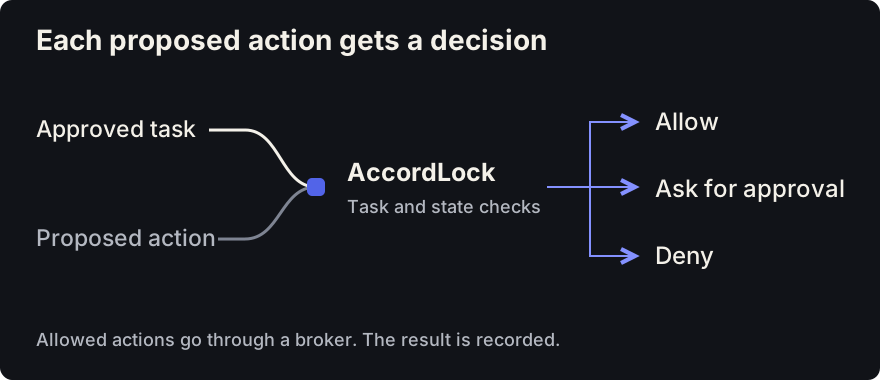
Changing a bound target or argument invalidates the authorization. Consumed
grants cannot be reused. When a broker cannot confirm the result, it records
UNKNOWN; that outcome requires reconciliation before another attempt.
These controls apply to supported actions routed through the brokers. Untrusted content cannot grant extra permissions on those paths. Actions that bypass the runtime are outside its protection.
The desktop's free-text intent check currently shows Not verified: it has no qualified production evidence provider. Structural task permissions still apply. An allowed action is not proof that the model understood the request.
See the architecture and threat model.
Tests and formal models
This snapshot includes 81 Lean theorems over selected abstract authorization properties, eight bounded TLA+ models and 73 AccordBench cases. Ten assurance claims link models to source and tests.
python assurance/verify.py --root runtime --json
python -m unittest discover -s assurance/tests -t assurance -v
The models do not prove the complete Rust implementation or a production deployment. Read the assurance contract and local validation record for scope and results.
Whence informs the treatment of configuration provenance and stale authority. Research provenance explains that connection.
ETP defines separate, product-neutral records for action authorization and outcomes. Native ETP mediation is planned.
Before production use
Clean-checkout desktop validation, signed installation and updates, retained cloud and messaging tests, and an independent security review remain open. See known limitations.
Source and license
The desktop, runtime and assurance tools are included here. Source provenance records the published snapshot.
Apache-2.0, with attribution in NOTICE and third-party notices. Read CONTRIBUTING.md before changing an enforcement path. Report vulnerabilities through SECURITY.md.
Contributors

41 commits
Similar repos


Languages
Rust
69.0%
TypeScript
21.8%
Python
3.6%
TLA
1.2%
PLpgSQL
1.0%
A desktop AI agent that checks actions against an approved task. Built on Goose.
Rust
0
41 commits
updated Sep 10, 2026
README
AccordLock
A desktop AI agent that checks actions against an approved task.
Based on Goose, with a Rust runtime for protected file, command and network operations.
Engineering alpha. For local evaluation. Production deployment has not been validated, and signed installers are not available.
Run the demo | Desktop source | Current status | Roadmap
Try it without a model
From the repository root:
python scripts/run_demo.py --display markdown
Requires Python 3.11+, the pinned Rust toolchain, and C++ build tools on Windows. The demo builds native programs and tests five cases: protected files, blocked domains, action-bound approval, single-use grants and stale authority.
PASS provider_free_demo cases=5 provider=NONE network=NOT_ATTEMPTED
No model or cloud account is needed. The cases make no external requests. See the demo guide for offline mode and expected results.
What you can use
| Area | Available in this source |
|---|---|
| Desktop | Projects, tasks, model connections, approvals and settings |
| Files and commands | Scoped access, change previews, recoverable file deletion and configured executable access |
| Network | HTTPS GET and HEAD on exact configured public domains |
| Audit | Action history, integrity checks, search, JSON/Markdown export, revocation and supported file recovery |
| Cloud preflight | Read-only GitHub, ECR, EKS and Kubernetes observations with signed receipts; real-account validation remains |
| Remote approvals | Local protocol foundations for Slack, Teams, Telegram and WhatsApp; live gateways still need validation |
Provider and model compatibility varies. File recovery covers supported operations; it cannot undo every external action.
How actions are checked
The agent proposes an action. The runtime checks its task permissions, relevant state and expiry. An allowed action receives a single-use grant. A broker consumes that grant before attempting the action and records the result.
Changing a bound target or argument invalidates the authorization. Consumed
grants cannot be reused. When a broker cannot confirm the result, it records
UNKNOWN; that outcome requires reconciliation before another attempt.
These controls apply to supported actions routed through the brokers. Untrusted content cannot grant extra permissions on those paths. Actions that bypass the runtime are outside its protection.
The desktop's free-text intent check currently shows Not verified: it has no qualified production evidence provider. Structural task permissions still apply. An allowed action is not proof that the model understood the request.
See the architecture and threat model.
Tests and formal models
This snapshot includes 81 Lean theorems over selected abstract authorization properties, eight bounded TLA+ models and 73 AccordBench cases. Ten assurance claims link models to source and tests.
python assurance/verify.py --root runtime --json
python -m unittest discover -s assurance/tests -t assurance -v
The models do not prove the complete Rust implementation or a production deployment. Read the assurance contract and local validation record for scope and results.
Whence informs the treatment of configuration provenance and stale authority. Research provenance explains that connection.
ETP defines separate, product-neutral records for action authorization and outcomes. Native ETP mediation is planned.
Before production use
Clean-checkout desktop validation, signed installation and updates, retained cloud and messaging tests, and an independent security review remain open. See known limitations.
Source and license
The desktop, runtime and assurance tools are included here. Source provenance records the published snapshot.
Apache-2.0, with attribution in NOTICE and third-party notices. Read CONTRIBUTING.md before changing an enforcement path. Report vulnerabilities through SECURITY.md.
Similar repos
Contributors
41 commits
Languages
Rust
69.0%
TypeScript
21.8%
Python
3.6%
TLA
1.2%
PLpgSQL
1.0%