
Implementation of denoising diffusion models with schedules, improved sampling, and other extensions using Keras.
Python
120
69 commits
updated Jan 22, 2024
README
Modular and Readable Denoising Diffusion Models in Keras

Diffusion models are trained to denoise noisy images, and can generate images by iteratively denoising pure noise.


This repository contains:
- An implementation of Denoising Diffusion Implicit Models (DDIM) with continuous time. All variables are properly named and the code is densely commented. It was used for ablations and hyperparameter optimization for the corresponding Keras code example.
- Stochastic sampling, with which the model becomes a Denoising Diffusion Probabilistic Model (DDPM).
Stochasticitycorresponds to eta in the DDIM paper, while thevariance_preservingflag selects between the two sampling versions (Equation 16 in DDIM). - General second-order sampling, as proposed in Elucidating the Design Space of Diffusion-Based Generative Models, controlled with
second_order_alpha. - Multistep sampling, similarly to Pseudo Numerical Methods for Diffusion Models on Manifolds (PNDM), supporting
num_multistepsbetween 1 and 5. Note that in the initial steps I use lower order multistep sampling, instead of other higher-order methods, for simplicity. - 3 diffusion schedules, selected with
schedule_type, see below. - 3 network parametrizations, selected with
prediction_type. It can predict the unscaled random gaussian noise, the original image, or even the diffusion velocity (v in Section 4). - 3 loss weightings, selected with
loss_type, which correspond minimising the error of the predicted unscaled noise, predicted original image, or the diffusion velocity.
The network was optimized to offer reasonable performance with modest compute requirements (training time is below an hour on an A100). Other design choices are explained in detail in the corresponding Keras code example.
Sampling techniques
KID at different sampling steps with different sampling techniques, using cosine schedule. Note that I selected the sampling hyperparameters using DDIM sampling and 5 diffusion steps.
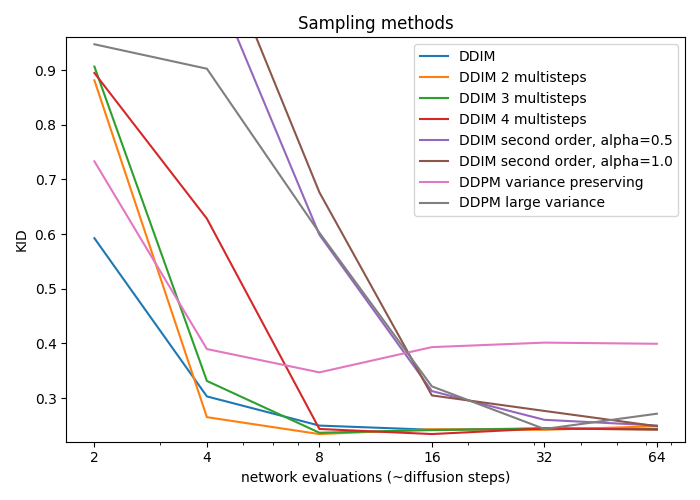
For first order methods network evaluations = diffusion steps, and for second order methods network evaluations = 2 * diffusion steps.
Diffusion schedules
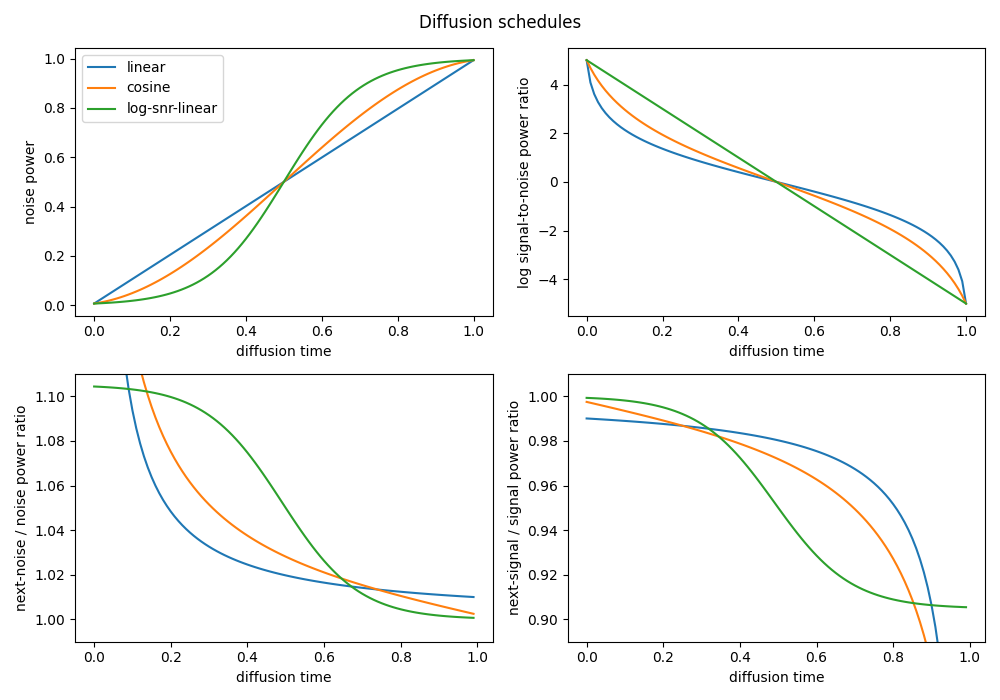
For this plot I used 100 diffusion steps, and a start_log_snr and end_log_snr of 5.0 and -5.0 for symmetry, while their defaults are 2.5 and -7.5.
For implementation details, check out diffusion_schedule() in model.py.
Generation quality
Kernel Inception Distance (KID):
| Dataset / Loss | mean absolute error (MAE) | mean squared error (MSE) |
|---|---|---|
| Oxford Flowers | 0.282 | 0.399 |
| CelebA | 0.148 | 0.104 |
| Caltech Birds | 1.382 | 1.697 |
| CIFAR-10 | 0.217 | 0.175 |
| Network output / Loss weighting | noise | velocity | signal |
|---|---|---|---|
| noise | 0.282 | 0.327 | 0.348 |
| velocity | 0.299 | 0.290 | 0.333 |
| signal | 0.291 | 0.319 | 0.329 |
Trained with default hyperparameters if not mentioned otherwise, tuned on Oxford Flowers.
- KID is a generative performance metric with a simple unbiased estimator, that is more suitable for limited amounts of images, and is also computationally cheaper to measure compared to the Frechet Inception Distance (FID).
- The Inceptionv3 network's pretrained weights are loaded from Keras applications.
- For computational efficiency, the images are evaluated at the minimal possible resolution (75x75 instead of 299x299), therefore the exact values might not be comparable with other implementations.
- For computational efficiency, it is measured only on the validation splits of the datasets.
- For computational efficiency, it is measured on images generated with only 5 diffusion steps.
Visualizations
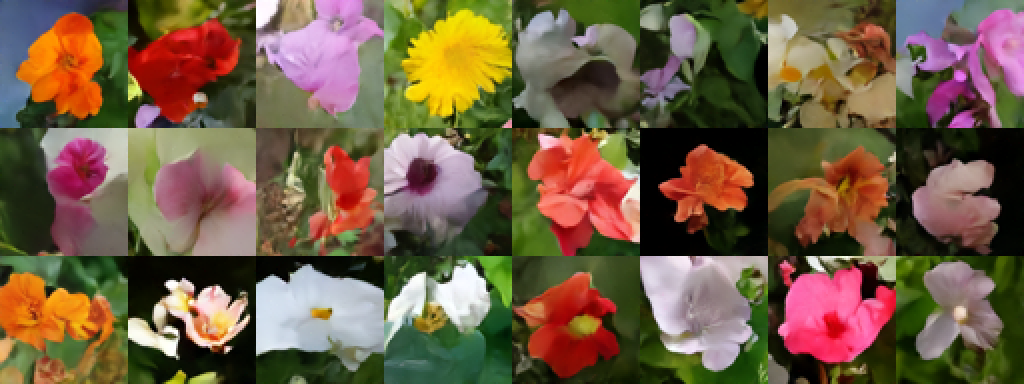
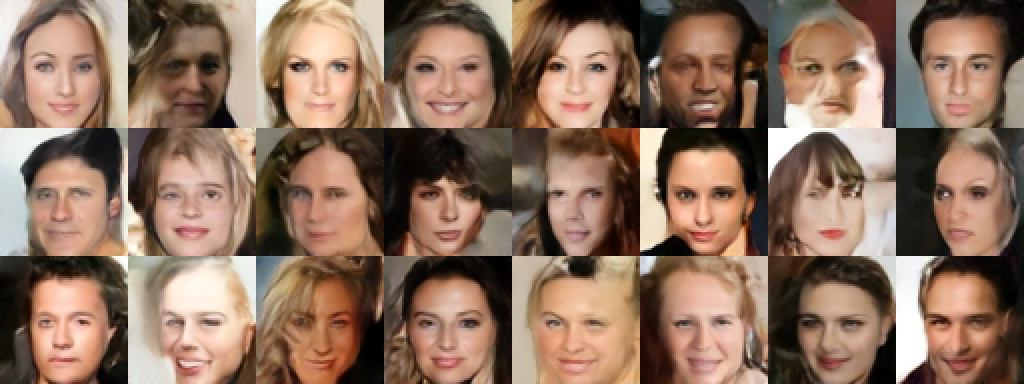
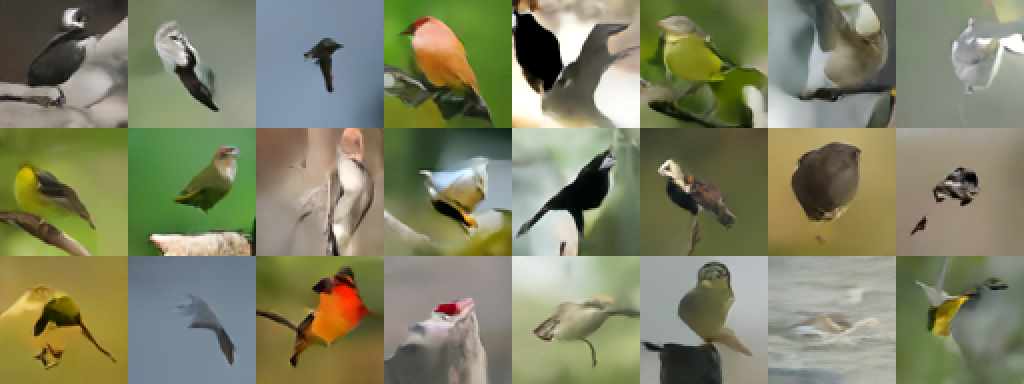
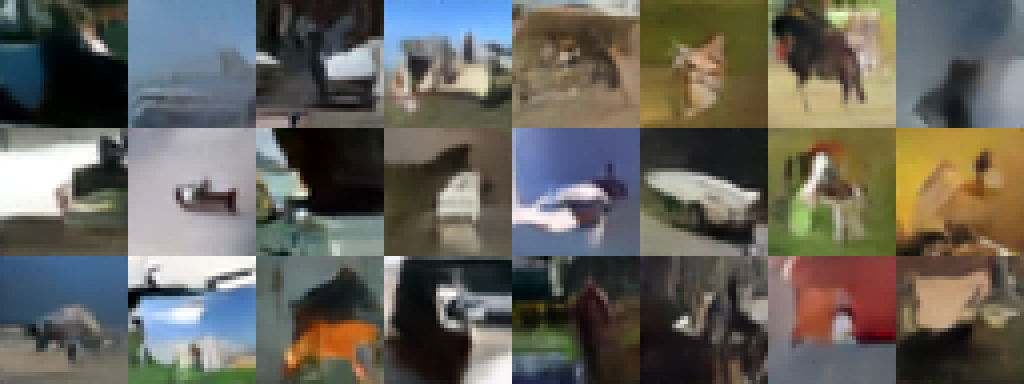
All visualizations below were generated using:
- 200 diffusion steps
- DDPM sampling with large variance (
stochasticity = 1.0, variance_preserving = False) - all other parameters left on default
Oxford Flowers 102
- 6500 training images (80% of every split)
- 64x64 resolution, center cropped
CelebFaces Attributes (CelebA)
- 160.000 training images
- 64x64 resolution, center cropped
Caltech Birds 2011 (CUB-200)
- 6000 training images
- 64x64 resolution, cropped on bounding boxes
CIFAR-10
- 50.000 training images
- 32x32 resolution
For a similar implementation of GANs and GAN losses, check out this repository.
Significant stargazers

161 followers · starred Jan 2024
Similar repos




Implementation of denoising diffusion models with schedules, improved sampling, and other extensions using Keras.
Python
120
69 commits
updated Jan 22, 2024
README
Modular and Readable Denoising Diffusion Models in Keras
Diffusion models are trained to denoise noisy images, and can generate images by iteratively denoising pure noise.
This repository contains:
- An implementation of Denoising Diffusion Implicit Models (DDIM) with continuous time. All variables are properly named and the code is densely commented. It was used for ablations and hyperparameter optimization for the corresponding Keras code example.
- Stochastic sampling, with which the model becomes a Denoising Diffusion Probabilistic Model (DDPM).
Stochasticitycorresponds to eta in the DDIM paper, while thevariance_preservingflag selects between the two sampling versions (Equation 16 in DDIM). - General second-order sampling, as proposed in Elucidating the Design Space of Diffusion-Based Generative Models, controlled with
second_order_alpha. - Multistep sampling, similarly to Pseudo Numerical Methods for Diffusion Models on Manifolds (PNDM), supporting
num_multistepsbetween 1 and 5. Note that in the initial steps I use lower order multistep sampling, instead of other higher-order methods, for simplicity. - 3 diffusion schedules, selected with
schedule_type, see below. - 3 network parametrizations, selected with
prediction_type. It can predict the unscaled random gaussian noise, the original image, or even the diffusion velocity (v in Section 4). - 3 loss weightings, selected with
loss_type, which correspond minimising the error of the predicted unscaled noise, predicted original image, or the diffusion velocity.
The network was optimized to offer reasonable performance with modest compute requirements (training time is below an hour on an A100). Other design choices are explained in detail in the corresponding Keras code example.
Sampling techniques
KID at different sampling steps with different sampling techniques, using cosine schedule. Note that I selected the sampling hyperparameters using DDIM sampling and 5 diffusion steps.
For first order methods network evaluations = diffusion steps, and for second order methods network evaluations = 2 * diffusion steps.
Diffusion schedules
For this plot I used 100 diffusion steps, and a start_log_snr and end_log_snr of 5.0 and -5.0 for symmetry, while their defaults are 2.5 and -7.5.
For implementation details, check out diffusion_schedule() in model.py.
Generation quality
Kernel Inception Distance (KID):
| Dataset / Loss | mean absolute error (MAE) | mean squared error (MSE) |
|---|---|---|
| Oxford Flowers | 0.282 | 0.399 |
| CelebA | 0.148 | 0.104 |
| Caltech Birds | 1.382 | 1.697 |
| CIFAR-10 | 0.217 | 0.175 |
| Network output / Loss weighting | noise | velocity | signal |
|---|---|---|---|
| noise | 0.282 | 0.327 | 0.348 |
| velocity | 0.299 | 0.290 | 0.333 |
| signal | 0.291 | 0.319 | 0.329 |
Trained with default hyperparameters if not mentioned otherwise, tuned on Oxford Flowers.
- KID is a generative performance metric with a simple unbiased estimator, that is more suitable for limited amounts of images, and is also computationally cheaper to measure compared to the Frechet Inception Distance (FID).
- The Inceptionv3 network's pretrained weights are loaded from Keras applications.
- For computational efficiency, the images are evaluated at the minimal possible resolution (75x75 instead of 299x299), therefore the exact values might not be comparable with other implementations.
- For computational efficiency, it is measured only on the validation splits of the datasets.
- For computational efficiency, it is measured on images generated with only 5 diffusion steps.
Visualizations
All visualizations below were generated using:
- 200 diffusion steps
- DDPM sampling with large variance (
stochasticity = 1.0, variance_preserving = False) - all other parameters left on default
Oxford Flowers 102
- 6500 training images (80% of every split)
- 64x64 resolution, center cropped
CelebFaces Attributes (CelebA)
- 160.000 training images
- 64x64 resolution, center cropped
Caltech Birds 2011 (CUB-200)
- 6000 training images
- 64x64 resolution, cropped on bounding boxes
CIFAR-10
- 50.000 training images
- 32x32 resolution
For a similar implementation of GANs and GAN losses, check out this repository.
Significant stargazers
161 followers · starred Jan 2024