
Turn your Obsidian vault into a personal identity layer — any AI agent knows who you are in 30 seconds.
74
stars
13
commits
Shell
primary language
May 15, 2026
updated
README
Personal API
Turn your Obsidian vault into an AI identity layer. Any AI agent reads
ME.md+AGENT.mdand immediately gets your identity context, collaboration rules, and knowledge-system navigation.
中文说明:README.zh-CN.md





Why
Every new chat, project, or AI tool usually starts with re-explaining your background, preferences, communication style, and boundaries. Personal API turns that repeated onboarding into a versioned vault contract:
ME.md— identity contract.AGENT.md— behavior contract.CLAUDE.md/AGENTS.md— thin adapter files for agent runtimes.30.knowledge/00.system/methodology.md— Knowledge Palace v2 operating manual.
Default setup creates the full Knowledge Palace v2 structure, including 30.knowledge/. Use --minimal only when you want the lightweight identity layer without the knowledge-production system.
Quick Start
# 1. Set your vault path
export OBSIDIAN_VAULT_PATH="/path/to/your/vault"

# 2. Run the full scaffolder
bash scripts/setup.sh

# 3. Open your vault and fill in the placeholders
Minimal mode:
bash scripts/setup.sh --minimal
Minimal mode creates the identity layer, thin adapters, and basic navigation. It does not create 30.knowledge/.
What You Get
| Path | Role |
|---|---|
ME.md | Identity contract for AI |
AGENT.md | Behavior contract and collaboration rules |
CLAUDE.md | Thin Claude Code adapter |
AGENTS.md | Thin Codex / OpenAI Agents adapter |
.gitignore | Vault privacy helper, installed only if missing |
00.context/ | Current state and active project context |
10.identity/ | Values, vision, mental models, strengths and gaps |
20.skills/ | Capability map |
30.knowledge/ | Knowledge Palace v2 production track, full mode only |
40.memory-stream/ | Daily logs, reflections, milestones |
50.maps/ | Global navigation and skill maps |
The setup script preserves existing files and only creates missing files.
Architecture
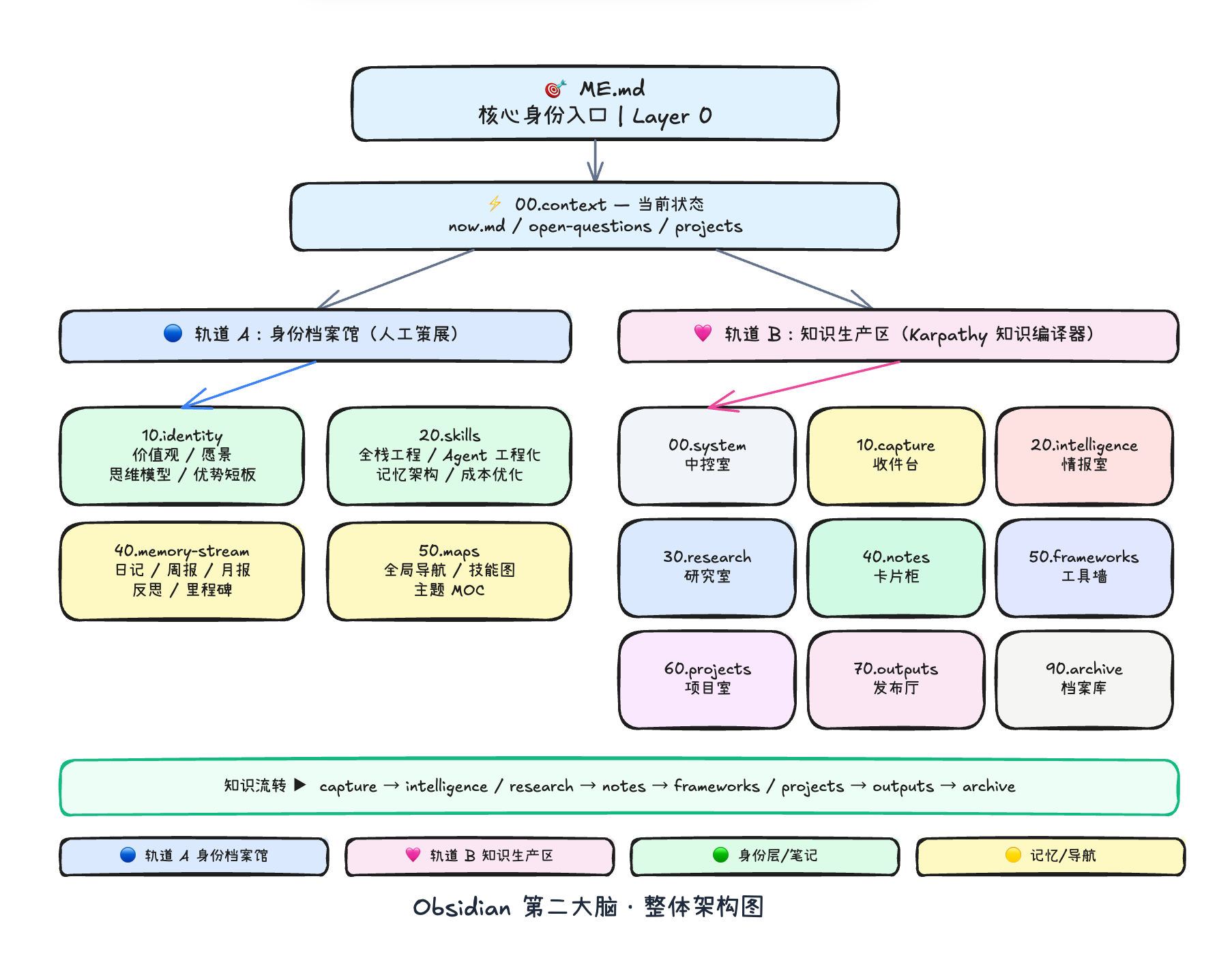
Personal API uses a dual-track vault model:
| Track | Scope | AI Role |
|---|---|---|
| Track A: Identity Archive | ME.md, AGENT.md, 00.context/, 10.identity/, 20.skills/, 40.memory-stream/, 50.maps/ | Read first; suggest carefully; do not rewrite core identity without authorization |
| Track B: Knowledge Production | 30.knowledge/ | Compile, organize, link, and maintain under methodology rules |
1. Vault overall structure
ME.md is the entry point. The vault splits into an identity track and a knowledge-production track so that personal context stays stable while working knowledge can keep evolving.
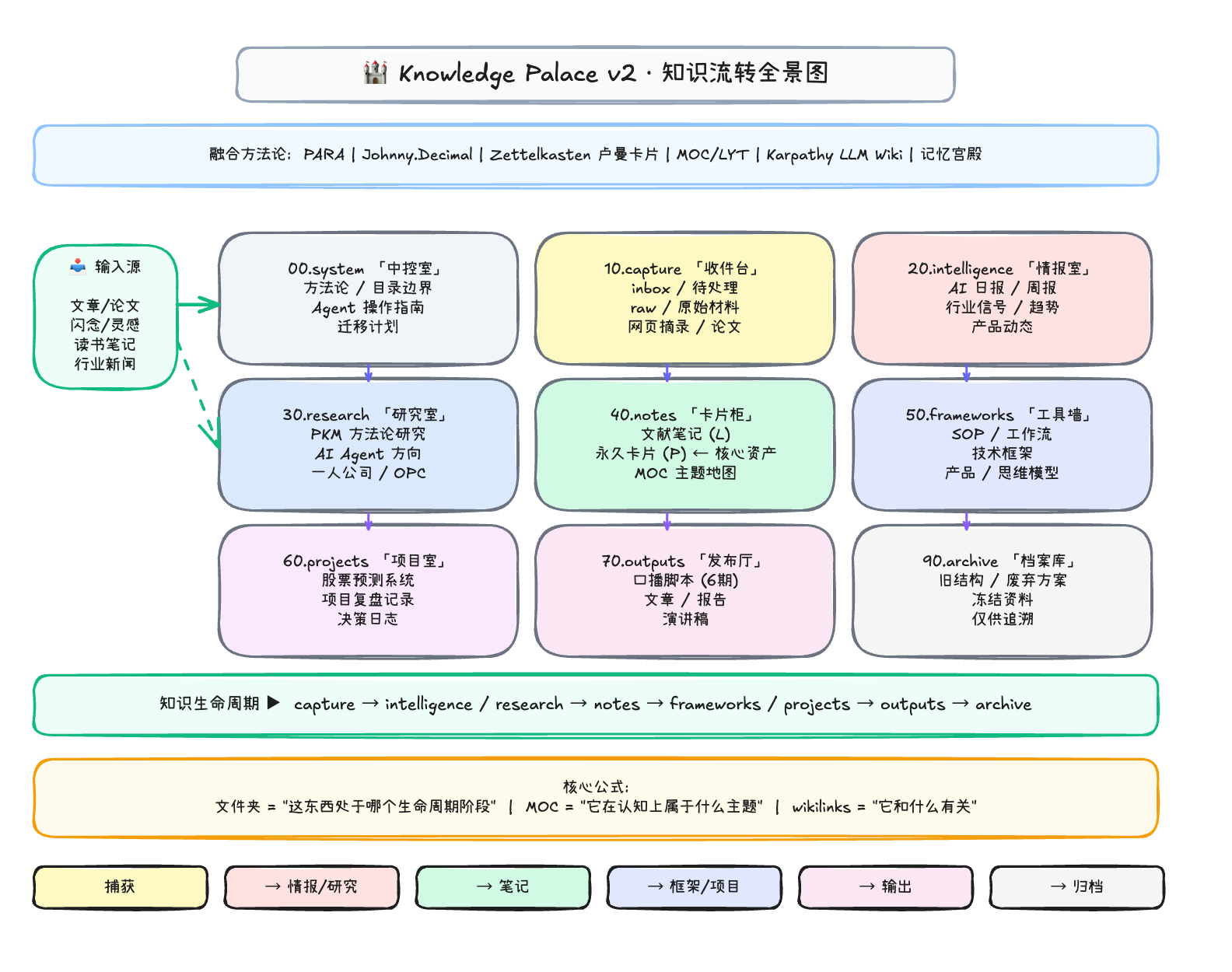
2. Knowledge Palace v2 flow
The knowledge-production track follows a lifecycle pipeline from capture to archive.
Core lifecycle:
capture -> intelligence / research -> notes -> frameworks / projects -> outputs -> archive
See:
- references/architecture.md
- references/vault-layout.md
- references/operation-boundaries.md
- references/maintenance.md
Agent Compatibility
The protocol is plain markdown, so any AI agent that can read files can use it.
- Claude Code reads
CLAUDE.md. - Codex / OpenAI Agents read
AGENTS.md. - Cursor, ChatGPT, Gemini, and custom LLM agents can be pointed at
ME.md+AGENT.md.
Standard prompt:
Read my
ME.mdandAGENT.mdto understand my context. Then proceed.
Maintenance And Release
Validate the skill before publishing:
bash -n scripts/setup.sh
python scripts/validate_skill.py
bash scripts/package_skillhub.sh
python scripts/validate_skill.py --dist dist/skillhub/personal-api-2.0.3-skillhub.zip
The generated SkillHub package is:
dist/skillhub/personal-api-2.0.3-skillhub.zip
Older local packages under dist/skillhub/ are historical artifacts.
Privacy
The skill ships templates, not your real personal data. After setup, filled-in ME.md and AGENT.md may contain sensitive personal context. The script installs a vault .gitignore only when one does not already exist; review it if you intentionally version your vault in a private repository.
Related
personal-knowledge-vault— cross-project entry skill that pulls context from this vault.knowledge-palace-builder— full step-by-step vault construction guide.
License: MIT.
Contributors

13 commits
Similar repos


Languages
Shell
52.7%
Python
47.3%
Turn your Obsidian vault into a personal identity layer — any AI agent knows who you are in 30 seconds.
74
stars
13
commits
Shell
primary language
May 15, 2026
updated
README
Personal API
Turn your Obsidian vault into an AI identity layer. Any AI agent reads
ME.md+AGENT.mdand immediately gets your identity context, collaboration rules, and knowledge-system navigation.
中文说明:README.zh-CN.md
Why
Every new chat, project, or AI tool usually starts with re-explaining your background, preferences, communication style, and boundaries. Personal API turns that repeated onboarding into a versioned vault contract:
ME.md— identity contract.AGENT.md— behavior contract.CLAUDE.md/AGENTS.md— thin adapter files for agent runtimes.30.knowledge/00.system/methodology.md— Knowledge Palace v2 operating manual.
Default setup creates the full Knowledge Palace v2 structure, including 30.knowledge/. Use --minimal only when you want the lightweight identity layer without the knowledge-production system.
Quick Start
# 1. Set your vault path
export OBSIDIAN_VAULT_PATH="/path/to/your/vault"

# 2. Run the full scaffolder
bash scripts/setup.sh

# 3. Open your vault and fill in the placeholders
Minimal mode:
bash scripts/setup.sh --minimal
Minimal mode creates the identity layer, thin adapters, and basic navigation. It does not create 30.knowledge/.
What You Get
| Path | Role |
|---|---|
ME.md | Identity contract for AI |
AGENT.md | Behavior contract and collaboration rules |
CLAUDE.md | Thin Claude Code adapter |
AGENTS.md | Thin Codex / OpenAI Agents adapter |
.gitignore | Vault privacy helper, installed only if missing |
00.context/ | Current state and active project context |
10.identity/ | Values, vision, mental models, strengths and gaps |
20.skills/ | Capability map |
30.knowledge/ | Knowledge Palace v2 production track, full mode only |
40.memory-stream/ | Daily logs, reflections, milestones |
50.maps/ | Global navigation and skill maps |
The setup script preserves existing files and only creates missing files.
Architecture
Personal API uses a dual-track vault model:
| Track | Scope | AI Role |
|---|---|---|
| Track A: Identity Archive | ME.md, AGENT.md, 00.context/, 10.identity/, 20.skills/, 40.memory-stream/, 50.maps/ | Read first; suggest carefully; do not rewrite core identity without authorization |
| Track B: Knowledge Production | 30.knowledge/ | Compile, organize, link, and maintain under methodology rules |
1. Vault overall structure
ME.md is the entry point. The vault splits into an identity track and a knowledge-production track so that personal context stays stable while working knowledge can keep evolving.
2. Knowledge Palace v2 flow
The knowledge-production track follows a lifecycle pipeline from capture to archive.
Core lifecycle:
capture -> intelligence / research -> notes -> frameworks / projects -> outputs -> archive
See:
- references/architecture.md
- references/vault-layout.md
- references/operation-boundaries.md
- references/maintenance.md
Agent Compatibility
The protocol is plain markdown, so any AI agent that can read files can use it.
- Claude Code reads
CLAUDE.md. - Codex / OpenAI Agents read
AGENTS.md. - Cursor, ChatGPT, Gemini, and custom LLM agents can be pointed at
ME.md+AGENT.md.
Standard prompt:
Read my
ME.mdandAGENT.mdto understand my context. Then proceed.
Maintenance And Release
Validate the skill before publishing:
bash -n scripts/setup.sh
python scripts/validate_skill.py
bash scripts/package_skillhub.sh
python scripts/validate_skill.py --dist dist/skillhub/personal-api-2.0.3-skillhub.zip
The generated SkillHub package is:
dist/skillhub/personal-api-2.0.3-skillhub.zip
Older local packages under dist/skillhub/ are historical artifacts.
Privacy
The skill ships templates, not your real personal data. After setup, filled-in ME.md and AGENT.md may contain sensitive personal context. The script installs a vault .gitignore only when one does not already exist; review it if you intentionally version your vault in a private repository.
Related
personal-knowledge-vault— cross-project entry skill that pulls context from this vault.knowledge-palace-builder— full step-by-step vault construction guide.
License: MIT.
Similar repos
Contributors
13 commits
Languages
Shell
52.7%
Python
47.3%