
Commodore 64 knowledge base for AI-assisted development — Qdrant vector search + FalkorDB knowledge graph, served over MCP
TypeScript
0
6 commits
updated Sep 17, 2026
README
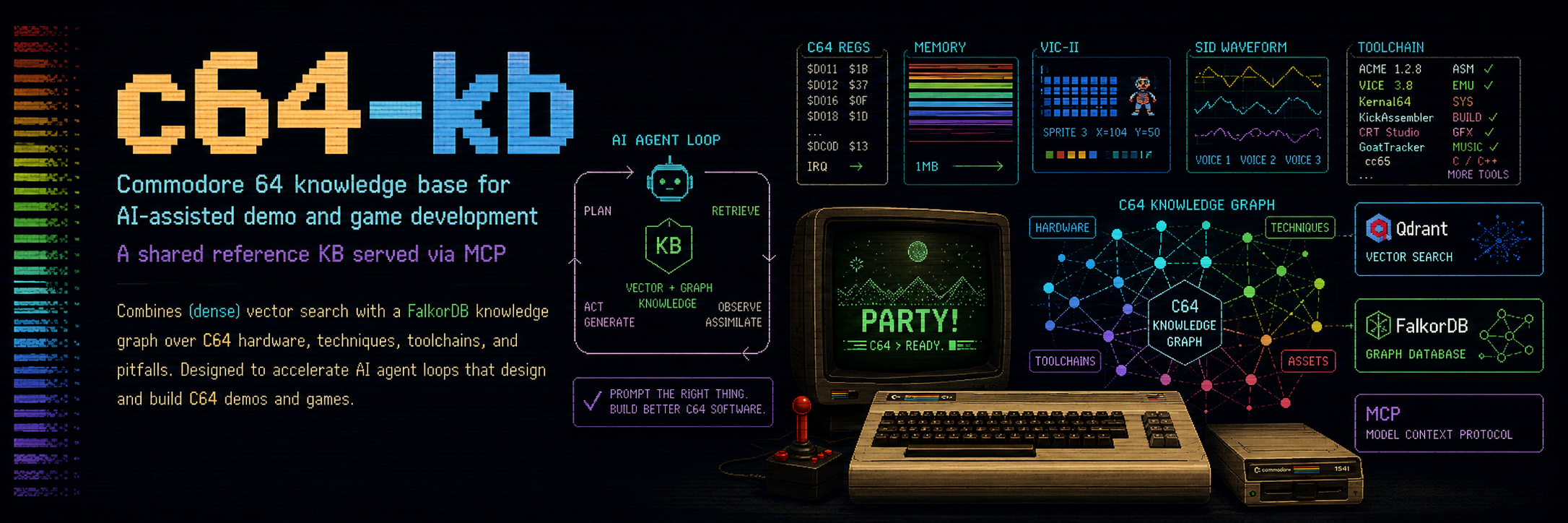
c64-kb — Commodore 64 knowledge base for AI-assisted demo and game development
A shared reference KB served via MCP. Combines Qdrant vector search with FalkorDB knowledge graph over C64 hardware, techniques, toolchains, and pitfalls. Designed to power AI agent loops that design and build C64 demos and games.
The pitch
LLMs trained on public C64 code suffer two compounding problems: their training data skews heavily toward cc65 patterns (which are common on GitHub but not idiomatic for demo-quality work), and timing claims are routinely wrong — raster splits at incorrect scanlines, sprite-multiplex cycle counts that do not fit in the badline window, SID filter cutoffs that differ between chip revisions. A model hallucinating cycle counts will produce code that assembles cleanly and crashes at runtime.
c64-kb counters this with a curated, structured reference. 70+ markdown docs are chunked and embedded into Qdrant for semantic retrieval, and the entities within them — registers, KERNAL routines, memory regions, techniques, recipes, pitfalls, and crash patterns — are materialized into a FalkorDB knowledge graph. The graph captures relationships that flat search misses: which registers a technique uses, which pitfalls it triggers, which recipes implement it, whether two techniques share a register in a conflicting way.
The intended consumers are two kinds: an autonomous agent loop (ingest a brief, synthesize a technique stack, generate code, iterate with vice-mcp and sim6502) and a human-in-the-loop developer using Claude Code who wants accurate, structured answers about C64 hardware and idioms rather than training-data guesses.
Current state
| Item | Value |
|---|---|
| Phases complete | 0–6 + 7a |
| MCP tools | 24 |
| FalkorDB nodes | 550 |
| FalkorDB edges | 989 |
| Qdrant chunks | 2413 (across 74 markdown files) |
| Technique nodes | 73 (10 categories) |
| Pitfall nodes | 41 |
| CrashPattern nodes | 15 |
| Recipe nodes | 17 |
| KERNAL routines | 39 |
| Tests | 121 passing |
| License | BSD-3-Clause |
Quick start
You need Node.js 22+, Docker, and Ollama with
mxbai-embed-large pulled. Ollama is optional: without it, search falls
back to keyword-only and the graph is unaffected.
# Start backing services (Qdrant + FalkorDB)
docker compose up -d

# Install and build
npm install
npm run build

# Hydrate the KB (first time only; idempotent thereafter)
npm run ingest

# Verify services and content
npx c64-kb health

# Start the MCP server (for Claude Code or other MCP clients)
npm run dev:serve
The repo ships a .mcp.json at the root. When you open this repository
in Claude Code it auto-discovers and connects to the MCP server without
any manual wiring.
Connecting another project
To wire c64-kb as an MCP server from a different repository, add
.mcp.json to that project's root:
{
  "mcpServers": {
    "c64-kb": {
      "type": "stdio",
      "command": "node",
      "args": ["/absolute/path/to/c64-kb/dist/cli.js", "serve"]
    }
  }
}
Substitute the real absolute path on your machine. The server must already
be built (npm run build) before connecting.
A templates/ directory (scaffolded in parallel as templates/c64-demo-starter
and templates/c64-game-starter) provides ready-to-clone starting points
that already include the .mcp.json wiring.
MCP tools
Query and search
| Tool | Purpose |
|---|---|
c64_health | Service health snapshot (Qdrant / FalkorDB / Ollama / analytics) |
c64_search | Hybrid semantic + keyword search across the KB |
c64_ingest_doc | Ingest a single markdown file at runtime (live add) |
Hardware reference
| Tool | Purpose |
|---|---|
c64_lookup_register | Structured register lookup by name (D011) or address |
c64_lookup_kernal | KERNAL routine lookup with paired-routine edges |
c64_memory_map | Memory region lookup by address ($0400 or 1024) |
c64_lookup_opcode | 6510 opcode lookup (legal + illegal) |
c64_pal_ntsc_diff | PAL vs NTSC differences scoped by topic |
Toolchain
| Tool | Purpose |
|---|---|
c64_toolchain_hint | Idiomatic snippet for a (toolchain, intent) pair. Defaults to Oscar64 when toolchain is omitted (bias enforcer). |
Recipes and techniques
| Tool | Purpose |
|---|---|
c64_recipe_lookup | Structured Recipe lookup by canonical name (e.g. oscar64-stable-raster-irq) |
c64_recipes_for | List recipes filtered by toolchain / region / technique / file format |
c64_technique_lookup | Technique lookup with USES Registers/KernalRoutines + implementing recipes + REQUIRES_REGION |
c64_techniques_for | List techniques filtered by category / chip / region / register / recipe |
Compatibility and timing
| Tool | Purpose |
|---|---|
c64_check_compatibility | Graph-traversal conflict detection across a list of techniques (shared register / KERNAL / region mismatch) |
c64_timing_budget | Per-scanline + per-frame cycle math for a technique on PAL or NTSC |
Pitfalls and failure analysis
| Tool | Purpose |
|---|---|
c64_pitfalls_for | Pitfalls triggered by a register, KERNAL routine, or technique name |
c64_failure_diagnose | Match a symptom description against CrashPattern nodes (relevance ranked) |
Synthesis and briefings
| Tool | Purpose |
|---|---|
c64_demo_briefing | Synthesise techniques + pitfalls + toolchain split + build order for a demo brief |
c64_game_briefing | Same synthesis for a game brief; genre hint selects archetype recipe as scaffold |
Self-improvement (Phase 7a)
| Tool | Purpose |
|---|---|
c64_coverage | Report coverage across technique categories, flag under-documented areas |
c64_suggest_links | Suggest missing graph edges for a named node |
c64_report_gap | Record a knowledge gap for triage |
Resources and prompts
11 Resources are exposed at c64:// URIs:
c64://memory-map          c64://kernal-jumptable      c64://vic-registers
c64://sid-registers       c64://cia-registers          c64://6510-opcodes
c64://illegal-opcodes     c64://techniques-index       c64://recipes-index
c64://pitfalls-index      c64://crash-patterns
2 Prompts: c64_demo_brief and c64_game_brief.
Architecture
Full system diagrams and data-flow documentation: docs/ARCHITECTURE.md. Graph schema (11 node types, 12 edge types): docs/ONTOLOGY.md.
Components
TypeScript MCP server (Node 24+, ES2022 modules). Tool logic lives in
src/tools/*.ts as pure functions returning strings. Both the CLI and the
MCP server call the same functions — the CLI for terminal use and hooks,
the MCP server as a thin wrapper mapping MCP calls to those functions.
Qdrant (Docker, host port 7333): dense + sparse (BM25) hybrid vector
store. Collection c64_docs. Embeddings are 768-dimensional via
mxbai-embed-large on Ollama. Falls back to keyword-only search when
Ollama is unavailable.
FalkorDB (Docker, host port 7379): Redis-compatible knowledge graph.
Graph name c64. 11 node types (Chip, Register, KernalRoutine,
MemoryRegion, Opcode, Technique, Recipe, Pitfall, CrashPattern,
ToolRecipe, Region) and 12 edge types. Range indexes on all primary keys.
Two-pass ingest: node creation in pass 1, edge linking in pass 2, so walk
order does not affect edge correctness.
Ollama (host, port 11434): mxbai-embed-large for embeddings. Shared
with amiga-kb if both are running.
SQLite (data/analytics.db): query analytics and gap detection. Records
every tool call; surfaces queries with no results as gap candidates.
70+ markdown reference docs under docs/: the human-readable corpus
that drives both vector chunks and graph entity extraction.
Ports
| Service | Host port |
|---|---|
| Qdrant REST | 7333 |
| Qdrant gRPC | 7334 |
| FalkorDB | 7379 |
| Ollama (shared) | 11434 |
| Dashboard | 3939 (Phase 7b, pending) |
Ports are shifted from amiga-kb (6333/6334/6379) so both KBs can run in parallel.
Toolchain ranking
The toolchain ranking is locked as of 2026-05-16 and reflected throughout
the KB content and the c64_toolchain_hint bias enforcer.
Primary: Oscar64. Modern C/C++ compiler targeting 6502. Most recipes
in the KB are written for Oscar64. The c64_toolchain_hint tool defaults
to Oscar64 when no toolchain is specified. This is deliberate: LLM training
data is saturated with cc65 patterns, which are workable but not idiomatic
for demo-quality code. c64-kb exists in part to push models toward Oscar64
idioms.
Secondary: KickAssembler. Cycle-tight escape hatch for work where C-level abstraction costs too many cycles: stable raster IRQs, sprite multiplexers, FLI, scene-quality timing routines. Called from Oscar64 via external asm linking. Deep KickAssembler recipes are present alongside their Oscar64 equivalents.
Tertiary: cc65. Light coverage. Text-mode utilities and niche cases where cc65's large training-data corpus is the path of least resistance. Do not reach for cc65 for techniques requiring cycle precision.
Hardware target
Stock Commodore 64, PAL and NTSC.
The following are explicitly out of scope: C128, Mega65, SuperCPU, REU, Ultimate II+. The KB documents PAL/NTSC differences thoroughly (raster line counts, cycle budgets, timer values) but does not cover expanded hardware.
Boundaries with sibling tools
c64-kb is pure reference — it describes what code should be. It has no runtime or emulator access.
| Need | Tool |
|---|---|
| Memory inspection, screenshots, breakpoints, cycle counts | vice-mcp |
| Unit testing C64 code without a full emulator | sim6502 |
| Reference: what code should be, hardware semantics, pitfalls | c64-kb (this repo) |
The intended agent loop: c64-kb generates the brief and code scaffold; vice-mcp inspects runtime behaviour; sim6502 runs unit tests on hot paths.
Phase roadmap
| Phase | Description | State |
|---|---|---|
| 0 | Infrastructure (services, CLI, MCP server, ingest pipeline) | complete |
| 1 | Hardware foundation (VIC-II, SID, CIA, 6510, KERNAL, memory map, opcodes, PAL/NTSC) | complete |
| 2 | Toolchain reference + runtime docs + file formats + core recipes | complete |
| 3 | Core techniques (raster, sprite, scroll, bitmap, memory banking) | complete |
| 4 | Advanced techniques + deep recipes (effects, SID music, CPU tricks, loaders/packers) | complete |
| 5 | Pitfalls + failure patterns + briefing tools | complete |
| 6 | Art/music production + design patterns | complete |
| 7a | Analytics + self-improvement tools (coverage, suggest-links, report-gap) | complete |
| 7b | Dashboard UI (C64-native design, port 3939) | pending |
| Future | Dream/consolidation cycle, autonomous agent loop integration | — |
Development
| Command | Description |
|---|---|
npm run build | Compile TypeScript (tsc) |
npm run dev | Run CLI via tsx (no build needed) |
npm run dev:serve | Run MCP server via tsx |
npm run ingest | Hydrate KB from docs/ (idempotent) |
npm run ingest -- --force | Re-ingest all docs, forcing hash refresh |
npm test | Run vitest (121 tests) |
npx tsc --noEmit | Type check without emitting |
./scripts/backup.sh | Snapshot all stateful data |
Prerequisites
- Node.js 22+
- Docker (for Qdrant + FalkorDB)
- Ollama with
mxbai-embed-largepulled (optional — falls back to keyword-only search without it)
Contributing
Add new reference material by dropping a markdown file into docs/ and
running:
npm run ingest -- --force
The ingest pipeline will chunk the file, embed it, upsert into Qdrant, and extract graph entities (registers, KERNAL routines, techniques, pitfalls, recipes) into FalkorDB.
For doc structure, follow the conventions files:
docs/CONVENTIONS-pitfalls.md— pitfall doc formatdocs/CONVENTIONS-failures.md— failure pattern doc format- Other
docs/CONVENTIONS-*.md— hardware, toolchain, recipe, technique conventions
Tests live in test/. Run npm test before committing. Run
npx tsc --noEmit to catch type errors.
License
BSD-3-Clause.
Contributors

6 commits
See what people are saying
Similar repos


Languages
TypeScript
91.4%
C
2.8%
Assembly
2.4%
Shell
1.7%
Makefile
1.6%
Commodore 64 knowledge base for AI-assisted development — Qdrant vector search + FalkorDB knowledge graph, served over MCP
TypeScript
0
6 commits
updated Sep 17, 2026
README
c64-kb — Commodore 64 knowledge base for AI-assisted demo and game development
A shared reference KB served via MCP. Combines Qdrant vector search with FalkorDB knowledge graph over C64 hardware, techniques, toolchains, and pitfalls. Designed to power AI agent loops that design and build C64 demos and games.
The pitch
LLMs trained on public C64 code suffer two compounding problems: their training data skews heavily toward cc65 patterns (which are common on GitHub but not idiomatic for demo-quality work), and timing claims are routinely wrong — raster splits at incorrect scanlines, sprite-multiplex cycle counts that do not fit in the badline window, SID filter cutoffs that differ between chip revisions. A model hallucinating cycle counts will produce code that assembles cleanly and crashes at runtime.
c64-kb counters this with a curated, structured reference. 70+ markdown docs are chunked and embedded into Qdrant for semantic retrieval, and the entities within them — registers, KERNAL routines, memory regions, techniques, recipes, pitfalls, and crash patterns — are materialized into a FalkorDB knowledge graph. The graph captures relationships that flat search misses: which registers a technique uses, which pitfalls it triggers, which recipes implement it, whether two techniques share a register in a conflicting way.
The intended consumers are two kinds: an autonomous agent loop (ingest a brief, synthesize a technique stack, generate code, iterate with vice-mcp and sim6502) and a human-in-the-loop developer using Claude Code who wants accurate, structured answers about C64 hardware and idioms rather than training-data guesses.
Current state
| Item | Value |
|---|---|
| Phases complete | 0–6 + 7a |
| MCP tools | 24 |
| FalkorDB nodes | 550 |
| FalkorDB edges | 989 |
| Qdrant chunks | 2413 (across 74 markdown files) |
| Technique nodes | 73 (10 categories) |
| Pitfall nodes | 41 |
| CrashPattern nodes | 15 |
| Recipe nodes | 17 |
| KERNAL routines | 39 |
| Tests | 121 passing |
| License | BSD-3-Clause |
Quick start
You need Node.js 22+, Docker, and Ollama with
mxbai-embed-large pulled. Ollama is optional: without it, search falls
back to keyword-only and the graph is unaffected.
# Start backing services (Qdrant + FalkorDB)
docker compose up -d

# Install and build
npm install
npm run build

# Hydrate the KB (first time only; idempotent thereafter)
npm run ingest

# Verify services and content
npx c64-kb health

# Start the MCP server (for Claude Code or other MCP clients)
npm run dev:serve
The repo ships a .mcp.json at the root. When you open this repository
in Claude Code it auto-discovers and connects to the MCP server without
any manual wiring.
Connecting another project
To wire c64-kb as an MCP server from a different repository, add
.mcp.json to that project's root:
{
  "mcpServers": {
    "c64-kb": {
      "type": "stdio",
      "command": "node",
      "args": ["/absolute/path/to/c64-kb/dist/cli.js", "serve"]
    }
  }
}
Substitute the real absolute path on your machine. The server must already
be built (npm run build) before connecting.
A templates/ directory (scaffolded in parallel as templates/c64-demo-starter
and templates/c64-game-starter) provides ready-to-clone starting points
that already include the .mcp.json wiring.
MCP tools
Query and search
| Tool | Purpose |
|---|---|
c64_health | Service health snapshot (Qdrant / FalkorDB / Ollama / analytics) |
c64_search | Hybrid semantic + keyword search across the KB |
c64_ingest_doc | Ingest a single markdown file at runtime (live add) |
Hardware reference
| Tool | Purpose |
|---|---|
c64_lookup_register | Structured register lookup by name (D011) or address |
c64_lookup_kernal | KERNAL routine lookup with paired-routine edges |
c64_memory_map | Memory region lookup by address ($0400 or 1024) |
c64_lookup_opcode | 6510 opcode lookup (legal + illegal) |
c64_pal_ntsc_diff | PAL vs NTSC differences scoped by topic |
Toolchain
| Tool | Purpose |
|---|---|
c64_toolchain_hint | Idiomatic snippet for a (toolchain, intent) pair. Defaults to Oscar64 when toolchain is omitted (bias enforcer). |
Recipes and techniques
| Tool | Purpose |
|---|---|
c64_recipe_lookup | Structured Recipe lookup by canonical name (e.g. oscar64-stable-raster-irq) |
c64_recipes_for | List recipes filtered by toolchain / region / technique / file format |
c64_technique_lookup | Technique lookup with USES Registers/KernalRoutines + implementing recipes + REQUIRES_REGION |
c64_techniques_for | List techniques filtered by category / chip / region / register / recipe |
Compatibility and timing
| Tool | Purpose |
|---|---|
c64_check_compatibility | Graph-traversal conflict detection across a list of techniques (shared register / KERNAL / region mismatch) |
c64_timing_budget | Per-scanline + per-frame cycle math for a technique on PAL or NTSC |
Pitfalls and failure analysis
| Tool | Purpose |
|---|---|
c64_pitfalls_for | Pitfalls triggered by a register, KERNAL routine, or technique name |
c64_failure_diagnose | Match a symptom description against CrashPattern nodes (relevance ranked) |
Synthesis and briefings
| Tool | Purpose |
|---|---|
c64_demo_briefing | Synthesise techniques + pitfalls + toolchain split + build order for a demo brief |
c64_game_briefing | Same synthesis for a game brief; genre hint selects archetype recipe as scaffold |
Self-improvement (Phase 7a)
| Tool | Purpose |
|---|---|
c64_coverage | Report coverage across technique categories, flag under-documented areas |
c64_suggest_links | Suggest missing graph edges for a named node |
c64_report_gap | Record a knowledge gap for triage |
Resources and prompts
11 Resources are exposed at c64:// URIs:
c64://memory-map          c64://kernal-jumptable      c64://vic-registers
c64://sid-registers       c64://cia-registers          c64://6510-opcodes
c64://illegal-opcodes     c64://techniques-index       c64://recipes-index
c64://pitfalls-index      c64://crash-patterns
2 Prompts: c64_demo_brief and c64_game_brief.
Architecture
Full system diagrams and data-flow documentation: docs/ARCHITECTURE.md. Graph schema (11 node types, 12 edge types): docs/ONTOLOGY.md.
Components
TypeScript MCP server (Node 24+, ES2022 modules). Tool logic lives in
src/tools/*.ts as pure functions returning strings. Both the CLI and the
MCP server call the same functions — the CLI for terminal use and hooks,
the MCP server as a thin wrapper mapping MCP calls to those functions.
Qdrant (Docker, host port 7333): dense + sparse (BM25) hybrid vector
store. Collection c64_docs. Embeddings are 768-dimensional via
mxbai-embed-large on Ollama. Falls back to keyword-only search when
Ollama is unavailable.
FalkorDB (Docker, host port 7379): Redis-compatible knowledge graph.
Graph name c64. 11 node types (Chip, Register, KernalRoutine,
MemoryRegion, Opcode, Technique, Recipe, Pitfall, CrashPattern,
ToolRecipe, Region) and 12 edge types. Range indexes on all primary keys.
Two-pass ingest: node creation in pass 1, edge linking in pass 2, so walk
order does not affect edge correctness.
Ollama (host, port 11434): mxbai-embed-large for embeddings. Shared
with amiga-kb if both are running.
SQLite (data/analytics.db): query analytics and gap detection. Records
every tool call; surfaces queries with no results as gap candidates.
70+ markdown reference docs under docs/: the human-readable corpus
that drives both vector chunks and graph entity extraction.
Ports
| Service | Host port |
|---|---|
| Qdrant REST | 7333 |
| Qdrant gRPC | 7334 |
| FalkorDB | 7379 |
| Ollama (shared) | 11434 |
| Dashboard | 3939 (Phase 7b, pending) |
Ports are shifted from amiga-kb (6333/6334/6379) so both KBs can run in parallel.
Toolchain ranking
The toolchain ranking is locked as of 2026-05-16 and reflected throughout
the KB content and the c64_toolchain_hint bias enforcer.
Primary: Oscar64. Modern C/C++ compiler targeting 6502. Most recipes
in the KB are written for Oscar64. The c64_toolchain_hint tool defaults
to Oscar64 when no toolchain is specified. This is deliberate: LLM training
data is saturated with cc65 patterns, which are workable but not idiomatic
for demo-quality code. c64-kb exists in part to push models toward Oscar64
idioms.
Secondary: KickAssembler. Cycle-tight escape hatch for work where C-level abstraction costs too many cycles: stable raster IRQs, sprite multiplexers, FLI, scene-quality timing routines. Called from Oscar64 via external asm linking. Deep KickAssembler recipes are present alongside their Oscar64 equivalents.
Tertiary: cc65. Light coverage. Text-mode utilities and niche cases where cc65's large training-data corpus is the path of least resistance. Do not reach for cc65 for techniques requiring cycle precision.
Hardware target
Stock Commodore 64, PAL and NTSC.
The following are explicitly out of scope: C128, Mega65, SuperCPU, REU, Ultimate II+. The KB documents PAL/NTSC differences thoroughly (raster line counts, cycle budgets, timer values) but does not cover expanded hardware.
Boundaries with sibling tools
c64-kb is pure reference — it describes what code should be. It has no runtime or emulator access.
| Need | Tool |
|---|---|
| Memory inspection, screenshots, breakpoints, cycle counts | vice-mcp |
| Unit testing C64 code without a full emulator | sim6502 |
| Reference: what code should be, hardware semantics, pitfalls | c64-kb (this repo) |
The intended agent loop: c64-kb generates the brief and code scaffold; vice-mcp inspects runtime behaviour; sim6502 runs unit tests on hot paths.
Phase roadmap
| Phase | Description | State |
|---|---|---|
| 0 | Infrastructure (services, CLI, MCP server, ingest pipeline) | complete |
| 1 | Hardware foundation (VIC-II, SID, CIA, 6510, KERNAL, memory map, opcodes, PAL/NTSC) | complete |
| 2 | Toolchain reference + runtime docs + file formats + core recipes | complete |
| 3 | Core techniques (raster, sprite, scroll, bitmap, memory banking) | complete |
| 4 | Advanced techniques + deep recipes (effects, SID music, CPU tricks, loaders/packers) | complete |
| 5 | Pitfalls + failure patterns + briefing tools | complete |
| 6 | Art/music production + design patterns | complete |
| 7a | Analytics + self-improvement tools (coverage, suggest-links, report-gap) | complete |
| 7b | Dashboard UI (C64-native design, port 3939) | pending |
| Future | Dream/consolidation cycle, autonomous agent loop integration | — |
Development
| Command | Description |
|---|---|
npm run build | Compile TypeScript (tsc) |
npm run dev | Run CLI via tsx (no build needed) |
npm run dev:serve | Run MCP server via tsx |
npm run ingest | Hydrate KB from docs/ (idempotent) |
npm run ingest -- --force | Re-ingest all docs, forcing hash refresh |
npm test | Run vitest (121 tests) |
npx tsc --noEmit | Type check without emitting |
./scripts/backup.sh | Snapshot all stateful data |
Prerequisites
- Node.js 22+
- Docker (for Qdrant + FalkorDB)
- Ollama with
mxbai-embed-largepulled (optional — falls back to keyword-only search without it)
Contributing
Add new reference material by dropping a markdown file into docs/ and
running:
npm run ingest -- --force
The ingest pipeline will chunk the file, embed it, upsert into Qdrant, and extract graph entities (registers, KERNAL routines, techniques, pitfalls, recipes) into FalkorDB.
For doc structure, follow the conventions files:
docs/CONVENTIONS-pitfalls.md— pitfall doc formatdocs/CONVENTIONS-failures.md— failure pattern doc format- Other
docs/CONVENTIONS-*.md— hardware, toolchain, recipe, technique conventions
Tests live in test/. Run npm test before committing. Run
npx tsc --noEmit to catch type errors.
License
BSD-3-Clause.
See what people are saying
Similar repos
Contributors
6 commits
Languages
TypeScript
91.4%
C
2.8%
Assembly
2.4%
Shell
1.7%
Makefile
1.6%