Project Interaction Library for Emacs
See the code





Projectile is a project interaction library for Emacs. It provides a powerful set of features operating at the project level, as well as simple heuristics to identify projects.
Here are some of Projectile's essential features:
.h <-> .c/.cpp, Gemfile <-> Gemfile.lock)main.service.js <-> main.service.spec.js)xref internally)completing-read-based completion UI (Vertico, Consult, Fido, Ido, etc.)projectile-project-search-path)project.el libraryThere's also a rich ecosystem of third-party Projectile extensions that add even more features.



I've been developing Projectile for over a decade now (since 2011). While it's a fun project to work on, it still requires a lot of time and energy to maintain.
Please consider supporting financially Projectile's ongoing development.
Here's a glimpse of Projectile in action (using vertico and marginalia):
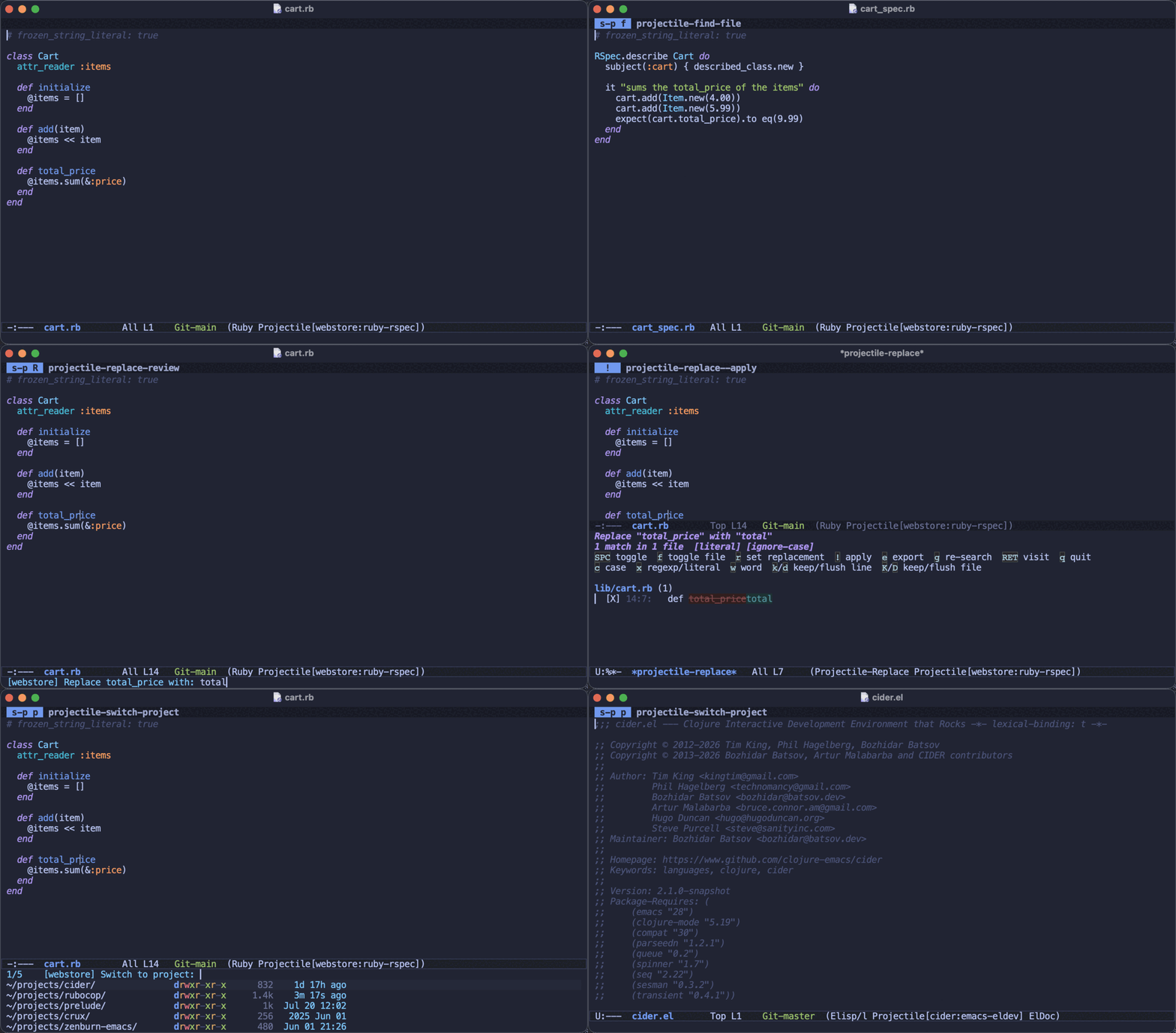
In this short demo you can see:
The strip across the top of the frame shows the keys being pressed and the commands they invoked.
The instructions that follow are meant to get you from zero to a running Projectile setup in a minute. Visit the online documentation for (way) more details.
package.el is the built-in package manager in Emacs.
Projectile is available on all major package.el community
maintained repos - NonGNU ELPA,
MELPA Stable
and MELPA.
You can install Projectile with the following command:
M-x package-install [RET] projectile [RET]
Alternatively, users of Debian 9 or later or Ubuntu 16.04 or later may
simply apt-get install elpa-projectile.
Finally add this to your Emacs config:
(projectile-mode +1)
;; Recommended keymap prefix on macOS
(define-key projectile-mode-map (kbd "s-p") 'projectile-command-map)
;; Recommended keymap prefix on Windows/Linux
(define-key projectile-mode-map (kbd "C-c p") 'projectile-command-map)
Those keymap prefixes are just a suggestion. Feel free to put there whatever works best for you.
Enable projectile-mode, open a file in one of your projects and type a command such as C-c p f.
See the online documentation for more details.
Projectile reads through Emacs's built-in completing-read, so it works with
whatever minibuffer completion UI you use. It's fine with the stock completion,
but to get the most out of it you're encouraged to enable (and, if needed,
install) a modern completion setup such as vertico (paired with consult,
marginalia, and orderless) or the built-in fido-vertical-mode. See this
section
of the documentation for more details.
[!NOTE]
As of Projectile 3.0 the dedicated
ido/ivy/helmcompletion systems (and the oldprojectile-completion-systemvalues) were removed in favor ofcompleting-read. Existing setups keep working via your completion UI;helm-projectileandcounsel-projectileare unaffected.
In this section you'll find some notes on Projectile's design goals, that have been upheld since the earliest days of the project.
Projectile provides a nice set of features operating on a project level without
introducing external dependencies (when feasible). For instance -
finding project files has a portable implementation written in pure
Emacs Lisp without the use of GNU find (but for performance's sake an
indexing mechanism backed by external commands exists as well).
This library provides easy project management and navigation. The concept of a
project is pretty basic - just a folder containing some special file (e.g. a VCS
marker or a project descriptor file like pom.xml or Gemfile). Projectile
will auto-detect pretty much every popular project type out of the box
and you can easily extend it with additional project types.
The configuration defaults are pretty reasonable and most users will probably never feel a strong need to change them.
All commands are easily discoverable and are unlikely to surprise you with their behavior.
Projectile tries to be practical - portability is great, but if some external tools could speed up some task substantially and the tools are available, Projectile will leverage them.
In the classic spirit of Emacs almost every aspect of Projectile's behavior is configurable.
find or fd (version 8.3.0+).
fd version add (setq projectile-generic-command "fd . -0 --type f --color=never") to your init-filefish shell.projectile-find-file
until their deletions are staged, due to a limitation of git ls-files. If
you install fd then it is automatically used
instead, and does not have this problem. (You can inhibit the use of fd by
setting projectile-git-use-fd to nil.)Check out the project's issue list a list of unresolved issues. By the way - feel free to fix any of them and send me a pull request. :-)
While Projectile is free software and will always be, the project would benefit immensely from some funding. If you (or the company you work for) are making serious use of Projectile, please consider supporting its ongoing development.
You can support my work on Projectile via:
Here's a list of all the people who have contributed to the development of Projectile (a.k.a. Projectile's Hall of Fame).
Joining this esteemed group of people is only a commit away!
A fairly extensive changelog is available here.
Copyright © 2011-2026 Bozhidar Batsov and contributors.
Distributed under the GNU General Public License, version 3
(top 24 of 85)
601 followers · starred Feb 2015
580 followers · starred Jul 2026
239 followers · starred Feb 2022
163 followers · starred Feb 2015
Project Interaction Library for Emacs
See the code
Projectile is a project interaction library for Emacs. It provides a powerful set of features operating at the project level, as well as simple heuristics to identify projects.
Here are some of Projectile's essential features:
.h <-> .c/.cpp, Gemfile <-> Gemfile.lock)main.service.js <-> main.service.spec.js)xref internally)completing-read-based completion UI (Vertico, Consult, Fido, Ido, etc.)projectile-project-search-path)project.el libraryThere's also a rich ecosystem of third-party Projectile extensions that add even more features.
I've been developing Projectile for over a decade now (since 2011). While it's a fun project to work on, it still requires a lot of time and energy to maintain.
Please consider supporting financially Projectile's ongoing development.
Here's a glimpse of Projectile in action (using vertico and marginalia):
In this short demo you can see:
The strip across the top of the frame shows the keys being pressed and the commands they invoked.
The instructions that follow are meant to get you from zero to a running Projectile setup in a minute. Visit the online documentation for (way) more details.
package.el is the built-in package manager in Emacs.
Projectile is available on all major package.el community
maintained repos - NonGNU ELPA,
MELPA Stable
and MELPA.
You can install Projectile with the following command:
M-x package-install [RET] projectile [RET]
Alternatively, users of Debian 9 or later or Ubuntu 16.04 or later may
simply apt-get install elpa-projectile.
Finally add this to your Emacs config:
(projectile-mode +1)
;; Recommended keymap prefix on macOS
(define-key projectile-mode-map (kbd "s-p") 'projectile-command-map)
;; Recommended keymap prefix on Windows/Linux
(define-key projectile-mode-map (kbd "C-c p") 'projectile-command-map)
Those keymap prefixes are just a suggestion. Feel free to put there whatever works best for you.
Enable projectile-mode, open a file in one of your projects and type a command such as C-c p f.
See the online documentation for more details.
Projectile reads through Emacs's built-in completing-read, so it works with
whatever minibuffer completion UI you use. It's fine with the stock completion,
but to get the most out of it you're encouraged to enable (and, if needed,
install) a modern completion setup such as vertico (paired with consult,
marginalia, and orderless) or the built-in fido-vertical-mode. See this
section
of the documentation for more details.
[!NOTE]
As of Projectile 3.0 the dedicated
ido/ivy/helmcompletion systems (and the oldprojectile-completion-systemvalues) were removed in favor ofcompleting-read. Existing setups keep working via your completion UI;helm-projectileandcounsel-projectileare unaffected.
In this section you'll find some notes on Projectile's design goals, that have been upheld since the earliest days of the project.
Projectile provides a nice set of features operating on a project level without
introducing external dependencies (when feasible). For instance -
finding project files has a portable implementation written in pure
Emacs Lisp without the use of GNU find (but for performance's sake an
indexing mechanism backed by external commands exists as well).
This library provides easy project management and navigation. The concept of a
project is pretty basic - just a folder containing some special file (e.g. a VCS
marker or a project descriptor file like pom.xml or Gemfile). Projectile
will auto-detect pretty much every popular project type out of the box
and you can easily extend it with additional project types.
The configuration defaults are pretty reasonable and most users will probably never feel a strong need to change them.
All commands are easily discoverable and are unlikely to surprise you with their behavior.
Projectile tries to be practical - portability is great, but if some external tools could speed up some task substantially and the tools are available, Projectile will leverage them.
In the classic spirit of Emacs almost every aspect of Projectile's behavior is configurable.
find or fd (version 8.3.0+).
fd version add (setq projectile-generic-command "fd . -0 --type f --color=never") to your init-filefish shell.projectile-find-file
until their deletions are staged, due to a limitation of git ls-files. If
you install fd then it is automatically used
instead, and does not have this problem. (You can inhibit the use of fd by
setting projectile-git-use-fd to nil.)Check out the project's issue list a list of unresolved issues. By the way - feel free to fix any of them and send me a pull request. :-)
While Projectile is free software and will always be, the project would benefit immensely from some funding. If you (or the company you work for) are making serious use of Projectile, please consider supporting its ongoing development.
You can support my work on Projectile via:
Here's a list of all the people who have contributed to the development of Projectile (a.k.a. Projectile's Hall of Fame).
Joining this esteemed group of people is only a commit away!
A fairly extensive changelog is available here.
Copyright © 2011-2026 Bozhidar Batsov and contributors.
Distributed under the GNU General Public License, version 3
(top 24 of 85)
601 followers · starred Feb 2015
580 followers · starred Jul 2026
239 followers · starred Feb 2022
163 followers · starred Feb 2015