
Search inside every document on your Mac. Scans included.
See the codeSee what people are saying (1)
README
Fouine
Spotlight never read your scans. Fouine does.
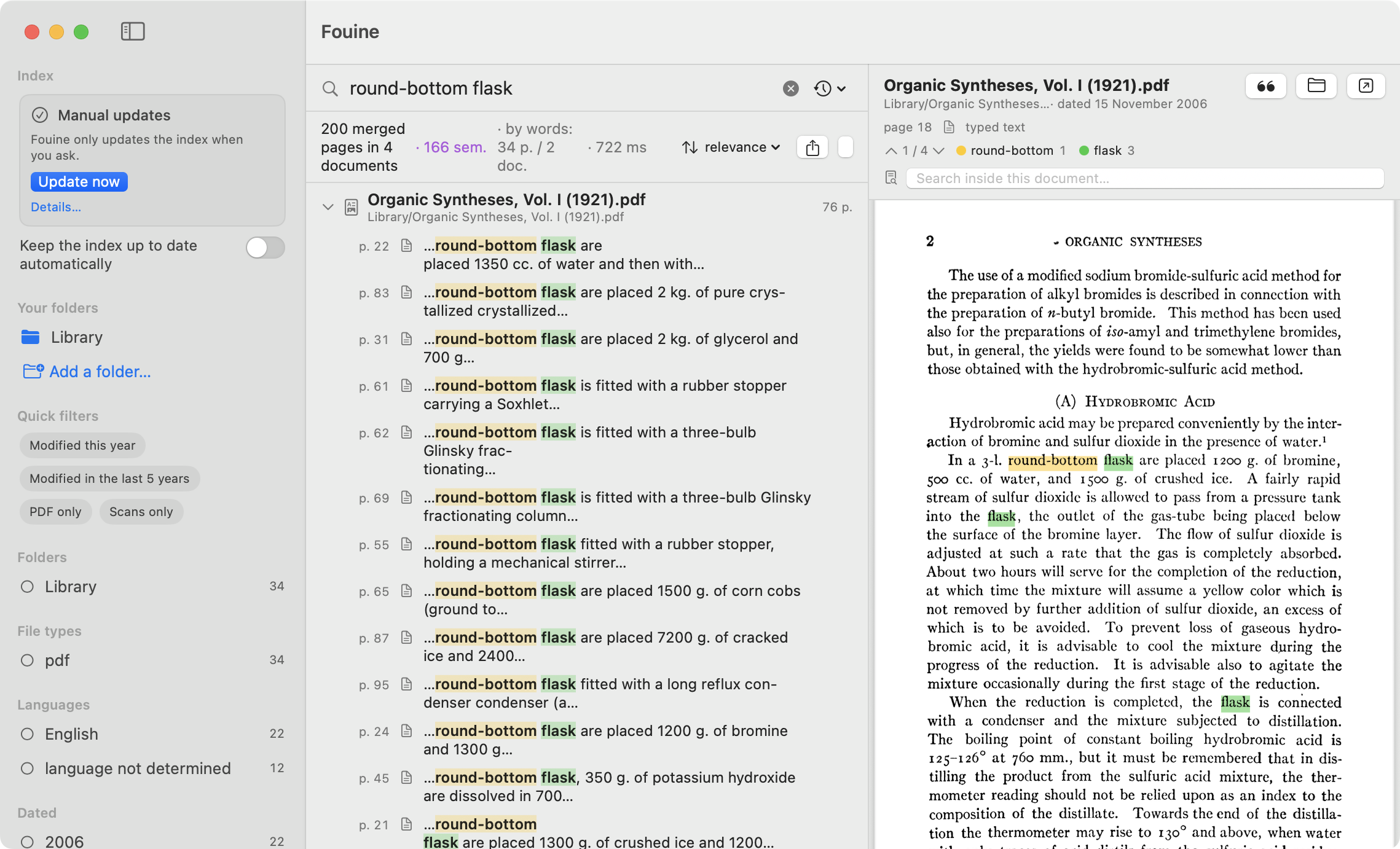
Fouine is a full-text search engine for macOS. It reads the folders you point
it at, extracts the text of every document, indexes it page by page, and
runs Apple's text recognition on the pages that carry no text layer: scanned
PDFs, comic pages, photographs pasted into a .docx. Everything happens on
your Mac. No document, no search, no usage data ever goes out on the network.
Start in five minutes
- Download the disk image.
Fouine-1.0.1.dmg, from the releases page of this repository. The product page is basedpolymer.eu/fouine. - Open the disk image and drag
Fouine.appontoApplications. macOS files privacy permissions by path and signature, so an app that moves around asks for them again every time. Leave it in/Applications. - Open Fouine. Nothing is indexed until you name a folder.
- Click "Add a folder…", or drop a folder into the window: a thesis, a library of PDFs, an archive drive.
- Accept the macOS prompt. If the folder sits under Documents, Desktop, Downloads, a removable volume or a network share, macOS asks for permission. This is the only moment it can appear, and a refusal leaves the folder indexing as if it were empty, with no error. See permissions.
- Search. Indexing starts, results arrive as they are found, and search answers while the index is still being built.
To keep the index current on its own, turn on "Keep the index up to date automatically" under the Index card: Fouine then watches your folders in the background, and reads scanned pages when the Mac is plugged in and idle. See the background agent.
Requirements: macOS 13 or later, Intel or Apple Silicon (universal binary).
Language: the app follows the system language and speaks English and French,
macOS permission prompts included; the fouine command and the agent's log are
in English, like git or brew.
What Fouine reads
PDF, EPUB, Word (including the old .doc), Excel, PowerPoint, ODF, RTF, Pages,
Numbers, Keynote, HTML and web archives, mail (EML, MBOX), plain text, Markdown,
CSV, LaTeX, subtitles, Jupyter notebooks, comic archives (CBZ, CBR), DjVu, and
source code. Old .doc, .xls and .ppt files are read for real: the type is
decided on the leading bytes, never on the extension. Images, audio and video
are read on request.
The full list, family by family, with what each one needs: formats. Pages with no text layer go to Apple's text recognition, and the result lives in Fouine's own database. None of your files is ever modified.
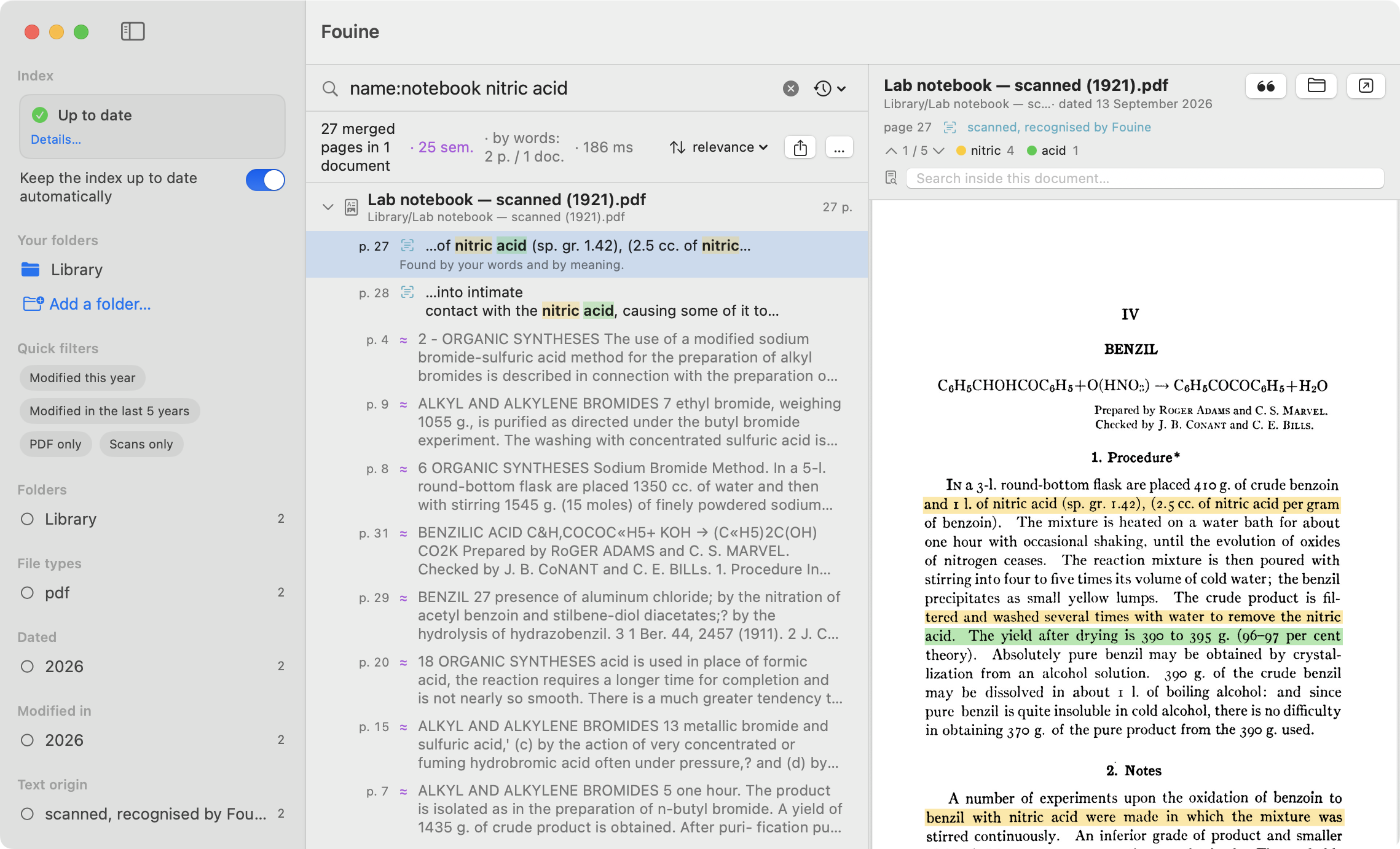
Typing mistakes and meaning are covered too. Fuzzy matching catches recognition
errors, and an optional local model searches by meaning: "catalyst selectivity"
finds a page about regioselectivity that shares none of its words. That model
is a 220 MB download, asked for by an explicit gesture (Settings ▸ Search by
meaning, or fouine model download), and full-text search never needs it. See
searching.
What Fouine does not do
| No document management | Fouine files nothing, sorts nothing, renames nothing. It reads your folders where they are. If you want a library with tags, notes and attachments, this is not it. |
| No syncing | One index per Mac. Nothing goes to a cloud, so nothing arrives from another device. |
| No PDF editing | The preview is read-only. Fouine never writes into your documents, not even to add the text layer it recognised. |
| No chat | No assistant, no summaries, no language model. Search by meaning is a local 384-dimension embedding model, nothing more. |
| macOS 13 and later only | Text recognition uses Vision, the background agent uses SMAppService. There is no Windows or Linux version, and there will not be one. |
| No Notion, no Craft | Their notes cannot be read on this Mac: Notion keeps an encrypted cache, Craft keeps files with no readable name. Export your pages as Markdown and add the export folder. |
Price, trial and key
Fouine runs for 30 days with nothing held back: every format, every folder, scanned page recognition, search by meaning. No card, no account.
Then €39, once. Updates for life, 3 Macs per key, no subscription. The sale goes through Creem, which takes the payment and handles VAT; the key appears after payment and arrives by email.
When the trial ends, search, preview, export, the assistant server and the read-only command line keep working on the index you have. Only index updates stop: nothing you indexed is held hostage.
To enter a key: Fouine ▸ Enter a licence key… (Settings ▸ Licence), or
fouine license activate <key>. To free the Mac for another one: Deactivate
this Mac, or fouine license deactivate.
Privacy
No document, no search, no usage data leaves your Mac. There is no account, no password, no server, no telemetry, no crash report sent anywhere.
Four outgoing connections exist, and only one of them does not wait for a gesture of yours: downloading the search-by-meaning model, checking for updates (off by default), activating or releasing a licence key, and a silent key check at launch, at most once every 30 days. None of them sends anything about your documents, and nothing goes out while Fouine indexes, reads or searches.
That last sentence is held by a continuous integration test rather than by a
promise: NetworkSilenceTests runs a local server while an indexing pass reads
deliberately booby-trapped fixtures, and asserts zero accepted connections.
What Fouine knows lives in one SQLite file, ~/Library/Application Support/Fouine/fouine.db. It holds the text extracted from your documents, so
it is as confidential as they are: back it up and encrypt it the same way.
Details, and how to check any of this yourself: privacy.
Command line
fouine does everything the app does, plus JSON export. It ships inside the app
and works on the same index. Install it from Fouine ▸ Install the command-line
tool…, which creates a symlink at /usr/local/bin/fouine.
fouine root add ~/Documents/Thesis --label Thesis   # add a folder
fouine search '"ideal gas" -biology'                # exact phrase, exclusion
fouine search 'catalysis' --hybrid --json           # meaning, JSON output
Every command and option: the command line.
Letting an assistant read your index. fouine mcp --stdio serves the index
to Claude Code, Claude Desktop, Cursor, Codex or Antigravity, read-only and with
no network: five tools to search, read a page, jump to nearby pages and see what
is indexed. It never writes, never indexes, and never hands over your original
files. fouine mcp install configures those five clients in one command; the
command line lives inside the app
(/Applications/Fouine.app/Contents/Helpers/fouine) until you install it from
Settings ▸ Advanced, and the welcome screen copies the whole request for your
assistant. For Claude Desktop there is also nothing to type, the
Fouine-<version>.mcpb file attached to each release installing with a
double-click. See the assistant server.
Building from source
git clone https://github.com/basedpolymer/fouine.git
cd fouine
make release ARCHS=$(uname -m)     # Fouine.app, ad-hoc signed
Xcode (Swift 5.10 or later) and nothing else. Three SwiftPM dependencies:
GRDB.swift (MIT),
swift-argument-parser
(Apache-2.0) and Sparkle (MIT).
Without a Developer ID certificate the signature is ad hoc, and the app runs only
on the machine that built it. See CONTRIBUTING.md.
Troubleshooting
| Symptom | What to do |
|---|---|
| Anything at all | fouine doctor first. It tests the effective read of every folder, names unmounted volumes, counts the scanned pages still to read and says when djvulibre is missing. |
| "Fouine is damaged and can't be opened" | Gatekeeper on an app that is not notarised, typically one you built yourself. An official release opens without a word. |
| A folder you added stays empty, with no error | Almost always a refused macOS permission. The warning banner offers Open Settings, and the Index card offers Allow access…. See permissions. |
| A folder under Downloads stays empty | Same cause, another checkbox: Privacy & Security ▸ Files and Folders ▸ Fouine ▸ Downloads Folder. |
.djvu files are "skipped" | djvulibre is missing: brew install djvulibre, then index again. It is optional, like ffmpeg for a few video containers. |
| A drive is unplugged | Not an error. Search keeps answering on what is indexed, and fouine doctor says which volume is missing. |
Trickier cases are in docs/pitfalls.md.
Licence
Fouine is source-available under LICENSE (Fouine
Source-Available Licence 1.0, held by Mathis Demory), on the Aseprite model.
What you may do. Read all the code, compile it, modify it for your own use, propose a contribution. Install Fouine on the Macs you use, and keep backups.
What you may not do. Redistribute Fouine, as source, modified or not, or as a binary, including one you compiled yourself; rent it, lend it, or offer it as a service. The code is open to read. It is not free software in the FSF sense, and that is not an oversight: the app is sold under a perpetual licence.
Contributions. By proposing one you grant the holder the right to use and
redistribute it under any licence (article 4, and
CONTRIBUTING.md). There is no separate agreement to sign.
Third-party components. GRDB.swift (MIT), swift-argument-parser (Apache-2.0)
and Sparkle (MIT) ship with the app; the multilingual-e5-small model is MIT,
Microsoft. Their notices are in
THIRD_PARTY_LICENSES.md, and fouine licenses
prints them in a terminal. Which licence covers which part, the MCP server
included: LICENSING.md.
Reporting a vulnerability goes through SECURITY.md, not a
public issue. Release notes: CHANGELOG.md.
Documentation
Everything else is indexed in docs/README.md: the app guide,
the background agent, search syntax, formats, the command line, the assistant
server, privacy, permissions, updates and installation, then the documents for
whoever reads the code.
Contributors

3 commits
Similar repos


Languages
Swift
95.9%
Python
2.4%
Shell
1.0%
Search inside every document on your Mac. Scans included.
See the codeSee what people are saying (1)
README
Fouine
Spotlight never read your scans. Fouine does.
Fouine is a full-text search engine for macOS. It reads the folders you point
it at, extracts the text of every document, indexes it page by page, and
runs Apple's text recognition on the pages that carry no text layer: scanned
PDFs, comic pages, photographs pasted into a .docx. Everything happens on
your Mac. No document, no search, no usage data ever goes out on the network.
Start in five minutes
- Download the disk image.
Fouine-1.0.1.dmg, from the releases page of this repository. The product page is basedpolymer.eu/fouine. - Open the disk image and drag
Fouine.appontoApplications. macOS files privacy permissions by path and signature, so an app that moves around asks for them again every time. Leave it in/Applications. - Open Fouine. Nothing is indexed until you name a folder.
- Click "Add a folder…", or drop a folder into the window: a thesis, a library of PDFs, an archive drive.
- Accept the macOS prompt. If the folder sits under Documents, Desktop, Downloads, a removable volume or a network share, macOS asks for permission. This is the only moment it can appear, and a refusal leaves the folder indexing as if it were empty, with no error. See permissions.
- Search. Indexing starts, results arrive as they are found, and search answers while the index is still being built.
To keep the index current on its own, turn on "Keep the index up to date automatically" under the Index card: Fouine then watches your folders in the background, and reads scanned pages when the Mac is plugged in and idle. See the background agent.
Requirements: macOS 13 or later, Intel or Apple Silicon (universal binary).
Language: the app follows the system language and speaks English and French,
macOS permission prompts included; the fouine command and the agent's log are
in English, like git or brew.
What Fouine reads
PDF, EPUB, Word (including the old .doc), Excel, PowerPoint, ODF, RTF, Pages,
Numbers, Keynote, HTML and web archives, mail (EML, MBOX), plain text, Markdown,
CSV, LaTeX, subtitles, Jupyter notebooks, comic archives (CBZ, CBR), DjVu, and
source code. Old .doc, .xls and .ppt files are read for real: the type is
decided on the leading bytes, never on the extension. Images, audio and video
are read on request.
The full list, family by family, with what each one needs: formats. Pages with no text layer go to Apple's text recognition, and the result lives in Fouine's own database. None of your files is ever modified.
Typing mistakes and meaning are covered too. Fuzzy matching catches recognition
errors, and an optional local model searches by meaning: "catalyst selectivity"
finds a page about regioselectivity that shares none of its words. That model
is a 220 MB download, asked for by an explicit gesture (Settings ▸ Search by
meaning, or fouine model download), and full-text search never needs it. See
searching.
What Fouine does not do
| No document management | Fouine files nothing, sorts nothing, renames nothing. It reads your folders where they are. If you want a library with tags, notes and attachments, this is not it. |
| No syncing | One index per Mac. Nothing goes to a cloud, so nothing arrives from another device. |
| No PDF editing | The preview is read-only. Fouine never writes into your documents, not even to add the text layer it recognised. |
| No chat | No assistant, no summaries, no language model. Search by meaning is a local 384-dimension embedding model, nothing more. |
| macOS 13 and later only | Text recognition uses Vision, the background agent uses SMAppService. There is no Windows or Linux version, and there will not be one. |
| No Notion, no Craft | Their notes cannot be read on this Mac: Notion keeps an encrypted cache, Craft keeps files with no readable name. Export your pages as Markdown and add the export folder. |
Price, trial and key
Fouine runs for 30 days with nothing held back: every format, every folder, scanned page recognition, search by meaning. No card, no account.
Then €39, once. Updates for life, 3 Macs per key, no subscription. The sale goes through Creem, which takes the payment and handles VAT; the key appears after payment and arrives by email.
When the trial ends, search, preview, export, the assistant server and the read-only command line keep working on the index you have. Only index updates stop: nothing you indexed is held hostage.
To enter a key: Fouine ▸ Enter a licence key… (Settings ▸ Licence), or
fouine license activate <key>. To free the Mac for another one: Deactivate
this Mac, or fouine license deactivate.
Privacy
No document, no search, no usage data leaves your Mac. There is no account, no password, no server, no telemetry, no crash report sent anywhere.
Four outgoing connections exist, and only one of them does not wait for a gesture of yours: downloading the search-by-meaning model, checking for updates (off by default), activating or releasing a licence key, and a silent key check at launch, at most once every 30 days. None of them sends anything about your documents, and nothing goes out while Fouine indexes, reads or searches.
That last sentence is held by a continuous integration test rather than by a
promise: NetworkSilenceTests runs a local server while an indexing pass reads
deliberately booby-trapped fixtures, and asserts zero accepted connections.
What Fouine knows lives in one SQLite file, ~/Library/Application Support/Fouine/fouine.db. It holds the text extracted from your documents, so
it is as confidential as they are: back it up and encrypt it the same way.
Details, and how to check any of this yourself: privacy.
Command line
fouine does everything the app does, plus JSON export. It ships inside the app
and works on the same index. Install it from Fouine ▸ Install the command-line
tool…, which creates a symlink at /usr/local/bin/fouine.
fouine root add ~/Documents/Thesis --label Thesis   # add a folder
fouine search '"ideal gas" -biology'                # exact phrase, exclusion
fouine search 'catalysis' --hybrid --json           # meaning, JSON output
Every command and option: the command line.
Letting an assistant read your index. fouine mcp --stdio serves the index
to Claude Code, Claude Desktop, Cursor, Codex or Antigravity, read-only and with
no network: five tools to search, read a page, jump to nearby pages and see what
is indexed. It never writes, never indexes, and never hands over your original
files. fouine mcp install configures those five clients in one command; the
command line lives inside the app
(/Applications/Fouine.app/Contents/Helpers/fouine) until you install it from
Settings ▸ Advanced, and the welcome screen copies the whole request for your
assistant. For Claude Desktop there is also nothing to type, the
Fouine-<version>.mcpb file attached to each release installing with a
double-click. See the assistant server.
Building from source
git clone https://github.com/basedpolymer/fouine.git
cd fouine
make release ARCHS=$(uname -m)     # Fouine.app, ad-hoc signed
Xcode (Swift 5.10 or later) and nothing else. Three SwiftPM dependencies:
GRDB.swift (MIT),
swift-argument-parser
(Apache-2.0) and Sparkle (MIT).
Without a Developer ID certificate the signature is ad hoc, and the app runs only
on the machine that built it. See CONTRIBUTING.md.
Troubleshooting
| Symptom | What to do |
|---|---|
| Anything at all | fouine doctor first. It tests the effective read of every folder, names unmounted volumes, counts the scanned pages still to read and says when djvulibre is missing. |
| "Fouine is damaged and can't be opened" | Gatekeeper on an app that is not notarised, typically one you built yourself. An official release opens without a word. |
| A folder you added stays empty, with no error | Almost always a refused macOS permission. The warning banner offers Open Settings, and the Index card offers Allow access…. See permissions. |
| A folder under Downloads stays empty | Same cause, another checkbox: Privacy & Security ▸ Files and Folders ▸ Fouine ▸ Downloads Folder. |
.djvu files are "skipped" | djvulibre is missing: brew install djvulibre, then index again. It is optional, like ffmpeg for a few video containers. |
| A drive is unplugged | Not an error. Search keeps answering on what is indexed, and fouine doctor says which volume is missing. |
Trickier cases are in docs/pitfalls.md.
Licence
Fouine is source-available under LICENSE (Fouine
Source-Available Licence 1.0, held by Mathis Demory), on the Aseprite model.
What you may do. Read all the code, compile it, modify it for your own use, propose a contribution. Install Fouine on the Macs you use, and keep backups.
What you may not do. Redistribute Fouine, as source, modified or not, or as a binary, including one you compiled yourself; rent it, lend it, or offer it as a service. The code is open to read. It is not free software in the FSF sense, and that is not an oversight: the app is sold under a perpetual licence.
Contributions. By proposing one you grant the holder the right to use and
redistribute it under any licence (article 4, and
CONTRIBUTING.md). There is no separate agreement to sign.
Third-party components. GRDB.swift (MIT), swift-argument-parser (Apache-2.0)
and Sparkle (MIT) ship with the app; the multilingual-e5-small model is MIT,
Microsoft. Their notices are in
THIRD_PARTY_LICENSES.md, and fouine licenses
prints them in a terminal. Which licence covers which part, the MCP server
included: LICENSING.md.
Reporting a vulnerability goes through SECURITY.md, not a
public issue. Release notes: CHANGELOG.md.
Documentation
Everything else is indexed in docs/README.md: the app guide,
the background agent, search syntax, formats, the command line, the assistant
server, privacy, permissions, updates and installation, then the documents for
whoever reads the code.
Similar repos
Contributors
3 commits
Languages
Swift
95.9%
Python
2.4%
Shell
1.0%