
Forth Lisp Python Continuum: A small highly dynamic self-bootstrapping language
Forth
225
11 commits
updated Feb 20, 2022
README
Forth Lisp Python Continuum
(Preview version. Even more of a code dump than usual. Should still run. Please report any issues.)
The Forth Lisp Python Continuum is a language made under the following incorrect assumption.
Python is Lisp with syntactic sugar and Lisp is Forth with syntactic sugar.
Highlights
- Almost all of Flpc is written in Flpc itself and defined at runtime. This means almost everything is modifiable at runtime using
rebind:including the loop for reading input, compiling functions, looking up names andrebind:itself! - Alter the Flpc syntax by writing only in Flpc! [1]
- Mix and match. Make your code as Forthy, Lispy or Pythonic as you like.
- Low LoC count (relatively) to easily modify the boot sequence for your needs.
- Save and load state (save not yet implemented).
[1] The first time around, the description of the syntax change has to be written in the old Flpc of course.
Syntax
All of the of the following are equivalent in (the default syntax of) Flpc. Python-like syntax
fib <- fun[i]:
    if i < 3:
        return(1)
    return(fib(x - 1) + fib(x - 2))
Lisp-like syntax
bind("fib" fun([i]
               [if(<(i 3) [return(1)])
                return(+(fib(-(i 1)) fib(-(i 2))))]))
Forth-like syntax
bind("fib" ["i" assign_() i 3 <() [1 return()] if()
            i 1 -() fib() i 2 -() fib() +() return()])
More Forth-like syntax
F'
[ 1 return2 ] bind: base-case
[ newfunc1 assign: i
  pick: i pushi: 3 < pushf: base-case if
  pick: i 1 - fib pick: i 2 - fib + return1
  ] bind: fib
'F
or just
F'
[ pick1 pushi: 3 < [ drop1 1 return ] if
  pick1 1 - fib pick2 - fib + s21 drop1 return ] bind: fib
'F
Or anything in between. For example, Lisp with sweet expressions:
bind("fib" fun([i]
               [if(i < 3 [return(1)])
                return(fib(i - 1) + fib(i - 2))]))
Eventually, the grammar itself will be modifiable at runtime (needs the Flpc compiler written in Flpc to be complete for that).
With the use optional linters to enforce the style combination of your choosing (not yet implemented or designed).
For technical reasons, all of the above need to be prepended with the line (this is because of the recursive call).
bind("fib" ["Dummy"])
Running
Run FlpcPython programs precompiled to FlpcForth with
nim c --gc:orc -d:danger flpc.nim
./flpc precompiled/interpreter.f
(or one of precompiled/self.f, precompiled/flpc-gen.f, precompiled/compiler.f, ). Tested with Nim Compiler Version 1.4.6.
Recompile .f files with
python compiler.py <list of sources> -o <output file>
compiler.py depends on pymetaterp. Install it with pip install -r requirements.txt.
The existing precompiled files were created with
python compiler.py lib/stage{0,1{a,b,b2,b3,c,d},3{a,b}}.flpc lib/flpc_grammar.flpc lib/stage{6{a,b},7a2,7a}.flpc -o precompiled/interpreter.f
python compiler.py lib/stage{0,1{a,b,b2,b3,c,d},3{a,b}}.flpc lib/flpc_grammar.flpc lib/stage6{a,b}.flpc -o precompiled/compiler.f
python compiler.py lib/stage{0,1{a,b,b2,b3,c,d}}.flpc lib/grammar.flpc lib/stage{2,3a}.flpc test/stage3-test.flpc -o precompiled/flpc-gen.f
python compiler.py lib/stage{0,1{a,b,b2,b3,c,d},3{a,b}}.flpc lib/flpc_grammar.flpc lib/stage6{a,b}.flpc test/self.flpc -o precompiled/self.f
To run tests (in test/), compile up to the needed test and append the test.
python compiler.py lib/stage{0,1{a,b,c}} test/stage1c-test.flpc -o precompiled/test.f
See Bootstrapping Sequence to get an idea of combinations that may work.
Bootstrapping sequence
Almost everything is modifiable at runtime using rebind: including the loop for reading input, compiling functions, looking up names and rebind: itself!
This is a long list but the size of each file is relatively small.
- boot.flpc: Preloaded into memory (instead of at runtime) by reading the file
init_memory.dat(a text file despite the name). Contains the REPL and compilation loop.init_memory.datalso containsnames.getwhich implicitly represents the function names dictionary. - stage0.flpc: Defines
bind:,rebind:and the debugger. - stage1a.flpc: Basic object system (
boot_obj,boot_array,boot_dict) - objects.flpc (was
stage1b.flpc): Object system (abandoned and unused for now; runs but is too slow without some kind of caching) - stage1b.flpc: Hashtable class
- stage1b2.flpc: Replace function name resolution
names.getwith hashtable lookups. Rewire existing name map. - stage1b3.flpc: Replace class attribute lookup
obj . attribwith hashtable lookups. Rewire existingattribs. - stage1c.flpc: More objects:
resizablearrays,nodeandInputfor reading files (unfortunately all in the style of the basic object system instead of the intended one from stage1b) - stage1d.flpc: Semantics for nodes of a grammar
- grammar.flpc: Rules of a grammar parsing grammar
- stage2.flpc: Use the grammar parsing grammar to parse flpc.grammar into a grammar tree
- stage3a.flpc: Generate FlpcPython from the grammar tree in stage2. Can generate the content of
flpc_grammar.flpc(by adding the content ofstage1-test.flpc). - stage3b.flpc: Defines some semantics and trickier rules for a Flpc parsing grammar.
- flpc_grammar.flpc: Rules of a FlpcPython parsing grammar.
- stage4.flpc: Parses a FlpcPython source file (by default
stage1.flpc; change the hard-coded value for a different file) into its Abstract Syntax Tree. - stage5.flpc: Pretty-prints the AST from stage4.
- stage6a.flpc: Missing language features for implementing
compiler.py: loops, list comprehension, string manipulation, some classes. - stage6b.flpc: Rest of the compiler. More or less a direct translation of
compiler.pyto FLPC. - stage7a.flpc: Starts a FlpcPython interpreter and triple quote.
- stage7a2.flpc: Objects using hashtable for method lookup.
- stage7a3.flpc: Python FFI. See
test/pyexec.flpcfor sample usage. - stage7a4.flpc: Other helpers. Currently contains easier dictionary creation (see
test/make_dict.flpc). - stage7b.flpc: Compiled and run by the compiler from stages 1-6.
What's next?
Its not clear what should go first, both as the next thing to write and the next thing to run in the boot sequence. (In fact, maybe the current boot sequence should be reordered).
- Flpc AST to FlpcForth compiler. COMPLETE This is the most obvious as it would remove the need for
compiler.py(so the only remaining source file in the project that is not Flpc would beflpc.c). However, competing with that are - Garbage collection. If the concatenation of all
stage1*.flpcfiles are compiled, it takes up millions of memory cells. A number of those could be reclaimed. - Caching mechanism. This woud let us use the actual intended object system (hopefully its fast enough!) and replaces
names.getwith the method of an actual dictionary (as instage1b.flpc). Binding and rebinding would be much easier and we can maybe also replace the memoizer. - Modules. We can't keep adding new features (like syscalls) as primitives. Ideally, they'd be referenced by name in some module system.
- Nested FlpcForth parser. The number of auto-generated functions is pretty high and makes it a bit unreadable. Maybe this should even come right after the debugger (stage0).
- Direct Flpc AST interpreter Maybe with an interpreter, we won't need the compiler (except at the very beginning). Everything can be rebound at runtime anyways.
- Foreign function interface. Early prototype COMPLETE We probably don't want to reimplement everything (at least, not at first). Is there some language we can connect to and just use its functions as primitives?
Debugging
Hopefully these will also help with determining what some of the undocumented functions do with just some trial.
printstate
ps or printstate prints the formatted debug stack, formatted call_stack and next command.
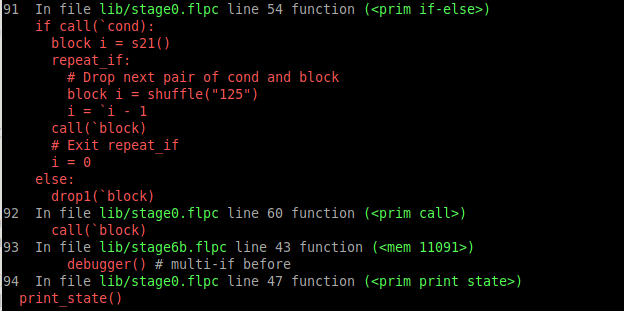
Each element of the data stack is printed as <name>: <value>, except for separators which are shown as ----- (five dashes).
print_stack prints only the stack portion.
debugger
Once debugger is defined, enters the debugger. Special commands are
sstep (step into)nnext (step over)rreturn (step until return)lprints stack, same asps
Other commands are run (added to the call stack) with control resuming after the command is finished.
rebind: either debugger_inner or debugger for the debugger to behave differently.
tprint
Typed print. Prints (and consumes) the top of the data stack. The value is formatted according to its type.
mpr
Prints the function-end separated memory with one character representing each cell.
debugging primitives
gcc -gdwarf-2 -g3 flpc_all.c -o flpc
gdb ./flpc
(gdb) b _error
(gdb) b bp
(gdb) r <input-file>
call ps() and p cstring(input_next_token()) should help determine the program state when a breakpoint or error is reached.
Primitives
The end of the C source contains a complete list (starting from int (*primitives[])(void) = ...)
- Integer and arithmetic operations
+ - * 0 1 pushi: - Boolean operations
|| && - Memory and stack access
memory.set memory.get memory.append push: pushf: functions_end functions_end.increase - Stack shuffling and naming
assign: pick: check: pick1 s21 shuffle: newfuncX returnX return_no_valueX - Very basic branch and loop
if if-else repeat repeat_if return_if - Display and debugging
print print_state mpr - stdin reading
input.next_token next_token2 - File read [1]
file_open fd_* - File write
set_output - String manipulation (*)
is_str is_alpha string_equal char_between str_join sub_str int_to_str - Memoizer helper [2]
memoizer_get memoizer_set memoizer_reset
[1] Should be in a module. But there's no module system yet. [2] Should be defined using other primitives instead
Most everything else is defined at runtime and can be rebind: (once rebind: itself is defined).
TODO: document this more
Other things to try
- Generate the content of
flpc_grammar.flpcandgrammar.flpc - Write some FlpcPython, compile it using
compiler.pyand run it.
Interpreter
To document.
Boot object model
To document.


Similar repos


Languages
Forth
82.2%
C
8.2%
Nim
7.4%
Python
2.2%
Forth Lisp Python Continuum: A small highly dynamic self-bootstrapping language
Forth
225
11 commits
updated Feb 20, 2022
README
Forth Lisp Python Continuum
(Preview version. Even more of a code dump than usual. Should still run. Please report any issues.)
The Forth Lisp Python Continuum is a language made under the following incorrect assumption.
Python is Lisp with syntactic sugar and Lisp is Forth with syntactic sugar.
Highlights
- Almost all of Flpc is written in Flpc itself and defined at runtime. This means almost everything is modifiable at runtime using
rebind:including the loop for reading input, compiling functions, looking up names andrebind:itself! - Alter the Flpc syntax by writing only in Flpc! [1]
- Mix and match. Make your code as Forthy, Lispy or Pythonic as you like.
- Low LoC count (relatively) to easily modify the boot sequence for your needs.
- Save and load state (save not yet implemented).
[1] The first time around, the description of the syntax change has to be written in the old Flpc of course.
Syntax
All of the of the following are equivalent in (the default syntax of) Flpc. Python-like syntax
fib <- fun[i]:
    if i < 3:
        return(1)
    return(fib(x - 1) + fib(x - 2))
Lisp-like syntax
bind("fib" fun([i]
               [if(<(i 3) [return(1)])
                return(+(fib(-(i 1)) fib(-(i 2))))]))
Forth-like syntax
bind("fib" ["i" assign_() i 3 <() [1 return()] if()
            i 1 -() fib() i 2 -() fib() +() return()])
More Forth-like syntax
F'
[ 1 return2 ] bind: base-case
[ newfunc1 assign: i
  pick: i pushi: 3 < pushf: base-case if
  pick: i 1 - fib pick: i 2 - fib + return1
  ] bind: fib
'F
or just
F'
[ pick1 pushi: 3 < [ drop1 1 return ] if
  pick1 1 - fib pick2 - fib + s21 drop1 return ] bind: fib
'F
Or anything in between. For example, Lisp with sweet expressions:
bind("fib" fun([i]
               [if(i < 3 [return(1)])
                return(fib(i - 1) + fib(i - 2))]))
Eventually, the grammar itself will be modifiable at runtime (needs the Flpc compiler written in Flpc to be complete for that).
With the use optional linters to enforce the style combination of your choosing (not yet implemented or designed).
For technical reasons, all of the above need to be prepended with the line (this is because of the recursive call).
bind("fib" ["Dummy"])
Running
Run FlpcPython programs precompiled to FlpcForth with
nim c --gc:orc -d:danger flpc.nim
./flpc precompiled/interpreter.f
(or one of precompiled/self.f, precompiled/flpc-gen.f, precompiled/compiler.f, ). Tested with Nim Compiler Version 1.4.6.
Recompile .f files with
python compiler.py <list of sources> -o <output file>
compiler.py depends on pymetaterp. Install it with pip install -r requirements.txt.
The existing precompiled files were created with
python compiler.py lib/stage{0,1{a,b,b2,b3,c,d},3{a,b}}.flpc lib/flpc_grammar.flpc lib/stage{6{a,b},7a2,7a}.flpc -o precompiled/interpreter.f
python compiler.py lib/stage{0,1{a,b,b2,b3,c,d},3{a,b}}.flpc lib/flpc_grammar.flpc lib/stage6{a,b}.flpc -o precompiled/compiler.f
python compiler.py lib/stage{0,1{a,b,b2,b3,c,d}}.flpc lib/grammar.flpc lib/stage{2,3a}.flpc test/stage3-test.flpc -o precompiled/flpc-gen.f
python compiler.py lib/stage{0,1{a,b,b2,b3,c,d},3{a,b}}.flpc lib/flpc_grammar.flpc lib/stage6{a,b}.flpc test/self.flpc -o precompiled/self.f
To run tests (in test/), compile up to the needed test and append the test.
python compiler.py lib/stage{0,1{a,b,c}} test/stage1c-test.flpc -o precompiled/test.f
See Bootstrapping Sequence to get an idea of combinations that may work.
Bootstrapping sequence
Almost everything is modifiable at runtime using rebind: including the loop for reading input, compiling functions, looking up names and rebind: itself!
This is a long list but the size of each file is relatively small.
- boot.flpc: Preloaded into memory (instead of at runtime) by reading the file
init_memory.dat(a text file despite the name). Contains the REPL and compilation loop.init_memory.datalso containsnames.getwhich implicitly represents the function names dictionary. - stage0.flpc: Defines
bind:,rebind:and the debugger. - stage1a.flpc: Basic object system (
boot_obj,boot_array,boot_dict) - objects.flpc (was
stage1b.flpc): Object system (abandoned and unused for now; runs but is too slow without some kind of caching) - stage1b.flpc: Hashtable class
- stage1b2.flpc: Replace function name resolution
names.getwith hashtable lookups. Rewire existing name map. - stage1b3.flpc: Replace class attribute lookup
obj . attribwith hashtable lookups. Rewire existingattribs. - stage1c.flpc: More objects:
resizablearrays,nodeandInputfor reading files (unfortunately all in the style of the basic object system instead of the intended one from stage1b) - stage1d.flpc: Semantics for nodes of a grammar
- grammar.flpc: Rules of a grammar parsing grammar
- stage2.flpc: Use the grammar parsing grammar to parse flpc.grammar into a grammar tree
- stage3a.flpc: Generate FlpcPython from the grammar tree in stage2. Can generate the content of
flpc_grammar.flpc(by adding the content ofstage1-test.flpc). - stage3b.flpc: Defines some semantics and trickier rules for a Flpc parsing grammar.
- flpc_grammar.flpc: Rules of a FlpcPython parsing grammar.
- stage4.flpc: Parses a FlpcPython source file (by default
stage1.flpc; change the hard-coded value for a different file) into its Abstract Syntax Tree. - stage5.flpc: Pretty-prints the AST from stage4.
- stage6a.flpc: Missing language features for implementing
compiler.py: loops, list comprehension, string manipulation, some classes. - stage6b.flpc: Rest of the compiler. More or less a direct translation of
compiler.pyto FLPC. - stage7a.flpc: Starts a FlpcPython interpreter and triple quote.
- stage7a2.flpc: Objects using hashtable for method lookup.
- stage7a3.flpc: Python FFI. See
test/pyexec.flpcfor sample usage. - stage7a4.flpc: Other helpers. Currently contains easier dictionary creation (see
test/make_dict.flpc). - stage7b.flpc: Compiled and run by the compiler from stages 1-6.
What's next?
Its not clear what should go first, both as the next thing to write and the next thing to run in the boot sequence. (In fact, maybe the current boot sequence should be reordered).
- Flpc AST to FlpcForth compiler. COMPLETE This is the most obvious as it would remove the need for
compiler.py(so the only remaining source file in the project that is not Flpc would beflpc.c). However, competing with that are - Garbage collection. If the concatenation of all
stage1*.flpcfiles are compiled, it takes up millions of memory cells. A number of those could be reclaimed. - Caching mechanism. This woud let us use the actual intended object system (hopefully its fast enough!) and replaces
names.getwith the method of an actual dictionary (as instage1b.flpc). Binding and rebinding would be much easier and we can maybe also replace the memoizer. - Modules. We can't keep adding new features (like syscalls) as primitives. Ideally, they'd be referenced by name in some module system.
- Nested FlpcForth parser. The number of auto-generated functions is pretty high and makes it a bit unreadable. Maybe this should even come right after the debugger (stage0).
- Direct Flpc AST interpreter Maybe with an interpreter, we won't need the compiler (except at the very beginning). Everything can be rebound at runtime anyways.
- Foreign function interface. Early prototype COMPLETE We probably don't want to reimplement everything (at least, not at first). Is there some language we can connect to and just use its functions as primitives?
Debugging
Hopefully these will also help with determining what some of the undocumented functions do with just some trial.
printstate
ps or printstate prints the formatted debug stack, formatted call_stack and next command.
Each element of the data stack is printed as <name>: <value>, except for separators which are shown as ----- (five dashes).
print_stack prints only the stack portion.
debugger
Once debugger is defined, enters the debugger. Special commands are
sstep (step into)nnext (step over)rreturn (step until return)lprints stack, same asps
Other commands are run (added to the call stack) with control resuming after the command is finished.
rebind: either debugger_inner or debugger for the debugger to behave differently.
tprint
Typed print. Prints (and consumes) the top of the data stack. The value is formatted according to its type.
mpr
Prints the function-end separated memory with one character representing each cell.
debugging primitives
gcc -gdwarf-2 -g3 flpc_all.c -o flpc
gdb ./flpc
(gdb) b _error
(gdb) b bp
(gdb) r <input-file>
call ps() and p cstring(input_next_token()) should help determine the program state when a breakpoint or error is reached.
Primitives
The end of the C source contains a complete list (starting from int (*primitives[])(void) = ...)
- Integer and arithmetic operations
+ - * 0 1 pushi: - Boolean operations
|| && - Memory and stack access
memory.set memory.get memory.append push: pushf: functions_end functions_end.increase - Stack shuffling and naming
assign: pick: check: pick1 s21 shuffle: newfuncX returnX return_no_valueX - Very basic branch and loop
if if-else repeat repeat_if return_if - Display and debugging
print print_state mpr - stdin reading
input.next_token next_token2 - File read [1]
file_open fd_* - File write
set_output - String manipulation (*)
is_str is_alpha string_equal char_between str_join sub_str int_to_str - Memoizer helper [2]
memoizer_get memoizer_set memoizer_reset
[1] Should be in a module. But there's no module system yet. [2] Should be defined using other primitives instead
Most everything else is defined at runtime and can be rebind: (once rebind: itself is defined).
TODO: document this more
Other things to try
- Generate the content of
flpc_grammar.flpcandgrammar.flpc - Write some FlpcPython, compile it using
compiler.pyand run it.
Interpreter
To document.
Boot object model
To document.
Similar repos
Languages
Forth
82.2%
C
8.2%
Nim
7.4%
Python
2.2%