The llama.cpp version of JEPA models, allowing fast CPU inference.
Python
5
236 commits
updated Oct 15, 2026




JEPA vision models in plain C/C++. One binary, one GGUF file, any CPU, optional CUDA. No Python in the loop.
jepa.cpp runs the JEPA family of self-supervised vision encoders and world models — I-JEPA, V-JEPA 2 / 2.1 / 2-AC, LeJEPA, LeVJEPA and LeWorldModel — on ggml, the engine behind llama.cpp. Every model reproduces its PyTorch reference to cosine 1.000 in f32, runs 1.1–1.8× faster than PyTorch on a CPU, and comes pre-converted on Hugging Face.
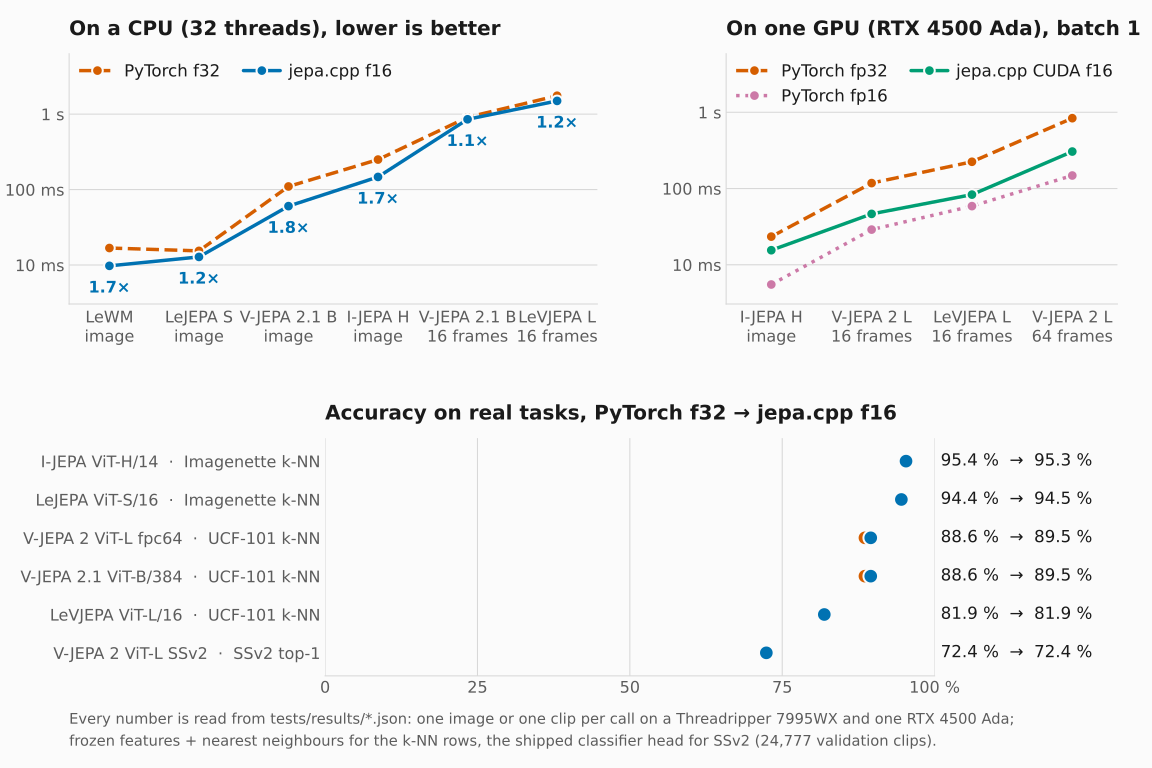
Every number is read from a committed artifact under tests/results/. The full tables, the
quantization study and the fine print are on the docs site.
Nine models and the H-JEPA collection, seven families, all on Hugging Face under
jepacpp. Each repo ships f32, f16, q8_0, q4_0 and q4_k files
(H-JEPA: f32, f16, q8_0) with their sha256 and measured parity on the card. f16 is the default; q8_0 halves it again and is safe for pooled features, retrieval and
rollouts.
| model | from | params | does | f16 / q8_0 | GGUF | licence |
|---|---|---|---|---|---|---|
| LeJEPA ViT-S/16 | OK-AI | 22 M | image features, fast | 42 / 23 MB | ↓ | Apache-2.0 |
| LeWorldModel Push-T | le-wm | 18 M | image features + action-conditioned world model | 38 / 23 MB | ↓ | MIT |
| H-JEPA (31 checkpoints) | H-JEPA | 11 – 86 M | hierarchical world models with the paper's top-down planner, 1 – 4 levels: AntMaze, FourRoom, Cube, Push-T, DROID | 25 – 217 / 16 – 157 MB | ↓ | MIT |
| V-JEPA 2.1 ViT-B/16 @384 | Meta FAIR | 110 M | image and video features + predictor | 210 / 113 MB | ↓ | MIT |
| LeVJEPA ViT-L/16 | galilai | 303 M | video features, block-causal attention | 579 / 310 MB | ↓ | CC-BY-NC-4.0 |
| V-JEPA 2 ViT-L/16 | Meta FAIR | 326 M | video features (16–64 frames) + masked predictor | 623 / 333 MB | ↓ | MIT |
| V-JEPA 2 ViT-L SSv2 | Meta FAIR | 375 M | video action classification, 174 classes | 717 / 383 MB | ↓ | MIT |
| I-JEPA ViT-H/14 | Meta FAIR | 631 M | image features | 1.2 / 0.64 GB | ↓ | CC-BY-NC-4.0 |
| V-JEPA 2 ViT-g/16 | Meta FAIR | 1.03 B | video features (16–64 frames) + masked predictor | 2.0 / 1.1 GB | ↓ | Apache-2.0 |
| V-JEPA 2-AC ViT-g | Meta FAIR | 1.32 B | action-conditioned world model + CEM planner | 2.5 / 1.3 GB | ↓ | MIT |
A new checkpoint of a known family needs no C++ change: the converter writes the metadata, the loader builds the graph from it.
Prebuilt Linux x86-64 binaries are on the releases page. From source (CMake ≥ 3.16, Ninja, a C++17 compiler):
git clone --recursive https://github.com/aselimc/jepa.cpp && cd jepa.cpp
cmake -S . -B build -G Ninja -DCMAKE_BUILD_TYPE=Release && cmake --build build -j
scripts/download_models.sh small      # LeJEPA, LeWorldModel, V-JEPA 2.1 at f16 (290 MB); "all" for the rest
scripts/download_fixtures.sh          # sample media (+ the PyTorch golden dumps for ctest)
# image -> feature vector
build/jepa-embed -m models/gguf/lejepa-vits16-pretrain-in1k-f16.gguf -i tests/fixtures/media/coco_000000000139.jpg --pool cls

# video -> feature vector (16 frames sampled like the PyTorch pipeline; needs ffmpeg)
build/jepa-embed -m models/gguf/vjepa2_1-vitb-384-f16.gguf --video tests/fixtures/media/archery.mp4 --frames 16 --pool mean

# video -> "what is happening?"  (SSv2, from download_models.sh all)
build/jepa-classify -m models/gguf/vjepa2-vitl-fpc16-256-ssv2-f16.gguf --video tests/fixtures/media/archery.mp4 -k 5

# image -> latent world model -> 8 action steps
build/jepa-worldmodel -m models/gguf/lewm-pusht-f16.gguf --image tests/fixtures/media/coco_000000000139.jpg --random-actions 8
build/jepa-plan -m models/gguf/ant_hjepa_l3-seed42-f16.gguf --obs now.png --goal goal.png   # H-JEPA: two images -> actions

# HTTP server: POST /v1/embeddings (OpenAI-shaped), /classify, /rollout, /metrics
build/jepa-server -m models/gguf/lejepa-vits16-pretrain-in1k-f16.gguf --workers 4
cmake -S . -B build-cuda -DJEPA_CUDA=ON, then --gpu on any tool.include/jepa.h — load, encode, pool or predict.pip install ./python wraps that header behind numpy, bit-identical to the CLI on a CPU
(python/README.md).build/jepa-quantize in-f16.gguf out-q8_0.gguf q8_0.| Getting started | build, download or convert, one worked example per tool, licences |
| Performance · Accuracy | every measured number: CPU, GPU, batching, quantization, real-task accuracy |
| Architecture | the shared ViT graph, 3-D RoPE, preprocessing, the family matrix, GPU notes |
| C API · Serving · GGUF schema | the header, the HTTP server, what a file carries |
| Parity | how correctness is tested: golden dumps, per-token thresholds, 19 ctest suites |
Built on ggml. Models by Meta FAIR (I-JEPA, V-JEPA 2 / 2.1 / 2-AC), Balestriero & LeCun / OK-AI (LeJEPA), galilai (LeVJEPA) and le-wm (LeWorldModel).
Code is MIT. Converted GGUFs keep their checkpoint's licence, carried inside the file; note that I-JEPA and LeVJEPA are CC-BY-NC-4.0, non-commercial.
696 followers · starred Oct 2026
The llama.cpp version of JEPA models, allowing fast CPU inference.
Python
5
236 commits
updated Oct 15, 2026
JEPA vision models in plain C/C++. One binary, one GGUF file, any CPU, optional CUDA. No Python in the loop.
jepa.cpp runs the JEPA family of self-supervised vision encoders and world models — I-JEPA, V-JEPA 2 / 2.1 / 2-AC, LeJEPA, LeVJEPA and LeWorldModel — on ggml, the engine behind llama.cpp. Every model reproduces its PyTorch reference to cosine 1.000 in f32, runs 1.1–1.8× faster than PyTorch on a CPU, and comes pre-converted on Hugging Face.
Every number is read from a committed artifact under tests/results/. The full tables, the
quantization study and the fine print are on the docs site.
Nine models and the H-JEPA collection, seven families, all on Hugging Face under
jepacpp. Each repo ships f32, f16, q8_0, q4_0 and q4_k files
(H-JEPA: f32, f16, q8_0) with their sha256 and measured parity on the card. f16 is the default; q8_0 halves it again and is safe for pooled features, retrieval and
rollouts.
| model | from | params | does | f16 / q8_0 | GGUF | licence |
|---|---|---|---|---|---|---|
| LeJEPA ViT-S/16 | OK-AI | 22 M | image features, fast | 42 / 23 MB | ↓ | Apache-2.0 |
| LeWorldModel Push-T | le-wm | 18 M | image features + action-conditioned world model | 38 / 23 MB | ↓ | MIT |
| H-JEPA (31 checkpoints) | H-JEPA | 11 – 86 M | hierarchical world models with the paper's top-down planner, 1 – 4 levels: AntMaze, FourRoom, Cube, Push-T, DROID | 25 – 217 / 16 – 157 MB | ↓ | MIT |
| V-JEPA 2.1 ViT-B/16 @384 | Meta FAIR | 110 M | image and video features + predictor | 210 / 113 MB | ↓ | MIT |
| LeVJEPA ViT-L/16 | galilai | 303 M | video features, block-causal attention | 579 / 310 MB | ↓ | CC-BY-NC-4.0 |
| V-JEPA 2 ViT-L/16 | Meta FAIR | 326 M | video features (16–64 frames) + masked predictor | 623 / 333 MB | ↓ | MIT |
| V-JEPA 2 ViT-L SSv2 | Meta FAIR | 375 M | video action classification, 174 classes | 717 / 383 MB | ↓ | MIT |
| I-JEPA ViT-H/14 | Meta FAIR | 631 M | image features | 1.2 / 0.64 GB | ↓ | CC-BY-NC-4.0 |
| V-JEPA 2 ViT-g/16 | Meta FAIR | 1.03 B | video features (16–64 frames) + masked predictor | 2.0 / 1.1 GB | ↓ | Apache-2.0 |
| V-JEPA 2-AC ViT-g | Meta FAIR | 1.32 B | action-conditioned world model + CEM planner | 2.5 / 1.3 GB | ↓ | MIT |
A new checkpoint of a known family needs no C++ change: the converter writes the metadata, the loader builds the graph from it.
Prebuilt Linux x86-64 binaries are on the releases page. From source (CMake ≥ 3.16, Ninja, a C++17 compiler):
git clone --recursive https://github.com/aselimc/jepa.cpp && cd jepa.cpp
cmake -S . -B build -G Ninja -DCMAKE_BUILD_TYPE=Release && cmake --build build -j
scripts/download_models.sh small      # LeJEPA, LeWorldModel, V-JEPA 2.1 at f16 (290 MB); "all" for the rest
scripts/download_fixtures.sh          # sample media (+ the PyTorch golden dumps for ctest)
# image -> feature vector
build/jepa-embed -m models/gguf/lejepa-vits16-pretrain-in1k-f16.gguf -i tests/fixtures/media/coco_000000000139.jpg --pool cls

# video -> feature vector (16 frames sampled like the PyTorch pipeline; needs ffmpeg)
build/jepa-embed -m models/gguf/vjepa2_1-vitb-384-f16.gguf --video tests/fixtures/media/archery.mp4 --frames 16 --pool mean

# video -> "what is happening?"  (SSv2, from download_models.sh all)
build/jepa-classify -m models/gguf/vjepa2-vitl-fpc16-256-ssv2-f16.gguf --video tests/fixtures/media/archery.mp4 -k 5

# image -> latent world model -> 8 action steps
build/jepa-worldmodel -m models/gguf/lewm-pusht-f16.gguf --image tests/fixtures/media/coco_000000000139.jpg --random-actions 8
build/jepa-plan -m models/gguf/ant_hjepa_l3-seed42-f16.gguf --obs now.png --goal goal.png   # H-JEPA: two images -> actions

# HTTP server: POST /v1/embeddings (OpenAI-shaped), /classify, /rollout, /metrics
build/jepa-server -m models/gguf/lejepa-vits16-pretrain-in1k-f16.gguf --workers 4
cmake -S . -B build-cuda -DJEPA_CUDA=ON, then --gpu on any tool.include/jepa.h — load, encode, pool or predict.pip install ./python wraps that header behind numpy, bit-identical to the CLI on a CPU
(python/README.md).build/jepa-quantize in-f16.gguf out-q8_0.gguf q8_0.| Getting started | build, download or convert, one worked example per tool, licences |
| Performance · Accuracy | every measured number: CPU, GPU, batching, quantization, real-task accuracy |
| Architecture | the shared ViT graph, 3-D RoPE, preprocessing, the family matrix, GPU notes |
| C API · Serving · GGUF schema | the header, the HTTP server, what a file carries |
| Parity | how correctness is tested: golden dumps, per-token thresholds, 19 ctest suites |
Built on ggml. Models by Meta FAIR (I-JEPA, V-JEPA 2 / 2.1 / 2-AC), Balestriero & LeCun / OK-AI (LeJEPA), galilai (LeVJEPA) and le-wm (LeWorldModel).
Code is MIT. Converted GGUFs keep their checkpoint's licence, carried inside the file; note that I-JEPA and LeVJEPA are CC-BY-NC-4.0, non-commercial.
696 followers · starred Oct 2026



