Decoding and encoding gigabytes of LEB128 variable-length integers per second in Rust with SIMD
See the code


varint-simd is a fast SIMD-accelerated variable-length integer and LEB128 encoder and decoder written in Rust. It combines a largely branchless design with compile-time specialization to achieve gigabytes per second of throughput encoding and decoding individual integers on commodity hardware. An interface to decode multiple adjacent variable-length integers is also provided to achieve even higher throughput, reaching over a billion decoded 8-bit integers per second on a single thread.
This library currently targets a minimum of x86_64 processors with support for SSSE3 (Intel Core/AMD Bulldozer or newer), with optional optimizations for processors supporting POPCNT, LZCNT, BMI2, and/or AVX2. It is intended for use in implementations of Protocol Buffers (protobuf), Apache Avro, and similar serialization formats, but likely has many other applications.
Important: Ensure the Rust compiler has an appropriate target-cpu setting. An example is provided in
.cargo/config.toml, but you may need to edit the file to specify the oldest CPUs your compiled
binaries will support. Your project will not compile unless this is set correctly.
The native-optimizations feature should be enabled if and only if target-cpu is set to native, such as in the
example. This enables some extra optimizations if suitable for your specific CPU.
Read more below.
use varint_simd::{encode, decode, encode_zigzag, decode_zigzag};

fn main() {
  let num: u32 = 300;

  let encoded = encode::<u32>(num); // turbofish for demonstration purposes, usually not necessary
  // encoded now contains a tuple
  // (
  //    [0xAC, 0x02, 0, 0, 0, 0, 0, 0, 0, 0, 0, 0, 0, 0, 0, 0], // encoded in a 128-bit vector
  //    2 // the number of bytes encoded
  // )

  let decoded = decode::<u32>(&encoded.0).unwrap();
  // decoded now contains another tuple:
  // (
  //    300, // the decoded number
  //    2 // the number of bytes read from the slice
  // )
  assert_eq!(decoded.0, num);

  // Signed integers can be encoded/decoded with convenience functions encode_zigzag and decode_zigzag
  let num: i32 = -20;
  let encoded = encode_zigzag::<i32>(num);
  let decoded = decode_zigzag::<i32>(&encoded.0).unwrap();
  assert_eq!(decoded.0, num);
}
The type parameter passed into the encode/decode functions greatly affects performance - the code takes shorter paths for shorter integers, and may exhibit comparatively poor performance if you're decoding a lot of tiny integers into u64's.
This crate uses a lot of unsafe code. Please exercise caution, although I do not expect there to be major issues.
There is also an optional "unsafe" interface for bypassing overflow and bounds checks. This can be used when you know your input data won't cause undefined behavior and your calling code can tolerate truncated numbers.
The benchmarks below reflect the performance of decoding and encoding a sequence of random integers bounded by each integer size. All benchmarks are run with native optimizations. For more details, please see the source code for these benchmarks.
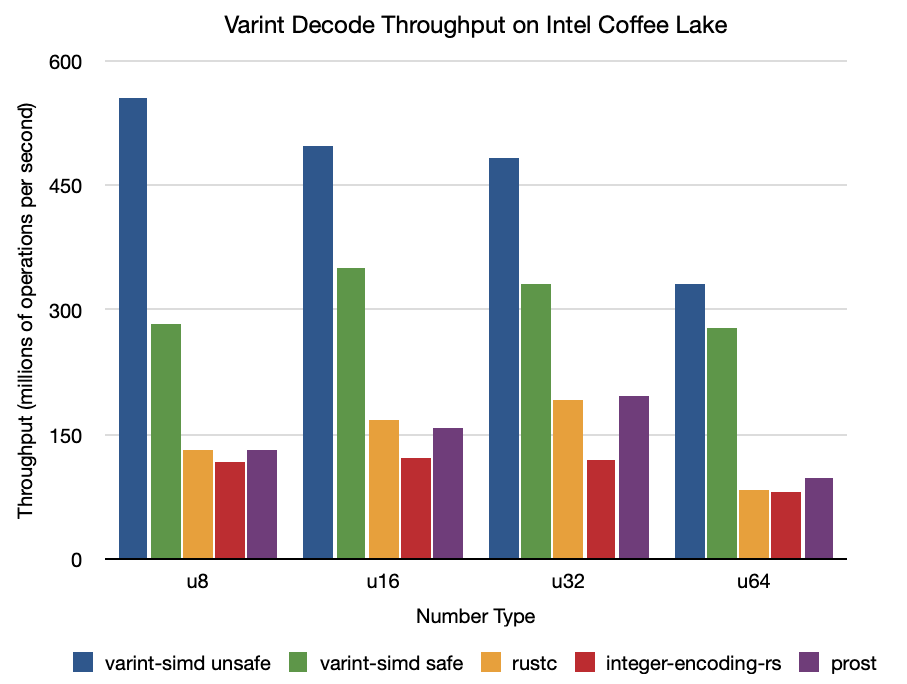
All numbers are in millions of integers per second.
| varint-simd unsafe | varint-simd safe | rustc | integer-encoding-rs | prost | |
|---|---|---|---|---|---|
u8 | 554.81 | 283.26 | 131.71 | 116.59 | 131.42 |
u16 | 493.96 | 349.74 | 168.09 | 121.35 | 157.68 |
u32 | 482.95 | 332.11 | 191.37 | 120.16 | 196.05 |
u64 | 330.86 | 277.65 | 82.315 | 80.328 | 97.585 |
| varint-simd 2x | varint-simd 4x | varint-simd 8x | |
|---|---|---|---|
u8 | 658.52 | 644.36 | 896.32 |
u16 | 547.39 | 540.93 | |
u32 | 688.11 |
| varint-simd | rustc | integer-encoding-rs | prost | |
|---|---|---|---|---|
u8 | 383.01 | 214.05 | 126.66 | 93.617 |
u16 | 341.25 | 181.18 | 126.79 | 85.014 |
u32 | 360.87 | 157.95 | 125.00 | 77.402 |
u64 | 303.72 | 72.660 | 78.153 | 46.456 |
| varint-simd unsafe | varint-simd safe | rustc | integer-encoding-rs | prost | |
|---|---|---|---|---|---|
u8 | 537.51 | 304.85 | 152.35 | 138.54 | 124.44 |
u16 | 403.39 | 300.68 | 170.31 | 156.06 | 147.83 |
u32 | 293.88 | 235.92 | 160.48 | 159.13 | 150.05 |
u64 | 229.28 | 193.28 | 75.822 | 85.010 | 83.407 |
| varint-simd 2x | varint-simd 4x | varint-simd 8x | |
|---|---|---|---|
u8 | 943.75 | 808.45 | 1,106.50 |
u16 | 721.01 | 632.03 | |
u32 | 459.77 |
| varint-simd | rustc | integer-encoding-rs | prost | |
|---|---|---|---|---|
u8 | 362.97 | 211.07 | 142.16 | 98.237 |
u16 | 334.10 | 172.09 | 140.78 | 96.480 |
u32 | 288.19 | 101.56 | 126.27 | 82.210 |
u64 | 207.89 | 52.515 | 79.375 | 48.088 |
u64 values with AVX2 (currently fairly slow)Contributions are welcome. 🙂
native-optimizations featureThis feature flag enables a build script that detects the current CPU and enables PDEP/PEXT optimizations if the CPU
supports running these instructions efficiently. It should be enabled if and only if the target-cpu option is set to
native.
This is necessary because AMD Zen, Zen+, and Zen 2 processors implement these instructions in microcode, which means
they run much, much slower than if they were implemented in hardware. Additionally, Rust does not allow conditional
compilation based on the target-cpu option, so it is necessary to
specify this feature manually.
Library crates should not enable this feature by default. A separate feature flag should be provided to enable this feature in this crate.
Licensed under either of
at your option.
Unless you explicitly state otherwise, any contribution intentionally submitted for inclusion in the work by you, as defined in the Apache-2.0 license, shall be dual licensed as above, without any additional terms or conditions.
Overall
Maintained
Code review
crates.io
Latest release
Releases this year
1,703 followers · starred Feb 2024
118 followers · starred Jan 2023
158 followers · starred May 2025
88 followers · starred Mar 2024
Decoding and encoding gigabytes of LEB128 variable-length integers per second in Rust with SIMD
See the code
varint-simd is a fast SIMD-accelerated variable-length integer and LEB128 encoder and decoder written in Rust. It combines a largely branchless design with compile-time specialization to achieve gigabytes per second of throughput encoding and decoding individual integers on commodity hardware. An interface to decode multiple adjacent variable-length integers is also provided to achieve even higher throughput, reaching over a billion decoded 8-bit integers per second on a single thread.
This library currently targets a minimum of x86_64 processors with support for SSSE3 (Intel Core/AMD Bulldozer or newer), with optional optimizations for processors supporting POPCNT, LZCNT, BMI2, and/or AVX2. It is intended for use in implementations of Protocol Buffers (protobuf), Apache Avro, and similar serialization formats, but likely has many other applications.
Important: Ensure the Rust compiler has an appropriate target-cpu setting. An example is provided in
.cargo/config.toml, but you may need to edit the file to specify the oldest CPUs your compiled
binaries will support. Your project will not compile unless this is set correctly.
The native-optimizations feature should be enabled if and only if target-cpu is set to native, such as in the
example. This enables some extra optimizations if suitable for your specific CPU.
Read more below.
use varint_simd::{encode, decode, encode_zigzag, decode_zigzag};

fn main() {
  let num: u32 = 300;

  let encoded = encode::<u32>(num); // turbofish for demonstration purposes, usually not necessary
  // encoded now contains a tuple
  // (
  //    [0xAC, 0x02, 0, 0, 0, 0, 0, 0, 0, 0, 0, 0, 0, 0, 0, 0], // encoded in a 128-bit vector
  //    2 // the number of bytes encoded
  // )

  let decoded = decode::<u32>(&encoded.0).unwrap();
  // decoded now contains another tuple:
  // (
  //    300, // the decoded number
  //    2 // the number of bytes read from the slice
  // )
  assert_eq!(decoded.0, num);

  // Signed integers can be encoded/decoded with convenience functions encode_zigzag and decode_zigzag
  let num: i32 = -20;
  let encoded = encode_zigzag::<i32>(num);
  let decoded = decode_zigzag::<i32>(&encoded.0).unwrap();
  assert_eq!(decoded.0, num);
}
The type parameter passed into the encode/decode functions greatly affects performance - the code takes shorter paths for shorter integers, and may exhibit comparatively poor performance if you're decoding a lot of tiny integers into u64's.
This crate uses a lot of unsafe code. Please exercise caution, although I do not expect there to be major issues.
There is also an optional "unsafe" interface for bypassing overflow and bounds checks. This can be used when you know your input data won't cause undefined behavior and your calling code can tolerate truncated numbers.
The benchmarks below reflect the performance of decoding and encoding a sequence of random integers bounded by each integer size. All benchmarks are run with native optimizations. For more details, please see the source code for these benchmarks.
All numbers are in millions of integers per second.
| varint-simd unsafe | varint-simd safe | rustc | integer-encoding-rs | prost | |
|---|---|---|---|---|---|
u8 | 554.81 | 283.26 | 131.71 | 116.59 | 131.42 |
u16 | 493.96 | 349.74 | 168.09 | 121.35 | 157.68 |
u32 | 482.95 | 332.11 | 191.37 | 120.16 | 196.05 |
u64 | 330.86 | 277.65 | 82.315 | 80.328 | 97.585 |
| varint-simd 2x | varint-simd 4x | varint-simd 8x | |
|---|---|---|---|
u8 | 658.52 | 644.36 | 896.32 |
u16 | 547.39 | 540.93 | |
u32 | 688.11 |
| varint-simd | rustc | integer-encoding-rs | prost | |
|---|---|---|---|---|
u8 | 383.01 | 214.05 | 126.66 | 93.617 |
u16 | 341.25 | 181.18 | 126.79 | 85.014 |
u32 | 360.87 | 157.95 | 125.00 | 77.402 |
u64 | 303.72 | 72.660 | 78.153 | 46.456 |
| varint-simd unsafe | varint-simd safe | rustc | integer-encoding-rs | prost | |
|---|---|---|---|---|---|
u8 | 537.51 | 304.85 | 152.35 | 138.54 | 124.44 |
u16 | 403.39 | 300.68 | 170.31 | 156.06 | 147.83 |
u32 | 293.88 | 235.92 | 160.48 | 159.13 | 150.05 |
u64 | 229.28 | 193.28 | 75.822 | 85.010 | 83.407 |
| varint-simd 2x | varint-simd 4x | varint-simd 8x | |
|---|---|---|---|
u8 | 943.75 | 808.45 | 1,106.50 |
u16 | 721.01 | 632.03 | |
u32 | 459.77 |
| varint-simd | rustc | integer-encoding-rs | prost | |
|---|---|---|---|---|
u8 | 362.97 | 211.07 | 142.16 | 98.237 |
u16 | 334.10 | 172.09 | 140.78 | 96.480 |
u32 | 288.19 | 101.56 | 126.27 | 82.210 |
u64 | 207.89 | 52.515 | 79.375 | 48.088 |
u64 values with AVX2 (currently fairly slow)Contributions are welcome. 🙂
native-optimizations featureThis feature flag enables a build script that detects the current CPU and enables PDEP/PEXT optimizations if the CPU
supports running these instructions efficiently. It should be enabled if and only if the target-cpu option is set to
native.
This is necessary because AMD Zen, Zen+, and Zen 2 processors implement these instructions in microcode, which means
they run much, much slower than if they were implemented in hardware. Additionally, Rust does not allow conditional
compilation based on the target-cpu option, so it is necessary to
specify this feature manually.
Library crates should not enable this feature by default. A separate feature flag should be provided to enable this feature in this crate.
Licensed under either of
at your option.
Unless you explicitly state otherwise, any contribution intentionally submitted for inclusion in the work by you, as defined in the Apache-2.0 license, shall be dual licensed as above, without any additional terms or conditions.
Overall
Maintained
Code review
crates.io
Latest release
Releases this year
1,703 followers · starred Feb 2024
118 followers · starred Jan 2023
158 followers · starred May 2025
88 followers · starred Mar 2024