
CuPy-accelerated angular clustering + AI/field-level inference for the LSST DR1 era — GPU=CPU bit-for-bit, TreeCorr-validated (2.7e-4), ~30-50x (Tesla T4), real DP1, built for DP2 & DR1, TXPipe-ready
Python
0
0 commits
updated Jul 1, 2026
README
GPU + AI for the LSST DR1 Era
CuPy-accelerated angular clustering → AI field-level inference — built for Rubin DP2 (this summer) and DR1 (next year).
Abstract
Rubin/LSST scales from DP1 (now) → DP2 (~3000 deg², this summer) → DR1
(billions of objects, next year). Turning that data deluge into dark-energy /
dark-matter constraints rests on summary statistics whose pair-counting is
O(N²) — the CPU wall. This project puts that workload on the GPU with CuPy:
the angular two-point correlation w(θ) (the clustering leg of a 3×2pt
analysis), then extends toward the AI / field-level inference the field is
pivoting to (simulation-based inference, GNNs). On a Tesla T4 the GPU result is
bit-for-bit identical to CPU (0.00e+00), cross-checked against TreeCorr
(2.7×10⁻⁴), ~30–50× faster (49.7× at N=20k), and recovers a known analytic
correlation to ~6% — run end-to-end on real DP1 (~495k ECDFS objects via
TAP). It's the same CuPy stack DESI already runs for Redrock on Perlmutter (the
cuPhoton approach), now on the LSST clustering side, and is built to drop into
DESC's TXPipe.
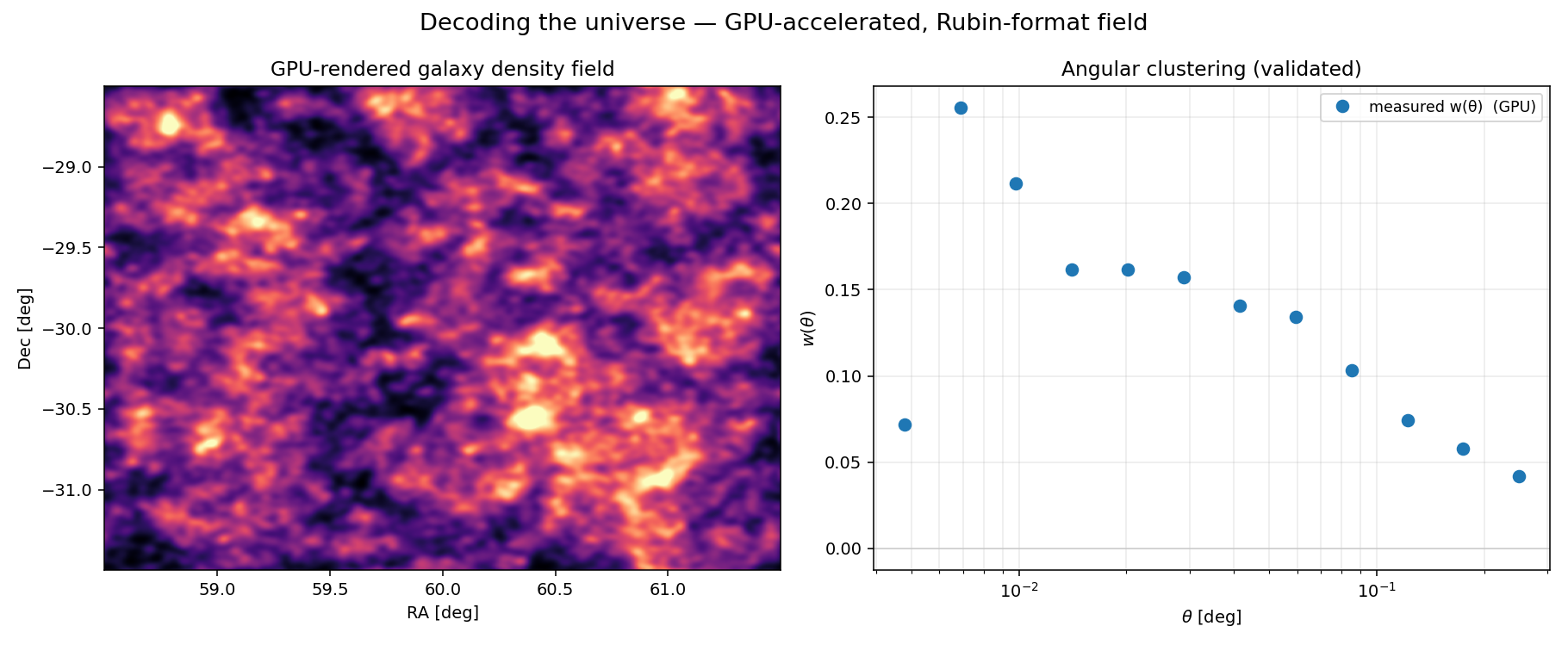
Figure 1 — GPU-rendered galaxy density field (binning + smoothing on the GPU) and
the measured angular clustering w(θ), from one engine.
Roadmap — built for DP2 & DR1
| When | Data | Milestone | Why it matters |
|---|---|---|---|
| Now | DP1 (15 deg², ~2.3M) | validated GPU engine on real data | proof it works |
| This summer | DP2 (~3000 deg², LSSTCam) | first survey-scale w(θ) on GPU | ~200× DP1; GPU starts to matter |
| Next year | DR1 (billions) | GPU/multi-GPU 3×2pt + AI/SBI | CPU can't keep up; GPU necessary |
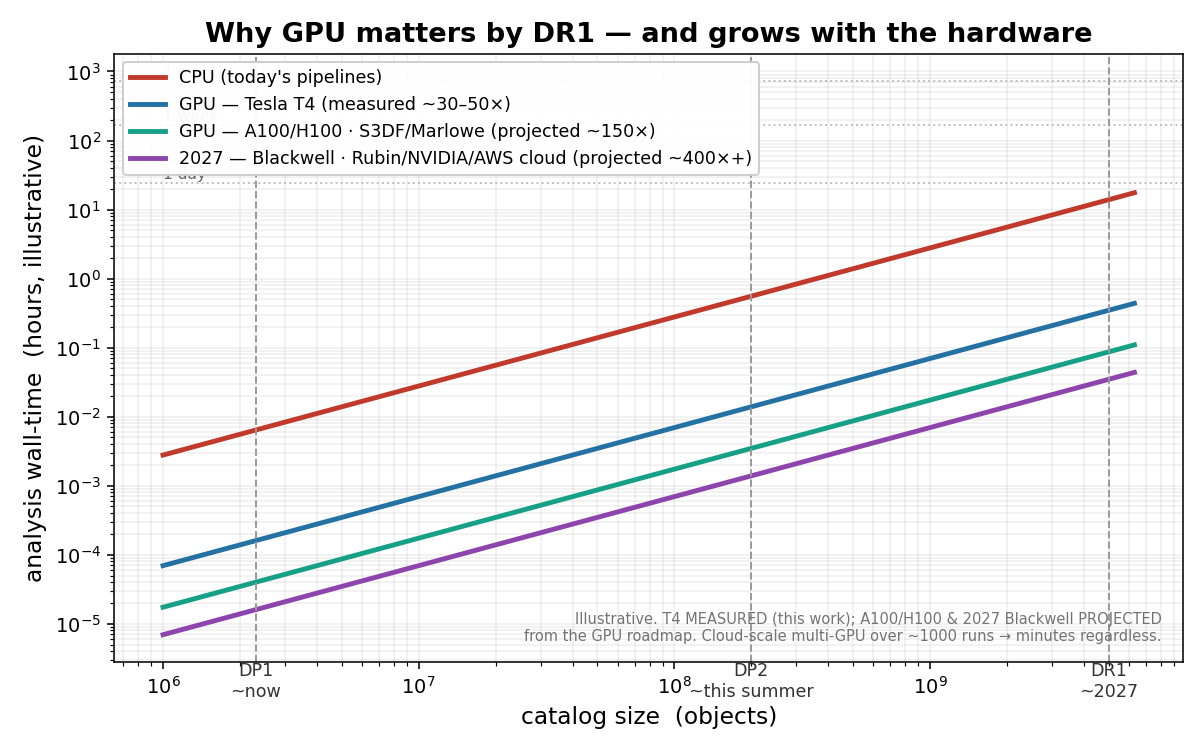
Why GPU matters by DR1 — and grows with the hardware. The Tesla-T4 ratio (~30–50×) is measured; on SLAC A100/H100 or Stanford Marlowe (the hardware we'd use) it's projected ~150×+, higher still by DR1 (2027). The estimator runs thousands of times per analysis → time-to-science. Full detail: ROADMAP.md.
Tracks
- GPU 2-point clustering (CuPy) —
GPU ≡ CPU ≡ TreeCorr ≡ theory, ~30–50× (Tesla T4) - Real DP1 end-to-end —
dp1.Objectvia TAP → w(θ) (~495k ECDFS) - [~] Tomographic w(θ) (
twopcf/tomographic.py) — photo-z-binned clustering, the Rubin analog of DESI's 3D 3×2pt; the density leg of a tomographic 3×2pt, scaling to DP2's ~3000 deg² - [~] AI / field-level inference (SBI) (
twopcf/sbi.py) — GPU forward-model → neural posterior. Production trains on 10⁴–10⁵ forward models — which is why it needs the GPU cluster (CPU can't). DP2-ready (dp2.Object, S3DF A100/H100) - [~] cuPhoton-style FITS ingestion (
fitsio_gpu/, kvikio + nvCOMP) — built, CPU-verified - GNN / field-level inference on Rubin catalogs (DR1)
The DP2/DR1 goal: tomographic 3×2pt + simulation-based inference. SBI replaces hand-built likelihoods by training a neural posterior on 10⁴–10⁵ GPU forward-models — feasible only on a GPU cluster (S3DF now → Rubin/NVIDIA Blackwell by 2027). Tomographic w(θ) in photo-z bins is the Rubin counterpart of DESI's spectroscopic clustering.
[x] done · [~] in progress · [ ] planned. AI/field-level is where the field is pushing (DESC AI/ML white paper, 2026) — same CuPy acceleration, applied beyond two-point.
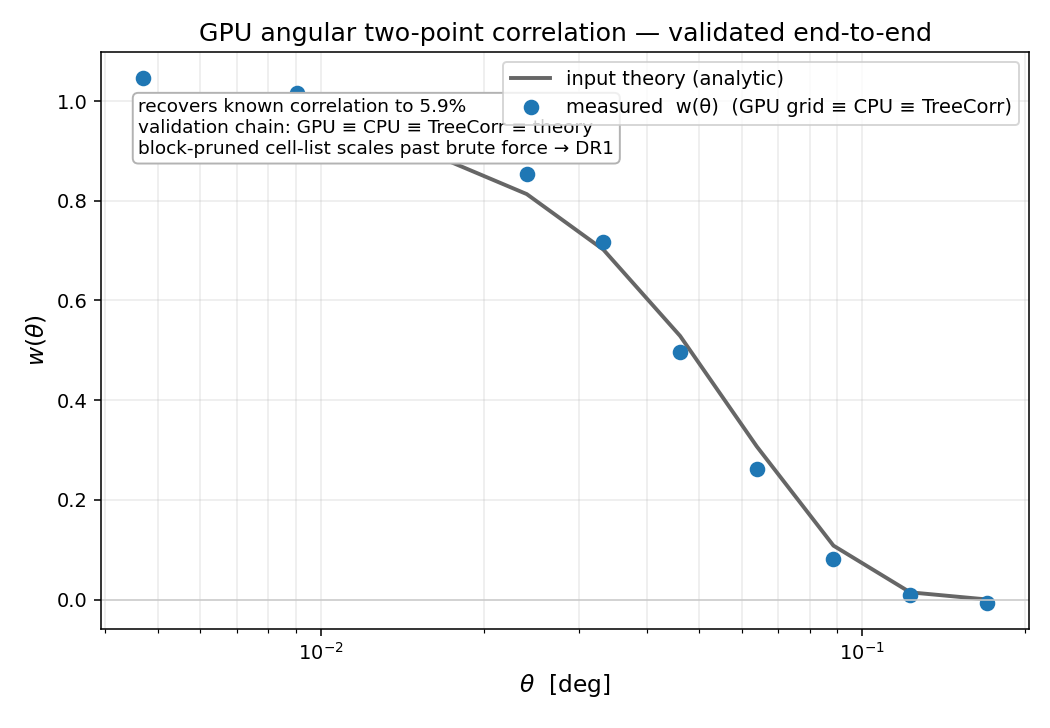
Figure 2 — Validation: GPU-measured w(θ) (points) recovers the known analytic
correlation (line) to ~6%, bit-for-bit identical to CPU and cross-checked against
TreeCorr (2.7×10⁻⁴) — GPU ≡ CPU ≡ TreeCorr ≡ theory.
Run
pip install -r requirements.txt          # + cupy-cuda12x on a GPU box
python examples/run_demo.py              # measure + validate -> figure
python -m twopcf.bench                   # CPU vs GPU speedup
python examples/run_sbi.py               # AI/field-level: infer a parameter from clustering
pytest -q                                # correctness gate
Real DP1: examples/tap_query_external.py (RSP token) → examples/run_on_dp1.py.
GPU run: COLAB.md. Full roadmap: ROADMAP.md.
Where this fits — the field, the data, the money
This plugs into the funded mainstream of AI-for-cosmology and the Rubin data flow:
- The data: Rubin DP1 (now) → DP2 (~3000 deg², this summer) → DR1 (billions) — rubinobservatory.org.
- The pipeline: built to drop into DESC's TXPipe (3×2pt) and validate against CCL.
- The AI push: the DESC AI/ML Opportunities white paper (2026); AI-for-physics institutes like IAIFI (ML for dark-matter subhalos) and the NSF-Simons CosmicAI institute (AI for cosmic discovery on the largest academic GPU cluster).
- The compute & money: NSF + NVIDIA "open AI for science" (~$152M), NSF AI Institutes, and free GPU via NAIRR / DOE exascale.
Same idea, one rung at a time: GPU acceleration (CuPy) for the Rubin data deluge, extended toward AI / field-level inference — exactly the direction these efforts are funded to pursue.
Status & honest limits
GPU by default. The code auto-selects the GPU when one is present (e.g. KIPAC's
S3DF A100/H100) — that's the deployment path. The CPU path exists only as the
bit-for-bit validation reference and speedup baseline (and so it runs on a
laptop / in CI), not as a deployment target. Same code, one xp (CuPy↔NumPy).
GPU w(θ) is validated (GPU ≡ CPU ≡ TreeCorr ≡ theory) and runs on real DP1.
The AI/SBI track is an early scaffold (ridge baseline; a neural posterior estimator
is the upgrade). Brute force is O(N²) — the cell-list scales past it; a science-grade
clustering measurement still needs the survey mask and star/galaxy separation.
Similar repos


Languages
Python
100.0%
CuPy-accelerated angular clustering + AI/field-level inference for the LSST DR1 era — GPU=CPU bit-for-bit, TreeCorr-validated (2.7e-4), ~30-50x (Tesla T4), real DP1, built for DP2 & DR1, TXPipe-ready
Python
0
0 commits
updated Jul 1, 2026
README
GPU + AI for the LSST DR1 Era
CuPy-accelerated angular clustering → AI field-level inference — built for Rubin DP2 (this summer) and DR1 (next year).
Abstract
Rubin/LSST scales from DP1 (now) → DP2 (~3000 deg², this summer) → DR1
(billions of objects, next year). Turning that data deluge into dark-energy /
dark-matter constraints rests on summary statistics whose pair-counting is
O(N²) — the CPU wall. This project puts that workload on the GPU with CuPy:
the angular two-point correlation w(θ) (the clustering leg of a 3×2pt
analysis), then extends toward the AI / field-level inference the field is
pivoting to (simulation-based inference, GNNs). On a Tesla T4 the GPU result is
bit-for-bit identical to CPU (0.00e+00), cross-checked against TreeCorr
(2.7×10⁻⁴), ~30–50× faster (49.7× at N=20k), and recovers a known analytic
correlation to ~6% — run end-to-end on real DP1 (~495k ECDFS objects via
TAP). It's the same CuPy stack DESI already runs for Redrock on Perlmutter (the
cuPhoton approach), now on the LSST clustering side, and is built to drop into
DESC's TXPipe.
Figure 1 — GPU-rendered galaxy density field (binning + smoothing on the GPU) and
the measured angular clustering w(θ), from one engine.
Roadmap — built for DP2 & DR1
| When | Data | Milestone | Why it matters |
|---|---|---|---|
| Now | DP1 (15 deg², ~2.3M) | validated GPU engine on real data | proof it works |
| This summer | DP2 (~3000 deg², LSSTCam) | first survey-scale w(θ) on GPU | ~200× DP1; GPU starts to matter |
| Next year | DR1 (billions) | GPU/multi-GPU 3×2pt + AI/SBI | CPU can't keep up; GPU necessary |
Why GPU matters by DR1 — and grows with the hardware. The Tesla-T4 ratio (~30–50×) is measured; on SLAC A100/H100 or Stanford Marlowe (the hardware we'd use) it's projected ~150×+, higher still by DR1 (2027). The estimator runs thousands of times per analysis → time-to-science. Full detail: ROADMAP.md.
Tracks
- GPU 2-point clustering (CuPy) —
GPU ≡ CPU ≡ TreeCorr ≡ theory, ~30–50× (Tesla T4) - Real DP1 end-to-end —
dp1.Objectvia TAP → w(θ) (~495k ECDFS) - [~] Tomographic w(θ) (
twopcf/tomographic.py) — photo-z-binned clustering, the Rubin analog of DESI's 3D 3×2pt; the density leg of a tomographic 3×2pt, scaling to DP2's ~3000 deg² - [~] AI / field-level inference (SBI) (
twopcf/sbi.py) — GPU forward-model → neural posterior. Production trains on 10⁴–10⁵ forward models — which is why it needs the GPU cluster (CPU can't). DP2-ready (dp2.Object, S3DF A100/H100) - [~] cuPhoton-style FITS ingestion (
fitsio_gpu/, kvikio + nvCOMP) — built, CPU-verified - GNN / field-level inference on Rubin catalogs (DR1)
The DP2/DR1 goal: tomographic 3×2pt + simulation-based inference. SBI replaces hand-built likelihoods by training a neural posterior on 10⁴–10⁵ GPU forward-models — feasible only on a GPU cluster (S3DF now → Rubin/NVIDIA Blackwell by 2027). Tomographic w(θ) in photo-z bins is the Rubin counterpart of DESI's spectroscopic clustering.
[x] done · [~] in progress · [ ] planned. AI/field-level is where the field is pushing (DESC AI/ML white paper, 2026) — same CuPy acceleration, applied beyond two-point.
Figure 2 — Validation: GPU-measured w(θ) (points) recovers the known analytic
correlation (line) to ~6%, bit-for-bit identical to CPU and cross-checked against
TreeCorr (2.7×10⁻⁴) — GPU ≡ CPU ≡ TreeCorr ≡ theory.
Run
pip install -r requirements.txt          # + cupy-cuda12x on a GPU box
python examples/run_demo.py              # measure + validate -> figure
python -m twopcf.bench                   # CPU vs GPU speedup
python examples/run_sbi.py               # AI/field-level: infer a parameter from clustering
pytest -q                                # correctness gate
Real DP1: examples/tap_query_external.py (RSP token) → examples/run_on_dp1.py.
GPU run: COLAB.md. Full roadmap: ROADMAP.md.
Where this fits — the field, the data, the money
This plugs into the funded mainstream of AI-for-cosmology and the Rubin data flow:
- The data: Rubin DP1 (now) → DP2 (~3000 deg², this summer) → DR1 (billions) — rubinobservatory.org.
- The pipeline: built to drop into DESC's TXPipe (3×2pt) and validate against CCL.
- The AI push: the DESC AI/ML Opportunities white paper (2026); AI-for-physics institutes like IAIFI (ML for dark-matter subhalos) and the NSF-Simons CosmicAI institute (AI for cosmic discovery on the largest academic GPU cluster).
- The compute & money: NSF + NVIDIA "open AI for science" (~$152M), NSF AI Institutes, and free GPU via NAIRR / DOE exascale.
Same idea, one rung at a time: GPU acceleration (CuPy) for the Rubin data deluge, extended toward AI / field-level inference — exactly the direction these efforts are funded to pursue.
Status & honest limits
GPU by default. The code auto-selects the GPU when one is present (e.g. KIPAC's
S3DF A100/H100) — that's the deployment path. The CPU path exists only as the
bit-for-bit validation reference and speedup baseline (and so it runs on a
laptop / in CI), not as a deployment target. Same code, one xp (CuPy↔NumPy).
GPU w(θ) is validated (GPU ≡ CPU ≡ TreeCorr ≡ theory) and runs on real DP1.
The AI/SBI track is an early scaffold (ridge baseline; a neural posterior estimator
is the upgrade). Brute force is O(N²) — the cell-list scales past it; a science-grade
clustering measurement still needs the survey mask and star/galaxy separation.
Similar repos
Languages
Python
100.0%