DiffuCoder: Understanding and Improving Masked Diffusion Models for Code Generation
Python
837
12 commits
updated Sep 11, 2026
 Masked Diffusion Models for Code Generation


This software project accompanies the research paper, DiffuCoder: Understanding and Improving Masked Diffusion Models for Code Generation.
MLX support on Apple Silicon is in progress. We will make necessary updates to the repository once it is available.
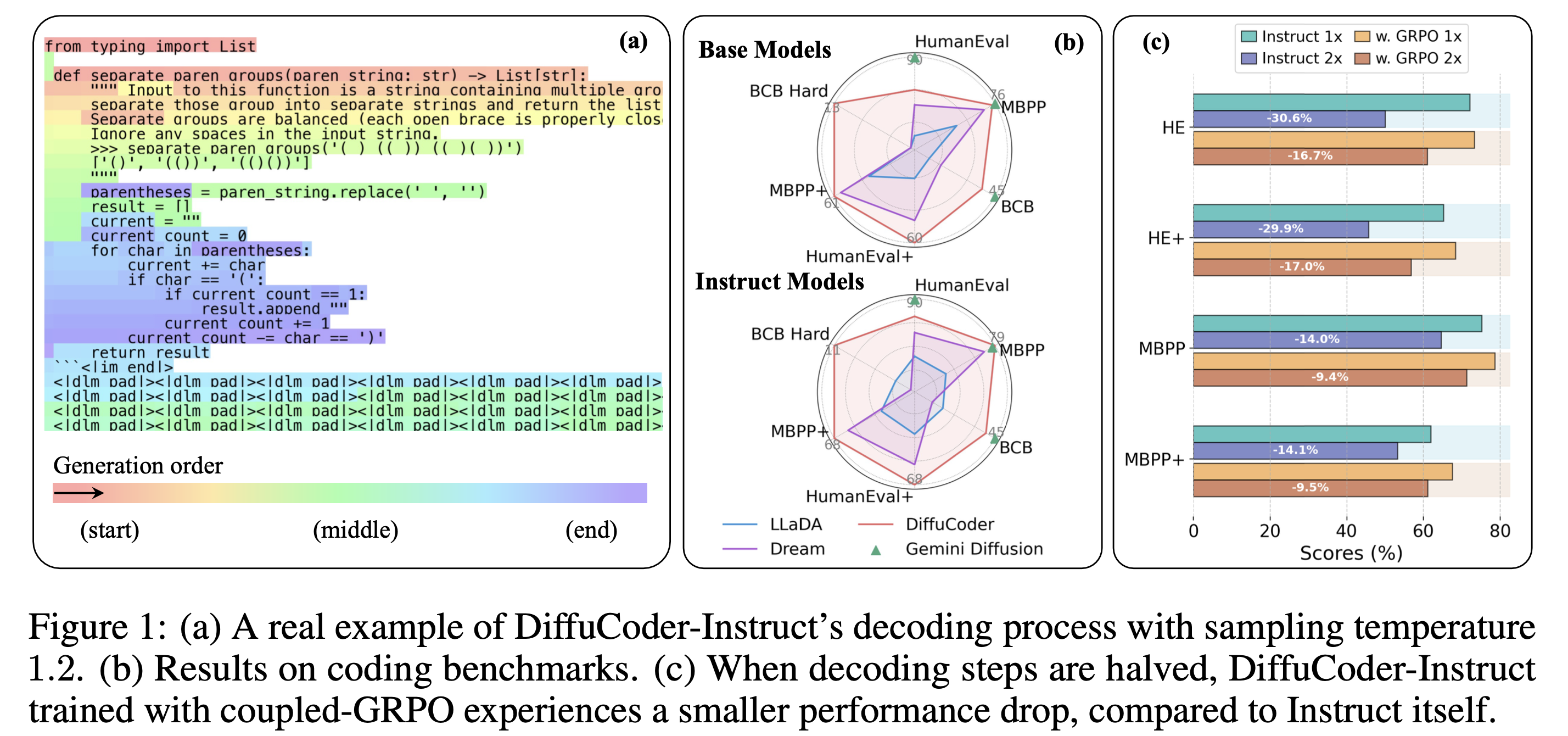
Scaling upon Masked Denoising Models (MDMs), diffusion LLMs (dLLMs) such as LLaDA and Dream have achieved performance on par with similarly sized autoregressive (AR) LLMs across many benchmarks. Recent commercial-scale dLLMs like Mercury and Gemini further demonstrate that diffusion-based code generators can rival top AR code models on programming tasks while offering faster text generation.
However, the generation pattern and post-training strategies of dLLMs remain under-explored. In this work, we investigate the following questions:

We train DiffuCoder using the adaptation approach in DiffuLLaMA and introduce a new metric — autoregressiveness score — to quantify the causal pattern during dLLM generation. The key findings are listed below.
dLLMs still exhibit a left-to-right bias due to the nature of text, but they can also break this strict order in AR models.
After pre-training, we show that code tasks induce less global AR-ness than math.
In dLLMs, changing the sampling temperature not only affects sampled tokens (as in AR models), but also alters the generation order itself.
For more interesting findings, please refer to our original paper!
We propose Coupled-GRPO, a post-training method to improve DiffuCoder's performance.
In diffusion LLMs, the per-timestep loss $\mathcal{L}_{t}$ typically computes log-probabilities only at masked token positions, which leads to inefficiency and high variance when sampling is limited. To address this, Coupled-GRPO introduces a coupled-sampling scheme:
This ensures that:
In this repository, we release our implementation of Coupled-GRPO, built upon open-r1.
├── run.sh # start training
├── setup.py # modified open-r1/setup.py
├── src/open_r1/ #  our code based on open-r1
│   ├── configs.py # with diffusion related params
│   ├── coupled_grpo.py # inherits trl GRPOTrainer
│   ├── grpo.py # main training script
│   ├── rewards.py # rewrite code reward and code_format reward
│   ├── utils/code_providers.py # rewrite pass rate extraction for E2B
├── recipes/process_data.py # prepare grpo training data
├── recipes/config_coupled_code.yaml # training config
├── tests/test_code_reward.py # test sandbox execution for code
Clone the source code of Open-R1 from git clone https://github.com/huggingface/open-r1. Merge and replace files between ours and Open-R1's (including setup.py).
Set up the environment and dependencies following Open-R1:
env=openr1
conda create -n $env python=3.11 -y -c anaconda
conda activate $env

pip install vllm==0.8.4
pip install setuptools
pip install flash-attn==2.8.0.post1 --no-build-isolation
pip install -e ".[code]"
Prepare a code sandbox at E2B. Export your E2B token to E2B_API_KEY environment variable. Log in to wandb and export your WANDB_ENTITY.
We prepare a hard split of GRPO training data based on AceCode-89k.
cd recipes
python process_data.py --dataset_path "TIGER-Lab/AceCode-89K" --output_path "./acecode_hard.jsonl" --difficulty "hard"
cd ..
bash run.sh
# in `run.sh`, we start e2b server locally, but you can also run it on CPU clusters.
The DiffuCoder models (Base, Instruct, and cpGRPO) are now available on HuggingFace.
Change TOKEN_PER_STEP to trade off between performance and speed.
import torch
from transformers import AutoModel, AutoTokenizer

model_path = "apple/DiffuCoder-7B-Base"
model = AutoModel.from_pretrained(model_path, torch_dtype=torch.bfloat16, trust_remote_code=True)
tokenizer = AutoTokenizer.from_pretrained(model_path, trust_remote_code=True)
model = model.to("cuda").eval()

prompt = """
from typing import List

def has_close_elements(numbers: List[float], threshold: float) -> bool:
    \"\"\"
    Check if in given list of numbers, are any two numbers closer to each other than given threshold.
    >>> has_close_elements([1.0, 2.0, 3.0], 0.5)
    False
    >>> has_close_elements([1.0, 2.8, 3.0, 4.0, 5.0, 2.0], 0.3)
    True
    \"\"\"
"""

TOKEN_PER_STEP = 1 # diffusion timesteps * TOKEN_PER_STEP = total new tokens

inputs = tokenizer(prompt, return_tensors="pt")
input_ids = inputs.input_ids.to(device="cuda")
attention_mask = inputs.attention_mask.to(device="cuda")

output = model.diffusion_generate(
    input_ids,
    attention_mask=attention_mask,
    max_new_tokens=256,
    output_history=True,
    return_dict_in_generate=True,
    steps=256//TOKEN_PER_STEP,
    temperature=0.2,
    top_p=0.95,
    alg="entropy",
    alg_temp=0.,
)
generations = [
    tokenizer.decode(g[len(p) :].tolist())
    for p, g in zip(input_ids, output.sequences)
]

print(generations[0].split(tokenizer.eos_token)[0])
    # Sort the list to make it easier to find close elements
    numbers.sort()

    # Iterate through the list, checking each adjacent pair
    for i in range(len(numbers) - 1):
        # If the difference between the current and next element is less than the threshold, return True
        if numbers[i + 1] - numbers[i] < threshold:
            return True

    # If no such pair is found, return False
    return False
Given an example input from the HumanEval test, the output of DiffuCoder-Base is a direct completion of the code snippet.
import torch
from transformers import AutoModel, AutoTokenizer

model_path = "apple/DiffuCoder-7B-cpGRPO"
model = AutoModel.from_pretrained(model_path, torch_dtype=torch.bfloat16, trust_remote_code=True)
tokenizer = AutoTokenizer.from_pretrained(model_path, trust_remote_code=True)
model = model.to("cuda").eval()

query = "Write a function to find the shared elements from the given two lists."
prompt = f"""<|im_start|>system
You are a helpful assistant.<|im_end|>
<|im_start|>user
{query.strip()}
<|im_end|>
<|im_start|>assistant
""" ## following the template of qwen; you can also use apply_chat_template function

TOKEN_PER_STEP = 1 # diffusion timesteps * TOKEN_PER_STEP = total new tokens

inputs = tokenizer(prompt, return_tensors="pt")
input_ids = inputs.input_ids.to(device="cuda")
attention_mask = inputs.attention_mask.to(device="cuda")

output = model.diffusion_generate(
    input_ids,
    attention_mask=attention_mask,
    max_new_tokens=256,
    output_history=True,
    return_dict_in_generate=True,
    steps=256//TOKEN_PER_STEP,
    temperature=0.4,
    top_p=0.95,
    alg="entropy",
    alg_temp=0.,
)
generations = [
    tokenizer.decode(g[len(p) :].tolist())
    for p, g in zip(input_ids, output.sequences)
]

print(generations[0].split('<|dlm_pad|>')[0])
Here is the code to solve this problem:
```python
def shared_elements(list1, list2):
  return [value for value in list1 if value in  list2]
```<|im_end|>
Given an example input from the MBPP test, the output of DiffuCoder-cpGRPO is a chat-based response.
🚀 Start the demo and enter any prompt you want!
python inference_demo.py
The diffusion inference algorithm is based on Dream-7B. The code evaluation is based on Qwen2.5-Coder.
We sincerely appreciate the following works for DiffuCoder:
@article{gong2025diffucoder,
  title={DiffuCoder: Understanding and Improving Masked Diffusion Models for Code Generation},
  author={Shansan Gong, Ruixiang Zhang, Huangjie Zheng, Jiatao Gu, Navdeep Jaitly, Lingpeng Kong, Yizhe Zhang},
  year={2025},
  eprint={2506.20639},
  archivePrefix={arXiv},
  primaryClass={cs.CL},
  url={https://arxiv.org/abs/2506.20639},
}
4,397 followers · starred Jul 2025
937 followers · starred Jul 2026
121 followers · starred Jul 2025
1,072 followers · starred Jul 2025
DiffuCoder: Understanding and Improving Masked Diffusion Models for Code Generation
Python
837
12 commits
updated Sep 11, 2026
Masked Diffusion Models for Code Generation
This software project accompanies the research paper, DiffuCoder: Understanding and Improving Masked Diffusion Models for Code Generation.
MLX support on Apple Silicon is in progress. We will make necessary updates to the repository once it is available.
Scaling upon Masked Denoising Models (MDMs), diffusion LLMs (dLLMs) such as LLaDA and Dream have achieved performance on par with similarly sized autoregressive (AR) LLMs across many benchmarks. Recent commercial-scale dLLMs like Mercury and Gemini further demonstrate that diffusion-based code generators can rival top AR code models on programming tasks while offering faster text generation.
However, the generation pattern and post-training strategies of dLLMs remain under-explored. In this work, we investigate the following questions:
We train DiffuCoder using the adaptation approach in DiffuLLaMA and introduce a new metric — autoregressiveness score — to quantify the causal pattern during dLLM generation. The key findings are listed below.
dLLMs still exhibit a left-to-right bias due to the nature of text, but they can also break this strict order in AR models.
After pre-training, we show that code tasks induce less global AR-ness than math.
In dLLMs, changing the sampling temperature not only affects sampled tokens (as in AR models), but also alters the generation order itself.
For more interesting findings, please refer to our original paper!
We propose Coupled-GRPO, a post-training method to improve DiffuCoder's performance.
In diffusion LLMs, the per-timestep loss $\mathcal{L}_{t}$ typically computes log-probabilities only at masked token positions, which leads to inefficiency and high variance when sampling is limited. To address this, Coupled-GRPO introduces a coupled-sampling scheme:
This ensures that:
In this repository, we release our implementation of Coupled-GRPO, built upon open-r1.
├── run.sh # start training
├── setup.py # modified open-r1/setup.py
├── src/open_r1/ #  our code based on open-r1
│   ├── configs.py # with diffusion related params
│   ├── coupled_grpo.py # inherits trl GRPOTrainer
│   ├── grpo.py # main training script
│   ├── rewards.py # rewrite code reward and code_format reward
│   ├── utils/code_providers.py # rewrite pass rate extraction for E2B
├── recipes/process_data.py # prepare grpo training data
├── recipes/config_coupled_code.yaml # training config
├── tests/test_code_reward.py # test sandbox execution for code
Clone the source code of Open-R1 from git clone https://github.com/huggingface/open-r1. Merge and replace files between ours and Open-R1's (including setup.py).
Set up the environment and dependencies following Open-R1:
env=openr1
conda create -n $env python=3.11 -y -c anaconda
conda activate $env

pip install vllm==0.8.4
pip install setuptools
pip install flash-attn==2.8.0.post1 --no-build-isolation
pip install -e ".[code]"
Prepare a code sandbox at E2B. Export your E2B token to E2B_API_KEY environment variable. Log in to wandb and export your WANDB_ENTITY.
We prepare a hard split of GRPO training data based on AceCode-89k.
cd recipes
python process_data.py --dataset_path "TIGER-Lab/AceCode-89K" --output_path "./acecode_hard.jsonl" --difficulty "hard"
cd ..
bash run.sh
# in `run.sh`, we start e2b server locally, but you can also run it on CPU clusters.
The DiffuCoder models (Base, Instruct, and cpGRPO) are now available on HuggingFace.
Change TOKEN_PER_STEP to trade off between performance and speed.
import torch
from transformers import AutoModel, AutoTokenizer

model_path = "apple/DiffuCoder-7B-Base"
model = AutoModel.from_pretrained(model_path, torch_dtype=torch.bfloat16, trust_remote_code=True)
tokenizer = AutoTokenizer.from_pretrained(model_path, trust_remote_code=True)
model = model.to("cuda").eval()

prompt = """
from typing import List

def has_close_elements(numbers: List[float], threshold: float) -> bool:
    \"\"\"
    Check if in given list of numbers, are any two numbers closer to each other than given threshold.
    >>> has_close_elements([1.0, 2.0, 3.0], 0.5)
    False
    >>> has_close_elements([1.0, 2.8, 3.0, 4.0, 5.0, 2.0], 0.3)
    True
    \"\"\"
"""

TOKEN_PER_STEP = 1 # diffusion timesteps * TOKEN_PER_STEP = total new tokens

inputs = tokenizer(prompt, return_tensors="pt")
input_ids = inputs.input_ids.to(device="cuda")
attention_mask = inputs.attention_mask.to(device="cuda")

output = model.diffusion_generate(
    input_ids,
    attention_mask=attention_mask,
    max_new_tokens=256,
    output_history=True,
    return_dict_in_generate=True,
    steps=256//TOKEN_PER_STEP,
    temperature=0.2,
    top_p=0.95,
    alg="entropy",
    alg_temp=0.,
)
generations = [
    tokenizer.decode(g[len(p) :].tolist())
    for p, g in zip(input_ids, output.sequences)
]

print(generations[0].split(tokenizer.eos_token)[0])
    # Sort the list to make it easier to find close elements
    numbers.sort()

    # Iterate through the list, checking each adjacent pair
    for i in range(len(numbers) - 1):
        # If the difference between the current and next element is less than the threshold, return True
        if numbers[i + 1] - numbers[i] < threshold:
            return True

    # If no such pair is found, return False
    return False
Given an example input from the HumanEval test, the output of DiffuCoder-Base is a direct completion of the code snippet.
import torch
from transformers import AutoModel, AutoTokenizer

model_path = "apple/DiffuCoder-7B-cpGRPO"
model = AutoModel.from_pretrained(model_path, torch_dtype=torch.bfloat16, trust_remote_code=True)
tokenizer = AutoTokenizer.from_pretrained(model_path, trust_remote_code=True)
model = model.to("cuda").eval()

query = "Write a function to find the shared elements from the given two lists."
prompt = f"""<|im_start|>system
You are a helpful assistant.<|im_end|>
<|im_start|>user
{query.strip()}
<|im_end|>
<|im_start|>assistant
""" ## following the template of qwen; you can also use apply_chat_template function

TOKEN_PER_STEP = 1 # diffusion timesteps * TOKEN_PER_STEP = total new tokens

inputs = tokenizer(prompt, return_tensors="pt")
input_ids = inputs.input_ids.to(device="cuda")
attention_mask = inputs.attention_mask.to(device="cuda")

output = model.diffusion_generate(
    input_ids,
    attention_mask=attention_mask,
    max_new_tokens=256,
    output_history=True,
    return_dict_in_generate=True,
    steps=256//TOKEN_PER_STEP,
    temperature=0.4,
    top_p=0.95,
    alg="entropy",
    alg_temp=0.,
)
generations = [
    tokenizer.decode(g[len(p) :].tolist())
    for p, g in zip(input_ids, output.sequences)
]

print(generations[0].split('<|dlm_pad|>')[0])
Here is the code to solve this problem:
```python
def shared_elements(list1, list2):
  return [value for value in list1 if value in  list2]
```<|im_end|>
Given an example input from the MBPP test, the output of DiffuCoder-cpGRPO is a chat-based response.
🚀 Start the demo and enter any prompt you want!
python inference_demo.py
The diffusion inference algorithm is based on Dream-7B. The code evaluation is based on Qwen2.5-Coder.
We sincerely appreciate the following works for DiffuCoder:
@article{gong2025diffucoder,
  title={DiffuCoder: Understanding and Improving Masked Diffusion Models for Code Generation},
  author={Shansan Gong, Ruixiang Zhang, Huangjie Zheng, Jiatao Gu, Navdeep Jaitly, Lingpeng Kong, Yizhe Zhang},
  year={2025},
  eprint={2506.20639},
  archivePrefix={arXiv},
  primaryClass={cs.CL},
  url={https://arxiv.org/abs/2506.20639},
}
4,397 followers · starred Jul 2025
937 followers · starred Jul 2026
121 followers · starred Jul 2025
1,072 followers · starred Jul 2025