
Your local AI stack in one app.
A web browser with a GPU-aware LLM runtime, chat and agents, local image,
video, music and voice, and browser automation for the AI tools you already use.
Website · Download · API docs · Agentic developer docs · License
Free · Open source (AGPL-3.0) · Runs on your own machine
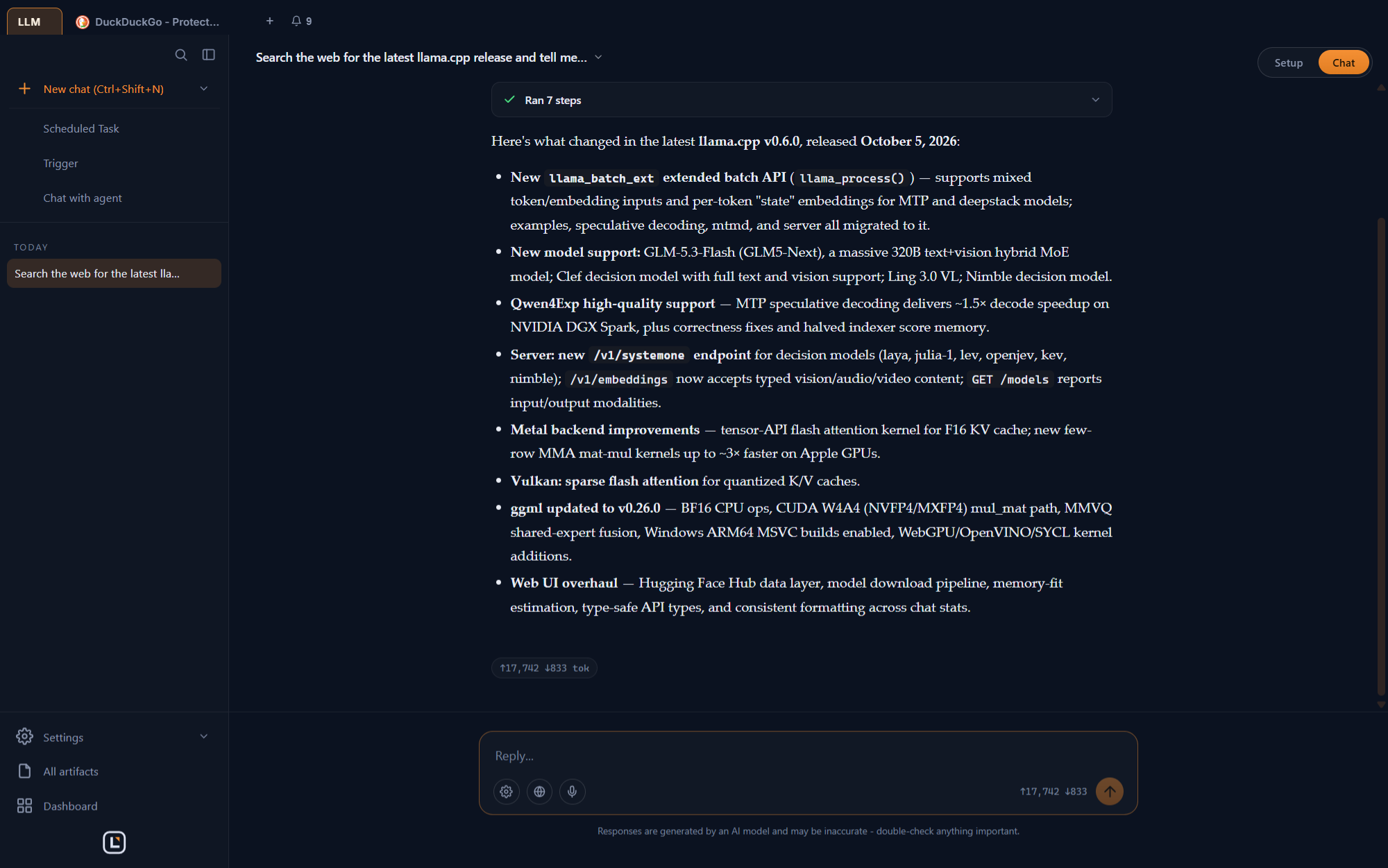
LumaBrowser replaces the pile of separate tools people run for local AI (a model server, a chat UI, an image generator, a voice stack, a headless browser for agents) with one desktop app. It looks at your GPUs, tells you which models fit before you download them, and runs everything locally. Your own tabs, logins and files stay on your machine, and outside agents like Claude Code, Codex, Cline and OpenCode can drive the browser through MCP.
Download the latest build from GitHub Releases:
| Platform | File |
|---|---|
| Windows x64 | Installer or portable .exe |
| Linux x64 | AppImage |
| macOS (Apple Silicon) | .dmg |
Or, with Node 18 or newer, fetch and launch the latest build from the terminal:
npx lumabrowser start
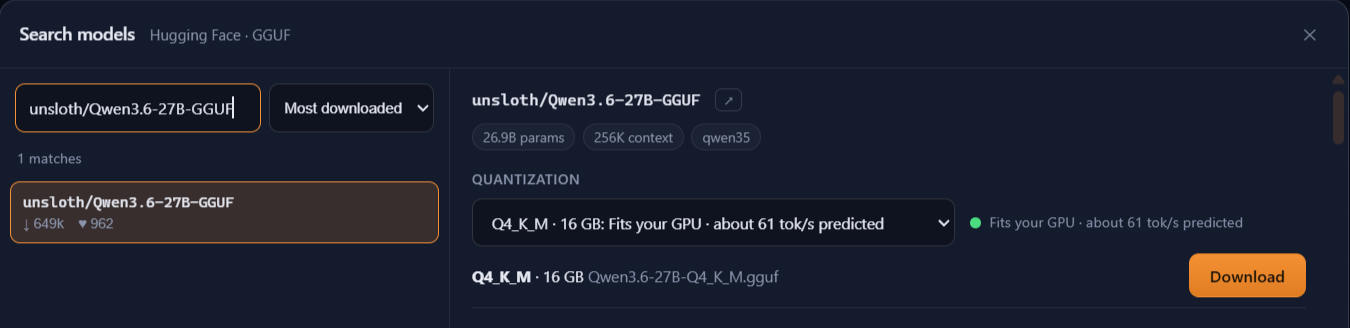
Open Models. LumaBrowser reads your hardware and puts a fit badge and a predicted speed on every model before you download it. Search Hugging Face directly, or link models you already have in LM Studio, Ollama or the Hugging Face cache without downloading them again.
Open a chat and ask for something that needs the web:
Search the web for the latest llama.cpp release and tell me in a few bullets what changed.
The agent opens its own tabs, reads the pages and answers. Your tabs stay yours.
| You want to... | Use |
|---|---|
| Chat with local models, generate images, browse with an assistant | The desktop app |
| Let Claude Code, Codex, Cline or OpenCode use a real browser | MCP server |
| Point Selenium, Puppeteer or Playwright at it | WebDriver or CDP |
| A coding agent in your terminal | luma CLI, see cli/README.md |
| The same agent in your editor | VS Code (also Cursor, Windsurf, VSCodium) and JetBrains plugins, installed from the app |
| Run it on a server | Docker |
Browser
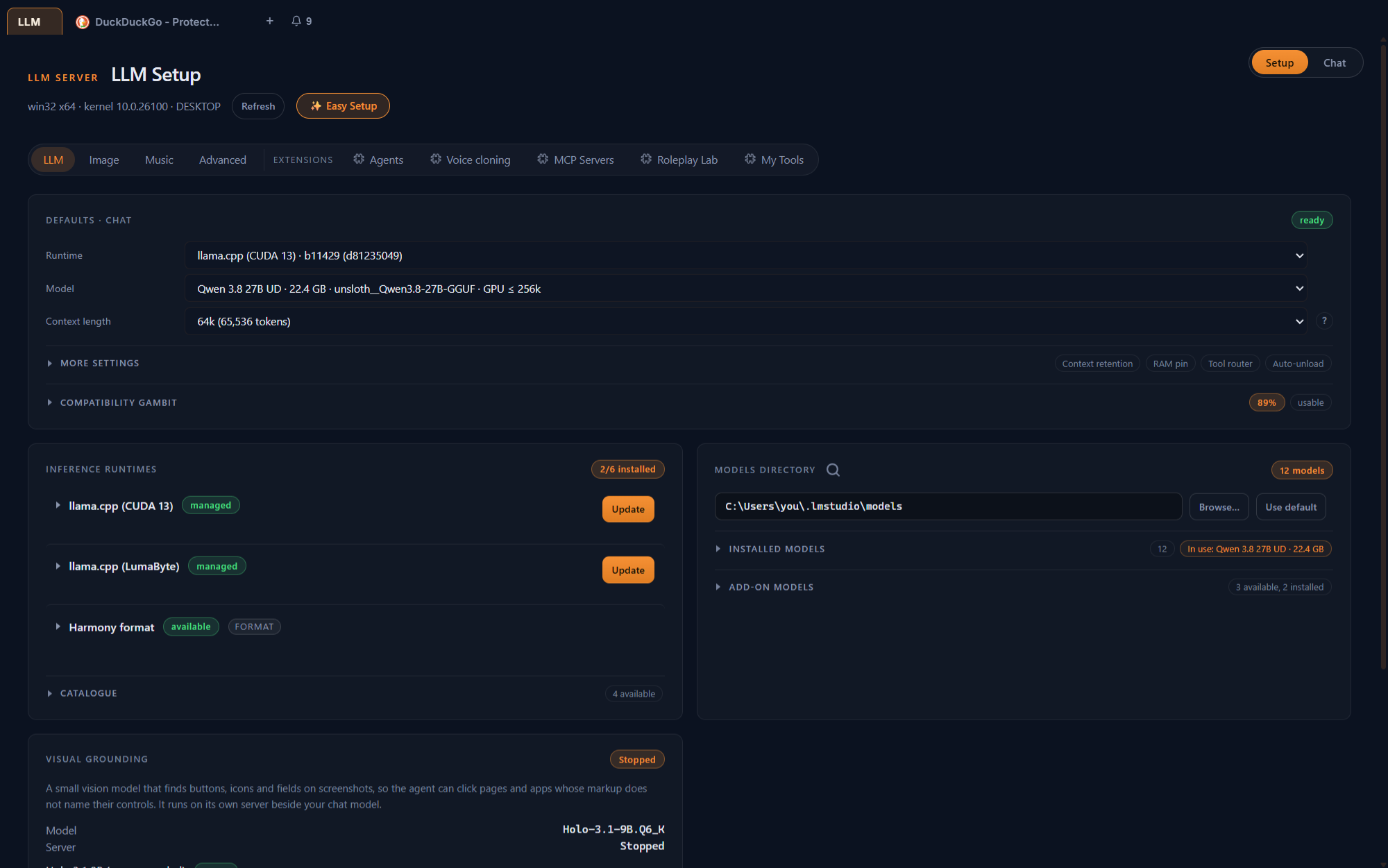
Local LLMs, fitted to your hardware
http://127.0.0.1:8317. Off by default.
Image, video, music and voice
Agents and coding
luma CLI and the IDE
plugins, and can build and hot-install LumaBrowser extensions.Automation and triggers
Sharing
Extensions
manifest.js and a main.js, and add routes, MCP tools and UI. See
Documentation/core/shell/extensions.LumaBrowser can write its MCP entry into Claude Code, Cline, Codex and OpenCode for you from Settings, or export the config to a file. By hand it looks like this:
{
  "mcpServers": {
    "luma-browser": {
      "command": "node",
      "args": ["<install dir>/resources/app.asar.unpacked/mcp-server.js"],
      "env": { "LUMA_API_PORT": "3000" }
    }
  }
}
The server starts LumaBrowser if it is not running. Tools cover browsing, tabs, page reading and extraction, agents, timed tasks, page monitors, and any MCP servers you have connected to LumaBrowser.
Both are off by default. Turn them on in Settings, then:
# Selenium (W3C WebDriver), default 127.0.0.1:9515
driver = webdriver.Remote("http://127.0.0.1:9515", options=options)
// Puppeteer or Playwright (Chrome DevTools Protocol), default 127.0.0.1:9222
const browser = await puppeteer.connect({ browserURL: 'http://127.0.0.1:9222' });
Clients only see the tabs automation created, never your own. Either driver can ask the LLM to resolve a selector that stopped matching.
The full API reference (REST, MCP tools and the OpenAI and Anthropic compatible local API) lives at lumabyte.com/apis.
| Tier | Video memory | What runs well |
|---|---|---|
| Laptop | under 8 GB, or no GPU | Small LLMs, speech, voices; image generation needs 8 GB |
| Gaming | 8 to 24 GB | Mid-size LLMs, image generation |
| High-end | 24 GB or more, or a Mac with 32 GB+ | Large LLMs, video; music needs about 34 GB |
Tiers use your largest single card, since cards do not add up for most workloads (LLMs are the exception: they can split across cards).
| GPU | Support |
|---|---|
| NVIDIA | CUDA 12 and CUDA 13 (recommended for RTX 50) on Windows; Vulkan or CUDA on Linux |
| AMD, Intel | Vulkan on Windows and Linux. No ROCm backend yet. |
| Apple Silicon | MLX for LLMs; CPU for image generation |
| None | CPU builds of every runtime |
Your browsing, chats, models, generated media and files stay on your machine. Nothing you type into a chat is sent anywhere unless you choose a cloud model.
What does leave the machine, and how to turn it off:
| What | Sent to | Default | Turn off |
|---|---|---|---|
| Usage ping: version, platform, machine id, every 5 minutes | lumabyte.com | On | Settings > About > Privacy |
| Update check | lumabyte.com | On | Settings: automatic update checks |
| Extension catalog | lumabyte.com | Only when you open Extensions | |
| Ad-block lists, runtimes, models | Ghostery, GitHub, Hugging Face and model hosts | When needed |
No feature depends on the usage ping.
Browser automation hands an agent your browser. Anything an MCP, WebDriver or CDP client can see, the model behind it can see. Connect only agents you trust, and keep the API, WebDriver and CDP ports on localhost (the default).
The REST API on port 3000 does not require a key by default. Set an API key in Settings before you expose it beyond localhost.
The Docker image runs the full app headless and serves the desktop in your browser over noVNC. It is meant for servers and agent hosts.
LUMA_VNC_PASSWORD=change-me docker compose up -d
http://localhost:6080: the app, through noVNC.http://localhost:3000: REST API and MCP proxy.In Docker the API accepts any address and needs no key by default. Do not publish port 3000 to a network you do not trust without setting an API key. GPU acceleration is not used in the container.
You need Node 20 and a C++ toolchain (Visual Studio 2022 Build Tools on Windows) for the native SQLite module.
npm install
npm run dev          # start the app in developer mode
npm test             # unit tests under Electron
npm run test:e2e     # end-to-end suites
npm run build        # installers for the current platform
The Documentation folder is written for coding agents
as much as for people. Every code file has a matching doc at
Documentation/<same path>.md covering its purpose, public methods and why it
exists, and Documentation/index.md lists them all in
one line each. Point your agent at the index first so it can find the right
file without reading the whole codebase, and have it update the doc whenever it
changes the file.
Bug reports and pull requests are welcome. Read CONTRIBUTING.md first: contributions need a signed Contributor License Agreement.
LumaBrowser is free software under the GNU Affero General Public License v3.0 or later. You may use it, study it, change it and redistribute it. If you distribute a modified version, or run one for other people over a network, you must publish your changes under the same license.
Running unmodified official builds, including inside a company, needs nothing more. Organizations that want to keep their modifications private, combine LumaBrowser with proprietary software, or ship private extensions can obtain a commercial license from Lumabyte, LLC.
LumaBrowser is owned and maintained by Lumabyte, LLC, an Ohio company, which also runs lumabrowser.com and lumabyte.com. If you distribute a modified version, mark it as modified and do not present it as an official LumaBrowser release (AGPL section 7(c), see LICENSE). Third-party components keep their own licenses, listed in THIRD-PARTY-LICENSES.
Your local AI stack in one app.
A web browser with a GPU-aware LLM runtime, chat and agents, local image,
video, music and voice, and browser automation for the AI tools you already use.
Website · Download · API docs · Agentic developer docs · License
Free · Open source (AGPL-3.0) · Runs on your own machine
LumaBrowser replaces the pile of separate tools people run for local AI (a model server, a chat UI, an image generator, a voice stack, a headless browser for agents) with one desktop app. It looks at your GPUs, tells you which models fit before you download them, and runs everything locally. Your own tabs, logins and files stay on your machine, and outside agents like Claude Code, Codex, Cline and OpenCode can drive the browser through MCP.
Download the latest build from GitHub Releases:
| Platform | File |
|---|---|
| Windows x64 | Installer or portable .exe |
| Linux x64 | AppImage |
| macOS (Apple Silicon) | .dmg |
Or, with Node 18 or newer, fetch and launch the latest build from the terminal:
npx lumabrowser start
Open Models. LumaBrowser reads your hardware and puts a fit badge and a predicted speed on every model before you download it. Search Hugging Face directly, or link models you already have in LM Studio, Ollama or the Hugging Face cache without downloading them again.
Open a chat and ask for something that needs the web:
Search the web for the latest llama.cpp release and tell me in a few bullets what changed.
The agent opens its own tabs, reads the pages and answers. Your tabs stay yours.
| You want to... | Use |
|---|---|
| Chat with local models, generate images, browse with an assistant | The desktop app |
| Let Claude Code, Codex, Cline or OpenCode use a real browser | MCP server |
| Point Selenium, Puppeteer or Playwright at it | WebDriver or CDP |
| A coding agent in your terminal | luma CLI, see cli/README.md |
| The same agent in your editor | VS Code (also Cursor, Windsurf, VSCodium) and JetBrains plugins, installed from the app |
| Run it on a server | Docker |
Browser
Local LLMs, fitted to your hardware
http://127.0.0.1:8317. Off by default.
Image, video, music and voice
Agents and coding
luma CLI and the IDE
plugins, and can build and hot-install LumaBrowser extensions.Automation and triggers
Sharing
Extensions
manifest.js and a main.js, and add routes, MCP tools and UI. See
Documentation/core/shell/extensions.LumaBrowser can write its MCP entry into Claude Code, Cline, Codex and OpenCode for you from Settings, or export the config to a file. By hand it looks like this:
{
  "mcpServers": {
    "luma-browser": {
      "command": "node",
      "args": ["<install dir>/resources/app.asar.unpacked/mcp-server.js"],
      "env": { "LUMA_API_PORT": "3000" }
    }
  }
}
The server starts LumaBrowser if it is not running. Tools cover browsing, tabs, page reading and extraction, agents, timed tasks, page monitors, and any MCP servers you have connected to LumaBrowser.
Both are off by default. Turn them on in Settings, then:
# Selenium (W3C WebDriver), default 127.0.0.1:9515
driver = webdriver.Remote("http://127.0.0.1:9515", options=options)
// Puppeteer or Playwright (Chrome DevTools Protocol), default 127.0.0.1:9222
const browser = await puppeteer.connect({ browserURL: 'http://127.0.0.1:9222' });
Clients only see the tabs automation created, never your own. Either driver can ask the LLM to resolve a selector that stopped matching.
The full API reference (REST, MCP tools and the OpenAI and Anthropic compatible local API) lives at lumabyte.com/apis.
| Tier | Video memory | What runs well |
|---|---|---|
| Laptop | under 8 GB, or no GPU | Small LLMs, speech, voices; image generation needs 8 GB |
| Gaming | 8 to 24 GB | Mid-size LLMs, image generation |
| High-end | 24 GB or more, or a Mac with 32 GB+ | Large LLMs, video; music needs about 34 GB |
Tiers use your largest single card, since cards do not add up for most workloads (LLMs are the exception: they can split across cards).
| GPU | Support |
|---|---|
| NVIDIA | CUDA 12 and CUDA 13 (recommended for RTX 50) on Windows; Vulkan or CUDA on Linux |
| AMD, Intel | Vulkan on Windows and Linux. No ROCm backend yet. |
| Apple Silicon | MLX for LLMs; CPU for image generation |
| None | CPU builds of every runtime |
Your browsing, chats, models, generated media and files stay on your machine. Nothing you type into a chat is sent anywhere unless you choose a cloud model.
What does leave the machine, and how to turn it off:
| What | Sent to | Default | Turn off |
|---|---|---|---|
| Usage ping: version, platform, machine id, every 5 minutes | lumabyte.com | On | Settings > About > Privacy |
| Update check | lumabyte.com | On | Settings: automatic update checks |
| Extension catalog | lumabyte.com | Only when you open Extensions | |
| Ad-block lists, runtimes, models | Ghostery, GitHub, Hugging Face and model hosts | When needed |
No feature depends on the usage ping.
Browser automation hands an agent your browser. Anything an MCP, WebDriver or CDP client can see, the model behind it can see. Connect only agents you trust, and keep the API, WebDriver and CDP ports on localhost (the default).
The REST API on port 3000 does not require a key by default. Set an API key in Settings before you expose it beyond localhost.
The Docker image runs the full app headless and serves the desktop in your browser over noVNC. It is meant for servers and agent hosts.
LUMA_VNC_PASSWORD=change-me docker compose up -d
http://localhost:6080: the app, through noVNC.http://localhost:3000: REST API and MCP proxy.In Docker the API accepts any address and needs no key by default. Do not publish port 3000 to a network you do not trust without setting an API key. GPU acceleration is not used in the container.
You need Node 20 and a C++ toolchain (Visual Studio 2022 Build Tools on Windows) for the native SQLite module.
npm install
npm run dev          # start the app in developer mode
npm test             # unit tests under Electron
npm run test:e2e     # end-to-end suites
npm run build        # installers for the current platform
The Documentation folder is written for coding agents
as much as for people. Every code file has a matching doc at
Documentation/<same path>.md covering its purpose, public methods and why it
exists, and Documentation/index.md lists them all in
one line each. Point your agent at the index first so it can find the right
file without reading the whole codebase, and have it update the doc whenever it
changes the file.
Bug reports and pull requests are welcome. Read CONTRIBUTING.md first: contributions need a signed Contributor License Agreement.
LumaBrowser is free software under the GNU Affero General Public License v3.0 or later. You may use it, study it, change it and redistribute it. If you distribute a modified version, or run one for other people over a network, you must publish your changes under the same license.
Running unmodified official builds, including inside a company, needs nothing more. Organizations that want to keep their modifications private, combine LumaBrowser with proprietary software, or ship private extensions can obtain a commercial license from Lumabyte, LLC.
LumaBrowser is owned and maintained by Lumabyte, LLC, an Ohio company, which also runs lumabrowser.com and lumabyte.com. If you distribute a modified version, mark it as modified and do not present it as an official LumaBrowser release (AGPL section 7(c), see LICENSE). Third-party components keep their own licenses, listed in THIRD-PARTY-LICENSES.



