
README
scalpel


Your agent asks "where is collectDefinitions defined?" Here's the same question, answered two ways, on this exact codebase:
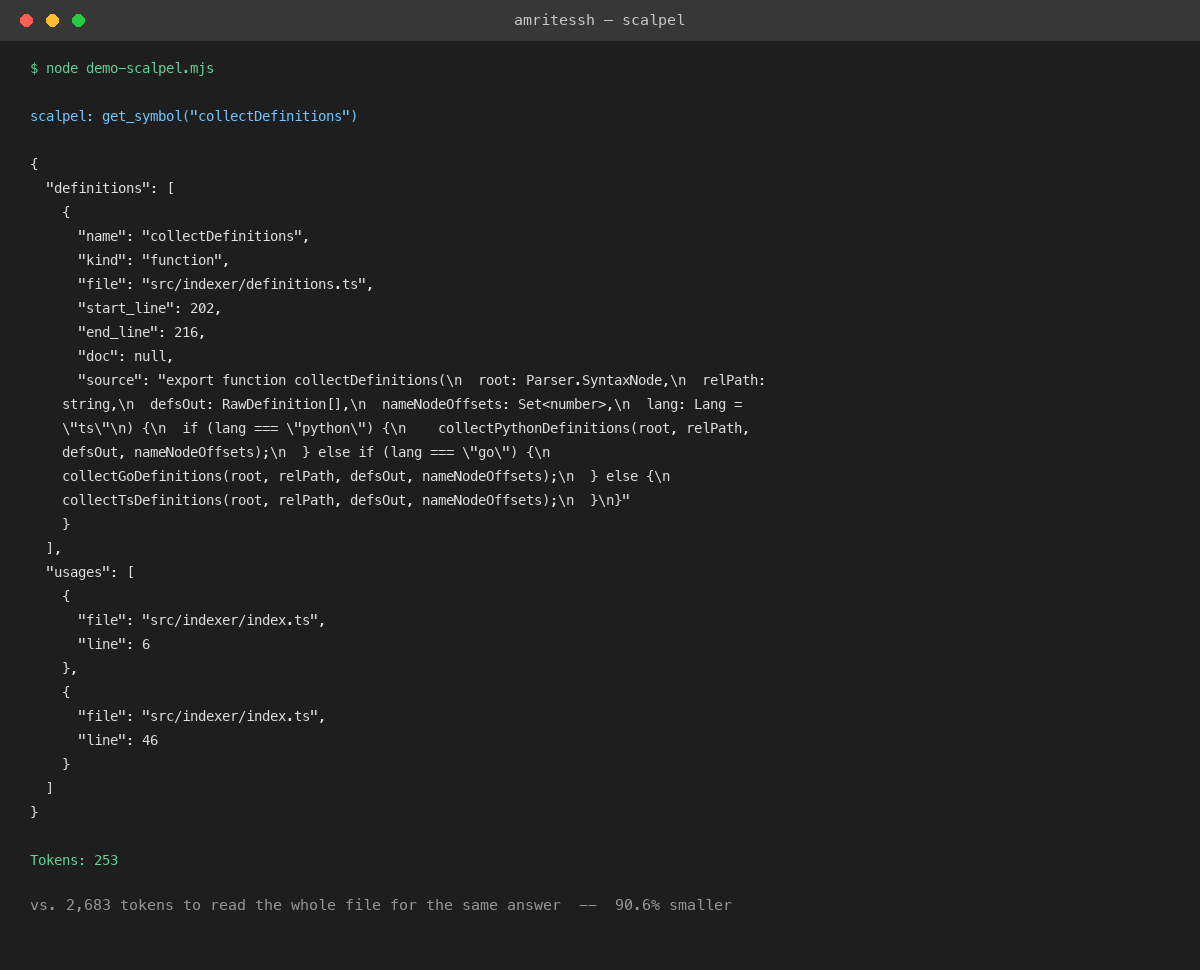
That's not a mockup — it's real output from running this tool against its own source. Same answer, 90% fewer tokens, because it never reads the file it doesn't need.
What it does
An MCP server that gives an agent get_symbol(name) instead of a whole file. It returns just the definition span and its usages — nothing else gets read.
npm install -g @amritessh/scalpel

# index a repo (lang: ts | python | go, default ts)
scalpel-index /path/to/repo /path/to/repo/.scalpel/index.db [lang]

# run the MCP server over stdio
scalpel /path/to/repo /path/to/repo/.scalpel/index.db
Point an MCP client at it (stdio transport, args: <repoPath> <dbPath>). For Claude Code:
claude mcp add scalpel -- scalpel /path/to/repo /path/to/repo/.scalpel/index.db
How it compares
Measured against real, installed competitors — not a straw-man "read everything" baseline (zod/TypeScript, n=40 questions):
| Tool | Definition-only cost | Definition accuracy | Usage-lookup cost | Usage accuracy |
|---|---|---|---|---|
| grep | 6,783 tokens | 100% | 29,898 tokens | 60% |
| jcodemunch-mcp | 2,723 tokens | 82% | — | — |
| Serena (LSP) | 2,386 tokens | 100% | ~245–250K tokens (hub fns) | — |
| scalpel | 1,732 tokens | 100% | 3,126 tokens | 100% |
scalpel wins on cost and accuracy on both question types — cheapest on plain definition lookups and on usage/reference lookups, where grep's text-matching produces false positives and misses real callers.
We didn't always win that table — here's the fix
The first version of this comparison had scalpel losing to both competitors on definition-only cost (4,158 tokens vs. 2,723 and 2,386). Instead of tuning the marketing copy, we read the code: get_symbol was unconditionally fetching and returning every usage site, even when the question was just "where is this defined." Added a flag to skip that when it's not needed, re-ran the full benchmark, and the table above is the corrected result — publishing the numbers we actually measured, including the ones that were worse first. Full writeup, raw data, and the fix itself: scalpel-fse2027-artifact.
What it's honest about not doing
Tested on 57 real historical bug-fixes: an agent using scalpel and a plain grep/Read agent fixed the same bugs, at the same speed. This tool makes retrieval cheaper and more accurate — it does not, on this evidence, make an agent better at finishing the task. If you're installing this hoping for faster bug fixes, the data says don't expect that; if you're running agents at volume where token cost is a real budget line, or doing usage/reference-heavy work (refactors, impact analysis), the numbers above hold up.
Background
This tool grew out of a research study on symbol-level code retrieval for AI coding agents — token cost, real dollar cost, and task-completion effects, tested across multiple languages and 57 real historical bugs, submitted to ACM FSE 2027. The frozen research artifact (raw data, benchmark harness, full writeup) lives at amritessh/scalpel-fse2027-artifact.
This repository is the maintained, installable product — its source is developed separately from the research artifact above.
Contributors

3 commits
See what people are saying
Similar repos


README
scalpel
Your agent asks "where is collectDefinitions defined?" Here's the same question, answered two ways, on this exact codebase:
That's not a mockup — it's real output from running this tool against its own source. Same answer, 90% fewer tokens, because it never reads the file it doesn't need.
What it does
An MCP server that gives an agent get_symbol(name) instead of a whole file. It returns just the definition span and its usages — nothing else gets read.
npm install -g @amritessh/scalpel

# index a repo (lang: ts | python | go, default ts)
scalpel-index /path/to/repo /path/to/repo/.scalpel/index.db [lang]

# run the MCP server over stdio
scalpel /path/to/repo /path/to/repo/.scalpel/index.db
Point an MCP client at it (stdio transport, args: <repoPath> <dbPath>). For Claude Code:
claude mcp add scalpel -- scalpel /path/to/repo /path/to/repo/.scalpel/index.db
How it compares
Measured against real, installed competitors — not a straw-man "read everything" baseline (zod/TypeScript, n=40 questions):
| Tool | Definition-only cost | Definition accuracy | Usage-lookup cost | Usage accuracy |
|---|---|---|---|---|
| grep | 6,783 tokens | 100% | 29,898 tokens | 60% |
| jcodemunch-mcp | 2,723 tokens | 82% | — | — |
| Serena (LSP) | 2,386 tokens | 100% | ~245–250K tokens (hub fns) | — |
| scalpel | 1,732 tokens | 100% | 3,126 tokens | 100% |
scalpel wins on cost and accuracy on both question types — cheapest on plain definition lookups and on usage/reference lookups, where grep's text-matching produces false positives and misses real callers.
We didn't always win that table — here's the fix
The first version of this comparison had scalpel losing to both competitors on definition-only cost (4,158 tokens vs. 2,723 and 2,386). Instead of tuning the marketing copy, we read the code: get_symbol was unconditionally fetching and returning every usage site, even when the question was just "where is this defined." Added a flag to skip that when it's not needed, re-ran the full benchmark, and the table above is the corrected result — publishing the numbers we actually measured, including the ones that were worse first. Full writeup, raw data, and the fix itself: scalpel-fse2027-artifact.
What it's honest about not doing
Tested on 57 real historical bug-fixes: an agent using scalpel and a plain grep/Read agent fixed the same bugs, at the same speed. This tool makes retrieval cheaper and more accurate — it does not, on this evidence, make an agent better at finishing the task. If you're installing this hoping for faster bug fixes, the data says don't expect that; if you're running agents at volume where token cost is a real budget line, or doing usage/reference-heavy work (refactors, impact analysis), the numbers above hold up.
Background
This tool grew out of a research study on symbol-level code retrieval for AI coding agents — token cost, real dollar cost, and task-completion effects, tested across multiple languages and 57 real historical bugs, submitted to ACM FSE 2027. The frozen research artifact (raw data, benchmark harness, full writeup) lives at amritessh/scalpel-fse2027-artifact.
This repository is the maintained, installable product — its source is developed separately from the research artifact above.
See what people are saying
Similar repos
Contributors
3 commits