Grade every agent, scraper and model in a claim's chain — provenance, trust scoring and audit evidence for LLM pipelines
See the code
Isnād–Rijāl Framework · grades the transmitters and the chain, not just the claim.
Open-source pip install isnad — LLM provenance, agent trust, and an
AI audit trail for RAG and multi-agent systems. Apache-2.0, permanently.
Every claim your pipeline produces carries a verifiable weakest-link trust grade and a tamper-detecting audit trail, so you can answer the question hallucination detectors and observability tools skip: who handled this claim, in what order, and how much do we trust each one?
The one-sentence pitch: ISNAD gives you the tamper-detecting audit records your regulators will demand — a SHA-256 hash for every graded claim, mapped to the EU AI Act, ISO/IEC 42001, NIST AI RMF, and SDAIA. You get the evidence an auditor verifies. 📋
Proof it works: ISNAD's weakest-link rule reproduces a rule-based grading convention derived from Ibn Hajar's 12 narrator tiers at Cohen's κ = 0.87 across 575,060 graded hadith chains. (For context: scholars disagree with each other on narrator grades at κ = 0.33 — a different task.) Full benchmark below.
# 30 seconds to a verdict:
from isnad import Registry, grade
from isnad.types import NarratorGrade

reg = Registry()
reg.register("openstax", "physics", grade=NarratorGrade.RELIABLE)
reg.register("pdf-scraper", "physics", grade=NarratorGrade.UNGRADED)
reg.register("ingest-model", "physics", grade=NarratorGrade.ACCEPTABLE)

verdict = grade("p = mv", ["openstax", "pdf-scraper", "ingest-model"], reg, domain="physics")
print(verdict.why)
# claim 'p = mv' → chain DAIF (weakest: pdf-scraper, ungraded)
Paper: arXiv:2607.24117 · Software DOI: 10.5281/zenodo.23201516






🌐 Project home: https://isnadhq.com/ · 📚 Docs: https://isnadhq.com/docs · ⭐ Star to follow along · Contribute · Code of Conduct
JavaScript/TypeScript verifier: npm install isnad verifies ISNAD audit records (SHA-256 / Merkle / detached signatures) from JS — verifier only, grading stays in the Python core. See js/README.md.
In a RAG pipeline or multi-agent system, a factual claim passes through many hands — a scraper extracts it, an agent compiles it, another model serves it. Each hand can drop, distort, or invent. Observability and data-lineage tools record what happened; ISNAD grades who transformed the claim, so you know how much to trust the result — and can export the whole judgment as a tamper-detecting audit record for governance review.
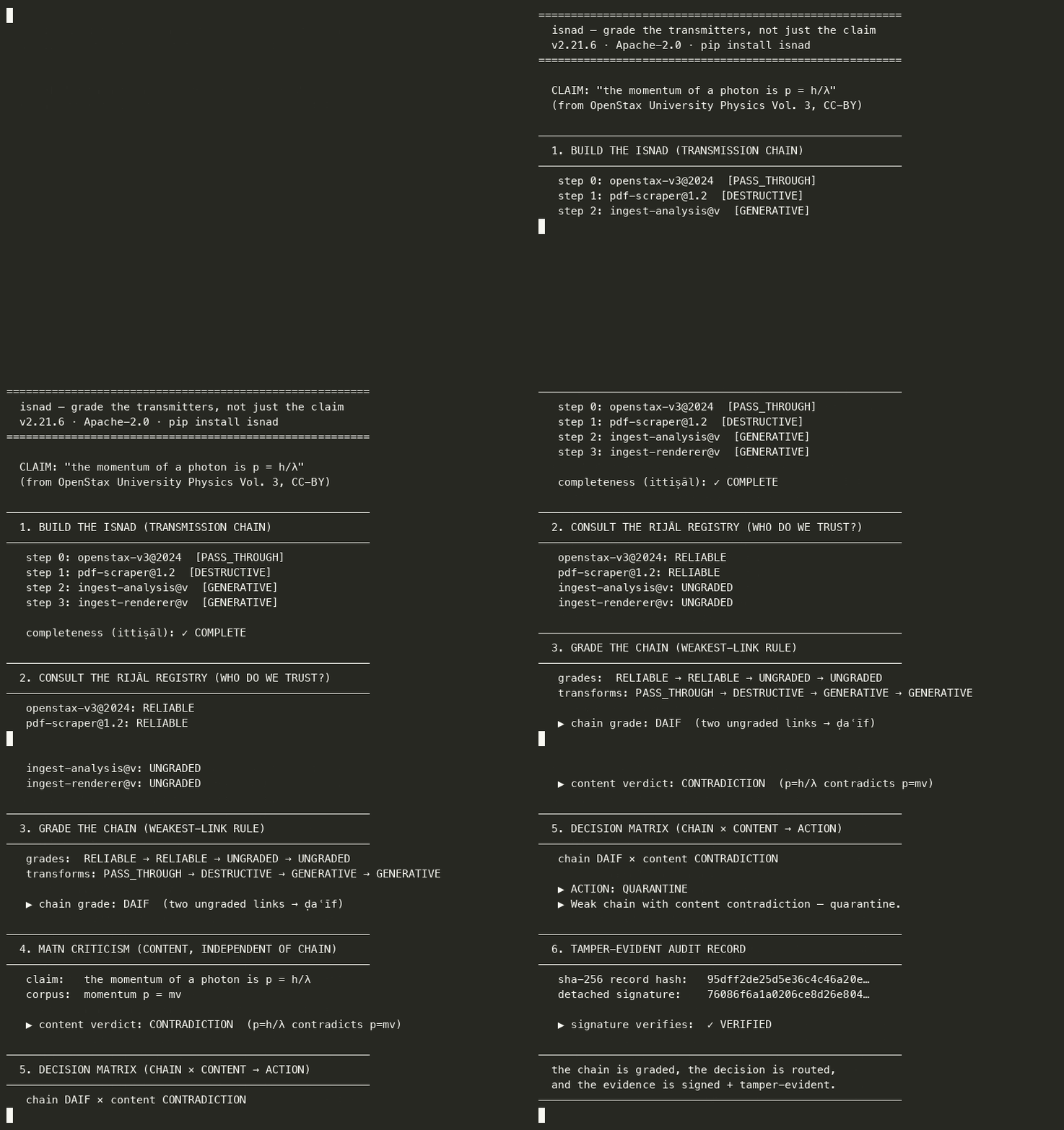
The framework adapts hadith transmission science — one of history's most rigorous epistemologies, refined over fourteen centuries — into a Python library. Every claim carries its complete chain of transmitters (isnād); each transmitter is graded in a living registry (rijāl); chains are capped by their weakest link; content is criticized independently of transmission; and the two combine in a decision matrix that routes claims to serve, review, or quarantine.
Most tools ask about the output — "is this answer grounded in the retrieved context?" (Cleanlab TLM, Galileo, Patronus, TruLens, RAGAS) or "what happened during this run?" (LangSmith, Langfuse, Arize). ISNAD asks the question they skip: "who handled this claim, and how much do we trust each transmitter?"
| Tool | What it grades | Records the chain (lineage)? | Grades the transmitters / chain (trust)? |
|---|---|---|---|
| 🧪 Cleanlab TLM | Trustworthiness of the LLM response | ❌ | ❌ |
| 🎯 Galileo / Patronus / TruLens / RAGAS | Output faithfulness / groundedness vs retrieved context | ❌ | ❌ |
| 🔍 LangSmith / Langfuse / Arize | Traces (what happened) + output evals | ✅ | ❌ |
| 🧬 OpenLineage / Marquez / DataHub | Data lineage (what touched what) | ✅ | ❌ |
| ✨ ISNAD | The transmitters and the transmission chain — weakest-link grading, corroboration with madār discounting, tamper-detecting audit | ✅ | ✅ |
What ISNAD is NOT — and why that's the point. Three honest answers, up front:
Free, Apache-2.0, self-hostable — permanently. The core (src/isnad/) stays
Apache-2.0 forever; any future commercial surface lives in a separate repo under
its own licence (see LICENSING.md). The claim-graders above are
paid SaaS APIs; ISNAD is open-source and self-hostable.
pip install isnad
from isnad import Registry, grade
from isnad.types import NarratorGrade

reg = Registry()
reg.register("openstax", "physics", grade=NarratorGrade.RELIABLE)
reg.register("pdf-scraper", "physics", grade=NarratorGrade.UNGRADED)
reg.register("ingest-model", "physics", grade=NarratorGrade.ACCEPTABLE)

verdict = grade("p = mv", ["openstax", "pdf-scraper", "ingest-model"], reg, domain="physics")
print(verdict.why)
# claim 'p = mv' → chain DAIF (weakest: pdf-scraper, ungraded)
pip install isnad
from isnad import Registry, Chain, ChainLinkSpec, grade_chain_from_registry, decide
from isnad.types import NarratorGrade, ContentVerdict
from isnad.critics import EmbeddingCritic

chain = Chain([
    ChainLinkSpec("openstax-textbook", 0, domain="physics"),
    ChainLinkSpec("pdf-scraper-v2", 1, domain="physics"),
    ChainLinkSpec("ingest-model-v3", 2, domain="physics"),
])

reg = Registry()
reg.register("openstax-textbook", "physics", grade=NarratorGrade.RELIABLE)
reg.register("pdf-scraper-v2", "physics", grade=NarratorGrade.RELIABLE)
reg.register("ingest-model-v3", "physics", grade=NarratorGrade.ACCEPTABLE)

chain_grade = grade_chain_from_registry(reg, chain)

critic = EmbeddingCritic()  # offline; obvious contradictions only — see Scope
verdict = critic.evaluate("p = h/λ", "p = h/lambda", ["p = mv"])
action = decide(chain_grade, verdict)

print(f"Chain: {chain_grade.value.upper()} | Content: {verdict.value} | Action: {action.value}")
pip install isnad[langchain]
from isnad.integrations.langchain import IsnadCallbackHandler, seed_registry

reg = seed_registry({"source:docs": "reliable", "model:gpt-4o": "acceptable"})
handler = IsnadCallbackHandler(registry=reg, domain="physics")
chain.invoke("What is F=ma?", config={"callbacks": [handler]})
trace = handler.to_trace()  # isnad_trace v0.1 JSON
Also available: IsnadTracer and AsyncIsnadCallbackHandler for async pipelines.
IsnadMiddleware (gating). The callback captures traces; the middleware
gates claims. Note, honestly: the core gate() function is importable and
testable today, but the LangChain AgentMiddleware wiring is forward-looking
(it targets LangChain's 2026 AgentMiddleware API; see
src/isnad/integrations/langchain/middleware.py). The callback handler is the
production-ready capture path.
from isnad.integrations.langchain import IsnadMiddleware
mw = IsnadMiddleware(reg, domain="physics")  # wrap_tool_call grades + gates
Want to ship this to a real system this afternoon? See
docs/onboard-in-a-day.mdfor three copy-paste recipes (self-maintaining KB, medical RAG, legal RAG) and the honesty contract that must not be broken.
Read in order, or jump to what you need:
The honesty box is the point: what's proven, what's measured, and what's open.
| Component | Status | Notes |
|---|---|---|
| Weakest-link quarantine | ✅ Validated | Every COMPROMISED-integrity narrator chain (proven liar/fabricator) grades MAWDU and is blocked; a SUSPECT (accused/abandoned) narrator grades ḍaʿīf jiddan — both quarantine (the SUSPECT→ḍaʿīf jiddan path is exercised in §8; the COMPROMISED→mawḍūʿ path is unit-tested) |
| ISNAD-Bench (classical ground truth) | ✅ Measured | κ = 0.871 (3-way headline) / 0.8667 (5-way, mapping v2) / 0.761 lenient vs 575,060 chains graded by a rule-based convention (Ibn Hajar's 12 narrator tiers); narrator-grade agreement κ = 0.331; shuffled control −0.0066 — bench/docs/RESULTS.md |
| Corroboration (mutābaʿāt) | ✅ Validated | 603/603 Wikipedia + 104/104 physics semantically-matched pairs; 8/8 Wikipedia + 9/9 physics negative controls (#127); requires attested distinct lineage (#54) |
| Chain-scoped grounding | ⚠️ Partial | ChainLinkSpec.retrieved_rows + chain_scoped_corpus + ChainScopedGroundingPolicy flag a claim grounded only off its own chain (grounded_off_chain_only, a grounding gap — evidence, not an action). Wired into POST /v1/claims (#216); the flag requires a CONSISTENT-capable critic (NLI/LLM with the affirmation gate bypassed — the default EmbeddingCritic is contradiction-only, so the flag is inert unless you configure one); FP measurable via experiments/grounding_eval (#239; requires the nli extra — the committed result artifact is pending NLI-model availability, and the harness aborts rather than report FP=0 by construction). |
| Content-madār fingerprint calibration | ✅ Measured | experiments/madar_eval — the shared-error fingerprint is measured at FP 0.375 on independent agreement (down from 0.750 after tightening #232) with token-bearing recall 1.0. The near-miss boundary class (a correct vs wrong value, e.g. 1687 vs 1689) is now correctly separated (0/4 false positives) (#233). |
| Seed-grade bootstrapping | ✅ Validated | Evidence-backed Registry.seed(); coverage is critic-bound: the contradiction-only EmbeddingCritic now serves 0% (it can no longer affirm CONSISTENT); the LLM critic is the coverage ceiling — experiments/cold_start_coverage/RESULTS.md |
| Content criticism | ⚠️ Partial | The binding constraint. LLM critic: 1.000 recall / 0.000 false-consistent on the 60-case eval set, but 39.1% false-consistent on §8 content corruption (#126) — see docs/critics.md. Offline critics are safe but conservative (recall 0.12–0.76); the zero-dependency TF-IDF critic is now contradiction-only (never affirms consistency, so 0.000 false-consistent by construction). |
| jarḥ–taʿdīl discovery | ⚠️ Partial | Finds injected weak narrators; good narrators need seed grades |
| Bayesian grading | ✅ Default | Beta posterior per (narrator, role, domain); ISNAD_POLICY env override |
| Confidence-gating | ❌ Useless | Model self-confidence is uncorrelated with defects — stated, not hidden |
| Tamper-detecting audit | ✅ Implemented | Self-hash + detached signatures + Merkle log; tail-truncation and forger limits disclosed |
| Period-sliced grades | ✅ Implemented | get_grade_as_of() — the ikhtilāṭ (decline) remedy, #43 |
| Integrity ladder + recoverability | ✅ Implemented | Integrity strikes are permanent; precision-driven REJECTED is recoverable (#30, #40) |
Honest limits (stated up front): grades are ordinal-only (ṣaḥīḥ > ḥasan > ḍaʿīf > ḍaʿīf jiddan > mawḍūʿ, never a numeric confidence); cold-start is worse per-role; integrity is domain-scoped, not global; chain independence cannot be proven from topology (only assumed from attested lineage, then discounted — #54); the content critic is the coverage ceiling; corroboration rarely fires on dense technical corpora where genuine cross-source overlap is rare. These are features, not bugs — ISNAD says exactly what works, what's limited, and where you supply your own components. The serving index is in-memory (single-node deployment; multi-worker HA is not yet supported — #199).
The strongest evidence is a number, not a claim: ISNAD's weakest-link rule, run on 575,060 graded hadith chains (a rule-based convention derived from Ibn Hajar's 12 narrator tiers), measured for agreement:
| Quantity | Cohen's κ |
|---|---|
| ISNAD vs the dataset's rule-based chain-verdict code (strict default, 3-way) | 0.8714 |
| — 5-way (mapping v2) | 0.8667 |
| — 4-way (v1, pre-review) | 0.8745 |
| a single critic vs Ibn Hajar's tier | 0.450 |
| critic vs critic (narrator-grade agreement, context) | 0.331 |
Not the same scale. The headline 0.8714 is chain-verdict agreement (3-way — ṣaḥīḥ / ḥasan / weak); the 5-way (0.8667, mapping v2, post-hoc after the expert review) is a sensitivity; v1's 4-way (0.8745) conflated "fabricated" with "very weak" before the split. ISNAD's mawḍūʿ class is now keyed on COMPROMISED integrity (proven liar/fabricator), and the 3-way κ is the robust headline;
the 0.450 and 0.331 figures measure narrator-grade agreement (5 classes) — a
different task. The 0.331 is context for how contested the underlying narrator
grades are, not a direct ceiling on the chain κ.
How to read it: κ = 0.87 is conformance, not agreement with independent
scholar judgment. The dataset's chain verdicts are a rule-based convention derived
from Ibn Hajar's 12 tiers (per-tier purity 0.88–0.97; the keyword classifier agrees
with the source's structured code at 99.92%, ruling out classifier error), and ISNAD's weakest-link mapping conforms to that convention. The
0.331/0.450 figures are narrator-grade agreement — context on how contested the
tiers are, not a ceiling. The benchmark is
pre-committed, carries negative controls (majority-class 0.000; shuffled grades
−0.0066), and buckets every disagreement. Full write-up: bench/docs/RESULTS.md.
uv run python -m bench.run               # strict (default), full corpus
uv run python -m bench.run --lenient     # ungraded → ḥasan
uv run python -m bench.human_ceiling     # the narrator-grade agreement
uv run python -m bench.ikhtilat          # the mukhtaliṭūn (period-sliced grades)
The dataset (emadjumaah/hadith-kg, CC-BY-4.0, 1.6 GB) is gitignored and pinned by
SHA-256 — see bench/README.md. The derived graded output (per-chain
convention verdict + ISNAD prediction + disagreement bucket) is published as the
alizahidraja/isnad-bench dataset on Hugging Face.
The κ = 0.871 above is the methodology's home turf (hadith chains). The transfer to live LLM
pipelines is measured separately and published honestly. On RAGTruth, the grounding critic ISNAD
composes with (its matn layer) transfers at Cohen's κ = 0.4345 over all 1,800 RAGTruth
responses (57 unparseable, 3.2%, scored fail-closed) — 96.0% hallucination recall at 60.4% precision
(plus a 49.9% false-positive rate on grounded responses), vs a 55.8% majority-class baseline. That
number belongs to the composed critic, not to ISNAD's
chain grading (WHO). The weak bi-encoder
signal (κ ≈ 0.1) is reported alongside, not hidden. Case study + limits: G1_CASE_STUDY.md.
Live product: isnad.islamandai.com
The name and lineage are the reason to trust the design; you don't need the Arabic to use it. Every term is defined on first use.
| Term | Meaning |
|---|---|
| isnād | The transmission chain — who handled a claim, in order |
| rijāl | The registry of transmitters ("narrators") and their grades |
| jarḥ–taʿdīl | The criticism-and-accreditation loop that moves grades with evidence |
| ʿadālah | Integrity — can this transmitter be trusted not to lie? |
| ḍabṭ | Precision — how often is this transmitter accurate? |
| ittiṣāl | Chain continuity (no gaps); a gap = munqaṭiʿ → capped weak |
| mutābaʿāt | Corroboration — independent chains agreeing upgrade a claim |
| madār | The hidden pivot — "independent" chains that secretly share an upstream |
| matn | The claim content, criticized separately from the chain |
| ṣaḥīḥ / ḥasan / ḍaʿīf / ḍaʿīf jiddan / mawḍūʿ | Sound / good / weak / very weak / fabricated — the five chain grades. "mawḍūʿ" (fabricated) is keyed on COMPROMISED integrity (proven liar/fabricator, rank 12); "ḍaʿīf jiddan" (very weak) on SUSPECT (accused/abandoned, ranks 10–11). Both quarantine — mawḍūʿ permanently, ḍaʿīf jiddan recoverably. |
| ʿilal | Hidden defects in the chain or matn that survive surface grading — ISNAD does not implement ʿilal detection; it routes such cases to human review |
| contradiction (taʿāruḍ) | A sound chain whose content contradicts the corpus — routed to human review (ISNAD does not auto-adjudicate which source outranks the other) |
Chain grade × content verdict → action:
| Content CONSISTENT | Content CONTRADICTION | Content UNVERIFIABLE | |
|---|---|---|---|
| Ṣaḥīḥ (sound) | ✅ SERVE — cache | 🔍 REVIEW — contradiction (taʿāruḍ, highest-value case) | ⚠️ SERVE WITH CAVEAT |
| Ḥasan (good) | ⚠️ SERVE WITH CAVEAT | 🔍 REVIEW — hold, do not serve | 🔍 REVIEW |
| Ḍaʿīf (weak) | 🔍 REVIEW — seek corroboration | 🚫 QUARANTINE | 🔍 REVIEW |
| Ḍaʿīf jiddan (very weak) | 🚫 QUARANTINE | 🚫 QUARANTINE | 🚫 QUARANTINE |
| Mawḍūʿ (fabricated) | ⛔ REJECT + QUARANTINE NARRATOR | ⛔ REJECT + QUARANTINE NARRATOR | ⛔ REJECT + QUARANTINE NARRATOR |
Two defaults to notice: contradictions go to a human by default (LLMs are bad at reconciling competing evidence), and ṣaḥīḥ × contradiction is the highest-value signal, not an error state.
Two serve-side gates apply on top of the matrix (both demote, never promote):
SERVE WITH CAVEAT at most; plain
SERVE requires observation- or human-backed narrators. High-stakes
domains opt into a hard gate (ISNAD_SERVE_GATE=hold or
ISNAD_SERVE_HOLD_DOMAINS=medical,legal) → REVIEW.REVIEW), never caveat-served.The framework leaves key parameters open by design (paper §4.2/§4.3). Swap any:
| Strategy | Default | What to provide |
|---|---|---|
GradingStrategy | RefinedWeakestLink | How links combine into a chain grade |
TransitionPolicy | BayesianTransitionPolicy | Evidence → narrator grade transitions |
CorroborationPolicy | CappedCorroborationPolicy | Independent chains → claim upgrade |
CorrelationDetector | SharedLineageDetector | True independence between chains |
ContentCritic | HybridCritic / EmbeddingCritic | Content contradiction detection |
Swap a critic in one line:
from isnad.critics import best_available_critic, EmbeddingCritic, LLMCritic

critic = best_available_critic()                 # LLM if configured, else NLI, else TF-IDF
critic = best_available_critic(prefer_llm=False) # force an offline critic
critic = LLMCritic(provider="ollama", model="llama3.1")  # local — no API key, no cloud
critic = LLMCritic(provider="openrouter", model="openai/gpt-4o-mini")  # any LLM
Critic tiers are documented with their measured recall in docs/critics.md.
The LLM critic is provider-agnostic (OpenRouter, OpenAI, DeepSeek, Anthropic,
Gemini, Groq, Together, Ollama, or any OpenAI-compatible endpoint). For best
results use the LLM critic — but see the honesty note above: it is not an
acceptance gate on content corruption (#126).
Cold-start bootstrapping (#33). A new pipeline starts with every narrator
UNGRADED, so nothing serves. Seed grades are the fix — evidence-backed priors
(Registry.seed records BOOTSTRAP_SEED evidence):
from isnad import Registry, NarratorGrade, seed_from_benchmark

reg = Registry()
reg.seed("source:openstax", "physics", NarratorGrade.RELIABLE, source="publisher")
seed_from_benchmark(reg, "model:gpt-4o@v1", "physics", 0.93, benchmark="mmlu")  # accuracy → grade
ISNAD can export a tamper-detecting audit record for any graded claim:
isnad export --claim <id> --format json # or jsonl|csv; --verify; --sign; --redact; --chain-log
Each record captures the full chain (as an explicit DAG via upstream_ids),
the weakest link, source-document hashes, human-oversight evidence, the
environment, and a SHA-256 integrity hash over the RFC 8785-canonical form of its
payload — plus an optional detached signature (HMAC/Ed25519), a tamper-detecting
hash chain, and a PII-redaction hook.
Serving-side signing: the API signs records with a detached HMAC only when
ISNAD_HMAC_SECRET is set; when unset, records are emitted audit_signed: false
(a self-hash a forger can recompute). Set it in any deployment that relies on
tamper-evidence — see .env.example.
Two tamper-evidence logs: a linear hash chain (single sequential writer)
and a Merkle batch log (mass parallel agents; build_batch/seal_batches/
verify_batches/prove_inclusion). Both detect modification, middle-deletion,
and reordering; neither detects tail truncation, and both commit to a self-hash,
so they detect post-hoc modification — not a forger who rebuilds the chain (#97).
from isnad.audit import build_audit_record
from isnad.audit.canonical import canonical_hash

record = build_audit_record(claim_id, session, registry)  # -> AuditRecord
assert record.integrity.record_hash == canonical_hash(record.to_dict(include_integrity=False))
ISNAD produces evidence artifacts; it does not confer conformity with any
regulation. See docs/evidence-mapping.md for an
informational mapping of each field to the EU AI Act, ISO/IEC 42001, the NIST AI
RMF, and SDAIA — and the explicit statement of what ISNAD deliberately does not
provide. The core library is Apache-2.0, permanently (LICENSING.md).
ISNAD grades post-entry provenance — who handled a claim after it entered your pipeline, and how much you trust them — not whether the upstream source or the final answer is objectively true.
What ISNAD covers: ordered chains + narrator grades; weakest-link grading + the decision matrix; content criticism against your corpus; corroboration when independent chains agree.
What ISNAD does not cover:
RELIABLE fake publisher + a clean
pipeline can still yield a high chain grade.Boundary vetting is the operator's responsibility — vet sources before
registering them as RELIABLE; register unknowns as UNGRADED; use matn,
corroboration, and human review as downstream gates, not a replacement for it.
isnad.integrations.crewai, .llamaindex).isnad ingest --otlp grades an existing GenAI trace (#73).MCPToolObserver records tool calls
as TOOL narrator links and grades the resulting chain; a grade_claim tool
exposes the operator's registry to an agent (isnad.integrations.mcp, #59).
isnad mcp runs a real FastMCP server over stdio (pip install isnad[mcp]).
Honest limit: tool narrators stay UNGRADED by default (no auto-grading from
call volume — that would be GIGO); the server returns operator-assigned grades,
never manufactured ones.verify: cryptographic seal as a high-trust narrator,
anchoring ʿadālah on day one (solves cold-start; see examples/issuer_demo/).
Honest limit: Live Verify proves authenticity, not truth.A chain viewer (viewer/index.html) renders transmission chains in the browser
— three fixtures including the most important one: false corroboration (five
transmitters across three chains, all tracing to one source) rendered as a warning,
not consensus.
Every headline number is reproducible from the repo (mostly no API keys):
experiments/adversarial_benchmark/).experiments/s8_gated_vs_ungated/).experiments/corroboration_v2/, corroboration_v3/).experiments/verified_vs_unverified/).RecomputeCritic/EnsembleCritic/AggregateRouter);
general semantic criticism is still LLM/NLI-tier.Built in public — collaborators welcome. The on-ramp:
CONTRIBUTING.md (branch flow, quality gates, code map) ·
CODE_OF_CONDUCT.md ·
SECURITY.md (honesty is a security property) ·
THREAT_MODEL.md ·
good first issues.
isnadQuickstart (5-minute LangChain) · Concepts (isnād–rijāl → multi-agent) · Compliance (EU AI Act · ISO 42001 · NIST RMF · SDAIA) · Model-drift leaderboarddocs/ARCHITECTURE.drawio · 🔗 Trace schema: docs/trace-schema.md · 👁️ Chain viewer: viewer/index.htmlbench/docs/RESULTS.md · 🤗 ISNAD-Bench dataset: alizahidraja/isnad-bench · 📊 Critic eval: docs/critics.md · 🕵️ xz sleeper-narrator case study: docs/case-study-xz-sleeper-narrator.md@article{raja2026grading,
author = {Ali Zahid Raja},
title = {Grading the Narrators: An Isnād–Rijāl Framework for
Claim-Level Provenance in Multi-Agent Knowledge Systems},
year = 2026,
doi = {10.48550/arXiv.2607.24117},
eprint = {2607.24117},
archivePrefix = {arXiv},
}
Built by Ali Zahid Raja · ORCID 0009-0003-7875-4590. The rigor belongs to fourteen centuries of muḥaddithūn; the transfer to AI systems is the contribution claimed here.
License: Code — Apache 2.0 · Paper & docs — CC BY 4.0
Grade every agent, scraper and model in a claim's chain — provenance, trust scoring and audit evidence for LLM pipelines
See the code
Isnād–Rijāl Framework · grades the transmitters and the chain, not just the claim.
Open-source pip install isnad — LLM provenance, agent trust, and an
AI audit trail for RAG and multi-agent systems. Apache-2.0, permanently.
Every claim your pipeline produces carries a verifiable weakest-link trust grade and a tamper-detecting audit trail, so you can answer the question hallucination detectors and observability tools skip: who handled this claim, in what order, and how much do we trust each one?
The one-sentence pitch: ISNAD gives you the tamper-detecting audit records your regulators will demand — a SHA-256 hash for every graded claim, mapped to the EU AI Act, ISO/IEC 42001, NIST AI RMF, and SDAIA. You get the evidence an auditor verifies. 📋
Proof it works: ISNAD's weakest-link rule reproduces a rule-based grading convention derived from Ibn Hajar's 12 narrator tiers at Cohen's κ = 0.87 across 575,060 graded hadith chains. (For context: scholars disagree with each other on narrator grades at κ = 0.33 — a different task.) Full benchmark below.
# 30 seconds to a verdict:
from isnad import Registry, grade
from isnad.types import NarratorGrade

reg = Registry()
reg.register("openstax", "physics", grade=NarratorGrade.RELIABLE)
reg.register("pdf-scraper", "physics", grade=NarratorGrade.UNGRADED)
reg.register("ingest-model", "physics", grade=NarratorGrade.ACCEPTABLE)

verdict = grade("p = mv", ["openstax", "pdf-scraper", "ingest-model"], reg, domain="physics")
print(verdict.why)
# claim 'p = mv' → chain DAIF (weakest: pdf-scraper, ungraded)
Paper: arXiv:2607.24117 · Software DOI: 10.5281/zenodo.23201516
🌐 Project home: https://isnadhq.com/ · 📚 Docs: https://isnadhq.com/docs · ⭐ Star to follow along · Contribute · Code of Conduct
JavaScript/TypeScript verifier: npm install isnad verifies ISNAD audit records (SHA-256 / Merkle / detached signatures) from JS — verifier only, grading stays in the Python core. See js/README.md.
In a RAG pipeline or multi-agent system, a factual claim passes through many hands — a scraper extracts it, an agent compiles it, another model serves it. Each hand can drop, distort, or invent. Observability and data-lineage tools record what happened; ISNAD grades who transformed the claim, so you know how much to trust the result — and can export the whole judgment as a tamper-detecting audit record for governance review.
The framework adapts hadith transmission science — one of history's most rigorous epistemologies, refined over fourteen centuries — into a Python library. Every claim carries its complete chain of transmitters (isnād); each transmitter is graded in a living registry (rijāl); chains are capped by their weakest link; content is criticized independently of transmission; and the two combine in a decision matrix that routes claims to serve, review, or quarantine.
Most tools ask about the output — "is this answer grounded in the retrieved context?" (Cleanlab TLM, Galileo, Patronus, TruLens, RAGAS) or "what happened during this run?" (LangSmith, Langfuse, Arize). ISNAD asks the question they skip: "who handled this claim, and how much do we trust each transmitter?"
| Tool | What it grades | Records the chain (lineage)? | Grades the transmitters / chain (trust)? |
|---|---|---|---|
| 🧪 Cleanlab TLM | Trustworthiness of the LLM response | ❌ | ❌ |
| 🎯 Galileo / Patronus / TruLens / RAGAS | Output faithfulness / groundedness vs retrieved context | ❌ | ❌ |
| 🔍 LangSmith / Langfuse / Arize | Traces (what happened) + output evals | ✅ | ❌ |
| 🧬 OpenLineage / Marquez / DataHub | Data lineage (what touched what) | ✅ | ❌ |
| ✨ ISNAD | The transmitters and the transmission chain — weakest-link grading, corroboration with madār discounting, tamper-detecting audit | ✅ | ✅ |
What ISNAD is NOT — and why that's the point. Three honest answers, up front:
Free, Apache-2.0, self-hostable — permanently. The core (src/isnad/) stays
Apache-2.0 forever; any future commercial surface lives in a separate repo under
its own licence (see LICENSING.md). The claim-graders above are
paid SaaS APIs; ISNAD is open-source and self-hostable.
pip install isnad
from isnad import Registry, grade
from isnad.types import NarratorGrade

reg = Registry()
reg.register("openstax", "physics", grade=NarratorGrade.RELIABLE)
reg.register("pdf-scraper", "physics", grade=NarratorGrade.UNGRADED)
reg.register("ingest-model", "physics", grade=NarratorGrade.ACCEPTABLE)

verdict = grade("p = mv", ["openstax", "pdf-scraper", "ingest-model"], reg, domain="physics")
print(verdict.why)
# claim 'p = mv' → chain DAIF (weakest: pdf-scraper, ungraded)
pip install isnad
from isnad import Registry, Chain, ChainLinkSpec, grade_chain_from_registry, decide
from isnad.types import NarratorGrade, ContentVerdict
from isnad.critics import EmbeddingCritic

chain = Chain([
    ChainLinkSpec("openstax-textbook", 0, domain="physics"),
    ChainLinkSpec("pdf-scraper-v2", 1, domain="physics"),
    ChainLinkSpec("ingest-model-v3", 2, domain="physics"),
])

reg = Registry()
reg.register("openstax-textbook", "physics", grade=NarratorGrade.RELIABLE)
reg.register("pdf-scraper-v2", "physics", grade=NarratorGrade.RELIABLE)
reg.register("ingest-model-v3", "physics", grade=NarratorGrade.ACCEPTABLE)

chain_grade = grade_chain_from_registry(reg, chain)

critic = EmbeddingCritic()  # offline; obvious contradictions only — see Scope
verdict = critic.evaluate("p = h/λ", "p = h/lambda", ["p = mv"])
action = decide(chain_grade, verdict)

print(f"Chain: {chain_grade.value.upper()} | Content: {verdict.value} | Action: {action.value}")
pip install isnad[langchain]
from isnad.integrations.langchain import IsnadCallbackHandler, seed_registry

reg = seed_registry({"source:docs": "reliable", "model:gpt-4o": "acceptable"})
handler = IsnadCallbackHandler(registry=reg, domain="physics")
chain.invoke("What is F=ma?", config={"callbacks": [handler]})
trace = handler.to_trace()  # isnad_trace v0.1 JSON
Also available: IsnadTracer and AsyncIsnadCallbackHandler for async pipelines.
IsnadMiddleware (gating). The callback captures traces; the middleware
gates claims. Note, honestly: the core gate() function is importable and
testable today, but the LangChain AgentMiddleware wiring is forward-looking
(it targets LangChain's 2026 AgentMiddleware API; see
src/isnad/integrations/langchain/middleware.py). The callback handler is the
production-ready capture path.
from isnad.integrations.langchain import IsnadMiddleware
mw = IsnadMiddleware(reg, domain="physics")  # wrap_tool_call grades + gates
Want to ship this to a real system this afternoon? See
docs/onboard-in-a-day.mdfor three copy-paste recipes (self-maintaining KB, medical RAG, legal RAG) and the honesty contract that must not be broken.
Read in order, or jump to what you need:
The honesty box is the point: what's proven, what's measured, and what's open.
| Component | Status | Notes |
|---|---|---|
| Weakest-link quarantine | ✅ Validated | Every COMPROMISED-integrity narrator chain (proven liar/fabricator) grades MAWDU and is blocked; a SUSPECT (accused/abandoned) narrator grades ḍaʿīf jiddan — both quarantine (the SUSPECT→ḍaʿīf jiddan path is exercised in §8; the COMPROMISED→mawḍūʿ path is unit-tested) |
| ISNAD-Bench (classical ground truth) | ✅ Measured | κ = 0.871 (3-way headline) / 0.8667 (5-way, mapping v2) / 0.761 lenient vs 575,060 chains graded by a rule-based convention (Ibn Hajar's 12 narrator tiers); narrator-grade agreement κ = 0.331; shuffled control −0.0066 — bench/docs/RESULTS.md |
| Corroboration (mutābaʿāt) | ✅ Validated | 603/603 Wikipedia + 104/104 physics semantically-matched pairs; 8/8 Wikipedia + 9/9 physics negative controls (#127); requires attested distinct lineage (#54) |
| Chain-scoped grounding | ⚠️ Partial | ChainLinkSpec.retrieved_rows + chain_scoped_corpus + ChainScopedGroundingPolicy flag a claim grounded only off its own chain (grounded_off_chain_only, a grounding gap — evidence, not an action). Wired into POST /v1/claims (#216); the flag requires a CONSISTENT-capable critic (NLI/LLM with the affirmation gate bypassed — the default EmbeddingCritic is contradiction-only, so the flag is inert unless you configure one); FP measurable via experiments/grounding_eval (#239; requires the nli extra — the committed result artifact is pending NLI-model availability, and the harness aborts rather than report FP=0 by construction). |
| Content-madār fingerprint calibration | ✅ Measured | experiments/madar_eval — the shared-error fingerprint is measured at FP 0.375 on independent agreement (down from 0.750 after tightening #232) with token-bearing recall 1.0. The near-miss boundary class (a correct vs wrong value, e.g. 1687 vs 1689) is now correctly separated (0/4 false positives) (#233). |
| Seed-grade bootstrapping | ✅ Validated | Evidence-backed Registry.seed(); coverage is critic-bound: the contradiction-only EmbeddingCritic now serves 0% (it can no longer affirm CONSISTENT); the LLM critic is the coverage ceiling — experiments/cold_start_coverage/RESULTS.md |
| Content criticism | ⚠️ Partial | The binding constraint. LLM critic: 1.000 recall / 0.000 false-consistent on the 60-case eval set, but 39.1% false-consistent on §8 content corruption (#126) — see docs/critics.md. Offline critics are safe but conservative (recall 0.12–0.76); the zero-dependency TF-IDF critic is now contradiction-only (never affirms consistency, so 0.000 false-consistent by construction). |
| jarḥ–taʿdīl discovery | ⚠️ Partial | Finds injected weak narrators; good narrators need seed grades |
| Bayesian grading | ✅ Default | Beta posterior per (narrator, role, domain); ISNAD_POLICY env override |
| Confidence-gating | ❌ Useless | Model self-confidence is uncorrelated with defects — stated, not hidden |
| Tamper-detecting audit | ✅ Implemented | Self-hash + detached signatures + Merkle log; tail-truncation and forger limits disclosed |
| Period-sliced grades | ✅ Implemented | get_grade_as_of() — the ikhtilāṭ (decline) remedy, #43 |
| Integrity ladder + recoverability | ✅ Implemented | Integrity strikes are permanent; precision-driven REJECTED is recoverable (#30, #40) |
Honest limits (stated up front): grades are ordinal-only (ṣaḥīḥ > ḥasan > ḍaʿīf > ḍaʿīf jiddan > mawḍūʿ, never a numeric confidence); cold-start is worse per-role; integrity is domain-scoped, not global; chain independence cannot be proven from topology (only assumed from attested lineage, then discounted — #54); the content critic is the coverage ceiling; corroboration rarely fires on dense technical corpora where genuine cross-source overlap is rare. These are features, not bugs — ISNAD says exactly what works, what's limited, and where you supply your own components. The serving index is in-memory (single-node deployment; multi-worker HA is not yet supported — #199).
The strongest evidence is a number, not a claim: ISNAD's weakest-link rule, run on 575,060 graded hadith chains (a rule-based convention derived from Ibn Hajar's 12 narrator tiers), measured for agreement:
| Quantity | Cohen's κ |
|---|---|
| ISNAD vs the dataset's rule-based chain-verdict code (strict default, 3-way) | 0.8714 |
| — 5-way (mapping v2) | 0.8667 |
| — 4-way (v1, pre-review) | 0.8745 |
| a single critic vs Ibn Hajar's tier | 0.450 |
| critic vs critic (narrator-grade agreement, context) | 0.331 |
Not the same scale. The headline 0.8714 is chain-verdict agreement (3-way — ṣaḥīḥ / ḥasan / weak); the 5-way (0.8667, mapping v2, post-hoc after the expert review) is a sensitivity; v1's 4-way (0.8745) conflated "fabricated" with "very weak" before the split. ISNAD's mawḍūʿ class is now keyed on COMPROMISED integrity (proven liar/fabricator), and the 3-way κ is the robust headline;
the 0.450 and 0.331 figures measure narrator-grade agreement (5 classes) — a
different task. The 0.331 is context for how contested the underlying narrator
grades are, not a direct ceiling on the chain κ.
How to read it: κ = 0.87 is conformance, not agreement with independent
scholar judgment. The dataset's chain verdicts are a rule-based convention derived
from Ibn Hajar's 12 tiers (per-tier purity 0.88–0.97; the keyword classifier agrees
with the source's structured code at 99.92%, ruling out classifier error), and ISNAD's weakest-link mapping conforms to that convention. The
0.331/0.450 figures are narrator-grade agreement — context on how contested the
tiers are, not a ceiling. The benchmark is
pre-committed, carries negative controls (majority-class 0.000; shuffled grades
−0.0066), and buckets every disagreement. Full write-up: bench/docs/RESULTS.md.
uv run python -m bench.run               # strict (default), full corpus
uv run python -m bench.run --lenient     # ungraded → ḥasan
uv run python -m bench.human_ceiling     # the narrator-grade agreement
uv run python -m bench.ikhtilat          # the mukhtaliṭūn (period-sliced grades)
The dataset (emadjumaah/hadith-kg, CC-BY-4.0, 1.6 GB) is gitignored and pinned by
SHA-256 — see bench/README.md. The derived graded output (per-chain
convention verdict + ISNAD prediction + disagreement bucket) is published as the
alizahidraja/isnad-bench dataset on Hugging Face.
The κ = 0.871 above is the methodology's home turf (hadith chains). The transfer to live LLM
pipelines is measured separately and published honestly. On RAGTruth, the grounding critic ISNAD
composes with (its matn layer) transfers at Cohen's κ = 0.4345 over all 1,800 RAGTruth
responses (57 unparseable, 3.2%, scored fail-closed) — 96.0% hallucination recall at 60.4% precision
(plus a 49.9% false-positive rate on grounded responses), vs a 55.8% majority-class baseline. That
number belongs to the composed critic, not to ISNAD's
chain grading (WHO). The weak bi-encoder
signal (κ ≈ 0.1) is reported alongside, not hidden. Case study + limits: G1_CASE_STUDY.md.
Live product: isnad.islamandai.com
The name and lineage are the reason to trust the design; you don't need the Arabic to use it. Every term is defined on first use.
| Term | Meaning |
|---|---|
| isnād | The transmission chain — who handled a claim, in order |
| rijāl | The registry of transmitters ("narrators") and their grades |
| jarḥ–taʿdīl | The criticism-and-accreditation loop that moves grades with evidence |
| ʿadālah | Integrity — can this transmitter be trusted not to lie? |
| ḍabṭ | Precision — how often is this transmitter accurate? |
| ittiṣāl | Chain continuity (no gaps); a gap = munqaṭiʿ → capped weak |
| mutābaʿāt | Corroboration — independent chains agreeing upgrade a claim |
| madār | The hidden pivot — "independent" chains that secretly share an upstream |
| matn | The claim content, criticized separately from the chain |
| ṣaḥīḥ / ḥasan / ḍaʿīf / ḍaʿīf jiddan / mawḍūʿ | Sound / good / weak / very weak / fabricated — the five chain grades. "mawḍūʿ" (fabricated) is keyed on COMPROMISED integrity (proven liar/fabricator, rank 12); "ḍaʿīf jiddan" (very weak) on SUSPECT (accused/abandoned, ranks 10–11). Both quarantine — mawḍūʿ permanently, ḍaʿīf jiddan recoverably. |
| ʿilal | Hidden defects in the chain or matn that survive surface grading — ISNAD does not implement ʿilal detection; it routes such cases to human review |
| contradiction (taʿāruḍ) | A sound chain whose content contradicts the corpus — routed to human review (ISNAD does not auto-adjudicate which source outranks the other) |
Chain grade × content verdict → action:
| Content CONSISTENT | Content CONTRADICTION | Content UNVERIFIABLE | |
|---|---|---|---|
| Ṣaḥīḥ (sound) | ✅ SERVE — cache | 🔍 REVIEW — contradiction (taʿāruḍ, highest-value case) | ⚠️ SERVE WITH CAVEAT |
| Ḥasan (good) | ⚠️ SERVE WITH CAVEAT | 🔍 REVIEW — hold, do not serve | 🔍 REVIEW |
| Ḍaʿīf (weak) | 🔍 REVIEW — seek corroboration | 🚫 QUARANTINE | 🔍 REVIEW |
| Ḍaʿīf jiddan (very weak) | 🚫 QUARANTINE | 🚫 QUARANTINE | 🚫 QUARANTINE |
| Mawḍūʿ (fabricated) | ⛔ REJECT + QUARANTINE NARRATOR | ⛔ REJECT + QUARANTINE NARRATOR | ⛔ REJECT + QUARANTINE NARRATOR |
Two defaults to notice: contradictions go to a human by default (LLMs are bad at reconciling competing evidence), and ṣaḥīḥ × contradiction is the highest-value signal, not an error state.
Two serve-side gates apply on top of the matrix (both demote, never promote):
SERVE WITH CAVEAT at most; plain
SERVE requires observation- or human-backed narrators. High-stakes
domains opt into a hard gate (ISNAD_SERVE_GATE=hold or
ISNAD_SERVE_HOLD_DOMAINS=medical,legal) → REVIEW.REVIEW), never caveat-served.The framework leaves key parameters open by design (paper §4.2/§4.3). Swap any:
| Strategy | Default | What to provide |
|---|---|---|
GradingStrategy | RefinedWeakestLink | How links combine into a chain grade |
TransitionPolicy | BayesianTransitionPolicy | Evidence → narrator grade transitions |
CorroborationPolicy | CappedCorroborationPolicy | Independent chains → claim upgrade |
CorrelationDetector | SharedLineageDetector | True independence between chains |
ContentCritic | HybridCritic / EmbeddingCritic | Content contradiction detection |
Swap a critic in one line:
from isnad.critics import best_available_critic, EmbeddingCritic, LLMCritic

critic = best_available_critic()                 # LLM if configured, else NLI, else TF-IDF
critic = best_available_critic(prefer_llm=False) # force an offline critic
critic = LLMCritic(provider="ollama", model="llama3.1")  # local — no API key, no cloud
critic = LLMCritic(provider="openrouter", model="openai/gpt-4o-mini")  # any LLM
Critic tiers are documented with their measured recall in docs/critics.md.
The LLM critic is provider-agnostic (OpenRouter, OpenAI, DeepSeek, Anthropic,
Gemini, Groq, Together, Ollama, or any OpenAI-compatible endpoint). For best
results use the LLM critic — but see the honesty note above: it is not an
acceptance gate on content corruption (#126).
Cold-start bootstrapping (#33). A new pipeline starts with every narrator
UNGRADED, so nothing serves. Seed grades are the fix — evidence-backed priors
(Registry.seed records BOOTSTRAP_SEED evidence):
from isnad import Registry, NarratorGrade, seed_from_benchmark

reg = Registry()
reg.seed("source:openstax", "physics", NarratorGrade.RELIABLE, source="publisher")
seed_from_benchmark(reg, "model:gpt-4o@v1", "physics", 0.93, benchmark="mmlu")  # accuracy → grade
ISNAD can export a tamper-detecting audit record for any graded claim:
isnad export --claim <id> --format json # or jsonl|csv; --verify; --sign; --redact; --chain-log
Each record captures the full chain (as an explicit DAG via upstream_ids),
the weakest link, source-document hashes, human-oversight evidence, the
environment, and a SHA-256 integrity hash over the RFC 8785-canonical form of its
payload — plus an optional detached signature (HMAC/Ed25519), a tamper-detecting
hash chain, and a PII-redaction hook.
Serving-side signing: the API signs records with a detached HMAC only when
ISNAD_HMAC_SECRET is set; when unset, records are emitted audit_signed: false
(a self-hash a forger can recompute). Set it in any deployment that relies on
tamper-evidence — see .env.example.
Two tamper-evidence logs: a linear hash chain (single sequential writer)
and a Merkle batch log (mass parallel agents; build_batch/seal_batches/
verify_batches/prove_inclusion). Both detect modification, middle-deletion,
and reordering; neither detects tail truncation, and both commit to a self-hash,
so they detect post-hoc modification — not a forger who rebuilds the chain (#97).
from isnad.audit import build_audit_record
from isnad.audit.canonical import canonical_hash

record = build_audit_record(claim_id, session, registry)  # -> AuditRecord
assert record.integrity.record_hash == canonical_hash(record.to_dict(include_integrity=False))
ISNAD produces evidence artifacts; it does not confer conformity with any
regulation. See docs/evidence-mapping.md for an
informational mapping of each field to the EU AI Act, ISO/IEC 42001, the NIST AI
RMF, and SDAIA — and the explicit statement of what ISNAD deliberately does not
provide. The core library is Apache-2.0, permanently (LICENSING.md).
ISNAD grades post-entry provenance — who handled a claim after it entered your pipeline, and how much you trust them — not whether the upstream source or the final answer is objectively true.
What ISNAD covers: ordered chains + narrator grades; weakest-link grading + the decision matrix; content criticism against your corpus; corroboration when independent chains agree.
What ISNAD does not cover:
RELIABLE fake publisher + a clean
pipeline can still yield a high chain grade.Boundary vetting is the operator's responsibility — vet sources before
registering them as RELIABLE; register unknowns as UNGRADED; use matn,
corroboration, and human review as downstream gates, not a replacement for it.
isnad.integrations.crewai, .llamaindex).isnad ingest --otlp grades an existing GenAI trace (#73).MCPToolObserver records tool calls
as TOOL narrator links and grades the resulting chain; a grade_claim tool
exposes the operator's registry to an agent (isnad.integrations.mcp, #59).
isnad mcp runs a real FastMCP server over stdio (pip install isnad[mcp]).
Honest limit: tool narrators stay UNGRADED by default (no auto-grading from
call volume — that would be GIGO); the server returns operator-assigned grades,
never manufactured ones.verify: cryptographic seal as a high-trust narrator,
anchoring ʿadālah on day one (solves cold-start; see examples/issuer_demo/).
Honest limit: Live Verify proves authenticity, not truth.A chain viewer (viewer/index.html) renders transmission chains in the browser
— three fixtures including the most important one: false corroboration (five
transmitters across three chains, all tracing to one source) rendered as a warning,
not consensus.
Every headline number is reproducible from the repo (mostly no API keys):
experiments/adversarial_benchmark/).experiments/s8_gated_vs_ungated/).experiments/corroboration_v2/, corroboration_v3/).experiments/verified_vs_unverified/).RecomputeCritic/EnsembleCritic/AggregateRouter);
general semantic criticism is still LLM/NLI-tier.Built in public — collaborators welcome. The on-ramp:
CONTRIBUTING.md (branch flow, quality gates, code map) ·
CODE_OF_CONDUCT.md ·
SECURITY.md (honesty is a security property) ·
THREAT_MODEL.md ·
good first issues.
isnadQuickstart (5-minute LangChain) · Concepts (isnād–rijāl → multi-agent) · Compliance (EU AI Act · ISO 42001 · NIST RMF · SDAIA) · Model-drift leaderboarddocs/ARCHITECTURE.drawio · 🔗 Trace schema: docs/trace-schema.md · 👁️ Chain viewer: viewer/index.htmlbench/docs/RESULTS.md · 🤗 ISNAD-Bench dataset: alizahidraja/isnad-bench · 📊 Critic eval: docs/critics.md · 🕵️ xz sleeper-narrator case study: docs/case-study-xz-sleeper-narrator.md@article{raja2026grading,
author = {Ali Zahid Raja},
title = {Grading the Narrators: An Isnād–Rijāl Framework for
Claim-Level Provenance in Multi-Agent Knowledge Systems},
year = 2026,
doi = {10.48550/arXiv.2607.24117},
eprint = {2607.24117},
archivePrefix = {arXiv},
}
Built by Ali Zahid Raja · ORCID 0009-0003-7875-4590. The rigor belongs to fourteen centuries of muḥaddithūn; the transfer to AI systems is the contribution claimed here.
License: Code — Apache 2.0 · Paper & docs — CC BY 4.0



