
A bare-metal Quake 2 port for the ESP32-P4 microcontroller. Features hardware PPA upscaling, PIE SIMD optimizations, USB HID, and Ethernet multiplayer. Based on the portable quake2generic engine by ozkl.
C
7
6 commits
updated Sep 28, 2026
See what people are saying
README
ESP32_QUAKE2



A full Quake 2 port for the ESP32-P4 microcontroller, built on the
portable quake2generic engine with
its software renderer (ref_soft). The classic first-person shooter
runs on a single chip: the game logic, the software 3D renderer and the audio
mixer all run bare-metal on the P4 while the hardware handles the heavy lifting
— Pixel-Processing-Accelerator upscaling and DMA audio.
This port targets the ESP32-P4-Function-EV-Board (with HMI-SubBoard), but
is designed to be easily portable to other ESP32-P4 boards: the P4-specific
logic lives in main/ (display, audio, input, network) behind a thin
hardware-abstraction layer, while the engine in components/quake2 is
board-agnostic — only the OSPI flash/PSRAM config in sdkconfig.defaults and
the BSP calls in main/ need adapting.
🚀 Key Improvements
- PPA Hardware Scaling: The engine renders internally at
320x240(8bpp paletted) and is upscaled to1024x600on the MIPI-DSI panel via the ESP32-P4's Pixel Processing Accelerator, freeing the CPU for game logic. The 8bpp → RGB565 conversion runs on core 1 while the game runs on core 0. - SIMD PIE Optimizations: Custom
p4_memcpy/p4_memsetcomponents that leverage the P4's RISC-V PIE SIMD instructions, applied across the render hot paths, 2D/model buffers, audio mixing and entity handling. - DMA-Engineered Audio: The engine mixes SFX directly into a circular DMA
buffer broadcast over I2S to the onboard ES8311 codec at
22050 Hz, 16-bit stereo. - SD Card Pak Loading: Full game data loading from a FAT32 MicroSD card.
The engine reads
baseq2/pak0.pak,pak1.pakandpak2.pakfrom the card. - USB HID Support: Direct plug-and-play support for USB keyboards and mice (with freelook and tuned mouse sensitivity).
- Ethernet Multiplayer: UDP network support over Ethernet for client/server play.
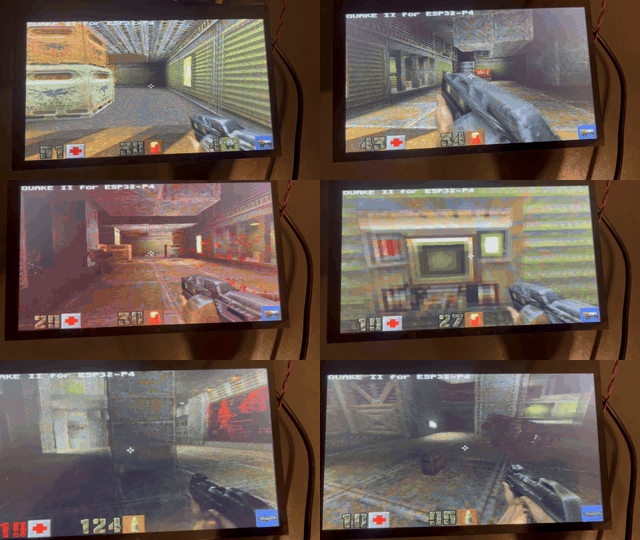
🖼️ Screenshots
🧠 Memory Architecture
- Dual-core split: Core 0 runs the
quaketask (engine + software renderer, producing the 8bpp framebuffer); Core 1 runs thedrawtask (8bpp → RGB565 conversion + PPA scale → MIPI-DSI panel). - Hot tables in internal RAM:
vid.colormap/alphamapand the frame buffer live in internal SRAM for the hottest pixel paths.
📦 Quake 2 Game Data
The engine requires the base game data files, which are not included (they are copyrighted by id Software). You need either the full retail game or the first demo:
-
Get a copy of
pak0.pak,pak1.pakandpak2.pakfrom the original Quake 2 (or the demo).Don't own Quake 2? The shareware demo (
q2-314-demo-x86.exe, freely available online) ships with abaseq2folder containing a playablepak0.pak— just extract it and follow the steps below. -
Create a
baseq2folder on the root of a FAT32 MicroSD card and place the paks inside:/sdcard/baseq2/pak0.pak /sdcard/baseq2/pak1.pak /sdcard/baseq2/pak2.pak -
Insert the SD card into the board.
🌐 Multiplayer
Multiplayer is supported over Ethernet using Quake 2's UDP net code.
- Host: start your own server from the in-game menu, or run a map
directly (
map base1). - Join: open the console with
`and typeconnect <server-ip>.
📋 Missing Features / To-Do
- Music (CD audio tracks are not played).
- Gamepad support (currently keyboard + mouse only).
- Wi-Fi (networking is wired Ethernet only).
🧰 Requirements
- ESP32-P4-Function-EV-Board (with the HMI-SubBoard: 1024x600 DSI panel, ES8311 codec, USB-H ports, SD card slot, 16MB flash / 24MB PSRAM).
- USB Keyboard (and mouse for aiming) connected via the USB-H port.
- FAT32 MicroSD card with the
baseq2paks. - Ethernet cable (only for multiplayer).
- esp-idf v5.5.5 toolchain.
🔧 Build and Flashing
- Game Data: prepare the SD card as described in the Quake 2 Game Data section.
- Compile and Flash:
idf.py build flash monitor
🤝 Contributing
Contributions are welcome! If you have ideas for improvements, optimizations, bug fixes or new features, feel free to open an issue or submit a pull request.
👨💻 About the Developer
Developed and optimized for the ESP32-P4 by Alejandro Villegas Alonso. If you are interested in embedded systems, ESP-IDF development, or want to discuss professional opportunities, feel free to connect!



🙏 Credits and Acknowledgements
- quake2generic: The portable engine core by ozkl.
- esp32p4_memcpy_pie_benchmark: Reference for the SIMD PIE
mem_cpy/memsetroutines incomponents/p4_memcpy(original code by BitsForPeople). - ESP32-P4 SIMD Explained: Reference tutorial by Larry Bank on the ESP32-P4 SIMD/PIE instructions used by the
components/p4_memcpyroutines. - id Software: The original legends of gaming.
- John Carmack: For the original Quake II source (GPL) that this port builds upon.
- Espressif Systems: For the powerful P4 chip and IDF framework, and the official esp32-quake port that served as a memory-architecture reference.
This project is based on quake2generic by ozkl, licensed under the GNU General Public License v2.0. This port adds ESP32-P4 support, custom hardware integration, platform-specific code and performance optimizations. Please retain the original attribution and license when creating forks or derivative projects.
⚖️ License
Licensed under the GNU General Public License v2.0. See the LICENSE file.
The engine is based on quake2generic
(Quake II source by id Software, GPL-2.0). Note: the PIE SIMD routines in
components/p4_memcpy originate from the
esp32p4_memcpy_pie_benchmark
project (code by BitsForPeople), which publishes no explicit license — check
with the original author before reusing that code outside this project.
Similar repos


Languages
C
99.1%
A bare-metal Quake 2 port for the ESP32-P4 microcontroller. Features hardware PPA upscaling, PIE SIMD optimizations, USB HID, and Ethernet multiplayer. Based on the portable quake2generic engine by ozkl.
C
7
6 commits
updated Sep 28, 2026
See what people are saying
README
ESP32_QUAKE2
A full Quake 2 port for the ESP32-P4 microcontroller, built on the
portable quake2generic engine with
its software renderer (ref_soft). The classic first-person shooter
runs on a single chip: the game logic, the software 3D renderer and the audio
mixer all run bare-metal on the P4 while the hardware handles the heavy lifting
— Pixel-Processing-Accelerator upscaling and DMA audio.
This port targets the ESP32-P4-Function-EV-Board (with HMI-SubBoard), but
is designed to be easily portable to other ESP32-P4 boards: the P4-specific
logic lives in main/ (display, audio, input, network) behind a thin
hardware-abstraction layer, while the engine in components/quake2 is
board-agnostic — only the OSPI flash/PSRAM config in sdkconfig.defaults and
the BSP calls in main/ need adapting.
🚀 Key Improvements
- PPA Hardware Scaling: The engine renders internally at
320x240(8bpp paletted) and is upscaled to1024x600on the MIPI-DSI panel via the ESP32-P4's Pixel Processing Accelerator, freeing the CPU for game logic. The 8bpp → RGB565 conversion runs on core 1 while the game runs on core 0. - SIMD PIE Optimizations: Custom
p4_memcpy/p4_memsetcomponents that leverage the P4's RISC-V PIE SIMD instructions, applied across the render hot paths, 2D/model buffers, audio mixing and entity handling. - DMA-Engineered Audio: The engine mixes SFX directly into a circular DMA
buffer broadcast over I2S to the onboard ES8311 codec at
22050 Hz, 16-bit stereo. - SD Card Pak Loading: Full game data loading from a FAT32 MicroSD card.
The engine reads
baseq2/pak0.pak,pak1.pakandpak2.pakfrom the card. - USB HID Support: Direct plug-and-play support for USB keyboards and mice (with freelook and tuned mouse sensitivity).
- Ethernet Multiplayer: UDP network support over Ethernet for client/server play.
🖼️ Screenshots
🧠 Memory Architecture
- Dual-core split: Core 0 runs the
quaketask (engine + software renderer, producing the 8bpp framebuffer); Core 1 runs thedrawtask (8bpp → RGB565 conversion + PPA scale → MIPI-DSI panel). - Hot tables in internal RAM:
vid.colormap/alphamapand the frame buffer live in internal SRAM for the hottest pixel paths.
📦 Quake 2 Game Data
The engine requires the base game data files, which are not included (they are copyrighted by id Software). You need either the full retail game or the first demo:
-
Get a copy of
pak0.pak,pak1.pakandpak2.pakfrom the original Quake 2 (or the demo).Don't own Quake 2? The shareware demo (
q2-314-demo-x86.exe, freely available online) ships with abaseq2folder containing a playablepak0.pak— just extract it and follow the steps below. -
Create a
baseq2folder on the root of a FAT32 MicroSD card and place the paks inside:/sdcard/baseq2/pak0.pak /sdcard/baseq2/pak1.pak /sdcard/baseq2/pak2.pak -
Insert the SD card into the board.
🌐 Multiplayer
Multiplayer is supported over Ethernet using Quake 2's UDP net code.
- Host: start your own server from the in-game menu, or run a map
directly (
map base1). - Join: open the console with
`and typeconnect <server-ip>.
📋 Missing Features / To-Do
- Music (CD audio tracks are not played).
- Gamepad support (currently keyboard + mouse only).
- Wi-Fi (networking is wired Ethernet only).
🧰 Requirements
- ESP32-P4-Function-EV-Board (with the HMI-SubBoard: 1024x600 DSI panel, ES8311 codec, USB-H ports, SD card slot, 16MB flash / 24MB PSRAM).
- USB Keyboard (and mouse for aiming) connected via the USB-H port.
- FAT32 MicroSD card with the
baseq2paks. - Ethernet cable (only for multiplayer).
- esp-idf v5.5.5 toolchain.
🔧 Build and Flashing
- Game Data: prepare the SD card as described in the Quake 2 Game Data section.
- Compile and Flash:
idf.py build flash monitor
🤝 Contributing
Contributions are welcome! If you have ideas for improvements, optimizations, bug fixes or new features, feel free to open an issue or submit a pull request.
👨💻 About the Developer
Developed and optimized for the ESP32-P4 by Alejandro Villegas Alonso. If you are interested in embedded systems, ESP-IDF development, or want to discuss professional opportunities, feel free to connect!
🙏 Credits and Acknowledgements
- quake2generic: The portable engine core by ozkl.
- esp32p4_memcpy_pie_benchmark: Reference for the SIMD PIE
mem_cpy/memsetroutines incomponents/p4_memcpy(original code by BitsForPeople). - ESP32-P4 SIMD Explained: Reference tutorial by Larry Bank on the ESP32-P4 SIMD/PIE instructions used by the
components/p4_memcpyroutines. - id Software: The original legends of gaming.
- John Carmack: For the original Quake II source (GPL) that this port builds upon.
- Espressif Systems: For the powerful P4 chip and IDF framework, and the official esp32-quake port that served as a memory-architecture reference.
This project is based on quake2generic by ozkl, licensed under the GNU General Public License v2.0. This port adds ESP32-P4 support, custom hardware integration, platform-specific code and performance optimizations. Please retain the original attribution and license when creating forks or derivative projects.
⚖️ License
Licensed under the GNU General Public License v2.0. See the LICENSE file.
The engine is based on quake2generic
(Quake II source by id Software, GPL-2.0). Note: the PIE SIMD routines in
components/p4_memcpy originate from the
esp32p4_memcpy_pie_benchmark
project (code by BitsForPeople), which publishes no explicit license — check
with the original author before reusing that code outside this project.
Similar repos
Languages
C
99.1%