
PyTorch Code for Explorative Modeling: Unlocking a Third Pretraining Axis and End-to-End Generation
Python
244
3 commits
updated Jul 31, 2026
README
🔭 Explorative Modeling: Unlocking a Third Pretraining Axis and End-to-End Generation
📚 Paper | 🌐 Website | 📝 Blog | 🚀 Getting Started with XMs | 🧾 Bibtex
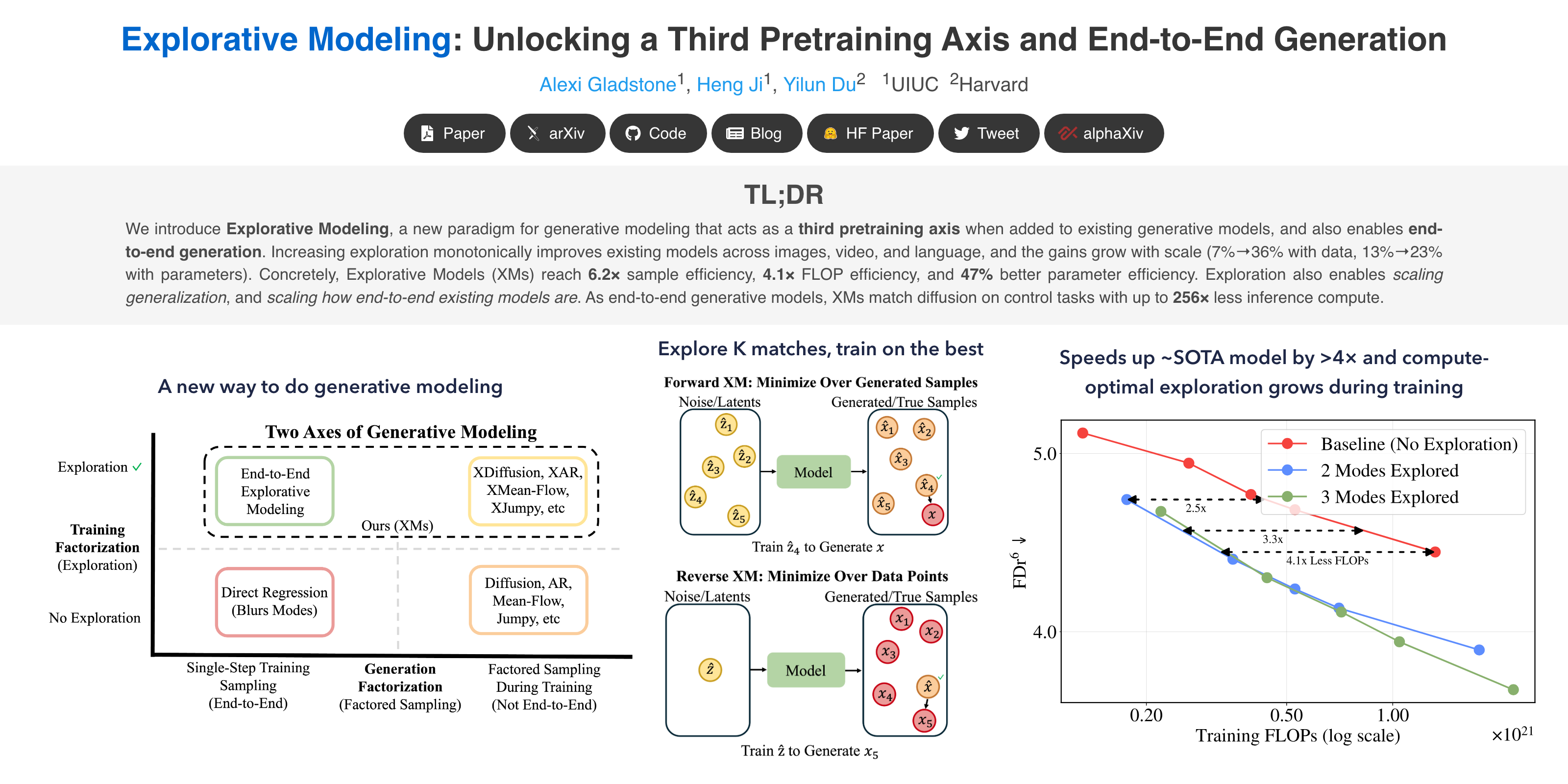
We introduce Explorative Modeling, a new paradigm for generative modeling that acts as a third pretraining axis when added to existing generative models, and also enables end-to-end generation. Explorative Models (XMs) work by exploring K candidate matches between what the model generates and the data at each training step, and training on the best one.
Setup
git clone https://github.com/alexiglad/XM.git
cd XM
Create the environment with Conda (recommended):
conda create -n xm python=3.12
conda activate xm
pip install -r requirements.txt
Then:
- Set
$HF_HOMEso datasets/models cache where you want, and$HF_TOKEN(ImageNet requires an accepted license). - Log in to Weights & Biases with
wandb login, and set--wandb_entity/--wandb_projectin the job scripts. - For video datasets (Something-Something V2, Kinetics-400) and
ffprobe, see data/vid/README.md.
Quick Start
Run any job script directly:
bash job_scripts/img/pretrain_class_conditional/xdit.sh
Or submit the same script to Slurm, which prepends a cluster header before sbatch:
bash slurm_executor.sh example_h100 job_scripts/img/pretrain_class_conditional/xdit.sh
The header lives in job_scripts/slurm_headers/example_h100.slurm — fill in the TODOs for your cluster. To add your own, drop a new .slurm file in that folder and add its name to VALID_HEADERS in slurm_executor.sh.
Getting Started with XMs
At each training step, XMs explore K possible matches between generations and data, and train only on the best match, so each prediction commits to a single mode rather than averaging across many. The pseudocode below shows Forward XM, which holds the data target fixed and explores over the model's own generations; Reverse XM flips this, holding a generation fixed and searching over K data targets (Sections 3.2 and A of the paper).
Before Exploration
y    = model(sample_latent())   # generate one output (from noise, a mask, …)
loss = recon_loss(y, x)         # score it against the data target x
loss.backward()
After Exploration · explore K generations, keep the best (Forward XM)
losses = []
for _ in range(K):                   # explore K candidate outputs
    y = model(sample_latent())       # generate one candidate
    losses.append(recon_loss(y, x))  # score each against x

min(losses).backward()               # train only the closest candidate
Example: Adding Exploration to a Diffusion / Flow Model
t = sample_timestep()
losses = []
for _ in range(K):                          # explore K candidate noises
    z    = randn_like(x)                    # one candidate noise
    x_t  = add_noise(x, z, t)               # noise the data to level t
    losses.append(diffusion_loss(model(x_t, t), x, z))

min(losses).backward()                      # train only the closest candidate
XMs combine with existing generative models very simply: explore over the latent variable (here, the noise) and backpropagate only through the best candidate. In this repo, exploration is just --xm_best_of_k K, and K = 1 is a model with no exploration (the baseline model).
Job Scripts
All experiments are launched from job_scripts/<modality>/:
| Script | What it trains |
|---|---|
img/pretrain_class_conditional/xdit.sh | XDiffusion (DiT + exploration), class-conditional ImageNet 256×256 |
img/pretrain_class_conditional/xjumpy.sh | XJumpy, same setup |
vid/pretrain_wm/xdit_128.sh | XDiffusion goal-conditioned video world model, 128×128 SSv2 |
vid/pretrain_wm/xjumpy_128.sh | XJumpy, same setup |
FID and FVD are evaluated online between training epochs via --run_online_evaluation.
Repo Structure
├── abbreviations.md              # abbreviations used across the repo
├── base_model_trainer.py         # PyTorch Lightning module: training/val/test loops, data setup, logging
├── data
│   ├── img                       # ImageNet + synthetic image dataloaders
│   ├── nlp                       # FineWeb and evaluation dataloaders
│   └── vid                       # SSv2/Kinetics dataloaders, preencoding (see its README)
├── inference
│   ├── img                       # online FID evaluation
│   ├── nlp                       # online LM harness evaluation
│   └── vid                       # online FVD evaluation
├── job_scripts                   # all training scripts, by modality, plus Slurm headers
├── model
│   ├── diffusion                 # diffusion utilities (from the DiT repo)
│   ├── diffusion_transformer.py  # DiT backbone
│   ├── flow                      # flow matching, schedulers, OT coupling
│   ├── img                       # class-conditional image models
│   ├── jumpy.py                  # Jumpy generative model
│   ├── model_utils.py            # shared model code, encoders, model sizes
│   ├── nlp                       # autoregressive and masked diffusion language models
│   ├── vid                       # video world models
│   └── video_transformer_3d.py   # 3D transformer backbone for video
├── optimization.py               # LR schedulers and optimizer helpers
├── slurm_executor.sh             # combines a Slurm header with a job script and submits it
├── train_model.py                # entry point: argparse, distributed setup, Lightning trainer
└── utils                         # latent caching, metrics, dataloader debugging, RAE
Abbreviations used throughout the code are listed in abbreviations.md.
Coming Soon
- The RAE results do not use this repo---those runs add exploration to the RAE codebase, which we will release separately soon.
- Code for masked diffusion language models (MDLMs) and the control tasks (Explorative Policy and Explorative World Model) will be open sourced soon as well.
Citation
If you find this repository useful, please consider giving a star ⭐ and citation 🙃:
@misc{gladstone2026explorativemodelingunlockingpretraining,
      title={Explorative Modeling: Unlocking a Third Pretraining Axis and End-to-End Generation},
      author={Alexi Gladstone and Heng Ji and Yilun Du},
      year={2026},
      eprint={2607.27372},
      archivePrefix={arXiv},
      primaryClass={cs.LG},
      url={https://arxiv.org/abs/2607.27372},
}
Contact
If you have questions feel free to post them on GitHub issues or email me (alexigladstone@gmail.com). Enjoy!
Contributors

3 commits
Similar repos


Languages
Python
97.3%
Shell
2.7%
PyTorch Code for Explorative Modeling: Unlocking a Third Pretraining Axis and End-to-End Generation
Python
244
3 commits
updated Jul 31, 2026
README
🔭 Explorative Modeling: Unlocking a Third Pretraining Axis and End-to-End Generation
📚 Paper | 🌐 Website | 📝 Blog | 🚀 Getting Started with XMs | 🧾 Bibtex
We introduce Explorative Modeling, a new paradigm for generative modeling that acts as a third pretraining axis when added to existing generative models, and also enables end-to-end generation. Explorative Models (XMs) work by exploring K candidate matches between what the model generates and the data at each training step, and training on the best one.
Setup
git clone https://github.com/alexiglad/XM.git
cd XM
Create the environment with Conda (recommended):
conda create -n xm python=3.12
conda activate xm
pip install -r requirements.txt
Then:
- Set
$HF_HOMEso datasets/models cache where you want, and$HF_TOKEN(ImageNet requires an accepted license). - Log in to Weights & Biases with
wandb login, and set--wandb_entity/--wandb_projectin the job scripts. - For video datasets (Something-Something V2, Kinetics-400) and
ffprobe, see data/vid/README.md.
Quick Start
Run any job script directly:
bash job_scripts/img/pretrain_class_conditional/xdit.sh
Or submit the same script to Slurm, which prepends a cluster header before sbatch:
bash slurm_executor.sh example_h100 job_scripts/img/pretrain_class_conditional/xdit.sh
The header lives in job_scripts/slurm_headers/example_h100.slurm — fill in the TODOs for your cluster. To add your own, drop a new .slurm file in that folder and add its name to VALID_HEADERS in slurm_executor.sh.
Getting Started with XMs
At each training step, XMs explore K possible matches between generations and data, and train only on the best match, so each prediction commits to a single mode rather than averaging across many. The pseudocode below shows Forward XM, which holds the data target fixed and explores over the model's own generations; Reverse XM flips this, holding a generation fixed and searching over K data targets (Sections 3.2 and A of the paper).
Before Exploration
y    = model(sample_latent())   # generate one output (from noise, a mask, …)
loss = recon_loss(y, x)         # score it against the data target x
loss.backward()
After Exploration · explore K generations, keep the best (Forward XM)
losses = []
for _ in range(K):                   # explore K candidate outputs
    y = model(sample_latent())       # generate one candidate
    losses.append(recon_loss(y, x))  # score each against x

min(losses).backward()               # train only the closest candidate
Example: Adding Exploration to a Diffusion / Flow Model
t = sample_timestep()
losses = []
for _ in range(K):                          # explore K candidate noises
    z    = randn_like(x)                    # one candidate noise
    x_t  = add_noise(x, z, t)               # noise the data to level t
    losses.append(diffusion_loss(model(x_t, t), x, z))

min(losses).backward()                      # train only the closest candidate
XMs combine with existing generative models very simply: explore over the latent variable (here, the noise) and backpropagate only through the best candidate. In this repo, exploration is just --xm_best_of_k K, and K = 1 is a model with no exploration (the baseline model).
Job Scripts
All experiments are launched from job_scripts/<modality>/:
| Script | What it trains |
|---|---|
img/pretrain_class_conditional/xdit.sh | XDiffusion (DiT + exploration), class-conditional ImageNet 256×256 |
img/pretrain_class_conditional/xjumpy.sh | XJumpy, same setup |
vid/pretrain_wm/xdit_128.sh | XDiffusion goal-conditioned video world model, 128×128 SSv2 |
vid/pretrain_wm/xjumpy_128.sh | XJumpy, same setup |
FID and FVD are evaluated online between training epochs via --run_online_evaluation.
Repo Structure
├── abbreviations.md              # abbreviations used across the repo
├── base_model_trainer.py         # PyTorch Lightning module: training/val/test loops, data setup, logging
├── data
│   ├── img                       # ImageNet + synthetic image dataloaders
│   ├── nlp                       # FineWeb and evaluation dataloaders
│   └── vid                       # SSv2/Kinetics dataloaders, preencoding (see its README)
├── inference
│   ├── img                       # online FID evaluation
│   ├── nlp                       # online LM harness evaluation
│   └── vid                       # online FVD evaluation
├── job_scripts                   # all training scripts, by modality, plus Slurm headers
├── model
│   ├── diffusion                 # diffusion utilities (from the DiT repo)
│   ├── diffusion_transformer.py  # DiT backbone
│   ├── flow                      # flow matching, schedulers, OT coupling
│   ├── img                       # class-conditional image models
│   ├── jumpy.py                  # Jumpy generative model
│   ├── model_utils.py            # shared model code, encoders, model sizes
│   ├── nlp                       # autoregressive and masked diffusion language models
│   ├── vid                       # video world models
│   └── video_transformer_3d.py   # 3D transformer backbone for video
├── optimization.py               # LR schedulers and optimizer helpers
├── slurm_executor.sh             # combines a Slurm header with a job script and submits it
├── train_model.py                # entry point: argparse, distributed setup, Lightning trainer
└── utils                         # latent caching, metrics, dataloader debugging, RAE
Abbreviations used throughout the code are listed in abbreviations.md.
Coming Soon
- The RAE results do not use this repo---those runs add exploration to the RAE codebase, which we will release separately soon.
- Code for masked diffusion language models (MDLMs) and the control tasks (Explorative Policy and Explorative World Model) will be open sourced soon as well.
Citation
If you find this repository useful, please consider giving a star ⭐ and citation 🙃:
@misc{gladstone2026explorativemodelingunlockingpretraining,
      title={Explorative Modeling: Unlocking a Third Pretraining Axis and End-to-End Generation},
      author={Alexi Gladstone and Heng Ji and Yilun Du},
      year={2026},
      eprint={2607.27372},
      archivePrefix={arXiv},
      primaryClass={cs.LG},
      url={https://arxiv.org/abs/2607.27372},
}
Contact
If you have questions feel free to post them on GitHub issues or email me (alexigladstone@gmail.com). Enjoy!
Similar repos
Contributors
3 commits
Languages
Python
97.3%
Shell
2.7%