Deep Reinforcement Learning: Zero to Hero!
Jupyter Notebook
2,294
15 commits
updated May 26, 2026


Welcome to drlzh.ai: a hands-on deep reinforcement learning course where you build the algorithms, not just read about them.
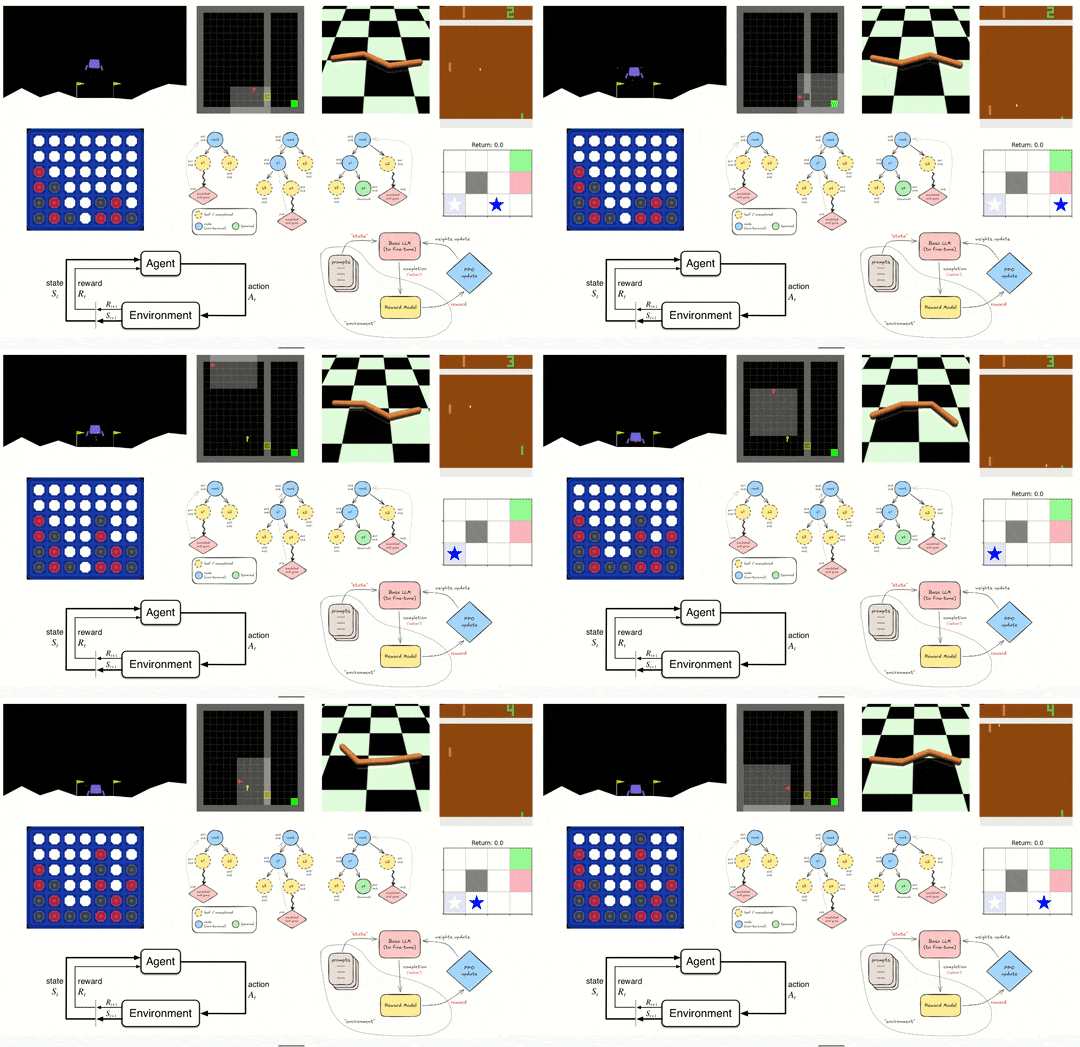
Start from MDPs and tabular RL, then work your way to the algorithms behind Atari agents, continuous-control robots, AlphaZero-style planning, RLHF for language models, Decision Transformers, VLA-style policies, world models, Dreamer, and meta-learning.
The root notebooks are the exercise track: code is intentionally replaced with guided TODO
sections. The solution/ notebooks contain the complete, runnable versions, so you can
unblock yourself without leaving the course.
| Notebooks | Track | You build |
|---|---|---|
00-07 | Foundations | MDPs, tabular RL, DQN, REINFORCE, actor-critic methods, DDPG, TD3, SAC, PPO |
08-10 | Breaking assumptions | RND curiosity, multi-agent RL, offline RL with BC and IQL |
11 | Planning | Monte Carlo Tree Search, self-play, AlphaZero-style policy/value learning |
12-13 | Modern AI stack | RLHF with PPO, DPO, GRPO, Decision Transformers, and NanoVLA (DTVLA) |
14 | Production | TensorBoard, checkpointing, debugging, multiple seeds, Ray, Optuna |
15-16 | World models | MBPO with SAC, then DR3AM/Dreamer with RSSM latent imagination |
17-18 | Meta + wrap-up | MAML, FOMAML, fast adaptation, and course conclusion |
The foundations are meant to be done in order. The advanced notebooks are self-contained, but the numbering gives you a good default path from exploration to the course capstone.
The Docker workspace includes the DRL-ZH AI Companion, a VS Code extension built for this
course. It knows which notebook and TODO you are working on, offers Socratic hints instead of
spoilers, and supports text or voice mode. Bring your own LLM key: Gemini is the default, with
OpenAI, Anthropic, and Groq supported too.
The recommended setup is Docker: it gives you code-server, the notebooks, Python >=3.13,<3.14, the
Jupyter kernel, dependencies, and the AI Companion in one reproducible workspace.
Install Docker and Git, then clone this repository and cd into it.
On Linux/macOS, run printf "UID=$(id -u)\nGID=$(id -g)\n" > .env so files are owned by you.
Start the default environment:
docker compose up --build -d
Open http://localhost:8080 in a Chromium-based browser and select the Python (drl-zh) kernel.
Open 00_Intro.ipynb and start filling in TODOs.
For NVIDIA GPU access, use:
docker compose -f docker-compose.yml -f docker-compose.gpu.yml up --build -d
For a smaller CPU-only image, use:
docker compose -f docker-compose.yml -f docker-compose.cpu.yml up --build -d
Prefer a native setup? See MANUAL.md for Python, Poetry, VS Code, and Companion instructions.
You should be comfortable with Python, PyTorch basics, and the usual math behind ML: probability, statistics, linear algebra, and derivatives. The notebooks teach the RL, but they assume you can read and modify real training code.
MIT. See LICENSE.
(top 24 of 36)
445 followers · starred Nov 2025
782 followers · starred May 2024
193 followers · starred May 2024
5 followers · starred Jul 2025
Deep Reinforcement Learning: Zero to Hero!
Jupyter Notebook
2,294
15 commits
updated May 26, 2026
Welcome to drlzh.ai: a hands-on deep reinforcement learning course where you build the algorithms, not just read about them.
Start from MDPs and tabular RL, then work your way to the algorithms behind Atari agents, continuous-control robots, AlphaZero-style planning, RLHF for language models, Decision Transformers, VLA-style policies, world models, Dreamer, and meta-learning.
The root notebooks are the exercise track: code is intentionally replaced with guided TODO
sections. The solution/ notebooks contain the complete, runnable versions, so you can
unblock yourself without leaving the course.
| Notebooks | Track | You build |
|---|---|---|
00-07 | Foundations | MDPs, tabular RL, DQN, REINFORCE, actor-critic methods, DDPG, TD3, SAC, PPO |
08-10 | Breaking assumptions | RND curiosity, multi-agent RL, offline RL with BC and IQL |
11 | Planning | Monte Carlo Tree Search, self-play, AlphaZero-style policy/value learning |
12-13 | Modern AI stack | RLHF with PPO, DPO, GRPO, Decision Transformers, and NanoVLA (DTVLA) |
14 | Production | TensorBoard, checkpointing, debugging, multiple seeds, Ray, Optuna |
15-16 | World models | MBPO with SAC, then DR3AM/Dreamer with RSSM latent imagination |
17-18 | Meta + wrap-up | MAML, FOMAML, fast adaptation, and course conclusion |
The foundations are meant to be done in order. The advanced notebooks are self-contained, but the numbering gives you a good default path from exploration to the course capstone.
The Docker workspace includes the DRL-ZH AI Companion, a VS Code extension built for this
course. It knows which notebook and TODO you are working on, offers Socratic hints instead of
spoilers, and supports text or voice mode. Bring your own LLM key: Gemini is the default, with
OpenAI, Anthropic, and Groq supported too.
The recommended setup is Docker: it gives you code-server, the notebooks, Python >=3.13,<3.14, the
Jupyter kernel, dependencies, and the AI Companion in one reproducible workspace.
Install Docker and Git, then clone this repository and cd into it.
On Linux/macOS, run printf "UID=$(id -u)\nGID=$(id -g)\n" > .env so files are owned by you.
Start the default environment:
docker compose up --build -d
Open http://localhost:8080 in a Chromium-based browser and select the Python (drl-zh) kernel.
Open 00_Intro.ipynb and start filling in TODOs.
For NVIDIA GPU access, use:
docker compose -f docker-compose.yml -f docker-compose.gpu.yml up --build -d
For a smaller CPU-only image, use:
docker compose -f docker-compose.yml -f docker-compose.cpu.yml up --build -d
Prefer a native setup? See MANUAL.md for Python, Poetry, VS Code, and Companion instructions.
You should be comfortable with Python, PyTorch basics, and the usual math behind ML: probability, statistics, linear algebra, and derivatives. The notebooks teach the RL, but they assume you can read and modify real training code.
MIT. See LICENSE.
(top 24 of 36)
445 followers · starred Nov 2025
782 followers · starred May 2024
193 followers · starred May 2024
5 followers · starred Jul 2025