
A cable-car journey risograph
See the codeSee what people are saying
README
A Journey on the Powell-Hyde Cable Car
A 97-second procedural risograph film of a ride on San Francisco's Powell–Hyde cable car, from
Union Square over Nob Hill and Russian Hill down to the bay, seen through one window of a Powell
car. Every pixel is drawn in Canvas 2D and every sound but one is synthesised, in a single
index.html with no libraries, fonts, images or network calls.
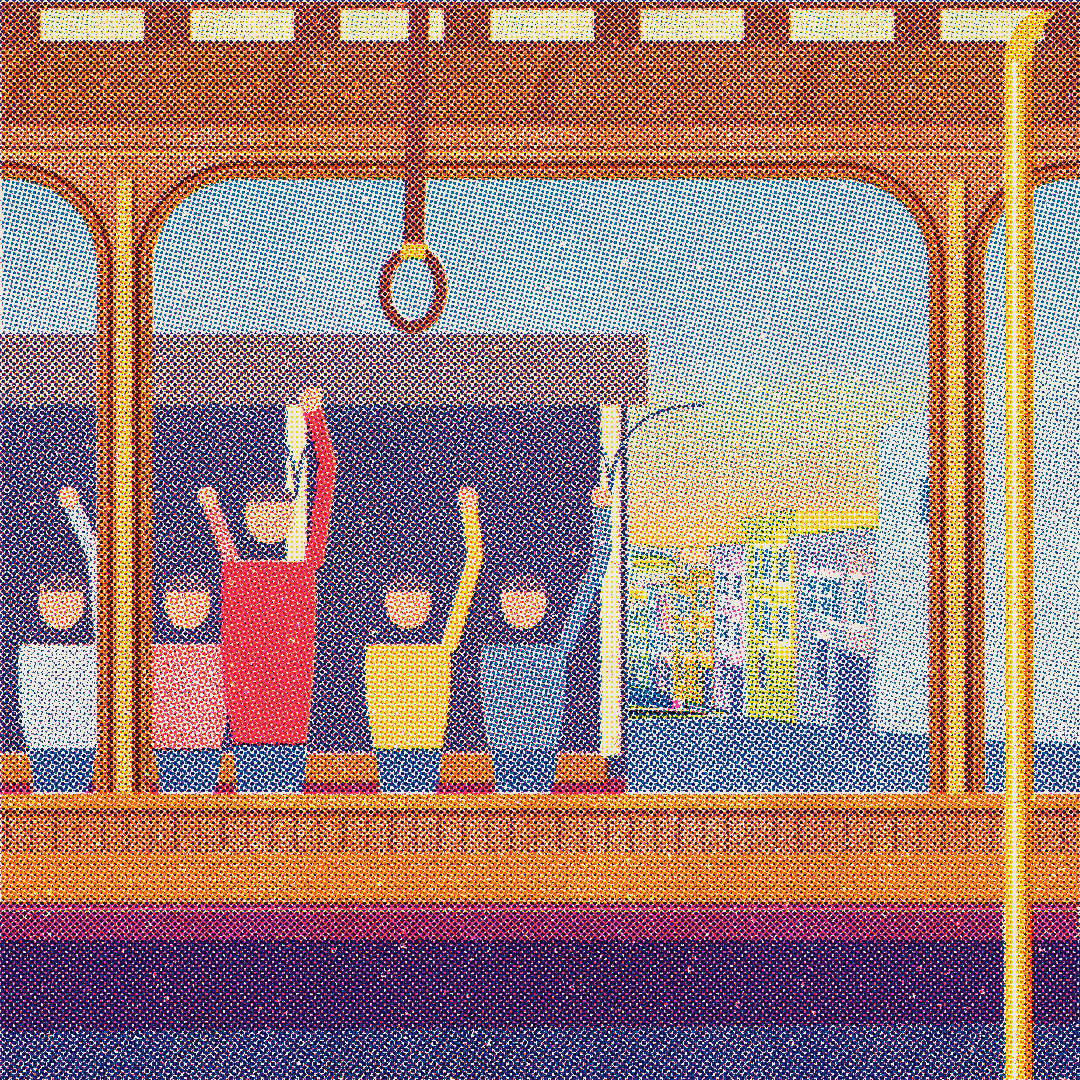
Watch: open site/ (deployed on Vercel), or open
films/hyde-street/index.html in a browser and press Play, with Sound on.
Hyde Street
The camera is bolted to the car. When it climbs Powell (up to 17%) or plunges down Hyde (21%, the steepest grade in the system), the street stays parallel to the sill and the whole city tilts; the leather strap hangs plumb and swings at every start and stop.
| Time | Passage |
|---|---|
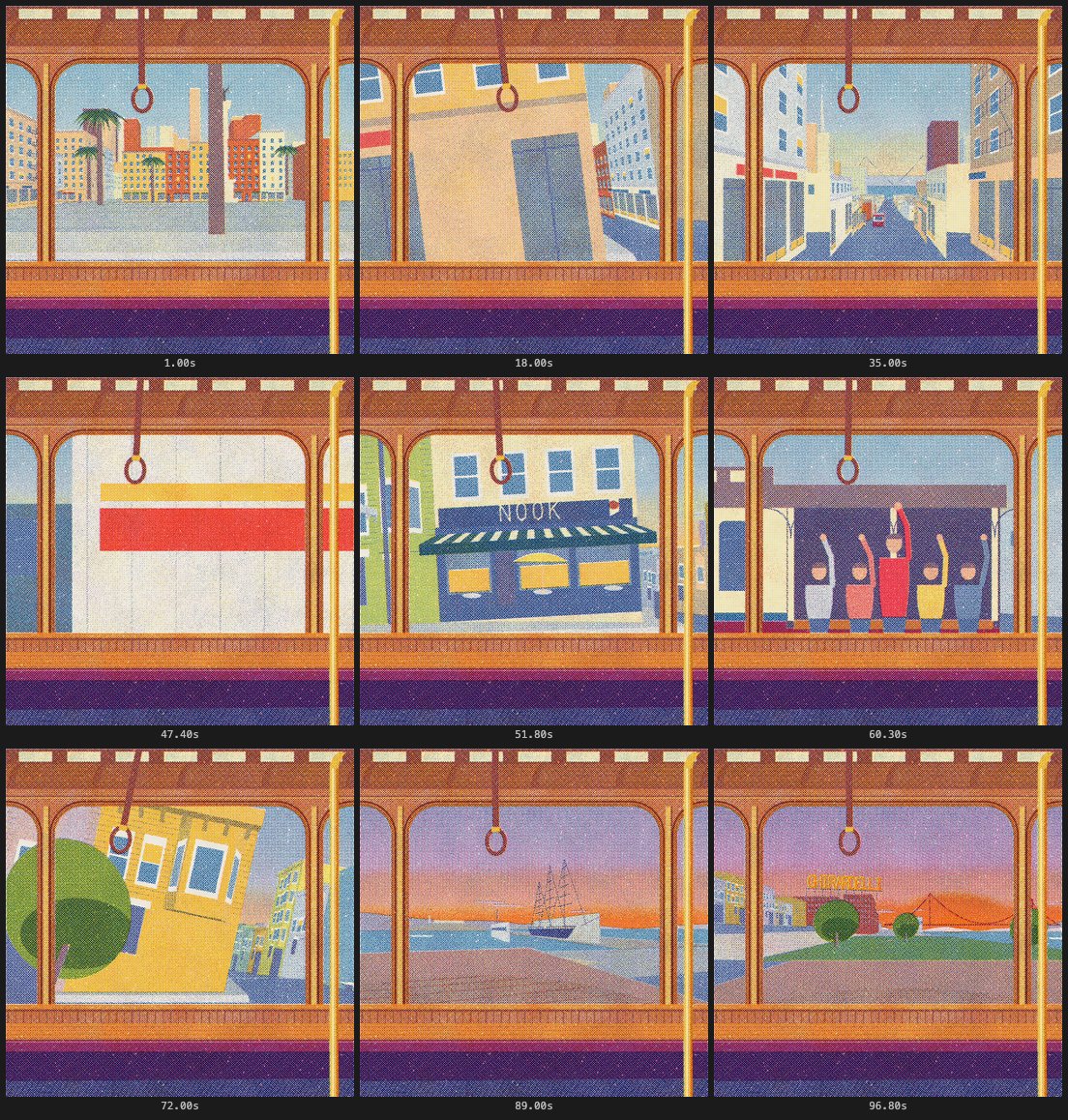
| 0–30 s | Union Square and the Dewey column, then the climb up Powell past hotels and neon blade signs |
| 30–39 s | The level crossing at California Street: down the canyon to the Bay Bridge, a California car climbing |
| 39–55 s | A truck overtakes and covers the turn through Jackson; Nook on the corner; Russian Hill Victorians |
| 55–65 s | Stopped at Lombard: the crooked street below, Coit Tower at the end, a southbound car passes with riders waving |
| 65–83 s | The 21% plunge toward the bay as the sun goes down |
| 83–97 s | The turntable at Hyde & Beach swings the window past the wharf, a tall ship, Alcatraz and the Golden Gate; the Ghirardelli sign comes on |
The sound is the ride: a grinding roar modelled on a field recording of a Powell car, wheels
knocking over rail joints, the grip, the brakes, the gripman's bell, gulls (a public-domain
National Park Service recording) and a foghorn. Design notes, measurements and known weaknesses
are in films/hyde-street/FILM.md; audio credits in
AUDIO-SOURCES.md.
The kit it was made with
This repo is built on riso-windowseat, the release of Window Seat together with the Claude Code skills, craft docs and render harness its films grew. Hyde Street was made with that kit; the original films are kept below.
The kit's films
All are 1080 × 1080, 30 fps. MP4s are on the
v1.0 release. To watch the
source instead, open any index.html in a browser and press play.
| Film | Length | |
|---|---|---|
| Hyde Street | 97 s | A Powell–Hyde cable car ride from Union Square to the bay, through one window |
| Window Seat | 78 s | A night train journey through one window, scored for piano |
| Roost | 70 s | One take of a starling murmuration from sunset to roost, scored for strings |
| Lumen | 28 s | A seed that contains a sun; the first short, in call-and-response form |
| Emergence | 28 s | Lumen's sibling: how machines learned to listen, as nine worlds |
Window Seat
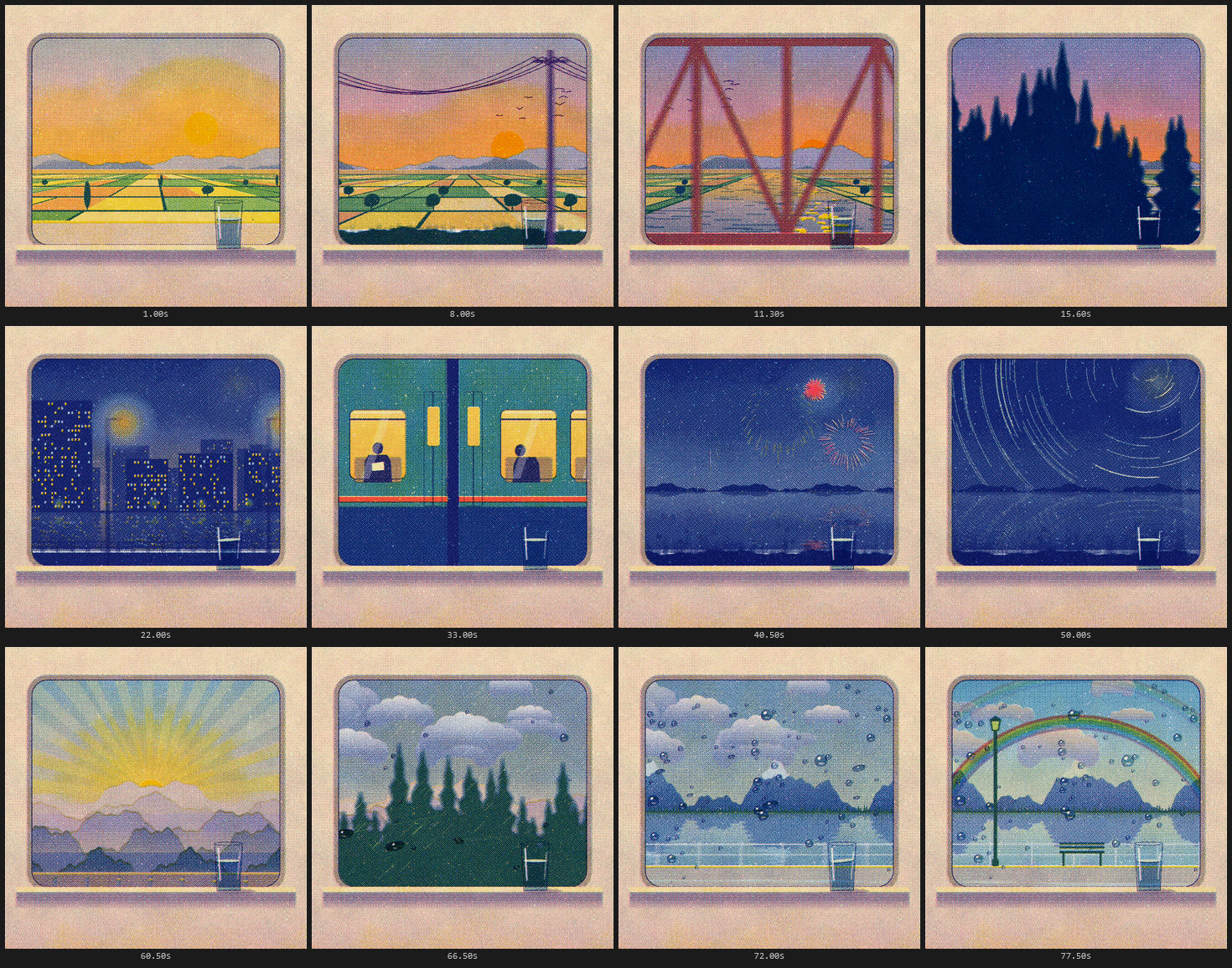
A night train journey seen through one fixed window with a glass of water on the sill. Every pixel and every sound except the piano is procedural.
| Time | Passage |
|---|---|
| 0–19 s | Golden departure from a platform, fields, a red truss bridge, a conifer cutting, a tunnel |
| 19–38 s | A night city with a canal and a level crossing; another train overtakes, passengers in its windows |
| 38–57 s | Fireworks over a lake, sleeper hours with star trails, pre-dawn fog |
| 57–78 s | Dawn from a viaduct, rain streaming back along the glass, a lakeside halt under a rainbow |
The score, "A Light Left in the Window", is an original piano piece in 6/8 whose phrasing follows the picture's timeline. The glass of water leans with every acceleration and is the last thing to settle.
Roost
A murmuration over a marsh in one fixed view. Each starling is a 2–3 px ink dot, so the flock is the halftone: where the sheet turns edge-on, the birds pile into dark printed ribbons. A falcon stoops through it and the flock pours into the reeds at nightfall. The string score is timed from the picture.
How they're made
I directed each film; Claude Code (Anthropic's coding agent) wrote the code, using the skills,
rules and docs in this repo. A work is designed in its FILM.md, its hardest frame is proved
first, and then it is inspected as frame strips, 1:1 crops and loudness sheets rendered by
tools/. Every frame is a pure function of time (seek(t)), so any moment can be inspected
exactly and the MP4 cannot drop frames. Each FILM.md records the design decisions and
measurements, and lists the film's remaining weaknesses.
Make your own
git clone https://github.com/akdeb/sf-cable-car-ride
cd sf-cable-car-ride/tools
npm install && npm run setup && npm test
Then open Claude Code in the repo root and ask, for example:
- "Make a 40 second riso film of a lighthouse keeper's night."
- "Make a riso poster of a heron on a pier at dusk."
- "Score this film" or "The rain at 66 s is too loud."
- "Extend Window Seat with a snowy mountain pass after the lake."
CLAUDE.md gives the session the contract and commands. The riso-film, riso-still and
riso-score skills in .claude/skills/ carry the workflow and gates. Each skill's examples.md
points to the routines in the shipped films that are worth reusing. A hook warns when an edit
breaks determinism.
What's inside
| Path | Contents |
|---|---|
films/ | The four films, each with its FILM.md; Window Seat and Roost include sample credits and bank rebuild scripts |
prints/workings/ | A still print series and the print kit new works start from |
docs/ | The craft: brief, visual development, drawing, scene space, motion, sound, quality bar |
studies/ | Interactive A/B studies of each technique, and the sound kit |
tools/ | Scaffolding, verification, contact sheets, audio analysis and MP4 export (README) |
.claude/ | Skills, the ink-plate rule and the determinism hook |
License
MIT, see LICENSE. The piano recordings embedded in Window Seat are Salamander Grand
Piano V3 by Alexander Holm under CC BY 3.0; see
AUDIO-SOURCES.md. The string recordings embedded in
Roost are VSCO 2 Community Edition by Versilian Studios under CC0 1.0; see
AUDIO-SOURCES.md.
Contributors

5 commits

5 commits
Similar repos


Languages
HTML
99.2%
A cable-car journey risograph
See the codeSee what people are saying
README
A Journey on the Powell-Hyde Cable Car
A 97-second procedural risograph film of a ride on San Francisco's Powell–Hyde cable car, from
Union Square over Nob Hill and Russian Hill down to the bay, seen through one window of a Powell
car. Every pixel is drawn in Canvas 2D and every sound but one is synthesised, in a single
index.html with no libraries, fonts, images or network calls.
Watch: open site/ (deployed on Vercel), or open
films/hyde-street/index.html in a browser and press Play, with Sound on.
Hyde Street
The camera is bolted to the car. When it climbs Powell (up to 17%) or plunges down Hyde (21%, the steepest grade in the system), the street stays parallel to the sill and the whole city tilts; the leather strap hangs plumb and swings at every start and stop.
| Time | Passage |
|---|---|
| 0–30 s | Union Square and the Dewey column, then the climb up Powell past hotels and neon blade signs |
| 30–39 s | The level crossing at California Street: down the canyon to the Bay Bridge, a California car climbing |
| 39–55 s | A truck overtakes and covers the turn through Jackson; Nook on the corner; Russian Hill Victorians |
| 55–65 s | Stopped at Lombard: the crooked street below, Coit Tower at the end, a southbound car passes with riders waving |
| 65–83 s | The 21% plunge toward the bay as the sun goes down |
| 83–97 s | The turntable at Hyde & Beach swings the window past the wharf, a tall ship, Alcatraz and the Golden Gate; the Ghirardelli sign comes on |
The sound is the ride: a grinding roar modelled on a field recording of a Powell car, wheels
knocking over rail joints, the grip, the brakes, the gripman's bell, gulls (a public-domain
National Park Service recording) and a foghorn. Design notes, measurements and known weaknesses
are in films/hyde-street/FILM.md; audio credits in
AUDIO-SOURCES.md.
The kit it was made with
This repo is built on riso-windowseat, the release of Window Seat together with the Claude Code skills, craft docs and render harness its films grew. Hyde Street was made with that kit; the original films are kept below.
The kit's films
All are 1080 × 1080, 30 fps. MP4s are on the
v1.0 release. To watch the
source instead, open any index.html in a browser and press play.
| Film | Length | |
|---|---|---|
| Hyde Street | 97 s | A Powell–Hyde cable car ride from Union Square to the bay, through one window |
| Window Seat | 78 s | A night train journey through one window, scored for piano |
| Roost | 70 s | One take of a starling murmuration from sunset to roost, scored for strings |
| Lumen | 28 s | A seed that contains a sun; the first short, in call-and-response form |
| Emergence | 28 s | Lumen's sibling: how machines learned to listen, as nine worlds |
Window Seat
A night train journey seen through one fixed window with a glass of water on the sill. Every pixel and every sound except the piano is procedural.
| Time | Passage |
|---|---|
| 0–19 s | Golden departure from a platform, fields, a red truss bridge, a conifer cutting, a tunnel |
| 19–38 s | A night city with a canal and a level crossing; another train overtakes, passengers in its windows |
| 38–57 s | Fireworks over a lake, sleeper hours with star trails, pre-dawn fog |
| 57–78 s | Dawn from a viaduct, rain streaming back along the glass, a lakeside halt under a rainbow |
The score, "A Light Left in the Window", is an original piano piece in 6/8 whose phrasing follows the picture's timeline. The glass of water leans with every acceleration and is the last thing to settle.
Roost
A murmuration over a marsh in one fixed view. Each starling is a 2–3 px ink dot, so the flock is the halftone: where the sheet turns edge-on, the birds pile into dark printed ribbons. A falcon stoops through it and the flock pours into the reeds at nightfall. The string score is timed from the picture.
How they're made
I directed each film; Claude Code (Anthropic's coding agent) wrote the code, using the skills,
rules and docs in this repo. A work is designed in its FILM.md, its hardest frame is proved
first, and then it is inspected as frame strips, 1:1 crops and loudness sheets rendered by
tools/. Every frame is a pure function of time (seek(t)), so any moment can be inspected
exactly and the MP4 cannot drop frames. Each FILM.md records the design decisions and
measurements, and lists the film's remaining weaknesses.
Make your own
git clone https://github.com/akdeb/sf-cable-car-ride
cd sf-cable-car-ride/tools
npm install && npm run setup && npm test
Then open Claude Code in the repo root and ask, for example:
- "Make a 40 second riso film of a lighthouse keeper's night."
- "Make a riso poster of a heron on a pier at dusk."
- "Score this film" or "The rain at 66 s is too loud."
- "Extend Window Seat with a snowy mountain pass after the lake."
CLAUDE.md gives the session the contract and commands. The riso-film, riso-still and
riso-score skills in .claude/skills/ carry the workflow and gates. Each skill's examples.md
points to the routines in the shipped films that are worth reusing. A hook warns when an edit
breaks determinism.
What's inside
| Path | Contents |
|---|---|
films/ | The four films, each with its FILM.md; Window Seat and Roost include sample credits and bank rebuild scripts |
prints/workings/ | A still print series and the print kit new works start from |
docs/ | The craft: brief, visual development, drawing, scene space, motion, sound, quality bar |
studies/ | Interactive A/B studies of each technique, and the sound kit |
tools/ | Scaffolding, verification, contact sheets, audio analysis and MP4 export (README) |
.claude/ | Skills, the ink-plate rule and the determinism hook |
License
MIT, see LICENSE. The piano recordings embedded in Window Seat are Salamander Grand
Piano V3 by Alexander Holm under CC BY 3.0; see
AUDIO-SOURCES.md. The string recordings embedded in
Roost are VSCO 2 Community Edition by Versilian Studios under CC0 1.0; see
AUDIO-SOURCES.md.
Similar repos
Contributors
5 commits
5 commits
Languages
HTML
99.2%