
Multiple Meta-model Quantifying for Medical Visual Question Answering (MICCAI 2021)
See the codeREADME
Multiple Meta-model Quantifying for Medical Visual Question Answering (MMQ-VQA)
This repository is the implementation of MMQ for the visual question answering task in medical domain. Our proposal achieves superior accuracy in comparison with other state-of-the-art (sota) methods on two public medical VQA datasets: PathVQA dataset and VQA-RAD dataset.
- On PathVQA dataset, our model achieved 13.9% for free-form and 63.8% for yes/no quetions.
- On VQA-RAD dataset, our model achieved 56.9% for open-ended and 75.7% for close-ended questions.
For the detail, please refer to link.
This repository is based on and inspired by @Binh D. Nguyen's work. We sincerely thank for their sharing of the codes.
Prerequisites
PYTHON 3.6
CUDA 9.2
Please install dependence package by run following command:
pip install -r requirements.txt
MMQ Progress
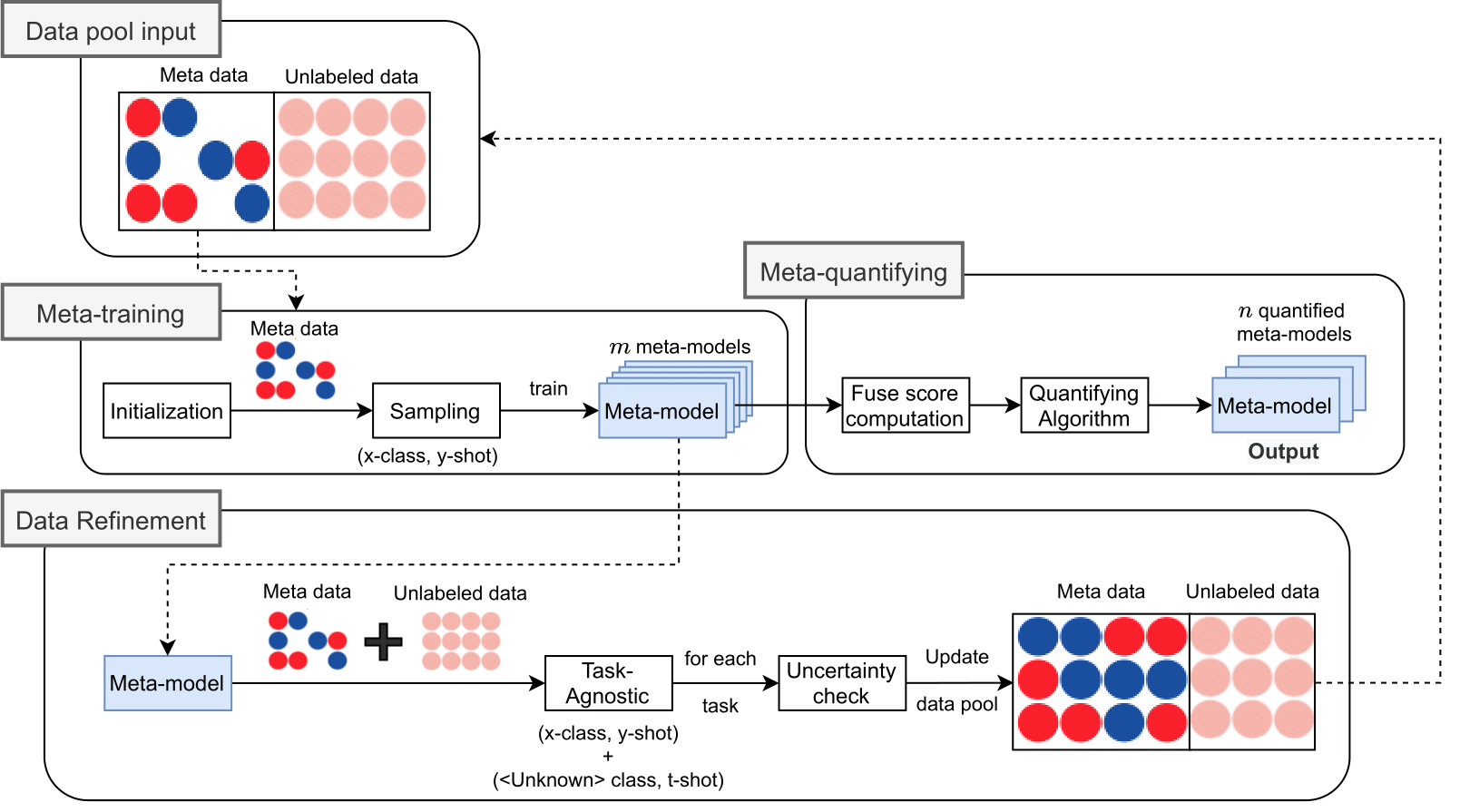
Preprocessing
Important: Before running any command lines, please run following command to access 'mmq_maml' folder:
$ cd mmq_maml
And now, you are in 'mmq_maml' folder.
- PathVQA dataset for MMQ task should be downloaded via link. The downloaded file should be extracted to
data/pathvqa_maml/directory. - VQA-RAD dataset for MMQ task should be downloaded via link. The downloaded file should be extracted to
data/vqarad_maml/directory.
Traing MAML models with MMQ
Train MAML models with MMQ on PathVQA dataset:
$ sh run_pathVQA.sh
Train MAML models with MMQ on VQA-RAD dataset:
$ sh run_VQA_RAD.sh
VQA Progress
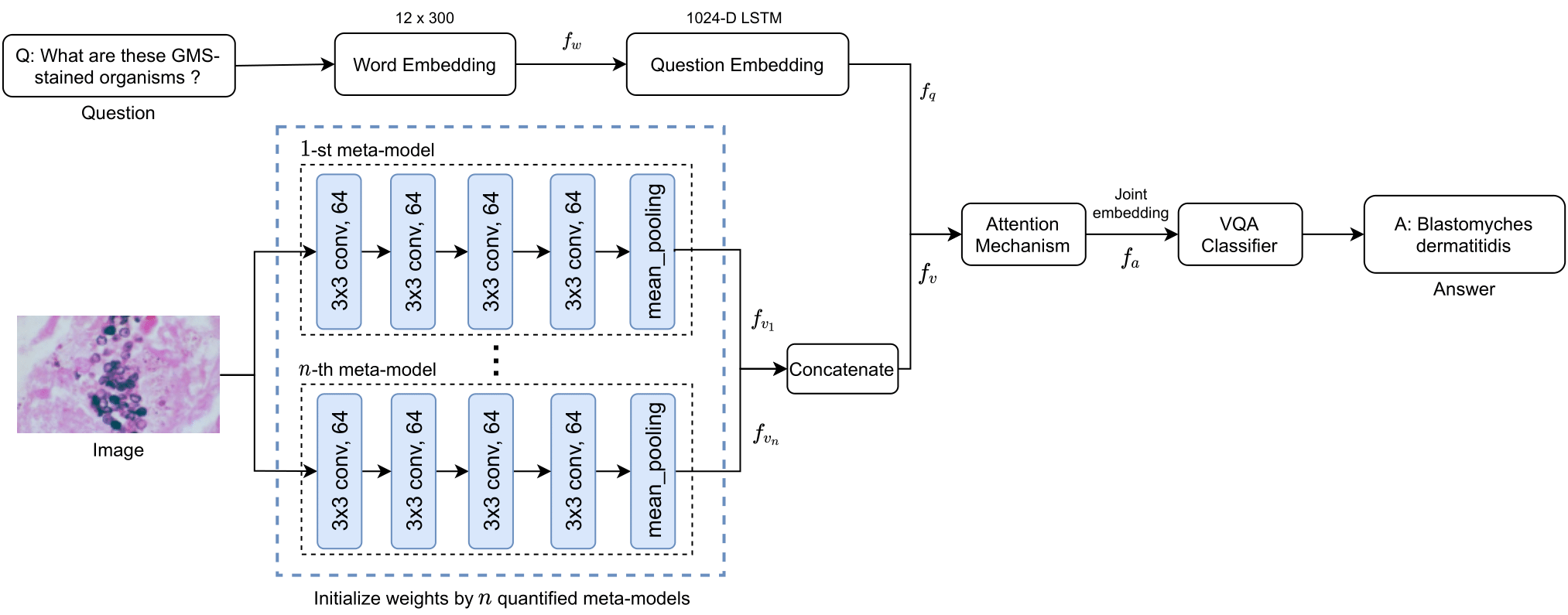
Important: For all VQA experiments, you should be in the 'root' folder.
Preprocessing
PathVQA dataset for VQA task
All data should be downloaded via link. The downloaded file should be extracted to data_PathVQA/ directory.
VQA-RAD dataset for VQA task
All data should be downloaded via link. The downloaded file should be extracted to data_RAD/ directory.
Experimental results
MMQ results on PathVQA test set.
| m | n | Free-form | Yes/No | Overall | |
|---|---|---|---|---|---|
| MAML | - | - | 5.8 | 79.5 | 42.9 |
| MEVF | - | - | 8.1 | 81.4 | 47.1 |
| MMQ | 5 | 3 | 13.4 | 84.0 | 48.8 |
| MMQ + MEVF | 5 | 2 | 13.9 | 83.8 | 49.0 |
MMQ results on VQA-RAD test set.
| m | n | Open-ended | Close-ended | Overall | |
|---|---|---|---|---|---|
| MAML | - | - | 40.1 | 72.4 | 59.6 |
| MEVF | - | - | 43.9 | 75.1 | 62.7 |
| MMQ | 5 | 3 | 53.7 | 75.8 | 67 |
| MMQ + MEVF | 5 | 2 | 56.9 | 75.7 | 68.2 |
We have considered the recommendation of our reviewers about integrating MMQ into the MEVF. The setup further improves the overall performance in both PathVQA and VQA-RAD datasets. The number of parameters is only a 3% increase in comparison with our original MMQ. We please to provide the pre-trained weights of our state-of-the-art (SOTA) models in here .
Training
Train MMQ + MEVF model with Bilinear Attention Network on PathVQA dataset.
$ sh run_vqa_PathVQA.sh
Train MMQ + MEVF model with Bilinear Attention Network on VQA-RAD dataset.
$ sh run_vqa_VQA_RAD.sh
Pretrained models and Testing
For our SOTA model on PathVQA dataset MMQ_BAN_MEVF_pathVQA. Please download the link and move to saved_models/MMQ_BAN_MEVF_pathVQA/. The trained MMQ_BAN_MEVF_pathVQA model can be tested in PathVQA test set via:
$ sh run_test_PathVQA.sh
For our SOTA model on VQA-RAD dataset MMQ_BAN_MEVF_vqaRAD. Please download the link and move to saved_models/MMQ_BAN_MEVF_vqaRAD/. The trained MMQ_BAN_MEVF_vqaRAD model can be tested in VQA-RAD test set via:
$ sh run_test_VQA_RAD.sh
The result json file can be found in the directory results/.
We also provides the pretrained meta-models and CDAE models for further investigation as belows:
- VQA-RAD:
- The MAML models
data_RAD/maml/*.pthis trained by using our MMQ source code. - The CDAE model
data_RAD/pretrained_ae.pth.
- The MAML models
- PathVQA:
- The MAML models
data_PathVQA/maml/*.pthis trained by using our MMQ source code. - The CDAE model
data_PathVQA/pretrained_ae.pth.
- The MAML models
Citation
If you use this code as part of any published research, we'd really appreciate it if you could cite the following paper:
@inproceedings{aioz_mmq_miccai21,
  author={Tuong Do and Binh X. Nguyen and Erman Tjiputra and Minh Tran and Quang D. Tran and Anh Nguyen},
  title={Multiple Meta-model Quantifying for Medical Visual Question Answering},
  booktitle = {MICCAI},
  year={2021}
}
If you find that the Mixture of Enhanced Visual Features (MEVF) model for MedVQA is useful, you could cite the following paper:
@inproceedings{aioz_mevf_miccai19,
  author={Binh D. Nguyen, Thanh-Toan Do, Binh X. Nguyen, Tuong Do, Erman Tjiputra, Quang D. Tran},
  title={Overcoming Data Limitation in Medical Visual Question Answering},
  booktitle = {MICCAI},
  year={2019}
}
License
MIT License
Similar repos


Languages
Python
98.3%
Shell
1.7%
Multiple Meta-model Quantifying for Medical Visual Question Answering (MICCAI 2021)
See the codeREADME
Multiple Meta-model Quantifying for Medical Visual Question Answering (MMQ-VQA)
This repository is the implementation of MMQ for the visual question answering task in medical domain. Our proposal achieves superior accuracy in comparison with other state-of-the-art (sota) methods on two public medical VQA datasets: PathVQA dataset and VQA-RAD dataset.
- On PathVQA dataset, our model achieved 13.9% for free-form and 63.8% for yes/no quetions.
- On VQA-RAD dataset, our model achieved 56.9% for open-ended and 75.7% for close-ended questions.
For the detail, please refer to link.
This repository is based on and inspired by @Binh D. Nguyen's work. We sincerely thank for their sharing of the codes.
Prerequisites
PYTHON 3.6
CUDA 9.2
Please install dependence package by run following command:
pip install -r requirements.txt
MMQ Progress
Preprocessing
Important: Before running any command lines, please run following command to access 'mmq_maml' folder:
$ cd mmq_maml
And now, you are in 'mmq_maml' folder.
- PathVQA dataset for MMQ task should be downloaded via link. The downloaded file should be extracted to
data/pathvqa_maml/directory. - VQA-RAD dataset for MMQ task should be downloaded via link. The downloaded file should be extracted to
data/vqarad_maml/directory.
Traing MAML models with MMQ
Train MAML models with MMQ on PathVQA dataset:
$ sh run_pathVQA.sh
Train MAML models with MMQ on VQA-RAD dataset:
$ sh run_VQA_RAD.sh
VQA Progress
Important: For all VQA experiments, you should be in the 'root' folder.
Preprocessing
PathVQA dataset for VQA task
All data should be downloaded via link. The downloaded file should be extracted to data_PathVQA/ directory.
VQA-RAD dataset for VQA task
All data should be downloaded via link. The downloaded file should be extracted to data_RAD/ directory.
Experimental results
MMQ results on PathVQA test set.
| m | n | Free-form | Yes/No | Overall | |
|---|---|---|---|---|---|
| MAML | - | - | 5.8 | 79.5 | 42.9 |
| MEVF | - | - | 8.1 | 81.4 | 47.1 |
| MMQ | 5 | 3 | 13.4 | 84.0 | 48.8 |
| MMQ + MEVF | 5 | 2 | 13.9 | 83.8 | 49.0 |
MMQ results on VQA-RAD test set.
| m | n | Open-ended | Close-ended | Overall | |
|---|---|---|---|---|---|
| MAML | - | - | 40.1 | 72.4 | 59.6 |
| MEVF | - | - | 43.9 | 75.1 | 62.7 |
| MMQ | 5 | 3 | 53.7 | 75.8 | 67 |
| MMQ + MEVF | 5 | 2 | 56.9 | 75.7 | 68.2 |
We have considered the recommendation of our reviewers about integrating MMQ into the MEVF. The setup further improves the overall performance in both PathVQA and VQA-RAD datasets. The number of parameters is only a 3% increase in comparison with our original MMQ. We please to provide the pre-trained weights of our state-of-the-art (SOTA) models in here .
Training
Train MMQ + MEVF model with Bilinear Attention Network on PathVQA dataset.
$ sh run_vqa_PathVQA.sh
Train MMQ + MEVF model with Bilinear Attention Network on VQA-RAD dataset.
$ sh run_vqa_VQA_RAD.sh
Pretrained models and Testing
For our SOTA model on PathVQA dataset MMQ_BAN_MEVF_pathVQA. Please download the link and move to saved_models/MMQ_BAN_MEVF_pathVQA/. The trained MMQ_BAN_MEVF_pathVQA model can be tested in PathVQA test set via:
$ sh run_test_PathVQA.sh
For our SOTA model on VQA-RAD dataset MMQ_BAN_MEVF_vqaRAD. Please download the link and move to saved_models/MMQ_BAN_MEVF_vqaRAD/. The trained MMQ_BAN_MEVF_vqaRAD model can be tested in VQA-RAD test set via:
$ sh run_test_VQA_RAD.sh
The result json file can be found in the directory results/.
We also provides the pretrained meta-models and CDAE models for further investigation as belows:
- VQA-RAD:
- The MAML models
data_RAD/maml/*.pthis trained by using our MMQ source code. - The CDAE model
data_RAD/pretrained_ae.pth.
- The MAML models
- PathVQA:
- The MAML models
data_PathVQA/maml/*.pthis trained by using our MMQ source code. - The CDAE model
data_PathVQA/pretrained_ae.pth.
- The MAML models
Citation
If you use this code as part of any published research, we'd really appreciate it if you could cite the following paper:
@inproceedings{aioz_mmq_miccai21,
  author={Tuong Do and Binh X. Nguyen and Erman Tjiputra and Minh Tran and Quang D. Tran and Anh Nguyen},
  title={Multiple Meta-model Quantifying for Medical Visual Question Answering},
  booktitle = {MICCAI},
  year={2021}
}
If you find that the Mixture of Enhanced Visual Features (MEVF) model for MedVQA is useful, you could cite the following paper:
@inproceedings{aioz_mevf_miccai19,
  author={Binh D. Nguyen, Thanh-Toan Do, Binh X. Nguyen, Tuong Do, Erman Tjiputra, Quang D. Tran},
  title={Overcoming Data Limitation in Medical Visual Question Answering},
  booktitle = {MICCAI},
  year={2019}
}
License
MIT License
Similar repos
Languages
Python
98.3%
Shell
1.7%