
Frontiers in Intelligent Colonoscopy [ColonSurvey | ColonINST | ColonGPT]
See the codeREADME

🔬 Paper (🔗 arXiv, 🔗 Springer, 🤗 Huggingface, 🤖 AIModels.fyi |
📖 ColonSurvey (🔗 Online Sheet) |
🏥 ColonINST (🔗 Google Drive, 🤗 Huggingface,  wisemodel) |
🤖 ColonGPT (🔗 Google Drive, 🤗 Huggingface, wisemodel) |
🏇 Multimodal benchmark (🔗 Google Drive, 🔗 PaperWithCode)
wisemodel) |
🤖 ColonGPT (🔗 Google Drive, 🤗 Huggingface, wisemodel) |
🏇 Multimodal benchmark (🔗 Google Drive, 🔗 PaperWithCode)
Keyworks: Intelligent Colonoscopy, Multimodal Colonoscopy Dataset, Multimodal Language Model, Vision-language Understanding, Endoscopic Image Analysis, Healthcare AI, Abdomen.

Colonoscopy is currently one of the most sensitive screening methods for colorectal cancer (🔗 Wikipedia). Have you ever wondered how to make colonoscopy smarter? Well, buckle up, let's enter the exciting world of intelligent colonoscopy!
- Our vision. To explore the frontiers of intelligent colonoscopy techniques and their potential impact on multimodal medical applications.
- Why use IntelliScope? It combines "Intelligent" and "colonoScope", where "Intelli" reflects the intelligent processing and decision-making capabilities of the system, and "Scope" refers to the colonoscope device used in medical endoscopy. Together, they imply a cutting-edge multimodal system designed to improve colonoscopy with advanced AI technologies.
- Project members. Ge-Peng Ji (🇦🇺 ANU), Jingyi Liu (🇯🇵 Keio), Peng Xu (🇨🇳 THU), Nick Barnes (🇦🇺 ANU), Fahad Shahbaz Khan (🇦🇪 MBZUAI), Salman Khan (🇦🇪 MBZUAI), Deng-Ping Fan (🇨🇳 NKU)
- Let's join our IntelliScope community. We are building a discussion forum for the convenience of researchers to 💬 ask any questions, 💬 showcase/promote your work, 💬 access data resources, and 💬 share research ideas.
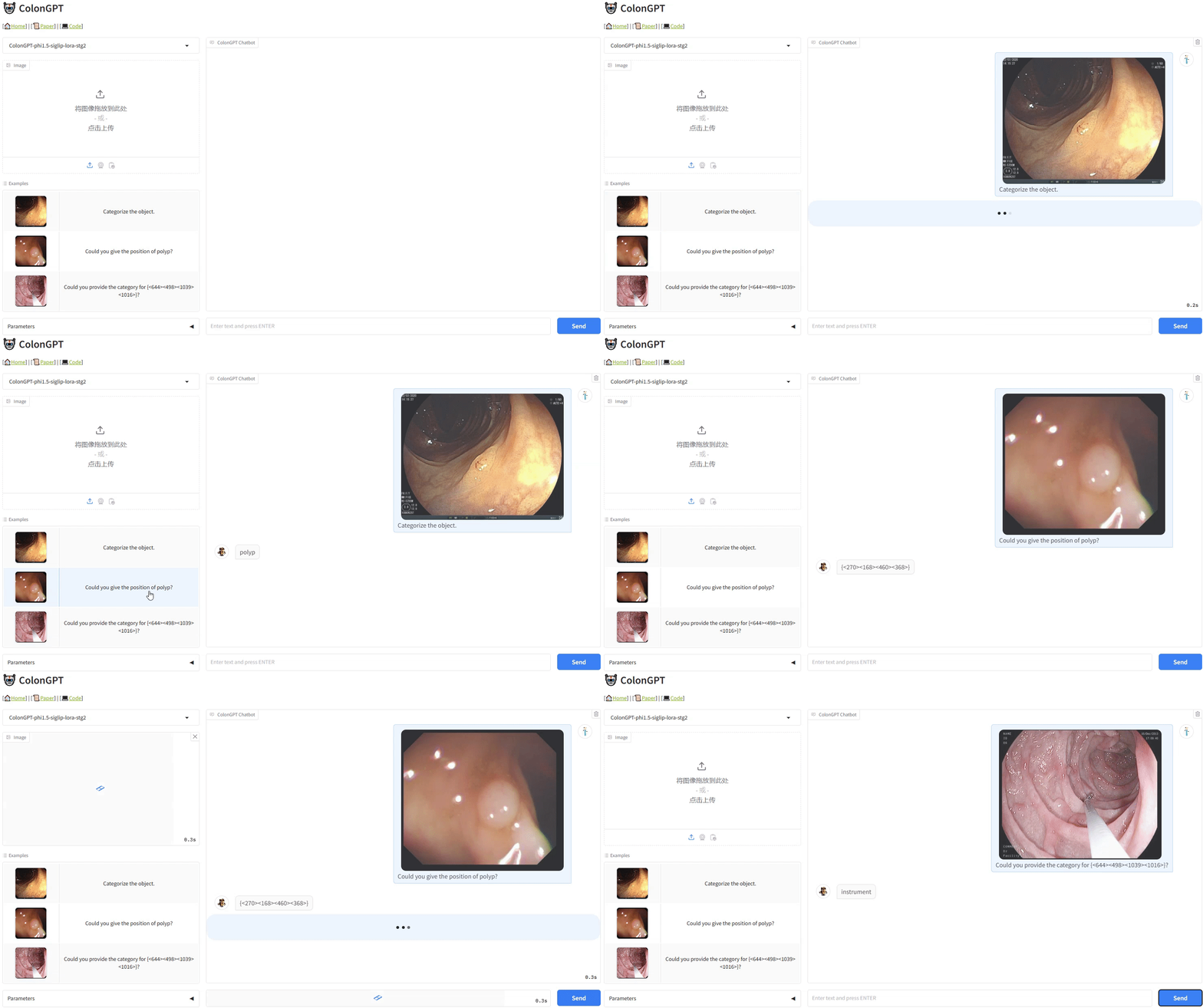
- Quick view. Next, we present some features of our colonoscopy-specific AI chatbot, ColonGPT. This is a domain-pioneering multimodal language model that can help endoscopists perform various user-driven tasks through interactive dialogues.
Updates
- [Mar/09/2026] We provide the translated version (CN) of the paper for the convenience of Chinese readers, enabling a broader audience to better understand the methodology, experimental results, and key contributions presented in this work.
- [Jan/07/2026] Our paper has officially available at Springer Nature, please read our paper with this link, and cite our paper using this bibtex.
- [Dec/09/2025] 🔥🔥🔥 Thrilled to announce the largest multimodal colonoscopy dataset, ColonVQA, with 1.1M+ VQA entries. We also propose the first reasoning-centric solutions: ColonReason dataset and the first reasoning-based model, ColonR1. Project is here: https://github.com/ai4colonoscopy/Colon-X. Your 🌟star is our biggest motivation to move forward.
- [April/05/2025] Our project now supports the Chinese AI platform wisemodel.
- [Feb/07/2025] We announce a new two-stage training strategy for enhancing ColonGPT's performance, achieving SOTA results on all downstream tasks. Further details are available in our technical report (arXiv-v2).
- [Oct/30/2024] We've set up an online benchmark on the paper-with-code website.
- [Oct/16/2024] Open-source the whole codebase of project.
🔥 Research Highlights
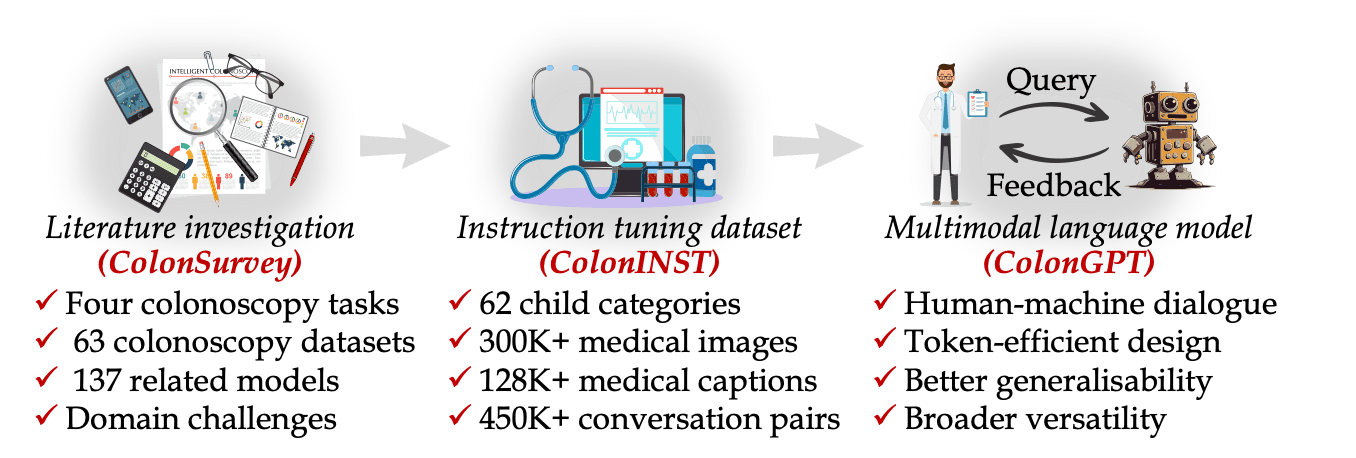
Figure 1: Introductary diagram.
- Survey on colonoscopic scene perception (CSP) ➡️ "We assess the current landscape to sort out domain challenges and under-researched areas in the AI era."
- 📖 ColonSurvey. We investigate the latest research progress in four colonoscopic scene perception tasks from both data-centric and model-centric perspectives. Our investigation summarises key features of 63 datasets and 137 representative deep techniques published since 2015. In addition, we highlight emerging trends and opportunities for future study. (🔗 Hyperlink)
- 💥 Multimodal AI Initiatives ➡️ "We advocate three initiatives to embrace the coming multimodal era in colonoscopy."
- 🏥 ColonINST. We introduce a pioneering instruction tuning dataset for multimodal colonoscopy research, aimed at instructing models to execute user-driven tasks interactively. This dataset comprises of 62 categories, 300K+ colonoscopic images, 128K+ medical captions (GPT-4V) generated), and 450K+ human-machine dialogues. (🔗 Hyperlink)
- 🤖 ColonGPT. We develop a domain-specific multimodal language model to assist endoscopists through interactive dialogues. To ensure reproducibility for average community users, we implement ColonGPT in a resource-friendly way, including three core designs: a 0.4B-parameter visual encoder 🤗 SigLIP-SO from Google, a 1.3B-parameter lightweight language model 🤗 Phi1.5 from Microsoft, and a multigranularity adapter for token reducing from 100% to only 33.74% but not compromise to performance. (🔗 Hyperlink)
- 💯 Multimodal Benchmark. We contribute a multimodal benchmark, including six general-purpose models and two designed for medical purposes, across three colonoscopy tasks to enable fair and rapid comparisons going forward. (🔗 Hyperlink)
📖 ColonSurvey
Our "ColonSurvey" project contributes various useful resources for the community. We investigate 63 colonoscopy datasets and 137 deep learning models focused on colonoscopic scene perception, all sourced from leading conferences or journals since 2015. This is a quick overview of our investigation; for a more detailed discussion, please refer to our paper in PDF format.
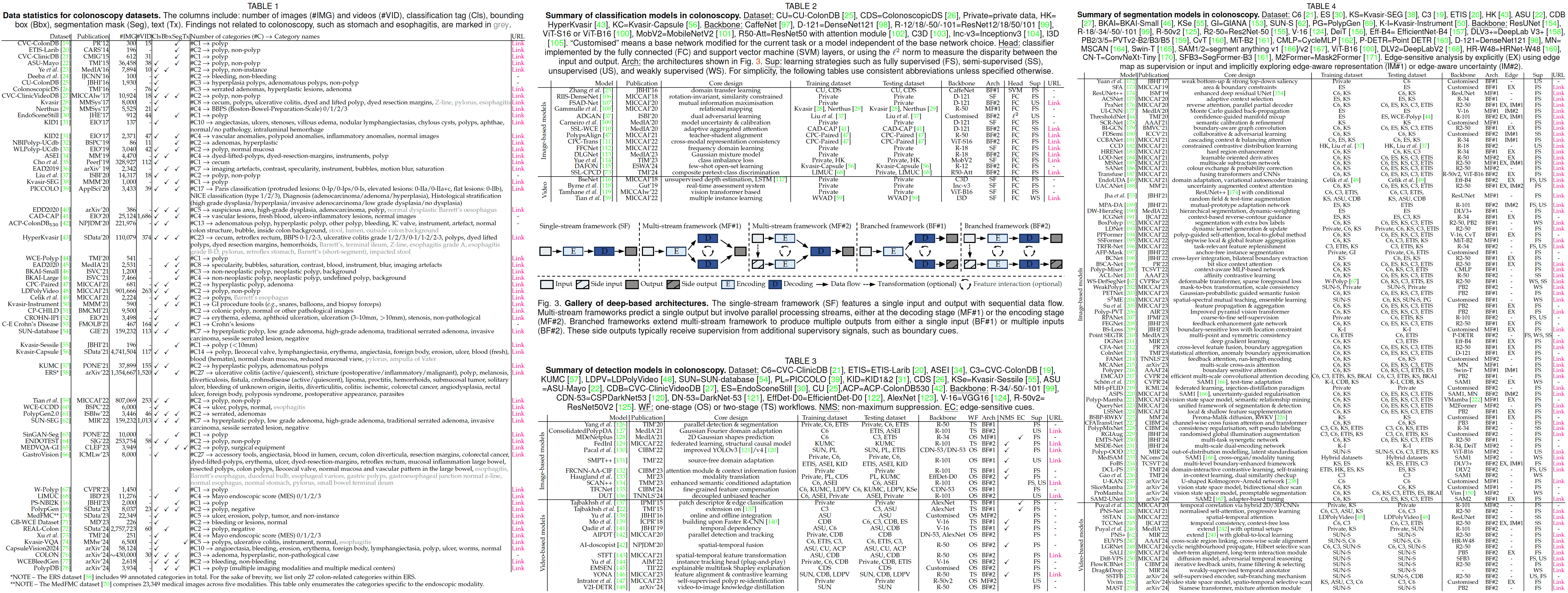
Figure 2: The investigation of colonoscopy datasets and models.
To better understand developments in this rapidly changing field and accelerate researchers’ progress, we are building a 📖 paper reading list, which includes a number of AI-based scientific studies on colonoscopy imaging from the past 12 years. [UPDATE ON OCT-14-2024] In detail, our online list contains:
- Colonoscopy datasets 🔗 Google sheet
- Colonoscopy models
- Classification tasks 🔗 Google sheet
- Detection tasks 🔗 Google sheet
- Segmentation tasks 🔗 Google sheet
- Vision language tasks 🔗 Google sheet
- 3D analysis tasks (*supplementary content) 🔗 Google sheet
Make our community great again. If we miss your valuable work in google sheet, please add it and this project would be a nice platform to promote your work. Or anyone can inform us via email (📮 gepengai.ji@gmail.com) or push a PR in github. We will work on your request as soon as possible. Thank you for your active feedback.
🏥 ColonINST (A multimodal instruction tuning dataset)
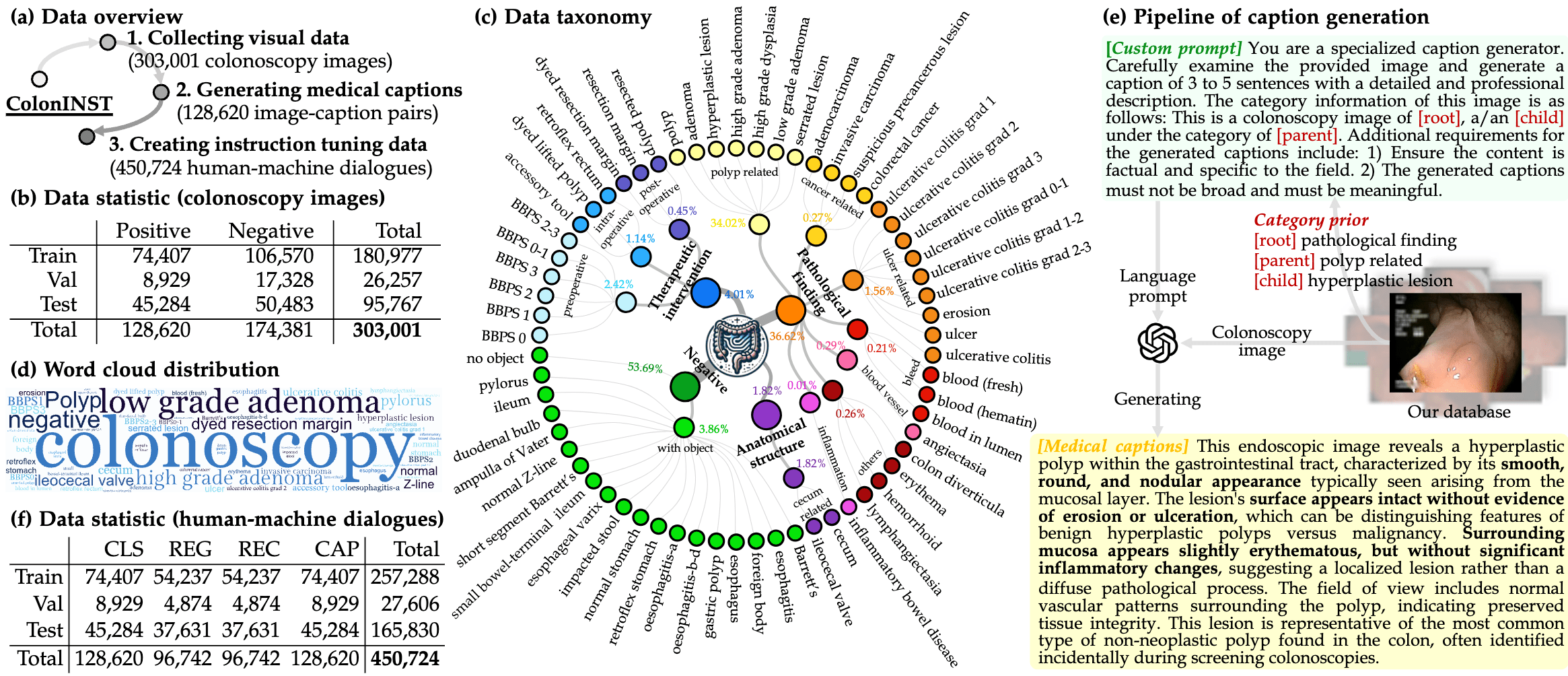
Figure 3: Details of our multimodal instruction tuning dataset, ColonINST. (a) Three sequential steps to create the instruction tuning dataset for multimodal research. (b) Numbers of colonoscopy images designated for training, validation, and testing purposes. (c) Data taxonomy of three-level categories. (d) A word cloud of the category distribution by name size. (e) Caption generation pipeline using the VL prompting mode of GPT-4V. (f) Numbers of human-machine dialogues created for four downstream tasks.
Our data contains two parts: colonoscopy images and human-machine dialogues (available at 🤗 huggingface and 🔗 google drive). However, due to privacy-preserving concerns, we can not directly share the origin medical images without its authorization. DO NOT WORRY! We prepare a data download list and an easy-to-use script to organise our ColonINST. The operation instructions are detailed in our document (🔗 ./docs/guideline-for-ColonINST.md)
Apply full data of the proposed ColonINST via google form: 🈸 https://forms.gle/C3FqtnCZmo5aZLR26
🤖 ColonGPT (A colonoscopy-specific multimodal Language Model)

Figure 4: Details of our multimodal language model, ColonGPT.
Our ColonGPT is a standard multimodal language model, which has been released at 🔗 google drive platform. It contains four basic components: a language tokenizer, an visual encoder (🤗 SigLIP-SO or 🔗 google drive), a multimodal connector, and a language model (🤗 Phi1.5 or 🔗 google drive).
✅ Quick start
We show a code snippet to show you how to quickly try-on our ColonGPT model with HuggingFace transformers quickly. For convenience, we manually combined some configuration and code files and merged the weights. Please note that this is a quick code, we recommend you installing ColonGPT's source code to explore more.
-
Before running the snippet, you only need to install the following minimum dependencies.
conda create -n quickstart python=3.10 conda activate quickstart pip install torch transformers accelerate pillow -
Then you can use
python script/quick_start/quickstart.pyto start.import torch import transformers from transformers import AutoModelForCausalLM, AutoTokenizer, StoppingCriteria from PIL import Image import warnings transformers.logging.set_verbosity_error() transformers.logging.disable_progress_bar() warnings.filterwarnings('ignore') device = 'cuda' # or cpu torch.set_default_device(device) model_name = "ai4colonoscopy/ColonGPT" model = AutoModelForCausalLM.from_pretrained( model_name, torch_dtype=torch.float16, # or float32 for cpu device_map='auto', trust_remote_code=True ) tokenizer = AutoTokenizer.from_pretrained( model_name, trust_remote_code=True ) class KeywordsStoppingCriteria(StoppingCriteria): def __init__(self, keyword, tokenizer, input_ids): self.keyword_id = tokenizer(keyword).input_ids self.tokenizer = tokenizer self.start_len = input_ids.shape[1] def __call__(self, input_ids: torch.LongTensor, scores: torch.FloatTensor, **kwargs) -> bool: for keyword_id in self.keyword_id: if keyword_id in input_ids[0, -len(self.keyword_id):]: return True return False prompt = "Categorize the object." text = f"USER: <image>\n{prompt} ASSISTANT:" text_chunks = [tokenizer(chunk).input_ids for chunk in text.split('<image>')] input_ids = torch.tensor(text_chunks[0] + [-200] + text_chunks[1], dtype=torch.long).unsqueeze(0).to(device) image = Image.open('cache/examples/example2.png') image_tensor = model.process_images([image], model.config).to(dtype=model.dtype, device=device) stop_str = "<|endoftext|>" stopping_criteria = KeywordsStoppingCriteria(stop_str, tokenizer, input_ids) output_ids = model.generate( input_ids, images=image_tensor, do_sample=False, temperature=0, max_new_tokens=512, use_cache=True, stopping_criteria=[stopping_criteria] ) outputs = tokenizer.decode(output_ids[0, input_ids.shape[1]:]).replace("<|endoftext|>", "").strip() print(outputs)
✅ Try full-version ColonGPT
The complete workflow scheme has been officially released, providing a streamlined and user-friendly process. This allows even average community users to easily develop, customize, and enhance their own models. To ensure a smooth experience, we have included comprehensive step-by-step instructions (🔗 ./docs/guideline-for-ColonGPT.md), which can be found in our detailed documentation. These resources are designed to guide users through every stage of the development process, making it accessible and efficient for both beginners and advanced practitioners.
- 🤖 How to train? Our model is a resource-friendly multimodal language model that can be trained in under seven hours using just two NVIDIA H200 GPUs. This efficient model is also compatible with other Amperer GPUs, such as NVIDIA 4090 card, making it accessible to a wider range of hardware setups.
- 👨🔬 How to infer? We support three inference modes, including batch inference, CLI inference, and Gradio WebUI inference.
💯 Multimodal benchmark
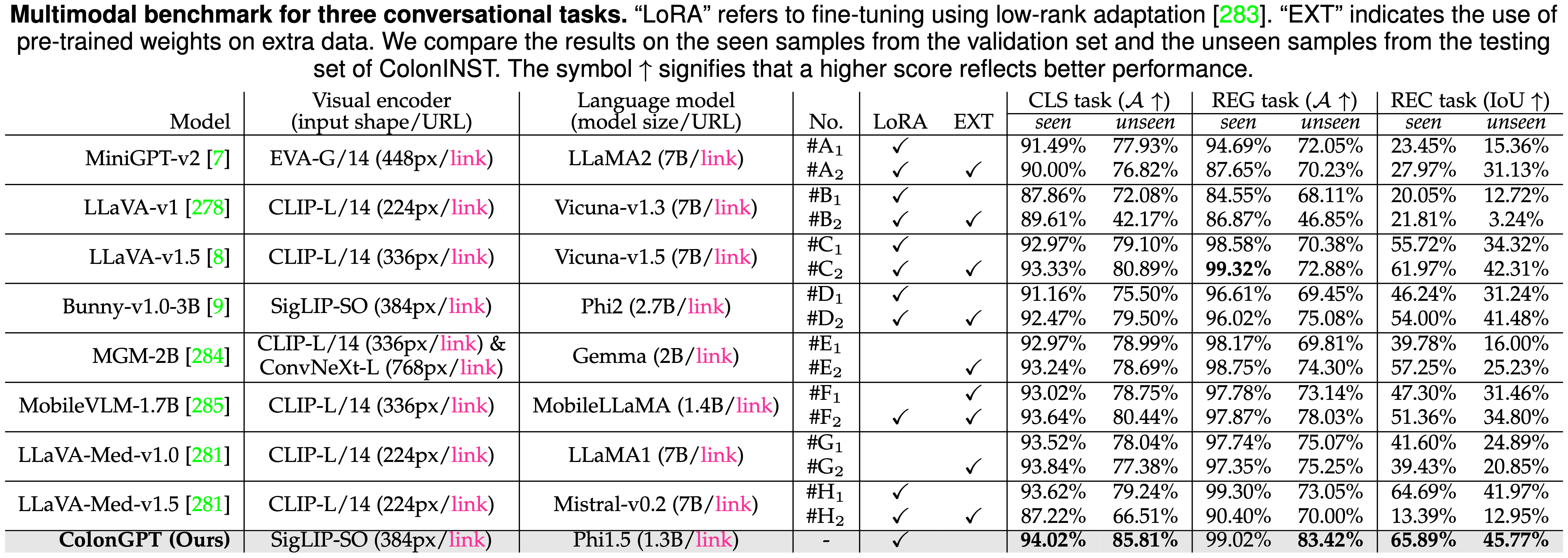
Figure 4: Multimodal benchmark.
We provide a comprehensive benchmark of eight latest multimodal competitors across three multimodal colonoscopy tasks, including MiniGPT-V2, LLaVA-v1, LLaVA-v1.5, Bunny-v1.0-3B, Mini-Gemini-2B, MobileVLM-1.7B, and LLaVA-Med-v1.0, and LLaVA-Med-v1.5. We provide 🔗 the meta prediction files, 🔗 the evaluation instructions. We believe these resources facilitate everyone to conveniently access their newly developed model, or rapidly conduct proof-of-concept development for follow-up research.
🙏 Acknowledgement
We gratefully acknowledge the contributions of the following projects, which served as the foundation and inspiration for our work:
- Bunny: A family of lightweight multimodal models
- LAVIS: A Library for Language-Vision Intelligence
- LLaVA: Large Language and Vision Assistant
👍 Citation
Please use the following reference if you find this project useful for your research or applications:
 @article{ji2026frontiers,
     title={Frontiers in intelligent colonoscopy},
     author={Ji, Ge-Peng and Liu, Jingyi and Xu, Peng and Barnes, Nick and Khan, Fahad Shahbaz and Khan, Salman and Fan, Deng-Ping},
     journal={Machine Intelligence Research},
     volume={23},
     number={1},
     pages={70--114},
     year={2026},
     publisher={Springer}
 }
🚨 Ethical and Responsible Use
ColonGPT is designed to assist in medical colonoscopy by leveraging multimodal capabilities, but it comes with no guarantees regarding its predictive accuracy or reliability in clinical practice. Users should be aware that the datasets and pre-trained models used in ColonGPT may contain inherent biases, including socioeconomic factors, which can lead to misclassification or other undesirable behaviors, such as the generation of offensive or inappropriate content.
We urge users and developers to carefully review and validate the performance of pre-trained models, particularly those integrated through the ColonGPT framework, before considering practical applications in a clinical setting. It is crucial that any AI-driven tool used in healthcare undergoes rigorous testing to ensure patient safety and avoid unintended consequences. Our commitment to ethical AI use extends to ongoing efforts to investigate, address, and mitigate the risks of bias and inappropriate behavior in ColonGPT. Continuous improvement of this codebase is a priority to ensure that the system aligns with responsible and equitable healthcare standards.
Contributors




Similar repos


Languages
Python
98.4%
Shell
1.6%
Frontiers in Intelligent Colonoscopy [ColonSurvey | ColonINST | ColonGPT]
See the codeREADME
🔬 Paper (🔗 arXiv, 🔗 Springer, 🤗 Huggingface, 🤖 AIModels.fyi |
📖 ColonSurvey (🔗 Online Sheet) |
🏥 ColonINST (🔗 Google Drive, 🤗 Huggingface, wisemodel) |
🤖 ColonGPT (🔗 Google Drive, 🤗 Huggingface, wisemodel) |
🏇 Multimodal benchmark (🔗 Google Drive, 🔗 PaperWithCode)
Keyworks: Intelligent Colonoscopy, Multimodal Colonoscopy Dataset, Multimodal Language Model, Vision-language Understanding, Endoscopic Image Analysis, Healthcare AI, Abdomen.
Colonoscopy is currently one of the most sensitive screening methods for colorectal cancer (🔗 Wikipedia). Have you ever wondered how to make colonoscopy smarter? Well, buckle up, let's enter the exciting world of intelligent colonoscopy!
- Our vision. To explore the frontiers of intelligent colonoscopy techniques and their potential impact on multimodal medical applications.
- Why use IntelliScope? It combines "Intelligent" and "colonoScope", where "Intelli" reflects the intelligent processing and decision-making capabilities of the system, and "Scope" refers to the colonoscope device used in medical endoscopy. Together, they imply a cutting-edge multimodal system designed to improve colonoscopy with advanced AI technologies.
- Project members. Ge-Peng Ji (🇦🇺 ANU), Jingyi Liu (🇯🇵 Keio), Peng Xu (🇨🇳 THU), Nick Barnes (🇦🇺 ANU), Fahad Shahbaz Khan (🇦🇪 MBZUAI), Salman Khan (🇦🇪 MBZUAI), Deng-Ping Fan (🇨🇳 NKU)
- Let's join our IntelliScope community. We are building a discussion forum for the convenience of researchers to 💬 ask any questions, 💬 showcase/promote your work, 💬 access data resources, and 💬 share research ideas.
- Quick view. Next, we present some features of our colonoscopy-specific AI chatbot, ColonGPT. This is a domain-pioneering multimodal language model that can help endoscopists perform various user-driven tasks through interactive dialogues.
Updates
- [Mar/09/2026] We provide the translated version (CN) of the paper for the convenience of Chinese readers, enabling a broader audience to better understand the methodology, experimental results, and key contributions presented in this work.
- [Jan/07/2026] Our paper has officially available at Springer Nature, please read our paper with this link, and cite our paper using this bibtex.
- [Dec/09/2025] 🔥🔥🔥 Thrilled to announce the largest multimodal colonoscopy dataset, ColonVQA, with 1.1M+ VQA entries. We also propose the first reasoning-centric solutions: ColonReason dataset and the first reasoning-based model, ColonR1. Project is here: https://github.com/ai4colonoscopy/Colon-X. Your 🌟star is our biggest motivation to move forward.
- [April/05/2025] Our project now supports the Chinese AI platform wisemodel.
- [Feb/07/2025] We announce a new two-stage training strategy for enhancing ColonGPT's performance, achieving SOTA results on all downstream tasks. Further details are available in our technical report (arXiv-v2).
- [Oct/30/2024] We've set up an online benchmark on the paper-with-code website.
- [Oct/16/2024] Open-source the whole codebase of project.
🔥 Research Highlights
Figure 1: Introductary diagram.
- Survey on colonoscopic scene perception (CSP) ➡️ "We assess the current landscape to sort out domain challenges and under-researched areas in the AI era."
- 📖 ColonSurvey. We investigate the latest research progress in four colonoscopic scene perception tasks from both data-centric and model-centric perspectives. Our investigation summarises key features of 63 datasets and 137 representative deep techniques published since 2015. In addition, we highlight emerging trends and opportunities for future study. (🔗 Hyperlink)
- 💥 Multimodal AI Initiatives ➡️ "We advocate three initiatives to embrace the coming multimodal era in colonoscopy."
- 🏥 ColonINST. We introduce a pioneering instruction tuning dataset for multimodal colonoscopy research, aimed at instructing models to execute user-driven tasks interactively. This dataset comprises of 62 categories, 300K+ colonoscopic images, 128K+ medical captions (GPT-4V) generated), and 450K+ human-machine dialogues. (🔗 Hyperlink)
- 🤖 ColonGPT. We develop a domain-specific multimodal language model to assist endoscopists through interactive dialogues. To ensure reproducibility for average community users, we implement ColonGPT in a resource-friendly way, including three core designs: a 0.4B-parameter visual encoder 🤗 SigLIP-SO from Google, a 1.3B-parameter lightweight language model 🤗 Phi1.5 from Microsoft, and a multigranularity adapter for token reducing from 100% to only 33.74% but not compromise to performance. (🔗 Hyperlink)
- 💯 Multimodal Benchmark. We contribute a multimodal benchmark, including six general-purpose models and two designed for medical purposes, across three colonoscopy tasks to enable fair and rapid comparisons going forward. (🔗 Hyperlink)
📖 ColonSurvey
Our "ColonSurvey" project contributes various useful resources for the community. We investigate 63 colonoscopy datasets and 137 deep learning models focused on colonoscopic scene perception, all sourced from leading conferences or journals since 2015. This is a quick overview of our investigation; for a more detailed discussion, please refer to our paper in PDF format.
Figure 2: The investigation of colonoscopy datasets and models.
To better understand developments in this rapidly changing field and accelerate researchers’ progress, we are building a 📖 paper reading list, which includes a number of AI-based scientific studies on colonoscopy imaging from the past 12 years. [UPDATE ON OCT-14-2024] In detail, our online list contains:
- Colonoscopy datasets 🔗 Google sheet
- Colonoscopy models
- Classification tasks 🔗 Google sheet
- Detection tasks 🔗 Google sheet
- Segmentation tasks 🔗 Google sheet
- Vision language tasks 🔗 Google sheet
- 3D analysis tasks (*supplementary content) 🔗 Google sheet
Make our community great again. If we miss your valuable work in google sheet, please add it and this project would be a nice platform to promote your work. Or anyone can inform us via email (📮 gepengai.ji@gmail.com) or push a PR in github. We will work on your request as soon as possible. Thank you for your active feedback.
🏥 ColonINST (A multimodal instruction tuning dataset)
Figure 3: Details of our multimodal instruction tuning dataset, ColonINST. (a) Three sequential steps to create the instruction tuning dataset for multimodal research. (b) Numbers of colonoscopy images designated for training, validation, and testing purposes. (c) Data taxonomy of three-level categories. (d) A word cloud of the category distribution by name size. (e) Caption generation pipeline using the VL prompting mode of GPT-4V. (f) Numbers of human-machine dialogues created for four downstream tasks.
Our data contains two parts: colonoscopy images and human-machine dialogues (available at 🤗 huggingface and 🔗 google drive). However, due to privacy-preserving concerns, we can not directly share the origin medical images without its authorization. DO NOT WORRY! We prepare a data download list and an easy-to-use script to organise our ColonINST. The operation instructions are detailed in our document (🔗 ./docs/guideline-for-ColonINST.md)
Apply full data of the proposed ColonINST via google form: 🈸 https://forms.gle/C3FqtnCZmo5aZLR26
🤖 ColonGPT (A colonoscopy-specific multimodal Language Model)
Figure 4: Details of our multimodal language model, ColonGPT.
Our ColonGPT is a standard multimodal language model, which has been released at 🔗 google drive platform. It contains four basic components: a language tokenizer, an visual encoder (🤗 SigLIP-SO or 🔗 google drive), a multimodal connector, and a language model (🤗 Phi1.5 or 🔗 google drive).
✅ Quick start
We show a code snippet to show you how to quickly try-on our ColonGPT model with HuggingFace transformers quickly. For convenience, we manually combined some configuration and code files and merged the weights. Please note that this is a quick code, we recommend you installing ColonGPT's source code to explore more.
-
Before running the snippet, you only need to install the following minimum dependencies.
conda create -n quickstart python=3.10 conda activate quickstart pip install torch transformers accelerate pillow -
Then you can use
python script/quick_start/quickstart.pyto start.import torch import transformers from transformers import AutoModelForCausalLM, AutoTokenizer, StoppingCriteria from PIL import Image import warnings transformers.logging.set_verbosity_error() transformers.logging.disable_progress_bar() warnings.filterwarnings('ignore') device = 'cuda' # or cpu torch.set_default_device(device) model_name = "ai4colonoscopy/ColonGPT" model = AutoModelForCausalLM.from_pretrained( model_name, torch_dtype=torch.float16, # or float32 for cpu device_map='auto', trust_remote_code=True ) tokenizer = AutoTokenizer.from_pretrained( model_name, trust_remote_code=True ) class KeywordsStoppingCriteria(StoppingCriteria): def __init__(self, keyword, tokenizer, input_ids): self.keyword_id = tokenizer(keyword).input_ids self.tokenizer = tokenizer self.start_len = input_ids.shape[1] def __call__(self, input_ids: torch.LongTensor, scores: torch.FloatTensor, **kwargs) -> bool: for keyword_id in self.keyword_id: if keyword_id in input_ids[0, -len(self.keyword_id):]: return True return False prompt = "Categorize the object." text = f"USER: <image>\n{prompt} ASSISTANT:" text_chunks = [tokenizer(chunk).input_ids for chunk in text.split('<image>')] input_ids = torch.tensor(text_chunks[0] + [-200] + text_chunks[1], dtype=torch.long).unsqueeze(0).to(device) image = Image.open('cache/examples/example2.png') image_tensor = model.process_images([image], model.config).to(dtype=model.dtype, device=device) stop_str = "<|endoftext|>" stopping_criteria = KeywordsStoppingCriteria(stop_str, tokenizer, input_ids) output_ids = model.generate( input_ids, images=image_tensor, do_sample=False, temperature=0, max_new_tokens=512, use_cache=True, stopping_criteria=[stopping_criteria] ) outputs = tokenizer.decode(output_ids[0, input_ids.shape[1]:]).replace("<|endoftext|>", "").strip() print(outputs)
✅ Try full-version ColonGPT
The complete workflow scheme has been officially released, providing a streamlined and user-friendly process. This allows even average community users to easily develop, customize, and enhance their own models. To ensure a smooth experience, we have included comprehensive step-by-step instructions (🔗 ./docs/guideline-for-ColonGPT.md), which can be found in our detailed documentation. These resources are designed to guide users through every stage of the development process, making it accessible and efficient for both beginners and advanced practitioners.
- 🤖 How to train? Our model is a resource-friendly multimodal language model that can be trained in under seven hours using just two NVIDIA H200 GPUs. This efficient model is also compatible with other Amperer GPUs, such as NVIDIA 4090 card, making it accessible to a wider range of hardware setups.
- 👨🔬 How to infer? We support three inference modes, including batch inference, CLI inference, and Gradio WebUI inference.
💯 Multimodal benchmark
Figure 4: Multimodal benchmark.
We provide a comprehensive benchmark of eight latest multimodal competitors across three multimodal colonoscopy tasks, including MiniGPT-V2, LLaVA-v1, LLaVA-v1.5, Bunny-v1.0-3B, Mini-Gemini-2B, MobileVLM-1.7B, and LLaVA-Med-v1.0, and LLaVA-Med-v1.5. We provide 🔗 the meta prediction files, 🔗 the evaluation instructions. We believe these resources facilitate everyone to conveniently access their newly developed model, or rapidly conduct proof-of-concept development for follow-up research.
🙏 Acknowledgement
We gratefully acknowledge the contributions of the following projects, which served as the foundation and inspiration for our work:
- Bunny: A family of lightweight multimodal models
- LAVIS: A Library for Language-Vision Intelligence
- LLaVA: Large Language and Vision Assistant
👍 Citation
Please use the following reference if you find this project useful for your research or applications:
 @article{ji2026frontiers,
     title={Frontiers in intelligent colonoscopy},
     author={Ji, Ge-Peng and Liu, Jingyi and Xu, Peng and Barnes, Nick and Khan, Fahad Shahbaz and Khan, Salman and Fan, Deng-Ping},
     journal={Machine Intelligence Research},
     volume={23},
     number={1},
     pages={70--114},
     year={2026},
     publisher={Springer}
 }
🚨 Ethical and Responsible Use
ColonGPT is designed to assist in medical colonoscopy by leveraging multimodal capabilities, but it comes with no guarantees regarding its predictive accuracy or reliability in clinical practice. Users should be aware that the datasets and pre-trained models used in ColonGPT may contain inherent biases, including socioeconomic factors, which can lead to misclassification or other undesirable behaviors, such as the generation of offensive or inappropriate content.
We urge users and developers to carefully review and validate the performance of pre-trained models, particularly those integrated through the ColonGPT framework, before considering practical applications in a clinical setting. It is crucial that any AI-driven tool used in healthcare undergoes rigorous testing to ensure patient safety and avoid unintended consequences. Our commitment to ethical AI use extends to ongoing efforts to investigate, address, and mitigate the risks of bias and inappropriate behavior in ColonGPT. Continuous improvement of this codebase is a priority to ensure that the system aligns with responsible and equitable healthcare standards.
Similar repos
Contributors
Languages
Python
98.4%
Shell
1.6%