A benchmarking repo with various solution methods to various machine scheduling problems
Jupyter Notebook
212
104 commits
updated Sep 24, 2026


This repository provides a comprehensive benchmarking environment for a variety of machine scheduling problems, including Job Shop Scheduling (JSP), Flow Shop Scheduling (FSP), Flexible Job Shop Scheduling (FJSP), FJSP with Assembly constraints (FAJSP), FJSP with Sequence-Dependent Setup Times (FJSP-SDST), and the online FJSP (with online job arrivals). It aims to be a centralized hub for researchers, practitioners, and enthusiasts interested in tackling machine scheduling challenges.
The repository includes exact, heuristic and learning based solution methods, each compatible with one or more machine scheduline problem variants:
| Solution methods | Type | JSP | FSP | FJSP | SDST | AJSP | Dynamic JSP |
|---|---|---|---|---|---|---|---|
| MILP | Exact | ✓ | ✓ | ✓ | ✓ | ✓ | ✗ |
| CP-SAT | Exact | ✓ | ✓ | ✓ | ✓ | ✓ | ✗ |
| Dispatching Rules | Heuristic | ✓ | ✓ | ✓ | ✓ | ✓ | ✓ |
| Genetic Algorithm | Heuristic | ✓ | ✓ | ✓ | ✓ | ✓ | ✗ |
| L2D | DRL | ✓ | ✓ | ✗ | ✗ | ✗ | |
| FJSP-DRL | DRL | ✓ | ✓ | ✓ | ✗ | ✗ | ✓ |
| DANIEL | DRL | ✓ | ✓ | ✓ | ✗ | ✗ |
Here we provide some short examples on how to use the solution methods in this repository. For more detailed information and more examples, please refer to the tutorials here and here.
from solution_methods.L2D import run_dispatching_rules
from solution_methods.helper_functions import load_job_shop_env, load_parameters

parameters = load_parameters("configs/dispatching_rules.toml")
jobShopEnv = load_job_shop_env(parameters['instance'].get('problem_instance'))

makespan, jobShopEnv = run_dispatching_rules(jobShopEnv, **parameters)
from solution_methods.helper_functions import load_job_shop_env, load_parameters
from solution_methods.GA.run_GA import run_GA
from solution_methods.GA.src.initialization import initialize_run

parameters = load_parameters("configs/genetic_algorithm.toml")
jobShopEnv = load_job_shop_env(parameters['instance'].get('problem_instance'))

population, toolbox, stats, hof = initialize_run(jobShopEnv, **parameters)
makespan, jobShopEnv = run_GA(jobShopEnv, population, toolbox, stats, hof, **parameters)
from solution_methods.L2D.src.run_L2D import run_L2D
from solution_methods.helper_functions import load_job_shop_env, load_parameters

parameters = load_parameters("configs/L2D.toml")
jobShopEnv = load_job_shop_env(parameters['instance'].get('problem_instance'))
makespan, jobShopEnv = run_L2D(jobShopEnv, **parameters)
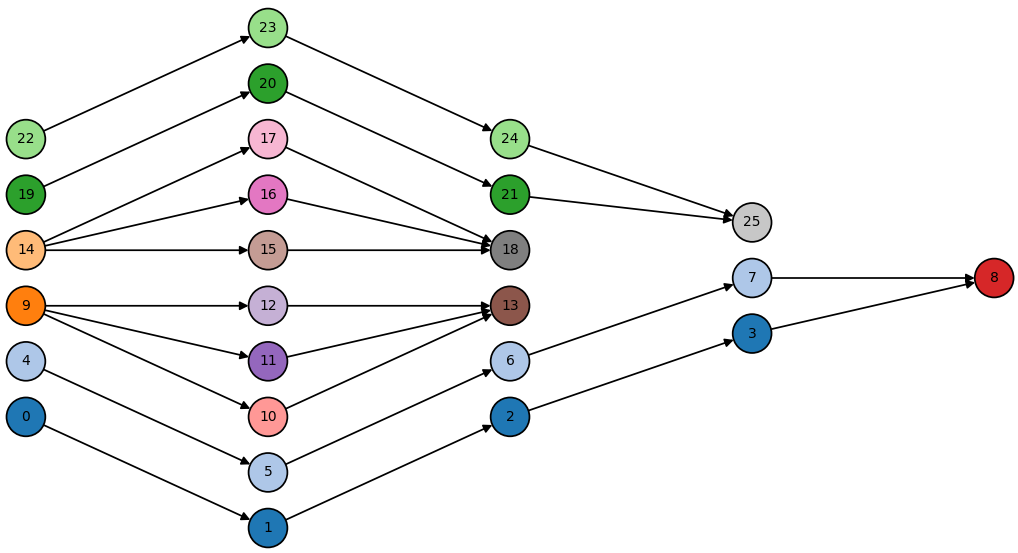
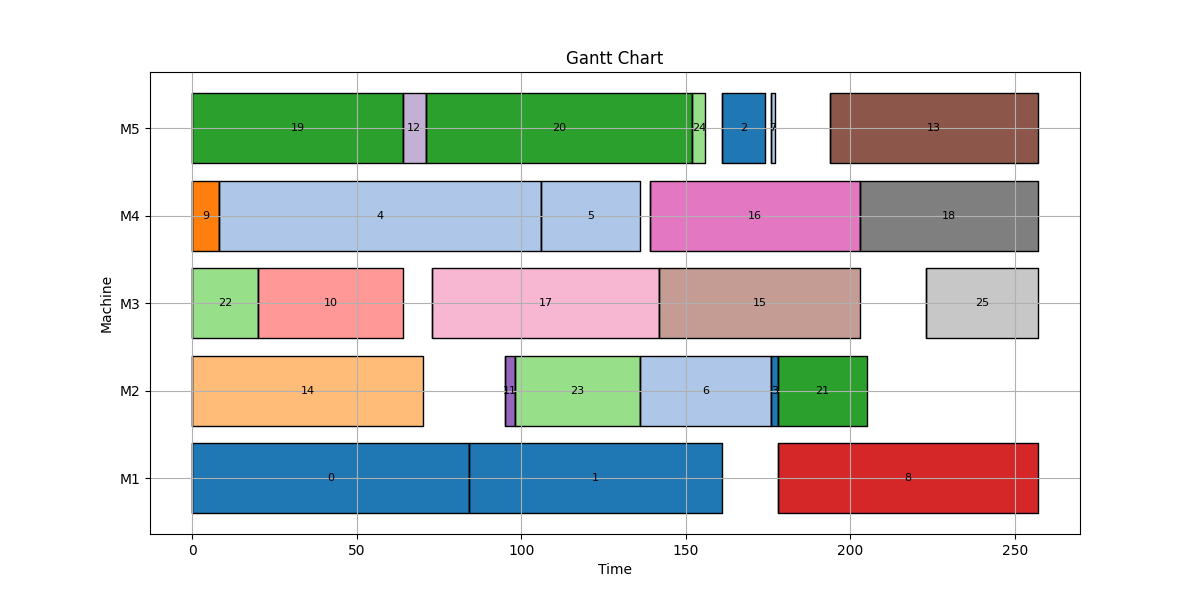
We provide plotting functions to draw both the precedence relations between operationsand the Gantt chart for the job shop scheduling problems:
 |  |
|---|
The repository is structured to provide ease of use and flexibility:
job, operation, machine, and jobShop). Also contains the simulationEnv for dynamic scheduling problems with online job arrivals.For more detailed information, please refer to our paper. If you use this repository in your research, please consider citing the following paper:
Reijnen, R., Smit, I. G., Zhang, H., Wu, Y., Bukhsh, Z., & Zhang, Y. (2026). Job shop scheduling benchmark: Environments and instances for learning and non-learning methods. Annals of Mathematics and Artificial Intelligence, 1-31. https://doi.org/10.1007/s10472-026-10007-3
Or, using the following BibTeX entry:
@article{reijnen2026job,
  title={Job shop scheduling benchmark: Environments and instances for learning and non-learning methods},
  author={Reijnen, Robbert and Smit, Igor G and Zhang, Hongxiang and Wu, Yaoxin and Bukhsh, Zaharah and Zhang, Yingqian},
  journal={Annals of Mathematics and Artificial Intelligence},
  pages={1--31},
  year={2026},
  publisher={Springer}
}
A preprint of this paper is available or arXiv.
A benchmarking repo with various solution methods to various machine scheduling problems
Jupyter Notebook
212
104 commits
updated Sep 24, 2026
This repository provides a comprehensive benchmarking environment for a variety of machine scheduling problems, including Job Shop Scheduling (JSP), Flow Shop Scheduling (FSP), Flexible Job Shop Scheduling (FJSP), FJSP with Assembly constraints (FAJSP), FJSP with Sequence-Dependent Setup Times (FJSP-SDST), and the online FJSP (with online job arrivals). It aims to be a centralized hub for researchers, practitioners, and enthusiasts interested in tackling machine scheduling challenges.
The repository includes exact, heuristic and learning based solution methods, each compatible with one or more machine scheduline problem variants:
| Solution methods | Type | JSP | FSP | FJSP | SDST | AJSP | Dynamic JSP |
|---|---|---|---|---|---|---|---|
| MILP | Exact | ✓ | ✓ | ✓ | ✓ | ✓ | ✗ |
| CP-SAT | Exact | ✓ | ✓ | ✓ | ✓ | ✓ | ✗ |
| Dispatching Rules | Heuristic | ✓ | ✓ | ✓ | ✓ | ✓ | ✓ |
| Genetic Algorithm | Heuristic | ✓ | ✓ | ✓ | ✓ | ✓ | ✗ |
| L2D | DRL | ✓ | ✓ | ✗ | ✗ | ✗ | |
| FJSP-DRL | DRL | ✓ | ✓ | ✓ | ✗ | ✗ | ✓ |
| DANIEL | DRL | ✓ | ✓ | ✓ | ✗ | ✗ |
Here we provide some short examples on how to use the solution methods in this repository. For more detailed information and more examples, please refer to the tutorials here and here.
from solution_methods.L2D import run_dispatching_rules
from solution_methods.helper_functions import load_job_shop_env, load_parameters

parameters = load_parameters("configs/dispatching_rules.toml")
jobShopEnv = load_job_shop_env(parameters['instance'].get('problem_instance'))

makespan, jobShopEnv = run_dispatching_rules(jobShopEnv, **parameters)
from solution_methods.helper_functions import load_job_shop_env, load_parameters
from solution_methods.GA.run_GA import run_GA
from solution_methods.GA.src.initialization import initialize_run

parameters = load_parameters("configs/genetic_algorithm.toml")
jobShopEnv = load_job_shop_env(parameters['instance'].get('problem_instance'))

population, toolbox, stats, hof = initialize_run(jobShopEnv, **parameters)
makespan, jobShopEnv = run_GA(jobShopEnv, population, toolbox, stats, hof, **parameters)
from solution_methods.L2D.src.run_L2D import run_L2D
from solution_methods.helper_functions import load_job_shop_env, load_parameters

parameters = load_parameters("configs/L2D.toml")
jobShopEnv = load_job_shop_env(parameters['instance'].get('problem_instance'))
makespan, jobShopEnv = run_L2D(jobShopEnv, **parameters)
We provide plotting functions to draw both the precedence relations between operationsand the Gantt chart for the job shop scheduling problems:
| |
|---|
The repository is structured to provide ease of use and flexibility:
job, operation, machine, and jobShop). Also contains the simulationEnv for dynamic scheduling problems with online job arrivals.For more detailed information, please refer to our paper. If you use this repository in your research, please consider citing the following paper:
Reijnen, R., Smit, I. G., Zhang, H., Wu, Y., Bukhsh, Z., & Zhang, Y. (2026). Job shop scheduling benchmark: Environments and instances for learning and non-learning methods. Annals of Mathematics and Artificial Intelligence, 1-31. https://doi.org/10.1007/s10472-026-10007-3
Or, using the following BibTeX entry:
@article{reijnen2026job,
  title={Job shop scheduling benchmark: Environments and instances for learning and non-learning methods},
  author={Reijnen, Robbert and Smit, Igor G and Zhang, Hongxiang and Wu, Yaoxin and Bukhsh, Zaharah and Zhang, Yingqian},
  journal={Annals of Mathematics and Artificial Intelligence},
  pages={1--31},
  year={2026},
  publisher={Springer}
}
A preprint of this paper is available or arXiv.



