Modality Dropout Enables Antibody Paratope Prediction With or Without Structure From a Single Model
Python
2
36 commits
updated Oct 5, 2026






🚀 Try AntiSite on 🤗 Hugging Face now!!! Predict a paratope from sequence alone, or upload a structure — both modes, one checkpoint, live in your browser!
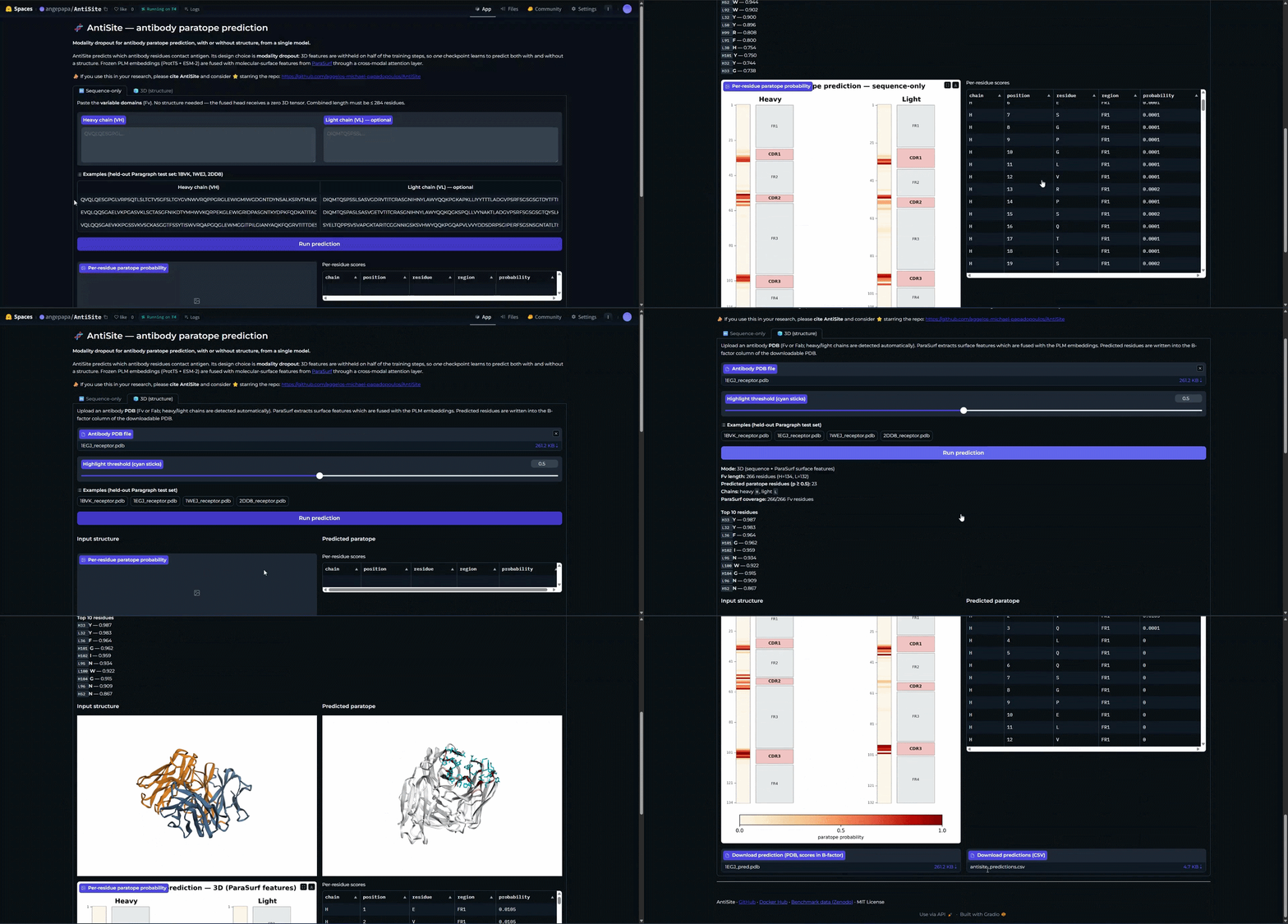
Note: If you see "This Space is sleeping due to inactivity", click "Restart this Space" and give it 3 minutes to load.
AntiSite predicts the antibody paratope (the residues that contact antigen) from a single trained model. It is antigen agnostic. Its key design choice is modality dropout: the 3D features are withheld on half of the training steps, so one checkpoint learns to predict both with and without a structure. It combines frozen protein-language-model (PLM) embeddings with molecular-surface features (from ParaSurf) through a cross-modal attention layer, so that one checkpoint serves two inference modes:
| Mode | Input | When to use |
|---|---|---|
| Sequence-only | Heavy + light chain sequences | No structure available |
| 3D | Sequences**+** a structure (ParaSurf features) | Structure available, best accuracy |
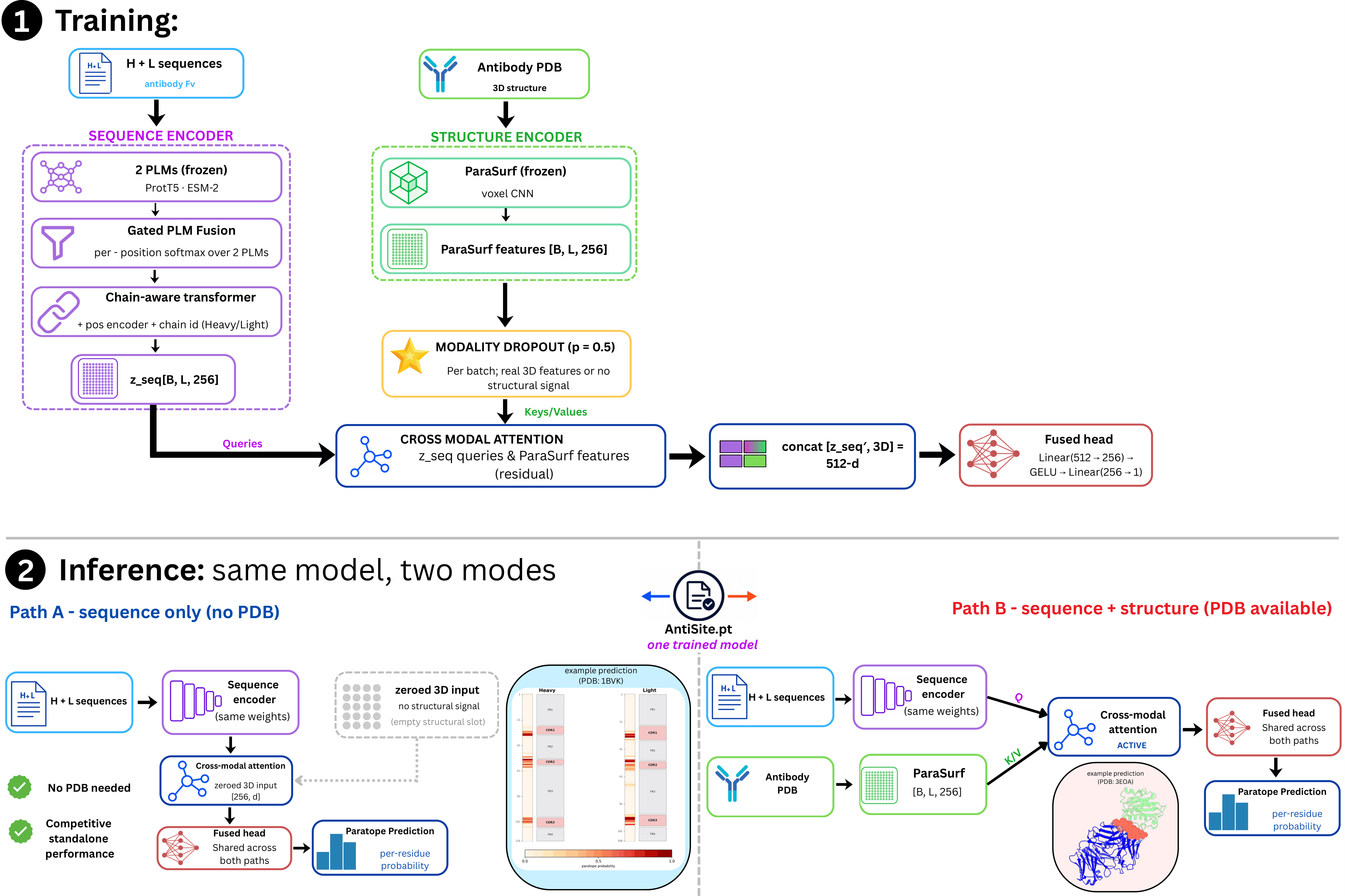
AntiSite's headline model is structure-aware, so the full install below sets up both the sequence and the 3D (ParaSurf) path. The same checkpoint can still run sequence-only at inference when you have no structure; that is a runtime choice, not a lighter install.
A fully self-contained GPU image is the easiest way to run AntiSite. It bakes in the code, the
ParaSurf surface stack (DMS, OpenBabel, pdb2pqr) and all model weights — AntiSite checkpoints,
ParaSurf, ProtT5 and ESM-2 — so once you have the image there is nothing left to download and no
native dependencies to install. Requirements: an NVIDIA GPU with the
NVIDIA Container Toolkit
(so --gpus all works).
Pull the pre-built image:
docker pull angepapa/antisite:latest # or: sudo docker pull angepapa/antisite:latest
👉 For how to run predictions, run the offline smoke test, and build the image yourself, see docker/README.md.
Prefer a manual install, or no GPU-in-Docker? Use the from-source steps below.
git clone https://github.com/aggelos-michael-papadopoulos/AntiSite.git
cd AntiSite
conda create -n antisite python=3.10 -y
conda activate antisite
pip install -e ".[threed]"
This installs AntiSite and PyTorch, the two protein language models (ProtT5 and ESM-2;
pretrained weights download automatically from HuggingFace on first use), and the
extra dependencies ParaSurf needs (torchsummary, jsonpickle).
The 3D path runs ParaSurf to extract molecular-surface features from the antibody structure:
# 1) Clone ParaSurf into the repo root
git clone https://github.com/aggelos-michael-papadopoulos/ParaSurf.git

# 2) OpenBabel (chemical features): conda only
conda install -c conda-forge openbabel -y

# 3) DMS molecular-surface program (needs sudo); pdb2pqr ships inside ParaSurf
cd ParaSurf/dms && sudo make install && cd ../..

# 4) ParaSurf model weights — download FIRST (required for 3D mode).
#    Download the Paragraph-expanded ParaSurf model (link below) and save it as:
#        ParaSurf/Paragraph_expanded_entire_dataset_best.pth
Download the ParaSurf Paragraph-expanded weights here: Paragraph_expanded_entire_dataset_best.pth
Do not run
pip install -r ParaSurf/requirements.txtinside this environment; it pins an oldertorchand will break the AntiSite install. The steps above are all the 3D path needs.
At inference, point AntiSite at a ParaSurf weight file with --parasurf-weights (3D mode); omit the
structure to run sequence-only.
The headline released model is release/checkpoints/antisite_paragraph.pt;
the same file runs both inference modes. Checkpoints trained on each benchmark are provided under
release/checkpoints/:
| Checkpoint | Trained on |
|---|---|
antisite_paragraph.pt | Paragraph (headline model) |
antisite_pecan.pt | PECAN |
antisite_aacdb.pt | AACDB |
antisite_mipe_fold{0..4}.pt | MIPE (5-fold) |
Every checkpoint uses the same 2-PLM (ProtT5 + ESM-2) architecture and runs both inference modes.
One command, one .pt file, two operating modes — the same checkpoint handles both.
python antisite.py \
    --weights release/checkpoints/antisite_paragraph.pt \
    -vh DVKLVQSGPGLVAPSQSLSITCTVSGFSLTTYGVSWVRQPPGKGLEWLGVIWGDGNTTYHSALISRLSISKDNSRSQVFLKLNSLHTDDTATYYCAGNYYGMDYWGQGTSVTVSS \
    -vl DIAMTQTTSSLSASLGQKVTISCRASQDIGNYLNWYQQKPDGTVRLLIYYTSRLHSGVPSRFSGSGSGTDYSLTISNLESEDIATYFCQNGGTNPWTFGGGTKLEVKR
The PLMs encode the sequences and the fused head is fed zero 3D features (modality dropout taught it to handle this).
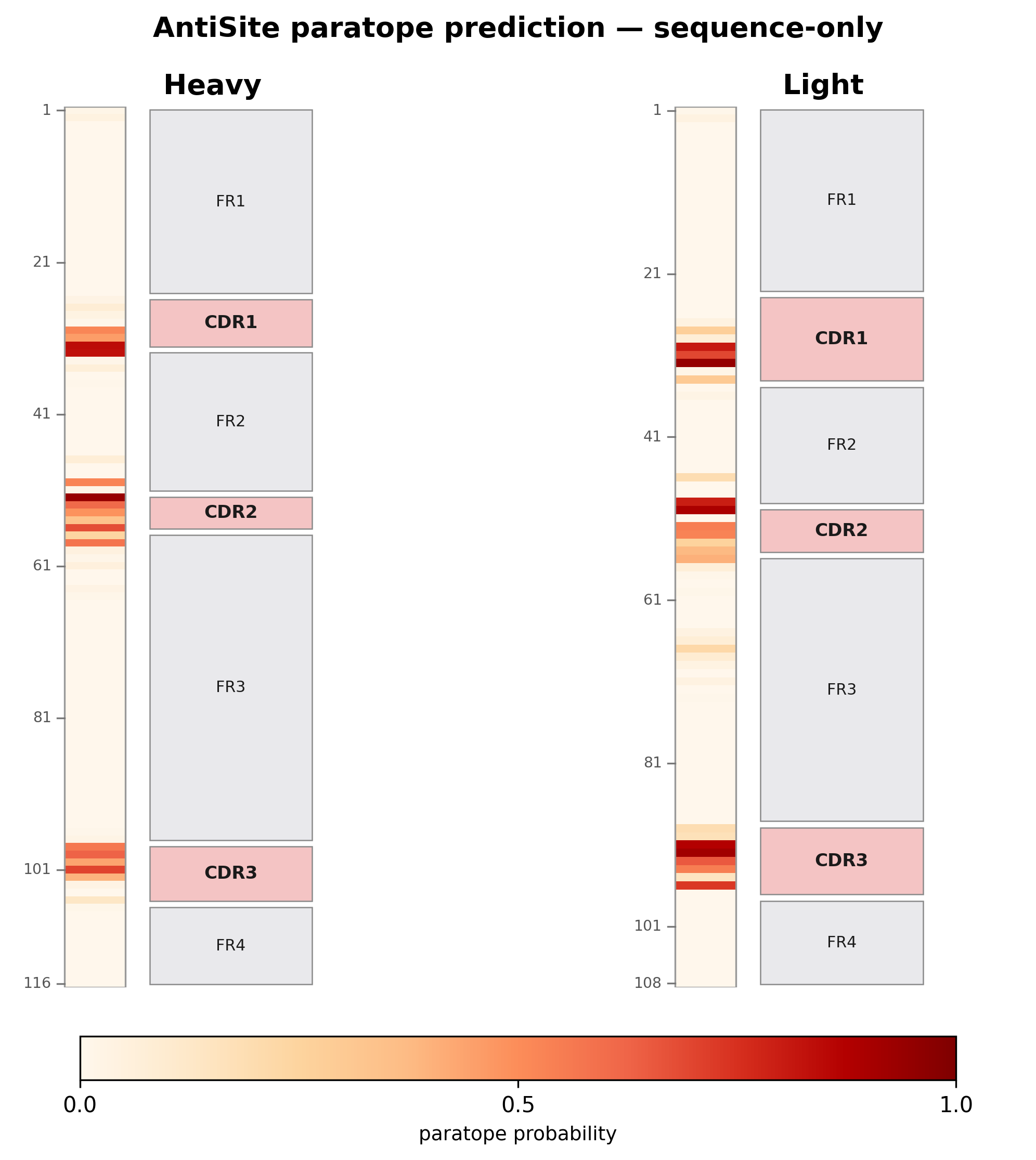
Sequence-only residue-level paratope probabilities.
python antisite.py \
    --weights release/checkpoints/antisite_paragraph.pt \
    --antibody 1FSK_antibody.pdb \
    --parasurf-weights ParaSurf/Paragraph_expanded_entire_dataset_best.pth #frozen ParaSurf
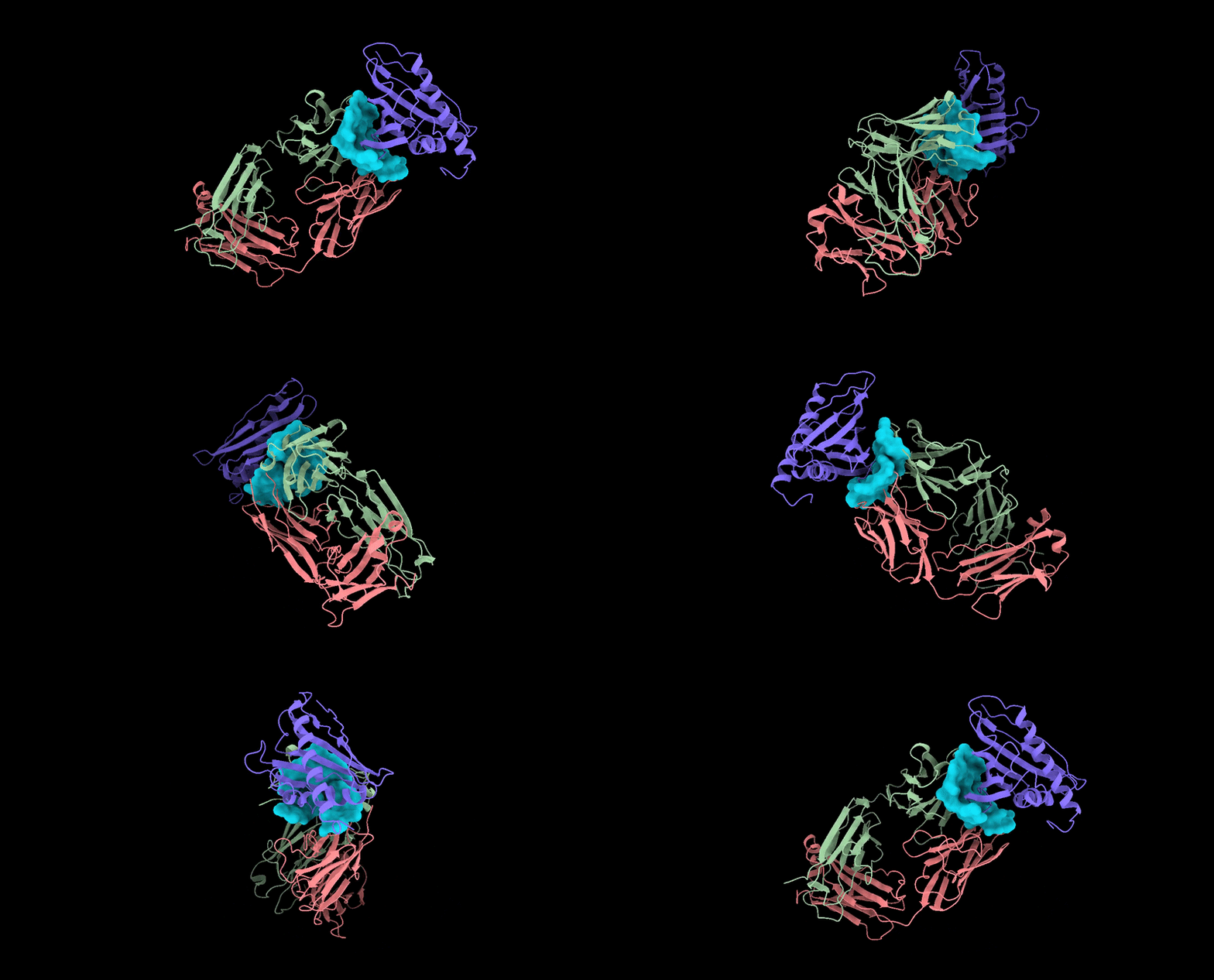
Example 3D paratope prediction for PDB 1FSK; predicted residues are shown in cyan.
Train / validation / test splits for all four benchmarks (Paragraph, PECAN, AACDB, MIPE) are provided
under Data/ — each row gives the antibody heavy/light and antigen chain IDs and their
sequences. See Data/README.md for the schema, split sizes, correction notes, and
checkpoint caveat.
The exact processed PDB inputs and corrected split metadata are archived on Zenodo.
To reproduce AntiSite from scratch (data preparation, PLM embedding, ParaSurf feature precompute, and single-dataset / 5-fold training), see TRAIN.md.
Released under the MIT License.
If you use AntiSite in your research, please cite the preprint:
@article{papadopoulos2026antisite,
  title={AntiSite: Modality Dropout Enables Antibody Paratope Prediction With or Without Structure From a Single Model},
  author={Papadopoulos, Angelos Michail and Alvarez, Federico and Daras, Petros},
  journal={bioRxiv},
  pages={2026--08},
  year={2026},
  publisher={Cold Spring Harbor Laboratory}
}
This is a preprint; the citation will be updated here if the paper is published after peer review.
Modality Dropout Enables Antibody Paratope Prediction With or Without Structure From a Single Model
Python
2
36 commits
updated Oct 5, 2026
🚀 Try AntiSite on 🤗 Hugging Face now!!! Predict a paratope from sequence alone, or upload a structure — both modes, one checkpoint, live in your browser!
Note: If you see "This Space is sleeping due to inactivity", click "Restart this Space" and give it 3 minutes to load.
AntiSite predicts the antibody paratope (the residues that contact antigen) from a single trained model. It is antigen agnostic. Its key design choice is modality dropout: the 3D features are withheld on half of the training steps, so one checkpoint learns to predict both with and without a structure. It combines frozen protein-language-model (PLM) embeddings with molecular-surface features (from ParaSurf) through a cross-modal attention layer, so that one checkpoint serves two inference modes:
| Mode | Input | When to use |
|---|---|---|
| Sequence-only | Heavy + light chain sequences | No structure available |
| 3D | Sequences**+** a structure (ParaSurf features) | Structure available, best accuracy |
AntiSite's headline model is structure-aware, so the full install below sets up both the sequence and the 3D (ParaSurf) path. The same checkpoint can still run sequence-only at inference when you have no structure; that is a runtime choice, not a lighter install.
A fully self-contained GPU image is the easiest way to run AntiSite. It bakes in the code, the
ParaSurf surface stack (DMS, OpenBabel, pdb2pqr) and all model weights — AntiSite checkpoints,
ParaSurf, ProtT5 and ESM-2 — so once you have the image there is nothing left to download and no
native dependencies to install. Requirements: an NVIDIA GPU with the
NVIDIA Container Toolkit
(so --gpus all works).
Pull the pre-built image:
docker pull angepapa/antisite:latest # or: sudo docker pull angepapa/antisite:latest
👉 For how to run predictions, run the offline smoke test, and build the image yourself, see docker/README.md.
Prefer a manual install, or no GPU-in-Docker? Use the from-source steps below.
git clone https://github.com/aggelos-michael-papadopoulos/AntiSite.git
cd AntiSite
conda create -n antisite python=3.10 -y
conda activate antisite
pip install -e ".[threed]"
This installs AntiSite and PyTorch, the two protein language models (ProtT5 and ESM-2;
pretrained weights download automatically from HuggingFace on first use), and the
extra dependencies ParaSurf needs (torchsummary, jsonpickle).
The 3D path runs ParaSurf to extract molecular-surface features from the antibody structure:
# 1) Clone ParaSurf into the repo root
git clone https://github.com/aggelos-michael-papadopoulos/ParaSurf.git

# 2) OpenBabel (chemical features): conda only
conda install -c conda-forge openbabel -y

# 3) DMS molecular-surface program (needs sudo); pdb2pqr ships inside ParaSurf
cd ParaSurf/dms && sudo make install && cd ../..

# 4) ParaSurf model weights — download FIRST (required for 3D mode).
#    Download the Paragraph-expanded ParaSurf model (link below) and save it as:
#        ParaSurf/Paragraph_expanded_entire_dataset_best.pth
Download the ParaSurf Paragraph-expanded weights here: Paragraph_expanded_entire_dataset_best.pth
Do not run
pip install -r ParaSurf/requirements.txtinside this environment; it pins an oldertorchand will break the AntiSite install. The steps above are all the 3D path needs.
At inference, point AntiSite at a ParaSurf weight file with --parasurf-weights (3D mode); omit the
structure to run sequence-only.
The headline released model is release/checkpoints/antisite_paragraph.pt;
the same file runs both inference modes. Checkpoints trained on each benchmark are provided under
release/checkpoints/:
| Checkpoint | Trained on |
|---|---|
antisite_paragraph.pt | Paragraph (headline model) |
antisite_pecan.pt | PECAN |
antisite_aacdb.pt | AACDB |
antisite_mipe_fold{0..4}.pt | MIPE (5-fold) |
Every checkpoint uses the same 2-PLM (ProtT5 + ESM-2) architecture and runs both inference modes.
One command, one .pt file, two operating modes — the same checkpoint handles both.
python antisite.py \
    --weights release/checkpoints/antisite_paragraph.pt \
    -vh DVKLVQSGPGLVAPSQSLSITCTVSGFSLTTYGVSWVRQPPGKGLEWLGVIWGDGNTTYHSALISRLSISKDNSRSQVFLKLNSLHTDDTATYYCAGNYYGMDYWGQGTSVTVSS \
    -vl DIAMTQTTSSLSASLGQKVTISCRASQDIGNYLNWYQQKPDGTVRLLIYYTSRLHSGVPSRFSGSGSGTDYSLTISNLESEDIATYFCQNGGTNPWTFGGGTKLEVKR
The PLMs encode the sequences and the fused head is fed zero 3D features (modality dropout taught it to handle this).
Sequence-only residue-level paratope probabilities.
python antisite.py \
    --weights release/checkpoints/antisite_paragraph.pt \
    --antibody 1FSK_antibody.pdb \
    --parasurf-weights ParaSurf/Paragraph_expanded_entire_dataset_best.pth #frozen ParaSurf
Example 3D paratope prediction for PDB 1FSK; predicted residues are shown in cyan.
Train / validation / test splits for all four benchmarks (Paragraph, PECAN, AACDB, MIPE) are provided
under Data/ — each row gives the antibody heavy/light and antigen chain IDs and their
sequences. See Data/README.md for the schema, split sizes, correction notes, and
checkpoint caveat.
The exact processed PDB inputs and corrected split metadata are archived on Zenodo.
To reproduce AntiSite from scratch (data preparation, PLM embedding, ParaSurf feature precompute, and single-dataset / 5-fold training), see TRAIN.md.
Released under the MIT License.
If you use AntiSite in your research, please cite the preprint:
@article{papadopoulos2026antisite,
  title={AntiSite: Modality Dropout Enables Antibody Paratope Prediction With or Without Structure From a Single Model},
  author={Papadopoulos, Angelos Michail and Alvarez, Federico and Daras, Petros},
  journal={bioRxiv},
  pages={2026--08},
  year={2026},
  publisher={Cold Spring Harbor Laboratory}
}
This is a preprint; the citation will be updated here if the paper is published after peer review.



