
Benchmark for automated failure attributions in agentic systems (🏆 ICML 2025 Spotlight)
See the codeREADME
License • Paper • Dataset • Synced (机器之心) • AIEra (新智元) • QbitAI (量子位) • Discord • Project Page Awsome Failure Attributions
The first and the best benchmark debugging failures from agentic trajectories.
🧐 Overview
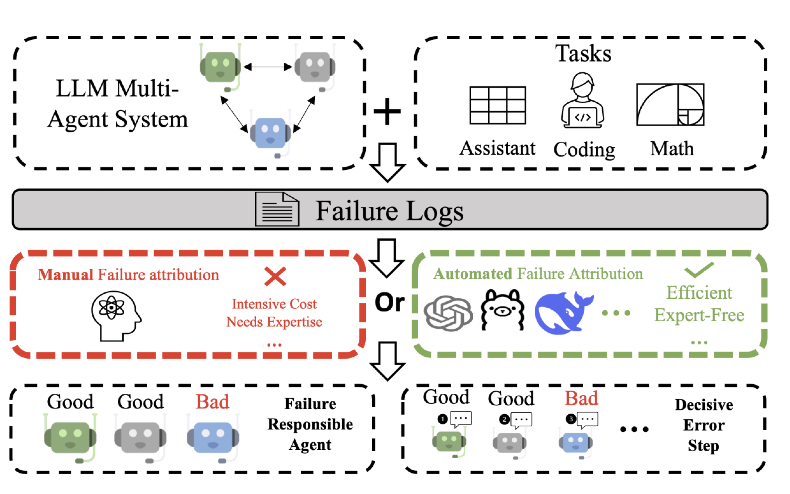
This repository provides the implementation of ICML 2025 spotlight paper "Which Agent Causes Task Failures and When?", which introduces the task of automated failure attribution in LLM-based multi-agent systems. Given a failed task, the goal failure attribution is to automatically identify the agent and step responsible for the failure.
Automated failure-attributions offers several key advantages:
- Reduces manual debugging effort: Automates the labor-intensive process of inspecting failure logs and tracing errors.
- Accelerates system development: Speeds up the iteration cycle by quickly identifying faulty agents and critical mistakes.
- Enables intermediate feedback for agent self-improvement: Pinpointing decisive errors provides actionable signals for agentic systems' self-correction or can serve as rewards in reinforcement learning.
🔧 Who&When: #1 Benchmark for MAS automated failure attribution.
- 184 annotated failure tasks collected from
- Algorithm-generated agentic systems built using CaptainAgent,
- Hand-crafted systems such as Magnetic-One.
- Fine-grained annotations for each failure, including:
- The failure-responsible agent (who failed),
- The decisive error step (when the critical error occurred),
- A natural language explanation of the failure.
The dataset covers a wide range of realistic multi-agent scenarios based on queries from GAIA and AssistantBench. It serves as a foundational resource for developing and evaluating methods that aim to automatically pinpoint the causes of failures in complex agentic systems. We follow the following guide to annotate these failure logs. More information could be found in the paper.
[!IMPORTANT] Check out the dataset on Hugging Face 🤗.
💡 Evaluations
Requirements
To install requirements:
pip install -r requirements.txt
Inference
Please ensure that you specify the AutoFA method (--method) in the corresponding sections of the code before executing it.
- Models We support the following models:
| Model Name | Command-line Argument |
|---|---|
| GPT-4o | --model gpt-4o |
| GPT-4 | --model gpt4 |
| GPT-4o-mini | --model gpt4o-mini |
| Llama-3.1-8B-Instruct | --model llama-8b |
| Llama-3.1-70B-Instruct | --model llama-70b |
| Qwen2.5-7B-Instruct | --model qwen-7b |
| Qwen2.5-72B-Instruct | --model qwen-72b |
Run
python inference.py --method #METHOD --model #MODEL --is_handcrafted #DATA --directory_path #PATH
where:
-
--methodspecifies the failure attribution method:all_at_once: All-at-Once judgingstep_by_step: Step-by-Step judgingbinary_search: Binary Search judging
-
--is_handcraftedspecifies the dataset type:True: Use hand-crafted agentic systemsFalse: Use algorithm-generated agentic systems
-
--directory_pathspecifies the path to the dataset:../Who&When/Hand-Crafted: Path to hand-crafted systems../Who&When/Algorithm-Generated: Path to algorithm-generated systems
Example:
python inference.py --method step_by_step --model gpt-4o --is_handcrafted False --directory_path ../Who&When/Algorithm-Generated
Evaluation
After that, you can evaluate the results. By default, the results are stored in the outputs.
Example:
python evaluate.py --data_path ../Who\&When/Algorithm-Generated --eval_file outputs/step_by_step_gpt-4o_alg_generated.txt
🧪 Experimental Results
|
|
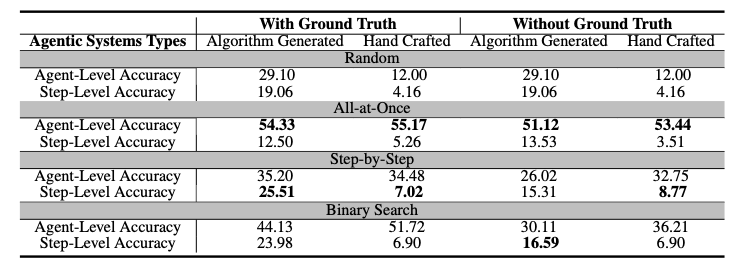
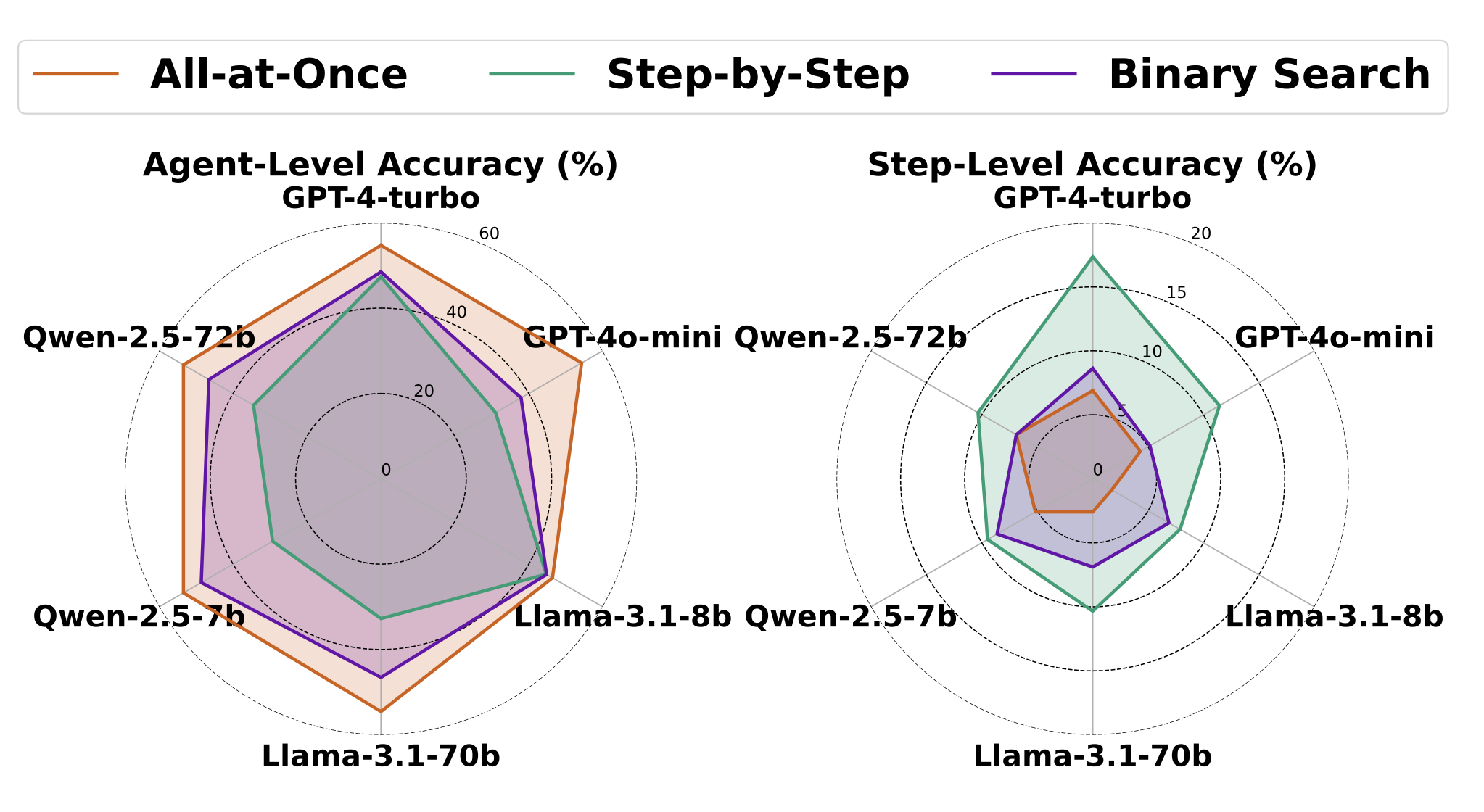
More results could be found in the paper.
📖 Reference
[!IMPORTANT] If you find it useful, please consider citing our work:
@inproceedings{
zhang2025which,
title={Which Agent Causes Task Failures and When? On Automated Failure Attribution of {LLM} Multi-Agent Systems},
author={Shaokun Zhang and Ming Yin and Jieyu Zhang and Jiale Liu and Zhiguang Han and Jingyang Zhang and Beibin Li and Chi Wang and Huazheng Wang and Yiran Chen and Qingyun Wu},
booktitle={Forty-second International Conference on Machine Learning},
year={2025},
url={https://openreview.net/forum?id=GazlTYxZss}
}
Star History
Contributors


Similar repos





Languages
Python
100.0%
Benchmark for automated failure attributions in agentic systems (🏆 ICML 2025 Spotlight)
See the codeREADME
License • Paper • Dataset • Synced (机器之心) • AIEra (新智元) • QbitAI (量子位) • Discord • Project Page Awsome Failure Attributions
The first and the best benchmark debugging failures from agentic trajectories.
🧐 Overview
This repository provides the implementation of ICML 2025 spotlight paper "Which Agent Causes Task Failures and When?", which introduces the task of automated failure attribution in LLM-based multi-agent systems. Given a failed task, the goal failure attribution is to automatically identify the agent and step responsible for the failure.
Automated failure-attributions offers several key advantages:
- Reduces manual debugging effort: Automates the labor-intensive process of inspecting failure logs and tracing errors.
- Accelerates system development: Speeds up the iteration cycle by quickly identifying faulty agents and critical mistakes.
- Enables intermediate feedback for agent self-improvement: Pinpointing decisive errors provides actionable signals for agentic systems' self-correction or can serve as rewards in reinforcement learning.
🔧 Who&When: #1 Benchmark for MAS automated failure attribution.
- 184 annotated failure tasks collected from
- Algorithm-generated agentic systems built using CaptainAgent,
- Hand-crafted systems such as Magnetic-One.
- Fine-grained annotations for each failure, including:
- The failure-responsible agent (who failed),
- The decisive error step (when the critical error occurred),
- A natural language explanation of the failure.
The dataset covers a wide range of realistic multi-agent scenarios based on queries from GAIA and AssistantBench. It serves as a foundational resource for developing and evaluating methods that aim to automatically pinpoint the causes of failures in complex agentic systems. We follow the following guide to annotate these failure logs. More information could be found in the paper.
[!IMPORTANT] Check out the dataset on Hugging Face 🤗.
💡 Evaluations
Requirements
To install requirements:
pip install -r requirements.txt
Inference
Please ensure that you specify the AutoFA method (--method) in the corresponding sections of the code before executing it.
- Models We support the following models:
| Model Name | Command-line Argument |
|---|---|
| GPT-4o | --model gpt-4o |
| GPT-4 | --model gpt4 |
| GPT-4o-mini | --model gpt4o-mini |
| Llama-3.1-8B-Instruct | --model llama-8b |
| Llama-3.1-70B-Instruct | --model llama-70b |
| Qwen2.5-7B-Instruct | --model qwen-7b |
| Qwen2.5-72B-Instruct | --model qwen-72b |
Run
python inference.py --method #METHOD --model #MODEL --is_handcrafted #DATA --directory_path #PATH
where:
-
--methodspecifies the failure attribution method:all_at_once: All-at-Once judgingstep_by_step: Step-by-Step judgingbinary_search: Binary Search judging
-
--is_handcraftedspecifies the dataset type:True: Use hand-crafted agentic systemsFalse: Use algorithm-generated agentic systems
-
--directory_pathspecifies the path to the dataset:../Who&When/Hand-Crafted: Path to hand-crafted systems../Who&When/Algorithm-Generated: Path to algorithm-generated systems
Example:
python inference.py --method step_by_step --model gpt-4o --is_handcrafted False --directory_path ../Who&When/Algorithm-Generated
Evaluation
After that, you can evaluate the results. By default, the results are stored in the outputs.
Example:
python evaluate.py --data_path ../Who\&When/Algorithm-Generated --eval_file outputs/step_by_step_gpt-4o_alg_generated.txt
🧪 Experimental Results
|
|
|
More results could be found in the paper.
📖 Reference
[!IMPORTANT] If you find it useful, please consider citing our work:
@inproceedings{
zhang2025which,
title={Which Agent Causes Task Failures and When? On Automated Failure Attribution of {LLM} Multi-Agent Systems},
author={Shaokun Zhang and Ming Yin and Jieyu Zhang and Jiale Liu and Zhiguang Han and Jingyang Zhang and Beibin Li and Chi Wang and Huazheng Wang and Yiran Chen and Qingyun Wu},
booktitle={Forty-second International Conference on Machine Learning},
year={2025},
url={https://openreview.net/forum?id=GazlTYxZss}
}
Star History
Similar repos
Contributors
Languages
Python
100.0%