
See what people are saying (1)
README

Repairo
Dependabot bumps the package. Repairo fixes the call sites that break.
OpenAPI-grounded breaking-change detection · AST impact mapping · compile-checked repair PRs
Website · Live demo · Docs · npm · Issues






See it (30 seconds)
CLI on this repo’s fixtures (animated terminal capture — same commands you can run locally):
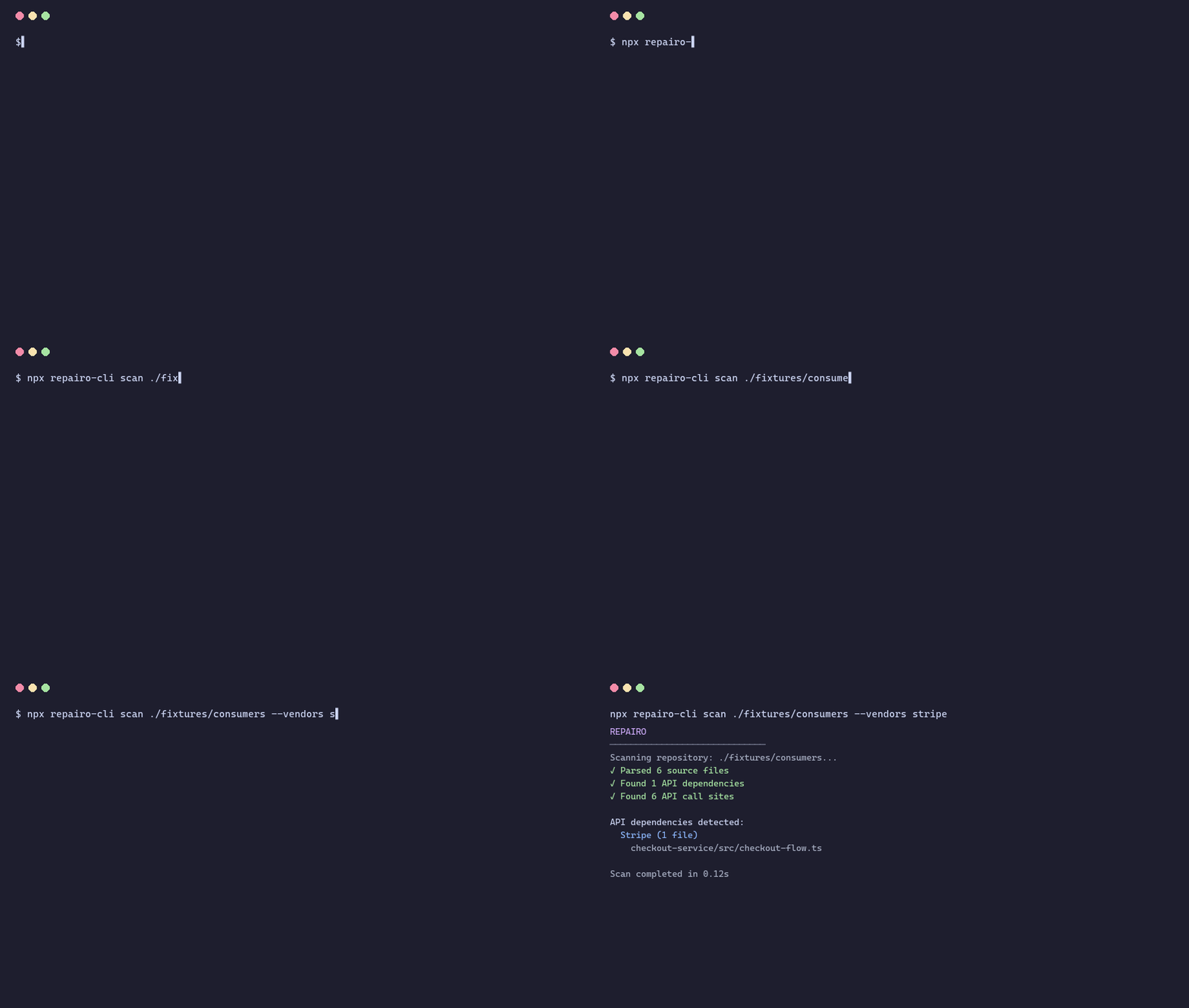
npx repairo-cli scan ./fixtures/consumers --vendors stripe
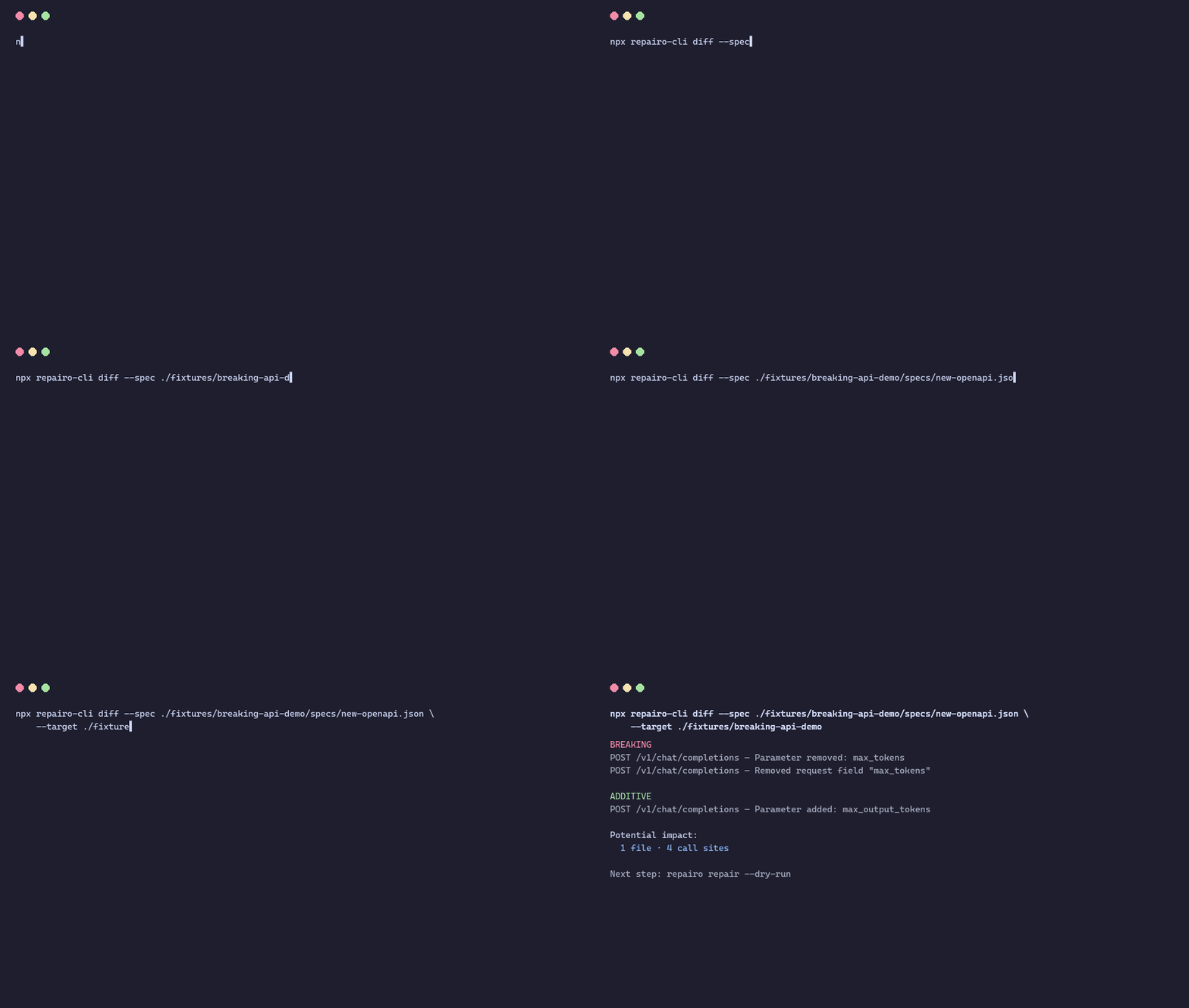
Full pipeline in the browser (no install): heyrepairo.in/demo — OpenAPI diff → impact → patch → validation on bundled scenarios.
Quick start
No signup. No config file.
npx repairo-cli scan ./src --vendors stripe,openai,supabase
Global install + typical workflow:
npm install -g repairo-cli   # requires Node ≥ 22

repairo init --repo owner/your-app --vendors stripe,openai
repairo scan ./src
repairo check --vendors stripe,openai --target ./src
repairo repair --dry-run --target ./src
repairo repair --create-pr     # needs git + GitHub token for PR creation
Try the in-repo fixture without touching your app:
git clone https://github.com/adityacs50-lab/Repairo.git && cd Repairo
npm install
npx repairo-cli scan ./fixtures/consumers --vendors stripe
cp fixtures/breaking-api-demo/specs/old-openapi.json .repairo/snapshots/openapi.json
npx repairo-cli diff --spec ./fixtures/breaking-api-demo/specs/new-openapi.json --target ./fixtures/breaking-api-demo
The problem
Version bumpers update package.json. They do not rewrite your call sites when a vendor removes a field, renames a parameter, or ships a new base path.
You end up grepping the repo, fixing files by hand, or handing broad context to an AI agent — hard to audit and easy to miss edge cases.
What Repairo does
- Watches vendor OpenAPI (live fetch or pinned specs) and computes a structural diff
- Maps impact with compiler-grade parsing (TypeScript/JavaScript via
ts-morph; Python/Go tokenizer paths in the engine) - Applies deterministic AST/token transforms where the spec change is unambiguous
- Validates before proposing — TypeScript/JavaScript typecheck; Python/Go syntax checks (optional Pyright when your project already has config)
- Opens a reviewable PR with evidence — never auto-merges, especially when optional agent assist was used
Optional: repairo repair --agent-resolve proposes enum mappings only when the diff is ambiguous (off by default; needs your ANTHROPIC_API_KEY).
Supported today (honest)
| Area | Status |
|---|---|
npm CLI (repairo-cli) | Shipped — badges above reflect live npm/GitHub stats |
| Languages | TypeScript/JavaScript strongest; Python and Go repair paths exist with dedicated tests — expect rough edges on untyped or dynamic code |
| Vendors (watch list) | Stripe, OpenAI, Anthropic, Supabase, Gemini, GitHub REST — plus your own OpenAPI files via diff / snapshots |
| Hosted app | Beta at heyrepairo.in — GitHub connect, watch list, repair PRs |
| GitHub App | In repo (src/github-app/) — self-host or use when app slug is configured on the site |
| Distribution | Early — treat stars/downloads as signal, not “customers” |
Proof you can run locally: npm test (engine + GitHub app + Python/Go repair + web app suites). CI runs the same workflow on every push to main.
Example repair
From the breaking-api-demo fixture (max_tokens → max_output_tokens on chat completions):
- const response = await openai.chat.completions.create({
-   model: "gpt-4",
-   max_tokens: 500,
- });

+ const response = await openai.chat.completions.create({
+   model: "gpt-4",
+   max_output_tokens: 500,
+ });
Scoped to the real call site via AST — unrelated objects with the same property name are left alone.
How it works
Same pipeline as our technical deep dive (runRepair() in src/lib/engine/index.ts):
  before/after OpenAPI ──► parseOpenApi ──► diffOpenApi ──► ApiChange[]
  consumer files       ──► findImpactedCode ─────────────► ImpactMatch[]
                                    │
              optional agentResolve ► resolveAmbiguousEnums
                                    ▼
                            generateFixes
                                    ▼
                    buildPullRequest (safety score, merge flags)
                                    ▼
              validateInMemory (hosted) / validateCodebase (CLI repair)
                                    ▼
                    RepairRunResult + PR for human review
Details: docs/architecture.md (CLI vs hosted validation order).
Repairo vs…
| Dependabot / Renovate | AI coding agents | Repairo | |
|---|---|---|---|
| Bumps package version | ✅ | — | ✅ (via your workflow) |
| Fixes calling code | ❌ | ✅ (probabilistic) | ✅ (deterministic where spec is clear) |
| Checked before you see a PR | N/A | Often no | ✅ (typecheck / syntax gate) |
| Ambiguous mappings | N/A | Often silent guesses | Flagged or agent-proposed, review required |
| Customer source in the cloud | N/A | Often broad context | CLI is local; hosted beta uses OAuth scopes you approve |
CI
# .github/workflows/repairo.yml
name: API contract check
on:
  schedule:
    - cron: "0 6 * * *"
  workflow_dispatch:

jobs:
  check:
    runs-on: ubuntu-latest
    steps:
      - uses: actions/checkout@v4
      - uses: adityacs50-lab/Repairo@main
        with:
          vendors: stripe,openai
          target: ./src
First run writes baselines under .repairo/snapshots/ (commit them). Later runs fail when a watched contract breaks.
Privacy & security
- CLI: runs on your machine; repairs are computed in-process for local commands.
- Hosted / GitHub App: only the OAuth scopes and webhooks you configure — see security.
- Agent resolve: sends minimal structured context (field names + candidates), not whole files, when you opt in.
- Vulnerabilities: info@heyrepairo.in (please don’t file public issues for security reports).
Development
npm install
npm run dev          # Next.js app (heyrepairo.in UI)
npm test             # full test matrix
npm run repairo -- scan ./fixtures/consumers
Demo asset sources: docs/assets/README.md.
Contributing
Issues and focused PRs welcome — especially repro fixtures and deterministic repair cases.
- Open an issue
- Keep the deterministic repair path strict; don’t expand unsupervised AI write access
License
Contributors


Similar repos


Languages
TypeScript
92.0%
CSS
6.7%
See what people are saying (1)
README
Repairo
Dependabot bumps the package. Repairo fixes the call sites that break.
OpenAPI-grounded breaking-change detection · AST impact mapping · compile-checked repair PRs
Website · Live demo · Docs · npm · Issues
See it (30 seconds)
CLI on this repo’s fixtures (animated terminal capture — same commands you can run locally):
npx repairo-cli scan ./fixtures/consumers --vendors stripe
Full pipeline in the browser (no install): heyrepairo.in/demo — OpenAPI diff → impact → patch → validation on bundled scenarios.
Quick start
No signup. No config file.
npx repairo-cli scan ./src --vendors stripe,openai,supabase
Global install + typical workflow:
npm install -g repairo-cli   # requires Node ≥ 22

repairo init --repo owner/your-app --vendors stripe,openai
repairo scan ./src
repairo check --vendors stripe,openai --target ./src
repairo repair --dry-run --target ./src
repairo repair --create-pr     # needs git + GitHub token for PR creation
Try the in-repo fixture without touching your app:
git clone https://github.com/adityacs50-lab/Repairo.git && cd Repairo
npm install
npx repairo-cli scan ./fixtures/consumers --vendors stripe
cp fixtures/breaking-api-demo/specs/old-openapi.json .repairo/snapshots/openapi.json
npx repairo-cli diff --spec ./fixtures/breaking-api-demo/specs/new-openapi.json --target ./fixtures/breaking-api-demo
The problem
Version bumpers update package.json. They do not rewrite your call sites when a vendor removes a field, renames a parameter, or ships a new base path.
You end up grepping the repo, fixing files by hand, or handing broad context to an AI agent — hard to audit and easy to miss edge cases.
What Repairo does
- Watches vendor OpenAPI (live fetch or pinned specs) and computes a structural diff
- Maps impact with compiler-grade parsing (TypeScript/JavaScript via
ts-morph; Python/Go tokenizer paths in the engine) - Applies deterministic AST/token transforms where the spec change is unambiguous
- Validates before proposing — TypeScript/JavaScript typecheck; Python/Go syntax checks (optional Pyright when your project already has config)
- Opens a reviewable PR with evidence — never auto-merges, especially when optional agent assist was used
Optional: repairo repair --agent-resolve proposes enum mappings only when the diff is ambiguous (off by default; needs your ANTHROPIC_API_KEY).
Supported today (honest)
| Area | Status |
|---|---|
npm CLI (repairo-cli) | Shipped — badges above reflect live npm/GitHub stats |
| Languages | TypeScript/JavaScript strongest; Python and Go repair paths exist with dedicated tests — expect rough edges on untyped or dynamic code |
| Vendors (watch list) | Stripe, OpenAI, Anthropic, Supabase, Gemini, GitHub REST — plus your own OpenAPI files via diff / snapshots |
| Hosted app | Beta at heyrepairo.in — GitHub connect, watch list, repair PRs |
| GitHub App | In repo (src/github-app/) — self-host or use when app slug is configured on the site |
| Distribution | Early — treat stars/downloads as signal, not “customers” |
Proof you can run locally: npm test (engine + GitHub app + Python/Go repair + web app suites). CI runs the same workflow on every push to main.
Example repair
From the breaking-api-demo fixture (max_tokens → max_output_tokens on chat completions):
- const response = await openai.chat.completions.create({
-   model: "gpt-4",
-   max_tokens: 500,
- });

+ const response = await openai.chat.completions.create({
+   model: "gpt-4",
+   max_output_tokens: 500,
+ });
Scoped to the real call site via AST — unrelated objects with the same property name are left alone.
How it works
Same pipeline as our technical deep dive (runRepair() in src/lib/engine/index.ts):
  before/after OpenAPI ──► parseOpenApi ──► diffOpenApi ──► ApiChange[]
  consumer files       ──► findImpactedCode ─────────────► ImpactMatch[]
                                    │
              optional agentResolve ► resolveAmbiguousEnums
                                    ▼
                            generateFixes
                                    ▼
                    buildPullRequest (safety score, merge flags)
                                    ▼
              validateInMemory (hosted) / validateCodebase (CLI repair)
                                    ▼
                    RepairRunResult + PR for human review
Details: docs/architecture.md (CLI vs hosted validation order).
Repairo vs…
| Dependabot / Renovate | AI coding agents | Repairo | |
|---|---|---|---|
| Bumps package version | ✅ | — | ✅ (via your workflow) |
| Fixes calling code | ❌ | ✅ (probabilistic) | ✅ (deterministic where spec is clear) |
| Checked before you see a PR | N/A | Often no | ✅ (typecheck / syntax gate) |
| Ambiguous mappings | N/A | Often silent guesses | Flagged or agent-proposed, review required |
| Customer source in the cloud | N/A | Often broad context | CLI is local; hosted beta uses OAuth scopes you approve |
CI
# .github/workflows/repairo.yml
name: API contract check
on:
  schedule:
    - cron: "0 6 * * *"
  workflow_dispatch:

jobs:
  check:
    runs-on: ubuntu-latest
    steps:
      - uses: actions/checkout@v4
      - uses: adityacs50-lab/Repairo@main
        with:
          vendors: stripe,openai
          target: ./src
First run writes baselines under .repairo/snapshots/ (commit them). Later runs fail when a watched contract breaks.
Privacy & security
- CLI: runs on your machine; repairs are computed in-process for local commands.
- Hosted / GitHub App: only the OAuth scopes and webhooks you configure — see security.
- Agent resolve: sends minimal structured context (field names + candidates), not whole files, when you opt in.
- Vulnerabilities: info@heyrepairo.in (please don’t file public issues for security reports).
Development
npm install
npm run dev          # Next.js app (heyrepairo.in UI)
npm test             # full test matrix
npm run repairo -- scan ./fixtures/consumers
Demo asset sources: docs/assets/README.md.
Contributing
Issues and focused PRs welcome — especially repro fixtures and deterministic repair cases.
- Open an issue
- Keep the deterministic repair path strict; don’t expand unsupervised AI write access
License
Similar repos
Contributors
Languages
TypeScript
92.0%
CSS
6.7%