
Lightweight remote control infrastructure for agent harnesses, securely connecting private TCP/UDP services through one public port.
Rust
75
253 commits
updated Sep 9, 2026
README
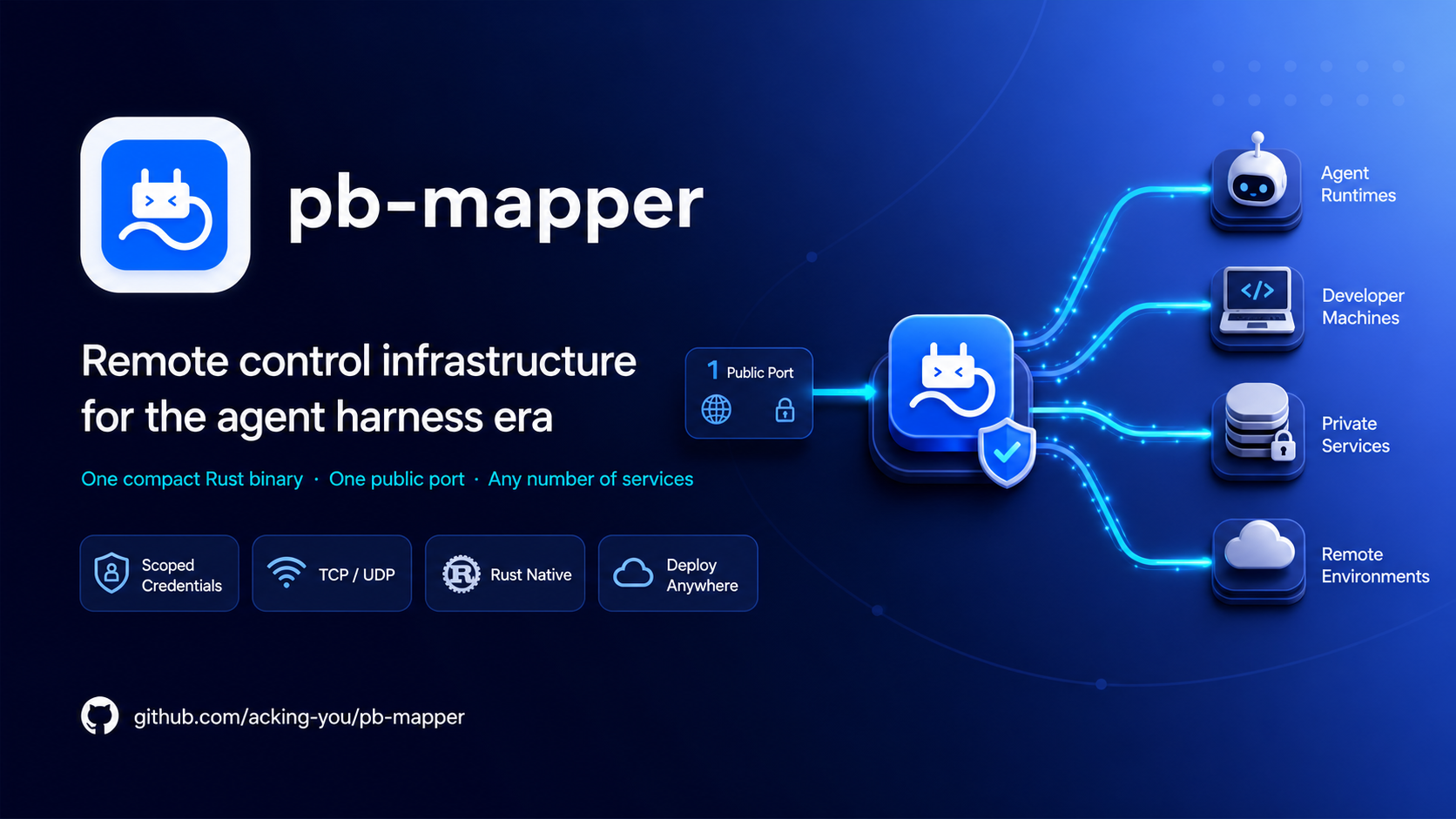


Remote control infrastructure for the agent harness era.
Agent harnesses can write code, run tools, and coordinate long workflows. They still need a narrow, durable path into private runtimes. pb-mapper provides that network primitive: expose one relay port, register any number of keyed TCP/UDP services behind it, and delegate access without publishing every service or sharing the relay's root credential.
pb-mapper transports bytes. The service behind a tunnel still owns its application-level authentication and authorization.
Why it fits an agent harness
- Compact and easy to embed — one Rust binary contains the relay, register, connect, status, and administrator roles. Linux releases are distributed as a small, self-contained archive with no language runtime to install.
- One public port, many control paths — registration, subscription, status, and administration all enter through the same relay port. Adding another remote-control endpoint does not require another public listener.
- Delegate access instead of the root key — keep one 32-byte administrator
key on the relay and issue renewable, expiring
pbmt1_credentials to harnesses or workloads. Each credential receives an isolated namespace. - Revoke live access — expiry, revocation, auth-state reset, and root-key rotation close affected live control and data connections.
- Native performance, production experience — the data path is implemented in Rust on Tokio, supports TCP and UDP, and has been exercised by long-running self-hosted products and real game-server traffic. The end-to-end suite covers the transport/encryption matrix and credential lifecycle.
One relay, many private services
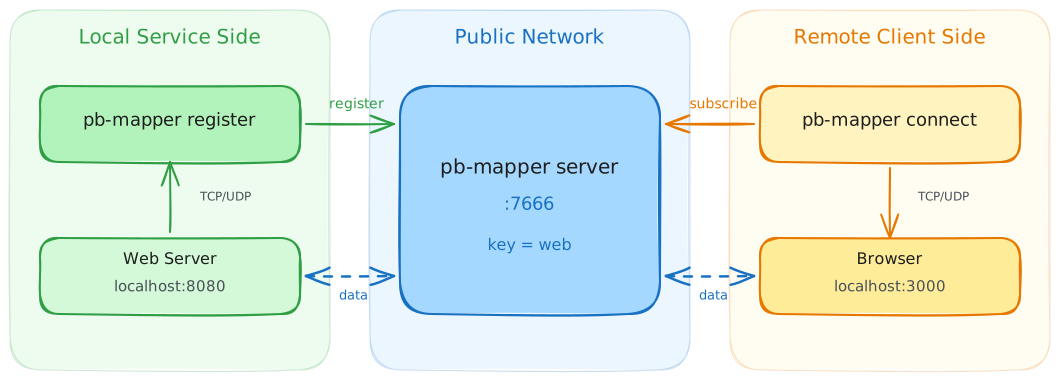
 private runtime A ── register "app" ──┐
 private runtime B ── register "shell" ├──► pb-mapper relay :7666 ◄── agent harnesses
 private runtime C ── register "tools" ┘          one public port
pb-mapper registerruns beside a private TCP/UDP service and publishes a service name to the relay.pb-mapper connectruns beside an agent or operator and exposes that service on a local address.- The relay matches both sides by namespace and service name, then forwards data bidirectionally.
- Different temporary credentials can reuse the same service names without seeing or colliding with each other.
This makes a relay a useful rendezvous layer for remote agent runtimes, coding harnesses, private APIs, model gateways, browser-control endpoints, development machines, and operational tools.
Install the agent Skill
Tell your agent:
Fetch and follow instructions from https://raw.githubusercontent.com/acking-you/pb-mapper/master/skills/pb-mapper-suite/INSTALL.md
Credential model for automation
| Credential | Intended holder | Authority |
|---|---|---|
| Administrator key | Relay operator or trusted provisioning automation | Issue, reveal, renew, revoke, rotate, inspect all namespaces |
Temporary pbmt1_ credential | One harness, tenant, device, or workload | Register, connect, and inspect only its own namespace |
Protocol v2 authenticates the encrypted first request without adding a separate
handshake round trip. Temporary credentials are derived from the administrator
key, persistent server instance ID, and key ID; the relay stores lifecycle
metadata rather than a copy of each temporary secret. Optional AES-256-GCM data
encryption is enabled with --codec when registering a service.
pb-mapper uses pre-shared credentials, not public-key identity. Use TLS or another application protocol when you also need certificate-based endpoint identity or protection against traffic analysis. See the authentication design for the exact boundary.
Current integration surface
| Surface | What is available today |
|---|---|
| Unified CLI | server, register, connect, status, and admin roles |
| Agent Skills | Complete installation, relay, register/connect, and verification through pb-mapper-suite, plus a separate release workflow |
| Operations | Linux systemd units, install scripts, Docker image, status and administrator inventory |
| Native embedding | Rust crate pb-mapper (Client for register/connect/status/admin), C ABI for the Flutter UI, Node-API package under js/ |
| Networking | TCP and UDP, per-tunnel keep-alive, optional forwarded-data encryption |
Rust SDK
pb-mapper = "0.5"
use pb_mapper::{Client, ClientConfig, RegisterRequest, Transport};

let client = Client::new(ClientConfig {
    server: "relay.example.com:7666".into(),
    credential: std::env::var("MSG_HEADER_KEY")?,
    keep_alive: true,
    namespace: None,
})?;
let registration = client.register(RegisterRequest {
    key: "echo".into(),
    local_addr: "127.0.0.1:8080".into(),
    transport: Transport::Tcp,
    codec: false,
    force_namespace: false,
}).await?;
registration.wait_ready().await?;
CLI and relay server
Install the unified CLI directly from crates.io:
cargo install pb-mapper-cli --locked
The package is named pb-mapper-cli, and it installs one executable named
pb-mapper. That executable contains the server, register, connect,
status, and admin roles, so a separate server executable is not required.
The relay implementation is also published as the pb-mapper-server library
for applications that need to embed it.
TypeScript (Node-API)
npm install pb-mapper
import { Client } from "pb-mapper";

const client = new Client({
  server: "relay.example.com:7666",
  credential: process.env.MSG_HEADER_KEY!,
});
const admin = client.admin();
const issued = await admin.issueKey(3600, "agent");
Roadmap: harness-native remote control
The current release provides the secure network, a Rust client SDK, and a Node-API package. Remaining work:
- harness-specific adapters and credential automation built on the existing
pb-mapper-suiteworkflow; - further shrinking the client-only Node addon (release-node + strip is already under 5 MB on linux-x64);
- browser and edge adapters for runtimes that cannot load a native Node-API addon;
- harness adapters and examples for remote model runtimes, tool servers, private APIs, development machines, and browser-control endpoints.
These are roadmap items, not yet part of the published compatibility contract.
Build and documentation
make build-pb-mapper
cargo test
- User guide:
docs/user-guide.md - Authentication and protocol v2:
docs/authentication-v2.md - Docker server guide:
DOCKER_README.md - Chinese documentation:
README.zh-CN.md,docs/user-guide.zh-CN.md
Repository layout:
crates/— Rust workspace: core, auth, protocol, server, client, SDK facade (pb-mapper), Node-API (pb-mapper-node), CLI, and testkitjs/— JS package wrapping the Node-API addon (built with bun)ui/— Flutter UI and native C ABI bridgeskills/— agent-readable deployment and release workflowsdocs/— architecture, authentication, user guides, and project assetsdocker/,services/,scripts/— packaging and operations
License
Released under the MIT License.
Contributors

253 commits
Similar repos


Languages
Rust
66.2%
Dart
21.8%
C++
2.9%
JavaScript
2.6%
Shell
2.4%
Python
1.3%
CMake
1.3%
Lightweight remote control infrastructure for agent harnesses, securely connecting private TCP/UDP services through one public port.
Rust
75
253 commits
updated Sep 9, 2026
README
Remote control infrastructure for the agent harness era.
Agent harnesses can write code, run tools, and coordinate long workflows. They still need a narrow, durable path into private runtimes. pb-mapper provides that network primitive: expose one relay port, register any number of keyed TCP/UDP services behind it, and delegate access without publishing every service or sharing the relay's root credential.
pb-mapper transports bytes. The service behind a tunnel still owns its application-level authentication and authorization.
Why it fits an agent harness
- Compact and easy to embed — one Rust binary contains the relay, register, connect, status, and administrator roles. Linux releases are distributed as a small, self-contained archive with no language runtime to install.
- One public port, many control paths — registration, subscription, status, and administration all enter through the same relay port. Adding another remote-control endpoint does not require another public listener.
- Delegate access instead of the root key — keep one 32-byte administrator
key on the relay and issue renewable, expiring
pbmt1_credentials to harnesses or workloads. Each credential receives an isolated namespace. - Revoke live access — expiry, revocation, auth-state reset, and root-key rotation close affected live control and data connections.
- Native performance, production experience — the data path is implemented in Rust on Tokio, supports TCP and UDP, and has been exercised by long-running self-hosted products and real game-server traffic. The end-to-end suite covers the transport/encryption matrix and credential lifecycle.
One relay, many private services
 private runtime A ── register "app" ──┐
 private runtime B ── register "shell" ├──► pb-mapper relay :7666 ◄── agent harnesses
 private runtime C ── register "tools" ┘          one public port
pb-mapper registerruns beside a private TCP/UDP service and publishes a service name to the relay.pb-mapper connectruns beside an agent or operator and exposes that service on a local address.- The relay matches both sides by namespace and service name, then forwards data bidirectionally.
- Different temporary credentials can reuse the same service names without seeing or colliding with each other.
This makes a relay a useful rendezvous layer for remote agent runtimes, coding harnesses, private APIs, model gateways, browser-control endpoints, development machines, and operational tools.
Install the agent Skill
Tell your agent:
Fetch and follow instructions from https://raw.githubusercontent.com/acking-you/pb-mapper/master/skills/pb-mapper-suite/INSTALL.md
Credential model for automation
| Credential | Intended holder | Authority |
|---|---|---|
| Administrator key | Relay operator or trusted provisioning automation | Issue, reveal, renew, revoke, rotate, inspect all namespaces |
Temporary pbmt1_ credential | One harness, tenant, device, or workload | Register, connect, and inspect only its own namespace |
Protocol v2 authenticates the encrypted first request without adding a separate
handshake round trip. Temporary credentials are derived from the administrator
key, persistent server instance ID, and key ID; the relay stores lifecycle
metadata rather than a copy of each temporary secret. Optional AES-256-GCM data
encryption is enabled with --codec when registering a service.
pb-mapper uses pre-shared credentials, not public-key identity. Use TLS or another application protocol when you also need certificate-based endpoint identity or protection against traffic analysis. See the authentication design for the exact boundary.
Current integration surface
| Surface | What is available today |
|---|---|
| Unified CLI | server, register, connect, status, and admin roles |
| Agent Skills | Complete installation, relay, register/connect, and verification through pb-mapper-suite, plus a separate release workflow |
| Operations | Linux systemd units, install scripts, Docker image, status and administrator inventory |
| Native embedding | Rust crate pb-mapper (Client for register/connect/status/admin), C ABI for the Flutter UI, Node-API package under js/ |
| Networking | TCP and UDP, per-tunnel keep-alive, optional forwarded-data encryption |
Rust SDK
pb-mapper = "0.5"
use pb_mapper::{Client, ClientConfig, RegisterRequest, Transport};

let client = Client::new(ClientConfig {
    server: "relay.example.com:7666".into(),
    credential: std::env::var("MSG_HEADER_KEY")?,
    keep_alive: true,
    namespace: None,
})?;
let registration = client.register(RegisterRequest {
    key: "echo".into(),
    local_addr: "127.0.0.1:8080".into(),
    transport: Transport::Tcp,
    codec: false,
    force_namespace: false,
}).await?;
registration.wait_ready().await?;
CLI and relay server
Install the unified CLI directly from crates.io:
cargo install pb-mapper-cli --locked
The package is named pb-mapper-cli, and it installs one executable named
pb-mapper. That executable contains the server, register, connect,
status, and admin roles, so a separate server executable is not required.
The relay implementation is also published as the pb-mapper-server library
for applications that need to embed it.
TypeScript (Node-API)
npm install pb-mapper
import { Client } from "pb-mapper";

const client = new Client({
  server: "relay.example.com:7666",
  credential: process.env.MSG_HEADER_KEY!,
});
const admin = client.admin();
const issued = await admin.issueKey(3600, "agent");
Roadmap: harness-native remote control
The current release provides the secure network, a Rust client SDK, and a Node-API package. Remaining work:
- harness-specific adapters and credential automation built on the existing
pb-mapper-suiteworkflow; - further shrinking the client-only Node addon (release-node + strip is already under 5 MB on linux-x64);
- browser and edge adapters for runtimes that cannot load a native Node-API addon;
- harness adapters and examples for remote model runtimes, tool servers, private APIs, development machines, and browser-control endpoints.
These are roadmap items, not yet part of the published compatibility contract.
Build and documentation
make build-pb-mapper
cargo test
- User guide:
docs/user-guide.md - Authentication and protocol v2:
docs/authentication-v2.md - Docker server guide:
DOCKER_README.md - Chinese documentation:
README.zh-CN.md,docs/user-guide.zh-CN.md
Repository layout:
crates/— Rust workspace: core, auth, protocol, server, client, SDK facade (pb-mapper), Node-API (pb-mapper-node), CLI, and testkitjs/— JS package wrapping the Node-API addon (built with bun)ui/— Flutter UI and native C ABI bridgeskills/— agent-readable deployment and release workflowsdocs/— architecture, authentication, user guides, and project assetsdocker/,services/,scripts/— packaging and operations
License
Released under the MIT License.
Similar repos
Contributors
253 commits
Languages
Rust
66.2%
Dart
21.8%
C++
2.9%
JavaScript
2.6%
Shell
2.4%
Python
1.3%
CMake
1.3%