Evolve your language agent with Agentic Context Engineering (ACE)
See the code





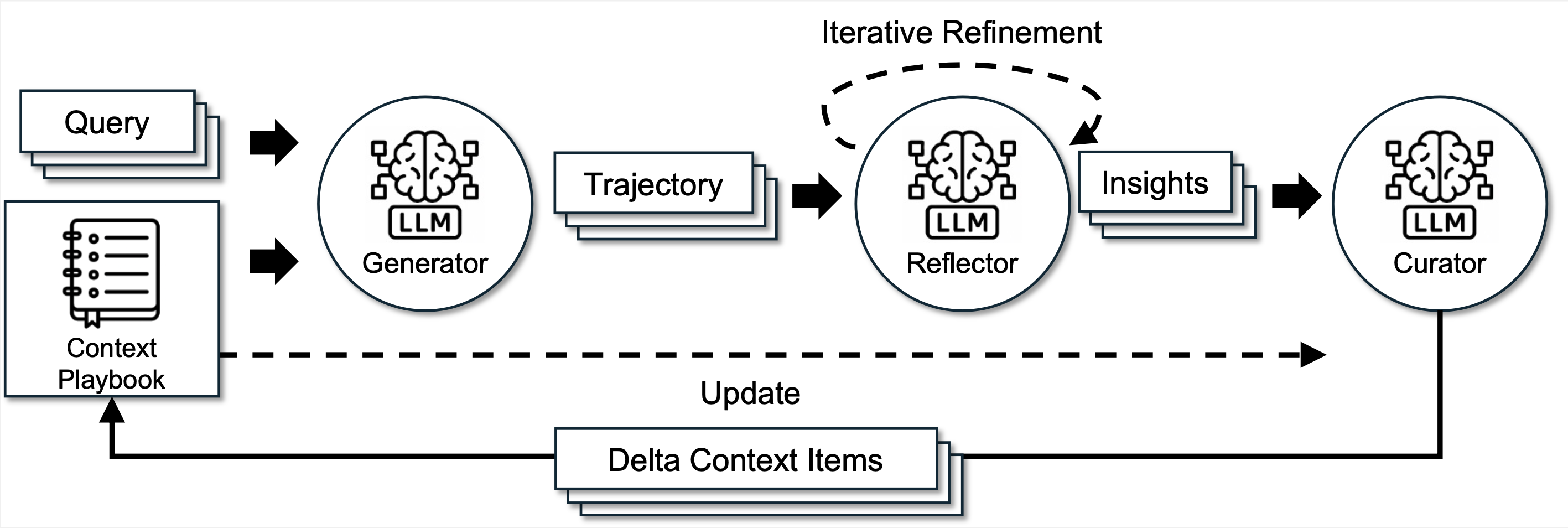
ACE (Agentic Context Engineering) is a framework that enables large language models to self-improve by treating contexts as evolving playbooks that accumulate, refine, and organize strategies through a modular process of generation, reflection, and curation. Unlike traditional approaches that suffer from brevity bias and context collapse, ACE introduces structured, incremental updates guided by a grow-and-refine principle, preserving detailed, domain-specific knowledge while remaining comprehensive and scalable throughout adaptation.
ACE consistently outperforms strong baselines, achieving average gains of +10.6% on agent tasks and +8.6% on domain-specific benchmarks, across both offline and online adaptation settings.
| Task Category | Dataset | Improvement | Details |
|---|---|---|---|
| Agent Tasks | AppWorld | +10.6% | Matches top-ranked production-level agent (GPT-4.1) on average and surpasses it on harder test-challenge split, using smaller open-source model |
| Finance | FiNER + XBRL Formula | +8.6% | Domain-specific reasoning with structured information extraction |
This design prevents the context collapse problem where iterative rewriting erodes details over time.
# Clone the repository
git clone https://github.com/ace-agent/ace.git
cd ace

# Install uv (if not already installed)
curl -LsSf https://astral.sh/uv/install.sh | sh

# Install ACE and core dependencies
uv sync

# Set up API keys
cp .env.example .env
# Edit .env and set the API key(s) you need
from ace import ACE
from utils import initialize_clients

# Initialize API clients
api_provider = "sambanova" # or "together", "openai", "commonstack"

# Initialize ACE system
ace_system = ACE(
    api_provider=api_provider,
    generator_model="DeepSeek-V3.1",
    reflector_model="DeepSeek-V3.1",
    curator_model="DeepSeek-V3.1",
    max_tokens=4096
)

# Prepare configuration
config = {
    'num_epochs': 1,
    'max_num_rounds': 3,
    'curator_frequency': 1,
    'eval_steps': 100,
    'online_eval_frequency': 15,
    'save_steps': 50,
    'playbook_token_budget': 80000,
    'task_name': 'your_task',
    'json_mode': False,
    'no_ground_truth': False,
    'save_dir': './results',
    'test_workers': 20,
    'use_bulletpoint_analyzer': false,
    'api_provider': api_provider

}

# Offline adaptation
results = ace_system.run(
    mode='offline',
    train_samples=train_data,
    val_samples=val_data,
    test_samples=test_data,  # Optional
    data_processor=processor,
    config=config
)

# Online adaptation
results = ace_system.run(
    mode='online',
    test_samples=test_data,
    data_processor=processor,
    config=config
)

# Evaluation only
results = ace_system.run(
    mode='eval_only',
    test_samples=test_data,
    data_processor=processor,
    config=config
)
The finance/run.py script provides a unified interface for training and evaluation on financial analysis tasks.
# Offline training (with automatic initial and final testing)
uv run python -m eval.finance.run \
    --task_name finer \
    --mode offline \
    --save_path results

# Online training and testing
uv run python -m eval.finance.run \
    --task_name finer \
    --mode online \
    --save_path results

# Run evaluation on the test split only. Provide a pre-trained playbook or leave initial_playbook_path empty to evaluate an uninitialized playbook.
uv run python -m eval.finance.run \
    --task_name finer \
    --mode eval_only \
    --initial_playbook_path results/ace_run_TIMESTAMP_finer_offline/best_playbook.txt \
    --save_path test_results

# Training with custom configuration
uv run python -m eval.finance.run \
    --task_name finer \
    --mode offline \
    --save_path results \
    --num_epochs 3 \
    --eval_steps 100 \
    --max_tokens 4096
| Argument | Description | Default |
|---|---|---|
--task_name | Task to train on (e.g., finer, formula) | Required |
--save_path | Directory to save results | Required |
--initial_playbook_path | Path to initial playbook | Optional |
--mode | Run mode: 'offline' for offline training with validation, 'online' for online training and testing on test split, 'eval_only' for evaluation only | offline |
--api_provider | API provider for LLM calls. Choose from ['sambanova', 'together', 'openai', 'commonstack'] | sambanova |
--num_epochs | Number of training epochs | 1 |
--max_num_rounds | Max reflection rounds for incorrect answers | 3 |
--curator_frequency | Run curator every N steps | 1 |
--eval_steps | Evaluate every N steps | 100 |
--online_eval_frequency | Update playbook every N samples for evaluation in online mode | 15 |
--save_steps | Save intermediate playbooks every N steps | 50 |
--max_tokens | Maximum tokens for LLM responses | 4096 |
--playbook_token_budget | Total token budget for playbook | 80000 |
--test_workers | Number of parallel workers for testing | 20 |
--generator_model | Model for generator | DeepSeek-V3.1 |
--reflector_model | Model for reflector | DeepSeek-V3.1 |
--curator_model | Model for curator | DeepSeek-V3.1 |
--json_mode | Enable JSON mode for structured output | False |
--no_ground_truth | Don't use ground truth in reflection | False |
--use_bulletpoint_analyzer | Enable bulletpoint analyzer for playbook deduplication and merging | False |
--bulletpoint_analyzer_threshold | Similarity threshold for bulletpoint analyzer (0-1) | 0.9 |
Using offline training as an example, after training, ACE generates:
results/
└── ace_run_TIMESTAMP_finer_offline/
    ├── run_config.json                # Training configuration
    ├── final_results.json             # Consolidated results from all stages
    ├── initial_test_results.json      # Initial test results with empty playbook (baseline)
    ├── final_test_results.json        # Final test results with best playbook
    ├── train_results.json             # Training results
    ├── val_results.json               # Validation results and error logs
    ├── pre_train_post_train_results.json     # Detailed pre-train and post-train generator output for each training sample
    ├── final_playbook.txt             # Final evolved context
    ├── best_playbook.txt              # Best performing context (only for offline training)
    ├── bullet_usage_log.jsonl         # Bullet usage tracking
    ├── curator_operations_diff.jsonl  # Curator operation tracking
    ├── detailed_llm_logs/             # Detailed LLM call logs
    └── intermediate_playbooks/        # Intermediate playbooks
The evolved context (playbook) follows this structure:
## STRATEGIES & INSIGHTS
[str-00001] helpful=5 harmful=0 :: Always verify data types before processing
[str-00002] helpful=3 harmful=1 :: Consider edge cases in financial data

## FORMULAS & CALCULATIONS
[cal-00003] helpful=8 harmful=0 :: NPV = Σ(Cash Flow / (1+r)^t)

## COMMON MISTAKES TO AVOID
[mis-00004] helpful=6 harmful=0 :: Don't forget timezone conversions
Each bullet has:
[section_slug-00000] for trackinghelpful=X harmful=Y updated by Reflector:: actual advice or strategyACE is designed to be easily extended to new tasks and domains. To add your own task:
process_task_data(), answer_is_correct(), evaluate_accuracy()run() methodThe evaluation orchestration (parallel test execution, result aggregation) is handled by reusable utilities in utils.py, so you only need to focus on task-specific logic.
class DataProcessor:
    def process_task_data(self, raw_data):
        # Convert your data format to standardized format
        return [{"context": ..., "question": ..., "target": ..., "others": {...}}]

    def answer_is_correct(self, predicted, ground_truth):
        # Your comparison logic
        return predicted.strip() == ground_truth.strip()

    def evaluate_accuracy(self, predictions, ground_truths):
        # Calculate accuracy
        return sum(self.answer_is_correct(p, g) for p, g in zip(predictions, ground_truths)) / len(predictions)
📖 Read the full extension guide →
We welcome contributions! Please follow these steps:
git checkout -b feature/amazing-feature)git commit -m 'Add amazing feature')git push origin feature/amazing-feature)This work builds upon insights from Dynamic Cheatsheet and incorporates ideas from the broader LLM agent and context optimization research community.
For questions and feedback:
If you use ACE in your research, please cite our paper:
@misc{zhang2025agenticcontextengineeringevolving,
      title={Agentic Context Engineering: Evolving Contexts for Self-Improving Language Models},
      author={Qizheng Zhang and Changran Hu and Shubhangi Upasani and Boyuan Ma and Fenglu Hong and Vamsidhar Kamanuru and Jay Rainton and Chen Wu and Mengmeng Ji and Hanchen Li and Urmish Thakker and James Zou and Kunle Olukotun},
      year={2025},
      eprint={2510.04618},
      archivePrefix={arXiv},
      primaryClass={cs.LG},
      url={https://arxiv.org/abs/2510.04618},
}
⭐ Star us on GitHub if ACE helps your research!
Made with ❤️ by the ACE team
2,245 followers · starred Dec 2025
4,411 followers · starred Dec 2025
1,303 followers · starred Nov 2025
92 followers · starred May 2026
Evolve your language agent with Agentic Context Engineering (ACE)
See the code
ACE (Agentic Context Engineering) is a framework that enables large language models to self-improve by treating contexts as evolving playbooks that accumulate, refine, and organize strategies through a modular process of generation, reflection, and curation. Unlike traditional approaches that suffer from brevity bias and context collapse, ACE introduces structured, incremental updates guided by a grow-and-refine principle, preserving detailed, domain-specific knowledge while remaining comprehensive and scalable throughout adaptation.
ACE consistently outperforms strong baselines, achieving average gains of +10.6% on agent tasks and +8.6% on domain-specific benchmarks, across both offline and online adaptation settings.
| Task Category | Dataset | Improvement | Details |
|---|---|---|---|
| Agent Tasks | AppWorld | +10.6% | Matches top-ranked production-level agent (GPT-4.1) on average and surpasses it on harder test-challenge split, using smaller open-source model |
| Finance | FiNER + XBRL Formula | +8.6% | Domain-specific reasoning with structured information extraction |
This design prevents the context collapse problem where iterative rewriting erodes details over time.
# Clone the repository
git clone https://github.com/ace-agent/ace.git
cd ace

# Install uv (if not already installed)
curl -LsSf https://astral.sh/uv/install.sh | sh

# Install ACE and core dependencies
uv sync

# Set up API keys
cp .env.example .env
# Edit .env and set the API key(s) you need
from ace import ACE
from utils import initialize_clients

# Initialize API clients
api_provider = "sambanova" # or "together", "openai", "commonstack"

# Initialize ACE system
ace_system = ACE(
    api_provider=api_provider,
    generator_model="DeepSeek-V3.1",
    reflector_model="DeepSeek-V3.1",
    curator_model="DeepSeek-V3.1",
    max_tokens=4096
)

# Prepare configuration
config = {
    'num_epochs': 1,
    'max_num_rounds': 3,
    'curator_frequency': 1,
    'eval_steps': 100,
    'online_eval_frequency': 15,
    'save_steps': 50,
    'playbook_token_budget': 80000,
    'task_name': 'your_task',
    'json_mode': False,
    'no_ground_truth': False,
    'save_dir': './results',
    'test_workers': 20,
    'use_bulletpoint_analyzer': false,
    'api_provider': api_provider

}

# Offline adaptation
results = ace_system.run(
    mode='offline',
    train_samples=train_data,
    val_samples=val_data,
    test_samples=test_data,  # Optional
    data_processor=processor,
    config=config
)

# Online adaptation
results = ace_system.run(
    mode='online',
    test_samples=test_data,
    data_processor=processor,
    config=config
)

# Evaluation only
results = ace_system.run(
    mode='eval_only',
    test_samples=test_data,
    data_processor=processor,
    config=config
)
The finance/run.py script provides a unified interface for training and evaluation on financial analysis tasks.
# Offline training (with automatic initial and final testing)
uv run python -m eval.finance.run \
    --task_name finer \
    --mode offline \
    --save_path results

# Online training and testing
uv run python -m eval.finance.run \
    --task_name finer \
    --mode online \
    --save_path results

# Run evaluation on the test split only. Provide a pre-trained playbook or leave initial_playbook_path empty to evaluate an uninitialized playbook.
uv run python -m eval.finance.run \
    --task_name finer \
    --mode eval_only \
    --initial_playbook_path results/ace_run_TIMESTAMP_finer_offline/best_playbook.txt \
    --save_path test_results

# Training with custom configuration
uv run python -m eval.finance.run \
    --task_name finer \
    --mode offline \
    --save_path results \
    --num_epochs 3 \
    --eval_steps 100 \
    --max_tokens 4096
| Argument | Description | Default |
|---|---|---|
--task_name | Task to train on (e.g., finer, formula) | Required |
--save_path | Directory to save results | Required |
--initial_playbook_path | Path to initial playbook | Optional |
--mode | Run mode: 'offline' for offline training with validation, 'online' for online training and testing on test split, 'eval_only' for evaluation only | offline |
--api_provider | API provider for LLM calls. Choose from ['sambanova', 'together', 'openai', 'commonstack'] | sambanova |
--num_epochs | Number of training epochs | 1 |
--max_num_rounds | Max reflection rounds for incorrect answers | 3 |
--curator_frequency | Run curator every N steps | 1 |
--eval_steps | Evaluate every N steps | 100 |
--online_eval_frequency | Update playbook every N samples for evaluation in online mode | 15 |
--save_steps | Save intermediate playbooks every N steps | 50 |
--max_tokens | Maximum tokens for LLM responses | 4096 |
--playbook_token_budget | Total token budget for playbook | 80000 |
--test_workers | Number of parallel workers for testing | 20 |
--generator_model | Model for generator | DeepSeek-V3.1 |
--reflector_model | Model for reflector | DeepSeek-V3.1 |
--curator_model | Model for curator | DeepSeek-V3.1 |
--json_mode | Enable JSON mode for structured output | False |
--no_ground_truth | Don't use ground truth in reflection | False |
--use_bulletpoint_analyzer | Enable bulletpoint analyzer for playbook deduplication and merging | False |
--bulletpoint_analyzer_threshold | Similarity threshold for bulletpoint analyzer (0-1) | 0.9 |
Using offline training as an example, after training, ACE generates:
results/
└── ace_run_TIMESTAMP_finer_offline/
    ├── run_config.json                # Training configuration
    ├── final_results.json             # Consolidated results from all stages
    ├── initial_test_results.json      # Initial test results with empty playbook (baseline)
    ├── final_test_results.json        # Final test results with best playbook
    ├── train_results.json             # Training results
    ├── val_results.json               # Validation results and error logs
    ├── pre_train_post_train_results.json     # Detailed pre-train and post-train generator output for each training sample
    ├── final_playbook.txt             # Final evolved context
    ├── best_playbook.txt              # Best performing context (only for offline training)
    ├── bullet_usage_log.jsonl         # Bullet usage tracking
    ├── curator_operations_diff.jsonl  # Curator operation tracking
    ├── detailed_llm_logs/             # Detailed LLM call logs
    └── intermediate_playbooks/        # Intermediate playbooks
The evolved context (playbook) follows this structure:
## STRATEGIES & INSIGHTS
[str-00001] helpful=5 harmful=0 :: Always verify data types before processing
[str-00002] helpful=3 harmful=1 :: Consider edge cases in financial data

## FORMULAS & CALCULATIONS
[cal-00003] helpful=8 harmful=0 :: NPV = Σ(Cash Flow / (1+r)^t)

## COMMON MISTAKES TO AVOID
[mis-00004] helpful=6 harmful=0 :: Don't forget timezone conversions
Each bullet has:
[section_slug-00000] for trackinghelpful=X harmful=Y updated by Reflector:: actual advice or strategyACE is designed to be easily extended to new tasks and domains. To add your own task:
process_task_data(), answer_is_correct(), evaluate_accuracy()run() methodThe evaluation orchestration (parallel test execution, result aggregation) is handled by reusable utilities in utils.py, so you only need to focus on task-specific logic.
class DataProcessor:
    def process_task_data(self, raw_data):
        # Convert your data format to standardized format
        return [{"context": ..., "question": ..., "target": ..., "others": {...}}]

    def answer_is_correct(self, predicted, ground_truth):
        # Your comparison logic
        return predicted.strip() == ground_truth.strip()

    def evaluate_accuracy(self, predictions, ground_truths):
        # Calculate accuracy
        return sum(self.answer_is_correct(p, g) for p, g in zip(predictions, ground_truths)) / len(predictions)
📖 Read the full extension guide →
We welcome contributions! Please follow these steps:
git checkout -b feature/amazing-feature)git commit -m 'Add amazing feature')git push origin feature/amazing-feature)This work builds upon insights from Dynamic Cheatsheet and incorporates ideas from the broader LLM agent and context optimization research community.
For questions and feedback:
If you use ACE in your research, please cite our paper:
@misc{zhang2025agenticcontextengineeringevolving,
      title={Agentic Context Engineering: Evolving Contexts for Self-Improving Language Models},
      author={Qizheng Zhang and Changran Hu and Shubhangi Upasani and Boyuan Ma and Fenglu Hong and Vamsidhar Kamanuru and Jay Rainton and Chen Wu and Mengmeng Ji and Hanchen Li and Urmish Thakker and James Zou and Kunle Olukotun},
      year={2025},
      eprint={2510.04618},
      archivePrefix={arXiv},
      primaryClass={cs.LG},
      url={https://arxiv.org/abs/2510.04618},
}
⭐ Star us on GitHub if ACE helps your research!
Made with ❤️ by the ACE team
2,245 followers · starred Dec 2025
4,411 followers · starred Dec 2025
1,303 followers · starred Nov 2025
92 followers · starred May 2026