Official implementation of "Reconstructing Humans and Objects in Interaction using Large Reconstruction Models" (ECCV 2026).


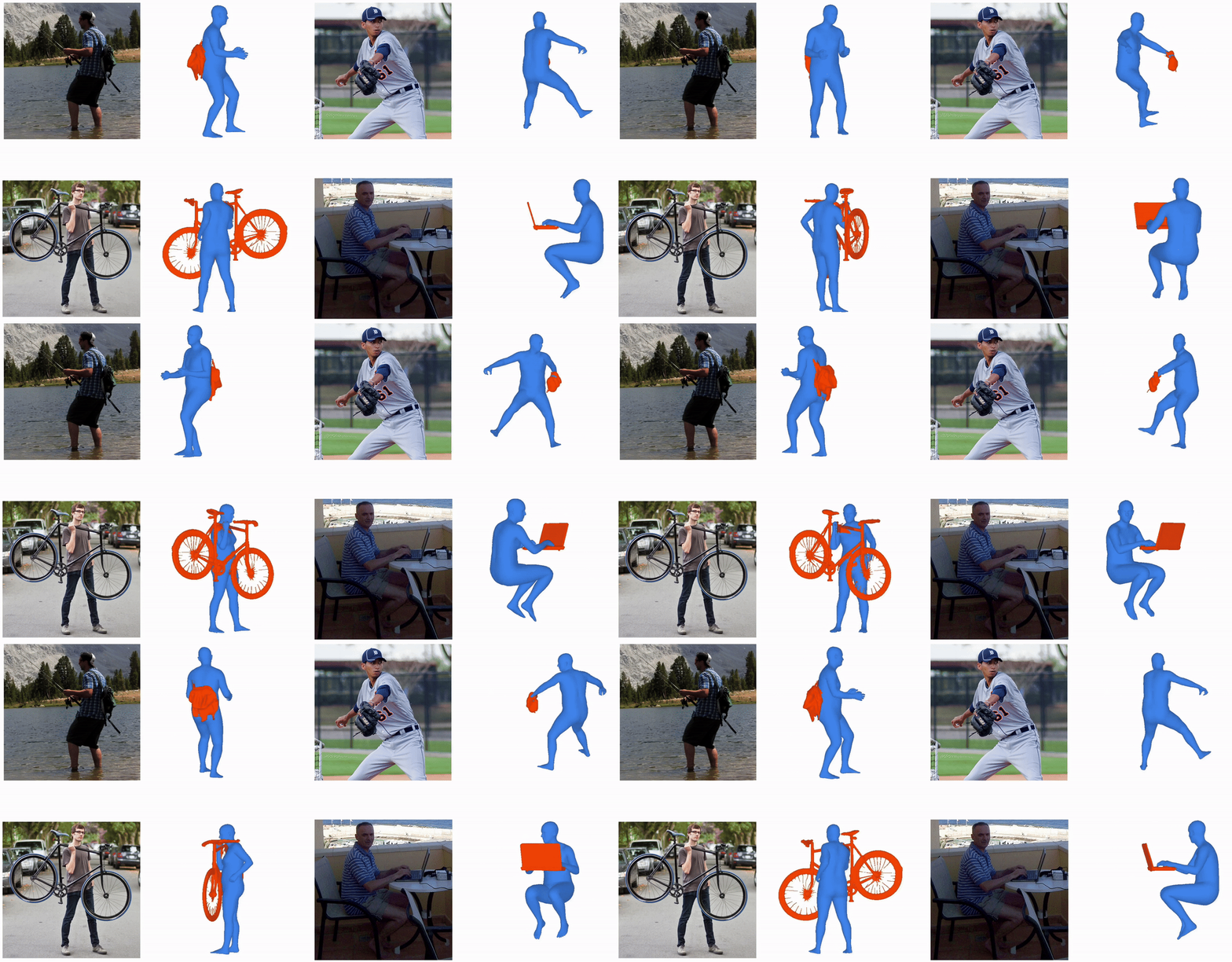
MILO reconstructs detailed 3D human–object interactions (HOI) from a single RGB image. The key idea is to use a Large Reconstruction Model - Hunyuan3D-2.0 by default, or SAM 3D Objects with --lrm sam3d - as a geometric scaffold that jointly reconstructs the person and the object, preserving their relative arrangement. Instead of relying on reprojection objectives or ground-truth contact, MILO interprets the LRM mesh:
MILO achieves state-of-the-art accuracy on InterCap, HODome and IMHD², and works on in-the-wild images - without ground-truth contact. Pipeline details: docs/PIPELINE.md.
See docs/INSTALL.md, then download the model weights per docs/DATA.md.
Run the full pipeline on the bundled example (a person with a trolley):
python milo/pipeline/run_pipeline.py --data_root demo --seq example --object "trolley" \
    --object_prompt "a green trolleycase"
The final meshes (fitted_human.obj, segmented_object.obj) and a render
(render_human_object.png) land at the top of demo/example/; intermediates are collated
into demo/example/intermediate_results/. Add --template demo/example/template.obj to
also align the object template.
--object is a short single-word label (keys mask filenames); --object_prompt is a
descriptive noun phrase for SAM 3 grounding. The only required per-sequence input is the
RGB image - missing masks are auto-generated, but providing your own is recommended when
an image contains several people/objects. Details: milo/pipeline/README.md.
Full pipeline over every sequence folder under a data root (add --seq <name> for one sequence):
python milo/pipeline/run_pipeline.py \
    --data_root /path/to/data_root \
    --object "chair" \
    --object_prompt "a wooden chair" \
    --filter_object
Common flags: --template <mesh> (object-template alignment), --gpus 0,1,2,3 (distribute
sequences), --steps <list> (subset of steps), --pytorch3d (pytorch3d renderer),
--segmenter gsam2 (Grounded-SAM-2 instead of SAM 3), --lrm sam3d (SAM 3D Objects instead
of Hunyuan3D-2). All flags: milo/pipeline/README.md.
A single step can also be run directly:
python -m milo.pipeline.steps.init_smpl --seq_dir /path/to/<seq> --overwrite
We evaluate on InterCap, HODome and IMHD², with qualitative results on the in-the-wild PICO-db. See the paper for protocols.
The frames per dataset are listed in milo/eval/splits/<dataset>_test.txt. milo/eval/prepare_dataset.py converts an official dataset release into the per-sequence layout, and writes a job script:
python milo/eval/prepare_dataset.py intercap --raw_root /path/to/InterCap      --out_root <data_root>  # GPU (gt_human fit)
python milo/eval/prepare_dataset.py hodome   --raw_root /path/to/HODome        --out_root <data_root>
python milo/eval/prepare_dataset.py imhd     --raw_root /path/to/IMHD-Dataset  --out_root <data_root>
bash run_<dataset>_eval.sh                              # run the pipeline on every sequence
bash scripts/eval_results.sh --data_root <data_root>    # score it
For HODome / IMHD² the GT human forward pass needs the official SMPL+H neutral/model.npz at _DATA/body_models/smplh/neutral/model.npz. For InterCap, gt_human.obj is the dataset's shipped SMPL-X GT fitted to SMPL-H (deformation transfer + gendered LBFGS fit, done inline by prepare_dataset.py intercap); this needs a GPU and the registration-gated SMPL-X→SMPL+H setup - fetch it with bash scripts/setup_transfer_data.sh (register at smpl-x.is.tue.mpg.de first).
Metrics. scripts/eval_results.sh reports the Procrustes-Aligned Chamfer Distance (PA-CD in the paper) for the human, object and combined reconstruction - CD_h, CD_o, CD_comb - per sequence and averaged. Two metrics are printed when their inputs are available:
icp - object = filtered_h3d_obj_pc.obj (the LRM point cloud); human-aligned Fast-Robust-ICP + SLERP. Uses the vendored FRICP binary (built by scripts/install_milo.sh).template - object = aligned_template.obj; a single Procrustes of the combined human+object to GT (needs the optional template steps, no FRICP).Each sequence folder needs fitted_human.obj, one of the object predictions above, gt_human.obj (SMPL-H, vertex-corresponded to the prediction) and gt_object.obj (mesh with faces):
bash scripts/eval_results.sh --data_root demo              # print the metric table
bash scripts/eval_results.sh --data_root demo --save_mesh  # also write <seq>/eval/combined_aligned_{icp,template}.obj
This research was supported by NSF-2504906, and 2544200; gifts from Adobe, Google, and Nvidia; and computing support on the Vista GPU Cluster through the Center for Generative AI (CGAI) and the Texas Advanced Computing Center (TACC) at the University of Texas at Austin.
MILO builds on excellent prior work and open-source releases: Hunyuan3D-2.0, SAM 3D Objects, HMR2.0 / 4D-Humans, HaMeR, ViTPose, SAM 3, Grounded-SAM-2, GeoAware-SC, and the SMPL-H / VPoser / MANO body models. The fitting engine derives from SLAHMR.
@inproceedings{chatterjee2026milo,
  title     = {Reconstructing Humans and Objects in Interaction using Large Reconstruction Models},
  author    = {Chatterjee, Agniv and Pavlakos, Georgios},
  booktitle = {European Conference on Computer Vision (ECCV)},
  year      = {2026}
}
This code is released under the MIT License. The third-party submodules and the SMPL-H / SMPL-X / VPoser / MANO body models keep their own licenses - the body models require registration.
Official implementation of "Reconstructing Humans and Objects in Interaction using Large Reconstruction Models" (ECCV 2026).
MILO reconstructs detailed 3D human–object interactions (HOI) from a single RGB image. The key idea is to use a Large Reconstruction Model - Hunyuan3D-2.0 by default, or SAM 3D Objects with --lrm sam3d - as a geometric scaffold that jointly reconstructs the person and the object, preserving their relative arrangement. Instead of relying on reprojection objectives or ground-truth contact, MILO interprets the LRM mesh:
MILO achieves state-of-the-art accuracy on InterCap, HODome and IMHD², and works on in-the-wild images - without ground-truth contact. Pipeline details: docs/PIPELINE.md.
See docs/INSTALL.md, then download the model weights per docs/DATA.md.
Run the full pipeline on the bundled example (a person with a trolley):
python milo/pipeline/run_pipeline.py --data_root demo --seq example --object "trolley" \
    --object_prompt "a green trolleycase"
The final meshes (fitted_human.obj, segmented_object.obj) and a render
(render_human_object.png) land at the top of demo/example/; intermediates are collated
into demo/example/intermediate_results/. Add --template demo/example/template.obj to
also align the object template.
--object is a short single-word label (keys mask filenames); --object_prompt is a
descriptive noun phrase for SAM 3 grounding. The only required per-sequence input is the
RGB image - missing masks are auto-generated, but providing your own is recommended when
an image contains several people/objects. Details: milo/pipeline/README.md.
Full pipeline over every sequence folder under a data root (add --seq <name> for one sequence):
python milo/pipeline/run_pipeline.py \
    --data_root /path/to/data_root \
    --object "chair" \
    --object_prompt "a wooden chair" \
    --filter_object
Common flags: --template <mesh> (object-template alignment), --gpus 0,1,2,3 (distribute
sequences), --steps <list> (subset of steps), --pytorch3d (pytorch3d renderer),
--segmenter gsam2 (Grounded-SAM-2 instead of SAM 3), --lrm sam3d (SAM 3D Objects instead
of Hunyuan3D-2). All flags: milo/pipeline/README.md.
A single step can also be run directly:
python -m milo.pipeline.steps.init_smpl --seq_dir /path/to/<seq> --overwrite
We evaluate on InterCap, HODome and IMHD², with qualitative results on the in-the-wild PICO-db. See the paper for protocols.
The frames per dataset are listed in milo/eval/splits/<dataset>_test.txt. milo/eval/prepare_dataset.py converts an official dataset release into the per-sequence layout, and writes a job script:
python milo/eval/prepare_dataset.py intercap --raw_root /path/to/InterCap      --out_root <data_root>  # GPU (gt_human fit)
python milo/eval/prepare_dataset.py hodome   --raw_root /path/to/HODome        --out_root <data_root>
python milo/eval/prepare_dataset.py imhd     --raw_root /path/to/IMHD-Dataset  --out_root <data_root>
bash run_<dataset>_eval.sh                              # run the pipeline on every sequence
bash scripts/eval_results.sh --data_root <data_root>    # score it
For HODome / IMHD² the GT human forward pass needs the official SMPL+H neutral/model.npz at _DATA/body_models/smplh/neutral/model.npz. For InterCap, gt_human.obj is the dataset's shipped SMPL-X GT fitted to SMPL-H (deformation transfer + gendered LBFGS fit, done inline by prepare_dataset.py intercap); this needs a GPU and the registration-gated SMPL-X→SMPL+H setup - fetch it with bash scripts/setup_transfer_data.sh (register at smpl-x.is.tue.mpg.de first).
Metrics. scripts/eval_results.sh reports the Procrustes-Aligned Chamfer Distance (PA-CD in the paper) for the human, object and combined reconstruction - CD_h, CD_o, CD_comb - per sequence and averaged. Two metrics are printed when their inputs are available:
icp - object = filtered_h3d_obj_pc.obj (the LRM point cloud); human-aligned Fast-Robust-ICP + SLERP. Uses the vendored FRICP binary (built by scripts/install_milo.sh).template - object = aligned_template.obj; a single Procrustes of the combined human+object to GT (needs the optional template steps, no FRICP).Each sequence folder needs fitted_human.obj, one of the object predictions above, gt_human.obj (SMPL-H, vertex-corresponded to the prediction) and gt_object.obj (mesh with faces):
bash scripts/eval_results.sh --data_root demo              # print the metric table
bash scripts/eval_results.sh --data_root demo --save_mesh  # also write <seq>/eval/combined_aligned_{icp,template}.obj
This research was supported by NSF-2504906, and 2544200; gifts from Adobe, Google, and Nvidia; and computing support on the Vista GPU Cluster through the Center for Generative AI (CGAI) and the Texas Advanced Computing Center (TACC) at the University of Texas at Austin.
MILO builds on excellent prior work and open-source releases: Hunyuan3D-2.0, SAM 3D Objects, HMR2.0 / 4D-Humans, HaMeR, ViTPose, SAM 3, Grounded-SAM-2, GeoAware-SC, and the SMPL-H / VPoser / MANO body models. The fitting engine derives from SLAHMR.
@inproceedings{chatterjee2026milo,
  title     = {Reconstructing Humans and Objects in Interaction using Large Reconstruction Models},
  author    = {Chatterjee, Agniv and Pavlakos, Georgios},
  booktitle = {European Conference on Computer Vision (ECCV)},
  year      = {2026}
}
This code is released under the MIT License. The third-party submodules and the SMPL-H / SMPL-X / VPoser / MANO body models keep their own licenses - the body models require registration.



