
Go-first framework for dependable AI agents: typed dependencies and outputs, explicit tools, composable models, observable runs
See the codeSee what people are saying
README
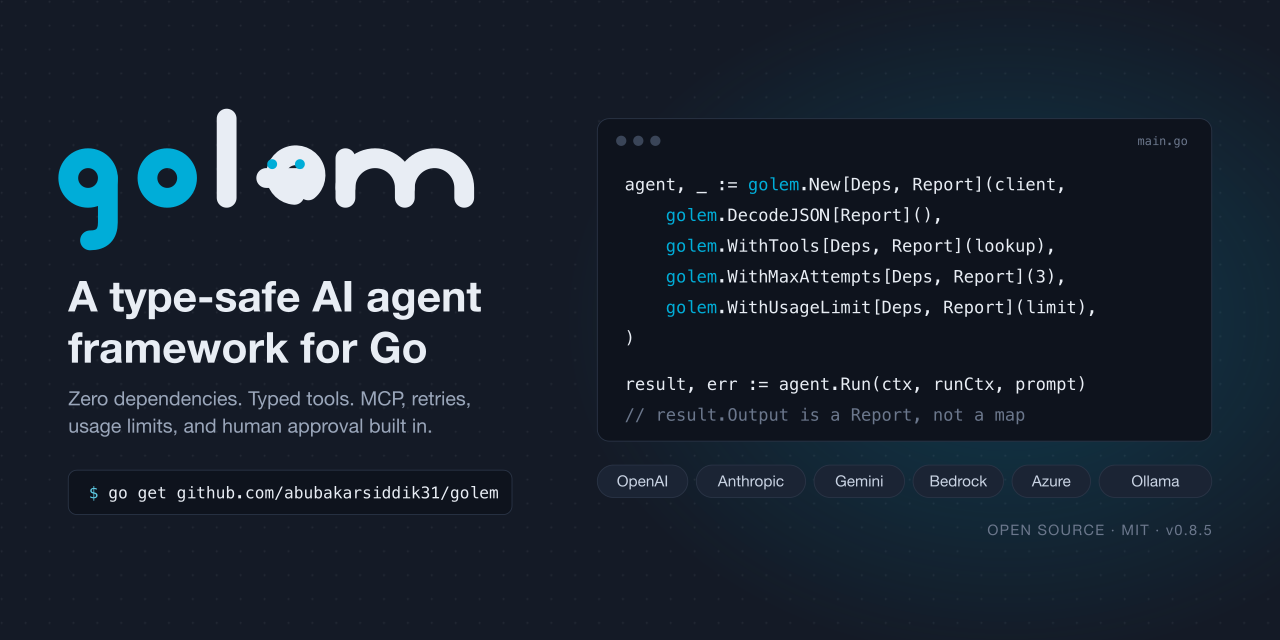
A Go-first framework for building dependable, production-grade AI agents.
Compile-time type safety, zero external dependencies, explicit execution control, and deep MCP integration.


-brightgreen.svg)


Read the Documentation »
Why Golem? •
Quick Start •
Supported Providers •
Architecture •
Common Tools & MCP •
Testing •
Guides Index •
Examples •
Contributing
Why Golem?
Python frameworks like Pydantic AI made agent prototyping accessible with typed schemas and clean ergonomics. However, deploying AI agents to mission-critical production systems demands the strengths of Go: high-throughput concurrency, predictable memory usage, fast execution, small deployment binaries, and compile-time correctness.
Golem bridges that gap by offering idiomatic, enterprise-ready agent abstractions designed specifically for Go engineers:
- 🛡️ Compile-Time Type Safety & Generics: Agents are declared as
Agent[Deps, Output]. Tools access strongly-typed dependencies (databases, auth contexts, HTTP clients) viaRunContext[Deps]. Nomap[string]anyspaghetti or unexpected runtime reflection errors. - 📦 Zero External Dependencies: Built exclusively on Go's standard library. Instant compilation, tiny container images, and a clean security profile free of supply-chain vulnerabilities.
- 🌐 Provider Agnostic: Native adapters for OpenAI, Anthropic (with prompt caching and thinking signatures), Google Gemini, AWS Bedrock (Converse API with SigV4), Azure OpenAI, and local offline models with Ollama and LM Studio.
- 🔌 Native Model Context Protocol (MCP): Full-featured MCP client supporting both
stdioand streaming HTTP transports, effortlessly turning external MCP servers into typed agent tools. - 🔄 Production Resilience & Self-Correction: In-loop model self-correction (
ModelRetry), automated multi-model fallbacks, exponential backoff, per-tool deadlines, and clean in-tool cancellation (tool.Canceled). - 📊 Auditable & Observable Evidence: Every run produces normalized messages, durable additive JSON, live streamable run events, reasoning/thinking token capture, and
RunError.Partial—preserving all intermediate tool results even when a run fails or gets cancelled. - ⏸️ Human-in-the-Loop & Deferred Execution: Pause agent runs cleanly when tools require human sign-off or external async triggers, and resume deterministically with full preserved state.
- 🛠️ Batteries-Included Tooling: Layout-aware PDF extraction (
pdfextract), multi-format document extraction (docextract: Word, Excel, PowerPoint, Markdown, CSV), SSR web reader (webfetch), workspace file accessor (fileread), shell command execution (shell), and Agent Skills progressive loading (skills). - 💰 Budget & Cost Guards: Pre-send token estimation, token-budgeted history truncation, client-side untrusted history sanitization (
SanitizeHistory), and user-defined price tables to calculate and cap dollar costs per run.
Architecture
Golem orchestrates agents through a transparent, observable execution loop:
                         ┌────────────────────────────────────────┐
                         │         golem.RunContext[Deps]         │
                         │        (Typed Run Dependencies)        │
                         └───────────────────┬────────────────────┘
                                             ▼
┌─────────────────┐          ┌───────────────────────────────┐          ┌─────────────────┐
│     Prompt      │ ───────► │     golem.Agent[Deps, Out]    │ ───────► │  Typed Output   │
│ (Text, Images,  │          │                               │          │  Result[Output] │
│ Docs, Audio)    │          │  ┌─────────────────────────┐  │          └─────────────────┘
└─────────────────┘          │  │ Observable Loop         │  │                   │
                             │  │ - Self-Correction       │  │                   ▼
                             │  │ - Retries & Fallbacks   │  │          ┌─────────────────┐
                             │  │ - Token & Cost Bounds   │  │          │ Durable Evidence│
                             │  │ - Run Events Stream     │  │          │ (Messages, Cost,│
                             │  └────────────┬────────────┘  │          │  Token Usage)   │
                             └───────────────┼───────────────┘          └─────────────────┘
                                             │
                      ┌──────────────────────┴──────────────────────┐
                      ▼                                             ▼
        ┌───────────────────────────┐                 ┌───────────────────────────┐
        │      Model Adapters       │                 │      Tools & Protocols    │
        │  • OpenAI & Azure OpenAI  │                 │  • Strongly Typed Tools   │
        │  • Anthropic Claude       │                 │  • MCP Client (stdio/HTTP)│
        │  • Google Gemini          │                 │  • PDF & Doc Extractors   │
        │  • AWS Bedrock (SigV4)    │                 │  • Web Fetch & Shell      │
        │  • Local (Ollama/LMStudio)│                 │  • Agent Skills (SKILL.md)│
        └───────────────────────────┘                 └───────────────────────────┘
Installation
go get github.com/abubakarsiddik31/golem
Requires Go 1.26.5 or newer. Zero external dependencies.
Quick Start
1. Minimal Agent
Initialize a model adapter, create a typed agent, and execute a prompt:
package main

import (
	"context"
	"fmt"
	"os"

	"github.com/abubakarsiddik31/golem"
	"github.com/abubakarsiddik31/golem/model"
	"github.com/abubakarsiddik31/golem/providers/openai"
)

func main() {
	client, err := openai.New(openai.Config{
		APIKey: os.Getenv("OPENAI_API_KEY"),
		Model:  "gpt-4o-mini",
	})
	if err != nil {
		panic(err)
	}

	agent, err := golem.New[struct{}, string](client,
		golem.DecodeFunc[string](func(_ context.Context, r model.Response) (string, error) {
			return r.Message.Content, nil
		}),
	)
	if err != nil {
		panic(err)
	}

	result, err := agent.Run(context.Background(), golem.RunContext[struct{}]{}, "Why is Go ideal for AI agents?")
	if err != nil {
		panic(err)
	}

	fmt.Println(result.Output)
	fmt.Printf("Tokens: %d input, %d output\n", result.Usage.InputTokens, result.Usage.OutputTokens)
}
2. Typed Tools with Dependency Injection
Golem tools are strongly typed and receive dependencies via RunContext[Deps]. No global state, no untyped maps:
type Database struct {
	Users map[int]string
}

// Declare a tool typed to Database dependencies
getUser := tool.MustNew(tool.Tool[Database]{
	Name:        "get_user",
	Description: "Look up a user name by their ID.",
	Schema: json.RawMessage(`{
		"type": "object",
		"properties": {"id": {"type": "integer"}},
		"required": ["id"]
	}`),
	Exec: func(ctx context.Context, db Database, args json.RawMessage) (tool.Result, error) {
		var input struct {
			ID int `json:"id"`
		}
		if err := json.Unmarshal(args, &input); err != nil {
			return tool.Result{}, err
		}
		name, ok := db.Users[input.ID]
		if !ok {
			return tool.Text("User not found"), nil
		}
		return tool.Text(name), nil
	},
})

// Create an agent parameterized with Database dependencies
agent, err := golem.New[Database, string](client,
	golem.DecodeFunc[string](func(_ context.Context, r model.Response) (string, error) {
		return r.Message.Content, nil
	}),
	golem.WithTools[Database, string](getUser),
)

// Run passing the typed dependency instance
db := Database{Users: map[int]string{42: "Alice"}}
result, err := agent.Run(ctx, golem.RunContext[Database]{Deps: db}, "Who is user 42?")
3. Structured Output & Schema Validation
Guarantee your agent returns strongly-typed Go structs with golem.DecodeJSON[T]() and strict schema enforcement:
type WeatherReport struct {
	City        string  `json:"city"`
	Temperature float64 `json:"temperature_celsius"`
	Condition   string  `json:"condition"`
}

agent, err := golem.New[struct{}, WeatherReport](client,
	golem.DecodeJSON[WeatherReport](),
	golem.WithOutputSchema[struct{}, WeatherReport](json.RawMessage(`{
		"type": "object",
		"properties": {
			"city": {"type": "string"},
			"temperature_celsius": {"type": "number"},
			"condition": {"type": "string"}
		},
		"required": ["city", "temperature_celsius", "condition"],
		"additionalProperties": false
	}`)),
)

result, err := agent.Run(ctx, golem.RunContext[struct{}]{}, "Forecast for Lagos, Nigeria.")
fmt.Printf("%s: %.1f°C (%s)\n", result.Output.City, result.Output.Temperature, result.Output.Condition)
Supported Providers
Golem ships with standard-library-only adapters for all major frontier and open-weight models:
| Provider | Adapter Package | Streaming | Thinking / Reasoning | Multimodal | Embeddings | Token Counting |
|---|---|---|---|---|---|---|
| OpenAI | providers/openai | :white_check_mark: | :white_check_mark: | :white_check_mark: | :white_check_mark: | — |
| Anthropic | providers/anthropic | :white_check_mark: | :white_check_mark: | :white_check_mark: | — | :white_check_mark: |
| Google Gemini | providers/gemini | :white_check_mark: | :white_check_mark: | :white_check_mark: | :white_check_mark: | :white_check_mark: |
| AWS Bedrock | providers/bedrock | :white_check_mark: | :white_check_mark: | :white_check_mark: | — | :white_check_mark: |
| Azure OpenAI | providers/azure | :white_check_mark: | :white_check_mark: | :white_check_mark: | :white_check_mark: | — |
| Ollama / Local | providers/openai | :white_check_mark: | :white_check_mark: | :white_check_mark: | :white_check_mark: | — |
| OpenAI-Compatible | providers/openai | :white_check_mark: | :white_check_mark: | :white_check_mark: | :white_check_mark: | — |
Batteries-Included Tools
Golem includes pre-built common tools written entirely in pure Go:
| Package | Capability | Features |
|---|---|---|
mcp | Model Context Protocol Client | Connects to any MCP tool server over stdio or streaming HTTP (SSE). |
pdfextract | Layout-Aware PDF Extraction | High-performance PDF parser preserving reading order, layout, tables, and embedded images. |
docextract | Multi-Format Document Extraction | Extracts text and structure from Word (.docx), Excel (.xlsx), PowerPoint (.pptx), CSV, and Markdown. |
webfetch | Web Extraction | Fetches URLs and returns clean, agent-readable text without browser overhead. |
fileread | File Reader | Safe workspace file reading with path boundaries and clean formatting. |
shell | Command Execution | Isolated command execution with timeout handling and combined stdout/stderr output. |
skills | Agent Skills Loader | Discovers and loads standard SKILL.md skill folders on demand for progressive prompt enrichment. |
Testing Without a Provider
Never mock HTTP endpoints or pay for tokens in unit tests. Golem includes testmodel, a fully deterministic, offline model implementation:
package main

import (
	"context"
	"testing"

	"github.com/abubakarsiddik31/golem"
	"github.com/abubakarsiddik31/golem/model"
	"github.com/abubakarsiddik31/golem/testmodel"
)

func TestAgent(t *testing.T) {
	client := testmodel.New().Respond(
		model.Response{Message: model.Message{Role: model.RoleAssistant, Content: "pong"}},
	)

	agent, _ := golem.New[struct{}, string](client,
		golem.DecodeFunc[string](func(_ context.Context, r model.Response) (string, error) {
			return r.Message.Content, nil
		}),
	)

	result, err := agent.Run(context.Background(), golem.RunContext[struct{}]{}, "ping")
	if err != nil || result.Output != "pong" {
		t.Fatalf("unexpected result: %v, output: %s", err, result.Output)
	}
}
Documentation
The feature guides provide complete references for each capability and mirror the published documentation site at abubakarsiddik31.github.io/golem.
| Guide | Covers |
|---|---|
| Getting started | The smallest agent, result shape, error stages |
| Providers | OpenAI-compatible and Anthropic adapters, error classification |
| Embeddings | The embedding.Embedder port: queries, documents, usage |
| Token counting | The tokens.Counter port: budgets, pre-send limits |
| Cost | User-supplied pricing: Result.Cost and cost bounds |
| Tools and dependencies | Typed tools, dependencies, and controlled parallel execution |
| Web fetch | The webfetch common tool: URLs as agent-readable text |
| File read | The fileread common tool: workspace files as agent-readable text |
| Command execution | The shell common tool: one command, combined output |
| PDF extract | The pdfextract common tool: PDF documents as structured Markdown with tables and images |
| Document extract | The docextract common tool: Word, Excel, PowerPoint, Markdown, CSV, and multi-format documents |
| Agent skills | The skills common tool: standard SKILL.md folders loaded on demand |
| MCP client | Bridging Model Context Protocol servers into agent tools |
| Agent delegation | One agent exposed as another agent's tool |
| Tool timeouts | Context-aware deadlines for individual tool calls |
| Conversations and history | Multi-turn runs, durable message JSON, history trimming |
| Multimodal input | Images, documents, audio, and video in prompts, per-provider mapping |
| Structured output | Output schemas, tool-mode output, DecodeJSON |
| Self-correction | Output and tool rejection budgets (ModelRetry) |
| Retries | Transient model failures, backoff, fallback models |
| Streaming | RunStream, the streaming capability port, SSE adapters |
| Run events | Observing attempts, tool calls, and corrections as they happen |
| Thinking | Reasoning models: requesting thinking, keeping signatures, replay |
| Usage limits | Bounding tokens, requests, and tool calls |
| Testing without a provider | Deterministic fakes, contract assertions |
| Deferred tools | Approvals and external results: pausing a run and resuming it |
Design records live in docs/adr/; each guide links the ADR that decided its behavior.
Examples
Runnable programs live in examples/; provider-backed examples read their API key from the environment and exit cleanly with instructions when unset.
| Example | Shows |
|---|---|
minimal | Smallest agent against an OpenAI-compatible API |
tools | Typed tool with a run dependency |
structured-output | Output schema + JSON decoding |
structured-output-tool | Tool-mode structured output |
conversation | Interactive multi-turn chat with history |
streaming | RunStream printing fragments as they arrive |
run-events | WithRunEvents printing the event sequence of a run |
mcp-client | MCP server bridged into agent tools over stdio |
mcp-http | MCP server bridged over streamable HTTP |
skills | The skills common tool loading a standard SKILL.md folder |
web-fetch | The webfetch common tool fetching a local test page |
file-read | The fileread common tool reading a workspace file |
command-execution | The shell common tool running one local command |
pdf-extract | The pdfextract common tool extracting tables and reading order, offline |
doc-extract | The docextract common tool extracting Word, Excel, and Markdown, offline |
delegation | A specialist agent delegated to as a tool |
tool-results | Tools returning parts and definitive failures, offline |
self-correction | Tool rejecting correctable arguments |
fallback | Primary model with a fallback and a request bound |
token-counting | Pre-send limits and budget-bounded history over the tokens.Counter port |
cost | User-supplied pricing: Result.Cost and cost-bounded runs, offline |
embeddings | Semantic search over the embedding.Embedder port |
multimodal-input | Prompts with images and document attachments |
thinking | Adaptive thinking with reasoning blocks and signatures |
run-cancellation | A tool ending the run deliberately with tool.Canceled, resuming evidence, offline |
run-ids | Run and conversation identity across chained and forked runs, offline |
deferred-tools | Pausing runs for approvals or external results, and resuming, offline |
partial-evidence | A failed run's RunError.Partial evidence resumed with history, offline |
history-repair | Normalizing a damaged conversation with a report, offline |
history-sanitization | Sanitizing a client-submitted history at the trust boundary, offline |
anthropic | Anthropic Messages API adapter |
gemini | Google Gemini GenerateContent adapter |
azure | Azure OpenAI deployment adapter |
bedrock | AWS Bedrock Converse adapter with SigV4 |
local-models | Ollama or LM Studio through the OpenAI-compatible adapter |
testing-without-a-provider | Scripted fake model, offline and deterministic |
To run any example:
# Run with OpenAI
OPENAI_API_KEY=sk-... go run ./examples/minimal

# Run locally with Ollama or LM Studio
GOLEM_LOCAL_BASE_URL=http://localhost:11434/v1 go run ./examples/local-models

# Run offline examples (no credentials needed)
go run ./examples/testing-without-a-provider
go run ./examples/pdf-extract
go run ./examples/deferred-tools
go run ./examples/partial-evidence
Package Structure
golem/        Agent configuration and typed run API
model/        Provider-neutral model request/response contract
tool/         Tool declarations and execution contracts
mcp/          Model Context Protocol client (stdio & streaming HTTP)
pdfextract/   Common tool: layout-aware PDF parser (tables, images, text)
docextract/   Common tool: Word, Excel, PowerPoint, CSV, and Markdown extractor
webfetch/     Common tool: fetch a URL as agent-readable text
fileread/     Common tool: read a file as agent-readable text
shell/        Common tool: run one command, return combined output
skills/       Common tool: standard SKILL.md folder progressive loader
providers/    Stdlib-only adapters implementing model.Model
testmodel/    Deterministic in-memory model doubles for unit testing
internal/     Execution runner loop and private mechanics
examples/     Runnable programs per capability
docs/guides/  Feature guides (source of truth for behavior)
docs/adr/     Decisions that shape public contracts
Status & Roadmap
Golem is currently at v0.8.5.
The core execution contract is frozen and verified with continuous race-detector CI, memory fuzzing, and deterministic offline tests. The public API adheres strictly to additive-only changes on the road to v1.0.0.
- Resilient Execution: Self-correction loops (
ModelRetry), fallback models, exponential backoff, per-tool timeouts, in-tool cancellation (tool.Canceled), and partial evidence preservation (RunError.Partial). - Comprehensive Multimodal: Text, images, PDF documents, audio, and video inputs mapped natively across all model adapters.
- Observability & Durability: Normalized conversation messages, durable additive JSON serialization, reasoning/thinking token capture with provider signatures, and streamable run events.
- Production Guardrails: Pre-send token estimation, token-budgeted history truncation, client-side untrusted history sanitization (
SanitizeHistory), history repair (NormalizeHistory), and user-configurable cost/token bounding. - Rich Tool Ecosystem: First-class Model Context Protocol (MCP) client over stdio and HTTP, layout-aware PDF extraction, multi-format doc parsing, sandboxed shell execution, SSR web fetch, and progressive Agent Skills loading.
- Zero Dependencies: Built exclusively on the Go standard library.
For architecture rationale, read the foundation brief. For upcoming milestones, read the development roadmap.
Development
Run the test suite and verification checks:
go test ./...
go test -race ./...
go vet ./...
The feature guides publish as the official documentation site; preview it locally with mkdocs serve (see docs/website.md). Brand assets and guidelines live in assets/brand/.
Community & Contributing
Golem is an open-source project and actively welcomes community contributions!
- Good First Issues — approachable issues scoped for newcomers
- Roadmap to v1.0.0 — roadmap progress, open items, and design decisions
- GitHub Discussions — ask questions, share architectures, and propose RFCs
- Contributing Guide — instructions for setting up, running checks, and submitting changes
- Security Policy — guidelines for privately reporting vulnerabilities
- Code of Conduct — standards for participation
License
Released under the MIT License.
Similar repos





Go-first framework for dependable AI agents: typed dependencies and outputs, explicit tools, composable models, observable runs
See the codeSee what people are saying
README
A Go-first framework for building dependable, production-grade AI agents.
Compile-time type safety, zero external dependencies, explicit execution control, and deep MCP integration.
Read the Documentation »
Why Golem? •
Quick Start •
Supported Providers •
Architecture •
Common Tools & MCP •
Testing •
Guides Index •
Examples •
Contributing
Why Golem?
Python frameworks like Pydantic AI made agent prototyping accessible with typed schemas and clean ergonomics. However, deploying AI agents to mission-critical production systems demands the strengths of Go: high-throughput concurrency, predictable memory usage, fast execution, small deployment binaries, and compile-time correctness.
Golem bridges that gap by offering idiomatic, enterprise-ready agent abstractions designed specifically for Go engineers:
- 🛡️ Compile-Time Type Safety & Generics: Agents are declared as
Agent[Deps, Output]. Tools access strongly-typed dependencies (databases, auth contexts, HTTP clients) viaRunContext[Deps]. Nomap[string]anyspaghetti or unexpected runtime reflection errors. - 📦 Zero External Dependencies: Built exclusively on Go's standard library. Instant compilation, tiny container images, and a clean security profile free of supply-chain vulnerabilities.
- 🌐 Provider Agnostic: Native adapters for OpenAI, Anthropic (with prompt caching and thinking signatures), Google Gemini, AWS Bedrock (Converse API with SigV4), Azure OpenAI, and local offline models with Ollama and LM Studio.
- 🔌 Native Model Context Protocol (MCP): Full-featured MCP client supporting both
stdioand streaming HTTP transports, effortlessly turning external MCP servers into typed agent tools. - 🔄 Production Resilience & Self-Correction: In-loop model self-correction (
ModelRetry), automated multi-model fallbacks, exponential backoff, per-tool deadlines, and clean in-tool cancellation (tool.Canceled). - 📊 Auditable & Observable Evidence: Every run produces normalized messages, durable additive JSON, live streamable run events, reasoning/thinking token capture, and
RunError.Partial—preserving all intermediate tool results even when a run fails or gets cancelled. - ⏸️ Human-in-the-Loop & Deferred Execution: Pause agent runs cleanly when tools require human sign-off or external async triggers, and resume deterministically with full preserved state.
- 🛠️ Batteries-Included Tooling: Layout-aware PDF extraction (
pdfextract), multi-format document extraction (docextract: Word, Excel, PowerPoint, Markdown, CSV), SSR web reader (webfetch), workspace file accessor (fileread), shell command execution (shell), and Agent Skills progressive loading (skills). - 💰 Budget & Cost Guards: Pre-send token estimation, token-budgeted history truncation, client-side untrusted history sanitization (
SanitizeHistory), and user-defined price tables to calculate and cap dollar costs per run.
Architecture
Golem orchestrates agents through a transparent, observable execution loop:
                         ┌────────────────────────────────────────┐
                         │         golem.RunContext[Deps]         │
                         │        (Typed Run Dependencies)        │
                         └───────────────────┬────────────────────┘
                                             ▼
┌─────────────────┐          ┌───────────────────────────────┐          ┌─────────────────┐
│     Prompt      │ ───────► │     golem.Agent[Deps, Out]    │ ───────► │  Typed Output   │
│ (Text, Images,  │          │                               │          │  Result[Output] │
│ Docs, Audio)    │          │  ┌─────────────────────────┐  │          └─────────────────┘
└─────────────────┘          │  │ Observable Loop         │  │                   │
                             │  │ - Self-Correction       │  │                   ▼
                             │  │ - Retries & Fallbacks   │  │          ┌─────────────────┐
                             │  │ - Token & Cost Bounds   │  │          │ Durable Evidence│
                             │  │ - Run Events Stream     │  │          │ (Messages, Cost,│
                             │  └────────────┬────────────┘  │          │  Token Usage)   │
                             └───────────────┼───────────────┘          └─────────────────┘
                                             │
                      ┌──────────────────────┴──────────────────────┐
                      ▼                                             ▼
        ┌───────────────────────────┐                 ┌───────────────────────────┐
        │      Model Adapters       │                 │      Tools & Protocols    │
        │  • OpenAI & Azure OpenAI  │                 │  • Strongly Typed Tools   │
        │  • Anthropic Claude       │                 │  • MCP Client (stdio/HTTP)│
        │  • Google Gemini          │                 │  • PDF & Doc Extractors   │
        │  • AWS Bedrock (SigV4)    │                 │  • Web Fetch & Shell      │
        │  • Local (Ollama/LMStudio)│                 │  • Agent Skills (SKILL.md)│
        └───────────────────────────┘                 └───────────────────────────┘
Installation
go get github.com/abubakarsiddik31/golem
Requires Go 1.26.5 or newer. Zero external dependencies.
Quick Start
1. Minimal Agent
Initialize a model adapter, create a typed agent, and execute a prompt:
package main

import (
	"context"
	"fmt"
	"os"

	"github.com/abubakarsiddik31/golem"
	"github.com/abubakarsiddik31/golem/model"
	"github.com/abubakarsiddik31/golem/providers/openai"
)

func main() {
	client, err := openai.New(openai.Config{
		APIKey: os.Getenv("OPENAI_API_KEY"),
		Model:  "gpt-4o-mini",
	})
	if err != nil {
		panic(err)
	}

	agent, err := golem.New[struct{}, string](client,
		golem.DecodeFunc[string](func(_ context.Context, r model.Response) (string, error) {
			return r.Message.Content, nil
		}),
	)
	if err != nil {
		panic(err)
	}

	result, err := agent.Run(context.Background(), golem.RunContext[struct{}]{}, "Why is Go ideal for AI agents?")
	if err != nil {
		panic(err)
	}

	fmt.Println(result.Output)
	fmt.Printf("Tokens: %d input, %d output\n", result.Usage.InputTokens, result.Usage.OutputTokens)
}
2. Typed Tools with Dependency Injection
Golem tools are strongly typed and receive dependencies via RunContext[Deps]. No global state, no untyped maps:
type Database struct {
	Users map[int]string
}

// Declare a tool typed to Database dependencies
getUser := tool.MustNew(tool.Tool[Database]{
	Name:        "get_user",
	Description: "Look up a user name by their ID.",
	Schema: json.RawMessage(`{
		"type": "object",
		"properties": {"id": {"type": "integer"}},
		"required": ["id"]
	}`),
	Exec: func(ctx context.Context, db Database, args json.RawMessage) (tool.Result, error) {
		var input struct {
			ID int `json:"id"`
		}
		if err := json.Unmarshal(args, &input); err != nil {
			return tool.Result{}, err
		}
		name, ok := db.Users[input.ID]
		if !ok {
			return tool.Text("User not found"), nil
		}
		return tool.Text(name), nil
	},
})

// Create an agent parameterized with Database dependencies
agent, err := golem.New[Database, string](client,
	golem.DecodeFunc[string](func(_ context.Context, r model.Response) (string, error) {
		return r.Message.Content, nil
	}),
	golem.WithTools[Database, string](getUser),
)

// Run passing the typed dependency instance
db := Database{Users: map[int]string{42: "Alice"}}
result, err := agent.Run(ctx, golem.RunContext[Database]{Deps: db}, "Who is user 42?")
3. Structured Output & Schema Validation
Guarantee your agent returns strongly-typed Go structs with golem.DecodeJSON[T]() and strict schema enforcement:
type WeatherReport struct {
	City        string  `json:"city"`
	Temperature float64 `json:"temperature_celsius"`
	Condition   string  `json:"condition"`
}

agent, err := golem.New[struct{}, WeatherReport](client,
	golem.DecodeJSON[WeatherReport](),
	golem.WithOutputSchema[struct{}, WeatherReport](json.RawMessage(`{
		"type": "object",
		"properties": {
			"city": {"type": "string"},
			"temperature_celsius": {"type": "number"},
			"condition": {"type": "string"}
		},
		"required": ["city", "temperature_celsius", "condition"],
		"additionalProperties": false
	}`)),
)

result, err := agent.Run(ctx, golem.RunContext[struct{}]{}, "Forecast for Lagos, Nigeria.")
fmt.Printf("%s: %.1f°C (%s)\n", result.Output.City, result.Output.Temperature, result.Output.Condition)
Supported Providers
Golem ships with standard-library-only adapters for all major frontier and open-weight models:
| Provider | Adapter Package | Streaming | Thinking / Reasoning | Multimodal | Embeddings | Token Counting |
|---|---|---|---|---|---|---|
| OpenAI | providers/openai | :white_check_mark: | :white_check_mark: | :white_check_mark: | :white_check_mark: | — |
| Anthropic | providers/anthropic | :white_check_mark: | :white_check_mark: | :white_check_mark: | — | :white_check_mark: |
| Google Gemini | providers/gemini | :white_check_mark: | :white_check_mark: | :white_check_mark: | :white_check_mark: | :white_check_mark: |
| AWS Bedrock | providers/bedrock | :white_check_mark: | :white_check_mark: | :white_check_mark: | — | :white_check_mark: |
| Azure OpenAI | providers/azure | :white_check_mark: | :white_check_mark: | :white_check_mark: | :white_check_mark: | — |
| Ollama / Local | providers/openai | :white_check_mark: | :white_check_mark: | :white_check_mark: | :white_check_mark: | — |
| OpenAI-Compatible | providers/openai | :white_check_mark: | :white_check_mark: | :white_check_mark: | :white_check_mark: | — |
Batteries-Included Tools
Golem includes pre-built common tools written entirely in pure Go:
| Package | Capability | Features |
|---|---|---|
mcp | Model Context Protocol Client | Connects to any MCP tool server over stdio or streaming HTTP (SSE). |
pdfextract | Layout-Aware PDF Extraction | High-performance PDF parser preserving reading order, layout, tables, and embedded images. |
docextract | Multi-Format Document Extraction | Extracts text and structure from Word (.docx), Excel (.xlsx), PowerPoint (.pptx), CSV, and Markdown. |
webfetch | Web Extraction | Fetches URLs and returns clean, agent-readable text without browser overhead. |
fileread | File Reader | Safe workspace file reading with path boundaries and clean formatting. |
shell | Command Execution | Isolated command execution with timeout handling and combined stdout/stderr output. |
skills | Agent Skills Loader | Discovers and loads standard SKILL.md skill folders on demand for progressive prompt enrichment. |
Testing Without a Provider
Never mock HTTP endpoints or pay for tokens in unit tests. Golem includes testmodel, a fully deterministic, offline model implementation:
package main

import (
	"context"
	"testing"

	"github.com/abubakarsiddik31/golem"
	"github.com/abubakarsiddik31/golem/model"
	"github.com/abubakarsiddik31/golem/testmodel"
)

func TestAgent(t *testing.T) {
	client := testmodel.New().Respond(
		model.Response{Message: model.Message{Role: model.RoleAssistant, Content: "pong"}},
	)

	agent, _ := golem.New[struct{}, string](client,
		golem.DecodeFunc[string](func(_ context.Context, r model.Response) (string, error) {
			return r.Message.Content, nil
		}),
	)

	result, err := agent.Run(context.Background(), golem.RunContext[struct{}]{}, "ping")
	if err != nil || result.Output != "pong" {
		t.Fatalf("unexpected result: %v, output: %s", err, result.Output)
	}
}
Documentation
The feature guides provide complete references for each capability and mirror the published documentation site at abubakarsiddik31.github.io/golem.
| Guide | Covers |
|---|---|
| Getting started | The smallest agent, result shape, error stages |
| Providers | OpenAI-compatible and Anthropic adapters, error classification |
| Embeddings | The embedding.Embedder port: queries, documents, usage |
| Token counting | The tokens.Counter port: budgets, pre-send limits |
| Cost | User-supplied pricing: Result.Cost and cost bounds |
| Tools and dependencies | Typed tools, dependencies, and controlled parallel execution |
| Web fetch | The webfetch common tool: URLs as agent-readable text |
| File read | The fileread common tool: workspace files as agent-readable text |
| Command execution | The shell common tool: one command, combined output |
| PDF extract | The pdfextract common tool: PDF documents as structured Markdown with tables and images |
| Document extract | The docextract common tool: Word, Excel, PowerPoint, Markdown, CSV, and multi-format documents |
| Agent skills | The skills common tool: standard SKILL.md folders loaded on demand |
| MCP client | Bridging Model Context Protocol servers into agent tools |
| Agent delegation | One agent exposed as another agent's tool |
| Tool timeouts | Context-aware deadlines for individual tool calls |
| Conversations and history | Multi-turn runs, durable message JSON, history trimming |
| Multimodal input | Images, documents, audio, and video in prompts, per-provider mapping |
| Structured output | Output schemas, tool-mode output, DecodeJSON |
| Self-correction | Output and tool rejection budgets (ModelRetry) |
| Retries | Transient model failures, backoff, fallback models |
| Streaming | RunStream, the streaming capability port, SSE adapters |
| Run events | Observing attempts, tool calls, and corrections as they happen |
| Thinking | Reasoning models: requesting thinking, keeping signatures, replay |
| Usage limits | Bounding tokens, requests, and tool calls |
| Testing without a provider | Deterministic fakes, contract assertions |
| Deferred tools | Approvals and external results: pausing a run and resuming it |
Design records live in docs/adr/; each guide links the ADR that decided its behavior.
Examples
Runnable programs live in examples/; provider-backed examples read their API key from the environment and exit cleanly with instructions when unset.
| Example | Shows |
|---|---|
minimal | Smallest agent against an OpenAI-compatible API |
tools | Typed tool with a run dependency |
structured-output | Output schema + JSON decoding |
structured-output-tool | Tool-mode structured output |
conversation | Interactive multi-turn chat with history |
streaming | RunStream printing fragments as they arrive |
run-events | WithRunEvents printing the event sequence of a run |
mcp-client | MCP server bridged into agent tools over stdio |
mcp-http | MCP server bridged over streamable HTTP |
skills | The skills common tool loading a standard SKILL.md folder |
web-fetch | The webfetch common tool fetching a local test page |
file-read | The fileread common tool reading a workspace file |
command-execution | The shell common tool running one local command |
pdf-extract | The pdfextract common tool extracting tables and reading order, offline |
doc-extract | The docextract common tool extracting Word, Excel, and Markdown, offline |
delegation | A specialist agent delegated to as a tool |
tool-results | Tools returning parts and definitive failures, offline |
self-correction | Tool rejecting correctable arguments |
fallback | Primary model with a fallback and a request bound |
token-counting | Pre-send limits and budget-bounded history over the tokens.Counter port |
cost | User-supplied pricing: Result.Cost and cost-bounded runs, offline |
embeddings | Semantic search over the embedding.Embedder port |
multimodal-input | Prompts with images and document attachments |
thinking | Adaptive thinking with reasoning blocks and signatures |
run-cancellation | A tool ending the run deliberately with tool.Canceled, resuming evidence, offline |
run-ids | Run and conversation identity across chained and forked runs, offline |
deferred-tools | Pausing runs for approvals or external results, and resuming, offline |
partial-evidence | A failed run's RunError.Partial evidence resumed with history, offline |
history-repair | Normalizing a damaged conversation with a report, offline |
history-sanitization | Sanitizing a client-submitted history at the trust boundary, offline |
anthropic | Anthropic Messages API adapter |
gemini | Google Gemini GenerateContent adapter |
azure | Azure OpenAI deployment adapter |
bedrock | AWS Bedrock Converse adapter with SigV4 |
local-models | Ollama or LM Studio through the OpenAI-compatible adapter |
testing-without-a-provider | Scripted fake model, offline and deterministic |
To run any example:
# Run with OpenAI
OPENAI_API_KEY=sk-... go run ./examples/minimal

# Run locally with Ollama or LM Studio
GOLEM_LOCAL_BASE_URL=http://localhost:11434/v1 go run ./examples/local-models

# Run offline examples (no credentials needed)
go run ./examples/testing-without-a-provider
go run ./examples/pdf-extract
go run ./examples/deferred-tools
go run ./examples/partial-evidence
Package Structure
golem/        Agent configuration and typed run API
model/        Provider-neutral model request/response contract
tool/         Tool declarations and execution contracts
mcp/          Model Context Protocol client (stdio & streaming HTTP)
pdfextract/   Common tool: layout-aware PDF parser (tables, images, text)
docextract/   Common tool: Word, Excel, PowerPoint, CSV, and Markdown extractor
webfetch/     Common tool: fetch a URL as agent-readable text
fileread/     Common tool: read a file as agent-readable text
shell/        Common tool: run one command, return combined output
skills/       Common tool: standard SKILL.md folder progressive loader
providers/    Stdlib-only adapters implementing model.Model
testmodel/    Deterministic in-memory model doubles for unit testing
internal/     Execution runner loop and private mechanics
examples/     Runnable programs per capability
docs/guides/  Feature guides (source of truth for behavior)
docs/adr/     Decisions that shape public contracts
Status & Roadmap
Golem is currently at v0.8.5.
The core execution contract is frozen and verified with continuous race-detector CI, memory fuzzing, and deterministic offline tests. The public API adheres strictly to additive-only changes on the road to v1.0.0.
- Resilient Execution: Self-correction loops (
ModelRetry), fallback models, exponential backoff, per-tool timeouts, in-tool cancellation (tool.Canceled), and partial evidence preservation (RunError.Partial). - Comprehensive Multimodal: Text, images, PDF documents, audio, and video inputs mapped natively across all model adapters.
- Observability & Durability: Normalized conversation messages, durable additive JSON serialization, reasoning/thinking token capture with provider signatures, and streamable run events.
- Production Guardrails: Pre-send token estimation, token-budgeted history truncation, client-side untrusted history sanitization (
SanitizeHistory), history repair (NormalizeHistory), and user-configurable cost/token bounding. - Rich Tool Ecosystem: First-class Model Context Protocol (MCP) client over stdio and HTTP, layout-aware PDF extraction, multi-format doc parsing, sandboxed shell execution, SSR web fetch, and progressive Agent Skills loading.
- Zero Dependencies: Built exclusively on the Go standard library.
For architecture rationale, read the foundation brief. For upcoming milestones, read the development roadmap.
Development
Run the test suite and verification checks:
go test ./...
go test -race ./...
go vet ./...
The feature guides publish as the official documentation site; preview it locally with mkdocs serve (see docs/website.md). Brand assets and guidelines live in assets/brand/.
Community & Contributing
Golem is an open-source project and actively welcomes community contributions!
- Good First Issues — approachable issues scoped for newcomers
- Roadmap to v1.0.0 — roadmap progress, open items, and design decisions
- GitHub Discussions — ask questions, share architectures, and propose RFCs
- Contributing Guide — instructions for setting up, running checks, and submitting changes
- Security Policy — guidelines for privately reporting vulnerabilities
- Code of Conduct — standards for participation
License
Released under the MIT License.