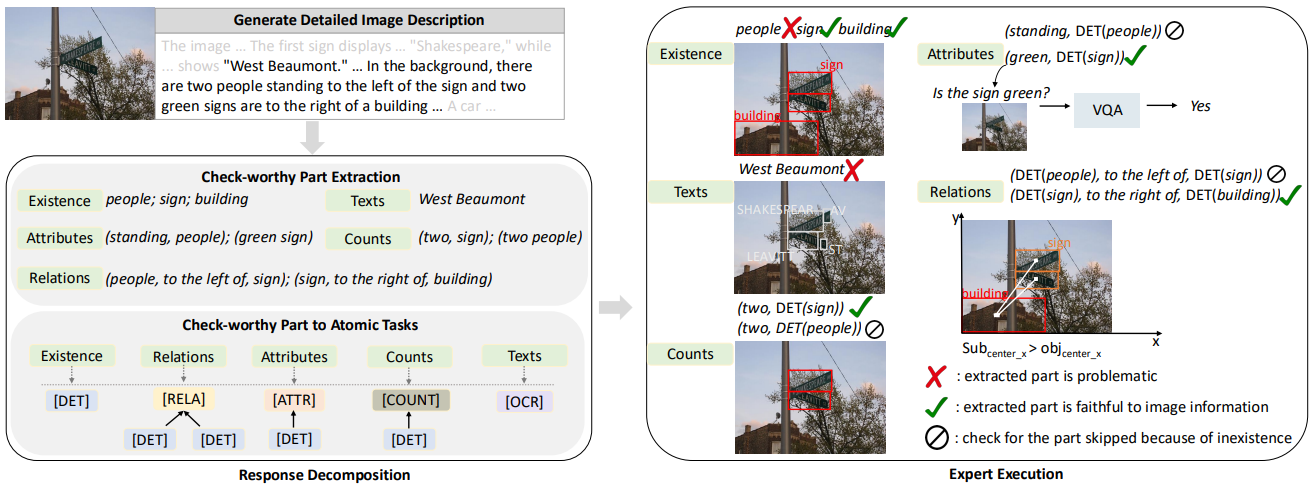
We proposed a decomposable framework with expert models, DecompGen, for automatically generating preference data (DGPref) for enhancing trustworthiness of MLLMs. This repositories contain both the code for atomatic preference data collection and the code for direct preference optimization (DPO) of MLLMs based on the constructed preference dataset, DGPref.
For DecompGen, it consists of two steps: 1) response decomposition and 2) expert execution. In response decomposition, it convert a lengthy and composition MLLM response into atomic verification tasks. In the expert execution step, atomic tasks will be assigned to approporiate expert models to generate fine-grained assessments. The assessments are leveraged for preference dataset construction.
Below, we elaborate the data used for preference dataset contruction and model evaluation, our experiment settings, the pipeline for constructing DGPref (i.e., preference data collection) and how to leverage DGPref for DPO:
In order to replicate the code and performance, you need to prepare two-fold of data: 1) data for generating preference data; and 2) data for evaluation.
Our code is compatible with any images (i.e., you can generate raw detailed descriptions for any images and generate preference data with our code). Specifically, in our implementation, we use the Visual Genome images, as the main image source. The Visual Genome dataset is denoted as vsg in our implementation. You can download the Visual Genome images with the script below:
wget https://cs.stanford.edu/people/rak248/VG_100K_2/images.zip -P images_part_1
wget https://cs.stanford.edu/people/rak248/VG_100K_2/images2.zip -P images_part_2
Scene graphs for Visual Genome images are available here, which we denoted as train_sceneGraphs/val_sceneGraphs.
Theoritically, we can use any images for preference data generation. An alternative option we considered in our ablations is to use COCO-2014 training images for preference data generation. The dataset can be downloaded with the script:
wget images.cocodatsaet.org/zips/train2014.zip
The COCO dataset is denoted as coco in our implementation.
We use three benchmarks as main evaluation datasets:
wget http://images.cocodataset.org/annotations/annotations_trainval2014.zip
unzip annotations_trainval2014.zip
Be careful!!!! After downloading all data, you still need to update the path in our implementation to your file path.
Essential requirements are listed in essential_requirement.txt, the versions of which matter. For other required packages, please see the import command in each file. More detailed experiment setup can be found in Appendix I in our paper.
python Fine_Grained_Alignment/src/raw_caption_gen.py --MODEL_NAME "llava-hf/llava-1.5-7b-hf" --GEN_DATASETS "vsg"
python Decomp_Gen_Cap/src/meta_llama3_extract.py --GQA_PATH [YOUR_FILE_PATH] --target_file [YOU_GENERATED_CAPTION_PATH]
python Decomp_Gen_Cap/src/program_to_tool.py
python Fine_Grained_Alignment/src/pref_data_gen.py --CONSIDERED_ASPECTS [YOUR_CONCERNED_ASPECTS] --MODEL_NAME [YOUR_MODEL] --DATA_NAME "[VSG or COCO or Other Image Sources] --raw_gen_file [YOU_GENERATED_CAPTION_PATH] --expert_score_file [EXPERT_EXECUTION_RESULT]
After generating the preference data, you can conduct direct preference optimization (DPO) of MLLMs. To conduct DPO, the log probabilities of captions are also needed as the reference log probability. You need to execute:
python Fine_Grained_Alignment/src/logp_gen_for_pairs.py --MODEL_NAME [YOUR_MODEL] --CONSIDERED_ASPECTS [YOUR_CONCERNED_ASPECTS] --DATA_NAME "[VSG or COCO or Other Image Sources]
for generating the log probabilities. We provide the log probability of both LLaVA and QWen-VL-Chat here. Then, DPO training for LLaVA can be conducted with:
python Fine_Grained_Alignment/src/main.py --micro_batch_size 4 --gen_step 4500 --gen_start 9000 --eval_step 4500 --lora_r 32 --lora_alpha 32 --learning_rate 5e-6 --num_epochs 2 --batch_size 8 --CONSIDERED_ASPECTS "object,count,attribute,spatial,scale,text" --HAL_DATASETS "objhal,mmhal,amber" --infer_batch_size 12 --MODEL_NAME "llava-hf/llava-1.5-7b-hf" --temperature 0.0
DPO training for Qwen-VL-Chat can be conducted with:
python Fine_Grained_Alignment/src/main.py --micro_batch_size 1 --gen_step 2400 --gen_start 4800 --eval_step 2400 --lora_r 32 --lora_alpha 32 --learning_rate 7e-6 --num_epochs 1 --batch_size 8 --CONSIDERED_ASPECTS "object,object,count,attribute,spatial,scale,text" --HAL_DATASETS "objhal,mmhal,amber" --infer_batch_size 12 --MODEL_NAME "Qwen/Qwen-VL-Chat" --temperature 0.0
If you find our model/code/data/paper helpful, please consider cite our papers and star us!
@misc{cao2024decomposeleveragepreferencesexpert,
      title={Decompose and Leverage Preferences from Expert Models for Improving Trustworthiness of MLLMs},
      author={Rui Cao and Yuming Jiang and Michael Schlichtkrull and Andreas Vlachos},
      year={2024},
      eprint={2411.13697},
      archivePrefix={arXiv},
      primaryClass={cs.CV},
      url={https://arxiv.org/abs/2411.13697},
}
We benefit a lot from the excellent work as wel as its code from:
@article{yu2024rlaifv,
  title={RLAIF-V: Aligning MLLMs through Open-Source AI Feedback for Super GPT-4V Trustworthiness},
  author={Yu, Tianyu and Zhang, Haoye and Yao, Yuan and Dang, Yunkai and Chen, Da and Lu, Xiaoman and Cui, Ganqu and He, Taiwen and Liu, Zhiyuan and Chua, Tat-Seng and Sun, Maosong},
  journal={arXiv preprint arXiv:2405.17220},
  year={2024},
}
We proposed a decomposable framework with expert models, DecompGen, for automatically generating preference data (DGPref) for enhancing trustworthiness of MLLMs. This repositories contain both the code for atomatic preference data collection and the code for direct preference optimization (DPO) of MLLMs based on the constructed preference dataset, DGPref.
For DecompGen, it consists of two steps: 1) response decomposition and 2) expert execution. In response decomposition, it convert a lengthy and composition MLLM response into atomic verification tasks. In the expert execution step, atomic tasks will be assigned to approporiate expert models to generate fine-grained assessments. The assessments are leveraged for preference dataset construction.
Below, we elaborate the data used for preference dataset contruction and model evaluation, our experiment settings, the pipeline for constructing DGPref (i.e., preference data collection) and how to leverage DGPref for DPO:
In order to replicate the code and performance, you need to prepare two-fold of data: 1) data for generating preference data; and 2) data for evaluation.
Our code is compatible with any images (i.e., you can generate raw detailed descriptions for any images and generate preference data with our code). Specifically, in our implementation, we use the Visual Genome images, as the main image source. The Visual Genome dataset is denoted as vsg in our implementation. You can download the Visual Genome images with the script below:
wget https://cs.stanford.edu/people/rak248/VG_100K_2/images.zip -P images_part_1
wget https://cs.stanford.edu/people/rak248/VG_100K_2/images2.zip -P images_part_2
Scene graphs for Visual Genome images are available here, which we denoted as train_sceneGraphs/val_sceneGraphs.
Theoritically, we can use any images for preference data generation. An alternative option we considered in our ablations is to use COCO-2014 training images for preference data generation. The dataset can be downloaded with the script:
wget images.cocodatsaet.org/zips/train2014.zip
The COCO dataset is denoted as coco in our implementation.
We use three benchmarks as main evaluation datasets:
wget http://images.cocodataset.org/annotations/annotations_trainval2014.zip
unzip annotations_trainval2014.zip
Be careful!!!! After downloading all data, you still need to update the path in our implementation to your file path.
Essential requirements are listed in essential_requirement.txt, the versions of which matter. For other required packages, please see the import command in each file. More detailed experiment setup can be found in Appendix I in our paper.
python Fine_Grained_Alignment/src/raw_caption_gen.py --MODEL_NAME "llava-hf/llava-1.5-7b-hf" --GEN_DATASETS "vsg"
python Decomp_Gen_Cap/src/meta_llama3_extract.py --GQA_PATH [YOUR_FILE_PATH] --target_file [YOU_GENERATED_CAPTION_PATH]
python Decomp_Gen_Cap/src/program_to_tool.py
python Fine_Grained_Alignment/src/pref_data_gen.py --CONSIDERED_ASPECTS [YOUR_CONCERNED_ASPECTS] --MODEL_NAME [YOUR_MODEL] --DATA_NAME "[VSG or COCO or Other Image Sources] --raw_gen_file [YOU_GENERATED_CAPTION_PATH] --expert_score_file [EXPERT_EXECUTION_RESULT]
After generating the preference data, you can conduct direct preference optimization (DPO) of MLLMs. To conduct DPO, the log probabilities of captions are also needed as the reference log probability. You need to execute:
python Fine_Grained_Alignment/src/logp_gen_for_pairs.py --MODEL_NAME [YOUR_MODEL] --CONSIDERED_ASPECTS [YOUR_CONCERNED_ASPECTS] --DATA_NAME "[VSG or COCO or Other Image Sources]
for generating the log probabilities. We provide the log probability of both LLaVA and QWen-VL-Chat here. Then, DPO training for LLaVA can be conducted with:
python Fine_Grained_Alignment/src/main.py --micro_batch_size 4 --gen_step 4500 --gen_start 9000 --eval_step 4500 --lora_r 32 --lora_alpha 32 --learning_rate 5e-6 --num_epochs 2 --batch_size 8 --CONSIDERED_ASPECTS "object,count,attribute,spatial,scale,text" --HAL_DATASETS "objhal,mmhal,amber" --infer_batch_size 12 --MODEL_NAME "llava-hf/llava-1.5-7b-hf" --temperature 0.0
DPO training for Qwen-VL-Chat can be conducted with:
python Fine_Grained_Alignment/src/main.py --micro_batch_size 1 --gen_step 2400 --gen_start 4800 --eval_step 2400 --lora_r 32 --lora_alpha 32 --learning_rate 7e-6 --num_epochs 1 --batch_size 8 --CONSIDERED_ASPECTS "object,object,count,attribute,spatial,scale,text" --HAL_DATASETS "objhal,mmhal,amber" --infer_batch_size 12 --MODEL_NAME "Qwen/Qwen-VL-Chat" --temperature 0.0
If you find our model/code/data/paper helpful, please consider cite our papers and star us!
@misc{cao2024decomposeleveragepreferencesexpert,
      title={Decompose and Leverage Preferences from Expert Models for Improving Trustworthiness of MLLMs},
      author={Rui Cao and Yuming Jiang and Michael Schlichtkrull and Andreas Vlachos},
      year={2024},
      eprint={2411.13697},
      archivePrefix={arXiv},
      primaryClass={cs.CV},
      url={https://arxiv.org/abs/2411.13697},
}
We benefit a lot from the excellent work as wel as its code from:
@article{yu2024rlaifv,
  title={RLAIF-V: Aligning MLLMs through Open-Source AI Feedback for Super GPT-4V Trustworthiness},
  author={Yu, Tianyu and Zhang, Haoye and Yao, Yuan and Dang, Yunkai and Chen, Da and Lu, Xiaoman and Cui, Ganqu and He, Taiwen and Liu, Zhiyuan and Chua, Tat-Seng and Sun, Maosong},
  journal={arXiv preprint arXiv:2405.17220},
  year={2024},
}



