
A minimal, extensible, agent-native knowledge base that keeps shared context current and inspectable
See the codeSee what people are saying
README
📜 OpenLore


Sponsored by 
Give every AI agent on your team the same up-to-date knowledge.
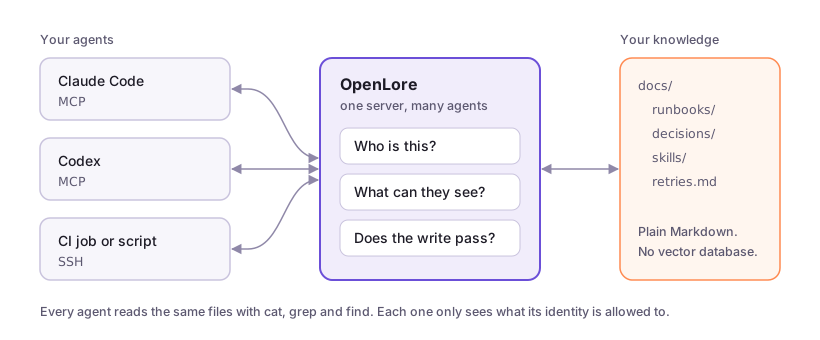
Point OpenLore at a folder of Markdown and every agent on your team reads the same files, whether it's Claude Code, Codex, Cursor or a CI job. Agents use the tools they already know, like cat, grep and find. You decide who can see and change what.

One-click hosted server. See Deploy OpenLore to Render.
Quick start
Install and serve a folder:
brew install --cask aakarim/tap/lore
openlore ./docs
SSH runs on port 2222. The web view and MCP share port 8080. The contents of ./docs appear at /.
Connect an agent:
# Claude Code
claude mcp add --transport http openlore http://localhost:8080/mcp

# Codex
codex mcp add openlore --url http://localhost:8080/mcp

# Anything with a shell
ssh -p 2222 localhost "grep -r 'retry' /"
Tell your agents when to use it:
ssh -p 2222 localhost agents >> AGENTS.md
Or let your agent do the whole setup:
ssh openlore.sh teach | claude
Not on Homebrew? See the Quickstart for Linux and Windows.
Why not just keep Markdown in your repo?
For one agent in one repository, do that.
OpenLore is for when several agents, repositories or people need the same knowledge, and you need to say who can read, write or publish what. Update a file once and every agent sees the new version on its next read.
There's no vector database, ingestion pipeline or SDK. Your knowledge stays as ordinary Markdown.
Guides
- What is OpenLore
- Claude Code
- Codex
- Cursor
- OpenCode
- Any agent over SSH
- Let an agent publish into an inbox
- Deploy to Render
- All documentation
Features
- Agent-native retrieval — Agents use the shell tools and composition patterns they already understand instead of learning a bespoke retrieval API.
- One knowledge surface, multiple transports — Serve the same virtual filesystem over SSH, SFTP/SSHFS (including direct VS Code browsing and editing), MCP, and a human-friendly web view.
- Live, governed knowledge — Keep content read-only, allow scoped publishing, or enable full writes per docset. Writes are atomic, conflict-aware and validated before they commit.
- Identity-scoped views — Give each person or agent only the docsets it
needs, with role-based
ro,publish, andrwgrants, path aliases, and private home directories. - Safe by construction — The shell is an in-memory Go interpreter, not a real operating-system shell. There is no shell escape, arbitrary process execution, or ambient network access in a normal session.
- Portable knowledge bundles — Embed docs into a self-contained binary, build cross-platform bundles with the GitHub Action, or package them as a desktop MCP extension.
- Structured knowledge without a new query language — Inspect frontmatter
as NDJSON with
lore meta, query it withjq, and validate Google's Open Knowledge Format (OKF) bundles and Agent Skills close to the write path. - Extensible policy and processing — Plugins can add validation, grants, read/write middleware, metadata, and post-commit processing while preserving the same filesystem interface.
Use Cases
- Continuous Learning repository - store sessions and learnings in one shared server. Add metrics so you can optimise. Allow agents to share learnings with each other while maintaining user isolation.
- Team Artifact Repository - share markdown, HTML, JSON, Excel etc. documents you've created while maintaining access controls. Much more natural than git, more agent-native than Confluence/Notion.
- Documentation for coding agents — Put internal API docs, runbooks, product context, and architecture notes behind a familiar, greppable interface.
- A shared live memory for teams of agents — Give agents separate or shared docsets so they can publish findings, hand off work, and accumulate durable context across sessions.
- Public docs site - add any files to your public docset, enable public access and it will be shown to any agent that stumbles across your site. Improves AEO/GEO with no need to edit your existing docs.
- Skills sharing — Publish Agent Skills into shared collections so every authorised agent can discover and use the same governed procedures.
- Agent Plugins repository — Version-pin Agent Plugins repos from GitHub and serve them to your team's agents. Skills packaged in the open standard stay current automatically.
- Governed knowledge contribution — Let contributors publish into inboxes while reserving existing documents for maintainers and preventing accidental overwrites.
- Artifact repository — Store and expose reports, logs, screenshots, and generated files through the browser or SSH without building a custom artifact viewer or granting access to the agent's machine.
- Identity-specific workspaces — Mount a private home for each agent plus shared team knowledge, all through one server and one authorisation model.
- Portable customer or project knowledge — Ship a versioned executable with the relevant docs embedded, or distribute the same knowledge as an MCPB desktop extension.
- Validated knowledge catalogues — Enforce frontmatter and bundle conventions, inspect metadata cheaply, and stop malformed knowledge at admission time.
How It Works
OpenLore is built on Wish for SSH transport. A connection is handled entirely against a virtual filesystem:
- Authenticate — connect keylessly or resolve an SSH key, certificate, passkey, or OAuth login to an identity.
- Compose a view — mount only the docsets and paths granted to that identity.
- Explore — run shell commands implemented as pure Go functions over that
view, or use the equivalent MCP
shelltool. - Contribute safely — if writing is enabled, authorise and validate a whole-file change before committing it atomically.
OAuth clients use delegated identities, so durable write provenance distinguishes
direct work by adil from work performed as adil/claude@claude.ai. Delegates
can inherit no more authority than their principal and can be narrowed by
docset and capability deny lists. CIMD clients can additionally authenticate
with vendor-hosted metadata and private_key_jwt; see
Authenticated OAuth Clients.
The normal shell cannot invoke bash, exec, curl, or arbitrary host
processes. Embedded documentation is always read-only. Explicitly trusted
identities can be granted narrowly scoped asynchronous processing through the
spawn capability.
Governed Writing
OpenLore is read-only by default. Writable deployments keep a single,
policy-controlled write path for redirects, append, tee, patch, sed -i,
file moves, publishing, and trusted external jobs.
echo "# Research" | publish /backend/findings.md
cat change.diff | patch /backend/api.md
sed -i 's/old/new/g' /backend/runbook.md
Writes are whole-object atomic swaps. Compare-and-swap protection rejects stale edits by default, docset grants constrain the target, and plugins can validate or defer a write before it commits.
See Writing and publishing for user-facing setup and Write system internals for the implementation model.
Installation
See the Quickstart for Homebrew, Linux and Windows releases, and which installations include the dashboard. To build OpenLore yourself, see Building from source.
Embed docs in a binary
Place documentation in assets/lore/ and build. The resulting binary contains
the docs and serves them read-only at /docs when run with no directory
argument:
make dashboard-build   # optional: include the web UI
go build -o my-docs ./cmd/openlore
Build with the GitHub Action
Produce cross-platform binaries with your docs embedded:
- uses: aakarim/openlore@v1
  with:
    docs-dir: ./docs
    config: ./openlore.yml
See Ways to use OpenLore for direct VS Code editing, MCP stdio, MCPB desktop packaging, SSHFS, and Go library usage.
Create a customised deployment
Use the bundled setup skill to create <team>-lore, a small customer-owned
repository containing openlore.yml, a thin Containerfile pinned to an
official OpenLore release, and deployment artifacts. It builds a working local
server and verifies HTTP, MCP, authenticated SSH, writes, and persistence before
deployment:
ssh openlore.sh setup | amp
The generated repository keeps initial lore.json policy and SSH-visible files
under gitignored .local/. The first deployment initialises an empty persistent
volume from that state. Root openlore.yml remains the Git/IaC authority and is
deployed separately to /var/lib/openlore/config/openlore.yml; it is not baked
into the image. Later lore.json and filesystem edits on the server are
authoritative and are never overwritten by image updates.
Additional instruction commands support the full lifecycle:
onboardingadds initial identities, roles, homes, and folders locally;deployselects Fly.io, Railway, AWS, Google Cloud, Azure, DigitalOcean, or a custom deployment and verifies a shared persistence/networking contract;upgradeprepares only the pinned base-image version change so existing CD can deploy it.
Provider deployments require HTTPS/MCP, authenticated OpenLore SSH,
administrative shell access, and a persistent /var/lib/openlore volume. Where
the provider supports it, deployment configures public port 22 to forward to
OpenLore port 2222. Otherwise it reports the assigned port and recommends an
external TCP forwarding system.
The published container contains only OpenLore. It deliberately contains no
onboarding policy or server configuration. Before the service starts, the
deployment must put openlore.yml and lore.json in the persistent config
directory and run:
./out --config /var/lib/openlore/config/openlore.yml
This keeps configuration independently deployable: a simple deployment can
copy openlore.yml onto the volume, while Kubernetes can project the same file
from a ConfigMap. Use the deploy skill for Fly.io, Railway, AWS, Google Cloud,
Azure, DigitalOcean, or custom infrastructure. The repository's Railpack and
Fly files provide the image, persistent-volume, and port wiring; they do not
seed or mutate configuration at process startup.
For a quick hosted server without a customised repository, use the
Deploy to Render button. Unlike the Railpack and Fly files,
its start script writes a starter openlore.yml and lore.json to an empty
disk on first boot. Render serves HTTPS, MCP and the web view only; it has no
public TCP ingress for OpenLore SSH.
Railway assigns its SSH TCP proxy a public hostname and port. Standard SSH port 22 requires an external raw TCP load balancer. Fly.io can map public port 22 to OpenLore's internal port 2222 with a dedicated address. Raw SSH has no hostname or SNI routing, so one listener cannot route multiple domains on port 22.
The container workflow publishes latest from main; releases also publish
VERSION, vVERSION, major, and minor image tags.
Documentation
The same pages, in the same groups, are published at openlore.sh/docs.
Introduction
| Page | Contents |
|---|---|
| What is OpenLore | Serve, connect, scope, govern and observe in one page |
| Changelog | Current version, release notes, compatibility notes, and versioned docs |
Start
| Page | Contents |
|---|---|
| Quickstart | Install OpenLore, serve a folder, and connect an agent |
| Claude Code | Connect Claude Code over MCP and scope what it sees |
| Codex | Connect Codex over MCP |
| Cursor | Connect Cursor over MCP |
| OpenCode | Connect OpenCode over MCP |
| Any agent over SSH | Connect a coding agent or CI job over SSH and give it an identity |
Concepts
How OpenLore works: transports, identity, writes, rules, and observation.
| Page | Contents |
|---|---|
| Ways to use OpenLore | SSH, MCP, web, SSHFS, embedded binaries, GitHub Action, MCPB, and library usage |
| Auth | Authentication posture, how SSH keys, certificates, passkeys, OAuth tokens and inbox credentials resolve to an identity, roles, docsets, aliases, homes, and workload identity federation |
| Writing and publishing | Write modes, inboxes, conflict handling, what a successful write does and does not check, and jobs |
| Folder rules | .lore/config.yaml and lore.json rules, layering, permissions, rejection messages, and growth limits |
| Plugins and formats | Provider interfaces, Open Knowledge Format validation, lore validate, lore meta, and the Agent Skills plugin |
| Dashboard and metrics | Dashboard authentication, facts versus activity, and the file viewer |
How to
Task walkthroughs.
| Page | Contents |
|---|---|
| Configure the server | Create openlore.yml, precedence over embedded config and flags, analytics, and debug logging |
| Let an agent publish into an inbox | Accept contributions from an agent without letting it edit anything else |
| Browse and edit from an editor | Direct VS Code and SFTP editor setup without a local project mirror |
| Run headlong / shellm | Use OpenLore over SSH from headlong's shellm engine, including its housekeeping skill |
| Build from source | Build the web UI and binary yourself, or build without the web UI |
| Deploy OpenLore to Render | One-click Render deployment, first passkey sign-in, upgrades, and custom domains |
Reference
Lookup material: commands, keys, endpoints, interfaces, and internals.
| Page | Contents |
|---|---|
| Command reference | Complete shell, introspection, publishing, syntax, CLI command, and flag reference |
| openlore.yml reference | Generated reference for every key openlore.yml accepts |
| Rules standard library | Generated reference for compiled-in rule members and their parameters |
| HTTP inbox API | POST /inbox/{docset} with bearer or HMAC credentials, and the token endpoints |
| OAuth clients | CIMD client identity, private_key_jwt, mTLS corroboration, and signing-key rotation |
| Write system internals | Filesystem layering, write seam, admission middleware, and async jobs |
| Build the dashboard | Frontend build and backend-only Go builds |
| Security evaluation | Threat model and security properties |
Security
- Commands run in a pure-Go interpreter, not through
os/exec. - The virtual filesystem cleans paths and enforces docset boundaries.
- Allowed file patterns and ignored directories keep secrets out of the view.
- RBAC controls reads, publishing, writes, approvals, and trusted capabilities.
- The web endpoint can publish the SSH host key over TLS to avoid blind trust on first use; SSH user and host certificates are also supported.
See SECURITY.md for the full security evaluation.
License
Apache License 2.0 — Copyright © 2026 Adil Karim
OpenLore bundles third-party open-source components. Their licences and required
notices are listed in
assets/legal/THIRD_PARTY_NOTICES.md, with
full licence texts in assets/legal/licenses/. These are
embedded in the binary and served by the running service at /legal.
Significant stargazers

894 followers · starred Sep 2026

188 followers · starred Aug 2026
Similar repos


A minimal, extensible, agent-native knowledge base that keeps shared context current and inspectable
See the codeSee what people are saying
README
📜 OpenLore
Sponsored by
Give every AI agent on your team the same up-to-date knowledge.
Point OpenLore at a folder of Markdown and every agent on your team reads the same files, whether it's Claude Code, Codex, Cursor or a CI job. Agents use the tools they already know, like cat, grep and find. You decide who can see and change what.
One-click hosted server. See Deploy OpenLore to Render.
Quick start
Install and serve a folder:
brew install --cask aakarim/tap/lore
openlore ./docs
SSH runs on port 2222. The web view and MCP share port 8080. The contents of ./docs appear at /.
Connect an agent:
# Claude Code
claude mcp add --transport http openlore http://localhost:8080/mcp

# Codex
codex mcp add openlore --url http://localhost:8080/mcp

# Anything with a shell
ssh -p 2222 localhost "grep -r 'retry' /"
Tell your agents when to use it:
ssh -p 2222 localhost agents >> AGENTS.md
Or let your agent do the whole setup:
ssh openlore.sh teach | claude
Not on Homebrew? See the Quickstart for Linux and Windows.
Why not just keep Markdown in your repo?
For one agent in one repository, do that.
OpenLore is for when several agents, repositories or people need the same knowledge, and you need to say who can read, write or publish what. Update a file once and every agent sees the new version on its next read.
There's no vector database, ingestion pipeline or SDK. Your knowledge stays as ordinary Markdown.
Guides
- What is OpenLore
- Claude Code
- Codex
- Cursor
- OpenCode
- Any agent over SSH
- Let an agent publish into an inbox
- Deploy to Render
- All documentation
Features
- Agent-native retrieval — Agents use the shell tools and composition patterns they already understand instead of learning a bespoke retrieval API.
- One knowledge surface, multiple transports — Serve the same virtual filesystem over SSH, SFTP/SSHFS (including direct VS Code browsing and editing), MCP, and a human-friendly web view.
- Live, governed knowledge — Keep content read-only, allow scoped publishing, or enable full writes per docset. Writes are atomic, conflict-aware and validated before they commit.
- Identity-scoped views — Give each person or agent only the docsets it
needs, with role-based
ro,publish, andrwgrants, path aliases, and private home directories. - Safe by construction — The shell is an in-memory Go interpreter, not a real operating-system shell. There is no shell escape, arbitrary process execution, or ambient network access in a normal session.
- Portable knowledge bundles — Embed docs into a self-contained binary, build cross-platform bundles with the GitHub Action, or package them as a desktop MCP extension.
- Structured knowledge without a new query language — Inspect frontmatter
as NDJSON with
lore meta, query it withjq, and validate Google's Open Knowledge Format (OKF) bundles and Agent Skills close to the write path. - Extensible policy and processing — Plugins can add validation, grants, read/write middleware, metadata, and post-commit processing while preserving the same filesystem interface.
Use Cases
- Continuous Learning repository - store sessions and learnings in one shared server. Add metrics so you can optimise. Allow agents to share learnings with each other while maintaining user isolation.
- Team Artifact Repository - share markdown, HTML, JSON, Excel etc. documents you've created while maintaining access controls. Much more natural than git, more agent-native than Confluence/Notion.
- Documentation for coding agents — Put internal API docs, runbooks, product context, and architecture notes behind a familiar, greppable interface.
- A shared live memory for teams of agents — Give agents separate or shared docsets so they can publish findings, hand off work, and accumulate durable context across sessions.
- Public docs site - add any files to your public docset, enable public access and it will be shown to any agent that stumbles across your site. Improves AEO/GEO with no need to edit your existing docs.
- Skills sharing — Publish Agent Skills into shared collections so every authorised agent can discover and use the same governed procedures.
- Agent Plugins repository — Version-pin Agent Plugins repos from GitHub and serve them to your team's agents. Skills packaged in the open standard stay current automatically.
- Governed knowledge contribution — Let contributors publish into inboxes while reserving existing documents for maintainers and preventing accidental overwrites.
- Artifact repository — Store and expose reports, logs, screenshots, and generated files through the browser or SSH without building a custom artifact viewer or granting access to the agent's machine.
- Identity-specific workspaces — Mount a private home for each agent plus shared team knowledge, all through one server and one authorisation model.
- Portable customer or project knowledge — Ship a versioned executable with the relevant docs embedded, or distribute the same knowledge as an MCPB desktop extension.
- Validated knowledge catalogues — Enforce frontmatter and bundle conventions, inspect metadata cheaply, and stop malformed knowledge at admission time.
How It Works
OpenLore is built on Wish for SSH transport. A connection is handled entirely against a virtual filesystem:
- Authenticate — connect keylessly or resolve an SSH key, certificate, passkey, or OAuth login to an identity.
- Compose a view — mount only the docsets and paths granted to that identity.
- Explore — run shell commands implemented as pure Go functions over that
view, or use the equivalent MCP
shelltool. - Contribute safely — if writing is enabled, authorise and validate a whole-file change before committing it atomically.
OAuth clients use delegated identities, so durable write provenance distinguishes
direct work by adil from work performed as adil/claude@claude.ai. Delegates
can inherit no more authority than their principal and can be narrowed by
docset and capability deny lists. CIMD clients can additionally authenticate
with vendor-hosted metadata and private_key_jwt; see
Authenticated OAuth Clients.
The normal shell cannot invoke bash, exec, curl, or arbitrary host
processes. Embedded documentation is always read-only. Explicitly trusted
identities can be granted narrowly scoped asynchronous processing through the
spawn capability.
Governed Writing
OpenLore is read-only by default. Writable deployments keep a single,
policy-controlled write path for redirects, append, tee, patch, sed -i,
file moves, publishing, and trusted external jobs.
echo "# Research" | publish /backend/findings.md
cat change.diff | patch /backend/api.md
sed -i 's/old/new/g' /backend/runbook.md
Writes are whole-object atomic swaps. Compare-and-swap protection rejects stale edits by default, docset grants constrain the target, and plugins can validate or defer a write before it commits.
See Writing and publishing for user-facing setup and Write system internals for the implementation model.
Installation
See the Quickstart for Homebrew, Linux and Windows releases, and which installations include the dashboard. To build OpenLore yourself, see Building from source.
Embed docs in a binary
Place documentation in assets/lore/ and build. The resulting binary contains
the docs and serves them read-only at /docs when run with no directory
argument:
make dashboard-build   # optional: include the web UI
go build -o my-docs ./cmd/openlore
Build with the GitHub Action
Produce cross-platform binaries with your docs embedded:
- uses: aakarim/openlore@v1
  with:
    docs-dir: ./docs
    config: ./openlore.yml
See Ways to use OpenLore for direct VS Code editing, MCP stdio, MCPB desktop packaging, SSHFS, and Go library usage.
Create a customised deployment
Use the bundled setup skill to create <team>-lore, a small customer-owned
repository containing openlore.yml, a thin Containerfile pinned to an
official OpenLore release, and deployment artifacts. It builds a working local
server and verifies HTTP, MCP, authenticated SSH, writes, and persistence before
deployment:
ssh openlore.sh setup | amp
The generated repository keeps initial lore.json policy and SSH-visible files
under gitignored .local/. The first deployment initialises an empty persistent
volume from that state. Root openlore.yml remains the Git/IaC authority and is
deployed separately to /var/lib/openlore/config/openlore.yml; it is not baked
into the image. Later lore.json and filesystem edits on the server are
authoritative and are never overwritten by image updates.
Additional instruction commands support the full lifecycle:
onboardingadds initial identities, roles, homes, and folders locally;deployselects Fly.io, Railway, AWS, Google Cloud, Azure, DigitalOcean, or a custom deployment and verifies a shared persistence/networking contract;upgradeprepares only the pinned base-image version change so existing CD can deploy it.
Provider deployments require HTTPS/MCP, authenticated OpenLore SSH,
administrative shell access, and a persistent /var/lib/openlore volume. Where
the provider supports it, deployment configures public port 22 to forward to
OpenLore port 2222. Otherwise it reports the assigned port and recommends an
external TCP forwarding system.
The published container contains only OpenLore. It deliberately contains no
onboarding policy or server configuration. Before the service starts, the
deployment must put openlore.yml and lore.json in the persistent config
directory and run:
./out --config /var/lib/openlore/config/openlore.yml
This keeps configuration independently deployable: a simple deployment can
copy openlore.yml onto the volume, while Kubernetes can project the same file
from a ConfigMap. Use the deploy skill for Fly.io, Railway, AWS, Google Cloud,
Azure, DigitalOcean, or custom infrastructure. The repository's Railpack and
Fly files provide the image, persistent-volume, and port wiring; they do not
seed or mutate configuration at process startup.
For a quick hosted server without a customised repository, use the
Deploy to Render button. Unlike the Railpack and Fly files,
its start script writes a starter openlore.yml and lore.json to an empty
disk on first boot. Render serves HTTPS, MCP and the web view only; it has no
public TCP ingress for OpenLore SSH.
Railway assigns its SSH TCP proxy a public hostname and port. Standard SSH port 22 requires an external raw TCP load balancer. Fly.io can map public port 22 to OpenLore's internal port 2222 with a dedicated address. Raw SSH has no hostname or SNI routing, so one listener cannot route multiple domains on port 22.
The container workflow publishes latest from main; releases also publish
VERSION, vVERSION, major, and minor image tags.
Documentation
The same pages, in the same groups, are published at openlore.sh/docs.
Introduction
| Page | Contents |
|---|---|
| What is OpenLore | Serve, connect, scope, govern and observe in one page |
| Changelog | Current version, release notes, compatibility notes, and versioned docs |
Start
| Page | Contents |
|---|---|
| Quickstart | Install OpenLore, serve a folder, and connect an agent |
| Claude Code | Connect Claude Code over MCP and scope what it sees |
| Codex | Connect Codex over MCP |
| Cursor | Connect Cursor over MCP |
| OpenCode | Connect OpenCode over MCP |
| Any agent over SSH | Connect a coding agent or CI job over SSH and give it an identity |
Concepts
How OpenLore works: transports, identity, writes, rules, and observation.
| Page | Contents |
|---|---|
| Ways to use OpenLore | SSH, MCP, web, SSHFS, embedded binaries, GitHub Action, MCPB, and library usage |
| Auth | Authentication posture, how SSH keys, certificates, passkeys, OAuth tokens and inbox credentials resolve to an identity, roles, docsets, aliases, homes, and workload identity federation |
| Writing and publishing | Write modes, inboxes, conflict handling, what a successful write does and does not check, and jobs |
| Folder rules | .lore/config.yaml and lore.json rules, layering, permissions, rejection messages, and growth limits |
| Plugins and formats | Provider interfaces, Open Knowledge Format validation, lore validate, lore meta, and the Agent Skills plugin |
| Dashboard and metrics | Dashboard authentication, facts versus activity, and the file viewer |
How to
Task walkthroughs.
| Page | Contents |
|---|---|
| Configure the server | Create openlore.yml, precedence over embedded config and flags, analytics, and debug logging |
| Let an agent publish into an inbox | Accept contributions from an agent without letting it edit anything else |
| Browse and edit from an editor | Direct VS Code and SFTP editor setup without a local project mirror |
| Run headlong / shellm | Use OpenLore over SSH from headlong's shellm engine, including its housekeeping skill |
| Build from source | Build the web UI and binary yourself, or build without the web UI |
| Deploy OpenLore to Render | One-click Render deployment, first passkey sign-in, upgrades, and custom domains |
Reference
Lookup material: commands, keys, endpoints, interfaces, and internals.
| Page | Contents |
|---|---|
| Command reference | Complete shell, introspection, publishing, syntax, CLI command, and flag reference |
| openlore.yml reference | Generated reference for every key openlore.yml accepts |
| Rules standard library | Generated reference for compiled-in rule members and their parameters |
| HTTP inbox API | POST /inbox/{docset} with bearer or HMAC credentials, and the token endpoints |
| OAuth clients | CIMD client identity, private_key_jwt, mTLS corroboration, and signing-key rotation |
| Write system internals | Filesystem layering, write seam, admission middleware, and async jobs |
| Build the dashboard | Frontend build and backend-only Go builds |
| Security evaluation | Threat model and security properties |
Security
- Commands run in a pure-Go interpreter, not through
os/exec. - The virtual filesystem cleans paths and enforces docset boundaries.
- Allowed file patterns and ignored directories keep secrets out of the view.
- RBAC controls reads, publishing, writes, approvals, and trusted capabilities.
- The web endpoint can publish the SSH host key over TLS to avoid blind trust on first use; SSH user and host certificates are also supported.
See SECURITY.md for the full security evaluation.
License
Apache License 2.0 — Copyright © 2026 Adil Karim
OpenLore bundles third-party open-source components. Their licences and required
notices are listed in
assets/legal/THIRD_PARTY_NOTICES.md, with
full licence texts in assets/legal/licenses/. These are
embedded in the binary and served by the running service at /legal.
Similar repos
Significant stargazers
894 followers · starred Sep 2026
188 followers · starred Aug 2026