
A procedural macro development framework designed to simplify and add structure to rust macro development
Rust
196
219 commits
updated Sep 18, 2026
See what people are saying
README






A proc macro framework with templates, composable elements, and built-in diagnostics.
[!IMPORTANT] Zyn is being superseded by Moxy. Moxy takes the ideas behind Zyn further by owning the token, AST, parsing, templating, formatting, and diagnostics stack. Some Zyn features are not yet available in Moxy, but are planned to be added soon.
Read Moxy is replacing Zyn for more about the project and the rationale behind the change.
cargo add zyn
Table of Contents
Templates
Templates are fully type-checked at compile time — errors appear inline, just like regular Rust code.
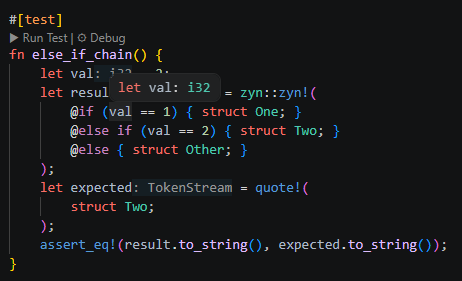
The zyn! macro is the core of zyn. Write token output as if it were source code,
with {{ }} interpolation and @ control flow directives.
Interpolation — any ToTokens value:
let name = zyn::format_ident!("hello_world");
zyn::zyn!(fn {{ name }}() {})
// → fn hello_world() {}
Pipes — transform values inline:
zyn::zyn!(fn {{ name | pascal }}() {})
// name = "hello_world" → fn HelloWorld() {}
Control flow:
zyn::zyn!(
    @if (is_pub) { pub }
    @for (field in fields.named.iter()) {
        fn {{ field.ident }}(&self) -> &{{ field.ty }} {
            &self.{{ field.ident }}
        }
    }
)
Full template syntax:
| Syntax | Purpose |
|---|---|
{{ expr }} | Interpolate any ToTokens value |
{{ expr | pipe }} | Transform value through a pipe before inserting |
@if (cond) { ... } | Conditional token emission |
@else { ... } | Else branch |
@else if (cond) { ... } | Else-if branch |
@for (x in iter) { ... } | Loop over an iterator |
@for (N) { ... } | Repeat N times |
@match (expr) { pat => { ... } } | Pattern-based emission |
@element_name(prop = val) | Invoke a #[element] component |
Elements
Elements are reusable template components defined with #[zyn::element].
They encapsulate a fragment of token output and accept typed props.
Define an element:
#[zyn::element]
fn getter(name: zyn::syn::Ident, ty: zyn::syn::Type) -> zyn::TokenStream {
    zyn::zyn! {
        pub fn {{ name | snake | ident:"get_{}" }}(&self) -> &{{ ty }} {
            &self.{{ name }}
        }
    }
}
Invoke it inside any template with @:
zyn::zyn! {
    impl {{ ident }} {
        @for (field in fields.named.iter()) {
            @getter(name = field.ident.clone().unwrap(), ty = field.ty.clone())
        }
    }
}
Elements can also receive extractors — values resolved automatically from proc macro
input — by marking a param with #[zyn(input)]:
#[zyn::derive]
fn my_getters(
    #[zyn(input)] ident: zyn::Extract<zyn::syn::Ident>,
    #[zyn(input)] fields: zyn::Fields<zyn::syn::FieldsNamed>,
) -> zyn::TokenStream {
    zyn::zyn! {
        impl {{ ident }} {
            @for (field in fields.named.iter()) {
                pub fn {{ field.ident | snake | ident:"get_{}" }}(&self) -> &{{ field.ty }} {
                    &self.{{ field.ident }}
                }
            }
        }
    }
}
// Applied to: struct User { first_name: String, age: u32 }
// Generates:
// impl User {
//     pub fn get_first_name(&self) -> &String { &self.first_name }
//     pub fn get_age(&self) -> &u32 { &self.age }
// }
Pipes
Pipes transform interpolated values: {{ expr | pipe }}. They chain left to right:
zyn::zyn!(fn {{ name | snake | ident:"get_{}" }}() {})
// name = "HelloWorld" → fn get_hello_world() {}
Built-in pipes:
| Pipe | Input example | Output |
|---|---|---|
snake | HelloWorld | hello_world |
pascal | hello_world | HelloWorld |
camel | hello_world | helloWorld |
screaming | HelloWorld | HELLO_WORLD |
kebab | HelloWorld | "hello-world" |
upper | hello | HELLO |
lower | HELLO | hello |
str | hello | "hello" |
trim | __foo__ | foo |
plural | user | users |
singular | users | user |
ident:"pattern_{}" | hello | pattern_hello (ident) |
fmt:"pattern_{}" | hello | "pattern_hello" (string) |
Custom pipes via #[zyn::pipe]:
#[zyn::pipe]
fn shout(input: String) -> zyn::syn::Ident {
    zyn::syn::Ident::new(&format!("{}_BANG", input.to_uppercase()), zyn::Span::call_site())
}

zyn::zyn!(fn {{ name | shout }}() {})
// name = "hello" → fn HELLO_BANG() {}
Attributes
zyn provides two tools for attribute handling: a derive macro for typed parsing and a proc macro attribute for writing attribute macros.
Typed attribute structs via #[derive(Attribute)]:
#[derive(zyn::Attribute)]
#[zyn("builder")]
struct BuilderConfig {
    #[zyn(default)]
    skip: bool,
    #[zyn(default = "build".to_string())]
    method: String,
}
// users write: #[builder(skip)] or #[builder(method = "create")]
The derive generates from_args, FromArg, and FromInput implementations, as well as
a human-readable about() string for error messages.
Auto-suggest
When a user misspells an argument name, zyn automatically suggests the closest known field. No extra setup required:
error: unknown argument `skiip`
  --> src/main.rs:5:12
   |
5  | #[builder(skiip)]
   |           ^^^^^
   |
   = help: did you mean `skip`?
Suggestions are offered when the edit distance is ≤ 3 characters. Distant or completely unknown keys produce only the "unknown argument" error without a suggestion.
Attribute proc macros via #[zyn::attribute]:
#[zyn::attribute]
fn my_attr(#[zyn(input)] item: zyn::syn::ItemFn, args: zyn::Args) -> zyn::TokenStream {
    // args: parsed key=value arguments from the attribute invocation
    zyn::zyn!({ { item } })
}
Testing
Assertions
zyn! returns Output — test both tokens and diagnostics directly:
#[test]
fn generates_function() {
    let input: zyn::Input = zyn::parse!("struct Foo;" => zyn::syn::DeriveInput).unwrap().into();
    let output = zyn::zyn!(fn hello() {});
    let expected = zyn::quote::quote!(fn hello() {});
    zyn::assert_tokens!(output, expected);
}
Diagnostic assertions check error messages from error!, warn!, bail!:
#[zyn::element]
fn validated(name: zyn::syn::Ident) -> zyn::TokenStream {
    if name == "forbidden" {
        bail!("reserved identifier `{}`", name);
    }
    zyn::zyn!(fn {{ name }}() {})
}

#[test]
fn rejects_forbidden_name() {
    let input: zyn::Input = zyn::parse!("struct Foo;" => zyn::syn::DeriveInput).unwrap().into();
    let output = zyn::zyn!(@validated(name = zyn::format_ident!("forbidden")));
    zyn::assert_diagnostic_error!(output, "reserved identifier");
    zyn::assert_tokens_empty!(output);
    // ✓ error diagnostic present, no tokens produced
}

#[test]
fn accepts_valid_name() {
    let input: zyn::Input = zyn::parse!("struct Foo;" => zyn::syn::DeriveInput).unwrap().into();
    let output = zyn::zyn!(@validated(name = zyn::format_ident!("hello")));
    zyn::assert_tokens_contain!(output, "fn hello");
    // ✓ tokens contain "fn hello"
}
| Macro | Purpose |
|---|---|
assert_tokens! | Compare two token streams |
assert_tokens_empty! | Assert no tokens produced |
assert_tokens_contain! | Check for substring in output |
assert_diagnostic_error! | Assert error diagnostic with message |
assert_diagnostic_warning! | Assert warning diagnostic |
assert_diagnostic_note! | Assert note diagnostic |
assert_diagnostic_help! | Assert help diagnostic |
assert_compile_error! | Alias for assert_diagnostic_error! |
With the pretty feature:
| Macro | Purpose |
|---|---|
assert_tokens_pretty! | Compare using prettyplease-formatted output |
assert_tokens_contain_pretty! | Substring check on pretty-printed output |
Debugging
Inspect generated code by adding debug to any zyn attribute macro. Set ZYN_DEBUG to the generated type name (or * for all) to enable output:
#[zyn::element(debug)]
fn greeting(name: zyn::syn::Ident) -> zyn::TokenStream {
    zyn::zyn!(fn {{ name }}() {})
}
ZYN_DEBUG="*" cargo build
note: zyn::element ─── Greeting

      fn {{ name }}() {}
  --> src/lib.rs:1:1
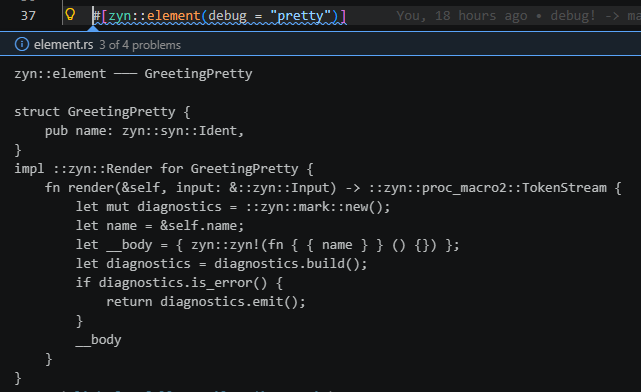
Without injection, props show as {{ name }} placeholders. With the pretty feature, use debug(pretty) for formatted output:
#[zyn::element(debug(pretty))]
fn greeting(name: zyn::syn::Ident) -> zyn::TokenStream {
    zyn::zyn!(fn {{ name }}() {})
}
note: zyn::element ─── Greeting

      fn {{ name }}() {}
  --> src/lib.rs:1:1
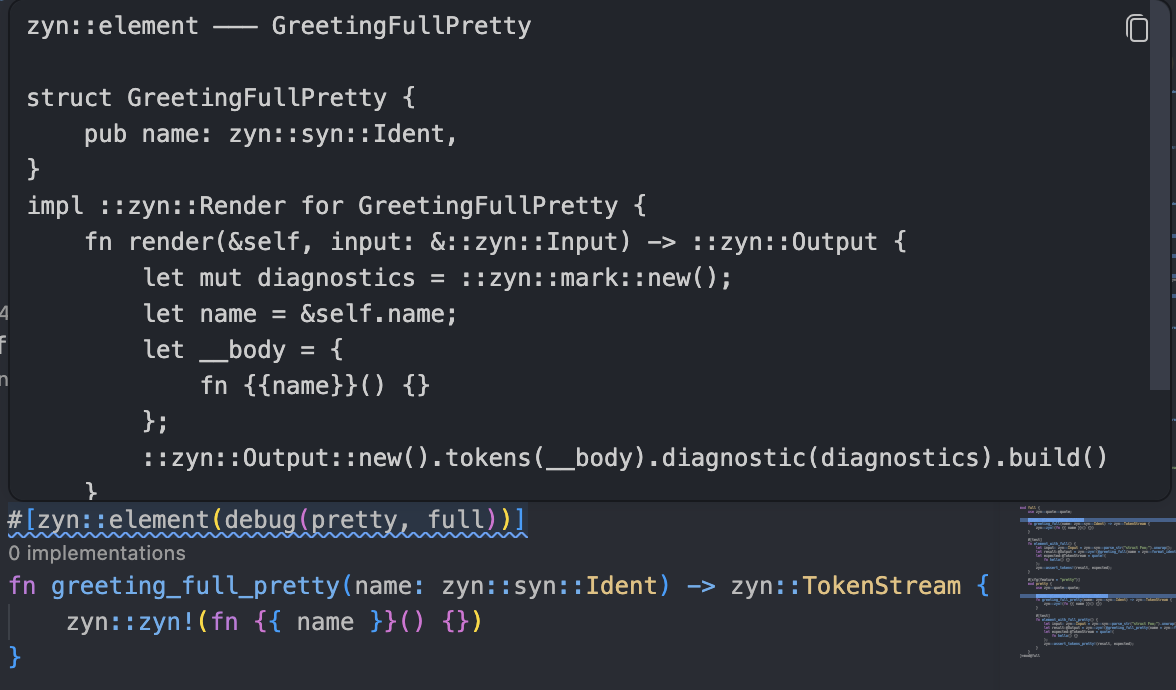
Use debug(full) to emit the full generated struct + impl instead of just the body. Combine with pretty: debug(pretty, full).
Supply key = "value" injection pairs to substitute static values for props — useful when the real value isn't known at proc-macro time:
#[zyn::element(debug(name = "Foo", ty = "String"))]
fn setter(name: zyn::syn::Ident, ty: zyn::syn::Type) -> zyn::TokenStream {
    zyn::zyn!(fn {{ name }}(value: {{ ty }}) -> Self { self })
}
Output: fn Foo(value : String) -> Self { self }. Without injection, props show as {{ name }}, {{ ty }}.
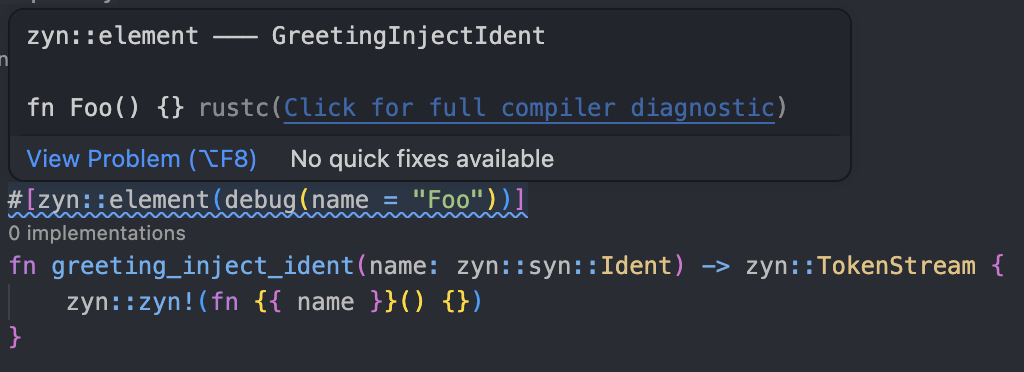
All macros support debug: #[zyn::element], #[zyn::pipe], #[zyn::derive], #[zyn::attribute].
ZYN_DEBUG accepts comma-separated *-wildcard patterns matched against the generated PascalCase type name:
ZYN_DEBUG="Greeting" cargo build        # exact match
ZYN_DEBUG="Greet*" cargo build          # prefix wildcard
ZYN_DEBUG="*Element" cargo build        # suffix wildcard
ZYN_DEBUG="Greeting,Shout" cargo build  # multiple patterns
Features
| Feature | Default | Description |
|---|---|---|
derive | ✓ | All proc macro attributes: #[element], #[pipe], #[derive], #[attribute], and #[derive(Attribute)] |
ext | Extension traits for common syn AST types (AttrExt, FieldExt, TypeExt, etc.) | |
pretty | Pretty-printed token output in debug mode | |
diagnostics | Error accumulation — collect multiple errors before aborting |
ext
The ext module adds ergonomic extension traits for navigating syn AST types.
zyn = { features = ["ext"] }
use zyn::ext::{AttrExt, TypeExt};

// check and read attribute arguments
if attr.is("serde") {
    let rename: Option<_> = attr.get("rename"); // → Some(Meta::NameValue)
    let skip: bool = attr.exists("skip");
}

// inspect field types
if field.is_option() {
    let inner = field.inner_type().unwrap();
}
pretty
Pretty-printed debug output and assert_tokens_pretty! / assert_tokens_contain_pretty! assertion macros via prettyplease. See Debugging for usage.
zyn = { features = ["pretty"] }
diagnostics
The diagnostics feature enables error accumulation — collecting multiple compiler
errors before aborting, so users see all problems at once instead of one at a time.
zyn = { features = ["diagnostics"] }
Inside any #[zyn::element], #[zyn::derive], or #[zyn::attribute] body, use the
built-in diagnostic macros directly — no setup required:
#[zyn::element]
fn my_element(name: zyn::syn::Ident) -> zyn::TokenStream {
    if name == "forbidden" {
        bail!("reserved identifier `{}`", name);
    }

    if name.to_string().starts_with('_') {
        warn!("identifiers starting with `_` are conventionally unused");
    }

    zyn::zyn!(fn {{ name }}() {})
}
| Macro | Level | Behaviour |
|---|---|---|
error!(msg) | error | accumulates, does not stop execution |
warn!(msg) | warning | accumulates, does not stop execution |
note!(msg) | note | accumulates, does not stop execution |
help!(msg) | help | accumulates, does not stop execution |
bail!(msg) | error | accumulates and immediately returns |
All accumulated diagnostics are emitted together at the end of the element or macro body, so users see every error at once instead of fixing them one by one.
error: reserved identifier `forbidden`
 --> src/main.rs:3:1

error: reserved identifier `forbidden`
 --> src/main.rs:7:1
Performance
Benchmarks confirm the zero-overhead claim: the full pipeline (parse, extract, codegen) matches vanilla syn + quote for both structs and enums. Where zyn replaces external crates, it's faster — case conversion is ~6x faster than heck, and attribute parsing is ~14% faster than darling.
Live benchmark charts on bencher.dev
Discussions
License
MIT


Similar repos


Languages
Rust
83.4%
CSS
7.8%
JavaScript
5.8%
Handlebars
3.0%
A procedural macro development framework designed to simplify and add structure to rust macro development
Rust
196
219 commits
updated Sep 18, 2026
See what people are saying
README
A proc macro framework with templates, composable elements, and built-in diagnostics.
[!IMPORTANT] Zyn is being superseded by Moxy. Moxy takes the ideas behind Zyn further by owning the token, AST, parsing, templating, formatting, and diagnostics stack. Some Zyn features are not yet available in Moxy, but are planned to be added soon.
Read Moxy is replacing Zyn for more about the project and the rationale behind the change.
cargo add zyn
Table of Contents
Templates
Templates are fully type-checked at compile time — errors appear inline, just like regular Rust code.
The zyn! macro is the core of zyn. Write token output as if it were source code,
with {{ }} interpolation and @ control flow directives.
Interpolation — any ToTokens value:
let name = zyn::format_ident!("hello_world");
zyn::zyn!(fn {{ name }}() {})
// → fn hello_world() {}
Pipes — transform values inline:
zyn::zyn!(fn {{ name | pascal }}() {})
// name = "hello_world" → fn HelloWorld() {}
Control flow:
zyn::zyn!(
    @if (is_pub) { pub }
    @for (field in fields.named.iter()) {
        fn {{ field.ident }}(&self) -> &{{ field.ty }} {
            &self.{{ field.ident }}
        }
    }
)
Full template syntax:
| Syntax | Purpose |
|---|---|
{{ expr }} | Interpolate any ToTokens value |
{{ expr | pipe }} | Transform value through a pipe before inserting |
@if (cond) { ... } | Conditional token emission |
@else { ... } | Else branch |
@else if (cond) { ... } | Else-if branch |
@for (x in iter) { ... } | Loop over an iterator |
@for (N) { ... } | Repeat N times |
@match (expr) { pat => { ... } } | Pattern-based emission |
@element_name(prop = val) | Invoke a #[element] component |
Elements
Elements are reusable template components defined with #[zyn::element].
They encapsulate a fragment of token output and accept typed props.
Define an element:
#[zyn::element]
fn getter(name: zyn::syn::Ident, ty: zyn::syn::Type) -> zyn::TokenStream {
    zyn::zyn! {
        pub fn {{ name | snake | ident:"get_{}" }}(&self) -> &{{ ty }} {
            &self.{{ name }}
        }
    }
}
Invoke it inside any template with @:
zyn::zyn! {
    impl {{ ident }} {
        @for (field in fields.named.iter()) {
            @getter(name = field.ident.clone().unwrap(), ty = field.ty.clone())
        }
    }
}
Elements can also receive extractors — values resolved automatically from proc macro
input — by marking a param with #[zyn(input)]:
#[zyn::derive]
fn my_getters(
    #[zyn(input)] ident: zyn::Extract<zyn::syn::Ident>,
    #[zyn(input)] fields: zyn::Fields<zyn::syn::FieldsNamed>,
) -> zyn::TokenStream {
    zyn::zyn! {
        impl {{ ident }} {
            @for (field in fields.named.iter()) {
                pub fn {{ field.ident | snake | ident:"get_{}" }}(&self) -> &{{ field.ty }} {
                    &self.{{ field.ident }}
                }
            }
        }
    }
}
// Applied to: struct User { first_name: String, age: u32 }
// Generates:
// impl User {
//     pub fn get_first_name(&self) -> &String { &self.first_name }
//     pub fn get_age(&self) -> &u32 { &self.age }
// }
Pipes
Pipes transform interpolated values: {{ expr | pipe }}. They chain left to right:
zyn::zyn!(fn {{ name | snake | ident:"get_{}" }}() {})
// name = "HelloWorld" → fn get_hello_world() {}
Built-in pipes:
| Pipe | Input example | Output |
|---|---|---|
snake | HelloWorld | hello_world |
pascal | hello_world | HelloWorld |
camel | hello_world | helloWorld |
screaming | HelloWorld | HELLO_WORLD |
kebab | HelloWorld | "hello-world" |
upper | hello | HELLO |
lower | HELLO | hello |
str | hello | "hello" |
trim | __foo__ | foo |
plural | user | users |
singular | users | user |
ident:"pattern_{}" | hello | pattern_hello (ident) |
fmt:"pattern_{}" | hello | "pattern_hello" (string) |
Custom pipes via #[zyn::pipe]:
#[zyn::pipe]
fn shout(input: String) -> zyn::syn::Ident {
    zyn::syn::Ident::new(&format!("{}_BANG", input.to_uppercase()), zyn::Span::call_site())
}

zyn::zyn!(fn {{ name | shout }}() {})
// name = "hello" → fn HELLO_BANG() {}
Attributes
zyn provides two tools for attribute handling: a derive macro for typed parsing and a proc macro attribute for writing attribute macros.
Typed attribute structs via #[derive(Attribute)]:
#[derive(zyn::Attribute)]
#[zyn("builder")]
struct BuilderConfig {
    #[zyn(default)]
    skip: bool,
    #[zyn(default = "build".to_string())]
    method: String,
}
// users write: #[builder(skip)] or #[builder(method = "create")]
The derive generates from_args, FromArg, and FromInput implementations, as well as
a human-readable about() string for error messages.
Auto-suggest
When a user misspells an argument name, zyn automatically suggests the closest known field. No extra setup required:
error: unknown argument `skiip`
  --> src/main.rs:5:12
   |
5  | #[builder(skiip)]
   |           ^^^^^
   |
   = help: did you mean `skip`?
Suggestions are offered when the edit distance is ≤ 3 characters. Distant or completely unknown keys produce only the "unknown argument" error without a suggestion.
Attribute proc macros via #[zyn::attribute]:
#[zyn::attribute]
fn my_attr(#[zyn(input)] item: zyn::syn::ItemFn, args: zyn::Args) -> zyn::TokenStream {
    // args: parsed key=value arguments from the attribute invocation
    zyn::zyn!({ { item } })
}
Testing
Assertions
zyn! returns Output — test both tokens and diagnostics directly:
#[test]
fn generates_function() {
    let input: zyn::Input = zyn::parse!("struct Foo;" => zyn::syn::DeriveInput).unwrap().into();
    let output = zyn::zyn!(fn hello() {});
    let expected = zyn::quote::quote!(fn hello() {});
    zyn::assert_tokens!(output, expected);
}
Diagnostic assertions check error messages from error!, warn!, bail!:
#[zyn::element]
fn validated(name: zyn::syn::Ident) -> zyn::TokenStream {
    if name == "forbidden" {
        bail!("reserved identifier `{}`", name);
    }
    zyn::zyn!(fn {{ name }}() {})
}

#[test]
fn rejects_forbidden_name() {
    let input: zyn::Input = zyn::parse!("struct Foo;" => zyn::syn::DeriveInput).unwrap().into();
    let output = zyn::zyn!(@validated(name = zyn::format_ident!("forbidden")));
    zyn::assert_diagnostic_error!(output, "reserved identifier");
    zyn::assert_tokens_empty!(output);
    // ✓ error diagnostic present, no tokens produced
}

#[test]
fn accepts_valid_name() {
    let input: zyn::Input = zyn::parse!("struct Foo;" => zyn::syn::DeriveInput).unwrap().into();
    let output = zyn::zyn!(@validated(name = zyn::format_ident!("hello")));
    zyn::assert_tokens_contain!(output, "fn hello");
    // ✓ tokens contain "fn hello"
}
| Macro | Purpose |
|---|---|
assert_tokens! | Compare two token streams |
assert_tokens_empty! | Assert no tokens produced |
assert_tokens_contain! | Check for substring in output |
assert_diagnostic_error! | Assert error diagnostic with message |
assert_diagnostic_warning! | Assert warning diagnostic |
assert_diagnostic_note! | Assert note diagnostic |
assert_diagnostic_help! | Assert help diagnostic |
assert_compile_error! | Alias for assert_diagnostic_error! |
With the pretty feature:
| Macro | Purpose |
|---|---|
assert_tokens_pretty! | Compare using prettyplease-formatted output |
assert_tokens_contain_pretty! | Substring check on pretty-printed output |
Debugging
Inspect generated code by adding debug to any zyn attribute macro. Set ZYN_DEBUG to the generated type name (or * for all) to enable output:
#[zyn::element(debug)]
fn greeting(name: zyn::syn::Ident) -> zyn::TokenStream {
    zyn::zyn!(fn {{ name }}() {})
}
ZYN_DEBUG="*" cargo build
note: zyn::element ─── Greeting

      fn {{ name }}() {}
  --> src/lib.rs:1:1
Without injection, props show as {{ name }} placeholders. With the pretty feature, use debug(pretty) for formatted output:
#[zyn::element(debug(pretty))]
fn greeting(name: zyn::syn::Ident) -> zyn::TokenStream {
    zyn::zyn!(fn {{ name }}() {})
}
note: zyn::element ─── Greeting

      fn {{ name }}() {}
  --> src/lib.rs:1:1
Use debug(full) to emit the full generated struct + impl instead of just the body. Combine with pretty: debug(pretty, full).
Supply key = "value" injection pairs to substitute static values for props — useful when the real value isn't known at proc-macro time:
#[zyn::element(debug(name = "Foo", ty = "String"))]
fn setter(name: zyn::syn::Ident, ty: zyn::syn::Type) -> zyn::TokenStream {
    zyn::zyn!(fn {{ name }}(value: {{ ty }}) -> Self { self })
}
Output: fn Foo(value : String) -> Self { self }. Without injection, props show as {{ name }}, {{ ty }}.
All macros support debug: #[zyn::element], #[zyn::pipe], #[zyn::derive], #[zyn::attribute].
ZYN_DEBUG accepts comma-separated *-wildcard patterns matched against the generated PascalCase type name:
ZYN_DEBUG="Greeting" cargo build        # exact match
ZYN_DEBUG="Greet*" cargo build          # prefix wildcard
ZYN_DEBUG="*Element" cargo build        # suffix wildcard
ZYN_DEBUG="Greeting,Shout" cargo build  # multiple patterns
Features
| Feature | Default | Description |
|---|---|---|
derive | ✓ | All proc macro attributes: #[element], #[pipe], #[derive], #[attribute], and #[derive(Attribute)] |
ext | Extension traits for common syn AST types (AttrExt, FieldExt, TypeExt, etc.) | |
pretty | Pretty-printed token output in debug mode | |
diagnostics | Error accumulation — collect multiple errors before aborting |
ext
The ext module adds ergonomic extension traits for navigating syn AST types.
zyn = { features = ["ext"] }
use zyn::ext::{AttrExt, TypeExt};

// check and read attribute arguments
if attr.is("serde") {
    let rename: Option<_> = attr.get("rename"); // → Some(Meta::NameValue)
    let skip: bool = attr.exists("skip");
}

// inspect field types
if field.is_option() {
    let inner = field.inner_type().unwrap();
}
pretty
Pretty-printed debug output and assert_tokens_pretty! / assert_tokens_contain_pretty! assertion macros via prettyplease. See Debugging for usage.
zyn = { features = ["pretty"] }
diagnostics
The diagnostics feature enables error accumulation — collecting multiple compiler
errors before aborting, so users see all problems at once instead of one at a time.
zyn = { features = ["diagnostics"] }
Inside any #[zyn::element], #[zyn::derive], or #[zyn::attribute] body, use the
built-in diagnostic macros directly — no setup required:
#[zyn::element]
fn my_element(name: zyn::syn::Ident) -> zyn::TokenStream {
    if name == "forbidden" {
        bail!("reserved identifier `{}`", name);
    }

    if name.to_string().starts_with('_') {
        warn!("identifiers starting with `_` are conventionally unused");
    }

    zyn::zyn!(fn {{ name }}() {})
}
| Macro | Level | Behaviour |
|---|---|---|
error!(msg) | error | accumulates, does not stop execution |
warn!(msg) | warning | accumulates, does not stop execution |
note!(msg) | note | accumulates, does not stop execution |
help!(msg) | help | accumulates, does not stop execution |
bail!(msg) | error | accumulates and immediately returns |
All accumulated diagnostics are emitted together at the end of the element or macro body, so users see every error at once instead of fixing them one by one.
error: reserved identifier `forbidden`
 --> src/main.rs:3:1

error: reserved identifier `forbidden`
 --> src/main.rs:7:1
Performance
Benchmarks confirm the zero-overhead claim: the full pipeline (parse, extract, codegen) matches vanilla syn + quote for both structs and enums. Where zyn replaces external crates, it's faster — case conversion is ~6x faster than heck, and attribute parsing is ~14% faster than darling.
Live benchmark charts on bencher.dev
Discussions
License
MIT
Similar repos
Languages
Rust
83.4%
CSS
7.8%
JavaScript
5.8%
Handlebars
3.0%