Minimum Bayes Risk Decoding for Hugging Face Transformers
Python
61
24 commits
updated Jun 3, 2024

mbr adds Sampling-based Minimum Bayes Risk decoding to Hugging Face transformers. Originally proposed by Eikema & Aziz (2022), this technique is a risk-minimizing algorithm for generating text with a language model. This repository implements several optimizations for MBR decoding. Most notably, mbr introduces reference aggregation Vamvas & Sennrich (2024).
Pronounce: ember /ˈɛm.bɚ/
pip install mbr
Requirements:
The main components of mbr are:
mbr.MBRGenerationMixin: overrides a model's generate method to add MBR decoding.mbr.MBRGenerationConfig: specifies the parameters of MBR decoding, e.g., the number of samples to generate and the metric to optimize.Models need to inherit from MBRGenerationMixin for MBR decoding to work. Here's two ways to achieve this, using the Llama model as an example:
Variant A:
from transformers import LlamaForCausalLM

from mbr import MBRGenerationMixin

class MBRLlamaForCausalLM(MBRGenerationMixin, LlamaForCausalLM):
    pass
Then, you can use MBRLlamaForCausalLM as you would use LlamaForCausalLM:
model = MBRLlamaForCausalLM.from_pretrained(...)
Variant B:
from mbr import MBR
model = MBR(LlamaForCausalLM).from_pretrained(...)
Create an MBRConfig object to pass to the model's generate method:
from mbr import MBRConfig

mbr_config = MBRConfig(
    num_samples=10,
    metric="chrf",
)
Call the model's generate method directly, or use the Pipeline API. Make sure to pass the mbr_config, as well as the model's tokenizer.
from transformers import pipeline

generator = pipeline("text-generation", model=model, tokenizer=tokenizer)
output = generator("Hello,", mbr_config=mbr_config, tokenizer=tokenizer)
The following research papers, among many others, provide a description of Sampling-based Minimum Bayes Risk decoding:
In practice, MBR decoding is most commonly implemented as follows (on the example of machine translation):
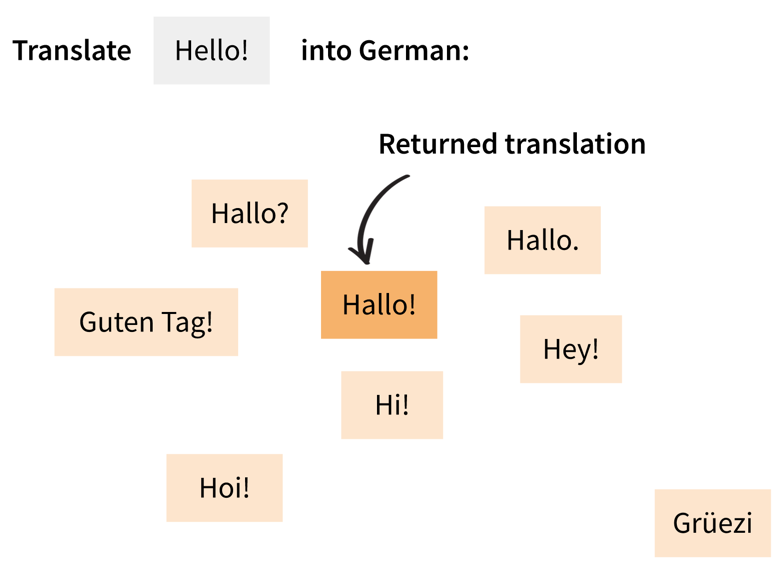
The terminology around MBR decoding varies:
| Term used in this codebase | Alternative terms |
|---|---|
| samples | candidates, hypotheses |
| references | pseudo-references, evidence |
| metric score | expected utility (negative) expected risk, error |
The generation of the samples can be customized by passing a generation_config to the generate method or to the pipeline call:
from transformers import GenerationConfig

generation_config = GenerationConfig.from_pretrained("mymodel",
    do_sample=True,
    num_beams=1,
    epsilon_cutoff=0.02,
)
model.generate(..., generation_config=generation_config)
By default, the samples themselves are used a references (or a subset of the samples if num_references is smaller than num_samples).
You could also sample the reference set independently, using a custom generation config for the references:
from transformers import GenerationConfig

references_config = GenerationConfig.from_pretrained("mymodel",
    do_sample=True,
    num_beams=1,
    top_p=0.9,
)
model.generate(..., references_config=references_config)
By default, mbr uses fastChrF, which is optimized for efficient comparison of many samples to many references.
You can also plug in metrics from the Hugging Face Evaluate library.
A full list of metrics is found here. Some typical choices are:
To use a metric from Hugging Face, either specify the metric's name (e.g., "comet", "bleurt") or pass an evaluate.Metric object directly.
Since different metrics output differently structured dicts, you need to specify the metric_output_field that should be used as the metric score.
from evaluate import load

metric = load('bleu')
mbr_config = MBRGenerationConfig(
    metric=metric,
    metric_output_field="bleu",  # the BLEU metric returns a dict with a "bleu" field
    ...
)
Internally, mbr will call the metric's compute method to calculate the metric score for each sample.
By default, mbr will call compute separately for each sample–reference pair.
Since this requires many compute calls, it can make sense to optimize the metric computation. Different metrics will require different optimization strategies.
To override the default way of calling the metric, define a MetricRunner class and pass it to the generate method:
from mbr import MetricRunner

class MyMetricRunner(MetricRunner):

    def __call__(self,
                 input_ids: torch.LongTensor,
                 sample_ids: Tuple[torch.LongTensor],
                 reference_ids: Tuple[torch.LongTensor],
                 ) -> torch.FloatTensor:
        ...  # TODO: implement your efficient metric computation here

model.generate(..., metric_runner=MyMetricRunner())
For COMET, an optimized implementation is already provided in CometMetricRunner:
from mbr.metrics.comet import CometMetricRunner

mbr_config = MBRGenerationConfig(
    ...,
    metric="comet",
    metric_output_field="mean_score",
)

metric_runner = CometMetricRunner(mbr_config, tokenizer)
model.generate(..., metric_runner=metric_runner)
MBR decoding is notoriously slow. mbr implements some optimizations:
CometMetricRunner caches sequence embeddings and reuses them for all pairwise comparisons.mbr.metrics.comet.AggregateCometMetricRunner instead of the default CometMetricRunner if you have many references.The experiments directory contains the code for reproductions of experiments from the following papers:
v0.3.0 (draft)
AggregateCometMetricRunner to allow for reference aggregation with COMETv0.2.0
MBRGenerationConfig to MBRConfigMetricRunner now returns a MetricOutput dict instead of the raw tensor of scores.MBRConfig.metric_cache_sizeGenerationConfig as parent class of MBRConfigWhen using this code for research, please cite the following paper:
@misc{vamvas-sennrich-2024-linear,
      title={Linear-time Minimum Bayes Risk Decoding with Reference Aggregation},
      author={Jannis Vamvas and Rico Sennrich},
      year={2024},
      eprint={2402.04251},
      archivePrefix={arXiv},
      primaryClass={cs.CL}
}
546 followers · starred Jan 2024
467 followers · starred Nov 2023
Minimum Bayes Risk Decoding for Hugging Face Transformers
Python
61
24 commits
updated Jun 3, 2024
mbr adds Sampling-based Minimum Bayes Risk decoding to Hugging Face transformers. Originally proposed by Eikema & Aziz (2022), this technique is a risk-minimizing algorithm for generating text with a language model. This repository implements several optimizations for MBR decoding. Most notably, mbr introduces reference aggregation Vamvas & Sennrich (2024).
Pronounce: ember /ˈɛm.bɚ/
pip install mbr
Requirements:
The main components of mbr are:
mbr.MBRGenerationMixin: overrides a model's generate method to add MBR decoding.mbr.MBRGenerationConfig: specifies the parameters of MBR decoding, e.g., the number of samples to generate and the metric to optimize.Models need to inherit from MBRGenerationMixin for MBR decoding to work. Here's two ways to achieve this, using the Llama model as an example:
Variant A:
from transformers import LlamaForCausalLM

from mbr import MBRGenerationMixin

class MBRLlamaForCausalLM(MBRGenerationMixin, LlamaForCausalLM):
    pass
Then, you can use MBRLlamaForCausalLM as you would use LlamaForCausalLM:
model = MBRLlamaForCausalLM.from_pretrained(...)
Variant B:
from mbr import MBR
model = MBR(LlamaForCausalLM).from_pretrained(...)
Create an MBRConfig object to pass to the model's generate method:
from mbr import MBRConfig

mbr_config = MBRConfig(
    num_samples=10,
    metric="chrf",
)
Call the model's generate method directly, or use the Pipeline API. Make sure to pass the mbr_config, as well as the model's tokenizer.
from transformers import pipeline

generator = pipeline("text-generation", model=model, tokenizer=tokenizer)
output = generator("Hello,", mbr_config=mbr_config, tokenizer=tokenizer)
The following research papers, among many others, provide a description of Sampling-based Minimum Bayes Risk decoding:
In practice, MBR decoding is most commonly implemented as follows (on the example of machine translation):
The terminology around MBR decoding varies:
| Term used in this codebase | Alternative terms |
|---|---|
| samples | candidates, hypotheses |
| references | pseudo-references, evidence |
| metric score | expected utility (negative) expected risk, error |
The generation of the samples can be customized by passing a generation_config to the generate method or to the pipeline call:
from transformers import GenerationConfig

generation_config = GenerationConfig.from_pretrained("mymodel",
    do_sample=True,
    num_beams=1,
    epsilon_cutoff=0.02,
)
model.generate(..., generation_config=generation_config)
By default, the samples themselves are used a references (or a subset of the samples if num_references is smaller than num_samples).
You could also sample the reference set independently, using a custom generation config for the references:
from transformers import GenerationConfig

references_config = GenerationConfig.from_pretrained("mymodel",
    do_sample=True,
    num_beams=1,
    top_p=0.9,
)
model.generate(..., references_config=references_config)
By default, mbr uses fastChrF, which is optimized for efficient comparison of many samples to many references.
You can also plug in metrics from the Hugging Face Evaluate library.
A full list of metrics is found here. Some typical choices are:
To use a metric from Hugging Face, either specify the metric's name (e.g., "comet", "bleurt") or pass an evaluate.Metric object directly.
Since different metrics output differently structured dicts, you need to specify the metric_output_field that should be used as the metric score.
from evaluate import load

metric = load('bleu')
mbr_config = MBRGenerationConfig(
    metric=metric,
    metric_output_field="bleu",  # the BLEU metric returns a dict with a "bleu" field
    ...
)
Internally, mbr will call the metric's compute method to calculate the metric score for each sample.
By default, mbr will call compute separately for each sample–reference pair.
Since this requires many compute calls, it can make sense to optimize the metric computation. Different metrics will require different optimization strategies.
To override the default way of calling the metric, define a MetricRunner class and pass it to the generate method:
from mbr import MetricRunner

class MyMetricRunner(MetricRunner):

    def __call__(self,
                 input_ids: torch.LongTensor,
                 sample_ids: Tuple[torch.LongTensor],
                 reference_ids: Tuple[torch.LongTensor],
                 ) -> torch.FloatTensor:
        ...  # TODO: implement your efficient metric computation here

model.generate(..., metric_runner=MyMetricRunner())
For COMET, an optimized implementation is already provided in CometMetricRunner:
from mbr.metrics.comet import CometMetricRunner

mbr_config = MBRGenerationConfig(
    ...,
    metric="comet",
    metric_output_field="mean_score",
)

metric_runner = CometMetricRunner(mbr_config, tokenizer)
model.generate(..., metric_runner=metric_runner)
MBR decoding is notoriously slow. mbr implements some optimizations:
CometMetricRunner caches sequence embeddings and reuses them for all pairwise comparisons.mbr.metrics.comet.AggregateCometMetricRunner instead of the default CometMetricRunner if you have many references.The experiments directory contains the code for reproductions of experiments from the following papers:
v0.3.0 (draft)
AggregateCometMetricRunner to allow for reference aggregation with COMETv0.2.0
MBRGenerationConfig to MBRConfigMetricRunner now returns a MetricOutput dict instead of the raw tensor of scores.MBRConfig.metric_cache_sizeGenerationConfig as parent class of MBRConfigWhen using this code for research, please cite the following paper:
@misc{vamvas-sennrich-2024-linear,
      title={Linear-time Minimum Bayes Risk Decoding with Reference Aggregation},
      author={Jannis Vamvas and Rico Sennrich},
      year={2024},
      eprint={2402.04251},
      archivePrefix={arXiv},
      primaryClass={cs.CL}
}
546 followers · starred Jan 2024
467 followers · starred Nov 2023



