
Source-integrated C++ Windows binary-protection SDK: anti-debug, anti-tamper, inline-hook detection, compile-time string/asset encryption, and offline Ed25519 licensing.
C++
1
3 commits
updated Oct 3, 2026
See what people are saying
README
A header-only C++ protection toolkit you compile into your own Windows application to make it harder to debug, crack, and reverse-engineer. No external dependencies — include the headers, call into them from your own code.
This is a source-integrated protection library (the developer builds it into their program). It is not a packer or a wrapper around arbitrary binaries.
What it does, at a glance
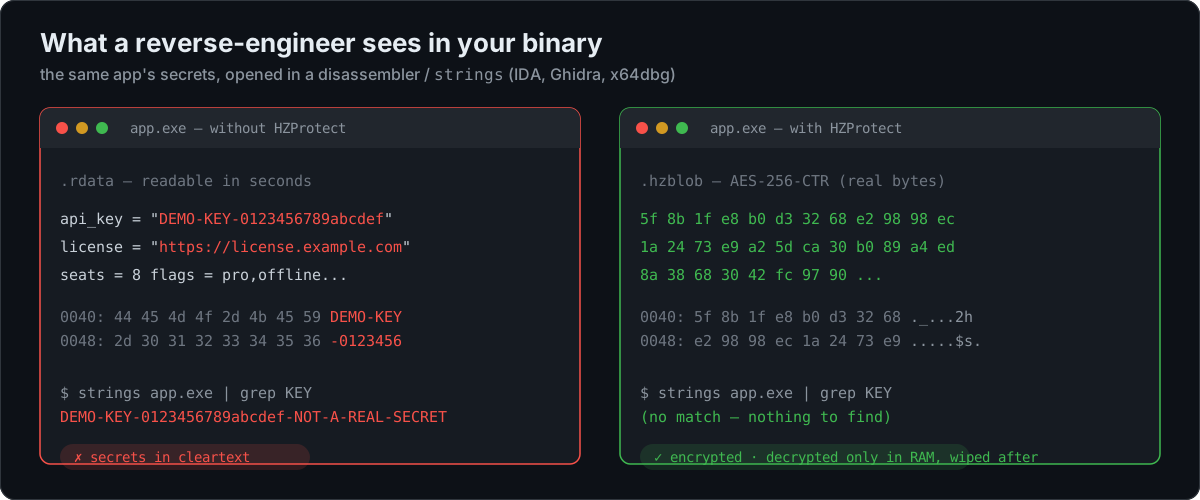
Your secrets never sit in the binary as readable text — they are AES-encrypted
and only decrypted in memory. The same bytes a reverse-engineer would open in
IDA, Ghidra or strings show nothing:
How it works
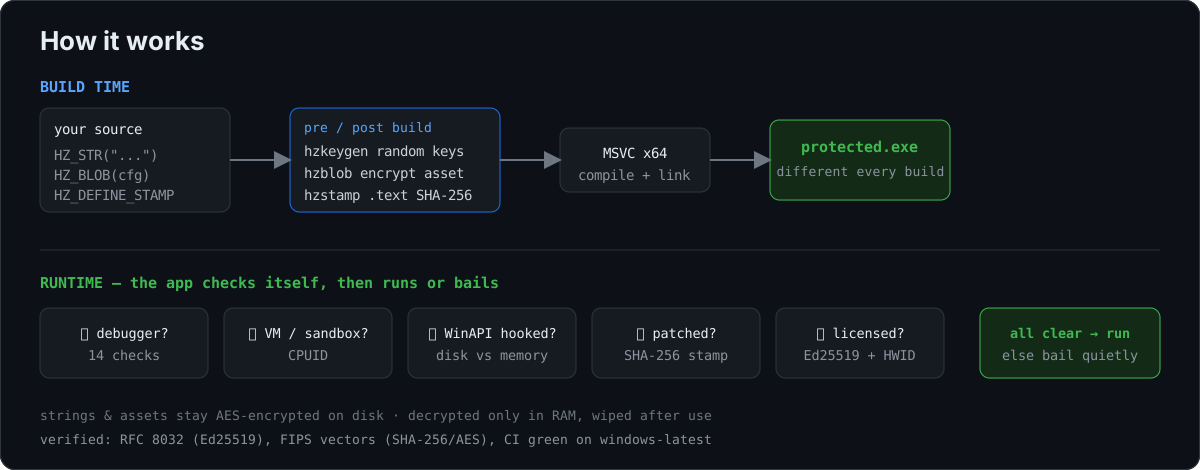
Modules
| Header | What it gives you |
|---|---|
hz_antidebug.h | 14 independent debugger / analysis checks, scored into one debugger_present() call, plus hide_from_debugger() |
hz_antivm.h | Hypervisor / VM detection via CPUID (present-bit + vendor string) |
hz_hooks.h | Inline-hook detection: compares WinAPI prologues in memory vs the clean bytes on disk |
hz_ed25519.h | Ed25519 signatures + SHA-512 (RFC 8032, validated against the official test vectors) |
hz_license.h | Offline signed licenses: HWID binding, expiry, feature flags; verify with an embedded public key |
hz_integrity.h | Runtime self-integrity: SHA-256 of your .text on disk, baked in by hzstamp and checked at startup (anti-crack) |
hz_strcrypt.h | HZ_STR("...") — literals encrypted at compile time, decrypted on use, wiped after; never cleartext in the file |
hz_sha256.h | SHA-256 + HMAC-SHA256 (no deps) |
hz_aes.h | AES-256-CTR (software, no AES-NI dependency) |
hz_blob.h | Embed an AES-encrypted asset; decrypt only in memory, wiped after use |
hzprotect.h | Umbrella include |
Tools (src/tools/)
| Tool | Role |
|---|---|
hzkeygen | Pre-build: emits fresh random key material each build — a 64-bit seed mixed into every HZ_STR key and a 256-bit master key for blobs |
hzblob | Encrypts an asset file with the per-build key into an embeddable header |
hzstamp | Post-build: bakes the .text SHA-256 into the integrity stamp slot |
hzlicense | Offline license authority: keygen, hwid, issue (HWID / expiry / features) |
Quick start
#include "hzprotect.h"

HZ_DEFINE_STAMP(g_stamp);   // one integrity slot; hzstamp fills it post-build

int main() {
    if (hz::debugger_present())                         // any strong debug signal
        return 0;                                       // bail quietly

    if (hz::verify_stamp(g_stamp) == hz::Integrity::Tampered)
        return 0;                                        // binary was patched -> refuse

    puts(HZ_STR("licensed build ok").c_str());          // string absent from the .exe
}
Build your app, then run the stamper once on the output:
hzstamp your_app.exe
hzstamp hashes the .text section and writes the digest into the stamp slot
(it locates the slot in a writable data section, never confusing it with the
magic constant in .rdata). At runtime verify_stamp recomputes the on-disk
.text hash and compares.
The modules in detail
Anti-debug (hz_antidebug.h)
hz::debugger_scan() returns a DebugReport with each check broken out;
hz::debugger_present(threshold) sums them. The 14 checks:
PEB.BeingDebugged,IsDebuggerPresent,CheckRemoteDebuggerPresentNtGlobalFlagheap bitsNtQueryInformationProcess: DebugPort / DebugObjectHandle / DebugFlags- Hardware breakpoints (DR0–DR3), RDTSC timing gap
ThreadHideFromDebuggerset/query mismatchCloseHandleinvalid-handle exception,int3swallowedDbgUiRemoteBreakinhead byte patched- Parent process is a known debugger (x64dbg, windbg, IDA, cdb, …)
Each is a heuristic; act on the aggregate. hide_from_debugger() is an active
measure that detaches the current thread from the debugger's event stream.
Self-integrity (hz_integrity.h)
Hashes the raw on-disk bytes of a section of your own executable — on disk, not
memory, because ASLR base relocations make an in-memory .text hash unstable
across runs, while the on-disk bytes are exactly what a patcher edits. CRC32 is
available as a lightweight option; SHA-256 via the stamp is the default. Fails
closed: if the hash can't be read, it reports tampering.
String encryption (hz_strcrypt.h)
HZ_STR("literal") XOR-encrypts the literal at compile time with a per-call-site
key (mixing __FILE__, __LINE__, __COUNTER__), stores only the ciphertext,
and decrypts into a stack buffer zeroed on scope exit. Two identical literals
encrypt differently. Returns a scoped object; use .c_str() for C APIs.
Inline-hook detection (hz_hooks.h)
hz::scan_hooks() walks a watch list of memory/process/module WinAPIs (ntdll
NtProtectVirtualMemory, NtReadVirtualMemory, NtWriteVirtualMemory,
LdrLoadDll, … plus kernel32), and for each one compares the first bytes of the
function in memory against the clean bytes read from the owning module's file on
disk. A difference shaped like a jmp rel32 / jmp [rip] / push;ret /
mov rax;jmp / int3 is reported as a trampoline hook. Legit jmp [rip]
forwarders (e.g. kernel32!VirtualProtect → kernelbase) are not flagged
because their on-disk bytes match. Detection is read-only.
Licensing (hz_license.h + hzlicense)
Offline licenses signed with Ed25519. You generate a key pair once
(hzlicense keygen), embed the 32-byte public key in your app, and keep the
private key offline. Each license is a small payload — feature bitmask, optional
machine binding (hz::hwid() = SHA-256 of MachineGuid + volume serial +
computer name + CPU brand), optional expiry — plus a 64-byte signature, wrapped
in base64. The app calls hz::verify_license(text, pubkey) and gets back
Valid / BadSignature / WrongMachine / Expired / BadFormat. Forging a
license needs the private key; pair it with the integrity stamp so that patching
the check out is itself detected.
hzlicense keygen priv.bin license_pubkey.h          # once; embed the header
hzlicense hwid                                       # a customer's machine id
hzlicense issue priv.bin --out c.key --hwid <id> --expiry 2027-01-01 --features ff
The Ed25519 + SHA-512 implementation is validated against the RFC 8032 test
vectors (public-key derivation, signature, and verification) in edtest.
Crypto (hz_sha256.h, hz_aes.h)
Standalone SHA-256 / HMAC-SHA256 and AES-256-CTR, both header-only with no dependencies, validated against FIPS test vectors in the demo.
Per-build randomization (hzkeygen)
Run hzkeygen before each build to emit hz_build_keys.h (a 64-bit
HZ_BUILD_SEED + a 256-bit HZ_BUILD_MASTER_KEY) with fresh random values. The
seed is folded into every HZ_STR compile-time key, so the same source and
the same asset encrypt to different bytes in every build — cross-version
diffing and static signatures on your protected strings/assets break, while each
shipped binary stays byte-stable (the integrity stamp still works). The
generated key files are git-ignored and must not be committed.
In-memory assets (hz_blob.h + hzblob)
hzblob asset.json out.h name key.bin encrypts an asset with AES-256-CTR (the
per-build master key + a random nonce) into an embeddable header. At runtime:
#include "config_blob.h"
hz::ScopedBytes cfg = HZ_BLOB(config_blob).decrypt();  // plaintext only in RAM
use(cfg.c_str());
// cfg is zeroed and freed here — plaintext never touches disk
The ciphertext is what sits in the binary; the plaintext exists only in a heap buffer that is wiped on scope exit.
Build
MSVC x64 (Visual Studio 2022). Either:
build.bat REM tools -> per-build keys -> encrypt asset -> build + stamp demo
or CMake:
cmake -B build -A x64
cmake --build build --config Release    REM auto-stamps hzdemo post-build
ctest --test-dir build -C Release
hzdemo exercises every module and prints a report. Run it normally, then under
a debugger to watch the anti-debug score climb.
Verified (CI, windows-latest)
- SHA-256 and AES-256 self-tests pass against FIPS vectors.
- Encrypted literals and the embedded asset (api_key, license server) do not appear in the binary; the asset decrypts correctly in memory at runtime.
- Every build produces a different seed and different asset ciphertext from the same source.
- A single-byte on-disk patch to
.textis detected (verify_stamp() = TAMPERED). - Ed25519 matches the RFC 8032 known-answer vectors; licenses verify as Valid / BadSignature / WrongMachine / Expired across all cases.
- Inline-hook scan reports 0 hooks on a clean process (10/10 prologues match disk) and the classifier recognizes every trampoline shape.
- Locally under
cdb, the anti-debug score reaches 8/14 anddebugger_present()returns true.
Scope / limits
These are deterrents, not guarantees — a determined analyst with a kernel debugger or an emulator can defeat any usermode check, and a self-integrity hash whose logic is in the same binary can be re-stamped by whoever cracks it. The goal is to raise the cost of casual cracking and static analysis of your own software.
License
MIT
Similar repos


Languages
C++
94.4%
CMake
3.1%
Batchfile
1.5%
Source-integrated C++ Windows binary-protection SDK: anti-debug, anti-tamper, inline-hook detection, compile-time string/asset encryption, and offline Ed25519 licensing.
C++
1
3 commits
updated Oct 3, 2026
See what people are saying
README
A header-only C++ protection toolkit you compile into your own Windows application to make it harder to debug, crack, and reverse-engineer. No external dependencies — include the headers, call into them from your own code.
This is a source-integrated protection library (the developer builds it into their program). It is not a packer or a wrapper around arbitrary binaries.
What it does, at a glance
Your secrets never sit in the binary as readable text — they are AES-encrypted
and only decrypted in memory. The same bytes a reverse-engineer would open in
IDA, Ghidra or strings show nothing:
How it works
Modules
| Header | What it gives you |
|---|---|
hz_antidebug.h | 14 independent debugger / analysis checks, scored into one debugger_present() call, plus hide_from_debugger() |
hz_antivm.h | Hypervisor / VM detection via CPUID (present-bit + vendor string) |
hz_hooks.h | Inline-hook detection: compares WinAPI prologues in memory vs the clean bytes on disk |
hz_ed25519.h | Ed25519 signatures + SHA-512 (RFC 8032, validated against the official test vectors) |
hz_license.h | Offline signed licenses: HWID binding, expiry, feature flags; verify with an embedded public key |
hz_integrity.h | Runtime self-integrity: SHA-256 of your .text on disk, baked in by hzstamp and checked at startup (anti-crack) |
hz_strcrypt.h | HZ_STR("...") — literals encrypted at compile time, decrypted on use, wiped after; never cleartext in the file |
hz_sha256.h | SHA-256 + HMAC-SHA256 (no deps) |
hz_aes.h | AES-256-CTR (software, no AES-NI dependency) |
hz_blob.h | Embed an AES-encrypted asset; decrypt only in memory, wiped after use |
hzprotect.h | Umbrella include |
Tools (src/tools/)
| Tool | Role |
|---|---|
hzkeygen | Pre-build: emits fresh random key material each build — a 64-bit seed mixed into every HZ_STR key and a 256-bit master key for blobs |
hzblob | Encrypts an asset file with the per-build key into an embeddable header |
hzstamp | Post-build: bakes the .text SHA-256 into the integrity stamp slot |
hzlicense | Offline license authority: keygen, hwid, issue (HWID / expiry / features) |
Quick start
#include "hzprotect.h"

HZ_DEFINE_STAMP(g_stamp);   // one integrity slot; hzstamp fills it post-build

int main() {
    if (hz::debugger_present())                         // any strong debug signal
        return 0;                                       // bail quietly

    if (hz::verify_stamp(g_stamp) == hz::Integrity::Tampered)
        return 0;                                        // binary was patched -> refuse

    puts(HZ_STR("licensed build ok").c_str());          // string absent from the .exe
}
Build your app, then run the stamper once on the output:
hzstamp your_app.exe
hzstamp hashes the .text section and writes the digest into the stamp slot
(it locates the slot in a writable data section, never confusing it with the
magic constant in .rdata). At runtime verify_stamp recomputes the on-disk
.text hash and compares.
The modules in detail
Anti-debug (hz_antidebug.h)
hz::debugger_scan() returns a DebugReport with each check broken out;
hz::debugger_present(threshold) sums them. The 14 checks:
PEB.BeingDebugged,IsDebuggerPresent,CheckRemoteDebuggerPresentNtGlobalFlagheap bitsNtQueryInformationProcess: DebugPort / DebugObjectHandle / DebugFlags- Hardware breakpoints (DR0–DR3), RDTSC timing gap
ThreadHideFromDebuggerset/query mismatchCloseHandleinvalid-handle exception,int3swallowedDbgUiRemoteBreakinhead byte patched- Parent process is a known debugger (x64dbg, windbg, IDA, cdb, …)
Each is a heuristic; act on the aggregate. hide_from_debugger() is an active
measure that detaches the current thread from the debugger's event stream.
Self-integrity (hz_integrity.h)
Hashes the raw on-disk bytes of a section of your own executable — on disk, not
memory, because ASLR base relocations make an in-memory .text hash unstable
across runs, while the on-disk bytes are exactly what a patcher edits. CRC32 is
available as a lightweight option; SHA-256 via the stamp is the default. Fails
closed: if the hash can't be read, it reports tampering.
String encryption (hz_strcrypt.h)
HZ_STR("literal") XOR-encrypts the literal at compile time with a per-call-site
key (mixing __FILE__, __LINE__, __COUNTER__), stores only the ciphertext,
and decrypts into a stack buffer zeroed on scope exit. Two identical literals
encrypt differently. Returns a scoped object; use .c_str() for C APIs.
Inline-hook detection (hz_hooks.h)
hz::scan_hooks() walks a watch list of memory/process/module WinAPIs (ntdll
NtProtectVirtualMemory, NtReadVirtualMemory, NtWriteVirtualMemory,
LdrLoadDll, … plus kernel32), and for each one compares the first bytes of the
function in memory against the clean bytes read from the owning module's file on
disk. A difference shaped like a jmp rel32 / jmp [rip] / push;ret /
mov rax;jmp / int3 is reported as a trampoline hook. Legit jmp [rip]
forwarders (e.g. kernel32!VirtualProtect → kernelbase) are not flagged
because their on-disk bytes match. Detection is read-only.
Licensing (hz_license.h + hzlicense)
Offline licenses signed with Ed25519. You generate a key pair once
(hzlicense keygen), embed the 32-byte public key in your app, and keep the
private key offline. Each license is a small payload — feature bitmask, optional
machine binding (hz::hwid() = SHA-256 of MachineGuid + volume serial +
computer name + CPU brand), optional expiry — plus a 64-byte signature, wrapped
in base64. The app calls hz::verify_license(text, pubkey) and gets back
Valid / BadSignature / WrongMachine / Expired / BadFormat. Forging a
license needs the private key; pair it with the integrity stamp so that patching
the check out is itself detected.
hzlicense keygen priv.bin license_pubkey.h          # once; embed the header
hzlicense hwid                                       # a customer's machine id
hzlicense issue priv.bin --out c.key --hwid <id> --expiry 2027-01-01 --features ff
The Ed25519 + SHA-512 implementation is validated against the RFC 8032 test
vectors (public-key derivation, signature, and verification) in edtest.
Crypto (hz_sha256.h, hz_aes.h)
Standalone SHA-256 / HMAC-SHA256 and AES-256-CTR, both header-only with no dependencies, validated against FIPS test vectors in the demo.
Per-build randomization (hzkeygen)
Run hzkeygen before each build to emit hz_build_keys.h (a 64-bit
HZ_BUILD_SEED + a 256-bit HZ_BUILD_MASTER_KEY) with fresh random values. The
seed is folded into every HZ_STR compile-time key, so the same source and
the same asset encrypt to different bytes in every build — cross-version
diffing and static signatures on your protected strings/assets break, while each
shipped binary stays byte-stable (the integrity stamp still works). The
generated key files are git-ignored and must not be committed.
In-memory assets (hz_blob.h + hzblob)
hzblob asset.json out.h name key.bin encrypts an asset with AES-256-CTR (the
per-build master key + a random nonce) into an embeddable header. At runtime:
#include "config_blob.h"
hz::ScopedBytes cfg = HZ_BLOB(config_blob).decrypt();  // plaintext only in RAM
use(cfg.c_str());
// cfg is zeroed and freed here — plaintext never touches disk
The ciphertext is what sits in the binary; the plaintext exists only in a heap buffer that is wiped on scope exit.
Build
MSVC x64 (Visual Studio 2022). Either:
build.bat REM tools -> per-build keys -> encrypt asset -> build + stamp demo
or CMake:
cmake -B build -A x64
cmake --build build --config Release    REM auto-stamps hzdemo post-build
ctest --test-dir build -C Release
hzdemo exercises every module and prints a report. Run it normally, then under
a debugger to watch the anti-debug score climb.
Verified (CI, windows-latest)
- SHA-256 and AES-256 self-tests pass against FIPS vectors.
- Encrypted literals and the embedded asset (api_key, license server) do not appear in the binary; the asset decrypts correctly in memory at runtime.
- Every build produces a different seed and different asset ciphertext from the same source.
- A single-byte on-disk patch to
.textis detected (verify_stamp() = TAMPERED). - Ed25519 matches the RFC 8032 known-answer vectors; licenses verify as Valid / BadSignature / WrongMachine / Expired across all cases.
- Inline-hook scan reports 0 hooks on a clean process (10/10 prologues match disk) and the classifier recognizes every trampoline shape.
- Locally under
cdb, the anti-debug score reaches 8/14 anddebugger_present()returns true.
Scope / limits
These are deterrents, not guarantees — a determined analyst with a kernel debugger or an emulator can defeat any usermode check, and a self-integrity hash whose logic is in the same binary can be re-stamped by whoever cracks it. The goal is to raise the cost of casual cracking and static analysis of your own software.
License
MIT
Similar repos
Languages
C++
94.4%
CMake
3.1%
Batchfile
1.5%