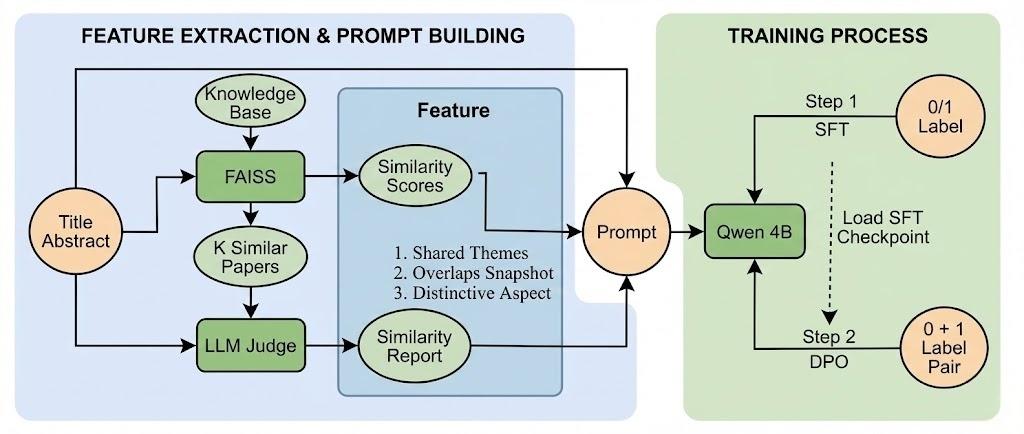
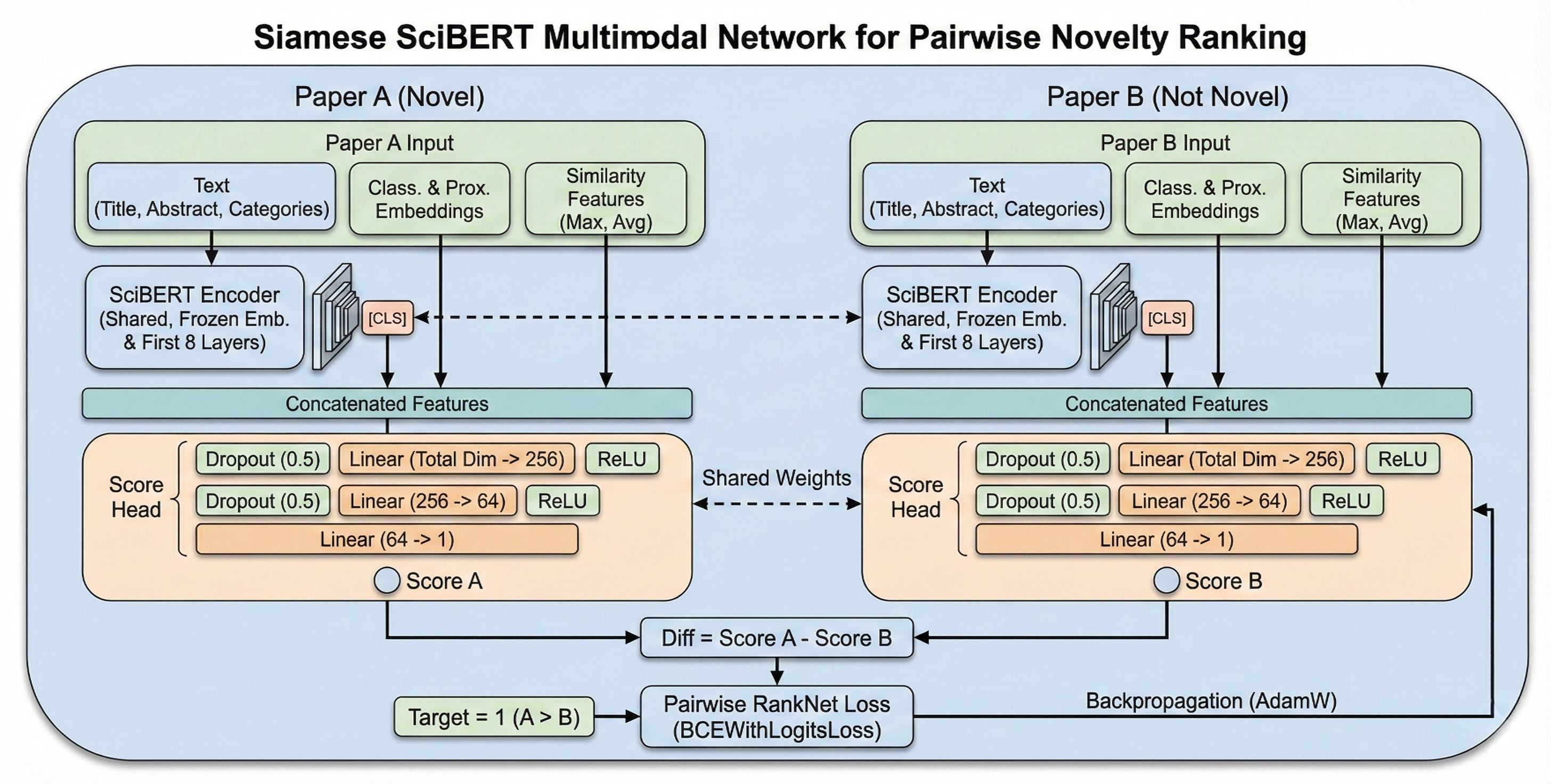
NoveltyRank evaluates the conceptual novelty of AI research papers using two complementary task formulations and three benchmark modeling approaches.
We implement:
To benchmark these tasks across different modeling scales, we compare three methods:
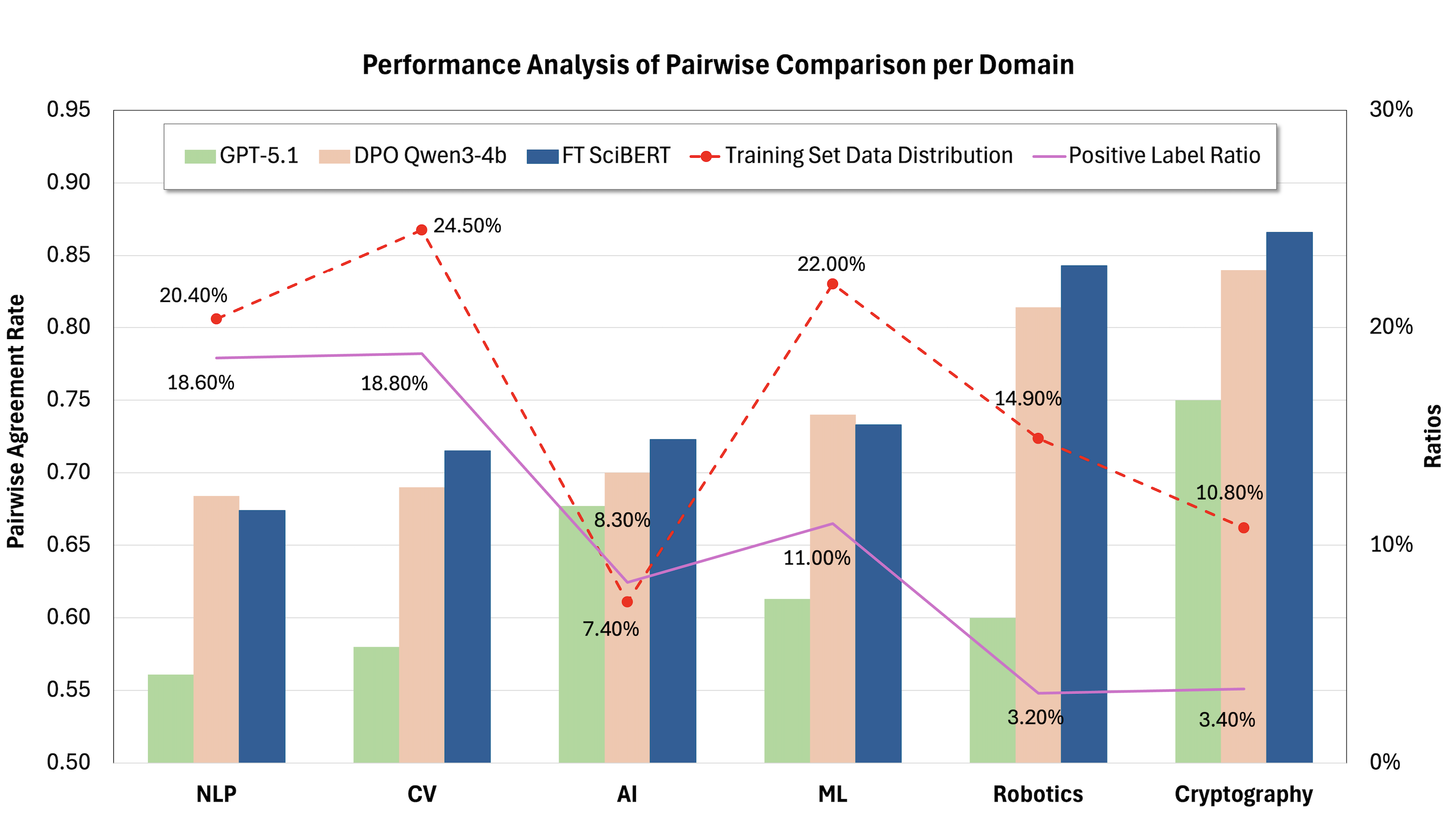
This framework highlights how task formulation and model adaptation influence novelty estimation, with pairwise comparison and fine-tuned models providing the most reliable performance.
This project is part of Stanford University’s CS230: Deep Learning (Fall 2025).
Dataset hosted at: Hugging Face – novelty-ranked-preprints
| Model | Acc | Prec | Rec | F1 |
|---|---|---|---|---|
| GPT-5.1 | 24.2% | 12.0% | 98.6% | 21.5% |
| SFT Qwen3-4b | 62.7% | 19.4% | 63.2% | 29.7% |
| DPO Qwen3-4b | 61.2% | 20.5% | 73.5% | 32.1% |
| SciBERT | 74.4% | 18.7% | 31.3% | 23.4% |
| Model | cs.AI | cs.CL | cs.CR | cs.CV | cs.LG | cs.RO | COMBINED |
|---|---|---|---|---|---|---|---|
| GPT-5.1 | 67.7% | 56.1% | 75.0% | 58.0% | 61.3% | 60.0% | 58.3% |
| DPO Qwen3-4b | 70.0% | 68.4% | 84.0% | 69.0% | 74.0% | 81.4% | 74.1% |
| SciBERT | 72.3% | 67.4% | 86.6% | 71.5% | 73.3% | 84.3% | 75.3% |
Create a Conda environment
conda create -n noveltyrank python=3.11
conda activate noveltyrank
Install dependencies
pip install tinker
pip install git+https://github.com/thinking-machines-lab/tinker-cookbook.git
Clone and install the repository
git clone [email protected]:ZhengxuYan/NoveltyRank.git
cd NoveltyRank
pip install -r requirements.txt
create .env file
Please create a .env file in the root directory and add the following lines with your respective API tokens:
HUGGINGFACEHUB_API_TOKEN=your_hugging_face_token_here
WANDB_API_KEY=your_wandb_api_key_here
TINKER_API_KEY=your_tinker_api_key_here
If you don't have these tokens, please sign up on the respective platforms to obtain them.
If you need to modify or run the frontend (under the web/ directory), install Node.js dependencies by running:
cd web
npm install
# or
yarn install
All packages will be installed into the node_modules/ folder, which is included in .gitignore and should not be committed to the repository. Only package.json and lock files (package-lock.json or yarn.lock) are needed for reproducibility.
NoveltyRank/
│
├── data_cache/                # Preprocessed and cached datasets (classification/similarity-aware) - gitignored
│
├── results/                   # Training outputs, evaluation results, model checkpoints - gitignored
│
├── embedding/
│   ├── embeddings.py          # SPECTER2 embedding generation
│   ├── similarity.py          # FAISS similarity computation
│   └── similiarity_report/    # Scripts for generating/managing similarity reports
│
├── models/
│   ├── Qwen_4B/               # Qwen model code and environment (e.g. sft_env.py, dpo_env.py, data_preparation.py)
│   └── scibert_multimodal/    # SciBERT multimodal model and configs
│
├── scripts/
│   ├── Qwen_4B/               # Qwen SFT/DPO training & evaluation scripts (sft.py, dpo.py, test_*.py)
│   ├── openai/                # Frontier/OpenAI baseline evaluation scripts
│   └── Sci_BERT/              # SciBERT training and analysis scripts
│
├── utils/
│   ├── create_hf_dataset.py   # HuggingFace dataset creation
│   ├── create_novelty_dataset.py # NoveltyRank custom dataset builder
│   ├── push_to_huggingface.py # Upload utilities
│   └── other helper scripts
│
├── web/                       # Frontend pages and config
│
├── README.md
└── requirements.txt
Collect papers from ArXiv and conferences:
# ArXiv papers
cd scrapers/arxiv_scraper
scrapy crawl arxiv -o results/arxiv_results.csv

# Conference papers (OpenReview)
cd scrapers/conference_scraper
python scrape_openreview.py --conference ICLR --start-year 2024 --end-year 2025
Generate SPECTER2 embeddings for the collected papers:
cd embedding
python embeddings.py --dataset JasonYan777/novelty-rank-dataset --batch-size 8
This creates both classification and proximity embeddings for each paper.
Compute FAISS indices and nearest neighbors based on the embeddings:
python similarity.py
Classification SFT (with similarity-aware data)
python scripts/Qwen_4B/train/sft.py \
  data_variant=sim \
  log_path=results/aligned_sft_classification_sim \
  wandb_name=aligned_sft_classification_sim \
  learning_rate=2e-5 \
  batch_size=256 \
  num_epochs=12 \
  eval_every=250 \
  save_every=250
Classification DPO (warm-start from SFT checkpoint, with similarity-aware data)
python scripts/Qwen_4B/train/dpo.py \
  env_config.dpo_mode=classification \
  env_config.data_variant=sim \
  env_config.load_checkpoint_path=tinker://b5ca8513-464a-563b-b0e0-6e3a26fe90f9:train:0/weights/final \
  env_config.log_path=results/aligned_dpo_classification_sim \
  env_config.wandb_name=aligned_dpo_classification_sim \
  env_config.learning_rate=1e-6 \
  env_config.batch_size=128 \
  env_config.num_epochs=1 \
  env_config.eval_every=100 \
  env_config.save_every=100
Comparison SFT (base data without similarity-aware data)
python scripts/Qwen_4B/train/sft.py \
  data_variant=base \
  sft_task=comparison \
  log_path=results/aligned_sft_comparison_base \
  wandb_name=aligned_sft_comparison_base \
  learning_rate=3e-5 \
  batch_size=64 \
  num_epochs=10 \
  eval_every=40 \
  save_every=40
Comparison DPO (warm-start from comparison SFT, base data without similarity-aware data)
python scripts/Qwen_4B/train/dpo.py \
  env_config.dpo_mode=comparison \
  env_config.data_variant=base \
  env_config.load_checkpoint_path=tinker://da6dc40b-ab62-5509-9a69-4691d2b5e044:train:0/weights/final \
  env_config.log_path=results/aligned_dpo_comparison_base \
  env_config.wandb_name=aligned_dpo_comparison_base \
  env_config.learning_rate=1.5e-6 \
  env_config.batch_size=64 \
  env_config.num_epochs=4 \
  env_config.eval_every=50 \
  env_config.save_every=50
Description
Qwen/Qwen3-4B-Instruct-2507 on the NoveltyRank dataset using supervised learning and DPO where applicable.log_path. Use unique directories when launching multiple experiments in parallel.Quickly sanity-check the latest checkpoints with the lightweight evaluation scripts:
# Classification accuracy on whole dataset with similarity report
python scripts/Qwen_4B/test/test_classification.py \
  --category WHOLE_DATASET \
  --model-path tinker://aa417c54-d5ee-5b99-a04e-66a1f4b40a51:train:0/sampler_weights/000900 \
  --data_variant sim

# Comparison accuracy on whole dataset without similarity report
python scripts/Qwen_4B/test/test_comparison.py \
  --category WHOLE_DATASET \
  --model-path tinker://a69d7dfe-9693-5eeb-9dea-b065b39b13e0:train:0/sampler_weights/000700 \
  --data_variant base
Key flags:
--category: Choose a category-specific cache if present (e.g. CS_CV, CS_AI). If not provided, the scripts fall back to the whole-dataset cache.--model-name: Base model registered with Tinker (defaults to the production Qwen3-4B checkpoint).--model-path: Tinker checkpoint URI. Pass an empty string to fall back to the base model.--temperature: Sampling temperature (default 0.0 for deterministic decoding).--max-tokens: Maximum generated tokens (10 for classification, 512 for comparison).--limit: Caps the number of evaluation examples (useful for quick smoke tests).--data-variant: Choose between base (no similarity features) and sim (with similarity features) datasets.Classification (SciBERT Multimodal)
python scripts/Sci_BERT/ft_scibert.py \
  --dataset JasonYan777/novelty-rank-with-similarities \
  --batch-size 32 \
  --learning-rate 2e-5 \
  --epochs 5
Comparison (Siamese SciBERT)
python scripts/siamese_scibert/train_pairwise.py
python scripts/siamese_scibert/evaluate_agreement.py
Evaluates frontier models (e.g., GPT-5.1) on the pairwise novelty task using the bespokelabs-curator library.
python scripts/openai/test_frontier_novelty_classification.py
python scripts/openai/test_frontier_novelty_comparison.py
NoveltyRank evaluates the conceptual novelty of AI research papers using two complementary task formulations and three benchmark modeling approaches.
We implement:
To benchmark these tasks across different modeling scales, we compare three methods:
This framework highlights how task formulation and model adaptation influence novelty estimation, with pairwise comparison and fine-tuned models providing the most reliable performance.
This project is part of Stanford University’s CS230: Deep Learning (Fall 2025).
Dataset hosted at: Hugging Face – novelty-ranked-preprints
| Model | Acc | Prec | Rec | F1 |
|---|---|---|---|---|
| GPT-5.1 | 24.2% | 12.0% | 98.6% | 21.5% |
| SFT Qwen3-4b | 62.7% | 19.4% | 63.2% | 29.7% |
| DPO Qwen3-4b | 61.2% | 20.5% | 73.5% | 32.1% |
| SciBERT | 74.4% | 18.7% | 31.3% | 23.4% |
| Model | cs.AI | cs.CL | cs.CR | cs.CV | cs.LG | cs.RO | COMBINED |
|---|---|---|---|---|---|---|---|
| GPT-5.1 | 67.7% | 56.1% | 75.0% | 58.0% | 61.3% | 60.0% | 58.3% |
| DPO Qwen3-4b | 70.0% | 68.4% | 84.0% | 69.0% | 74.0% | 81.4% | 74.1% |
| SciBERT | 72.3% | 67.4% | 86.6% | 71.5% | 73.3% | 84.3% | 75.3% |
Create a Conda environment
conda create -n noveltyrank python=3.11
conda activate noveltyrank
Install dependencies
pip install tinker
pip install git+https://github.com/thinking-machines-lab/tinker-cookbook.git
Clone and install the repository
git clone [email protected]:ZhengxuYan/NoveltyRank.git
cd NoveltyRank
pip install -r requirements.txt
create .env file
Please create a .env file in the root directory and add the following lines with your respective API tokens:
HUGGINGFACEHUB_API_TOKEN=your_hugging_face_token_here
WANDB_API_KEY=your_wandb_api_key_here
TINKER_API_KEY=your_tinker_api_key_here
If you don't have these tokens, please sign up on the respective platforms to obtain them.
If you need to modify or run the frontend (under the web/ directory), install Node.js dependencies by running:
cd web
npm install
# or
yarn install
All packages will be installed into the node_modules/ folder, which is included in .gitignore and should not be committed to the repository. Only package.json and lock files (package-lock.json or yarn.lock) are needed for reproducibility.
NoveltyRank/
│
├── data_cache/                # Preprocessed and cached datasets (classification/similarity-aware) - gitignored
│
├── results/                   # Training outputs, evaluation results, model checkpoints - gitignored
│
├── embedding/
│   ├── embeddings.py          # SPECTER2 embedding generation
│   ├── similarity.py          # FAISS similarity computation
│   └── similiarity_report/    # Scripts for generating/managing similarity reports
│
├── models/
│   ├── Qwen_4B/               # Qwen model code and environment (e.g. sft_env.py, dpo_env.py, data_preparation.py)
│   └── scibert_multimodal/    # SciBERT multimodal model and configs
│
├── scripts/
│   ├── Qwen_4B/               # Qwen SFT/DPO training & evaluation scripts (sft.py, dpo.py, test_*.py)
│   ├── openai/                # Frontier/OpenAI baseline evaluation scripts
│   └── Sci_BERT/              # SciBERT training and analysis scripts
│
├── utils/
│   ├── create_hf_dataset.py   # HuggingFace dataset creation
│   ├── create_novelty_dataset.py # NoveltyRank custom dataset builder
│   ├── push_to_huggingface.py # Upload utilities
│   └── other helper scripts
│
├── web/                       # Frontend pages and config
│
├── README.md
└── requirements.txt
Collect papers from ArXiv and conferences:
# ArXiv papers
cd scrapers/arxiv_scraper
scrapy crawl arxiv -o results/arxiv_results.csv

# Conference papers (OpenReview)
cd scrapers/conference_scraper
python scrape_openreview.py --conference ICLR --start-year 2024 --end-year 2025
Generate SPECTER2 embeddings for the collected papers:
cd embedding
python embeddings.py --dataset JasonYan777/novelty-rank-dataset --batch-size 8
This creates both classification and proximity embeddings for each paper.
Compute FAISS indices and nearest neighbors based on the embeddings:
python similarity.py
Classification SFT (with similarity-aware data)
python scripts/Qwen_4B/train/sft.py \
  data_variant=sim \
  log_path=results/aligned_sft_classification_sim \
  wandb_name=aligned_sft_classification_sim \
  learning_rate=2e-5 \
  batch_size=256 \
  num_epochs=12 \
  eval_every=250 \
  save_every=250
Classification DPO (warm-start from SFT checkpoint, with similarity-aware data)
python scripts/Qwen_4B/train/dpo.py \
  env_config.dpo_mode=classification \
  env_config.data_variant=sim \
  env_config.load_checkpoint_path=tinker://b5ca8513-464a-563b-b0e0-6e3a26fe90f9:train:0/weights/final \
  env_config.log_path=results/aligned_dpo_classification_sim \
  env_config.wandb_name=aligned_dpo_classification_sim \
  env_config.learning_rate=1e-6 \
  env_config.batch_size=128 \
  env_config.num_epochs=1 \
  env_config.eval_every=100 \
  env_config.save_every=100
Comparison SFT (base data without similarity-aware data)
python scripts/Qwen_4B/train/sft.py \
  data_variant=base \
  sft_task=comparison \
  log_path=results/aligned_sft_comparison_base \
  wandb_name=aligned_sft_comparison_base \
  learning_rate=3e-5 \
  batch_size=64 \
  num_epochs=10 \
  eval_every=40 \
  save_every=40
Comparison DPO (warm-start from comparison SFT, base data without similarity-aware data)
python scripts/Qwen_4B/train/dpo.py \
  env_config.dpo_mode=comparison \
  env_config.data_variant=base \
  env_config.load_checkpoint_path=tinker://da6dc40b-ab62-5509-9a69-4691d2b5e044:train:0/weights/final \
  env_config.log_path=results/aligned_dpo_comparison_base \
  env_config.wandb_name=aligned_dpo_comparison_base \
  env_config.learning_rate=1.5e-6 \
  env_config.batch_size=64 \
  env_config.num_epochs=4 \
  env_config.eval_every=50 \
  env_config.save_every=50
Description
Qwen/Qwen3-4B-Instruct-2507 on the NoveltyRank dataset using supervised learning and DPO where applicable.log_path. Use unique directories when launching multiple experiments in parallel.Quickly sanity-check the latest checkpoints with the lightweight evaluation scripts:
# Classification accuracy on whole dataset with similarity report
python scripts/Qwen_4B/test/test_classification.py \
  --category WHOLE_DATASET \
  --model-path tinker://aa417c54-d5ee-5b99-a04e-66a1f4b40a51:train:0/sampler_weights/000900 \
  --data_variant sim

# Comparison accuracy on whole dataset without similarity report
python scripts/Qwen_4B/test/test_comparison.py \
  --category WHOLE_DATASET \
  --model-path tinker://a69d7dfe-9693-5eeb-9dea-b065b39b13e0:train:0/sampler_weights/000700 \
  --data_variant base
Key flags:
--category: Choose a category-specific cache if present (e.g. CS_CV, CS_AI). If not provided, the scripts fall back to the whole-dataset cache.--model-name: Base model registered with Tinker (defaults to the production Qwen3-4B checkpoint).--model-path: Tinker checkpoint URI. Pass an empty string to fall back to the base model.--temperature: Sampling temperature (default 0.0 for deterministic decoding).--max-tokens: Maximum generated tokens (10 for classification, 512 for comparison).--limit: Caps the number of evaluation examples (useful for quick smoke tests).--data-variant: Choose between base (no similarity features) and sim (with similarity features) datasets.Classification (SciBERT Multimodal)
python scripts/Sci_BERT/ft_scibert.py \
  --dataset JasonYan777/novelty-rank-with-similarities \
  --batch-size 32 \
  --learning-rate 2e-5 \
  --epochs 5
Comparison (Siamese SciBERT)
python scripts/siamese_scibert/train_pairwise.py
python scripts/siamese_scibert/evaluate_agreement.py
Evaluates frontier models (e.g., GPT-5.1) on the pairwise novelty task using the bespokelabs-curator library.
python scripts/openai/test_frontier_novelty_classification.py
python scripts/openai/test_frontier_novelty_comparison.py