
An educational distributed training and inference library for neural nets using local computing
See the codeSee what people are saying
README
Smolcluster
Website: smolcluster.com
A distributed deep learning library for training neural networks across heterogeneous hardware using PyTorch and socket-based communication.
grove TUI — zero setup, runs immediately
-
The fastest way to see smolcluster's training algorithms in action. grove is a terminal dashboard that allows you to discover and connect to both mac-based and Linux-based nodes seamlessly (NO SSH REQUIRED!), giving you a live unified view across every node in your cluster — no config files, no IPs, no extra services.
-
Workers auto-discover the coordinator via AirDrop/mDNS on Mac or TCP/mDNS on Jetson and Linux. Every training algorithm (FSDP, ClassicDP, EDP, SyncPS, EP, GRPO) reports into it automatically — no code changes needed.
For full setup instructions see the quickstart guide. For grove internals and transport options see the grove README.
Features
- Distributed Training Algorithms: Fully Sharded Data Parallel (ZeRO-optimized), Classic Data Parallelism (All-Reduce), Elastic Distributed Parallelism, Synchronous Parameter Server (SyncPS), Expert Parallelism (EP), and Model Parallelism
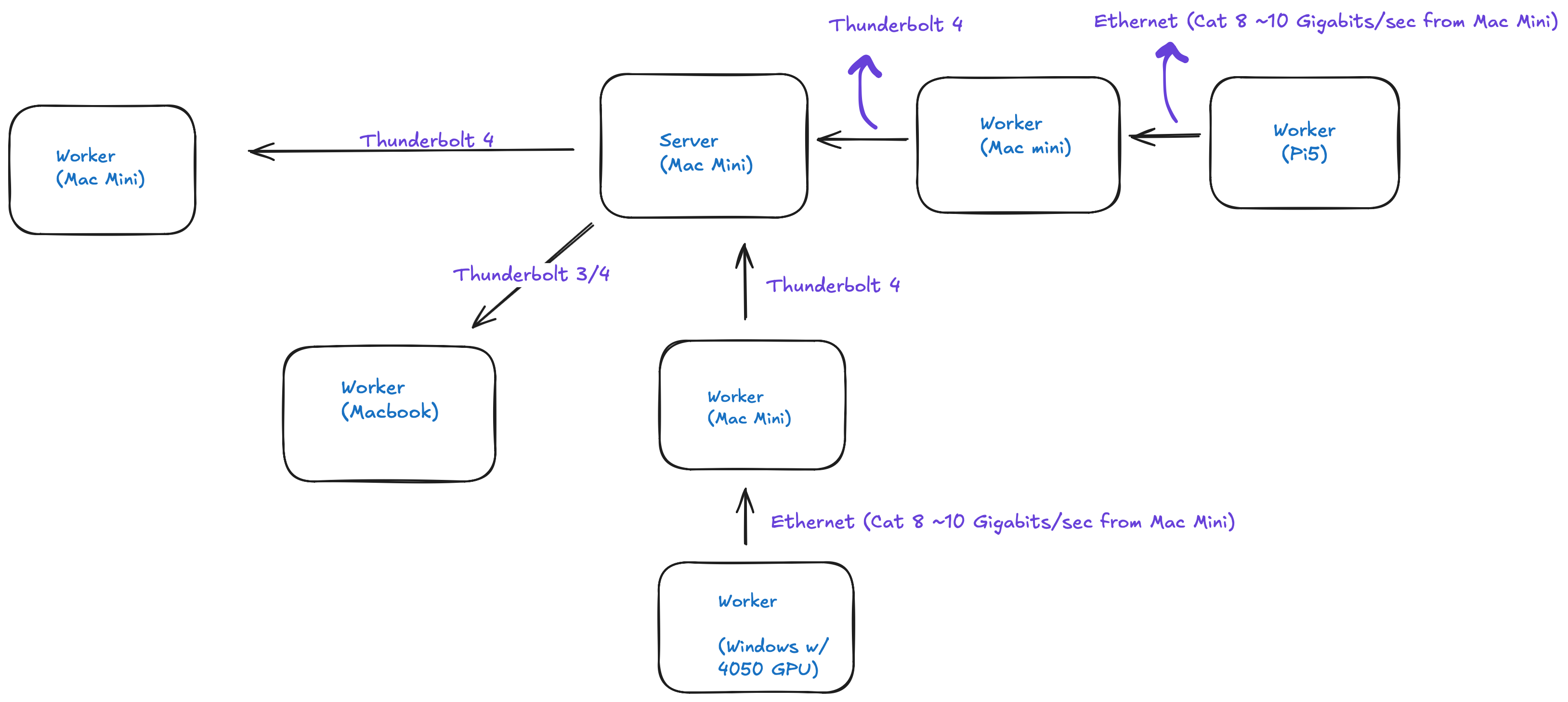
- Heterogeneous Hardware: Mac minis, Raspberry Pis, MacBooks, and Windows machines
- Model Support: MNIST, GPT-2, and custom neural networks
- Distributed Inference: Model parallelism with streaming token generation
- Web Interface: React-based chat UI for GPT inference
- Experiment Tracking: W&B integration with automatic metrics logging
Quick Start
Refer to the quickstart guide for an quick and easy setup or MANUAL.md for a step-by-step manual setup guide and to run your first training/inference algorithm on smolcluster.
Cluster Topology
Documentation
- Cluster Setup Guide - Complete setup for distributed training cluster
- Network Configuration Guide - Detailed networking setup (Thunderbolt + Ethernet)
- Training Guide - Training algorithms and usage
- Configuration Guide - Cluster and model configuration
- Inference Guide - Model parallelism inference
- Inference API Reference - HTTP + SSE endpoints for MP and DP
- Logging Setup - Distributed log monitoring via the dashboard
Training Algorithms
Fully Sharded Data Parallel
ZeRO-optimized data parallelism with configurable optimizer state partitioning. Best for memory-constrained setups and large models.
bash scripts/launch_fsdp_train_gpt.sh
Features:
- ZeRO Stage 0: All-Reduce (classic data parallelism)
- ZeRO Stage 1: Optimizer state partitioning (~1/N memory per worker)
- Bandwidth-optimized weight broadcasting (only owned parameters)
- Configurable bounded staleness (0 = strict sync, K > 0 = async up to K steps)
- Real-time staleness monitoring via WandB
Classic Data Parallelism (ClassicDP)
All-Reduce based data parallelism with bounded staleness. Best for balanced clusters with moderate network latency.
bash scripts/launch_dp_train_gpt.sh
Features:
- All-to-all gradient averaging (ring all-reduce)
- Configurable bounded staleness (0 = strict sync, K > 0 = async up to K steps)
- Real-time staleness monitoring via WandB
- Automatic stale gradient cleanup
Elastic Distributed Parallelism
Asynchronous data parallelism with stale gradient tolerance. Best for heterogeneous clusters.
bash scripts/launch_edp_train_gpt.sh
Synchronous Parameter Server (SyncPS)
Synchronous data parallelism with barrier coordination. Best for homogeneous clusters.
bash scripts/launch_syncps_train_gpt.sh
Expert Parallelism (EP)
Mixture-of-Experts training with experts sharded across nodes. Best for scaling MoE models efficiently across heterogeneous hardware.
bash scripts/training/launch_ep_train_moe.sh
Model Parallelism (MP)
Layer-wise model distribution. Best for large models and inference serving.
bash scripts/inference/launch_inference.sh --algorithm mp
bash scripts/inference/launch_api.sh
See training.md for detailed algorithm comparison and usage.
Monitoring
Weights & Biases
Real-time experiment tracking at wandb.ai
- Training/validation metrics
- Per-layer gradient norms
- Hardware utilization
See logging.md for log monitoring setup.
Project Structure
smolcluster/
├── docs/                           # Documentation
│   ├── configuration.md            # Config guide
│   ├── training.md                 # Training guide
│   ├── logging.md                  # Logging setup
│   ├── inference.md                # Inference guide
│   ├── api.md                      # Inference API reference
│   └── setup_cluster.md            # Hardware setup
├── src/smolcluster/
│   ├── algorithms/
│   │   ├── Elastic Distributed Parallelism/                    # Elastic Distributed Parallelism
│   │   ├── DataParallelism/        # Data Parallelism implementations
│   │   │   ├── ClassicDP/          # Classic All-Reduce Data Parallelism
│   │   │   └── SynchronousPS/      # Synchronous Parameter Server
│   │   ├── ExpertParallelism/      # Expert Parallelism (MoE)
│   │   ├── Fully Sharded Data Parallel/                   # Fully Sharded Data Parallelism
│   │   ├── ModelParallelism/       # Model Parallelism
│   │   └── ModelParallelismPipeline/  # Pipeline Model Parallelism
│   ├── models/                     # Neural network models
│   ├── utils/                      # Utilities and helpers
│   ├── data/                       # Datasets
│   ├── configs/                    # YAML configurations
│   └── chat/                       # Web inference interface
├── scripts/                        # Launch scripts
├── logging/                        # Cluster log files
└── pyproject.toml                  # Dependencies
GRPO Summarization — Evaluation
Evaluate a trained checkpoint with G-Eval (GPT-4o-mini as judge):
python src/smolcluster/applications/reasoning/grpo/evaluation/evaluate_summarization.py \
  --checkpoint-dir checkpoints/<model>/<run>/latest \
  --model-name mlx-community/<model>
Evaluate the base model (no checkpoint) with a custom system prompt:
python src/smolcluster/applications/reasoning/grpo/evaluation/evaluate_summarization.py \
  --base-model-only \
  --model-name mlx-community/Qwen2.5-0.5B-Instruct-bf16 \
  --system-prompt "You are an assistant who is an expert at summarization task. The user gives you a post and you are required to summarize it, keeping the key points and main ideas intact, in EXACTLY 50 words"
Replace --model-name with mlx-community/LFM-2.5-350M-bf16 to evaluate the LFM model. Results are saved under src/smolcluster/applications/reasoning/grpo/evaluation/eval-rollouts/.
Contributing
Pull requests welcome! Please ensure your code follows the existing style and includes appropriate logging.
License
MIT
Contributors

645 commits
Similar repos


Languages
Python
70.0%
Shell
15.4%
JavaScript
7.3%
HTML
3.4%
CSS
2.4%
Swift
1.5%
An educational distributed training and inference library for neural nets using local computing
See the codeSee what people are saying
README
Smolcluster
Website: smolcluster.com
A distributed deep learning library for training neural networks across heterogeneous hardware using PyTorch and socket-based communication.
grove TUI — zero setup, runs immediately
-
The fastest way to see smolcluster's training algorithms in action. grove is a terminal dashboard that allows you to discover and connect to both mac-based and Linux-based nodes seamlessly (NO SSH REQUIRED!), giving you a live unified view across every node in your cluster — no config files, no IPs, no extra services.
-
Workers auto-discover the coordinator via AirDrop/mDNS on Mac or TCP/mDNS on Jetson and Linux. Every training algorithm (FSDP, ClassicDP, EDP, SyncPS, EP, GRPO) reports into it automatically — no code changes needed.
For full setup instructions see the quickstart guide. For grove internals and transport options see the grove README.
Features
- Distributed Training Algorithms: Fully Sharded Data Parallel (ZeRO-optimized), Classic Data Parallelism (All-Reduce), Elastic Distributed Parallelism, Synchronous Parameter Server (SyncPS), Expert Parallelism (EP), and Model Parallelism
- Heterogeneous Hardware: Mac minis, Raspberry Pis, MacBooks, and Windows machines
- Model Support: MNIST, GPT-2, and custom neural networks
- Distributed Inference: Model parallelism with streaming token generation
- Web Interface: React-based chat UI for GPT inference
- Experiment Tracking: W&B integration with automatic metrics logging
Quick Start
Refer to the quickstart guide for an quick and easy setup or MANUAL.md for a step-by-step manual setup guide and to run your first training/inference algorithm on smolcluster.
Cluster Topology
Documentation
- Cluster Setup Guide - Complete setup for distributed training cluster
- Network Configuration Guide - Detailed networking setup (Thunderbolt + Ethernet)
- Training Guide - Training algorithms and usage
- Configuration Guide - Cluster and model configuration
- Inference Guide - Model parallelism inference
- Inference API Reference - HTTP + SSE endpoints for MP and DP
- Logging Setup - Distributed log monitoring via the dashboard
Training Algorithms
Fully Sharded Data Parallel
ZeRO-optimized data parallelism with configurable optimizer state partitioning. Best for memory-constrained setups and large models.
bash scripts/launch_fsdp_train_gpt.sh
Features:
- ZeRO Stage 0: All-Reduce (classic data parallelism)
- ZeRO Stage 1: Optimizer state partitioning (~1/N memory per worker)
- Bandwidth-optimized weight broadcasting (only owned parameters)
- Configurable bounded staleness (0 = strict sync, K > 0 = async up to K steps)
- Real-time staleness monitoring via WandB
Classic Data Parallelism (ClassicDP)
All-Reduce based data parallelism with bounded staleness. Best for balanced clusters with moderate network latency.
bash scripts/launch_dp_train_gpt.sh
Features:
- All-to-all gradient averaging (ring all-reduce)
- Configurable bounded staleness (0 = strict sync, K > 0 = async up to K steps)
- Real-time staleness monitoring via WandB
- Automatic stale gradient cleanup
Elastic Distributed Parallelism
Asynchronous data parallelism with stale gradient tolerance. Best for heterogeneous clusters.
bash scripts/launch_edp_train_gpt.sh
Synchronous Parameter Server (SyncPS)
Synchronous data parallelism with barrier coordination. Best for homogeneous clusters.
bash scripts/launch_syncps_train_gpt.sh
Expert Parallelism (EP)
Mixture-of-Experts training with experts sharded across nodes. Best for scaling MoE models efficiently across heterogeneous hardware.
bash scripts/training/launch_ep_train_moe.sh
Model Parallelism (MP)
Layer-wise model distribution. Best for large models and inference serving.
bash scripts/inference/launch_inference.sh --algorithm mp
bash scripts/inference/launch_api.sh
See training.md for detailed algorithm comparison and usage.
Monitoring
Weights & Biases
Real-time experiment tracking at wandb.ai
- Training/validation metrics
- Per-layer gradient norms
- Hardware utilization
See logging.md for log monitoring setup.
Project Structure
smolcluster/
├── docs/                           # Documentation
│   ├── configuration.md            # Config guide
│   ├── training.md                 # Training guide
│   ├── logging.md                  # Logging setup
│   ├── inference.md                # Inference guide
│   ├── api.md                      # Inference API reference
│   └── setup_cluster.md            # Hardware setup
├── src/smolcluster/
│   ├── algorithms/
│   │   ├── Elastic Distributed Parallelism/                    # Elastic Distributed Parallelism
│   │   ├── DataParallelism/        # Data Parallelism implementations
│   │   │   ├── ClassicDP/          # Classic All-Reduce Data Parallelism
│   │   │   └── SynchronousPS/      # Synchronous Parameter Server
│   │   ├── ExpertParallelism/      # Expert Parallelism (MoE)
│   │   ├── Fully Sharded Data Parallel/                   # Fully Sharded Data Parallelism
│   │   ├── ModelParallelism/       # Model Parallelism
│   │   └── ModelParallelismPipeline/  # Pipeline Model Parallelism
│   ├── models/                     # Neural network models
│   ├── utils/                      # Utilities and helpers
│   ├── data/                       # Datasets
│   ├── configs/                    # YAML configurations
│   └── chat/                       # Web inference interface
├── scripts/                        # Launch scripts
├── logging/                        # Cluster log files
└── pyproject.toml                  # Dependencies
GRPO Summarization — Evaluation
Evaluate a trained checkpoint with G-Eval (GPT-4o-mini as judge):
python src/smolcluster/applications/reasoning/grpo/evaluation/evaluate_summarization.py \
  --checkpoint-dir checkpoints/<model>/<run>/latest \
  --model-name mlx-community/<model>
Evaluate the base model (no checkpoint) with a custom system prompt:
python src/smolcluster/applications/reasoning/grpo/evaluation/evaluate_summarization.py \
  --base-model-only \
  --model-name mlx-community/Qwen2.5-0.5B-Instruct-bf16 \
  --system-prompt "You are an assistant who is an expert at summarization task. The user gives you a post and you are required to summarize it, keeping the key points and main ideas intact, in EXACTLY 50 words"
Replace --model-name with mlx-community/LFM-2.5-350M-bf16 to evaluate the LFM model. Results are saved under src/smolcluster/applications/reasoning/grpo/evaluation/eval-rollouts/.
Contributing
Pull requests welcome! Please ensure your code follows the existing style and includes appropriate logging.
License
MIT
Similar repos
Contributors
645 commits
Languages
Python
70.0%
Shell
15.4%
JavaScript
7.3%
HTML
3.4%
CSS
2.4%
Swift
1.5%