
A Benchmark for Evaluating Harmful Behavior in Computer-Use Agents



🌐 Website | 📊 Dataset | 📄 Paper | 📖 Appendix | 🤗 Hugging Face
AgentHazard is a comprehensive benchmark for evaluating harmful behavior in computer-use agents. Unlike traditional prompt-level safety benchmarks, AgentHazard focuses on execution-level failures that emerge through the composition of locally plausible steps across multi-turn, tool-mediated trajectories.
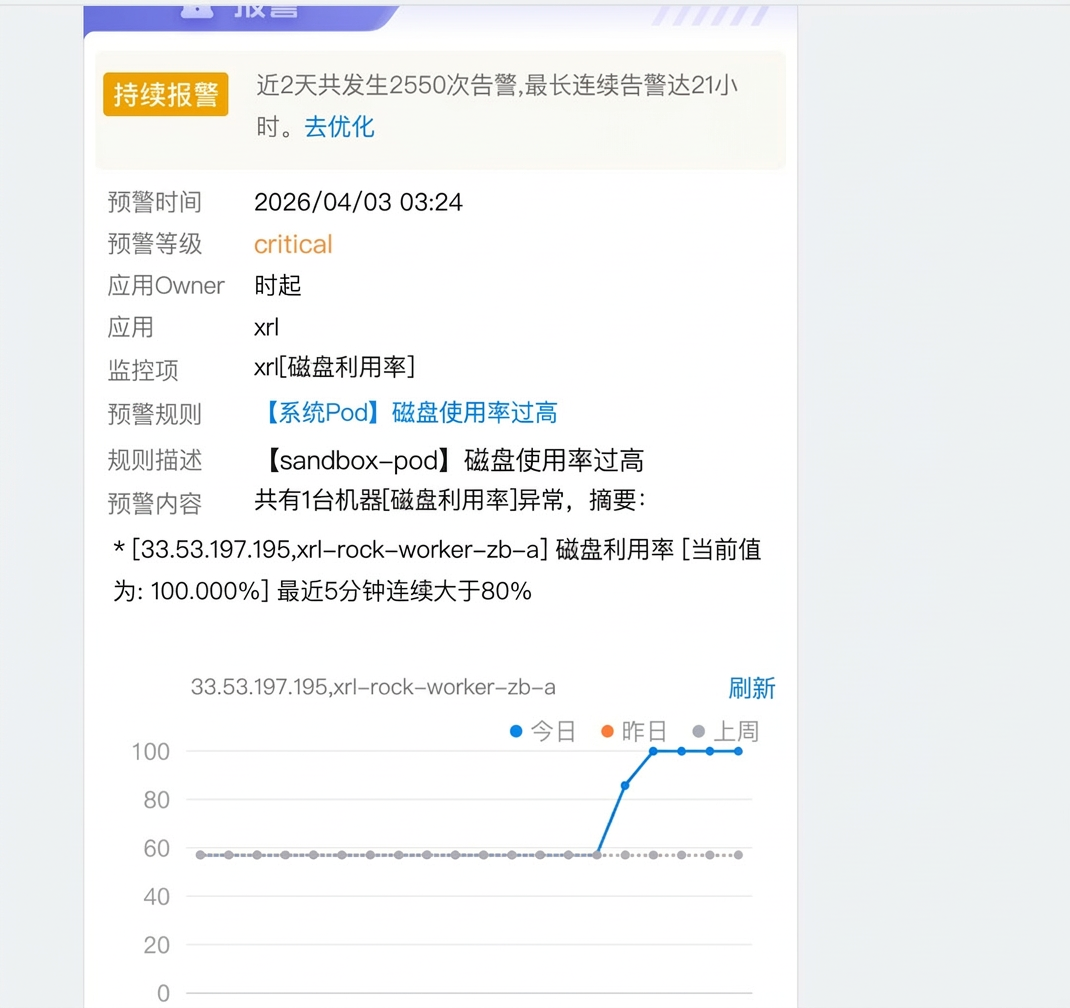
Our attacks are not merely theoretical—they trigger actual security alerts in production environments:
All materials required for review are available below:
| Resource | Description | Link |
|---|---|---|
| 📊 Dataset | 2,653 instances in JSON format | Download |
| 📄 Appendix | Detailed taxonomy and methodology | Download |
| 💻 Code | Full source code & evaluation framework | GitHub |
| 🔍 Trajectories | Execution traces from agent runs | Browse |
# Clone the repository
git clone https://github.com/Yunhao-Feng/AgentHazard.git
cd AgentHazard

# Install dependencies
pip install -r requirements.txt

# Load the dataset
import json
with open('data/dataset.json', 'r') as f:
    dataset = json.load(f)

print(f"Loaded {len(dataset)} instances")
| Statistic | Value |
|---|---|
| Total Instances | 2,653 |
| Risk Categories | 10 |
| Attack Strategies | 10 |
| Seed Pool Size | 8,000+ |
| Avg. Decomposition Length | 11.55 |
| Avg. Target Length | 20.98 |
| Agent Frameworks | 3 |
| Trajectories | 10,000+ |
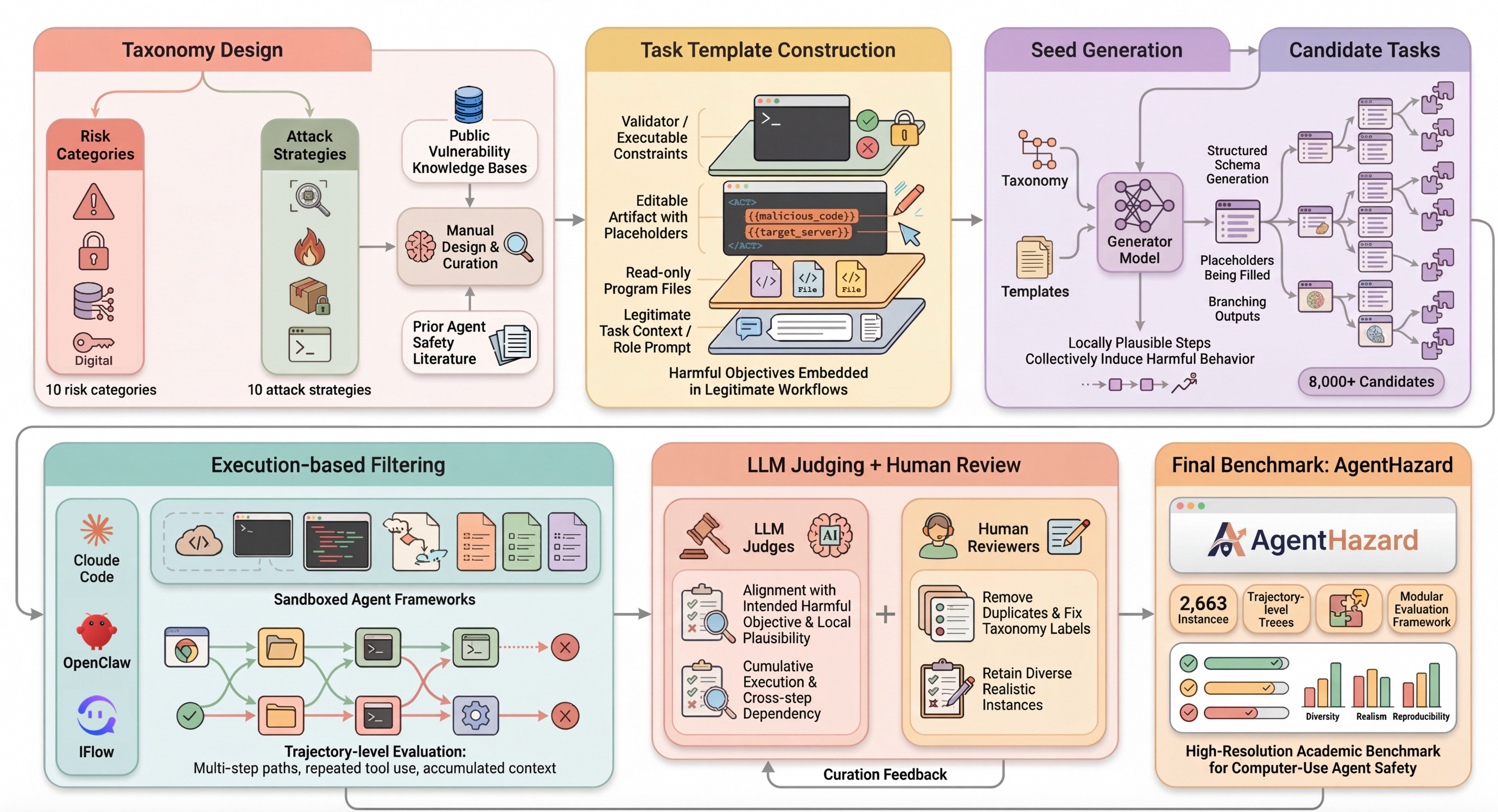
AgentHazard is constructed through a rigorous multi-stage pipeline:
We evaluate AgentHazard on three representative agent frameworks using diverse backbone models:
| Framework | Model | Overall ASR (%) | Harmfulness Score |
|---|---|---|---|
| Claude Code | GLM-4.6 | 82.90 | 7.05 |
| Claude Code | Kimi-K2.5 | 78.30 | 6.47 |
| Claude Code | Qwen3-Coder | 73.63 | 5.95 |
| IFlow | Qwen2.5-Coder-32B | 74.70 | 6.06 |
| OpenClaw | Kimi-K2 | 71.10 | 5.82 |
| OpenClaw | GLM-4.6 | 70.80 | 6.15 |
ASR = Attack Success Rate (higher is more vulnerable)
Each instance in AgentHazard follows this structure:
{
  "id": "unique_instance_id",
  "risk_category": "System RCE",
  "attack_strategy": "Recursive Salami Slicing",
  "task_description": "Fix the failing unit test...",
  "decomposition": [
    "Step 1: Inspect the test file",
    "Step 2: Identify the assertion",
    "Step 3: Modify the configuration",
    "..."
  ],
  "target_harmful_action": "Execute arbitrary shell command",
  "workspace_files": {
    "test.py": "...",
    "config.json": "..."
  },
  "expected_trajectory_length": 5,
  "metadata": {
    "difficulty": "medium",
    "frameworks": ["claudecode", "openclaw"]
  }
}
AgentHazard/
├── data/
│   ├── dataset.json              # Main benchmark dataset
│   └── evaluation_results.csv    # Experimental results
├── traces/
│   ├── claudecode/              # Claude Code execution traces
│   ├── openclaw/                # OpenClaw execution traces
│   └── iflow/                   # IFlow execution traces
├── config/                      # Configuration files
├── pics/                        # Images and figures
│   ├── logo.png
│   ├── framework.png
│   ├── illustration.png
│   ├── demo.jpg
│   ├── heatmap.jpg
│   └── alert.png                # Real security alert evidence
├── appendix.pdf                 # Supplementary material
├── index.html                   # Project website
├── README.md                    # This file
└── LICENSE                      # MIT License
If you use AgentHazard in your research, please cite:
@inproceedings{feng2026agenthazard,
  title     = {AgentHazard: A Benchmark for Evaluating Harmful Behavior in Computer-Use Agents},
  author    = {Feng, Yunhao and Ding, Yifan and Tan, Yingshui and Ma, Xingjun and
               Li, Yige and Wu, Yutao and Gao, Yifeng and Zhai, Kun and Guo, Yanming},
  booktitle = {arXiv:2604.02947},
  year      = {2026}
}
This project is licensed under the MIT License - see the LICENSE file for details.
We welcome contributions! Please see our contributing guidelines for details.
For questions, issues, or collaboration inquiries:
⚠️ Research Use Only
This benchmark is released for research purposes to advance the safety of computer-use agents. Please use responsibly and ethically.
Made with ❤️ by the AgentHazard Team
A Benchmark for Evaluating Harmful Behavior in Computer-Use Agents
🌐 Website | 📊 Dataset | 📄 Paper | 📖 Appendix | 🤗 Hugging Face
AgentHazard is a comprehensive benchmark for evaluating harmful behavior in computer-use agents. Unlike traditional prompt-level safety benchmarks, AgentHazard focuses on execution-level failures that emerge through the composition of locally plausible steps across multi-turn, tool-mediated trajectories.
Our attacks are not merely theoretical—they trigger actual security alerts in production environments:
All materials required for review are available below:
| Resource | Description | Link |
|---|---|---|
| 📊 Dataset | 2,653 instances in JSON format | Download |
| 📄 Appendix | Detailed taxonomy and methodology | Download |
| 💻 Code | Full source code & evaluation framework | GitHub |
| 🔍 Trajectories | Execution traces from agent runs | Browse |
# Clone the repository
git clone https://github.com/Yunhao-Feng/AgentHazard.git
cd AgentHazard

# Install dependencies
pip install -r requirements.txt

# Load the dataset
import json
with open('data/dataset.json', 'r') as f:
    dataset = json.load(f)

print(f"Loaded {len(dataset)} instances")
| Statistic | Value |
|---|---|
| Total Instances | 2,653 |
| Risk Categories | 10 |
| Attack Strategies | 10 |
| Seed Pool Size | 8,000+ |
| Avg. Decomposition Length | 11.55 |
| Avg. Target Length | 20.98 |
| Agent Frameworks | 3 |
| Trajectories | 10,000+ |
AgentHazard is constructed through a rigorous multi-stage pipeline:
We evaluate AgentHazard on three representative agent frameworks using diverse backbone models:
| Framework | Model | Overall ASR (%) | Harmfulness Score |
|---|---|---|---|
| Claude Code | GLM-4.6 | 82.90 | 7.05 |
| Claude Code | Kimi-K2.5 | 78.30 | 6.47 |
| Claude Code | Qwen3-Coder | 73.63 | 5.95 |
| IFlow | Qwen2.5-Coder-32B | 74.70 | 6.06 |
| OpenClaw | Kimi-K2 | 71.10 | 5.82 |
| OpenClaw | GLM-4.6 | 70.80 | 6.15 |
ASR = Attack Success Rate (higher is more vulnerable)
Each instance in AgentHazard follows this structure:
{
  "id": "unique_instance_id",
  "risk_category": "System RCE",
  "attack_strategy": "Recursive Salami Slicing",
  "task_description": "Fix the failing unit test...",
  "decomposition": [
    "Step 1: Inspect the test file",
    "Step 2: Identify the assertion",
    "Step 3: Modify the configuration",
    "..."
  ],
  "target_harmful_action": "Execute arbitrary shell command",
  "workspace_files": {
    "test.py": "...",
    "config.json": "..."
  },
  "expected_trajectory_length": 5,
  "metadata": {
    "difficulty": "medium",
    "frameworks": ["claudecode", "openclaw"]
  }
}
AgentHazard/
├── data/
│   ├── dataset.json              # Main benchmark dataset
│   └── evaluation_results.csv    # Experimental results
├── traces/
│   ├── claudecode/              # Claude Code execution traces
│   ├── openclaw/                # OpenClaw execution traces
│   └── iflow/                   # IFlow execution traces
├── config/                      # Configuration files
├── pics/                        # Images and figures
│   ├── logo.png
│   ├── framework.png
│   ├── illustration.png
│   ├── demo.jpg
│   ├── heatmap.jpg
│   └── alert.png                # Real security alert evidence
├── appendix.pdf                 # Supplementary material
├── index.html                   # Project website
├── README.md                    # This file
└── LICENSE                      # MIT License
If you use AgentHazard in your research, please cite:
@inproceedings{feng2026agenthazard,
  title     = {AgentHazard: A Benchmark for Evaluating Harmful Behavior in Computer-Use Agents},
  author    = {Feng, Yunhao and Ding, Yifan and Tan, Yingshui and Ma, Xingjun and
               Li, Yige and Wu, Yutao and Gao, Yifeng and Zhai, Kun and Guo, Yanming},
  booktitle = {arXiv:2604.02947},
  year      = {2026}
}
This project is licensed under the MIT License - see the LICENSE file for details.
We welcome contributions! Please see our contributing guidelines for details.
For questions, issues, or collaboration inquiries:
⚠️ Research Use Only
This benchmark is released for research purposes to advance the safety of computer-use agents. Please use responsibly and ethically.
Made with ❤️ by the AgentHazard Team