
[ICLR 2025] CREMA: Generalizable and Efficient Video-Language Reasoning via Multimodal Modular Fusion
See the codeREADME
 [ICLR 2025] CREMA: Generalizable and Efficient Video-Language Reasoning via Multimodal Modular Fusion



Authors: Shoubin Yu*, Jaehong Yoon*, Mohit Bansal
University of North Carolina at Chapel Hill
🔥 News
- Jan 23, 2025. CREMA has been accepted to ICLR 2025!
- Jun 14, 2024. Check our new arXiv-version2 for exciting additions to CREMA:
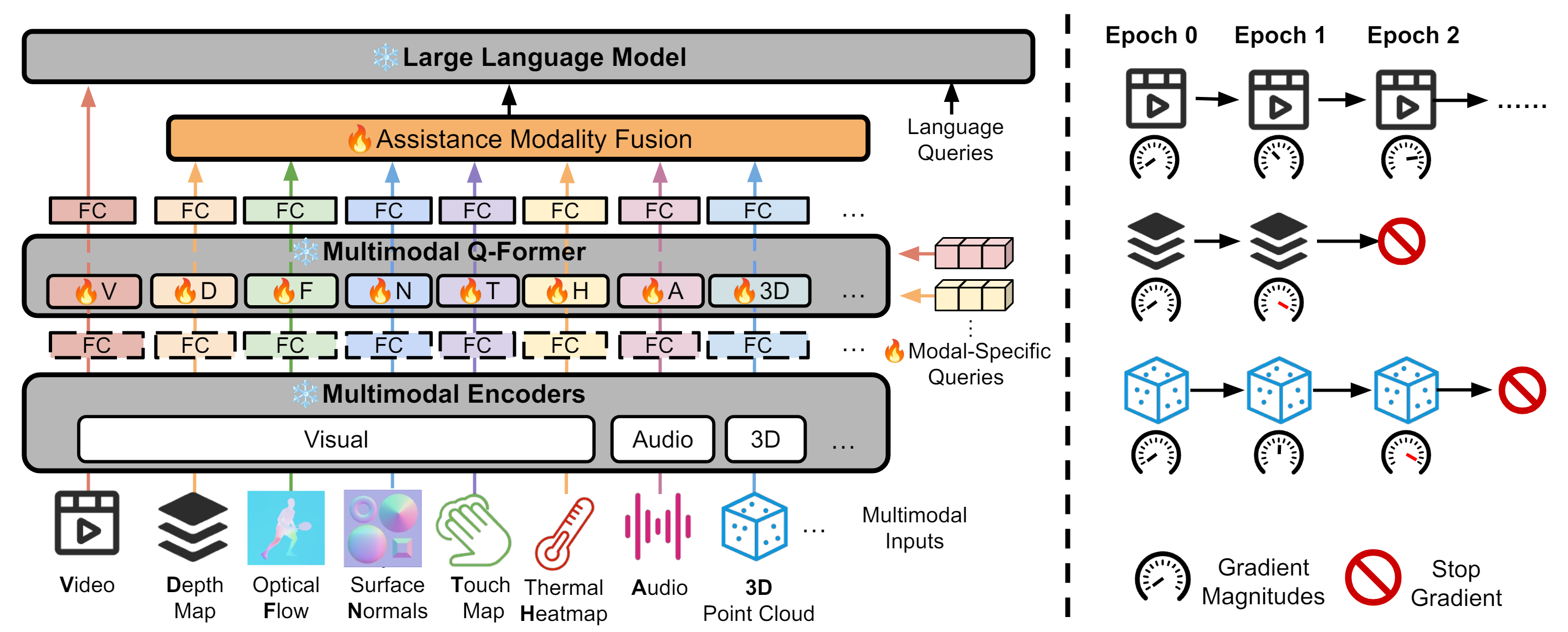
- New modality-sequential modular training & modality-adaptive early exit strategy to handle learning with many modalities.
- More unique/rare multimodal reasoning tasks (video-touch and video-thermal QA) to further demonstrate the generalizability of CREMA
Code structure
# CREMA code
./lavis/

# running scripts for CREMA training/inference
./run_scripts
Setup
Install Dependencies
- (Optional) Creating conda environment
conda create -n crema python=3.8
conda activate crema
- build from source
pip install -e .
Download Models
Pre-trained Models
Visual Encoder: we adopt pre-trained ViT-G (1B), the codebase downloads the model automatically.
Audio Encoder: we use pre-trained BEATs (iter3+), please download the model here, and update the path in the code
3D Encoder: we conduct off-line feature extraction following 3D-LLM, please refer to this page for per-extracted features. Please change the storage in dataset config.
Multimodal Qformer: We initialize query tokens and FC layer for each MMQA in Multimodal Q-Former form pre-trained BLIP-2 model checkpoints. We hold Multimodal Q-Fromer with pre-trained MMQA-audio and MMQA-3D via HuggingFace, and Multimodal Q-Fromer initilized from BLIP-2 can be found here.
Fine-tuned Models
| Dataset | Modalities |
|---|---|
| SQA3D | Video+3D+Depth+Norm |
| MUSIC-AVQA | Video+Audio+Flow+Norm+Depth |
| NExT-QA | Video+Flow+Depth+Normal |
Dataset Preparation & Feature Extraction
We test our model on:
-
MUSIC-AVQA: we follow the orginal MUSIC-AVQA data format.
-
Touch-QA (reformulated from Touch&Go): we follow SeViLA data format, and released our data here.
-
Thermal-QA (reformulated from Thermal-IM): we follow SeViLA data format, and released our data here.
To get trimmed Touch-QA and Thermal-QA video frames, you can first download raw videos from each original data project, and preprocess with our scripts after setting the custom data path, by running.
python trim_video.py

python decode_frames.py
We extract various extra modalities from raw video with pre-train models, please refer to each model repo and paper appendix for more details.
We will share extracted features.
| Dataset | Multimodal Features |
|---|---|
| SQA3D | Video Frames, Depth Map, Surface Normals |
| MUSIC-AVQA | Video Frames, Optical Flow , Depth Map, Surface Normals |
| NExT-QA | Video Frames, Depth Map, Optical Flow, Surface Normals |
| Touch-QA | Video Frames, Surface Normals |
| Thermal-QA | Video Frames, Depth Map |
We pre-train MMQA in our CRMEA framework with public modality-specific datasets:
Training and Inference
We provide CREMA training and inference script examples as follows.
1) Training
sh run_scripts/crema/finetune/sqa3d.sh
2) Inference
sh run_scripts/crema/inference/sqa3d.sh
Acknowledgments
We thank the developers of LAVIS, BLIP-2, CLIP, X-InstructBLIP, for their public code release.
Reference
Please cite our paper if you use our models in your works:
@article{yu2024crema,
  title={CREMA: Generalizable and Efficient Video-Language Reasoning via Multimodal Modular Fusion},
  author={Yu, Shoubin and Yoon, Jaehong and Bansal, Mohit},
  journal={ICLR},
  year={2025}
}
Similar repos



Languages
Python
98.7%
[ICLR 2025] CREMA: Generalizable and Efficient Video-Language Reasoning via Multimodal Modular Fusion
See the codeREADME
[ICLR 2025] CREMA: Generalizable and Efficient Video-Language Reasoning via Multimodal Modular Fusion
Authors: Shoubin Yu*, Jaehong Yoon*, Mohit Bansal
University of North Carolina at Chapel Hill
🔥 News
- Jan 23, 2025. CREMA has been accepted to ICLR 2025!
- Jun 14, 2024. Check our new arXiv-version2 for exciting additions to CREMA:
- New modality-sequential modular training & modality-adaptive early exit strategy to handle learning with many modalities.
- More unique/rare multimodal reasoning tasks (video-touch and video-thermal QA) to further demonstrate the generalizability of CREMA
Code structure
# CREMA code
./lavis/

# running scripts for CREMA training/inference
./run_scripts
Setup
Install Dependencies
- (Optional) Creating conda environment
conda create -n crema python=3.8
conda activate crema
- build from source
pip install -e .
Download Models
Pre-trained Models
Visual Encoder: we adopt pre-trained ViT-G (1B), the codebase downloads the model automatically.
Audio Encoder: we use pre-trained BEATs (iter3+), please download the model here, and update the path in the code
3D Encoder: we conduct off-line feature extraction following 3D-LLM, please refer to this page for per-extracted features. Please change the storage in dataset config.
Multimodal Qformer: We initialize query tokens and FC layer for each MMQA in Multimodal Q-Former form pre-trained BLIP-2 model checkpoints. We hold Multimodal Q-Fromer with pre-trained MMQA-audio and MMQA-3D via HuggingFace, and Multimodal Q-Fromer initilized from BLIP-2 can be found here.
Fine-tuned Models
| Dataset | Modalities |
|---|---|
| SQA3D | Video+3D+Depth+Norm |
| MUSIC-AVQA | Video+Audio+Flow+Norm+Depth |
| NExT-QA | Video+Flow+Depth+Normal |
Dataset Preparation & Feature Extraction
We test our model on:
-
MUSIC-AVQA: we follow the orginal MUSIC-AVQA data format.
-
Touch-QA (reformulated from Touch&Go): we follow SeViLA data format, and released our data here.
-
Thermal-QA (reformulated from Thermal-IM): we follow SeViLA data format, and released our data here.
To get trimmed Touch-QA and Thermal-QA video frames, you can first download raw videos from each original data project, and preprocess with our scripts after setting the custom data path, by running.
python trim_video.py

python decode_frames.py
We extract various extra modalities from raw video with pre-train models, please refer to each model repo and paper appendix for more details.
We will share extracted features.
| Dataset | Multimodal Features |
|---|---|
| SQA3D | Video Frames, Depth Map, Surface Normals |
| MUSIC-AVQA | Video Frames, Optical Flow , Depth Map, Surface Normals |
| NExT-QA | Video Frames, Depth Map, Optical Flow, Surface Normals |
| Touch-QA | Video Frames, Surface Normals |
| Thermal-QA | Video Frames, Depth Map |
We pre-train MMQA in our CRMEA framework with public modality-specific datasets:
Training and Inference
We provide CREMA training and inference script examples as follows.
1) Training
sh run_scripts/crema/finetune/sqa3d.sh
2) Inference
sh run_scripts/crema/inference/sqa3d.sh
Acknowledgments
We thank the developers of LAVIS, BLIP-2, CLIP, X-InstructBLIP, for their public code release.
Reference
Please cite our paper if you use our models in your works:
@article{yu2024crema,
  title={CREMA: Generalizable and Efficient Video-Language Reasoning via Multimodal Modular Fusion},
  author={Yu, Shoubin and Yoon, Jaehong and Bansal, Mohit},
  journal={ICLR},
  year={2025}
}
Similar repos
Languages
Python
98.7%